
TL;DR · 30-second read
The Short Version
Montgomery County, Maryland, a large suburb just outside Washington, has stopped accepting building applications for new data centers for six months. Data centers are the huge warehouses of computers that run apps, online storage and artificial intelligence.
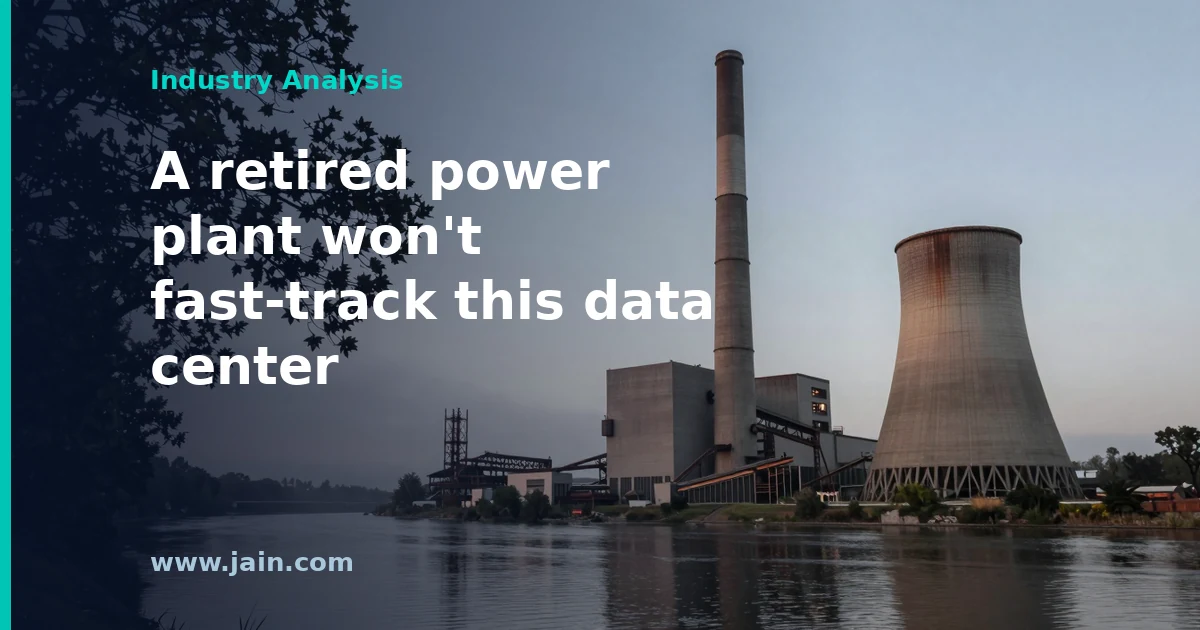
The surprise is that the pause also covers a project already proposed on the site of an old, shut-down power plant. Builders often like those sites because they are already wired into the electric grid.
Local leaders say they want rules on electricity, water and noise written before anything gets built.
On June 12, 2026, Montgomery County Executive Marc Elrich signed an executive order directing the county’s Department of Permitting Services to stop accepting, processing and considering permit applications for new data centers. Montgomery County announced that the order takes effect immediately and sets a six-month moratorium, which can end sooner if the County Council adopts permanent zoning rules for data centers.
The pause applies to projects already proposed, including a potential data center at the site of the decommissioned power plant in Dickerson, in the county’s western reaches along the Potomac River. Council Vice President Marilyn Balcombe and Councilmembers Will Jawando and Kristin Mink backed the order.
Executive Summary
Montgomery County has frozen data center permitting for six months so its County Council can write a legal framework for the industry. The county said the order responds to concerns about data centers’ energy consumption, water use for cooling, and noise near homes. It is a pause, not a ban: officials described it as time to set rules before applications move forward.
What makes the order consequential is its scope. Elrich said his approach differs from an earlier proposal by Council Member Glass that would have exempted the Dickerson site and let it keep moving through permitting. His order does not exempt it. A project on a retired power plant parcel, which is the kind of site developers typically prize for its existing grid ties, now waits in the same line as everything else.
For developers and investors, the signal is that in Montgomery County, a site’s power-plant legacy is not a substitute for local approval. The rules that emerge on clean energy, water, noise and labor will determine whether the county remains a practical option next to one of the world’s densest data center markets.
Why a Retired Power Plant Didn’t Earn a Head Start
For data center developers, a decommissioned power plant is often one of the most attractive parcels available. Such sites are usually already used for heavy industry, and they sit where high-voltage transmission lines once carried the plant’s output to the grid. That matters because the scarce input for today’s AI-driven data center buildout is electricity, not land. Connecting a large new electricity customer can take years, and a site with an existing grid footprint is widely seen as a way to shorten that wait.
Montgomery County’s order removes that advantage for Dickerson. Elrich explicitly contrasted his order with Council Member Glass’s earlier proposal, which exempted the Dickerson site. Councilmember Mink said a large data center is in the permitting process now and that the order covers it “and all others,” calling that an important distinction. Councilmember Jawando said the moratorium bill he introduced in May was the only one that covered the Dickerson project. The county’s elected leadership treated the site’s history as no reason to let it proceed ahead of the rules.
The reasoning is visible in the concerns officials named: grid strain, brownouts, water for cooling, noise, and watershed protection. An existing transmission connection addresses whether power can physically reach a site. It does not answer whether the county wants that load on its local system, where cooling water comes from, or how loud cooling equipment will be near homes. The Dickerson developer is the first party affected. The same logic applies to any developer or landowner that has valued retired generating sites on the assumption that local approval follows the grid connection. In Montgomery County, at least, it does not.
What Six Months Is Meant to Produce
The moratorium is scheduled to expire in six months, around mid-December 2026. It ends earlier if the County Council adopts Zoning Text Amendments, which are changes to the written zoning code that define where a use is allowed and under what conditions. In practice, the pause gives the Council a deadline. If permanent rules arrive first, the freeze lifts on them.
Officials have already sketched what they want those rules to cover. Jawando listed “clean energy, no subsidies, union labor, and a safe watershed.” Mink wants the County Noise Ordinance updated and watershed protections established. Climate Change Officer Sarah Kogel-Smucker said the goal is to align data center development with the county’s climate goals through best practices for clean energy and efficient cooling. Each of these would raise a project’s costs or narrow its design choices. Clean-energy requirements affect how a facility buys power. Water limits push operators toward cooling systems that use less water, which can mean more electricity. A no-subsidy stance removes the tax incentives many jurisdictions use to compete for these projects.
None of these positions has become law yet, and they will not all carry equal weight. How the Council balances them will decide whether Montgomery becomes a place where data centers can be built under strict conditions or one where the conditions make the economics hard to close. Balcombe framed the intent as the former: “The moratorium does not mean we stop; it means we work harder.”
A Pause on the Doorstep of Data Center Alley
Montgomery County sits across the Potomac River from Loudoun County, Virginia, whose Ashburn area is known as Data Center Alley and hosts one of the largest concentrations of data centers in the world. Maryland and Northern Virginia are both served by PJM Interconnection, the grid operator for much of the mid-Atlantic. That is why concerns about grid strain and brownouts carry weight on both sides of the river.
The order should not be read as more than it is. It is one county’s six-month pause, and it does not by itself redirect regional demand. What it does show is that a jurisdiction immediately adjacent to the industry’s busiest cluster has chosen to write rules before approving projects, including one on a site with an energy-industry past. Jawando cast the decision in national terms, saying communities across the country face the same choice. Developers looking for land near Northern Virginia’s network and power infrastructure now have one fewer county where timing is predictable.
Weighing the Claims on Both Sides
The order’s stated rationale includes serious claims, notably brownouts. Whether any single facility would contribute to them depends on its size and on the utility’s planning, and officials framed the risks in general terms rather than attaching load or water figures to the Dickerson project. The rules the Council writes will be more durable if they rest on measured impacts rather than on the general reputation of the industry.
The same scrutiny applies to the other side of the argument. Jawando’s description of “corporate promises of profits that may never come” is a political judgment, not a finding. Kogel-Smucker’s observation that data centers are “critical to our digital economy” is the counterweight. No jobs, tax revenue or investment figures for the Dickerson project were offered at the announcement to test either view. The six months are most useful if both the county and the developer put those numbers on the table.
Background
Montgomery County is a large suburban county bordering Washington, D.C., to the northwest, with its western edge on the Potomac River. Across the river lies Loudoun County, Virginia, home to Ashburn’s Data Center Alley, one of the largest concentrations of data centers anywhere. Data center demand across the region has grown with cloud computing and, more recently, artificial intelligence workloads, which require large amounts of electricity and cooling.
Montgomery County had been working toward data center rules before the order. Its Climate Change Officer co-led a community forum on data centers in February 2026, Council Member Glass had put forward a proposal that exempted the Dickerson site, and Councilmember Jawando introduced a moratorium bill in May that covered Dickerson. Elrich’s June 12 executive order paused permitting while the Council finishes that work. Source: Montgomery County Executive Marc Elrich Signs Executive Order to Temporarily Pause Data Center Permitting — Montgomery County, Maryland’s announcement of a six-month moratorium on data center permit applications, including the proposed Dickerson project.Sources