
Tag: power planning

  • Texas Bets on 765 kV Lines to Power the Next Wave of AI Data Centers

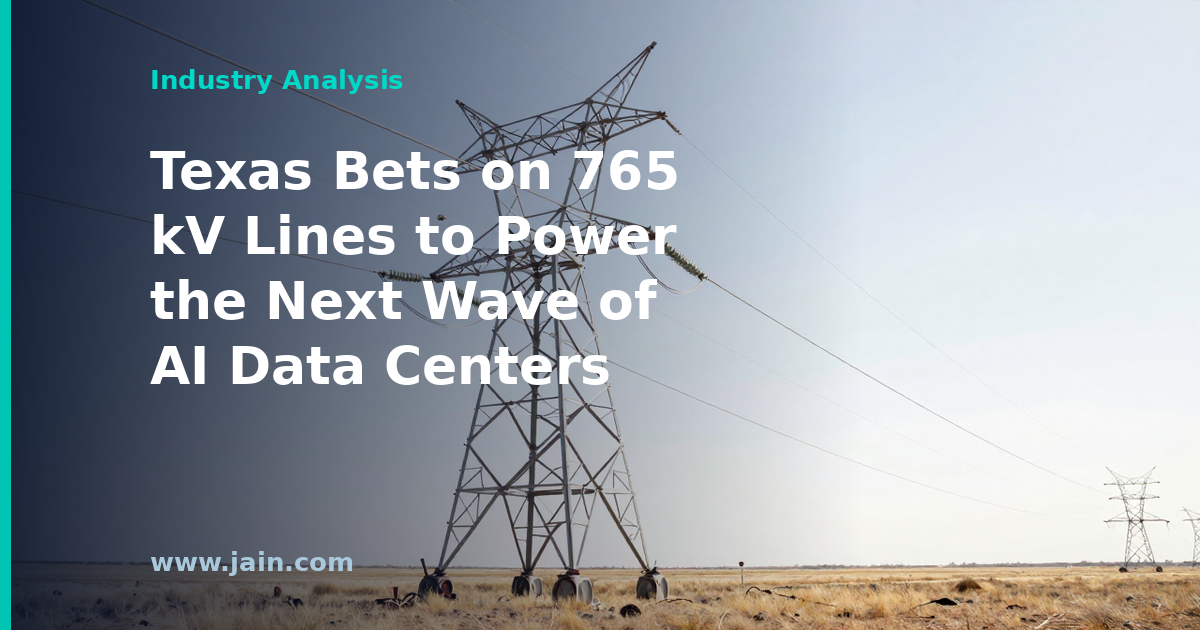
    Texas Bets on 765 kV Lines to Power the Next Wave of AI Data Centers

    Texas has committed to building out its grid with 765 kilovolt (kV) transmission lines — the highest-capacity class of overhead power line used in North America — in a strategy Data Center Knowledge summarized on July 5, 2026 as “build the wires, the AI will follow.” Rather than waiting for AI data center projects to sign up first, the state’s approach is to construct extra-high-voltage backbone capacity in anticipation of that demand arriving on the ERCOT grid.

    Executive Summary

    The decision reported here is less about a single project than about a planning philosophy. Historically, most U.S. transmission has been built reactively: a large customer or generator commits, studies are run, and wires follow years later. Texas is inverting that sequence at the 765 kV level — the class of line capable of moving several times the power of the 345 kV circuits that have long formed the backbone of ERCOT, the grid operator serving most of Texas.

    Why it matters: access to power has become the single biggest constraint on AI data center siting. A state that can credibly promise deliverable gigawatts on a known timeline gains a decisive edge in attracting capital-intensive AI campuses. But anticipatory building also shifts risk — if the forecast load arrives late, smaller than expected, or somewhere else, the cost of underused infrastructure lands on someone, and that someone is usually the ratepayer.

    Why 765 kV Is a Statement, Not Just a Specification

    Voltage class is the freeway-versus-farm-road question of the power grid. A 765 kV line can carry far more power than a 345 kV line over the same corridor, with proportionally lower electrical losses, which means fewer parallel lines, fewer towers, and less land consumed per delivered gigawatt. For a grid staring at data center campuses that each want hundreds of megawatts — sometimes a gigawatt or more — 765 kV is the only overhead technology that comfortably matches the scale of the ask.

    Choosing it is also a signal. 765 kV projects take longer to permit and build, require specialized transformers with notoriously long lead times, and cost more up front than incremental 345 kV additions. A jurisdiction that standardizes on 765 kV is telling the market it expects load growth measured in tens of gigawatts, not incremental upticks — and that it intends to be structurally ready rather than perpetually catching up.

    The Economics of Building Ahead of Demand

    The core bet is that transmission, not land or fiber, is now the scarce input for AI infrastructure. Interconnection timelines — the queue a new large customer or generator waits in before it can plug into the grid — have stretched to years across much of the country. Every month of waiting is a month of idle capital for an AI developer whose chips depreciate quickly. If Texas can compress that wait by having backbone capacity already energized, it converts grid readiness directly into economic development.

    The counterargument is forecast risk. AI load projections are among the most volatile numbers in the utility industry right now: they depend on chip supply, model efficiency gains, corporate capital cycles, and siting decisions that can pivot on a single tax incentive. Building wires for demand that hasn’t signed contracts means the state is, in effect, underwriting a demand forecast. If the forecast is right, the infrastructure looks prescient. If it’s wrong, Texas will have built expensive capacity whose carrying costs must still be recovered.

    Winners, Losers, and Who Carries the Risk

    The clearest winners are large-load customers — AI and cloud data center developers — who gain siting certainty, and the transmission utilities and equipment suppliers who get a multi-year construction pipeline. Landowners along new corridors face the familiar friction of routing and easement disputes, which 765 kV’s larger towers can intensify even as its higher capacity reduces the total number of corridors needed.

    The pivotal question is cost allocation. In ERCOT, transmission costs have traditionally been spread across consumers, which works when new load broadly benefits everyone but becomes contentious when the driver is a handful of very large private customers. Whether Texas requires AI-scale loads to shoulder a larger, more direct share of the wires built substantially for them — through contribution requirements, minimum-take commitments, or special rate classes — will determine whether this build-out is remembered as smart industrial strategy or as a subsidy from households to hyperscalers. The source piece frames the bet; it does not settle who holds the downside.

    What It Means Beyond Texas

    Other states and grid operators are watching, because Texas is running the experiment they have avoided: proactive, speculative, extra-high-voltage expansion in a market famous for moving faster and regulating lighter than its peers. If the wires fill up with AI load on schedule, expect copycat programs and renewed pressure on slower-moving regional planning processes elsewhere. If they don’t, the episode will become the cautionary tale cited in every future transmission docket.

    For the data center industry itself, the message is immediate: power-first siting is now official policy in at least one major market. Developers comparing regions will increasingly weigh not just today’s available megawatts but a grid’s demonstrated willingness to build ahead of them — and Texas has just bid aggressively on that dimension.

    Background

    Texas operates most of its grid through ERCOT, a system largely separate from the rest of the U.S., which allows the state to plan and permit infrastructure faster than regions governed by multi-state processes. That autonomy, combined with abundant land and energy resources, has already made Texas one of the country’s fastest-growing data center markets. The backbone of the ERCOT grid has long been built at 345 kV; standardizing new backbone corridors at 765 kV represents a step-change in the scale of power the state is preparing to move.

    The backdrop is the AI infrastructure boom: since the early 2020s, demand from AI training and cloud computing has transformed electricity access from a routine utility matter into the decisive factor in where billions of dollars of data center capital lands. Grid operators nationwide have struggled with long interconnection queues — the waiting line for new large loads and generators — and Texas’s 765 kV program is a direct attempt to turn that bottleneck into a competitive advantage.

    Source: Texas’ 765 kV Decision: Build the Wires, the AI Will Follow — Data Center Knowledge’s July 5, 2026 report on Texas’s anticipatory extra-high-voltage transmission strategy for AI data center growth.
  • Phantom Data Centers Expose a Grid Interconnection Queue Already in Crisis

    Phantom Data Centers Expose a Grid Interconnection Queue Already in Crisis

    POWER Magazine published an analysis on May 16, 2026, arguing that so-called phantom data centers — speculative, duplicative, or abandoned requests for grid connections at facilities that may never be built — did not break the U.S. power grid’s planning process. Its headline thesis is blunter: the flood of questionable megawatt requests proved the interconnection system was already broken before the AI-era demand surge arrived to stress it.

    Executive Summary

    The piece lands in the middle of one of the most consequential debates in energy and digital infrastructure: how much of the enormous projected data center load on utility books is real. Utilities and grid operators across the country have reported unprecedented volumes of large-load interconnection requests — the formal applications a big customer files to connect to the grid — driven by the AI build-out. A meaningful but unquantified share of those requests is widely believed to be speculative: the same project shopped to multiple utilities at once, or land plays filed to reserve capacity cheaply.

    POWER Magazine’s framing matters because it shifts the blame from the applicants to the process. If a planning system can be swamped by requests that cost little to file, take years to study, and require little proof of commitment, the vulnerability was structural — phantom load merely exposed it. For an industry whose credibility with regulators and the public increasingly depends on accurate demand forecasts, that distinction shapes what the fix should be.

    What a Phantom Megawatt Is — and Why It Ends Up on the Books

    An interconnection request is not a binding order for power; in most jurisdictions it has historically been a cheap option. A developer scouting sites can file requests with several utilities for the same prospective campus, keep every option open while negotiating land, chips, and capital, and walk away from all but one — or all of them. Each of those filings, however, can enter a utility’s load forecast and transmission-study pipeline as if it were a real future customer.

    The result is a compounding distortion. Study queues lengthen for everyone, including projects that are fully financed and ready to build. Forecasts inflate, which feeds into decisions about new generation, transmission lines, and rate cases. And because utilities cannot easily distinguish a committed hyperscale campus from a land speculator’s placeholder, the honest answer to “how much data center load is coming” becomes genuinely unknowable from the queue alone.

    The Queue Was Broken Before AI Showed Up

    The article’s central claim — that phantom load revealed rather than caused the breakdown — fits the longer history. Interconnection processes were designed for an era of slow, predictable load growth, with first-come-first-served study sequences, modest deposits, and few readiness screens. Generator interconnection queues showed the same failure mode years earlier, when speculative renewable projects piled up and forced regulators toward cluster studies and stiffer milestone requirements. Large-load interconnection, by contrast, has remained far less standardized, leaving each utility to improvise its own defenses.

    Seen that way, data centers are the stress test, not the disease. Any process that prices a multi-hundred-megawatt reservation at close to zero will attract free options in a land rush; AI simply supplied the land rush. The implication is uncomfortable for utilities and developers alike: tightening screens on data centers without reforming the underlying study process would treat the symptom that made the problem visible.

    Who Pays When the Forecast Is Wrong in Either Direction

    Phantom load creates a two-sided planning risk. If utilities build generation and wires for demand that evaporates, the cost of that overbuild lands in rate base — the pool of investment that ordinary electricity customers repay over decades. If utilities discount the queue too aggressively and real projects materialize, the grid is short, prices spike, and serious data center customers face multi-year connection delays that push investment to other regions or into on-site generation.

    That asymmetry explains the emerging middle path many utilities and regulators are pursuing: making the request itself carry real commitment. Larger deposits, demonstrated site control, staged payments tied to milestones, and contractual minimum-take obligations all convert a free option into a priced one. Developers with real projects generally have reason to support such screens, because they clear the queue of competitors who were never going to build — though they also raise the cost of legitimate early-stage flexibility.

    Background

    The AI infrastructure build-out has made data centers the dominant story in U.S. electricity demand, ending decades of roughly flat load growth. Utilities in many regions now report interconnection requests from prospective data center customers that dwarf their historical planning assumptions, and those figures flow into generation plans, transmission proposals, and rate cases. POWER Magazine, a long-running trade publication covering the power generation and delivery sector, has tracked the resulting tension: grid planners must commit capital years ahead of demand, using a queue that mixes committed hyperscale campuses with speculative placeholders. Generator interconnection went through a similar speculative pile-up in the renewables boom, prompting regulators to overhaul study processes — a precedent now shaping the debate over how to handle large loads.

    Source: Phantom Data Centers Didn’t Break the Power Grid—They Proved It Was Already Broken — POWER Magazine analysis, May 16, 2026, on speculative data center load and interconnection-queue dysfunction.

  • Grid Operators Issue Rare Warning on AI Data-Center Load Risks

    Grid Operators Issue Rare Warning on AI Data-Center Load Risks

    E&E News by POLITICO reported on May 4, 2026 that the AI boom has prompted a rare formal warning of “significant risks” to the electric grid. The warning, attributed to grid operators, centers on the reliability challenges created by rapid AI data-center load growth — the surge in electricity demand from facilities built to train and run artificial-intelligence models.

    Executive Summary

    According to the report, the organizations responsible for keeping the lights on have moved beyond quiet concern to an explicit, on-the-record caution: the pace and scale of AI-driven data-center demand now pose “significant risks” to grid reliability. In the deliberately understated language of the power sector, where public warnings are infrequent and carefully worded, a formal statement of this kind is a notable escalation.

    Why it matters: grid operators and reliability bodies are the institutions that decide whether new large loads can connect, how much generation and transmission must be built, and what margins the system must hold in reserve. When they formally flag a risk, that assessment flows into planning studies, interconnection decisions, and regulatory proceedings. For data-center developers, utilities, and the AI companies driving demand, the message is that electricity availability — not land, chips, or capital — may be the binding constraint on the buildout, and that the institutions controlling that constraint are now on notice.

    Why a Formal Warning Is a Turning Point

    Grid reliability institutions are structurally conservative communicators. Their public assessments are consensus documents, reviewed by member utilities and regulators, and they rarely single out a demand-side trend as a named risk. That is what makes the reported warning newsworthy: the characterization of AI data-center load growth as posing “significant risks” is the kind of language that, once issued, becomes a reference point in rate cases, interconnection disputes, and legislative hearings.

    The practical effect of such warnings is less about any single blackout scenario and more about institutional permission. Utilities that want to slow-walk large interconnection requests, regulators that want to impose cost-allocation conditions on data centers, and states weighing incentives for the industry can all now cite an authoritative reliability finding. In power planning, the paper trail matters.

    The Mismatch Behind the Alarm

    The underlying tension is one of timescales. A large data center can be designed, financed, and built in roughly two to three years, and AI developers are announcing capacity at an unprecedented cadence. The grid assets needed to serve that load — high-voltage transmission lines, large generators, transformers — routinely take far longer to permit and construct. When demand arrives faster than supply infrastructure can, the system’s cushion shrinks, and reliability planners see exactly the kind of risk the reported warning describes.

    Compounding the problem is forecasting uncertainty. Utilities plan around load forecasts, and data-center demand is uniquely hard to forecast: projects are speculative, developers often file duplicate interconnection requests in multiple territories while shopping for power, and a single hyperscale campus can rival the demand of a small city. Planners face risk in both directions — underbuilding invites shortfalls, while overbuilding for phantom load can leave other customers paying for stranded infrastructure.

    Winners, Losers, and the New Power Calculus

    If reliability concerns harden into policy, the advantage shifts to data-center operators who bring solutions rather than just load: projects with secured long-term power contracts, on-site or co-located generation, meaningful backup capacity, or genuinely flexible demand that can reduce consumption during grid stress. Flexibility is emerging as a currency — a data center that can curtail (temporarily reduce) its draw during peak hours is a far easier interconnection decision than one requiring firm power around the clock.

    The losers in a constrained environment are late-arriving projects in saturated markets, and potentially ordinary ratepayers if the costs of grid expansion are not allocated cleanly to the loads driving it. For utilities, the moment cuts both ways: data centers represent the largest load-growth opportunity in decades — and therefore revenue — but also a source of operational and political risk if reliability suffers. How regulators referee that tension will shape power planning for the rest of the decade.

    Background

    For roughly two decades before the AI boom, electricity demand in the United States was essentially flat, and grid planning settled into a routine of modest, predictable adjustments. That era ended when the generative-AI wave set off a race to build data centers at unprecedented scale, pushing utilities to revise load forecasts sharply upward and filling interconnection queues — the waiting lists for connecting new facilities to the grid — across multiple regions.

    Grid reliability in North America is overseen by a layered system: regional grid operators run the transmission network day to day, while reliability organizations set standards and publish periodic assessments of whether the system can meet projected demand. Those assessments had grown increasingly pointed about surging data-center load in the years before this reported warning, making the May 2026 statement the continuation — and apparent sharpening — of a trend the power sector has watched closely.

    Source: AI boom sparks rare warning of ‘significant risks’ to grid — E&E News by POLITICO report on grid operators’ formal warning about AI data-center load growth, May 4, 2026.