
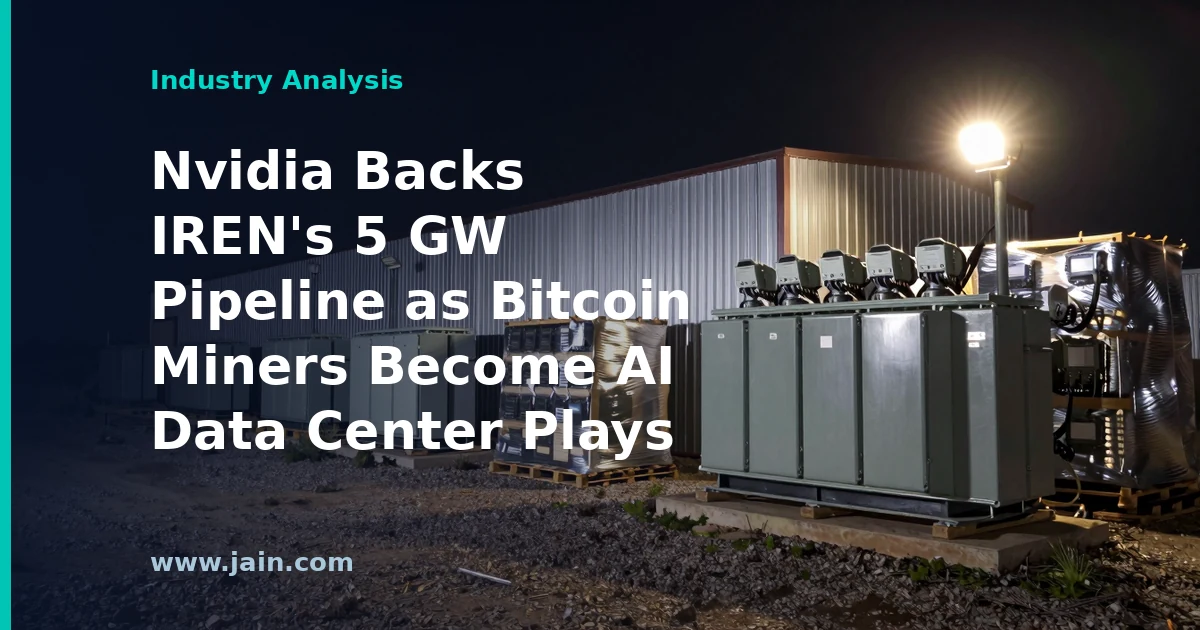
Nvidia is placing what Data Center Knowledge describes as a massive AI infrastructure bet on IREN, the Nasdaq-listed data center operator formerly known as Iris Energy, and its roughly 5 gigawatt (GW) power pipeline. IREN began life as a renewable-powered bitcoin miner and has been repositioning its sites for AI computing.
The report, published May 8, 2026, frames the move as part of a broader pattern: the world’s dominant AI chip maker is increasingly underwriting former cryptocurrency miners as vehicles for deploying its GPUs at scale.
Executive Summary
The significance here is less about any single transaction and more about what Nvidia’s endorsement confers. In today’s AI buildout, the binding constraint is no longer chips — it is energized land: sites with grid interconnection agreements, substations, and megawatts ready to draw. Bitcoin miners spent years accumulating exactly that, and IREN’s claimed 5 GW pipeline is among the largest such positions held by any former miner.
Nvidia backing a partner is a well-established playbook — the company took an equity stake in GPU cloud provider CoreWeave, itself a former Ethereum miner, before CoreWeave’s rise to prominence. Support from Nvidia typically signals preferential access to scarce GPU allocations, which in turn helps a company raise capital and sign customers. For IREN, that halo could be worth as much as any cash involved.
A caveat readers should hold onto: the available source material is a headline-level report, and it does not spell out the structure of Nvidia’s commitment — whether equity, chip supply priority, purchase commitments, or some combination. We flag what is and is not substantiated throughout.
Why Nvidia Underwrites Its Own Customers
Nvidia sells the picks and shovels of the AI gold rush, but picks are useless without mines — physical data centers with power, cooling, and fiber. By backing infrastructure operators, Nvidia expands the universe of buyers who can actually deploy its chips, diversifies demand beyond a handful of hyperscale cloud providers (Microsoft, Amazon, Google), and gains negotiating leverage against those same hyperscalers, who are all designing in-house AI silicon.
The strategy has precedent and critics alike. Supporting CoreWeave paid off handsomely. But analysts have raised fair questions about circularity when a chip vendor’s investment flows back to it as chip purchases: revenue is real, yet the demand signal is partly self-generated. Without the deal terms disclosed, one cannot say how much of that concern applies here — which is precisely why the terms matter.
Power Is the Moat: The Logic of the Bitcoin-to-AI Pivot
A gigawatt is roughly the output of a large nuclear reactor; 5 GW is enough electricity for several million homes. Grid interconnection queues in the United States now routinely run five years or more, so a company holding approved connections and built substations owns something money cannot quickly buy. That is the asset bitcoin miners stumbled into: they built low-cost, high-density power infrastructure when nobody else wanted it.
The pivot is not trivial, however. Bitcoin mining tolerates cheap, interruptible power and minimal redundancy; AI training and inference customers demand high uptime, liquid cooling for dense GPU racks, and enterprise-grade networking. Converting a mining site into an AI-grade facility means substantial re-engineering and capital — typically an order of magnitude more per megawatt than the original mining buildout. IREN, which runs sites on renewable-heavy grids in Texas and British Columbia, has been investing in exactly this conversion, but the pace and cost of that transition are where execution risk lives.
Reading the 5 GW Number Carefully
“Pipeline” is a term of art in data center development, and it deserves scrutiny wherever it appears — from IREN or any competitor. A pipeline typically blends operating capacity, sites under construction, and land with power applications in varying stages of approval. The operating fraction is usually a small share of the headline figure. The report does not break down how much of IREN’s 5 GW is energized today versus contracted, queued, or aspirational.
That distinction determines the economics. Energized megawatts can generate AI revenue within quarters; queued megawatts may be years and billions of dollars away. Nvidia’s backing suggests the company has seen enough to be confident, but investors should want the same breakdown Nvidia presumably received: megawatts by status, by site, and by expected energization date.
Winners, Losers, and the Competitive Ripple
If Nvidia’s model of anointing power-rich partners continues, the winners are miners with large, well-located, transferable power portfolios — and the electricity-rich regions that host them. Traditional data center developers, who must start interconnection processes from scratch, face a compressed timeline disadvantage. Hyperscalers gain another supply option but also another Nvidia-aligned competitor for the same GPUs.
The losers may be smaller miners without convertible assets, and potentially the bitcoin-mining business lines themselves, as boards conclude AI hosting offers steadier, contract-backed returns than volatile block rewards. For enterprise buyers of AI compute, more supply entering the market from converted mining sites should, over time, ease pricing and availability — assuming these conversions deliver true data-center-grade reliability.
Background
IREN was founded in 2018 as Iris Energy and listed on Nasdaq in 2021 as a renewable-powered bitcoin miner, later rebranding as IREN to reflect a broader data center ambition. Like several large miners, it responded to the post-2022 AI boom by redirecting its power-rich sites toward GPU computing, buying Nvidia hardware and marketing AI cloud services alongside its mining business.
The backdrop is an industry-wide land rush: AI demand has outstripped the electric grid’s ability to connect new data centers, turning companies with secured megawatts into acquisition and partnership targets. Nvidia, whose GPUs power most AI training, has repeatedly used investments and partnerships — most famously with CoreWeave — to cultivate infrastructure partners beyond the major cloud providers.
Source: Nvidia Places Massive AI Infrastructure Bet on IREN’s 5 GW Pipeline — Data Center Knowledge report, May 8, 2026, on Nvidia’s backing of IREN’s AI data center expansion.