PJM Interconnection, the grid operator serving 65 million people across 13 states and DC, has received regulatory clearance to instruct data centers within its footprint to shift onto on-site backup generation during a heat-wave-driven grid emergency, according to reporting from Maryland Matters on June 29, 2026.
The mechanism turns large data-center campuses — normally treated as firm, always-on load — into a de facto peak-shaving resource for the duration of the event.
Executive Summary
The clearance matters because PJM is the single largest wholesale power market in North America and the epicenter of the data-center boom driven by AI training and inference workloads. Northern Virginia’s "Data Center Alley" alone accounts for a double-digit share of PJM’s peak demand, and interconnection queues across the footprint are dominated by hyperscale requests.
Instructing those loads to island onto diesel or gas gensets during a heat wave is a pragmatic short-term relief valve — but it also establishes a precedent that data-center power draw is negotiable in an emergency, something operators have long resisted in contract negotiations with utilities.
For hyperscalers, colocation providers, and their enterprise tenants, the near-term question is whether this becomes a one-off emergency tool or a template that regulators, utilities, and lawmakers extend into standing tariffs and interconnection conditions.
A Grid Under AI-Era Stress Finds a New Lever
PJM has spent the past two seasons warning that reserve margins are tightening faster than new generation and transmission can be built. Data-center load growth — driven overwhelmingly by AI compute — is the most-cited demand-side driver in the operator’s own capacity-market filings. Shifting even a subset of that load onto behind-the-meter generation during peak hours effectively hands PJM a demand-response resource it did not previously have access to at scale. In a market where the last few gigawatts of firm capacity now clear at record prices, that flexibility has real economic value.
The trade-off is honest but uncomfortable: the backup fleet inside large data-center campuses is typically diesel, sometimes natural gas, and it runs cleaner than an emergency peaker only in the narrowest sense. Air-quality regulators in the Mid-Atlantic have historically capped generator runtime hours precisely because concentrated diesel exhaust during heat events coincides with the worst ground-level ozone conditions. Any recurring use of this mechanism will collide with those permits.
Winners, Losers, and the New Contract Question
The immediate winner is grid reliability: keeping the lights on for residential and small-commercial customers during a heat emergency is a policy priority that overrides most other considerations. PJM itself gains optionality and political cover. Utilities in the footprint gain a talking point when regulators ask why more transmission has not been built.
Data-center operators are in a more complicated position. Publicly, most will support emergency cooperation — refusing looks bad and invites harsher intervention. Privately, the concern is that "emergency" becomes elastic. Enterprise and AI-lab tenants sign colocation and cloud contracts on the premise of firm power; if the underlying facility must periodically island, service-level agreements, insurance, and fuel-logistics assumptions all need re-examination. Expect language on grid-emergency curtailment to become a live negotiation item in 2026 renewals.
Precedent Risk Cuts Both Ways
The clearance is best understood as a precedent event rather than a single operational decision. Once a regulator has said yes to load-shifting a hyperscale campus onto backup generation during a heat wave, the harder question is what other conditions qualify: winter peaks, generation outages, transmission constraints, wildfire smoke events on the western edge of the footprint. Each expansion is defensible in isolation and cumulatively significant.
For policymakers weighing whether to court or constrain new data-center construction, the mechanism cuts both ways. Advocates can point to it as evidence that hyperscale load can be a good grid citizen. Critics can point to it as confirmation that the current build-out is already outrunning firm supply. Both readings are supported by the announcement itself; which one dominates depends on how frequently PJM has to actually use the authority.
Background
PJM Interconnection was formed in its modern regional-transmission-organization form in the late 1990s and today coordinates the movement of wholesale electricity across a footprint stretching from Illinois to New Jersey and south to North Carolina. Its capacity market, which pays generators to be available years in advance, is the primary mechanism by which the region secures firm supply.
The data-center boom of the past decade — first driven by cloud, now accelerated by AI training and inference — has concentrated unprecedented demand in Northern Virginia and secondary hubs in Ohio, Pennsylvania, and Maryland. PJM’s own load forecasts have been repeatedly revised upward, and recent capacity auctions have cleared at record prices, framing the policy backdrop for the current heat-wave clearance.
CNBC published a feature on June 28, 2026 examining how GE Vernova builds its massive heavy-duty gas turbines — the machines increasingly ordered to supply electricity for AI data centers. The piece spotlights the manufacturer at the center of one of the power industry’s sharpest demand upswings, as hyperscalers and data center developers scramble for generation capacity that the grid alone cannot deliver on their timelines.
Executive Summary
The story here is less a single announcement than a snapshot of a structural shift: gas turbines — large rotating machines that burn natural gas to spin a generator — have moved from a mature, slow-growth product line to some of the most sought-after industrial hardware in the world, and GE Vernova is one of a small handful of companies that can build the largest ones. CNBC’s look inside the company’s manufacturing operation underscores how AI data center demand has redrawn the order books of the turbine industry.
Why it matters: AI training and inference clusters need firm, around-the-clock power at scales measured in hundreds of megawatts per campus. Interconnection queues — the waiting lines to plug new loads and generators into the transmission grid — stretch for years in many U.S. markets. That mismatch has pushed utilities and data center developers toward dedicated gas-fired generation, and the turbines themselves have become the bottleneck. Whoever controls turbine manufacturing slots now holds real leverage over where and when AI capacity gets built.
The Turbine Is the New Bottleneck
For most of the past decade, the constraint on building a data center was land, fiber, or chips. In 2025 and 2026 it has increasingly been electricity — and behind electricity, the physical equipment that generates and delivers it. Heavy-duty gas turbines sit at the top of that equipment stack: they are enormous precision machines, built in specialized factories by a global oligopoly of manufacturers, and they cannot be scaled up quickly. Casting, machining, and testing the hot-section components that survive combustion temperatures is skilled, capital-intensive work with deep supplier chains.
That is why a factory tour of a turbine plant is now business news. When manufacturing slots for major power equipment are scarce, the production line itself becomes strategic infrastructure. Data center developers who once treated power generation as someone else’s problem — the utility’s — are now tracking turbine lead times the way they track GPU allocations.
Why Gas, and Why Now
Gas turbines occupy a specific niche in the AI power story: they are dispatchable (they run when you need them, unlike weather-dependent wind and solar), they can be sited close to load, and they can be permitted and built faster than nuclear. For hyperscalers facing multi-year grid interconnection queues, gas-fired plants — whether utility-built or behind-the-meter on the data center campus itself — are often the only firm-power option available on an AI-relevant timeline. Combined-cycle configurations, which recycle exhaust heat to generate additional electricity, improve the economics for facilities that run flat-out around the clock, which is exactly the load profile of an AI campus.
The trade-offs are real. Gas plants lock in decades of fuel exposure and carbon emissions at the same moment many data center operators carry public net-zero commitments. Expect continued tension between the near-term physics of AI power demand and long-term decarbonization pledges — and expect operators to pair gas with renewable procurement, carbon-capture ambitions, or framing gas as a “bridge” technology. Readers should evaluate those framings project by project rather than accepting or dismissing them wholesale.
Winners, Losers, and the Queue
The clearest winners in a turbine-constrained market are the manufacturers — GE Vernova and its few global peers — along with their component suppliers and the engineering-and-construction firms that install the machines. Utilities in data center-heavy regions gain a growth story they have not had in decades. On the other side of the ledger, smaller data center developers and enterprises without hyperscaler purchasing power risk being priced or queued out of firm generation capacity, which could concentrate AI infrastructure further among the largest players.
There is also a cyclical risk worth naming evenly: the gas turbine industry has been through boom-and-bust before, most notably when a late-1990s ordering surge was followed by a painful capacity glut. Manufacturers appear to be expanding cautiously partly because of that memory. If AI power demand forecasts prove overstated — a live debate — today’s scarcity could look different in five years. If the forecasts hold, the constraint persists and lead times stay long. Either way, the ordering decisions being made now will shape the power landscape well into the 2030s.
Background
GE Vernova became an independent public company in April 2024, when General Electric completed its split into three businesses and placed its energy operations — gas power, wind, nuclear services, and grid electrification — under the new name. The gas turbine franchise it inherited is one of the oldest and largest in the world, with an installed fleet spanning utilities and industrial operators across the globe.
The company’s independence coincided almost exactly with the generative AI infrastructure boom, which transformed electricity demand forecasts that had been flat in the U.S. for roughly two decades. That timing turned a business once viewed as a mature, declining fossil-fuel franchise into a strategic asset at the center of the AI build-out — the shift CNBC’s factory-floor feature captures.
Reuters reported on June 22, 2026 that investors in data centers are acquiring power developers outright — not merely signing supply contracts with them — as competition to build new compute capacity intensifies. The report frames the trend as a race in which control of electricity generation has become as strategically important as control of the data center itself.
Executive Summary
According to Reuters, the capital behind data center construction is moving up the energy supply chain: rather than waiting in utility interconnection queues or negotiating power purchase agreements (long-term contracts to buy electricity from an independent producer), data center investors are simply buying the companies that develop power projects. Ownership gives them the pipeline of sites, permits, equipment orders, and grid connection positions that a developer has assembled — assets that have become scarce as AI-driven demand outruns the grid’s ability to deliver new supply.
The significance is structural. For decades, digital infrastructure and power generation were separate industries connected by contracts. If investors now find contracts insufficient and are acquiring generation capability outright, the boundary between the compute business and the energy business is dissolving. That changes who competes for power projects, what those projects are worth, and how quickly new data center capacity can realistically come online.
Power, Not Land or Chips, Is the Binding Constraint
A data center is, economically, a machine for converting electricity into computation. In recent years the hardest input to secure has shifted from real estate and even from processors to firm electric capacity — a guaranteed, always-available supply of megawatts. Connecting a large new load or a new power plant to the transmission grid requires passing through an interconnection queue, the utility and grid-operator study process that determines what upgrades are needed; those processes are widely understood across the industry to take years. A power developer’s real inventory is its queue positions, land control, permits, and equipment reservations. Buying the developer is a way of buying time — the years of lead work already done.
Seen that way, the behavior Reuters describes is rational sequencing. When an input is scarce and the market for it is slow, firms integrate backward into it. Railroads bought coal mines; aluminum smelters built dams. Data center capital buying power development capability is the same industrial logic applied to the AI build-out.
From Contracts to Control
The traditional instrument linking the two industries is the power purchase agreement. A PPA transfers energy and price risk, but it does not transfer control: the developer still decides which projects advance, on what schedule, and who else gets served. In a seller’s market for capacity, contract counterparties compete for the developer’s attention. Ownership removes that competition — the acquirer directs the entire pipeline toward its own loads and captures the development margin rather than paying it.
The trade-off is that data center investors are taking on a business with a very different risk profile. Power development involves permitting risk, supply chain exposure for equipment such as turbines and transformers, community opposition, and regulatory processes that money alone cannot compress. Vertical integration internalizes those risks instead of leaving them with a specialist counterparty. Whether the acquirers can manage them as well as standalone developers did is an open execution question, and the answer will vary by acquirer.
Winners, Losers, and the Ones in Between
The clearest immediate winners are power developers themselves and their backers: an asset class that was priced against utility-scale project returns is now being bid for by buyers who value it against AI infrastructure returns. Sellers of development pipelines are exiting into unusual demand. Conversely, buyers of power who lack that capital — smaller data center operators, industrial users, and potentially ordinary utility customers — face a market in which the deepest-pocketed players are locking up future supply at the source.
Utilities and grid operators sit in the middle. Well-capitalized customers willing to fund generation can accelerate supply additions, which helps everyone connected to the grid. But if acquired pipelines are steered toward dedicated or behind-the-meter service (generation wired directly to a facility rather than through the shared grid), the public grid may see less of that new supply than the raw development numbers suggest. How regulators allocate costs and capacity between hyperscale loads and everyone else was already contentious; concentrated ownership of development pipelines sharpens the question rather than settling it.
What This Signals About the AI Build-Out
Strategically, the trend is a statement about expectations. Buying a developer only makes sense if you believe demand for compute — and therefore for power — will remain strong past the multi-year horizon on which power projects are built. It is also a statement about the grid: participants with the most information about future load evidently do not expect conventional utility processes to deliver capacity fast enough, and are paying to route around the wait. Both signals are worth registering, with the usual caution that aggressive capacity bets made near the top of an investment cycle are precisely the ones that look overextended if demand growth moderates.
Background
Data centers — the facilities housing the servers behind cloud services and AI — have historically obtained electricity the way other large customers do: from utilities, supplemented by long-term purchase contracts with independent power producers. The surge in AI computing that began in the early 2020s changed the balance, pushing projected data center power demand up sharply while new generation and transmission remained slow to permit and build. Operators responded first with ever-larger contracts and reserved grid capacity; the acquisitions Reuters describes are the next step, moving from buying a developer’s output to buying the developer itself.
Reuters is a global news agency whose energy and infrastructure coverage is widely used as a market reference, and its June 2026 report distills a pattern visible across the sector rather than a single transaction.
The Federal Energy Regulatory Commission (FERC), the U.S. regulator overseeing the interstate power grid, will direct grid operators to expedite applications from AI data centers seeking to connect to the grid, according to a June 20, 2026 report by Tom’s Hardware. The acceleration comes with a condition: the regulator says projects should supply their own generation — or agree to cut their electricity usage during periods of high grid demand.
Executive Summary
The reported directive addresses the single biggest bottleneck in data center development today: the interconnection queue, the waiting line through which any large new electricity load or generator must pass before it can legally draw power from, or feed power into, the transmission grid. In many U.S. regions those queues stretch for years, and AI campuses — which can demand as much electricity as a small city — have made the backlog dramatically worse.
What makes this move notable is the trade embedded in it. Faster processing is not being offered unconditionally: FERC’s position, as reported, is that projects should either bring their own power (on-site or contracted generation) or operate as flexible, curtailable loads that stand down when the grid is stressed. That reframes the AI data center from a passive consumer the grid must accommodate into a participant that shares responsibility for reliability. If it holds, it changes the economics and design assumptions of every large AI campus now on the drawing board.
The Queue Is the Product
For AI infrastructure developers, time-to-power has replaced land and even chips as the scarcest input. A completed building with racks installed earns nothing while it waits for a utility to study, approve, and build its grid connection — a process that in congested regions can take longer than constructing the facility itself. Regulatory action that compresses that timeline is therefore worth real money, arguably more than most tax incentives, because it pulls forward the date revenue-generating capacity comes online.
That is why a procedural order from FERC — an agency most people have never heard of — can matter more to the AI buildout than headline-grabbing chip announcements. FERC governs how regional grid operators (organizations such as the regional transmission organizations that dispatch power across multi-state footprints) process connection requests. Changing the rules of that process changes the pace of the entire industry.
Bring Your Own Power: A Bargain, Not a Gift
The reported condition — supply your own generation or curtail during peak demand — is the substantive part of the story. Grid operators’ core fear about hyperscale loads is that they consume enormous amounts of firm capacity that would otherwise cushion the system during heat waves and cold snaps, shifting reliability risk and infrastructure cost onto ordinary ratepayers. Requiring new AI loads to arrive with their own generation, or to behave flexibly, directly answers that objection.
For developers, both paths carry cost. On-site or contracted generation — gas turbines, fuel cells, nuclear offtake agreements, renewables paired with storage — adds capital expense and lead time of its own, since turbines and grid-scale equipment face multi-year supply backlogs. Curtailment, meanwhile, cuts against the way AI facilities have traditionally been designed: as always-on loads running training jobs around the clock. Flexible operation is technically feasible — training workloads can checkpoint and pause in ways that, say, a hospital cannot — but it requires software, contractual, and financial engineering that most operators have not yet done at scale. The likely outcome is a two-tier market: operators who can credibly flex or self-supply get to the front of the line; those who cannot wait.
Winners, Losers, and the Ratepayer Question
The clearest beneficiaries are well-capitalized operators already investing in dedicated generation — those signing nuclear and gas supply deals or building on-site plants — because the rule converts their spending into queue priority. Equipment suppliers for on-site power and battery storage also gain a policy tailwind. The relative losers are speculative developers whose business model was to secure a grid connection cheaply and monetize the queue position, and smaller operators without the balance sheet to self-supply.
For utilities and consumers, the reported framework is a partial answer to a live political controversy: who pays for the grid upgrades AI demands. A bring-your-own-power norm reduces, though does not eliminate, the risk that residential customers subsidize hyperscale growth. It is worth saying plainly, however, that the source is a brief news report of an intended order — the actual allocation of costs, the definition of “high demand,” and the enforcement mechanics will be determined by the order’s text and subsequent proceedings, none of which are detailed here.
Implementation Risk Is Real
FERC directives to grid operators are not self-executing. Regional operators must translate them into tariff filings; utilities and states — which retain jurisdiction over retail service and much of the distribution system — must accommodate them; and contested provisions frequently end up in rehearing requests or federal court. The gap between an announced intention to expedite and shovels moving faster can be measured in years. Developers should treat this as a favorable signal about regulatory direction, not a schedule they can finance against yet.
Background
FERC oversees the U.S. interstate transmission system and the wholesale markets that regional grid operators run. Its interconnection rules were designed for an era of predictable load growth; the AI boom broke that assumption, as individual campuses began requesting power on the scale of heavy industry and queues swelled nationwide. Through 2025 and 2026 the agency has faced mounting pressure from developers wanting faster connections, utilities worried about reliability, and consumer advocates worried about who pays — with disputes over co-locating data centers at power plants becoming a flashpoint. The reported expedite-but-self-supply directive is best read as FERC’s attempt to satisfy all three constituencies at once: speed for developers, reliability protection for operators, and cost containment for ratepayers.
The U.S. Department of Energy has publicized a ‘Speed to Power’ effort focused on accelerating electric grid capacity for artificial intelligence data centers. Coverage surfaced via a DOE.gov item aggregated in June 2026, framing the initiative as a federal response to grid delays constraining large AI compute buildouts.
Executive Summary
DOE’s ‘Speed to Power’ is positioned as a program to compress the timelines that stand between AI data center projects and the megawatts they need to operate. The core problem it targets is well documented: interconnection queues, transmission siting, and new generation approvals routinely take years, while proposed AI campuses are being sized in hundreds of megawatts to multiple gigawatts.
The materials available at publication are thin on operational specifics, but the signal itself matters. When a cabinet department brands an initiative around ‘speed,’ it typically foreshadows a package of permitting guidance, loan-program alignment, and coordination with grid operators and states. For hyperscalers, colocation developers, and utilities, even a directional federal posture reshapes how projects are staged and financed.
Why Power, Not Chips, Is Now the Bottleneck
For roughly two decades, data center growth was gated by capital, land, and semiconductor supply. In the AI era, the binding constraint has shifted to electricity: the ability to interconnect large loads to a transmission system that was not planned for gigawatt-scale campuses on short timelines. Interconnection studies, transmission upgrades, and new generation each carry multi-year lead times, and they must line up in sequence. A federal ‘Speed to Power’ framing is an acknowledgment that no single utility or state can solve this alone.
For laypeople: ‘interconnection’ is the technical and legal process by which a new large customer — or a new power plant — is allowed to plug into the grid. It requires engineering studies to confirm the grid can handle the flows without instability, and often triggers upgrades that the requester helps fund. Queues at major U.S. grid operators have grown into the thousands of projects.
What a Federal ‘Speed’ Program Can and Cannot Do
DOE has real levers: loan guarantees through the Loan Programs Office, coordination authority on transmission corridors, research funding, and convening power with the Federal Energy Regulatory Commission (FERC), regional transmission organizations, and state public utility commissions. It can also fund studies that let utilities pre-position upgrades rather than wait for individual customer requests. Those tools can meaningfully shorten some timelines.
What DOE cannot do unilaterally is override state siting authority, compel a utility’s integrated resource plan, or bypass the rate cases that determine who pays for new transmission. If ‘Speed to Power’ is largely exhortation and coordination, its impact will depend on whether FERC rulemakings and state commissions move in parallel. If it comes with binding funding conditions or new categorical permitting pathways, the effect could be larger — but those details are not visible in the source material.
Winners, Losers, and the Cost Question
The clearest beneficiaries of a faster interconnection regime are hyperscale operators and AI-focused developers with projects already in queue, along with the utilities serving load-growth regions such as Northern Virginia, central Ohio, and parts of Texas and the Southeast. Independent power producers with dispatchable capacity — gas, nuclear, and storage-paired renewables — also stand to gain if new generation approvals accelerate.
The harder question is cost allocation. Grid upgrades funded to serve very large single customers can, under some tariff structures, socialize costs onto residential and small commercial ratepayers. Consumer advocates and several state commissions have already begun pushing back on that outcome. Any federal ‘speed’ initiative that does not address who pays risks trading one delay — engineering queues — for another: contested rate cases and political backlash.
Background
Electricity demand in the United States was essentially flat for over a decade before roughly 2022, when a combination of AI compute growth, domestic manufacturing reshoring, and electrification began pushing utility load forecasts sharply higher. Data center power demand has become the most visible driver, with major hubs in Northern Virginia, Ohio, Texas, Arizona, and the Southeast reporting multi-gigawatt pipelines.
The U.S. Department of Energy sets national energy policy, administers loan programs for energy projects, funds research through the national labs, and coordinates with independent regulators including the Federal Energy Regulatory Commission. It does not directly permit most power plants or transmission lines — those authorities generally rest with states and regional grid operators — but its convening role and funding levers give it meaningful influence over the pace of buildout.
Federal energy regulators have approved a plan to accelerate grid interconnection for AI-focused data centers, according to reporting from The Hill dated June 18, 2026. The action is aimed at shortening the multi-year waits large new electric loads currently face before they can plug into the U.S. transmission system.
Executive Summary
The Federal Energy Regulatory Commission (FERC) — the U.S. agency that oversees interstate electricity transmission — has cleared a policy pathway to speed how quickly new AI data centers can connect to the grid. Interconnection, the technical and legal process of joining a large customer or generator to the transmission network, has become one of the tightest bottlenecks in the buildout of AI infrastructure.
The decision matters because power, not chips or real estate, is now the binding constraint on where and when hyperscale AI campuses can come online. Faster interconnection could unlock stalled projects and shift competitive dynamics among regions, utilities, and cloud providers. It also raises pointed questions about cost allocation, reliability, and fairness to existing ratepayers that the underlying reporting does not fully resolve.
Why Interconnection Became the AI Bottleneck
Modern AI training campuses can draw hundreds of megawatts — the equivalent of a small city — from a single site. Under standard interconnection procedures, utilities and regional grid operators must study how such loads affect voltage, congestion, and reliability before allowing them to energize. Those studies, layered on top of transmission upgrades that can take years to build, have produced queues stretching well beyond the planning horizon of any AI product cycle. A FERC-blessed fast-track pathway signals that regulators now view the status quo as economically untenable for a strategically important sector.
For laypeople, the shorthand is this: getting a large factory or data center plugged into the high-voltage grid is not like flipping a switch. It requires engineering studies, contracts, and sometimes new wires or substations. Cutting that timeline is powerful — and, if done badly, risky.
Winners, Losers, and Regional Reshuffling
Hyperscalers and colocation developers with shovel-ready sites near existing transmission capacity are the most obvious beneficiaries. So are utilities in regions with headroom on their networks, which can now court AI load with a credible speed-to-power pitch. Conversely, developers whose projects depended on being ahead in a strict first-come, first-served queue may see their positional advantage erode if fast-track criteria reward readiness or strategic importance over queue date.
Regional grid operators — PJM in the Mid-Atlantic, ERCOT in Texas, MISO in the Midwest, and others — will translate the federal signal into local tariffs and procedures. Expect divergence: some markets will move aggressively, others cautiously, producing a patchwork that data center site selectors will have to navigate carefully.
Reliability, Ratepayers, and the Fairness Question
Speed has trade-offs. Interconnection studies exist to protect the grid from destabilizing new loads and to fairly allocate the cost of network upgrades. Compressing that process invites two legitimate concerns: whether reliability margins are being quietly thinned, and who ultimately pays for the transmission investments that AI campuses require. If costs are socialized to residential and small-business ratepayers, expect political blowback from consumer advocates and state regulators, some of whom have already pushed back on hyperscaler-driven rate designs.
A fair reading of the policy shift is that it is neither a giveaway nor a threat on its face — the details of eligibility, cost allocation, and reliability safeguards will determine whether it holds up. Those details are precisely what the initial reporting leaves thin, and they warrant close scrutiny from all sides, including industry proponents.
Background
The U.S. electric grid was largely built for a world of predictable, gradually growing demand. The arrival of AI training and inference at scale has upended that assumption, with individual campuses requesting more power than some entire industrial parks. At the same time, transmission construction has slowed under permitting, siting, and supply-chain pressures, producing interconnection queues that in some regions exceed the total installed capacity of the grid itself.
FERC has spent recent years working through a series of reforms to modernize interconnection procedures, including changes to generator queue processing. Extending similar urgency to large loads such as AI data centers marks a notable expansion of that agenda and reflects the growing recognition that power access is now central to U.S. competitiveness in artificial intelligence.
PJM Interconnection, the regional grid operator serving 13 states and the District of Columbia, announced on June 16, 2026 via its Inside Lines publication that its overhauled generator interconnection process is delivering results. The announcement, titled “New Interconnection Process Delivers,” signals that the reformed study framework — approved by federal regulators in 2022 to replace PJM’s clogged first-come, first-served queue — is now moving projects through review at a pace the old system could not match.
Executive Summary
Interconnection is the process by which a new power plant, battery, or other resource gets studied and approved to plug into the transmission grid. For years it has been one of the most stubborn bottlenecks in American energy: PJM’s legacy queue accumulated thousands of speculative and serious projects alike, with study timelines stretching years and many projects withdrawing before ever being built. In 2022, PJM won federal approval to replace that serial queue with a cluster-based, “first-ready, first-served” model that studies projects in batches and requires financial commitments up front to weed out placeholders.
PJM’s declaration that the new process “delivers” matters because the region is simultaneously facing surging electricity demand — driven prominently by data center growth in markets like Northern Virginia, the largest data center concentration in the world — alongside the retirement of older generation. Whether new supply can be connected fast enough is now a first-order question for grid reliability, electricity prices, and the pace of digital infrastructure buildout.
The announcement is a progress marker rather than a finish line: clearing studies is a necessary step, but megawatts only matter once projects secure equipment, financing, and construction — stages the interconnection process does not control.
Why the Queue Became the Grid’s Chokepoint
Under the old regime, PJM studied interconnection requests one at a time in the order received. That design worked when a handful of large plants applied each year, but it collapsed under the modern development model, in which developers file many speculative requests — often for renewables and storage — and decide later which to build. Each withdrawal forced restudies of everyone behind it, compounding delays. The result was a backlog measured in years, and a paradox: enormous volumes of proposed generation on paper, with comparatively little of it reaching commercial operation.
The reformed process attacks this structurally. Projects are studied together in clusters, network upgrade costs are shared across the cluster rather than assigned by queue position, and developers must post deposits and demonstrate site control to stay in. “First-ready, first-served” replaces “first-in-line,” which changes developer incentives from claiming a place early to being genuinely prepared. This is a governance fix as much as an engineering one — and PJM’s announcement suggests the incentive redesign is doing its job.
The Collision With Data Center Demand
PJM’s territory includes the densest data center market on the planet, and the region’s load forecasts have swung from decades of flat demand to sustained growth. That reversal makes interconnection speed a commercial issue for the digital infrastructure industry, not just a utility concern: a data center campus is only as viable as the power that can reach it, and new generation stuck in study limbo tightens capacity markets and pushes up costs for every large power buyer.
For data center operators, colocation providers, and their customers, a functioning interconnection pipeline is upstream of everything — site selection, lease pricing, and expansion timelines. If PJM can convert its backlog into energized projects, it relieves pressure on the supply side of an equation that has recently been dominated by demand headlines. If it cannot, the alternatives — demand curtailment, delayed retirements of aging plants, or higher capacity prices — all carry costs that eventually land on tenants and end users.
From Cleared Studies to Steel in the Ground
A cleared study is not a power plant. Projects that emerge from PJM’s process with signed interconnection agreements still face equipment lead times — transformers and high-voltage gear remain constrained industry-wide — plus financing, permitting, and supply chain realities. Historically, a large share of queued projects never get built, so the headline metric that matters over time is commercial operation dates, not study completions.
It is also worth noting the source here: this is PJM’s own publication reporting on PJM’s own reform. That does not make the claim wrong — grid operators publish detailed queue statistics that independent analysts scrutinize closely — but a self-assessment titled “Delivers” should be read as a progress report from the institution being measured. The durable test is whether independent queue data shows sustained throughput across successive study cycles, and whether new entrants, not just legacy backlog projects, move through on predictable timelines.
Background
PJM Interconnection, headquartered in Pennsylvania, is the largest regional transmission organization in the United States, coordinating the grid and wholesale power markets from the Mid-Atlantic into the Midwest. Like other U.S. grid operators, PJM saw its interconnection queue swell dramatically through the early 2020s as renewable, storage, and gas projects applied faster than its serial study process could handle, prompting a FERC-approved overhaul in 2022 that shifted to clustered, readiness-based studies and a phased transition to work off the backlog.
The reform arrived just as PJM’s demand outlook inverted. After years of flat load, forecasts turned sharply upward on data center growth and electrification, while older coal and gas plants moved toward retirement — making the speed at which new resources can connect a central reliability and cost question for the region, and a closely watched variable for the digital infrastructure industry that depends on PJM power.
LG Uplus, one of South Korea’s three big mobile phone companies, is building a giant data center in Paju, just north of Seoul. A data center is a warehouse full of computers, and this one will run artificial intelligence.
The first building won’t open until next year, but one large customer has already rented all of it. The whole site is designed to draw 200 megawatts, roughly the electricity a small city uses.
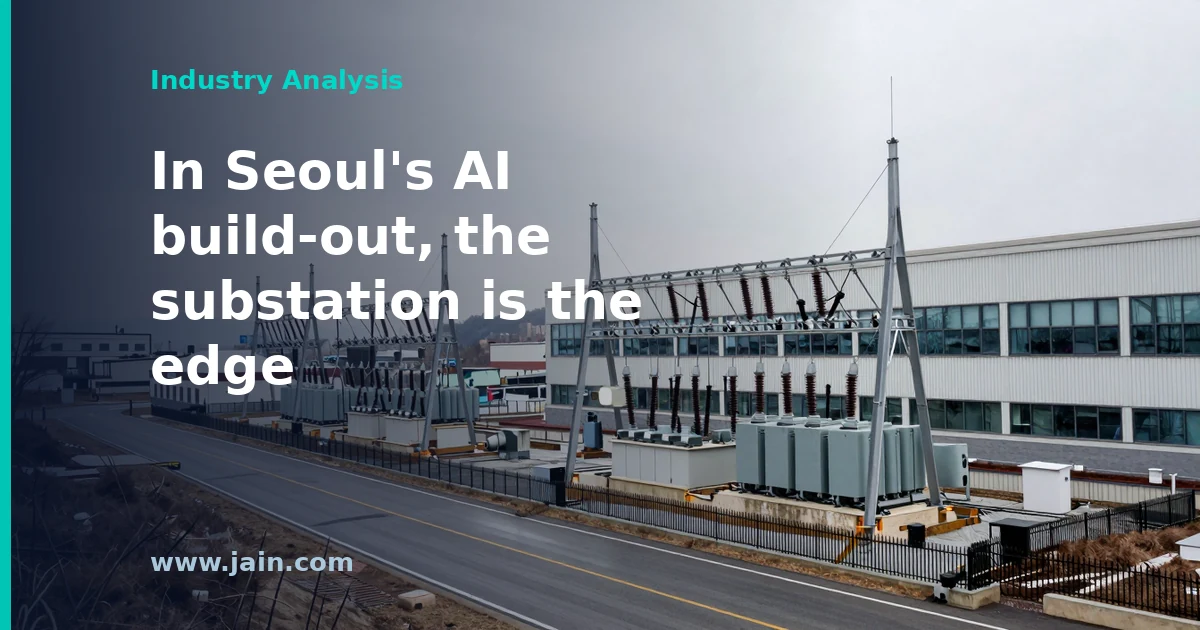
The surprising part: its biggest advantage isn’t the computers. It’s a major hub of the high-voltage power grid right across the road. Near Seoul, that kind of electricity hookup is hard to get.
Korea JoongAng Daily reported on June 7 that LG Uplus (LG U+) has made its Paju AI Data Center the centerpiece of a plan to win 5 trillion won ($3.3 billion) in cumulative AI data center orders by 2030. The site in Wollong-myeon, Gyeonggi Province, has a confirmed 200-megawatt power supply and will eventually hold five buildings with about 152,000 square meters (1.64 million square feet) of floor space.
Building 1 was about 20 percent complete at a June 5 site visit and is due for completion in June 2027. It is a 50-megawatt structure carrying about 30 megawatts of IT load, and it is already fully contracted to an unnamed large customer. LG Uplus expects more than 1 trillion won in orders a year through 2030 and projects 15 to 20 percent average annual revenue growth for the business.
Executive Summary
LG Uplus is repositioning itself from a traditional data center operator into what it calls an “AI Factory Operator.” In this model, the company sells the power, cooling and operational reliability that AI workloads need, not just rack space. Paju is the template. The site pairs a 200-megawatt grid connection with a hybrid air-and-liquid cooling design built in from the foundation. The first building sold out before its concrete had cured.
The announcement matters for two reasons. First, it shows where the scarcity lies in AI infrastructure near a capital city. Demand is plainly there; the harder thing to secure is a large, high-voltage power connection at a usable address. Second, it gives buyers and investors specific markers to track: the order target, the revenue growth projection, the 2027 completion date, and the commercial verification of liquid cooling later this year.
Vice president Ahn Hyurng-gyoon tied the build to a shift from training AI models to running them, known as inference. He said monthly token-processing volumes had risen roughly 67-fold over the past year. Tokens are the small chunks of text that AI models read and write.
Near Seoul, the Scarce Input Is a Grid Connection
LG Uplus led its pitch with power, and the details explain why. The Paju site draws from a 345-kilovolt substation directly across the road. That is a backbone transmission voltage, the level that carries bulk electricity across the grid. A 154-kilovolt line serves as backup, and both run underground at a depth of about nine meters. The company says the 200-megawatt supply was locked in after a formal power-impact assessment last August. It says local opposition has been muted because the land sits inside a former LG Display industrial complex.
Those facts matter more than the building rising above them. Concrete, steel and chillers can be bought and scheduled. The right to draw hundreds of megawatts at a specific address cannot be hurried in the same way. Near a capital region, it depends on an existing substation with spare capacity and on neighbors who will accept the load. LG Uplus’s own framing makes the point. It claims Paju will be the only hyperscale-class facility of its size in the greater Seoul area. Because demand clearly exists, with Building 1 sold out about a year before completion, that is in effect a claim about who secured the grid capacity.
Three groups feel the consequence. AI tenants that want large capacity close to Seoul’s users and enterprises have few alternatives at this scale, which strengthens the operator’s position on pricing and contract length. Rival developers face the same constraint: their bottleneck is less capital or construction skill than sites already wired to high-voltage infrastructure, which makes former industrial land valuable. The uniqueness claim itself is LG Uplus’s assertion, and it will be tested as competitors bring their own capacity forward.
Fifty Megawatts on the Building, Thirty for the Servers
Building 1 is described as a 50-megawatt structure carrying about 30 megawatts of actual IT load, the power that reaches servers, storage and networking gear. The rest is not wasted. In data centers, that margin typically covers cooling, power conversion losses, and the redundant headroom that keeps a site running when a component fails. But the gap is a reminder that the headline megawatt figure on an AI campus is not the same as the compute it can host.
For buyers comparing providers, the IT-load figure is the one to ask for. If the same ratio held across the full site, 200 megawatts would mean something closer to 120 megawatts for servers. That is an extrapolation, not a company figure, and later buildings may be designed differently. Cooling is where LG Uplus is trying to narrow the gap. Paju is designed as a hybrid air-and-liquid facility, with floor loads, waterproofing and piping engineered for liquid from the start. Its primary method is direct-to-chip cooling developed with LG Electronics, in which a cold plate is attached to the processor and coolant carries heat away. The company says its tests showed about 24 percent better energy efficiency than air cooling.
Designing for liquid up front is the operationally significant choice. Retrofitting pipes and reinforcing floors under a live data hall is disruptive and costly, and the newest AI chips increasingly run too hot for air alone. All three computing floors of Building 1 are designed for direct-to-chip cooling, so a tenant can switch as its hardware changes. The caveat is timing. Full commercial verification in a live server room is scheduled for later this year. Immersion cooling, in which servers are submerged in non-conductive fluid, still awaits certification.
An Order Target Is Not Yet a Revenue Line
The 5 trillion won ($3.3 billion) goal counts cumulative orders through 2030. LG Uplus expects more than 1 trillion won in orders a year to get there, or roughly a fifth of the target annually. Orders are contracted future business, not booked sales. A multi-year colocation contract can carry a large headline value that turns into revenue slowly over its term. The company’s separate projection of 15 to 20 percent average annual revenue growth is a better guide to what will reach the income statement, but the starting revenue base was not given.
The strategic repositioning is the more durable story. LG Uplus opened Korea’s first internet data center in 1999 and now runs 16 facilities nationwide. Ahn argued that competitiveness now depends “not on the scale of the facility but on how stably you can operate the entire infrastructure.” He pointed to a 27-year record of 99.999 percent uptime, which works out to about five minutes of downtime a year. That is a credible differentiator for a carrier with decades of network operations. It is also a claimed record, and the company itself says sustaining it at 200 megawatts is harder.
The first building also shows concentration risk: all of it is contracted to one unnamed customer. That validates demand, but it also means Paju’s early economics rest on a single relationship whose terms have not been disclosed.
Background
LG Uplus is one of South Korea’s three major mobile carriers, alongside SK Telecom and KT, and part of the LG Group. It opened Korea’s first internet data center (IDC) in 1999 and now operates 16 data centers nationwide. Its Paju project draws on group affiliates: the cooling system was co-developed with LG Electronics, and the site sits inside a former LG Display industrial complex.
AI data centers differ from traditional ones mainly in power density. Chips that train and run AI models draw far more electricity and give off far more heat per rack. That makes grid connections and liquid cooling central to design choices that were once secondary.
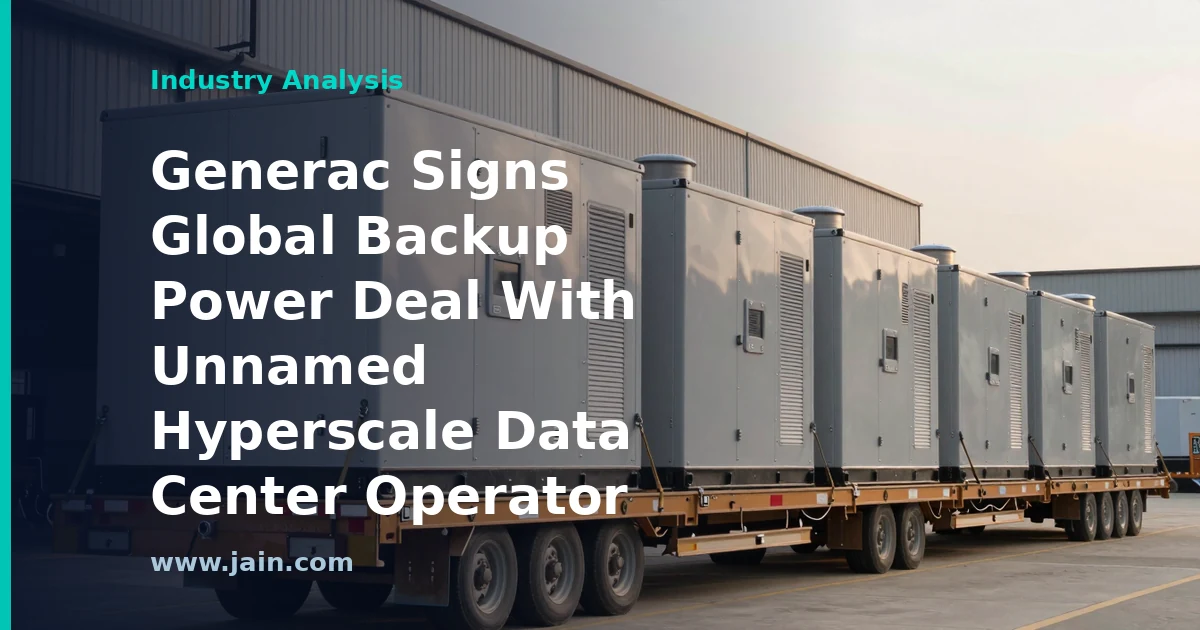
Generac Power Systems announced on June 1, 2026 that it has signed a global supply agreement to provide backup power equipment to a company it describes as a leading hyperscale data center operator. The customer was not named, and the announcement, distributed via PR Newswire, did not disclose financial terms, unit volumes, or a delivery timeline.
Executive Summary
The announcement matters less for its disclosed details — which are minimal — than for what it signals about both parties. For Generac, a company best known for residential standby generators, a global agreement with a hyperscaler is a credibility milestone in the large commercial and industrial power market, where data centers have become the most sought-after customer class. Hyperscalers — the handful of companies operating cloud and AI computing platforms at global scale — historically sourced backup generation from a small set of heavy-industrial incumbents.
For the data center industry, the deal is another data point in a broader pattern: operators locking in multi-year, multi-region supply of critical electrical equipment rather than procuring project by project. When a hyperscaler signs a global agreement for backup power, it suggests that generator capacity, like transformers and switchgear before it, is now scarce enough to justify strategic sourcing. That framing should be tempered by what the release does not say — no customer name, no dollar value, no megawatt figure — which limits how much weight the announcement can bear.
Backup Power Moves From Commodity to Constraint
Every serious data center pairs its utility feed with on-site backup generation — typically large diesel or natural gas generator sets that carry the facility through grid outages. For most of the industry’s history this was routine procurement: generators were a mature, readily available product bought near the end of a project’s design cycle. The AI-driven construction boom changed that. As operators race to bring gigawatts of new capacity online, long-lead electrical equipment — transformers, switchgear, and increasingly generator sets — has become a pacing item that can delay a facility as surely as a missing utility interconnection.
A global supply agreement is the procurement response to that scarcity. Instead of bidding each project separately, an operator reserves manufacturing capacity across regions and years, trading flexibility for certainty of delivery. The fact that a hyperscaler apparently judged this worthwhile for backup power is itself evidence of how tight the market has become, and it mirrors similar forward-buying behavior seen across the data center supply chain.
What the Deal Means for Generac
Generac built its business on home standby generators and mid-sized commercial units, while the largest data center generator orders have traditionally gone to heavy-industrial manufacturers such as Caterpillar, Cummins, and Rolls-Royce’s mtu brand. Generac has spent recent years pushing into larger industrial applications, and a hyperscale win — if it translates into sustained volume — would validate that strategy in the most demanding segment of the market. Hyperscale operators qualify suppliers rigorously, so passing that bar is meaningful even before any units ship.
The caution is that the release discloses no volumes or revenue. Supply agreements can range from firm multi-year commitments to framework arrangements that simply make a vendor eligible for future orders. Without disclosed terms, investors and industry observers cannot yet distinguish between the two, and the announcement should be read as a positive signal rather than a quantified backlog addition.
Why Hyperscalers Are Diversifying Their Supplier Base
From the buyer’s side, adding a supplier makes straightforward sense. When incumbent generator manufacturers carry extended backlogs, a hyperscaler that depends on a narrow vendor list risks having construction schedules dictated by someone else’s factory queue. Qualifying an additional manufacturer at global scale adds resilience, creates pricing competition, and expands total available manufacturing capacity — the same playbook hyperscalers have applied to chips, power equipment, and construction contractors.
The competitive implication for the wider market is worth watching: enterprise and colocation buyers, who lack hyperscale purchasing power, may find themselves further back in the queue as manufacturers allocate capacity to their largest strategic accounts. Backup power availability could quietly become another dimension on which the largest operators out-execute smaller ones.
Background
Generac Power Systems, founded in 1959 and headquartered in Waukesha, Wisconsin, became a household name in residential standby generators — the units that keep homes powered through grid outages. Over the past decade it has expanded into commercial and industrial generation, energy storage, and grid services, seeking growth beyond the housing-linked residential market. The largest tier of that industrial market is data center backup power, a segment long dominated by heavy-equipment incumbents.
The announcement lands amid an unprecedented data center construction cycle driven by cloud growth and AI computing demand. That boom has strained the supply chains for electrical infrastructure of every kind, prompting the biggest operators to lock in equipment supply years ahead — the context in which a global backup power agreement with a hyperscaler is best understood.
Alphabet, the parent of Google, plans to raise roughly $80 billion in debt to fund an expansion of its artificial intelligence infrastructure, according to a report published May 31, 2026. The financing is aimed at underwriting data centers, compute capacity, and related buildout needed to keep pace with rival hyperscalers.
Executive Summary
The reported $80 billion debt raise, if executed, would be one of the largest single-purpose financings ever undertaken by a major U.S. technology company. It signals that Alphabet views the current AI infrastructure cycle not as a discretionary bet fundable from operating cash flow alone, but as a strategic imperative worth taking on substantial leverage to accelerate.
For the broader industry, the move is another data point in a hyperscaler capex arms race that already spans Microsoft, Amazon, Meta, and Oracle. Each is pouring tens of billions into GPUs, custom silicon, data center shells, long-lead power contracts, and networking. Alphabet joining the debt market in this size shifts the competitive dynamic from "who has the cash" to "who can price and place the paper."
Why Debt, and Why Now
Alphabet historically finances itself out of one of the most productive cash engines in corporate history. Turning to the debt markets at this scale suggests two things at once: the buildout is large enough to strain even Google-sized free cash flow on the timelines management wants, and the company sees today’s rate environment and its own credit quality as attractive enough to lock in long-duration capital. Debt also preserves equity for shareholders and, in a rising-rate world for weaker credits, widens Alphabet’s advantage over sub-investment-grade AI challengers.
The tradeoff is straightforward. AI infrastructure depreciates fast — GPU generations turn over in roughly two years — while bonds may sit on the balance sheet for a decade or more. Alphabet is effectively financing short-lived assets with long-lived liabilities, a mismatch that only works if the revenue those assets generate outlasts any single chip cycle.
The Hyperscaler Capex Arms Race
Alphabet is not alone. Microsoft, Amazon Web Services, Meta, and Oracle have each signaled or executed unprecedented AI-related capital programs, and the collective bill is now measured in hundreds of billions per year. When one hyperscaler leans harder on debt, peers face pressure to match — either by tapping the same markets, by monetizing more of their existing footprint, or by leaning on customer prepayments and joint ventures with power providers.
The winners in this environment are the picks-and-shovels vendors: GPU makers, high-bandwidth memory suppliers, optical networking firms, liquid-cooling specialists, and, increasingly, utilities and independent power producers willing to sign long-duration contracts. The losers, potentially, are enterprises competing for the same grid capacity, permits, and construction crews — and any hyperscaler that misreads AI demand and ends up servicing debt against underutilized capacity.
The Real Bottleneck Is Power, Not Money
An $80 billion raise addresses the capital constraint but not the physical one. Data center site selection in 2026 is dominated by access to firm, dispatchable power on a multi-year horizon — a market where transformer lead times, interconnection queues, and local permitting can slip a project by years regardless of budget. Money accelerates what is buildable; it does not summon megawatts.
That reality is why hyperscaler announcements increasingly pair capex figures with power partnerships — nuclear PPAs, gas peakers, on-site generation, and behind-the-meter deals. The scale of Alphabet’s reported raise implies a matching pipeline of power and land commitments; whether that pipeline exists is a separate question the market will watch closely.
Credit Market Implications
A single issuer bringing $80 billion of new supply, even staggered across tranches, is a meaningful event for investment-grade credit. It tests appetite for tech-sector duration, may steepen spreads for other AAA/AA issuers in the queue, and gives portfolio managers a new benchmark for pricing AI-linked risk. If the deal is well-received, it opens the door for peers to follow; if it prices wide, it signals that even the strongest credits are approaching the market’s willingness to fund the AI cycle at current terms.
Background
Alphabet is the holding company for Google, YouTube, Google Cloud, and a portfolio of other bets. Google Cloud is the third-largest public cloud provider after AWS and Microsoft Azure, and has become a strategic priority as generative AI workloads reshape enterprise IT spending. Alphabet historically funds its capital program from operating cash flow and holds one of the strongest balance sheets in the S&P 500.
Since the launch of ChatGPT in late 2022, hyperscalers have entered a sustained capital-spending cycle to build the data centers, chips, and power capacity needed for large-scale AI training and inference. Announced capex budgets across Microsoft, Amazon, Meta, Google, and Oracle now dwarf prior cloud buildout eras, and financing structures — including debt, joint ventures with power providers, and long-term customer prepayments — have grown correspondingly creative.