The Trump administration is advancing measures to bar foreign technology considered a national-security risk from the US bulk-power system, according to a Nextgov/FCW report dated May 8, 2026. The move revives and extends earlier executive efforts to police the origins of transformers, inverters, control systems and other grid-connected equipment.
Executive Summary
Washington is again training its regulatory attention on the electric grid’s supply chain. The reported action would restrict the use of equipment from designated foreign adversaries in US power infrastructure, echoing a 2020 executive order that was paused and then partially unwound before returning to the policy agenda.
For data-center operators, the stakes are practical rather than abstract. High-voltage transformers, medium-voltage switchgear, battery inverters and grid-tied controls increasingly determine whether new capacity comes online on schedule. Any rule that narrows the pool of eligible suppliers reshapes procurement, lead times and cost curves for hyperscale and colocation builds alike.
What ‘Risky Foreign Technology’ Actually Means
The phrase is broad by design. In earlier iterations, US officials focused on bulk-power equipment sourced from countries designated as foreign adversaries, with particular concern about large power transformers and digital control systems that could be remotely accessed or tampered with. The underlying worry is that embedded firmware, software updates or hardware backdoors in critical grid equipment could be exploited during a conflict or crisis.
For a lay reader, the concern is less about a single dramatic hack than about slow, quiet dependence. If a handful of foreign vendors supply components that sit inside substations for thirty or forty years, replacing them later is expensive and disruptive. Regulators appear to be trying to prevent that lock-in from deepening while alternatives still exist.
Direct Line to Data-Center Power
Data centers do not run on abstractions; they run on transformers, switchgear and increasingly on-site generation. The industry is already contending with multi-year lead times for large transformers and constrained global manufacturing capacity. A rule that narrows sourcing options, even at the margin, tightens an already tight market and raises the premium on domestic and allied-country supply.
Operators building AI-scale campuses should expect procurement teams to be asked new questions: Where was this transformer wound? Whose firmware runs the relay? Is the inverter vendor on a restricted list? Compliance overhead is real, but the bigger operational risk is discovering late in a project that a specified component is no longer eligible.
Winners, Losers and Second-Order Effects
Domestic manufacturers of transformers, switchgear and inverters stand to benefit if the policy sticks and is enforced consistently. Allied suppliers in Europe, Japan, South Korea and Canada are likely secondary beneficiaries. The clearest losers would be Chinese-origin equipment makers and, indirectly, US buyers who had been counting on lower-cost imports to hold down capital budgets.
The second-order effect is timing. Even a well-intentioned rule can slow projects if the domestic industrial base cannot expand fast enough to absorb displaced demand. That risk deserves scrutiny on its own merits, separate from the security rationale.
An Even-Handed Read of the Politics
Supply-chain security in the grid is not a partisan invention; both the 2020 Trump executive order and subsequent Biden-era reviews concluded that the sector had exposure worth addressing. Where reasonable people differ is on scope, speed and how narrowly to define ‘risky.’ Overly broad rules can raise costs without proportionate security gains; overly narrow ones can leave gaps. The forthcoming details, not the headline, will determine which category this action falls into.
Background
Concerns about foreign-made equipment in the US grid escalated in May 2020, when the first Trump administration issued Executive Order 13920 declaring a national emergency over bulk-power system supply chains. That order was suspended early in the Biden administration pending review, and subsequent policy focused on voluntary guidance, prohibited-transaction rules for specific equipment and expanded domestic manufacturing incentives.
In parallel, US utilities and data-center developers have wrestled with a global shortage of large power transformers, lead times that can stretch past two years, and rapid load growth driven by AI, electrification and reshoring. Those pressures form the practical backdrop against which any new sourcing restrictions will be judged.
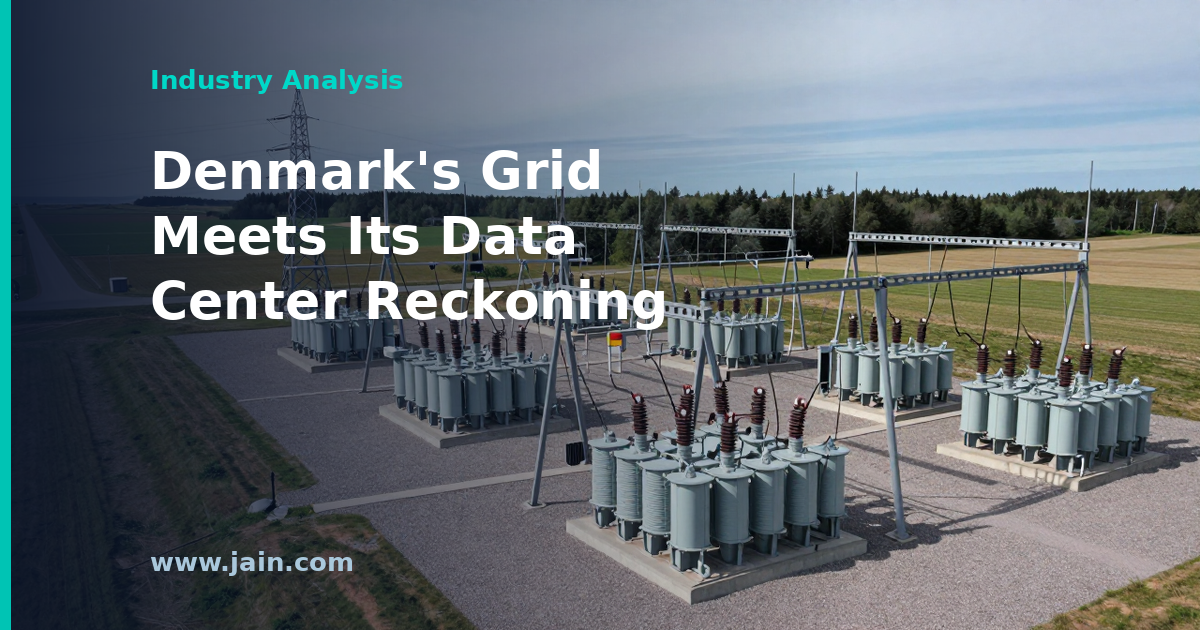
CNBC reports that Denmark is confronting a data center reckoning as its electricity grid struggles to keep pace with demand from new and planned compute campuses. The story frames Denmark — long marketed as a cool-climate, renewable-rich destination for hyperscale sites — as an early warning for the wider European market.
Executive Summary
Denmark built its data center pitch on wind power, fiber connectivity, and a stable regulatory climate. According to CNBC’s May 5, 2026 reporting, that pitch has now collided with a physical limit: the grid itself. Surging load from AI training clusters and cloud expansion is arriving faster than transmission and generation can be built to serve it.
The significance is less about one country and more about a pattern. When a small, wealthy, wind-heavy grid begins turning away or slow-walking data center load, it signals that Europe’s compute buildout is entering a capacity-constrained phase where power availability — not land, tax breaks, or fiber — decides who gets to build and when.
From Marketing Advantage to Physical Constraint
For roughly a decade, Nordic countries sold themselves as the natural home for hyperscale compute: cold air for free cooling, abundant wind and hydro, and grids with historically high renewable penetration. Denmark in particular attracted anchor tenants on that narrative. The CNBC framing suggests the narrative has aged faster than the infrastructure. Interconnection — the physical and contractual act of tying a new large load into the transmission system — is now a multi-year exercise in many European jurisdictions, and Denmark appears to be joining that queue-bound club.
The economics shift accordingly. When power is the binding constraint, the value of a permitted, energized site rises sharply relative to a greenfield parcel with only a land option. Developers holding older, already-connected sites gain leverage; newcomers face longer development cycles and more expensive grid upgrades passed through in connection fees.
The AI Load Curve Is Not the Cloud Load Curve
Traditional cloud regions grew in relatively predictable megawatt increments. AI training campuses do not. A single modern training hall can request tens to hundreds of megawatts at a single point of interconnection, with utilization profiles that are peakier and less flexible than a general-purpose cloud zone. Grids planned around gradual electrification of transport and heat were not sized for step-change industrial loads landing in single postcodes.
That mismatch is what turns a growth story into a reckoning. It is not that Denmark lacks renewable generation in aggregate; it is that moving power from where wind blows to where a proposed campus wants to plug in requires transmission that takes years to permit and build. In the interim, either the load waits, the grid operator constrains it, or fossil balancing quietly rises to keep the system stable.
Winners, Losers, and the New Site-Selection Playbook
Operators with existing energized capacity in Denmark and neighboring markets benefit from scarcity pricing on colocation and wholesale power capacity. Hyperscalers with the balance sheet to co-invest in transmission or to sign long-tenor renewable PPAs (power purchase agreements — long-term contracts to buy electricity from a specific generator) can still move forward, but on the utility’s timeline. Smaller enterprises and AI startups without that leverage are pushed toward secondary markets or toward renting capacity rather than building it.
Regulators and policymakers face their own trade-off. Restricting new data center load protects households and existing industry from grid stress and price spikes, but risks ceding a strategically important slice of the AI economy to jurisdictions willing to build faster. The Danish debate, as CNBC frames it, is a preview of choices Ireland, the Netherlands, and parts of Germany have already had to make explicitly.
What Substantiated, What Is Not
The reporting substantiates the direction — grid stress from data center demand in Denmark — more than any specific quantified ceiling. Readers should treat headline claims of “overwhelmed” grids as a description of pipeline pressure and interconnection backlog rather than active blackouts. The useful takeaway is directional: European compute siting is repricing around power, and Denmark is a visible early data point rather than a singular crisis.
Background
Denmark, along with Sweden, Norway, and Finland, spent the 2010s courting hyperscale data center investment on the strength of cool weather, renewable generation, and connectivity to mainland Europe. Anchor projects from major U.S. cloud providers helped establish the region as a credible alternative to the FLAP-D markets (Frankfurt, London, Amsterdam, Paris, Dublin).
By the mid-2020s, that same set of European markets began hitting grid constraints as electrification of transport, heating, and industry collided with a step-change in compute demand from AI. Ireland’s moratorium in the Dublin area and the Netherlands’ national siting restrictions were the first public signals; Denmark’s current situation extends that pattern into the Nordics themselves.
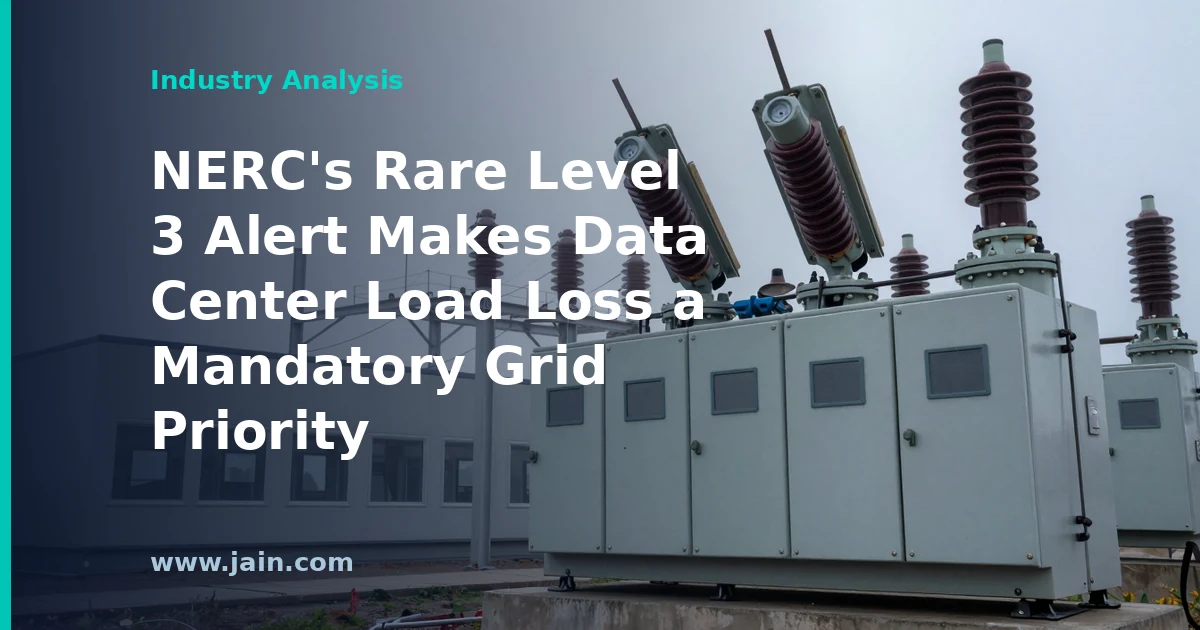
The North American Electric Reliability Corporation (NERC) has issued a Level 3 alert — the highest tier in its alert system, and one it has used only a handful of times in its history — mandating that grid entities take action to address data center load-loss events, as reported by Utility Dive on May 4, 2026. Load-loss events occur when large blocks of data center demand disconnect from the grid suddenly and simultaneously, typically during a voltage disturbance, leaving grid operators to manage an abrupt surplus of generation.
Executive Summary
NERC alerts come in three escalating levels: Level 1 advisories are informational, Level 2 recommendations ask industry to consider actions and report back, and Level 3 “Essential Action” alerts — which require approval by NERC’s board and carry mandatory reporting obligations — direct registered entities to take specific actions. By reaching for its strongest instrument short of a formal reliability standard, NERC is signaling that mass data center disconnections have moved from an academic concern to an operational risk it believes the industry must address now, not after the next major disturbance.
The timing matters. Data centers, driven heavily by AI computing demand, represent the fastest-growing category of large electric load in North America. When a routine transmission fault causes hundreds or thousands of megawatts of that load to transfer to on-site backup power in the same instant, the grid experiences the mirror image of losing a large power plant — and grid protection systems were largely designed around the latter problem, not the former. This alert effectively puts utilities, grid operators, and by extension their data center customers on notice that ride-through behavior is now a reliability obligation, not a private design choice.
Why a Level 3 Alert Is the Grid’s Equivalent of a Fire Alarm
NERC, the FERC-certified reliability organization for the North American bulk power system, issues Level 3 alerts rarely — prior uses have been reserved for systemic threats such as extreme cold weather preparedness after major winter grid failures. Unlike advisories, a Level 3 alert obligates recipients to act and to report what they have done. That distinction matters because the normal path for imposing new grid requirements — drafting and balloting a mandatory reliability standard — can take years. An Essential Action alert is the fastest mechanism NERC has to change industry behavior at scale.
Choosing that mechanism for data center load loss tells us two things. First, NERC’s technical analysis of past disturbance events has evidently convinced it that the risk is material today, at current data center penetration, rather than a projection for the 2030s. Second, it suggests NERC is unwilling to wait for the standards process — or for voluntary industry guidelines — to close the gap. The reasonable inference is that standards work will follow, with the alert serving as the bridge.
The Physics of Losing Load: Why Disconnection Is as Dangerous as a Plant Trip
Grid stability depends on generation and consumption balancing continuously. The industry has spent decades engineering around the sudden loss of a large generator. The inverse problem — sudden loss of a large load — produces the same imbalance in the opposite direction: frequency and voltage rise, and generators must ramp down quickly. Data centers are uniquely prone to causing it because they are designed for near-perfect uptime. When sensors detect a voltage sag from a routine transmission fault, uninterruptible power supply (UPS) systems and transfer switches shift the facility to batteries and generators in milliseconds. Each facility is behaving rationally; the grid experiences hundreds of rational decisions as one massive, uncontrolled event.
This is not hypothetical. NERC’s own disturbance analysis documented a 2024 event in Northern Virginia — the world’s densest data center market — in which dozens of facilities totaling roughly 1,500 MW disconnected simultaneously in response to a fault, an event NERC’s Large Loads Task Force has studied extensively since. As individual campuses grow from tens of megawatts toward gigawatt scale, a single region’s synchronized ride-through failure starts to approach the size of contingencies grids plan for when their largest nuclear units trip offline.
The Compliance Gap: NERC Regulates Utilities, Not Data Centers
There is a structural awkwardness at the heart of this alert: NERC’s authority runs to registered entities — utilities, transmission operators, balancing authorities — not to data center operators, who are simply customers. Generators have long faced mandatory ride-through requirements obliging them to stay connected through routine disturbances; comparable requirements for large loads have not existed. Any action mandated by this alert therefore has to flow through intermediaries, most likely via interconnection agreements, tariff provisions, and operating studies that utilities impose on their large-load customers.
That transmission chain creates both friction and leverage. Friction, because retrofitting ride-through behavior into existing facilities touches UPS configurations, protection settings, and uptime guarantees that operators consider core to their business and, in some cases, to their contractual service-level commitments. Leverage, because data center developers are currently queuing for grid capacity in nearly every major market — utilities negotiating multi-hundred-megawatt interconnections have more bargaining power today than at any point in memory. Expect ride-through specifications to become a standard term of large-load interconnection, and expect equipment vendors who can certify grid-friendly UPS behavior to find a receptive market.
Winners, Losers, and the Cost Question
For hyperscalers and colocation operators, the near-term cost is engineering effort and potentially revised protection settings; the longer-term risk is that ride-through obligations complicate the uptime architectures customers pay premium prices for. Facilities that can demonstrate they stay connected through disturbances may find interconnection approvals faster — a meaningful competitive edge when grid access, not land or capital, is the binding constraint on data center growth. Utilities gain a mandate they can point to when asking sophisticated customers to accept new technical requirements. The clearest beneficiaries may be power-equipment and controls vendors, since grid-aware UPS systems, smarter transfer logic, and monitoring that documents ride-through performance all become salable compliance infrastructure.
The unresolved tension is economic: someone must pay for retrofits, studies, and any incremental risk to uptime. If the costs land on data center operators, expect pushback framed around reliability commitments to their own customers. If they land on utilities, they ultimately reach ratepayers. The alert forces that negotiation to begin; it does not settle it.
Background
Data centers have become the defining load-growth story of the 2020s power sector, with AI training and inference driving interconnection requests measured in gigawatts across markets like Northern Virginia, Texas, and the Midwest. As that load concentrated, grid engineers identified an emergent failure mode: facilities built for maximum uptime disconnect en masse during routine disturbances, creating sudden supply-demand imbalances. NERC — the FERC-certified reliability regulator for the North American bulk power system — began studying the issue through disturbance reports and its Large Loads Task Force after documented multi-facility disconnection events, most prominently a roughly 1,500 MW simultaneous loss in Northern Virginia in 2024.
NERC’s alert system escalates from Level 1 advisories through Level 2 recommendations to Level 3 Essential Actions, which require board approval and mandatory response. Level 3 alerts have historically been reserved for systemic threats — notably extreme cold weather preparedness following major winter grid emergencies — making this application to data center load behavior a notable elevation of the issue.
CalMatters published a report on May 4, 2026, headlined “The data center backlash is here — and Big Tech is spending big to shape it.” The story frames a growing wave of community opposition to hyperscale data center projects alongside what the outlet characterizes as significant expenditures by large technology companies to influence public perception, local politics, and permitting outcomes.
Because only the headline and outlet are available in the source feed reviewed here, the specific dollar figures, named companies, jurisdictions, and campaign tactics referenced by CalMatters are not reproduced in this article.
Executive Summary
The CalMatters headline crystallizes a trend that has been building for at least two years: as artificial intelligence workloads push hyperscalers to site ever-larger campuses, the communities being asked to host them are pushing back on power draw, water consumption, tax abatements, noise, and land conversion. The report’s framing — that Big Tech is “spending big to shape” the response — asserts a coordinated influence effort rather than a series of isolated PR moves.
Why it matters: data center siting has moved from a technical procurement exercise into contested civic politics. If the pattern CalMatters describes holds, project timelines, community-benefit agreements, and utility-rate designs will increasingly be decided in front of city councils and public-utility commissions rather than in back-of-house negotiations. That reshapes cost of capital, land option strategies, and the reputational exposure of every operator in the sector — not only the hyperscalers named in any given story.
What is not yet substantiated from the source reviewed: the scale of spending, its recipients, which companies are most active, and whether the activity meets the legal threshold of lobbying, political advertising, or grassroots organizing under applicable state law.
Why the Backlash Arrived Now
Two forces converged. First, AI training and inference clusters draw hundreds of megawatts per campus — an order of magnitude above the 20 to 50 megawatt facilities that dominated the last cycle — which has pulled data centers onto grids and into rate cases that previously ignored them. Second, the queue of new interconnection requests in regions like Northern Virginia, Central Ohio, Georgia, and parts of California has spilled into residential-adjacent parcels, which surfaces zoning, noise, and traffic issues that colocation providers historically avoided by clustering in industrial zones. When a project competes with households for the same substation capacity, the fight becomes visible on the household’s electric bill.
The CalMatters framing suggests operators have recognized this shift and are resourcing it accordingly. That is consistent with public lobbying disclosures across several states in prior reporting cycles, though the specific 2026 figures referenced by CalMatters are not in the material reviewed here.
What ‘Spending to Shape’ Can Mean — And What It Cannot
Influence spending is a broad category. It ranges from clearly disclosed activity — registered lobbyists, campaign contributions filed with state ethics agencies, membership dues to trade associations — to less transparent forms such as sponsored community events, funded economic-impact studies, and paid grassroots organizing. Each carries different legal, ethical, and reputational weight. A community-benefits fund is not the same instrument as an astroturf letter-writing campaign, and conflating them weakens both critique and defense.
Fair questions cut both ways. Of industry: which expenditures are disclosed, which studies are independently peer-reviewed, and are the jobs and tax figures cited in siting hearings audited after the fact? Of critics: are the coalitions organic residents’ groups, or do they receive funding from competing land uses, ratepayer advocates, or ideological funders — and is that funding disclosed? Neither question should be used to dismiss the other side; both should be answered on the record.
The Economics Underneath the Politics
A single gigawatt-scale AI campus can represent 5 to 10 billion dollars of capital, decades of property-tax revenue, and a few hundred permanent jobs — a lopsided ratio that has always made data centers a peculiar economic-development target. Local officials get large capex announcements and modest payroll; residents get transmission upgrades that may or may not be socialized across the rate base. The math is defensible when the load is firm, the tax abatements are time-limited, and the utility recovers infrastructure costs from the specific customer causing them. It becomes politically fragile when any of those conditions slip.
Operators who invest early in transparent cost-allocation frameworks, independently verified water and power reporting, and enforceable community-benefit agreements tend to face lower opposition later. Those who rely primarily on influence spending to smooth approvals may win individual projects but raise the ambient political risk premium for the whole sector.
Implications for the Broader Infrastructure Stack
The backlash is not confined to hyperscalers. Colocation providers, connectivity carriers building fiber to new campuses, and power developers proposing behind-the-meter gas or nuclear all inherit the reputational climate the largest builders create. If permitting friction rises, the winners are likely to be operators with existing entitled land, brownfield reuse expertise, and demonstrated ability to close power-purchase agreements without triggering rate-case fights. The losers are speculative greenfield developers dependent on speed-to-permit assumptions that no longer hold.
For enterprise buyers and investors, the practical read is that siting risk deserves the same diligence weight as latency, power price, and fiber diversity. Contracts should account for the possibility that a project announced today may face a very different approval environment when it enters construction two years from now.
Background
Data centers evolved from single-tenant enterprise rooms in the 1990s to multi-tenant colocation campuses in the 2000s and hyperscale cloud regions in the 2010s. The current AI cycle, beginning roughly in 2023, has pushed unit sizes an order of magnitude higher and concentrated demand in a handful of metro areas already facing grid constraints. Communities that welcomed earlier generations of facilities as quiet, tax-generating neighbors have found the new class harder to absorb.
CalMatters is a nonprofit newsroom covering California policy and politics; its coverage of data center siting has focused on the intersection of AI infrastructure demand, state climate goals, and local land-use authority. The May 4, 2026 article extends that beat into the influence-spending dimension of the debate.
Goldman Sachs published research titled “Tracking Trillions: The Assumptions Shaping the Scale of the AI Build-Out,” dated May 1, 2026. As the title signals, the piece frames the artificial-intelligence infrastructure boom as a trillion-dollar-scale phenomenon whose ultimate size rests on a set of interlocking assumptions — about capital expenditure, electric power availability, and demand for AI chips — rather than on settled facts.
The item reached us as a syndicated headline via Google News; the full text of the underlying research was not included in the source material, so this article analyzes the framing the title and publication make public, and flags what cannot be verified from the release itself.
Executive Summary
When one of the world’s most influential investment banks organizes its AI-infrastructure research around the word “assumptions,” that word choice is itself the news. It signals that the scale of the build-out — the data centers, the power contracts, the semiconductor orders — is not a fixed trajectory but a forecast stacked on top of other forecasts. If the assumptions hold, the spending is rational; if any load-bearing one slips, the numbers built on it move too.
For the infrastructure industry, this kind of research matters because it shapes how capital markets price the boom. Data-center developers, utilities, and chipmakers are all making decade-scale commitments today against demand projections that mature years from now. A major bank publicly cataloguing the assumptions behind those projections gives lenders, investors, and boards a shared checklist — and a shared vocabulary for asking whether any given project’s premises are conservative or aggressive.
Because the source available to us is a headline-level syndication rather than the full report, we treat the specific figures inside Goldman’s analysis as unverified here, and focus on the three assumption categories the title and editorial framing identify: capex, power, and chip demand.
Why ‘Assumptions’ Is the Load-Bearing Word
Capital expenditure — capex, the money companies spend on long-lived physical assets — is the first pillar of any AI build-out forecast. Hyperscale cloud providers have been directing historically large budgets toward AI-capable data centers, and analysts across Wall Street have converged on aggregate build-out figures measured in the trillions of dollars over the coming years. But an aggregate capex forecast is not a single number; it is a chain of premises: that AI workloads keep growing, that enterprises convert experimentation into paid usage, that model training and inference continue to demand ever more compute, and that the companies writing the checks keep generating the cash flow to fund them.
Framing the build-out as assumption-driven is a quietly disciplined move. It invites readers to ask, for each dollar of projected spending: what has to be true for this to happen? That question separates committed capital — contracts signed, steel ordered, sites permitted — from projected capital, which can be revised down as quickly as it was revised up. Infrastructure operators know the difference intimately: a facility takes years to permit, power, and build, while a forecast can change in a quarter.
Power: The Constraint That Doesn’t Negotiate
The second assumption category is electric power, and it is the one the physical world enforces most strictly. AI data centers are extraordinarily energy-dense — a single large campus can draw as much electricity as a small city — and connecting that load to the grid requires generation, transmission lines, and substation capacity that take far longer to build than the data centers themselves. Any forecast of AI infrastructure scale therefore embeds an assumption that utilities and grid operators can deliver power on the industry’s timeline.
This is where assumption-mapping earns its keep. Capex can be accelerated by writing bigger checks; electrons cannot. Interconnection queues, turbine and transformer lead times, and local permitting fights are already the pacing items for many projects across major data-center markets. If power availability lags the demand curve that capex plans assume, the result is not a smaller boom so much as a rearranged one — capacity migrating to regions with available power, premiums for energized sites, and renewed interest in on-site and behind-the-meter generation.
Chip Demand and the Question of Payback
The third pillar is demand for AI chips — the graphics processing units (GPUs) and custom accelerators that fill these facilities. Chip demand is the assumption that connects the physical build-out back to economics: companies buy accelerators because they expect the AI services running on them to generate revenue that justifies the cost. The durability of that expectation is the central debate of the entire cycle, and it is notable that Goldman Sachs itself has hosted both sides of it — the bank’s own research in earlier phases of the boom publicly questioned whether generative AI’s benefits would arrive fast enough to justify the spending.
Treating chip demand as an assumption rather than a given keeps the analysis honest in both directions. Bulls can point to sustained order backlogs and rising inference workloads; skeptics can point to the gap between infrastructure spending and the AI application revenue reported so far. Neither side’s case is closed, and a framework that tracks the assumptions explicitly lets observers watch which ones are being confirmed by earnings and utilization data — and which are being quietly extended another year.
What Assumption-Mapping Means for the Infrastructure Industry
For data-center operators, connectivity providers, and their customers, research like this shapes the cost and availability of capital. Lenders underwriting a facility, utilities planning generation, and enterprises signing long-term colocation contracts all lean on frameworks from institutions like Goldman Sachs to judge whether the demand behind a project is durable. A well-publicized assumptions checklist tends to reward projects that can show contracted demand, secured power, and credit-worthy tenants — and to raise the bar for speculative builds.
The even-handed reading is this: mapping assumptions is not a bear case, and it is not a bull case. It is the analytical infrastructure for either. The AI build-out may prove to be one of the great capital deployments in industrial history, or parts of it may overshoot demand; in both scenarios, the parties who tracked the underlying assumptions — rather than the headline totals — will have seen the turn first.
Background
Goldman Sachs is one of the world’s largest investment banks, and its research division is a significant force in how capital markets interpret technology cycles. Since the generative-AI surge began, the bank’s analysts have examined the infrastructure boom from multiple angles — including, notably, earlier research that questioned whether AI’s economic benefits would arrive fast enough to justify the unprecedented spending. That history makes the firm a useful barometer: its published frameworks are read by the lenders, utilities, and boards whose decisions collectively determine the build-out’s actual pace.
The build-out itself has become one of the defining capital-investment stories of the decade. Hyperscale cloud providers and data-center developers have committed enormous sums to AI-capable capacity, straining electric grids and semiconductor supply chains in the process, while analysts and policymakers debate how much of the projected spending will ultimately be deployed — and how much of it will pay off.
On April 28, 2026, RAND — the nonprofit, nonpartisan policy research institution — published an analysis titled “How Much More Power Can the U.S. Grid Provide for AI? Projections and Policy Implications for 2030.” The work models the gap between surging AI-driven electricity demand and the grid’s realistic ability to serve it this decade, and maps the policy choices that will widen or narrow that gap.
Executive Summary
The question in RAND’s title is arguably the central resource question of the AI buildout. Data centers running artificial-intelligence workloads have become one of the fastest-growing sources of new electricity demand in the United States, and every hyperscale campus announcement ultimately depends on an answer to the same question: can the grid actually deliver the power, and by when?
What makes a RAND treatment notable is the framing. Rather than starting from what AI developers say they need — the demand-side forecasts that dominate industry discourse — the title starts from what the grid can provide, a supply-side constraint analysis. Pairing “projections” with “policy implications” signals that the answer is not a fixed number but a range whose outcome depends on decisions about generation, transmission, and interconnection that federal and state policymakers are making right now.
Because our source is the publication listing rather than the full report, this article analyzes the question RAND is posing and the market context around it, and flags below what the listing alone does not tell us about the report’s specific findings.
Why the Supply-Side Framing Matters
Most public numbers in the AI-power debate come from the demand side: forecasts of how many gigawatts AI data centers will request. Those forecasts are genuinely uncertain — utilities have reported that the same prospective data center project often applies for service in multiple territories, which can inflate aggregate demand figures if requests are summed naively. A supply-side analysis flips the question to the binding constraint: how much new load the existing fleet of power plants, transmission lines, and distribution infrastructure can absorb by 2030 under realistic buildout assumptions.
That reframing matters commercially. If credible headroom estimates exist region by region, they become a de facto siting map — telling developers where power is available and telling investors which announced projects face energization risk. It also disciplines the conversation: a project announcement is not capacity until a utility can serve it.
The Bottleneck Is Delivery, Not Just Generation
For readers new to the topic: connecting a large new power plant or a large new customer to the grid requires an engineering study process called interconnection, and in much of the country those study queues have stretched to multiple years. High-voltage transmission lines — the long-distance wires that move bulk power — routinely take the better part of a decade from proposal to operation because they cross many permitting jurisdictions. Meanwhile, a modern AI campus can be requesting hundreds of megawatts, the scale of a small city, on a two-to-three-year construction schedule.
That timing mismatch, not any absolute shortage of energy resources, is the crux of the 2030 question. It explains why data center operators are increasingly pursuing workarounds: siting at retired industrial locations with existing grid connections, contracting directly with power plants, adding on-site generation, and offering demand flexibility — agreeing to reduce draw during grid stress in exchange for faster hookups.
The Policy Levers on the Table
The “policy implications” half of RAND’s title points at a live agenda. The levers most commonly debated in this space include: reforming interconnection queues so viable projects move faster; accelerating transmission permitting and cost allocation; deciding who pays for grid upgrades triggered by large loads, a question with direct consequences for other ratepayers’ bills; and setting rules for large flexible loads and behind-the-meter generation. Each lever sits with a different actor — federal regulators, regional grid operators, state commissions — which is why national demand projections translate so unevenly into local reality.
For the infrastructure industry, the stakes cut both ways. Faster interconnection and transmission buildout expands the addressable market for data center development. But cost-allocation decisions that shift upgrade costs onto large loads change project economics, and jurisdictions that move slowly will simply watch capacity — and the tax base that comes with it — land elsewhere. An evenhanded, nonpartisan modeling effort that quantifies these tradeoffs is useful precisely because most numbers in circulation come from parties with a commercial or advocacy position.
Background
US electricity demand was roughly flat for about two decades before data centers — accelerated sharply by the generative AI boom that began in late 2022 — joined electrification and reshored manufacturing in pushing load growth back onto utility planning agendas. Since then, hyperscale campus announcements measured in the hundreds of megawatts or more have become routine, and access to power has displaced land and fiber as the primary siting constraint for the data center industry.
RAND, founded in 1948, is a nonprofit research institution known for quantitative analysis of defense, infrastructure, and technology policy. Its entry into the AI-and-grid debate adds an independent modeling voice to a discussion otherwise dominated by utilities, developers, and advocacy groups, each with a stake in how big the numbers are said to be.