
Tag: Power Equipment

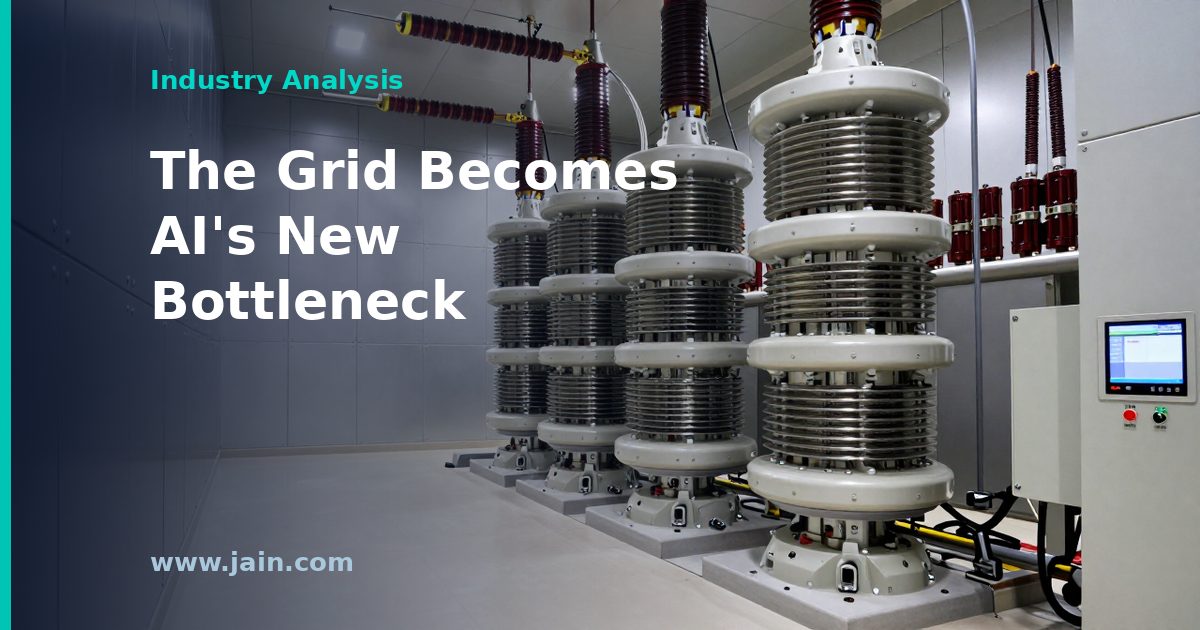
  • HVDC, Not Chips: The Grid Is Now AI’s Binding Constraint

    HVDC, Not Chips: The Grid Is Now AI’s Binding Constraint

    Four strands of coverage circulating in late August 2026 point at the same bottleneck. MarketScale reports that GE Vernova is adding HVDC (high-voltage direct current) capacity as grids work to serve data center demand. The Motley Fool notes that GE Vernova’s electrification revenue jumped 68% in a single quarter on data center deals, then asks why the stock sold off anyway. Benzinga frames a federal grid-security executive order as a reason to watch power-equipment ETFs, naming Eaton among the exposures. Yahoo Finance argues that Equinix’s AI power-grid push may reshape the investment case for the colocation operator.

    None of these are primary company announcements. The material available here is headline-and-summary level aggregation, so specifics such as project sites, contract values, capital commitments and delivery dates are not established. The 68% electrification figure and the existence of the grid-security order are the two concrete claims carried by the reporting.

    Executive Summary

    Taken together, the four items describe a shift in where AI capacity is actually rationed. For three years the scarce input was the accelerator chip. The reporting here suggests the scarce input is now the ability to energize a site: transmission capacity, interconnection approval, transformers, switchgear and the long-lead grid hardware that sits between a substation and a server hall.

    That matters commercially because the two constraints run on different clocks. Silicon supply responds to fab allocation and can loosen in quarters. Transmission responds to permitting, right-of-way acquisition, utility study queues and heavy-equipment manufacturing, which run in years. A market that can buy chips faster than it can buy amperes will reprice both — upward for anyone holding secured power, downward for anyone holding only land and capital.

    The caveat is equally important. A 68% revenue jump paired with a share-price decline is a reminder that a demand narrative and a shareholder return are separate things. Growth priced in advance is not growth delivered, and a policy order is not a purchase order.

    Why HVDC Suddenly Belongs in a Data Center Conversation

    High-voltage direct current is unglamorous infrastructure that most data center buyers have never had to think about. Conventional grids move alternating current, which is easy to step up and down in voltage but loses meaningful energy over long distances and struggles to link grids that are not synchronized. HVDC converts power to direct current for the long haul, moves it with lower losses, and converts it back at the far end. The converter stations are expensive; the line is efficient. That trade-off only pays when you need to move a large block of power a long way.

    AI campuses have made that trade-off pay more often. The cheapest and most available generation is frequently not where the fiber, the land and the tax abatements are. When local grid headroom is already committed, the choice narrows to building generation on site, waiting in an interconnection queue, or importing power from somewhere with surplus. HVDC is the third option’s enabling technology, which is why a grid-equipment vendor’s converter capacity has become a data center story rather than a utility-engineering story.

    The reporting does not tell us how much capacity GE Vernova is adding, where, or on what schedule. Readers should hold that gap open. Announced capacity in heavy electrical manufacturing is a multi-year commitment, and the difference between a stated expansion and a commissioned production line is the part that determines whether 2028 projects get energized on time.

    A 68% Jump and a Stock That Fell

    The most quantified claim in the set is the 68% single-quarter increase in GE Vernova’s electrification revenue, attributed to data center deals. That is a large number for a business selling physical grid hardware, and it is the clearest available evidence that AI demand has genuinely reached the equipment layer rather than remaining a slide in a keynote.

    The share-price reaction is the more instructive part. Equity markets price the delta against expectations, not the absolute level, so a headline growth rate can coexist with disappointment on gross margin, order intake, backlog conversion, guidance or free cash flow. Heavy electrical equipment is a business where revenue recognized today reflects orders taken years ago, and where growth funded by capacity expansion consumes cash before it produces it. A selloff on a strong revenue print is a legitimate signal that investors are asking about the quality and durability of that growth, not merely its speed.

    The even-handed read is that the coverage poses the question and does not resolve it. Without segment margin, book-to-bill and guidance detail, neither the bullish framing (structural demand shift) nor the bearish framing (peak expectations) is settled by what is on the page.

    Equinix and the Move From Grid Customer to Grid Participant

    The Equinix item describes a colocation operator pushing further up the power stack. Colocation providers have historically bought power as an input and sold space, cooling and interconnection as a product. If power access becomes the genuinely scarce good, then procurement strategy, grid relationships and the ability to bring energized megawatts to market become the differentiator rather than a back-office function.

    That is a plausible strategic logic, and the Yahoo Finance framing is appropriately conditional about it. It also cuts both ways for investors. Moving upstream raises capital intensity, lengthens payback, and imports execution risk from a domain — utility-scale power development — with a different risk profile than leasing cabinets. A REIT-like cash flow profile and a developer-like capital profile are not the same investment, and shifting between them deserves scrutiny rather than applause.

    For enterprise buyers, the practical implication is simpler and more immediate. If your provider is competing on secured power, then power terms belong in the contract discussion alongside space, cross-connects and SLAs.

    Policy as a Demand Signal, Not a Booked Order

    The Benzinga piece reads a federal grid-security executive order as a reason to watch power-equipment ETFs, with Eaton cited among the exposures. Policy attention to grid security is a reasonable thing for the sector to track: reliability and security mandates historically pull forward spending on protection, monitoring, transformers and switchgear, and they can shift permitting posture.

    The claim deserves the same scrutiny as any vendor claim. An executive order sets direction; it does not by itself appropriate money, complete a rate case, or sign a contract. Utility capital spending is approved by regulators on multi-year cycles, and equipment revenue follows funded, permitted projects. The gap between a policy signal and a delivered order is measured in quarters at best. We have not reviewed the order’s text here, so its scope, funding mechanism and enforceability remain unverified in this analysis.

    Framed carefully, the four items are consistent with a real structural story — grid capacity is the gating factor on AI buildout — while none of them individually establishes its magnitude. That distinction is worth preserving as the narrative gets repeated.

    Background

    GE Vernova was separated from General Electric in 2024 as a standalone energy company covering power generation, wind and electrification equipment. Its electrification segment sells the physical apparatus of the grid: transformers, switchgear, protection systems and HVDC converter technology. HVDC itself is decades-old utility technology, long used for subsea links and cross-region transfers, and supplied globally by a small group of manufacturers. What is new is the demand source. Grid hardware has historically tracked slow-moving utility capital cycles rather than the compressed schedules of technology buildouts.

    Equinix is one of the world’s largest colocation and interconnection operators, running data centers where enterprises, cloud providers and networks exchange traffic. Its traditional business sells space, power, cooling and connections between tenants. As AI training and inference clusters have pushed campus power requirements upward, the industry’s binding constraint has migrated from real estate and fiber toward electricity delivery, which is why colocation operators, equipment vendors and policymakers now appear in the same story.

    Source: GE Vernova is adding HVDC capacity as grids scramble to serve data centers — MarketScale reporting on GE Vernova’s HVDC expansion, read here alongside related coverage from The Motley Fool, Benzinga and Yahoo Finance.
  • Schneider Electric: India Data Center Growth Now Outpaces Its Core Business

    Schneider Electric: India Data Center Growth Now Outpaces Its Core Business

    Reuters reported on May 24, 2026 that Schneider Electric — the French energy-management and industrial-automation group — says its data center business in India is now growing faster than its core business, propelled by the country’s AI-driven data center buildout. The comment positions India as one of the standout markets in a global surge of demand for the electrical equipment that powers AI computing.

    Executive Summary

    The substance of the report is a growth signal, not a contract or a capacity announcement: Schneider Electric, one of the world’s largest suppliers of the switchgear, uninterruptible power supplies (UPS — the battery-backed systems that keep servers running through grid disturbances), and power-distribution equipment that data centers depend on, says demand from India’s data center sector is expanding faster than the rest of its business there.

    That matters for two reasons. First, it is a read on where the AI infrastructure wave is spreading: hyperscale-style demand is no longer confined to the United States and a handful of established hubs. Second, it comes from the supply side. Data center operators announce ambitions; equipment vendors see purchase orders. When a major electrical supplier says one segment is outgrowing everything else it does in a market, that is a comparatively hard signal that capital is actually being spent.

    The caveat is proportionality: “outpacing core growth” describes a rate, not a size, and the report as available does not quantify either. A fast-growing segment can still be a small one.

    The AI Boom Is Really an Electrical Equipment Boom

    Every AI data center is, underneath the servers, an electrical engineering project. Racks of AI accelerators draw several times the power of conventional servers, and that power has to be received from the grid, transformed, distributed, conditioned, and backed up — all with equipment from a fairly short list of global vendors, of which Schneider Electric is one of the largest alongside the likes of ABB, Siemens, Eaton, and Vertiv. This is why the AI cycle has been felt so strongly by electrical suppliers: compute demand converts almost directly into orders for switchgear, transformers, UPS systems, busway, and cooling infrastructure.

    Schneider’s India comment extends a pattern the industry has watched for two years in the US and Europe: the constraint on AI capacity is increasingly power delivery, not chips alone. When equipment vendors describe data centers as their fastest-growing segment in a new geography, it signals that the buildout — and potentially the associated equipment lead-time pressure — is going global.

    Why India Is the Market to Watch

    India combines several ingredients that data center investors look for: a very large and growing base of internet users, data-localization rules that encourage storing Indian data in-country, comparatively low construction costs, and government interest in domestic AI capability. Global cloud providers and regional operators have all announced Indian expansion in recent years, concentrated around hubs such as Mumbai, Chennai, and Hyderabad.

    For an equipment vendor, India offers something else: Schneider Electric has a long-established manufacturing and commercial presence there, so local data center demand can be served substantially from local operations. If AI-driven orders are now growing faster than the company’s traditional Indian business — which spans buildings, industry, and grid infrastructure — it suggests the data center segment is becoming a structural growth pillar rather than a side market.

    Supply-Side Signals Deserve Attention — and Context

    It is worth being precise about what this report does and does not establish. A vendor saying a segment is “outpacing core growth” is a directional claim about relative growth rates. As reported, it does not disclose the segment’s revenue, its share of Schneider’s India business, order backlog, or a forecast horizon. Growth from a small base can outpace a large core for years without changing the overall business mix, so the claim is credible but not yet quantified in the material available.

    It is also a statement any vendor has an interest in making during an AI investment cycle: data center exposure is currently rewarded by investors. That does not make the claim wrong — Schneider’s global results through this cycle have consistently shown genuine data center strength — but buyers and investors should look for the numbers behind the narrative when the company next reports segment detail. For data center operators, the practical takeaway is less about Schneider specifically and more about the market it describes: if India’s buildout is accelerating, competition for equipment, grid connections, and skilled electrical contractors in that market will accelerate with it.

    Background

    Schneider Electric traces its roots to 1836 in France and has evolved from heavy industry into a global leader in energy management and automation. Its data center relevance deepened with the 2007 acquisition of APC, a leading UPS maker, and the company now supplies integrated power, cooling, and management systems to hyperscale and colocation operators worldwide. Throughout the current AI investment cycle, data centers have been among the strongest demand drivers across the electrical equipment industry.

    India’s data center market has expanded rapidly since the country’s 2020s push on data localization and digital infrastructure, attracting investment from global cloud providers and domestic operators alike. The AI wave has added a second demand layer on top of that cloud-driven growth, with power availability widely viewed as the buildout’s key constraint.

    Source: Schneider Electric sees India data center business outpacing core growth on AI boom — Reuters, reporting the company’s comments on AI-driven data center demand in India, May 24, 2026.

  • CSIS: Tariffs Reshape AI Data Center Supply Chains

    CSIS: Tariffs Reshape AI Data Center Supply Chains

    The Center for Strategic and International Studies (CSIS), a Washington policy think tank, published an analysis titled The Impact of Tariffs on the AI Data Center Buildout: Balancing Supply Chain Security and AI Infrastructure Leadership. The piece frames tariffs as a policy lever that simultaneously shapes national supply chain security and the pace at which the United States can build out AI computing capacity.

    The item surfaced on May 14, 2026 via Google News; the underlying CSIS piece is a policy commentary rather than a corporate announcement, and the summary text available in the feed is limited to the headline framing.

    Executive Summary

    CSIS is putting a name on a tension operators have been living with for the last two years: every dollar of import duty on transformers, switchgear, servers, optics, or steel lands somewhere in the AI buildout stack, and the industry cannot simply absorb it without slipping schedules or raising the price of compute. The think tank frames the debate as balancing supply chain security — reducing dependence on adversary-linked components — against AI infrastructure leadership, which depends on cheap, fast, at-scale construction.

    For data center operators, hyperscalers, and their financiers, the analysis matters less for any single recommendation than for how it reframes tariffs as an input cost in AI economics rather than a purely trade-policy story. That reframing is where the interesting business questions start: who pays, who reshores, and whose megawatt timeline slips.

    Tariffs Become an AI Infrastructure Input Cost

    An AI data center is, in bill-of-materials terms, a stack of tariff-exposed goods: grain-oriented electrical steel for transformers, medium-voltage switchgear, generators, chillers, structural steel, copper busway, fiber optics, and the GPU-laden servers themselves. When tariffs move, they move all of those line items unevenly, and the cost does not stay with the importer — it flows into the price per kilowatt of built capacity and, ultimately, into the price of AI inference and training. CSIS’s contribution is to name that pass-through explicitly, treating tariff policy as industrial policy for compute.

    The economics are unforgiving because AI campuses are being sized in gigawatts rather than megawatts. A ten-percent adjustment on a niche component can add tens of millions of dollars to a single site and, more importantly, add months to a schedule if a domestic substitute does not yet exist at the volumes required.

    Supply Chain Security Versus Time-to-Power

    The security case for tariffs is straightforward: reduce dependence on suppliers in jurisdictions whose interests may diverge from the buyer’s, and rebuild domestic capacity in categories — transformers most visibly — where lead times have already blown out to multiple years. The leadership case cuts the other way: the country that stands up usable AI capacity fastest gets the workloads, the talent, and the downstream services revenue. Tariffs that protect a future domestic supplier can, in the interim, slow the very buildout they are meant to secure.

    Operators have limited tools to navigate that gap. They can pre-buy long-lead equipment, sign multi-year framework agreements, qualify additional vendors, or shift build sequencing so that tariff-heavy components sit on the critical path as briefly as possible. None of these are free, and all of them favor the largest balance sheets.

    Winners, Losers, and Who Actually Pays

    In a tariff-heavy regime, the clearest winners are domestic manufacturers of the constrained categories — transformer makers, switchgear producers, and any server integrator with a qualified US assembly footprint. Hyperscalers with the cash and forecasting horizon to lock in supply years ahead are relative winners too, because scarcity favors those who ordered first. The clearest losers are smaller colocation operators and enterprise buyers who arrive later in the queue and pay both the tariff-inflated price and the scarcity premium on top.

    The subtler question is whether tariffs accelerate domestic capacity enough, and fast enough, to matter. Factory build-outs for heavy electrical gear are themselves multi-year projects; a tariff imposed today does not deliver a domestic transformer tomorrow. If demand-side AI growth outruns supply-side reshoring, the net effect is higher costs without the intended security dividend.

    Background

    The US AI data center buildout has moved from a specialist infrastructure story to a macroeconomic one over the past two years, with hyperscalers and specialty developers committing to gigawatt-scale campuses and long-lead procurement of power equipment. At the same time, US trade policy has expanded the use of tariffs across categories relevant to that buildout, from steel and electrical equipment to semiconductors and finished electronics.

    Think tanks including CSIS have increasingly treated data center supply chains as a national-security topic rather than a purely commercial one, arguing that where and how compute capacity is built has strategic consequences comparable to earlier debates over telecom and semiconductor manufacturing.

    Source: The Impact of Tariffs on the AI Data Center Buildout: Balancing Supply Chain Security and AI Infrastructure Leadership – CSIS — policy analysis from the Center for Strategic and International Studies on how tariff policy shapes the cost, pace, and security of US AI infrastructure buildouts.