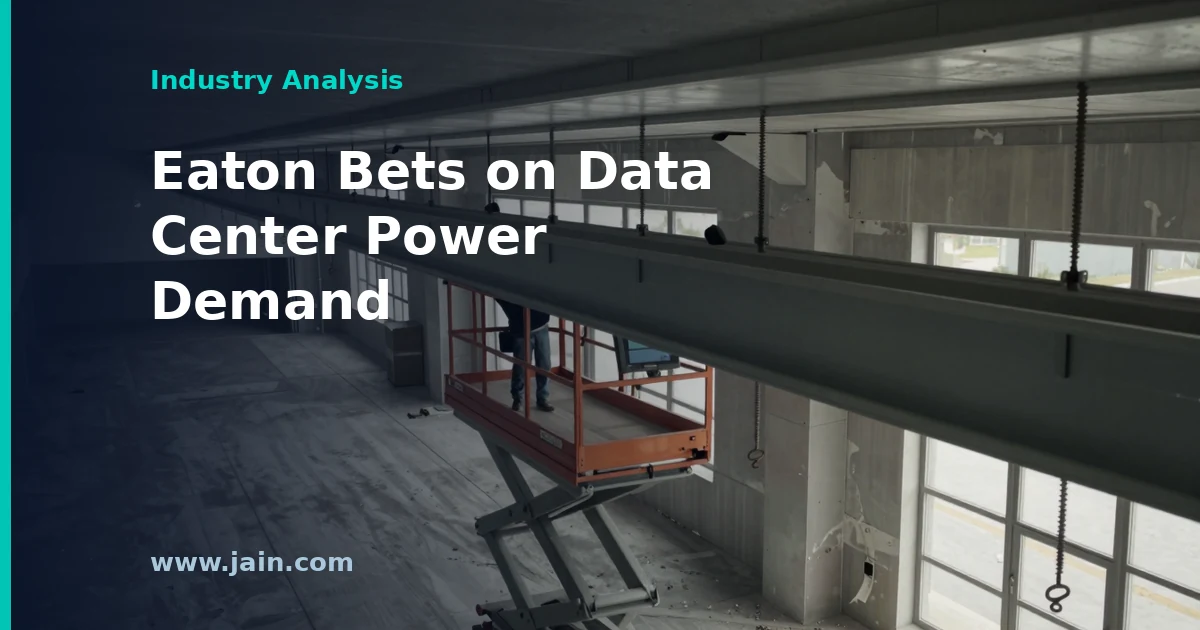
Eaton, a long-established maker of the equipment that moves electricity safely through buildings, says its best years are still ahead.
The reason is data centers: the giant warehouses of computers behind apps, online search and chatbots. Each one needs enormous amounts of electricity switched, routed and backed up in case the power fails, and Eaton sells much of that equipment.
The companies supplying the wiring behind the artificial intelligence boom can profit no matter which tech giant wins. The big open question is how long the building spree lasts.
Yahoo Finance reported that Eaton Corporation (NYSE: ETN), the power management company, sees its best years ahead, with demand from data centers powering its growth. The outlook ties Eaton’s trajectory directly to the electrical infrastructure needed by the facilities that run cloud computing and artificial intelligence (AI) workloads.
Executive Summary
Eaton is signaling confidence that data center construction will drive growth beyond anything in its recent history. The company makes the electrical backbone of these facilities: switchgear that routes and protects high-voltage power, uninterruptible power supplies (UPS) that keep servers running through outages, and power distribution units that deliver electricity to server racks.
The outlook matters because it points to where AI spending ultimately lands. Chips and cloud platforms get most of the attention, but every new data center hall needs power equipment before a single server can be switched on. That puts electrical suppliers among the most direct beneficiaries of the buildout, whichever chipmaker or cloud provider comes out ahead.
A forward-looking claim is not a result, though. A “best years ahead” view depends on data center spending staying strong, on Eaton’s ability to manufacture enough equipment, and on customers securing the grid power they need to finish their projects.
Selling Picks and Shovels for the AI Power Crunch
A data center is, at its core, a building that turns electricity into computation. Power arrives from the utility at high voltage, then passes through transformers, switchgear, backup systems and distribution equipment before it reaches the servers. Each stage is a purchase, and Eaton competes in many of them.
This is the classic picks-and-shovels position. Eaton does not need to predict which AI model, chip architecture or cloud provider will dominate. It needs data centers to keep getting built, and it needs those facilities to keep drawing more power. The industry trend toward denser server racks, where more computing and more electricity are packed into the same floor space, tends to raise the amount of electrical equipment each facility requires.
That makes the claim structurally credible. Unlike speculative software revenue, electrical infrastructure is a physical requirement: a facility cannot operate without it, and none of it can be skipped to save money.
Why Electrical Gear Holds Its Value
Power distribution equipment is often engineered to order, has to meet strict safety and reliability standards, and must be qualified by operators before it goes into a live facility. Large data center operators tend to standardize designs across many sites, so a supplier that wins a place in a reference design can see repeat orders as the design is rolled out.
Those features give incumbents such as Eaton real advantages over new entrants. They also help explain why established rivals, including Schneider Electric, Vertiv, ABB and Siemens, are chasing the same demand. The market is large enough to lift several suppliers, but competition over pricing, delivery slots and new designs will likely sharpen as manufacturing capacity catches up.
For data center developers, the practical result has been a supplier’s market for critical electrical equipment. Buyers who reserve manufacturing capacity early are generally better placed than those who order once a site is ready to build.
The Risks Beneath a Bullish Outlook
The most obvious risk is concentration. If much of Eaton’s growth depends on a few very large buyers of data center capacity, a slowdown in their capital spending would show up quickly in new orders. Infrastructure booms have historically been followed by periods of digestion, when customers pause to absorb capacity they have already built.
A less obvious risk is power itself. In many markets, data centers are limited less by equipment than by how quickly utilities can connect them to the grid. If projects stall while waiting for electricity, orders for the gear that distributes that electricity can slip too. Eaton’s fortunes are therefore tied partly to utility and grid timelines it does not control.
Execution matters as well. Meeting surging demand requires factory expansion, skilled labor and reliable component supply. Growth that outpaces manufacturing capacity can lead to delivery delays that push customers toward competitors.
What It Means for Buyers and Investors
For data center operators and developers, a supplier this confident in demand is a signal to lock in procurement early and to qualify more than one vendor for critical equipment. Lead times and pricing are likely to remain a negotiation shaped by how tight the market stays.
For investors, Eaton’s outlook reinforces the view that power infrastructure is one of the more direct ways to gain exposure to the AI buildout. The durability of that thesis rests on the questions below: how much demand is actually contracted, and how long it lasts.
Background
Eaton Corporation is a long-established industrial company that has repositioned itself around power management. Its electrical business makes the equipment that carries electricity from the utility connection to the point of use, including switchgear, uninterruptible power supplies, power distribution units and related controls. The company also serves the aerospace, vehicle and industrial markets, and it trades on the New York Stock Exchange as ETN.
Data centers have become one of the most important markets for electrical equipment suppliers. The spread of cloud computing, and more recently the rapid growth of AI, has driven large technology companies and data center developers to build bigger, more power-hungry facilities. That has strained both equipment supply chains and utility grids, turning electrical infrastructure from a background purchase into a strategic bottleneck.
The Swiss engineering group ABB and the consultancy Boston Consulting Group published a report saying the electricity inside data centers should increasingly flow the way it does in a battery, not the way it does in a wall socket.
Computers, solar panels and batteries all run on that kind of power already. Every time electricity is converted from one form to the other, a little is lost as heat, like a phone charger warming up.
Artificial intelligence machines use so much power that those small losses now add up to real money and real capacity.
ABB sells the equipment, so it has a stake in the argument.
ABB said on September 9 that it has published The Strategic Case for Hybrid AC/DC Power: Shaping the Transition to the Next Electrical Architecture, a report developed with Boston Consulting Group. The Zurich-headquartered electrification and automation group argues that direct current, or DC, is moving from the periphery to the center of industrial, commercial and digital infrastructure, and that choices made by executives and policymakers over the next two to three years will decide who shapes the transition and who simply inherits it.
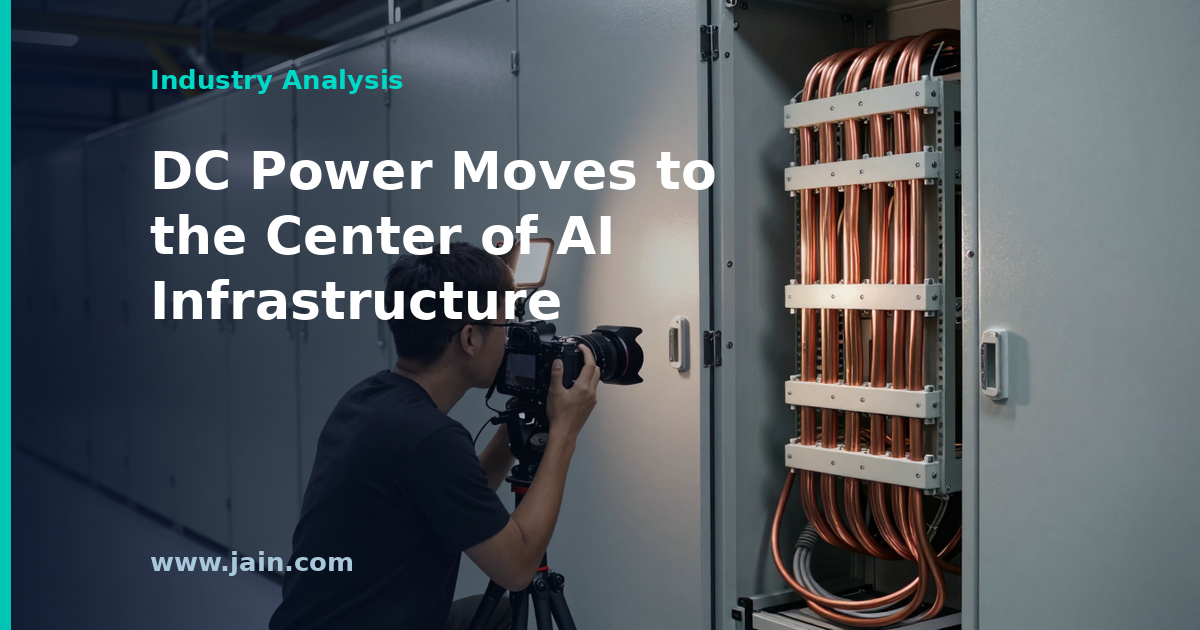
The report singles out AI data centers as one of the most immediate drivers of DC adoption, finding that 800-volt DC distribution is emerging as the defining architecture for next-generation AI infrastructure. It frames the outcome not as a contest between DC and alternating current, or AC, but as a hybrid system: AC remains the backbone of transmission and regional distribution, while DC spreads inside facilities where the major sources and loads already run natively on it.
Executive Summary
The argument rests on a piece of electrical plumbing that most people never see. Grids deliver alternating current, in which the flow reverses direction many times a second, because that form is cheap to push over long distances and easy to step up and down in voltage with transformers. Almost everything now growing fastest, though, is natively direct current: solar photovoltaic panels, batteries, electric vehicles, industrial automation gear and the graphics processors inside AI servers. Each handoff between the two forms runs through a converter, and each converter throws off a percentage of the energy as heat.
ABB and BCG contend that stripping conversion steps out of the chain does three things at once: it raises efficiency, it increases the usable compute capacity behind an existing grid connection, and it simplifies the integration of on-site generation and storage. That middle point is the commercially interesting one. In markets where new grid capacity is the scarce input, an efficiency gain converts directly into more revenue-generating hardware behind the same meter.
The report also reframes the obstacle. Concerns about DC at scale, its safety and its economics reflect outdated assumptions rather than the capabilities of current equipment, ABB and BCG conclude. What actually slows deployment, they say, is fragmented standards and a shortage of engineers and technicians trained on DC systems. That is a claim about institutions and labor markets rather than about physics, and it points to a slower, less predictable fix.
Why AI Racks Are Rewriting the Electrical Diagram
Conventional data center power design has been remarkably stable for two decades. Utility alternating current arrives at a substation, passes through switchgear, an uninterruptible power supply and a power distribution unit, then reaches a server whose internal supply finally converts it to the low-voltage direct current the chips actually consume. Each stage was tolerable when a rack drew a few kilowatts. The report’s contention is that at AI power densities, conventional architectures are reaching practical limits, and the accumulated conversion overhead stops being a rounding error.
The 800-volt DC figure is the specific technical claim worth understanding. Raising the distribution voltage lets a given amount of power travel through thinner conductors, because power is voltage multiplied by current and it is current that dictates copper cross-section and resistive heating. Delivering high-density racks at low voltage means either enormous busbars or unacceptable losses. Pushing distribution to 800 volts DC and converting close to the load is the same trick the automotive industry adopted for fast-charging electric vehicles, applied to a data hall.
The practical consequence is that the change does not stop at the rack. It touches switchgear, protection, uninterruptible power supply topology, on-site storage and the interface with the substation. That is a supply-chain shift as much as an engineering one, and it favors vendors who already hold the protection and conversion portfolios.
The Real Prize Is the Grid Connection
Read commercially, the strongest line in the release is not about efficiency in the abstract. It is that DC distribution lets operators maximize compute capacity within constrained grid connections. In the markets where AI capacity is being built hardest, the binding constraint is rarely capital or land. It is the megawatts a utility will actually deliver, and when they will deliver them.
Under that constraint, the economics change character. An efficiency improvement in a power-abundant market is a cost saving measured against the electricity bill. The same improvement behind a fixed, fully subscribed grid connection is a capacity unlock, measured against the revenue of the additional accelerators it lets you energize. Those two framings can differ by an order of magnitude in value, which explains why an argument about conversion losses is landing now rather than a decade ago.
It also explains the report’s two-to-three-year window. Electrical architecture is set early in a data center’s design and is expensive to revisit. Operators committing to buildings that will be energized late this decade are choosing their topology now, which is precisely when a vendor wants the conversation to happen.
Standards and Skills Are the Stated Bottleneck
ABB and BCG place the constraint on adoption in two unglamorous places: fragmented standards and a shortage of DC-specific skills. Both are credible. Direct current has no natural zero crossing, the instant of zero flow that lets a conventional breaker extinguish an arc, which is why DC protection historically demanded different hardware and different design practice. ABB says it launched the industry’s first solid state circuit breaker in 2022, and holds more than 700 DC-related patents.
That patent position is also why the call for harmonized standards deserves to be read with clear eyes. Common standards genuinely enlarge a market and reduce buyer risk, and buyers should want them. They also tend to reward whoever arrives with the deepest existing portfolio in the standardized technology. Nothing about that is improper, and ABB is not alone in it, but a customer evaluating this report should treat it as a well-argued position paper from an interested party rather than as neutral market research.
The skills point may be the more stubborn of the two. Standards can be negotiated on a schedule. A workforce of electricians, commissioning engineers and facility staff fluent in high-voltage DC protection is built over years, and its scarcity would constrain even operators fully convinced by the argument.
What Is Substantiated and What Is Asserted
The quantified evidence in the announcement is drawn from marine propulsion, where ABB says a DC-based onboard vessel power system achieved fuel savings of up to 27 percent. That is a real, specific result, and it is not a data center result. Ships run isolated power systems with variable-speed loads and their own economics; the number establishes that ABB has long-running DC field experience, not that a data hall should expect a comparable gain.
For the data center case itself, the announcement offers direction rather than magnitude. It says 800-volt DC is emerging as the defining architecture and that efficiency and usable capacity improve, without published percentages, capital-cost comparisons or named deployments in the summary. The conclusion that scale, safety and economic objections are now outdated is likewise stated as a finding, with the supporting analysis sitting in the full report published on ABB’s site.
None of that undercuts the thesis, which aligns with where high-density computing and on-site storage are visibly heading. It does mean the announcement is best treated as a framing document. The buyer’s question is not whether DC distribution helps, but by how much, at what installed cost premium, and with which protection and service ecosystem behind it.
Background
The choice between alternating and direct current was settled commercially in the late nineteenth century, when transformers made it cheap to step alternating voltage up for long-distance transmission and back down for use. Direct current never disappeared, though. It survived in specialist niches such as long submarine transmission links, traction systems and shipboard power, and it returned quietly through the back door as solar panels, batteries and electronics proliferated, each of them a direct current device tethered to an alternating current grid through a converter.
ABB sits on both sides of that history as one of the largest electrification and automation suppliers globally, selling switchgear, drives, protection and power distribution equipment into utilities, industry and data centers. The AI buildout has made its data center segment strategically prominent, because the constraint on new compute has shifted from chips and capital toward electrical delivery. This report, produced with Boston Consulting Group, is the company’s argument that the resulting architecture will look meaningfully different from the one the industry has built for the past twenty years.
Research firm MarketsandMarkets said on August 28, 2026 that the global laminated busbar market will grow from USD 1.13 billion in 2026 to USD 2.13 billion by 2035, a compound annual growth rate (CAGR) of 7.3%. The firm puts the 2025 base at USD 1.02 billion and covers the years 2022 through 2035 in a 295-page report containing 195 data tables and 75 figures.
Within that forecast, North America is called the fastest-growing region at a 7.8% CAGR, Europe the second-largest region overall. Copper led by conductor material in 2025 and polyester by insulation material, while polyimide insulation is projected to grow fastest at 9.7%. Switchgear and power distribution was the largest application segment in 2025; utilities and grid infrastructure accounted for 20.6% of the market by end-user industry. Named suppliers include Amphenol, Methode Electronics, Mersen, Rogers, Sun King Technology Group, Zhuzhou CRRC Times Electric and Ryoden Kasei.
Executive Summary
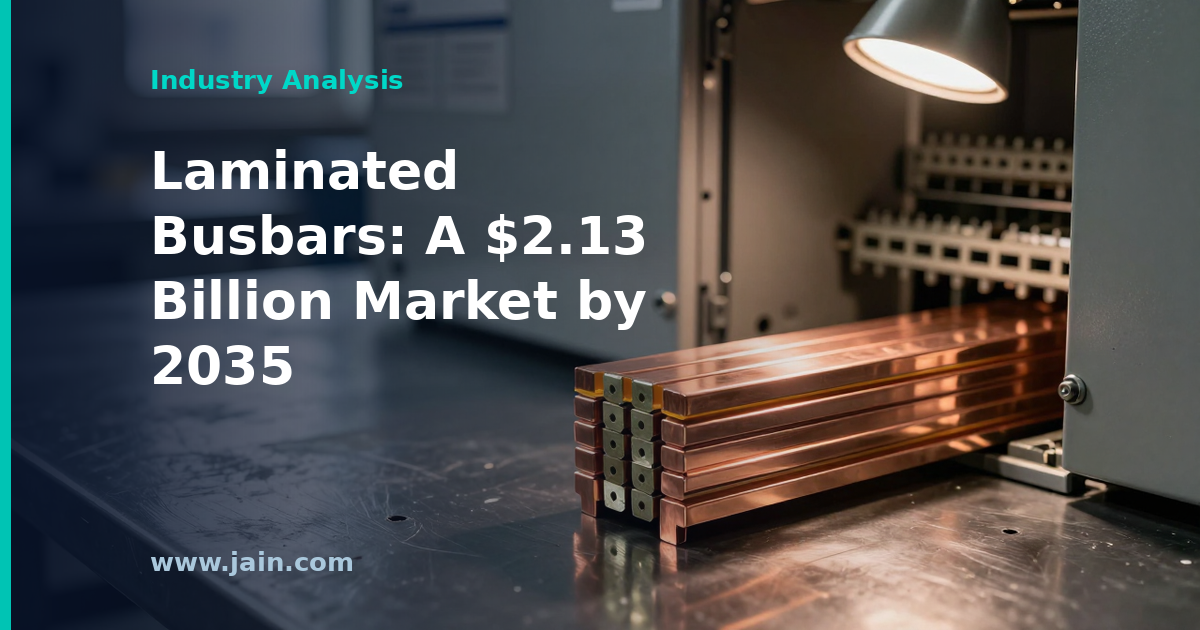
A laminated busbar is not a glamorous product. It is a stack of flat copper or aluminium conductors separated by thin insulating film and bonded into a rigid sandwich, used in place of a bundle of cables to carry current between power-electronic components. Because the conductors sit close together in parallel planes, the assembly has very low inductance — meaning it resists sudden changes in current far less than a cable loop does — which lets switching devices run faster and cooler. That physics is why the part is quietly becoming a design constraint rather than a catalogue purchase.
The headline forecast is a near-doubling of a small market: roughly $1 billion today to roughly $2 billion in a decade. The more interesting content sits in the segment detail. The above-3,000-amp current-rating band is projected to grow at 8.3%, faster than the market as a whole, and polyimide — a high-temperature insulating film used where polyester film would soften — at 9.7%. Both are thermal signals. They say that a growing slice of demand is coming from equipment running hotter and harder than the average installed base.
For infrastructure buyers, the practical reading is about supply relationships rather than market size. The release describes a shift toward co-engineered busbars designed around a specific customer’s mechanical layout, which converts a commodity part into a single-sourced, tooling-bound component with real switching costs. That is a procurement and continuity question worth asking before the part is designed in, not after.
The Conductor Becomes a Design Decision
The economic argument for a laminated busbar has always been assembly, not electricity. Replacing a hand-built harness of cables, lugs and terminals with one bonded plate removes labour hours, removes the variance between one technician’s build and the next, and removes the tolerance stack-up that makes high-volume electrical assembly expensive to test. The release frames this directly: manufacturers want solutions that simplify assembly, improve consistency and use space efficiently. In a factory producing thousands of identical power converters, repeatability is worth more than copper savings.
The second argument is electrical, and it is the one that scales with power density. Parallel plate geometry cancels much of the magnetic field between the conductors, cutting stray inductance. Lower inductance means lower voltage overshoot when a semiconductor switches off, which means the designer can either switch faster, run at higher voltage, or specify a smaller and cheaper device for the same job. As silicon carbide and other wide-bandgap semiconductors push switching frequencies up, the interconnect stops being neutral plumbing and starts setting the ceiling on what the rest of the design can do.
That is the structural reason a low-single-digit-billion component market is worth watching from an infrastructure seat. The busbar is a small line item that gates the performance of a much larger one. Buyers who treat it as a commodity late in the design cycle tend to discover the constraint at thermal validation, when changing it is most expensive.
What the Forecast Actually Supports
The arithmetic is internally consistent: $1.13 billion compounding at 7.3% over the nine years to 2035 does land near $2.13 billion, so the headline is not a rounding artefact. The segment CAGRs are also coherent with each other — high-current, high-temperature and North American growth all running above the blended rate is the pattern you would expect if electrification and power-electronics density are the underlying drivers.
Two things are worth flagging plainly. First, the step from the stated 2025 base of $1.02 billion to $1.13 billion in 2026 is about 10.8% growth, noticeably above the 7.3% rate forecast for the following decade. That implies a near-term acceleration followed by moderation, which may well be the firm’s considered view, but the release does not explain it. Second, the release names an application segment — EV chargers — as the fastest-growing, but gives the window as 2026–2031 in the subheading and 2026–2035 in the body. One of those is a typographical slip; a reader cannot tell which, and the two imply different demand curves.
None of this makes the forecast wrong. It makes it unverifiable from the material provided, which is the normal condition for a press release whose function is to sell a 295-page report. The honest position is that the segment mix is a plausible and useful directional signal, and the specific dollar figures are a vendor estimate that no reader can independently reconstruct.
Above 3,000 Amps: Reading the Thermal Signal
The single most informative number in the release may be the 8.3% CAGR attached to the above-3,000-amp current-rating band. Very high current at modest voltage is the signature of DC distribution inside dense equipment — battery systems, energy storage, fast-charging stacks, and the low-voltage DC rails that feed racks of processors. Current heats a conductor in proportion to the square of its magnitude, so every step up in amperage makes the conductor’s cross-section, surface area and thermal path a harder problem than the step before it. Polyimide’s projected 9.7% growth points the same way: designers reach for a costlier, higher-temperature film when they have run out of thermal headroom, not when they have plenty.
It is worth being precise about what the release does and does not say here. It does not mention data centres or AI infrastructure anywhere. The named end-user concentration is utilities and grid infrastructure at 20.6% in 2025, with switchgear and power distribution the largest application and EV charging the fastest-growing one. The connection between rising rack power density and high-current busbar demand is an inference drawn from the shared physics and the shared supplier base, not a claim the report makes.
That inference is still worth making, because the constraint travels. Whoever is building 350 kW charging stalls, grid-scale storage inverters and high-current server power shelves is buying from an overlapping pool of copper, polyimide film, lamination presses and press-brake capacity. If charging and storage demand grows at the rates forecast here, data-centre power teams will feel it as lead times and qualification queues in a component category most of them have never had to plan around.
Co-Engineering Rewrites the Supplier Relationship
The release’s clearest strategic claim is that demand is shifting toward co-engineered busbars developed around a customer’s specific mechanical layout, conductor arrangement and insulation requirements, with competition moving to design support, prototyping, testing and production scalability. That description matters more than the market size. A part designed around one enclosure is, in practice, single-sourced. Requalifying a second supplier means new tooling, new dielectric and thermal validation, and often a schedule slip measured in quarters.
The winners in that model are suppliers with engineering staff sitting alongside customer design teams early — which favours incumbents with scale, and the named list spans the US (Amphenol, Methode Electronics, Rogers), France (Mersen), China (Sun King Technology Group, Zhuzhou CRRC Times Electric) and Japan (Ryoden Kasei). The release gives no revenue or share figures for any of them, so the competitive ranking within that group is not established by this material. The losers are generic fabricators competing on price per kilogram of copper, and buyers who let a sole-source dependency form without pricing it.
There is a geographic dimension too. Design-stage collaboration is easier when the supplier is reachable, which is one plausible reason North America is forecast to grow fastest, alongside its build-out of charging and grid equipment. But co-engineering also deepens exposure: a supplier chosen for its engineering depth is harder to replace if tariffs, export controls or a plant outage intervene. The mitigation is unromantic and should happen at design time — dual-qualify where volume justifies it, keep the mechanical interface documented independently of the supplier’s CAD, and price continuity into the award rather than the unit cost alone.
Background
Busbars are the workhorses of electrical distribution: solid conductors that carry current between components where cables would be bulky, lossy or hard to route. Laminated busbars are the engineered end of that category, developed originally for aerospace and traction applications where space, weight and switching performance all mattered at once. They spread into industrial drives, then into electric vehicles, renewable inverters, battery storage and switchgear as power electronics moved to higher voltages and faster semiconductor switching.
MarketsandMarkets is a business-to-business research and growth-consulting firm that publishes syndicated market forecasts across technology and industrial sectors, promoting them through wire releases like this one. Its figures are vendor estimates rather than audited or regulatory data; the value to a general reader lies mainly in the segment structure and directional signals, which should be weighed alongside supplier disclosures and buyers’ own procurement experience.