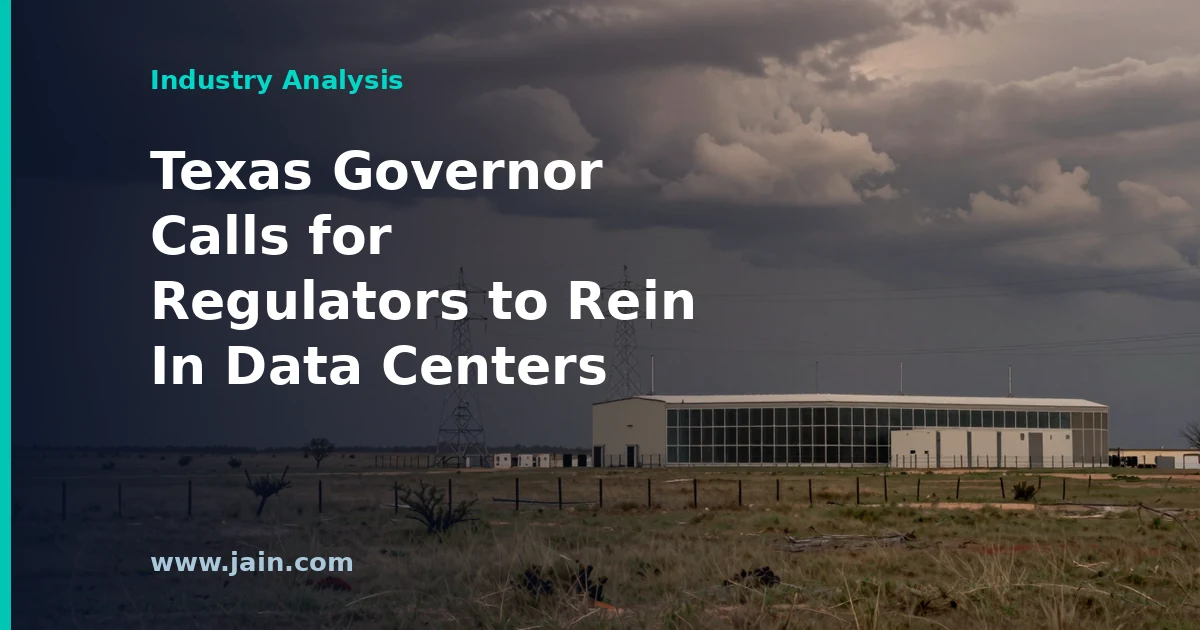
Texas Governor Greg Abbott has publicly called for regulators to clamp down on data centers, according to a June 11, 2026 report from E&E News by POLITICO headlined “Texas governor talks tough on data centers, calls for clampdown.” The remarks signal a potential policy shift in the state that has become one of the largest and fastest-growing data center markets in the United States.
The syndicated report available to us carries only the headline, so the specific mechanisms the governor proposed — and which regulators he addressed — are not detailed in the source material.
Executive Summary
The significance here is less about any single proposal and more about who is speaking. Texas has spent years courting data centers with cheap power, fast permitting, abundant land, and a light-touch regulatory reputation. When the governor of that state “talks tough” and calls for a clampdown, it suggests the political calculus around hyperscale computing growth is changing even in the market most identified with welcoming it.
The pressure has been building. Texas’ independent grid, operated by the Electric Reliability Council of Texas (ERCOT — the body that manages electricity flow for most of the state), has projected enormous demand growth driven heavily by large loads such as data centers. In 2025 the state enacted Senate Bill 6, a law giving regulators new tools to manage very large electricity users, including requirements that they be able to reduce consumption during grid emergencies. Gubernatorial rhetoric about a clampdown, if it translates into rulemaking or legislation, would extend that trajectory.
For the industry, the message is straightforward: even in the most development-friendly major market, social license is not unconditional. Grid reliability, cost allocation, and community impact are now live political issues that developers must plan for rather than assume away.
When the Friendliest Market Turns Cautious
Texas — anchored by the Dallas–Fort Worth metro, one of the largest data center hubs in the world, plus fast-growing clusters in San Antonio, Austin, and West Texas — has been a primary beneficiary of the AI-driven construction boom. Developers chose Texas precisely because its political environment favored speed: deregulated retail electricity, no state income tax, and officials who actively recruited large projects. A governor from that same political tradition calling for a clampdown is therefore a meaningful signal, whatever the eventual policy details turn out to be.
It is worth being precise about what a headline can and cannot tell us. “Talks tough” and “clampdown” are the reporter’s characterizations; the underlying remarks could range from a demand for strict new siting rules to a narrower push for large loads to pay their own way on the grid. Political rhetoric about data centers also does not always convert into binding regulation. But the direction of travel matches a broader national pattern in 2025–2026: statehouses in both parties’ hands have moved from recruiting data centers to scrutinizing them.
The Grid Is the Battleground
The most likely driver is electricity. ERCOT has repeatedly flagged that large flexible loads — data centers, crypto miners, industrial electrification — are the dominant source of projected demand growth, on a grid that already suffered a catastrophic failure during Winter Storm Uri in 2021. Every gigawatt of new computing load raises two politically sensitive questions: can the grid stay reliable, and who pays for the transmission and generation needed to serve it?
Texas’ 2025 Senate Bill 6 was the first major answer, imposing interconnection requirements on very large loads and enabling their curtailment (mandatory reduction of power use) in emergencies. A gubernatorial call for further clampdown suggests officials may view those tools as insufficient — or at least politically insufficient — as residential ratepayer concerns about rising bills and water use gain traction. For an industry whose product is uptime, curtailment obligations and slower interconnection are direct commercial threats, which is why many operators are already investing in on-site generation and storage to reduce their grid dependence.
Winners, Losers, and the Cost of Uncertainty
If Texas tightens meaningfully, the near-term losers are speculative developers whose pipeline value depends on fast, cheap grid connections. Established operators with secured power and existing interconnection agreements arguably benefit, since barriers to entry protect incumbents. Utilities and grid operators gain leverage to demand stronger financial commitments from data center customers, reducing the risk that infrastructure is built for projects that never materialize — a growing concern given inflated interconnection queues nationwide.
Competing markets should temper their enthusiasm, though. Rival states may market themselves as alternatives, but most face their own power constraints, and Texas’ fundamental advantages — land, energy resources, and scale — do not disappear because of tougher rules. The more realistic outcome is not an exodus but a repricing: longer timelines, more self-supplied power, and heavier upfront commitments becoming the standard cost of building in Texas. For buyers of data center capacity, that ultimately flows into pricing and delivery schedules.
Background
Texas rose to the top tier of global data center markets over the past decade on the strength of cheap and abundant energy, available land, fast permitting, and active state recruitment. The AI construction boom that accelerated from 2023 onward magnified that growth, with hyperscale campuses proposed across the Dallas–Fort Worth area, Central Texas, and West Texas — and with them, unprecedented projected demand on the ERCOT grid, which operates independently of the two large interconnections serving the rest of the continental U.S.
The politics shifted as the load forecasts grew. After the deadly 2021 winter blackout exposed the grid’s fragility, Texas lawmakers grew warier of unmanaged demand growth, culminating in 2025’s Senate Bill 6, which created a regulatory framework for very large electricity users. The governor’s June 2026 call for a clampdown, as reported by E&E News, suggests that framework may have been a starting point rather than a settlement.
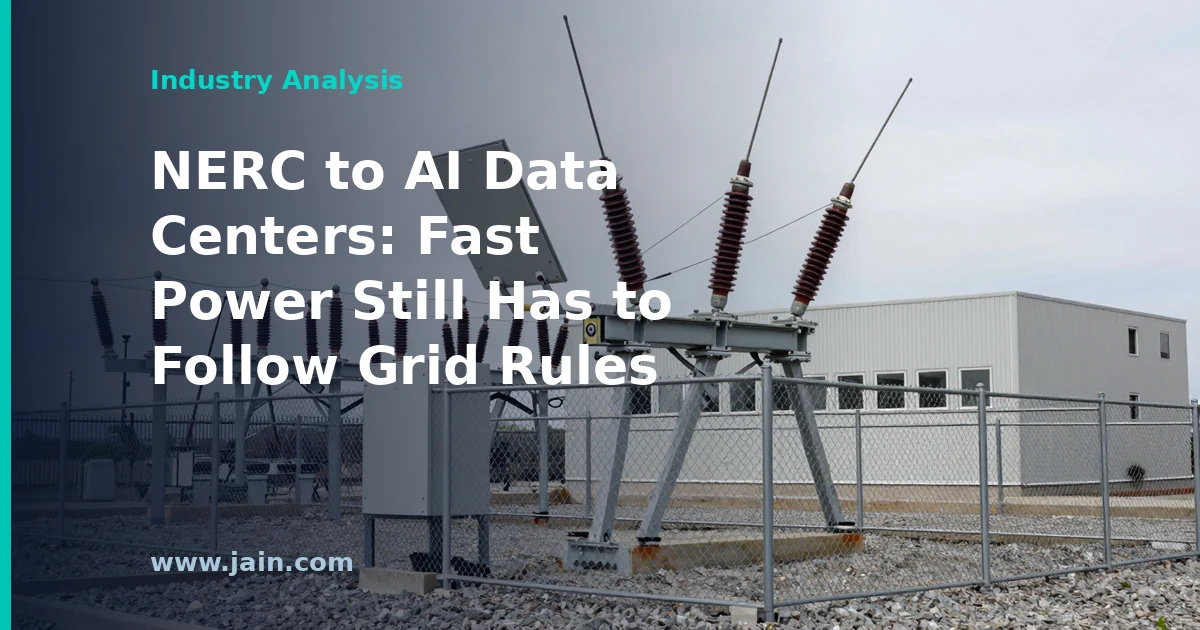
Politico reported on May 30, 2026 that the North American Electric Reliability Corporation (NERC) — the body that writes and enforces mandatory reliability rules for the continent’s bulk power grid — is pushing back on AI companies demanding rapid grid connections for their data centers. The message from the grid’s gatekeeper, per the report’s framing: the newest and hungriest class of electricity customers needs to learn the rules that everyone else on the grid already plays by.
Executive Summary
The AI buildout has turned electric power into the binding constraint on data center construction, and companies that once measured competition in chips now measure it in megawatts and interconnection dates. Politico’s report captures the resulting collision: AI developers want grid connections on startup timelines, while NERC — an organization most people outside the utility industry have never heard of — insists that speed cannot come at the expense of the engineering discipline that keeps the lights on.
It matters because NERC is not a lobbying group or a trade association. It is the FERC-certified reliability regulator for the bulk power system, and its standards carry legal force for the utilities and grid operators who would actually plug these data centers in. When NERC signals that giant new loads deserve closer scrutiny, that posture propagates into utility study processes, interconnection agreements, and ultimately into how fast — and under what conditions — AI capacity gets energized.
The Grid’s Gatekeeper Steps Into the AI Boom
NERC occupies an unusual position in American infrastructure: a not-for-profit corporation whose reliability standards are mandatory and enforceable, with penalty authority, under oversight from the Federal Energy Regulatory Commission. Its job is narrow but existential — keep the bulk power system from failing — and it has historically focused on the supply side: generators, transmission owners, and grid operators. The AI era is dragging it toward the demand side, because individual data center campuses are now being proposed at scales that used to describe power plants or small cities.
That shift explains the tone Politico’s headline captures. For decades, new load arrived gradually and predictably, and reliability planning could treat demand as a smooth curve. A single AI campus that wants hundreds of megawatts on an aggressive schedule breaks that model. From NERC’s vantage point, the question is not whether AI is worth powering — it is whether loads this large, connecting this fast, behave in ways the grid’s protection schemes, planning studies, and operating procedures were built to handle.
Why Giant Loads Make Reliability Engineers Nervous
An ‘interconnection’ is the formal process of studying and approving a new connection to the grid, so that a new customer or generator does not destabilize the network around it. Reliability engineers worry about large data centers for reasons that have little to do with total energy consumption. These facilities can change their draw very quickly, and their internal protection systems can disconnect them from the grid in a fraction of a second during a routine voltage disturbance. When a load the size of a small city vanishes instantaneously, the surplus power has to go somewhere, and the grid must absorb the swing without cascading into a wider failure. NERC has been studying exactly this class of large-load behavior in its recent reliability work.
This is why ‘learn the rules’ is more than institutional gatekeeping. The rules — ride-through expectations, modeling requirements, coordination of protection settings — exist because the bulk power system is a single interconnected machine, and every large participant’s behavior affects everyone else on it. AI developers accustomed to moving at software speed are encountering a domain where the failure modes are physical, shared, and measured in blackouts rather than bugs.
Speed Versus Stability: The Economics of the Standoff
Time-to-power is now arguably the scarcest commodity in AI infrastructure. A data center that energizes a year earlier than a rival’s can capture training contracts and cloud commitments worth far more than the cost of the facility’s electricity. That asymmetry pushes AI companies to treat interconnection queues and study timelines as bureaucratic friction to be compressed — and pushes them toward workarounds like on-site generation and co-location with existing power plants, arrangements that are themselves generating regulatory disputes.
The likely equilibrium is not that either side simply wins. Grid operators and utilities want this load — it is the largest organic demand growth the industry has seen in a generation, and it spreads fixed costs over more sales. But reliability institutions cannot underwrite shortcuts, because they absorb the blame when the system fails. Expect the practical outcome to favor developers who invest early in grid engineering competence: those who show up with credible load models, flexible operating commitments, and patience for the study process will connect faster than those who treat the grid as a vendor to be pressured. In infrastructure, sophistication about the rules is itself a competitive advantage.
Background
NERC traces its origins to the aftermath of the 1965 Northeast blackout, and its standards became mandatory and enforceable after the 2003 blackout prompted Congress to create a certified Electric Reliability Organization in the Energy Policy Act of 2005. For most of its history, its work centered on generators, transmission owners, and grid operators — the supply side of the system.
That focus is shifting because U.S. electricity demand, roughly flat for two decades, is now growing again, with AI data centers among the largest drivers. Individual campuses are being proposed at scales once associated with power plants, and NERC’s recent reliability assessments have increasingly flagged large loads — their size, speed of arrival, and electrical behavior — as an emerging risk category the grid’s rules were not originally designed around.
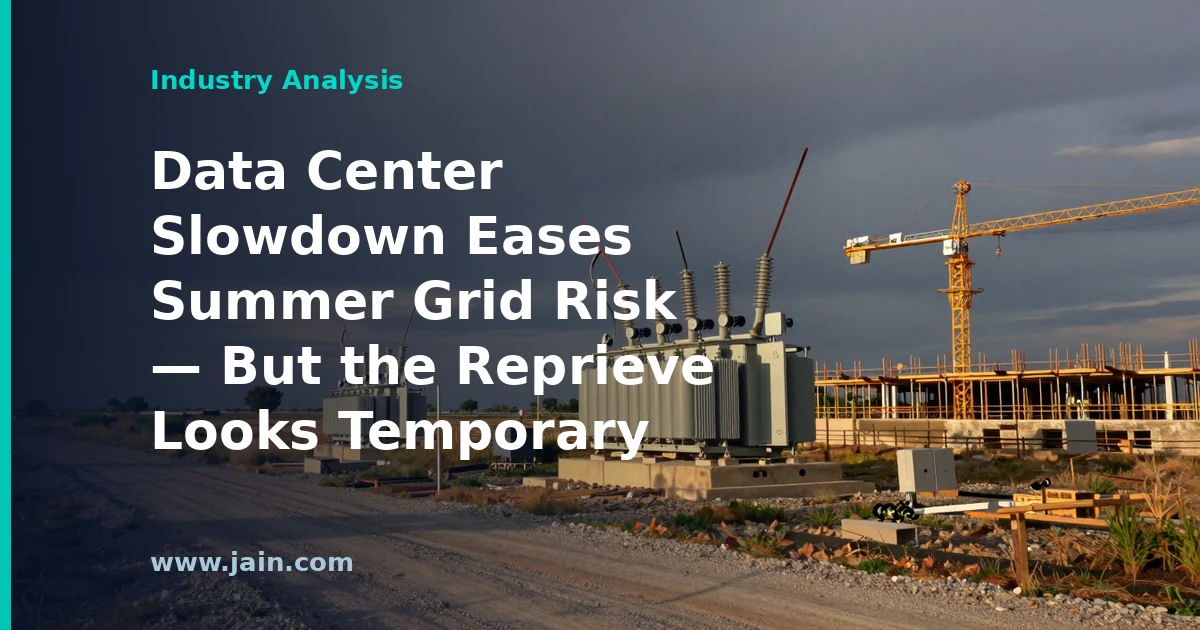
E&E News by POLITICO reported on May 21, 2026, that a slowdown in data center buildout is easing reliability risks for the U.S. electric grid heading into the summer of 2026 — the season when air-conditioning load pushes power systems closest to their limits. The report’s headline carries a caveat as important as its good news: “trouble looms.”
In plain terms: fewer new server farms plugging in right now means less new demand competing for scarce megawatts this summer, but the underlying collision between surging electricity demand and a slow-moving power supply chain has not been resolved — only postponed.
Executive Summary
The report frames a rare piece of breathing room for grid planners. For the past several years, utilities and reliability watchdogs have warned that data centers — especially those built for artificial intelligence workloads — were adding demand to the grid faster than new power plants and transmission lines could be built. A pause or deceleration in that buildout, as E&E News describes, mechanically reduces the risk that supply falls short of demand during summer heat waves.
Why it matters: summer reliability is the acid test of the U.S. power system. When a regional grid runs short, the consequences are emergency alerts, rolling blackouts, and price spikes that land on every ratepayer, not just data center customers. A slower buildout shifts near-term risk down without requiring a single new power plant.
The equally important message is the second half of the headline. A construction slowdown changes the timing of demand, not the trajectory. The structural drivers — AI computing growth, electrification, aging generators retiring, and multi-year waits to connect new supply — remain in place, which is why the report characterizes the relief as temporary rather than a turning point.
Why Slower Buildout Translates Directly Into Grid Relief
Grid reliability is a math problem: expected peak demand versus available supply, with a safety margin on top. Data centers are unusual demand because they arrive in very large blocks — a single campus can require as much power as a small city — and because they run around the clock, including during the late-afternoon summer peak when the grid is most stressed. When projects slip, pause, or get canceled, the demand side of that equation drops immediately, while the supply side (power plants and transmission already under construction) keeps arriving on schedule. That asymmetry is why even a modest deceleration in data center construction shows up quickly in seasonal reliability outlooks.
For grid operators, the near-term effect is wider reserve margins — the buffer between what the system can generate and what customers demand on the hottest day. Wider margins mean fewer emergency conservation calls and less reliance on aging plants being pushed past their planned retirement dates to keep the lights on.
Why the Reprieve Is Temporary, Not a Trend Change
The forces that created the crunch have not gone away. AI training and inference workloads continue to grow, and hyperscale operators have signaled sustained infrastructure investment even as individual projects get re-timed. Meanwhile, the supply side moves on decade-scale clocks: new gas turbines face multi-year equipment backlogs, transmission lines routinely take seven to ten years from planning to energization, and interconnection queues — the waiting lines where new power plants apply to plug into the grid — remain congested across most regions. A demand slowdown measured in quarters cannot offset a supply problem measured in decades.
There is also a rebound dynamic worth watching. If the slowdown reflects developers pausing to renegotiate power availability, tariffs on equipment, or financing terms rather than abandoning projects, the deferred demand returns — potentially in a more concentrated wave. Grid planners who treat this summer’s relief as a new baseline risk being caught out when re-timed projects come back into the queue.
Winners, Losers, and the Signal to Watch
In the near term, ratepayers and grid operators benefit: less emergency procurement, less upward pressure on capacity prices, and a summer with more margin for error. Utilities that raced to justify new generation on the back of data center forecasts face harder questions — regulators were already probing how much projected load is real versus speculative, and a visible slowdown strengthens the skeptics’ hand. For data center developers themselves, a cooler market has a silver lining: sites with secured power become more valuable relative to speculative announcements, rewarding operators who did the unglamorous work of locking in interconnection and substation capacity early.
The signal to watch is whether the slowdown shows up in canceled interconnection requests (a genuine demand reduction) or merely in slower construction starts (a deferral). The first would meaningfully rewrite load forecasts; the second only reschedules the crunch that reliability authorities have been warning about.
Background
Since the generative-AI boom began in late 2022, forecasts of U.S. electricity demand have swung sharply upward after roughly two decades of flat consumption, driven largely by planned data center campuses alongside manufacturing growth and electrification. Reliability authorities and regional grid operators have repeatedly flagged the resulting squeeze: enormous new loads seeking connection while older coal and gas plants retire and replacement generation and transmission crawl through permitting and interconnection processes.
That mismatch made every seasonal reliability assessment a referendum on data center growth, and it made the pace of buildout — not just its ultimate size — a first-order variable for grid planners. The May 2026 E&E News report lands in that context: the first widely noted moment when the demand side of the equation, rather than the supply side, moved in the grid’s favor.
S&P Global, the ratings and market-intelligence firm, reported that AI infrastructure results for 2025 topped its expectations and, on the strength of those results, has upgraded its forecast for the sector. The announcement, published May 7, 2026, signals that one of the most closely watched independent forecasters now sees more AI-driven data center, compute, and power investment ahead than it previously modeled.
Executive Summary
Forecast upgrades come in two flavors: those driven by sentiment and those driven by results. S&P Global’s revision belongs to the second category — the firm says actual 2025 outcomes in AI infrastructure exceeded what its prior models anticipated, and it has raised its outlook accordingly. That distinction matters. A results-based upgrade means the checks cleared: capital was deployed, capacity was delivered or contracted, and revenue showed up in reported financials rather than in investor-day slideware.
For the infrastructure ecosystem — data center operators, connectivity providers, power utilities, and the vendors that supply them — an independent forecaster moving its baseline upward extends the planning horizon for an already historic buildout. It also raises the stakes: the higher the consensus forecast climbs, the more painful any eventual shortfall in demand, power availability, or financing would be. The syndicated headline, however, carries no figures, so the size of the beat and the magnitude of the upgrade remain to be read in the underlying report.
An Upgrade Anchored in Results, Not Hype
Throughout the AI investment cycle, skeptics have argued that spending projections rest on circular enthusiasm — model builders forecasting demand for their own models. What distinguishes this announcement is its direction of inference: S&P Global is looking backward at 2025 actuals and concluding its earlier numbers were too low. When realized results outrun a forecast, the forecaster faces a choice between treating the beat as a one-time pull-forward of demand or as evidence the underlying trend is steeper. By upgrading, S&P Global has chosen the second interpretation.
That said, extrapolation is exactly how forecasters get caught at cycle peaks. Strong 2025 results confirm that money was spent and capacity absorbed; they do not by themselves prove that the returns on that spending will justify the next round. Readers should distinguish between the fact of the beat — which is evidence — and the upgraded projection, which remains a model.
What More Capex Means for Power and Land
AI infrastructure is shorthand for a physical supply chain: chips, servers, the data centers that house them, the fiber that connects them, and — increasingly the binding constraint — the electricity that powers them. A raised forecast implies more of all of it. For data center markets already contending with multi-year utility interconnection queues, transformer lead times, and community pushback on siting, an upgraded demand outlook translates directly into more competition for powered land and grid capacity.
For utilities and power developers, a higher independent forecast strengthens the case for generation and transmission investment that regulators must approve. For enterprise and colocation buyers, it points the other way: sustained demand above prior expectations tends to keep vacancy low and pricing firm, meaning tenants who deferred capacity decisions waiting for the market to loosen may be waiting longer than they planned.
Winners, Losers, and the Widening Gap
A rising forecast does not lift all boats equally. Operators with secured power, entitled land, and access to capital can convert an upgraded outlook into pre-leased expansion. Smaller players without those ingredients face the same rising input costs — power, equipment, construction labor — without the contracted revenue to offset them. The upgrade also sharpens the divide between markets: regions that can deliver megawatts on credible timelines will absorb a disproportionate share of the incremental demand the new forecast implies.
The risk ledger deserves equal attention. Every upward revision embeds assumptions about continued hyperscaler spending, stable financing conditions, and AI applications generating enough end-customer revenue to sustain the cycle. If any of those assumptions weakens, capacity ordered against the upgraded forecast could arrive into a softer market. S&P Global’s own ratings business exists precisely because leverage built in good times gets tested in bad ones — a useful lens to apply to its market forecasts as well.
Background
The AI infrastructure buildout accelerated sharply after generative AI reached mass adoption, with hyperscale cloud providers and AI developers committing historic sums to chips, data centers, and power. Throughout 2024 and 2025, a running debate pitted those who saw the spending as a durable platform shift against those who warned of overbuild, with independent forecasters like S&P Global serving as referees between the narratives.
S&P Global occupies an unusual vantage point in that debate: its ratings arm evaluates the creditworthiness of the utilities, data center operators, and technology firms doing the spending, while its market-intelligence arm models the demand itself. When a firm with exposure to both sides of the ledger raises its outlook based on realized results, it carries more weight than promotional projections — which is precisely why the details behind this upgrade merit close reading.
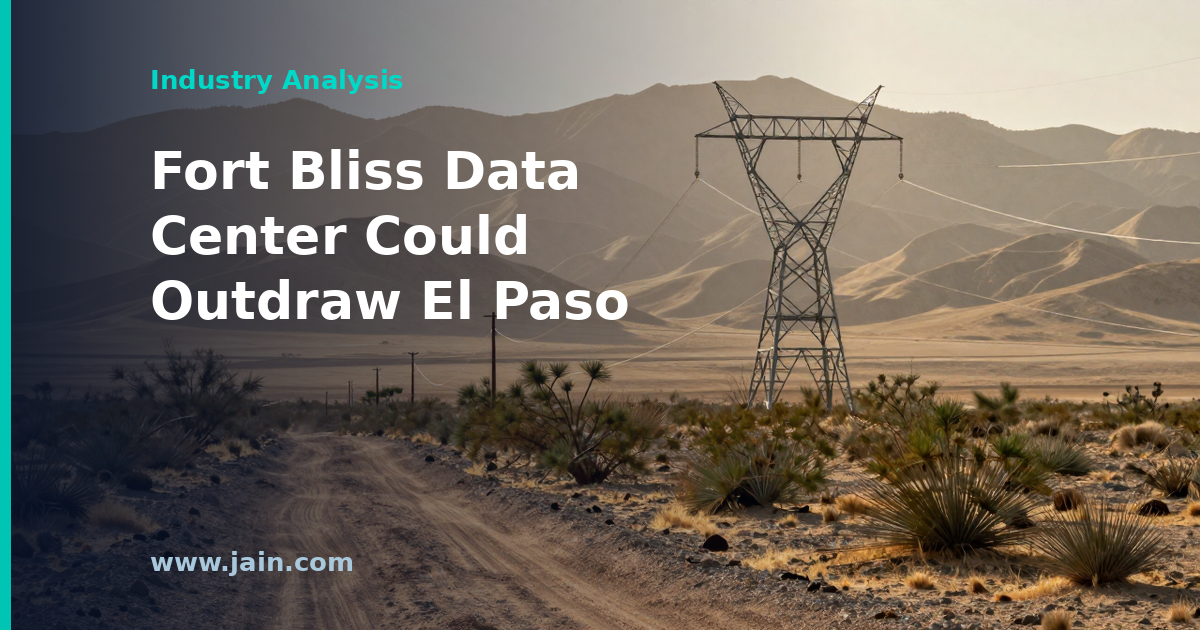
El Paso Matters reported on May 1, 2026 that a proposed data center at Fort Bliss, the U.S. Army installation adjoining El Paso, Texas, could consume more electricity than the entire city of El Paso. The project is at the proposal stage.
The comparison is the story’s core claim: a single campus on federal land whose electrical demand would rival or exceed that of the roughly 680-square-mile metropolitan area next door. Beyond that framing, the source material available to us does not carry a stated capacity figure, developer name, timeline, or power-supply arrangement.
Executive Summary
The news is a siting proposal, not a groundbreaking. What makes it notable is the combination of two ingredients that rarely appear together: a very large computing load and a U.S. Army installation as the host site. Federal land sidesteps some of the frictions that slow data center development — land assembly, municipal zoning fights, fragmented ownership — because a single federal landlord controls tens of thousands of contiguous acres behind an existing security perimeter.
What federal land does not do is generate electricity. A load described as larger than a city of roughly 680,000 people has to be served by wires, generation, and firm capacity that either already exist or must be built. El Paso sits in an unusual position for a Texas city: its incumbent utility, El Paso Electric, operates within the Western Interconnection rather than ERCOT, the grid that covers most of the state. That means the fast, deregulated Texas interconnection dynamics that have absorbed much of the state’s data center boom are not directly available here.
For infrastructure buyers, utilities, and investors, the useful question is not whether the headline comparison is dramatic — it is. The question is which of the four hard constraints (power, water, transmission, and mission compatibility with an active training installation) has an identified answer, and which are still open. On the evidence in this report, most remain open.
Why Federal Land Is Suddenly Attractive to Data Center Developers
Large computing campuses have become difficult to site in ordinary jurisdictions. Assembling several hundred acres from multiple private owners takes years; local zoning hearings have become genuine contests in Virginia, Georgia, and parts of Texas; and utility interconnection queues in popular markets stretch well past the point where a developer can promise a delivery date. Federal installations short-circuit several of those problems at once. One landlord controls the land, the parcels are already contiguous and large, physical security is a built-in feature rather than a capital line item, and the leasing path runs through federal real-property authorities rather than a city council.
Fort Bliss is an especially plausible candidate for that logic. It is among the largest Army posts in the country by land area, extending from El Paso north into New Mexico, with vast stretches of desert range. Where a private developer would need to buy out dozens of owners, a federal lease covers the same footprint in a single instrument.
The trade is that federal siting solves the land problem and leaves the harder problems untouched. Electricity, water, fiber routes, and construction labor all still have to come from the surrounding region. A campus on an Army post is not an island; it draws on the same regional grid and the same desert water system as the city beside it. The siting advantage is real, but it is narrower than the headline suggests.
El Paso Is in Texas, But It Is Not on the Texas Grid
This is the detail that most casual readers of the story will miss, and it matters more than any other technical point. The United States is divided into three major grids: ERCOT, which covers most of Texas and operates largely independently; the Eastern Interconnection; and the Western Interconnection, which runs from the Rockies to the Pacific. El Paso Electric, the incumbent utility serving El Paso and the surrounding area, sits in the Western Interconnection, not ERCOT. A very large load at Fort Bliss would therefore be interconnecting into a different market structure than a comparable load outside Dallas or Abilene.
The practical consequences are substantial. ERCOT’s combination of a large generation fleet, a fast-moving queue, and light-touch retail structure is a significant part of why so much data center demand has landed in Texas over the past several years. El Paso Electric is a considerably smaller, vertically integrated utility operating under Western planning and reliability processes, with regulatory oversight in both Texas and New Mexico. Adding generation and transmission at the scale implied by “more power than all of El Paso” is a multi-year capital program under any framework, and it is not one a single utility of that size undertakes casually.
None of this makes the proposal implausible. Behind-the-meter generation, phased buildout, on-site gas turbines, large-scale solar paired with storage, or a bespoke transmission arrangement are all mechanisms developers have used elsewhere. But each carries its own permitting path, its own capital requirement, and its own timeline — and the report as summarized does not identify which, if any, is on the table.
What a “More Power Than the Whole City” Comparison Does and Doesn’t Prove
City-scale comparisons are a legitimate way to convey magnitude to a general audience, and the figure deserves to be taken seriously rather than dismissed as alarmism. But readers evaluating it should know that such comparisons are sensitive to how both sides are measured. Peak demand in megawatts and annual energy consumption in megawatt-hours tell different stories, because a data center runs at a high, flat load factor around the clock while a city’s demand swings with weather and time of day. A campus that trails El Paso on peak summer demand could still exceed it on annual energy. “El Paso” itself can mean the municipality, the metropolitan area, or El Paso Electric’s full service territory, which reaches into southern New Mexico.
Two further caveats apply to nearly every announcement in this category. Stated capacity is almost always the fully built figure, reached over many years and many phases, not day-one load. And proposed capacity is not contracted capacity: the distance between a developer’s stated ambition and a signed interconnection agreement with firm delivery dates is where a large share of announced projects quietly stall.
The even-handed read, then: the comparison is a fair signal that the proposal is genuinely large and that the local grid implications warrant public scrutiny. It is not, on its own, evidence about what will be built, when, or on whose electrical system. Both the developer’s ambitions and the alarm the number generates should be measured against the same standard — a stated capacity figure, a defined phasing schedule, and an identified power supply.
Who Carries the Cost, and Who Carries the Risk
When a load of this size arrives in a mid-sized utility territory, the central regulatory question is cost allocation. Transmission upgrades, substation work, and any new generation built primarily to serve one customer represent capital that has to be recovered from someone. If those costs flow into general rates, every household and small business in the territory helps pay for them. If they are assigned to the customer through a large-load tariff, minimum-take commitments, or exit fees, the developer carries the risk that its own demand forecast proves optimistic. Utility commissions in several states have spent the past two years writing exactly these rules, and how Texas and New Mexico regulators would treat a Fort Bliss load is a live and unanswered question.
Water is the second cost that tends to surface late. El Paso sits in the Chihuahuan Desert and has built a national reputation for water management precisely because supply is constrained. Cooling technology choice — evaporative cooling, which consumes water to save electricity, versus closed-loop or air-cooled designs, which use more power to save water — is therefore not a technical footnote here. It is a direct trade against the grid constraint discussed above, and the two cannot be optimized independently.
There are plausible winners. Construction employment, a long-term property or lease revenue stream to the federal government, improved fiber routes, and potential grid investment that outlasts any single tenant are all genuine. But data centers are capital-dense and labor-light once operating, so permanent job counts are typically modest relative to investment, and on federal land the local property-tax treatment that usually anchors community benefit arguments works differently than it does for a private site. Those are the terms on which the community-benefit case should be argued, in either direction.
Background
El Paso is a metropolitan area of roughly 680,000 people in the city proper on the Texas–New Mexico–Mexico border, served electrically by El Paso Electric, a vertically integrated utility regulated in both Texas and New Mexico. Unlike most of the state, the region sits in the Western Interconnection rather than ERCOT, giving it a different set of grid neighbors, market rules, and planning processes than Dallas, Houston, or the Permian Basin. Fort Bliss, the adjoining Army installation, is among the largest in the country by land area and has long been a defining economic presence in the region.
The broader context is a multi-year surge in demand for computing capacity, driven substantially by AI training and inference workloads, that has run into the physical limits of land, electricity, and water in established data center markets. That pressure has pushed developers toward less conventional sites — including federal property, where land is abundant and controlled by a single owner. The Fort Bliss proposal reflects that search, and it puts the resulting trade-offs in unusually sharp relief: abundant land next to a mid-sized utility, in a desert, on a working military installation.