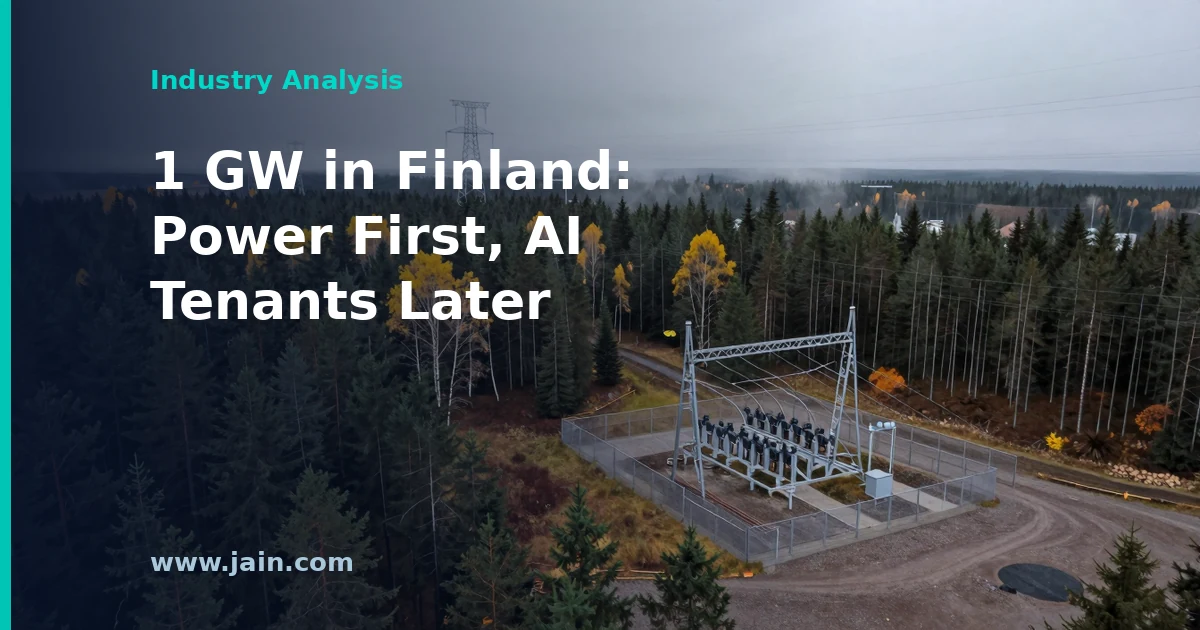
Applied Digital, a Dallas company that builds the huge computer warehouses used to run artificial intelligence, has signed a deal for access to a large supply of electricity in Finland. It is the company’s first project outside the United States.
At full size, the site could use about as much power as one large nuclear reactor produces. But the first electricity is not expected until 2028, and no customer has signed yet.
The lesson is that in this business, the electricity gets locked up first. The buildings and the paying tenants come later, if they come at all.
Applied Digital (Nasdaq: APLD) announced on October 6, 2026 that it has entered into an agreement providing access to up to 1 gigawatt (GW) of potential power capacity in Finland, its first development opportunity outside the United States. The company plans a large-scale “AI Factory” campus that could scale to as much as 1 GW, with initial power availability anticipated beginning in 2028.
Applied Digital said it has begun marketing the site and is in discussions with leading global hyperscale customers, the largest cloud and AI platform operators. It did not name the site’s location, the counterparty to the agreement, its financial terms or any prospective tenant.
Executive Summary
The Finland agreement gives Applied Digital a claim on a very large block of future electricity in a cool-climate market, the input that most constrains how fast AI data centers can be built. The company framed the deal as a measured first step abroad, structured to limit its initial exposure, with further investment contingent on customer demand, commercial milestones and regulatory approvals.
That framing matters as much as the headline number. “Up to 1 GW of potential” capacity, power from 2028 and an unsigned customer base describe an option rather than a project under construction. The announcement establishes where Applied Digital wants to grow next and how it intends to manage the risk; it does not yet establish how much capacity will actually be built, when, or for whom.
For industry readers, the deal is a test of whether a US developer’s site-selection model, built around abundant power and cold weather in North Dakota, transfers to the Nordics. For investors, it adds long-dated growth optionality while the company’s own guidance keeps near-term attention on its US pipeline.
What “Up to 1 GW of Potential” Actually Buys
Read closely, the release qualifies its headline figure at every step. The agreement provides access to “up to” 1 GW of “potential” power capacity; the campus is one “capable of scaling to as much as” 1 GW; and only “initial” power is anticipated, beginning in 2028. The company says future investment and development decisions will be tied to customer demand, commercial milestones and regulatory and development requirements, and that the deal was structured to limit initial exposure. Each of those statements points the same way: Applied Digital has secured the right to pursue a campus, not a commitment to build one at full scale.
That is a rational way to buy the scarcest input in AI infrastructure. A gigawatt is roughly the output of one large nuclear reactor, and AI campuses of this size are gated less by land or buildings than by how quickly a large, reliable grid connection can be delivered. Securing power years before a tenant signs lets a developer offer hyperscalers a dated path to capacity, which is the thing those customers are shopping for. The trade-off is that the value of the option depends on terms the company has not disclosed, including what it pays to hold the capacity and what happens if no tenant materialises.
The people most affected are prospective tenants, who gain another large-scale European option with a stated 2028 start, and shareholders, who should treat the 1 GW as a ceiling on what could be built rather than a measure of what has been contracted.
Why Finland Fits the North Dakota Playbook
Chief executive Wes Cummins tied the choice directly to the company’s US model: Finland “stood out because many of the characteristics that have supported our success in North Dakota are also present in the Nordics — a favorable climate, an attractive energy ecosystem, strong connectivity and the ability to develop at meaningful scale.” Each of those factors has an operational meaning. Cold ambient air reduces the energy spent removing heat from dense AI servers; a strong energy ecosystem determines whether large power blocks can be delivered; and fibre connectivity determines whether the site can serve customers beyond its immediate region.
The release presents this as continuity, not reinvention: securing scalable power and land where AI capacity can be developed “efficiently, responsibly and repeatedly.” That is a reasonable thesis, but it is a claim to be proven. Cummins said as much, describing Finland as the chance “to begin proving that platform can travel.” The company’s own risk disclosures in the release flag what could differ abroad, including sourcing materials and labour internationally and complying with regulations outside the US.
The 2028 Clock and the Hyperscaler Question
With initial power not expected until 2028, the commercial work happens now. Applied Digital says it has begun marketing the site and is in discussions with leading global hyperscale customers. Large AI campuses are typically financed around long-term leases with creditworthy tenants, so the timing and size of any signed lease will largely determine whether the Finland project moves from option to construction, and how quickly it scales beyond its first phase.
The release does not indicate how much of the 1 GW becomes available in 2028 versus later years. That phasing matters: a hyperscaler weighing the site will compare not just the headline ceiling but the megawatts deliverable in each year against competing sites. Until a tenant and a phasing schedule are disclosed, the near-term financial contribution of the Finland site should be treated as zero, consistent with the company’s own emphasis on its US projects.
Discipline as the Message
The release spends notable space reassuring investors. Cummins called the deal “a deliberate first step, not a change in our strategy,” and said scale “is not about planting flags in as many markets as possible.” That emphasis is consistent with the risk factors the company lists, which include its ability to raise additional capital for data center construction and to obtain financing for leases. Framing Finland as low-exposure optionality signals that the company does not intend to divert capital from US execution to fund it.
Whether that framing holds will depend on disclosures still to come: the cost of holding the capacity, any deposits or milestone payments, and how a Finnish build would be financed if a tenant signs.
Background
Applied Digital, founded in 2021 and headquartered in Dallas, designs, builds and operates large data centers for high-performance computing, including artificial intelligence, cloud, networking and blockchain workloads. The company markets closed-loop cooling, a system that recirculates coolant rather than continuously consuming water, along with rapid deployment, and describes its build model as an “AI Factory” franchise. Its US development has centred on North Dakota, which the company credits for traits it now seeks in Finland: cold weather, available energy and room to scale. Datacloud named it Best Data Center in the Americas for 2025.
Across the AI infrastructure market, developers increasingly compete to secure large blocks of electricity years ahead of construction, because access to reliable power at scale has become a principal constraint on how fast AI computing capacity can be added. The Nordics, which the company describes as an emerging European AI market, have drawn growing investment from global technology firms on the strength of their climate, energy and digital networks.
Galaxy Digital, a company that builds warehouses of computers for artificial intelligence, has cleared an important hurdle in Texas.
The state’s electricity grid operator conditionally agreed to let five of its sites plug in and draw an enormous amount of power, roughly what a large city consumes. Two sites got the firmer approval. Three still need more study.
Why it matters: in Texas, the grid now decides who gets that much electricity and who waits. That makes the power company, not the builder, the one setting the pace.
Galaxy Digital has secured conditional Batch Zero large load classifications from the Electric Reliability Council of Texas, the grid operator that runs most of the state’s power system, for five Texas data center projects covering roughly 4.2 gigawatts of gross power capacity. TipRanks reported that the decisions advance the company’s Helios I and Helios II campuses as Base Load, while three expansion sites were designated Studied Load, and that they lift Galaxy’s development pipeline to more than 5.7 gigawatts across four Texas sites.
The classifications are conditional rather than final. Some projects remain subject to further capacity allocation and audit, and the decisions were granted amid heightened regulatory scrutiny of very large electricity users by Texas authorities. Galaxy also has a planned campus called Merlin in McGregor, Texas, in the pipeline.
Executive Summary
What Galaxy Digital announced is not a customer, a construction start or a financing. It is a place in line. Batch Zero is the first tranche of requests processed under the interconnection regime Texas built for outsized electricity users, and a classification determines whether a proposed campus is treated as a load the grid is prepared to serve or as one that still has to be studied before capacity is set aside for it.
That distinction is the whole story. Galaxy’s two Helios campuses were classified as Base Load, the firmer designation. The three expansion sites were classified as Studied Load, which by the company’s own description leaves them exposed to further capacity allocation and audit. Roughly 4.2 gigawatts sits inside those five classifications; the pipeline figure Galaxy is promoting, more than 5.7 gigawatts, sits outside them.
For the wider market, the announcement is a useful demonstration of how power procurement has replaced land, capital and even chip supply as the gating item for artificial intelligence infrastructure in Texas. A developer can own the site, fund the shell and sign a tenant, and still be unable to energize anything until the grid operator says how many megawatts it will actually deliver and when.
The Interconnection Queue Is Now the Real Permit
For most of the past decade, a data center developer’s hardest document was a zoning approval or a fiber agreement. In Texas today it is a grid classification. A gigawatt is a thousand megawatts, and a megawatt is roughly the continuous draw of several hundred homes; campuses of this size arrive on the system as the equivalent of new cities appearing overnight, which is precisely why Texas legislators moved in 2025 to give the grid operator explicit authority over how the largest new loads are studied, sequenced and, in emergencies, curtailed.
Batch Zero is the first cohort run through that machinery, and Galaxy’s result shows what the process actually produces: not a yes or a no, but a tier. Base Load and Studied Load are not synonyms with a paperwork difference between them. One reflects capacity the operator is prepared to plan around. The other reflects a request that has been acknowledged and is still being evaluated. Galaxy’s announcement puts Helios I and II in the first category and its three expansion sites in the second, and states plainly that further capacity allocation and audit remain ahead.
The competitive implication is that queue position is becoming a genuine asset. Developers who filed early, on sites with existing electrical infrastructure, hold something that latecomers cannot buy with capital alone. Whether that advantage is durable depends on how fast the operator works through subsequent batches, which nobody outside the process can currently forecast.
Gross Gigawatts Are Not Leased Megawatts
Two numbers dominate the headlines, 4.2 gigawatts and 5.7 gigawatts, and neither describes computing capacity that exists or revenue that has been contracted. The 4.2 figure is gross power capacity, measured at the point where the campus meets the grid. Real facilities spend a meaningful share of that on cooling, power conversion and losses before any of it reaches a server, so the critical load available to tenants is always lower than the gross figure, and how much lower depends on design choices the announcement does not describe.
The 5.7 gigawatt pipeline number is broader still. It spans four Texas sites and includes projects that have not received Batch Zero classifications at all. Pipeline figures are legitimate planning disclosures, and every developer in this market publishes one, but they aggregate wildly different degrees of certainty into a single headline. A reader comparing developers on pipeline size is comparing intentions, not assets.
The arithmetic itself invites a question: five projects received classifications, the pipeline is described as spanning four sites, and one campus, Merlin in McGregor, appears in the announcement without a stated classification or capacity. That is not necessarily inconsistent, since a single site can host multiple projects, but it means the relationship between the two headline numbers is not self-explaining.
A Crypto Balance Sheet Funding a Utility-Scale Buildout
Galaxy is a digital asset firm that also develops data centers, and the two businesses have very different capital rhythms. Trading, asset management and custody generate returns on a cyclical, mark-to-market basis. Gigawatt-scale campuses consume billions of dollars over multi-year horizons before producing a dollar of lease revenue, and they are typically financed with project debt underwritten against signed, investment-grade tenant contracts.
The market has not fully resolved how to price that combination. The company carries a market capitalization of about ten billion dollars, and the most recent analyst rating cited in the announcement is a Hold with a twenty-six dollar price target, a stance that reads as neither endorsement nor rejection of the buildout thesis. That is a reasonable posture given what has and has not been established: the regulatory milestone is real and verifiable, while the conversion of classified megawatts into contracted, cash-generating capacity is not yet demonstrated by this announcement.
The strategic logic is nonetheless coherent. Sites originally developed for bitcoin mining tend to come with substantial interconnection already in place, which is exactly the scarce ingredient artificial intelligence tenants need and cannot manufacture. Galaxy’s ambition, as it describes it, is to fold power costs into hosting and lease arrangements, which would make it a seller of energy-inclusive capacity rather than a landlord of empty shells. That is a defensible model. It is also one that depends entirely on securing power at prices that stay below what tenants will pay for it, over lease terms measured in years.
Background
Texas has become the center of gravity for power-hungry computing in the United States, first for bitcoin mining and more recently for artificial intelligence. Its grid, operated independently of the two large interconnections that cover most of the country, offers abundant wind and solar generation, comparatively fast interconnection historically, and a market structure that rewards flexible consumers. That combination drew mining operators to remote West Texas sites, many of which were later positioned for conversion to artificial intelligence workloads because they already held the scarce asset: a completed connection to high-voltage transmission.
Galaxy Digital followed that path. Its Helios campus began as a mining facility and has been redeveloped as a multi-tenant site for artificial intelligence and high-performance computing, with Galaxy having previously announced long-term lease agreements with an artificial intelligence cloud provider there. The volume of such requests eventually forced a policy response: in 2025 Texas legislators gave the grid operator new authority to study, sequence and, in grid emergencies, curtail the largest new loads. Batch Zero is the first application of that framework, and it is why an interconnection classification now carries the weight a construction permit once did.
On July 27, 2026, Core Scientific (NASDAQ: CORZ) executed lease agreements covering 377 MW of critical IT capacity with AMD at its Pecos, Texas; Muskogee, Oklahoma; and Hunt County, Texas sites, plus 152 MW with an unnamed “Neocloud” at Auburn, Alabama and Dalton Phase 3, Georgia. Each lease runs fifteen years with three five-year renewal options. The AMD leases also grant AMD the right to reserve an additional 1,925 MW through December 28, 2028 — the arithmetic behind the “up to 2.5 gigawatts” headline in the two companies’ joint announcement of July 28. Core Scientific issued AMD a warrant for up to 30 million shares at $23.47, of which roughly 6.5 million vested on signing.
Credit where it is due: Stocktwits surfaced the market reaction to the partnership, and that pointer led us to the underlying filings, where the actual terms sit. What follows is built on those documents — the July 28 8-K, the same-day Q2 2026 results, the August 14 and August 27 8-Ks, and AMD’s own second-quarter report.
Executive Summary
The announcement matters because of what is contracted versus what is merely available. Approximately 530 MW across five sites is under signed fifteen-year leases, which Core Scientific told investors represents more than $14 billion of potential base contracted revenue. The remaining 1,925 MW is a reservation right — an option AMD may exercise “at certain times and under certain circumstances” before the end of 2028. Both numbers are real; they are not the same kind of real, and the gap between them is the single most important thing to understand about the deal.
The transaction lands on a company in the middle of a fast pivot. Core Scientific’s Q2 2026 colocation revenue was $136.7 million, up from $10.6 million a year earlier, on total revenue of $164.2 million and adjusted EBITDA of $41.1 million. Total leased customer power now stands at roughly 1.1 GW, which the company frames as more than $24 billion of potential contracted revenue. It also reported a net loss of $1,155.3 million, attributed primarily to the change in fair value of warrants as its share price appreciated — an accounting outcome, not a cash one, but one the AMD warrant will keep producing.
For AMD, this is ecosystem construction. Data Center revenue was $6.7 billion in Q2 2026, up 107% year over year and 58% of a company that grew total revenue 50% to $11.5 billion. Securing megawatts where Instinct GPUs and EPYC CPUs can land is a way of removing the physical bottleneck between a chip roadmap and a customer deployment. It also commits a semiconductor company to fifteen-year real-estate obligations, which is not a normal item on a fabless balance sheet.
Five Sites Signed, Four Times That Reserved
The joint press release says AMD “secures more than 500 megawatts of U.S. capacity.” The 8-K filed the same week is more precise: AMD itself is the tenant on 377 MW. The balance that gets the figure over 500 — 152 MW at Auburn and Dalton Phase 3 — is leased by an unnamed Neocloud, industry shorthand for a specialist cloud provider that rents out GPU compute rather than a general-purpose cloud. AMD’s involvement there is indirect: a tri-party Credit Support Agreement among Core Scientific, the Neocloud and AMD that protects AMD equipment on the premises and gives AMD the right, but not the obligation, to cure certain Neocloud defaults.
That structure is sensible and common — a chip vendor backstopping a smaller customer’s lease so the landlord will sign it — but it should be read for what it is. The Credit Support Agreements terminate automatically on the earliest of lease expiration, fifteen years, or “specified circumstances relating to the insolvency or default” of the Neocloud, and AMD may terminate on a material misrepresentation by Core Scientific after a cure period. The filing does not spell out which insolvency circumstances end the support. The protection is therefore strongest in the ordinary case and least defined in the scenario where it would matter most.
The 1,925 MW reservation right deserves equally plain language. It is not a lease, not a commitment to lease, and carries no disclosed reservation fee, exercise price or trigger. What it does is hold Core Scientific’s future development pipeline for AMD’s ecosystem through December 28, 2028. For a landlord in a market where power is the scarce input, exclusivity of that duration has a cost, and the filings do not say what AMD paid for it.
The Warrant Is the Deal’s Second Currency
AMD received a warrant for up to 30 million Core Scientific shares at $23.47 — the five-day volume-weighted average price before execution, so struck at market rather than at a discount. It vests at 12,222 shares per megawatt of critical IT load contemplated by the leases, which is why roughly 6.5 million shares vested immediately against the ~530 MW signed. Run the arithmetic in the other direction and the full 30 million shares correspond to about 2,455 MW: the 530 MW leased plus the 1,925 MW reserved, almost exactly. The warrant is calibrated to the whole 2.5 GW ambition, and it expires July 27, 2031.
This is a well-designed alignment mechanism. AMD only earns equity as it fills halls, and Core Scientific only dilutes as contracted revenue arrives. It is also genuine dilution, and it creates an unusual reporting artifact. Core Scientific carries warrants as liabilities — $1.81 billion in current warrant liabilities at June 30, against $1.77 billion of cash — and marks them to fair value each quarter. When the shares rise, the liability rises and the income statement records a loss. The company’s $1,155.3 million Q2 net loss was, on its own account, primarily that mechanism at work.
The practical consequence for anyone reading future quarters: good news about the stock will keep manufacturing headline losses. Adjusted EBITDA of $41.1 million and gross profit of $70.0 million are the figures that describe the operating business. Neither, however, makes the dilution imaginary. The two facts coexist: the loss is not cash, and the shares are.
The Cash Question: $797.5 Million a Quarter Against a $100 Million Revolver
Core Scientific spent $797.5 million on capital expenditure in Q2 2026, including land and development rights, and closed the acquisition of Polaris DS on August 13 for approximately $444.3 million in cash, with a further $40 million payable if an additional 40 MW of firm electric capacity reaches the target before December 31, 2026. Liquidity at quarter-end was $1,819.4 million. At the second quarter’s spending rate, that is a runway measured in quarters, not years, and the ~530 MW now under lease has to be built before it bills.
Against that, the August 25 credit agreement with JPMorgan Chase as administrative and collateral agent provides a $100.0 million revolving facility and a $500.0 million letter-of-credit facility, secured by a first-priority lien on substantially all assets, maturing in three years or four at the company’s election. The letter-of-credit line is the operationally important half: utilities require credit support for interconnection and project obligations, and $500 million of L/C capacity buys the ability to hold power positions. But only $100 million of it is borrowable cash. This is a liquidity and collateral facility, not a construction financing, and the company has not described how the remaining build is funded.
Two covenant details are worth flagging. Liquidity — unrestricted cash plus undrawn revolver commitments — must be at least $150.0 million at each quarter end. And each revolver borrowing is conditioned on a market capitalisation of at least $3.0 billion at the prior close. That second condition ties access to credit to the equity market’s continuing enthusiasm, at a company whose share price is also the input to its warrant accounting and the strike on AMD’s warrant. It is a reasonable lender protection. It is also a link between financing capacity and sentiment that did not exist before.
Why a Chip Company Signs a Fifteen-Year Lease
AMD’s own quarter explains the motive. Revenue of $11.5 billion was up 50% year over year with 54% GAAP gross margin and $2.3 billion of net income, and Data Center more than doubled to $6.7 billion. Alongside that, AMD reported partnerships to deploy Helios racks with Anthropic at up to 2 gigawatts and with Microsoft on Azure. The constraint on converting that demand into revenue is not wafer supply alone; it is energised, high-density space. Leasing it directly, rather than waiting for customers to find it, shortens the path from an MI400-series launch to an installed rack.
The cost is that a fabless semiconductor company now holds fifteen-year lease obligations with three five-year extensions, in a business whose product cycles run eighteen to twenty-four months. Nvidia’s competitive position, the pace of accelerator obsolescence, and the possibility that end customers prefer someone else’s real estate are all risks that a chip company does not usually take onto its balance sheet. AMD has structured around some of it — the Neocloud takes 152 MW directly, and the 1,925 MW is optional rather than committed — which is exactly the point of the option.
For the wider infrastructure market, the read-through is that GPU vendors are becoming counterparties to data center operators, not just suppliers to them. That is good for operators with power in hand: Core Scientific’s implied economics on the anchor leases, at more than $14 billion over fifteen years across roughly 530 MW, work out to roughly $1.76 million per megawatt-year, against roughly $1.45 million per megawatt-year implied by the $635 million average annualised colocation revenue on 437 MW of billing capacity as of mid-July. It also means the tenant roster in AI colocation increasingly includes firms whose primary business is selling the chips inside — a concentration of interest that buyers negotiating for capacity in the same markets should factor into their own timelines.
Background
Core Scientific designs, builds and operates large-scale, purpose-built data centers for high-density colocation, with facilities in Alabama, Georgia (2), Kentucky, North Carolina, North Dakota, Oklahoma and Texas (4). The majority of its revenue now comes from colocation services for AI workloads; the remainder comes from earning digital assets for its own account and from digital asset mining hosting, and the company says it is repurposing its remaining mining facilities to support colocation as circumstances allow. The scale of that transition shows in one comparison: colocation revenue of $10.6 million in Q2 2025 against $136.7 million in Q2 2026, with billing capacity rising from 225 MW at the end of Q1 2026 to 395 MW at the end of Q2 and 437 MW as of mid-July. On July 29, 2026 the company appointed Mark W. Adams — formerly chief executive of Penguin Solutions and president of Micron Technology — to its board as an independent director.
AMD is the second-largest supplier of data center CPUs and the principal challenger to Nvidia in AI accelerators, selling Instinct GPUs, EPYC server processors and the open-source ROCm software stack. Its recent product cadence includes the Helios rackscale system and the Instinct MI400 series. The competitive problem AMD faces is not only silicon performance but deployment surface: customers need somewhere powered to put the racks. Arrangements in which a chip vendor contracts for megawatts on behalf of its ecosystem — rather than waiting for customers to source capacity themselves — are a recent development in a market where interconnection queues and utility timelines, not manufacturing, increasingly set the pace.
MARA Holdings, one of the largest publicly traded bitcoin mining companies, has announced a deal to acquire a site in Texas that is described as doubling its power capacity. Shares in the company rose following the news, according to the market report carrying the item.
The coverage available is a short market wire summary rather than a detailed transaction announcement. It does not disclose a purchase price, a megawatt figure, the seller, the closing timetable, or whether the acquired capacity is already energized and delivering power. Those details matter enormously to how the deal should be valued, and we flag them as open below.
Executive Summary
The headline event is straightforward: MARA has agreed to buy a Texas power site, and the market read the deal as a material expansion of the company’s electrical footprint. The framing itself is the story. The acquisition is being described by its power capacity, not by how much bitcoin mining equipment it can run or what it does to the company’s hashrate — the industry’s traditional measure of mining scale.
That word choice reflects a genuine shift in how these assets are priced. Across the sector, companies that were built to mine cryptocurrency have found that their most valuable possession is not their machines but their grid connections: sites where a utility has already agreed to deliver large volumes of electricity. Artificial intelligence data centers need exactly that, and they need it years sooner than the conventional development process can supply it. Energized megawatts have become the scarce commodity, and buying a site is often the fastest way to obtain them.
What the available reporting does not establish is whether this particular transaction is an AI-oriented move, a straightforward mining expansion, or an option the company intends to keep open. Until MARA publishes the transaction terms and the technical characteristics of the site, the stock reaction should be read as a market judgment about direction of travel rather than a verified change in the company’s earnings power.
The Asset Being Bought Is the Interconnect
When a large electricity consumer wants to plug into the grid, it joins an interconnection queue — a regulated process in which the grid operator studies whether the local network can absorb the new load and what upgrades are required. For projects at the scale a data center campus needs, that process is commonly measured in years, and completion is not guaranteed. A site that has already cleared it, or that carries a signed agreement for firm delivery, is therefore not just land with a substation on it. It is a permit to consume power on a timeline no greenfield developer can match.
This is why acquisitions in this corner of the market are increasingly quoted in megawatts rather than in square footage, revenue, or equipment. The buyer is purchasing schedule certainty. In a market where the demand for AI compute is running ahead of the physical infrastructure available to host it, time-to-power has become a pricing input in its own right, and sites with existing connections trade at premiums that would look irrational if you valued them only on the cash flow they currently produce.
The important caveat is that not all capacity is equal. “Interconnected” can mean an executed agreement, a completed study, or power actually flowing today; it can be firm or interruptible; and it can carry obligations to fund transmission upgrades. The report on MARA’s deal does not specify which, and that distinction is the difference between an asset that can host a paying tenant next year and one that cannot.
From Hashrate to Landlord: What Converts and What Does Not
The strategic logic of the miner-to-AI-landlord pivot is sound. Bitcoin mining revenue is volatile, tied to a token price the operator cannot influence and to a protocol that periodically halves the reward per block. Hosting AI workloads under multi-year contracts offers something structurally different: contracted, creditworthy cash flow that lenders and equity investors will capitalize at a far higher multiple. Several listed miners have already announced conversions or hosting agreements with AI compute providers, and the market has generally rewarded those announcements. MARA’s framing of a purchase around power capacity sits comfortably inside that pattern.
What does not transfer cleanly is the building. A bitcoin mining facility is engineered to be cheap and tolerant: often little more than ventilated shells or immersion tanks, with minimal power redundancy, modest fiber connectivity, and a business model that welcomes being switched off when electricity prices spike. An AI training or inference facility is close to the opposite. It needs redundant power paths, dense liquid cooling, low-latency fiber routes, and uptime commitments that make curtailment a contractual breach rather than a revenue opportunity. Converting one to the other is typically a rebuild of everything except the grid connection and the land.
That gap is also a capital gap. The cost per megawatt of a high-availability AI facility is a large multiple of the cost per megawatt of a mining shed, which means the acquisition price is frequently the smaller half of the eventual investment. Companies pursuing this route generally require a signed tenant, a financing partner, or both before the conversion capital can be committed. Whether MARA has any of those in place for this site is not addressed in the available material.
Why the Shares Rose, and What the Market Is Pricing
A stock moving up on a transaction with undisclosed terms is a signal about narrative rather than arithmetic. Investors cannot have modeled the earnings contribution of a deal whose price and megawatt count they have not seen. What they can price is optionality: the possibility that a company currently valued as a commodity producer holds assets that would be worth considerably more in the hands of an infrastructure landlord.
That re-rating opportunity is real but conditional. It requires the capacity to be genuinely deliverable, the sites to be suitable or economically convertible, and — decisively — a customer willing to sign a long contract. Each of those conditions has failed for someone in this sector before. There is also a dilution question that positive share-price reactions tend to obscure: infrastructure buildouts are funded, and miners have historically funded them through equity and convertible issuance. A higher share price makes that cheaper, which is a legitimate corporate benefit, but it means existing holders may be paying for growth in ownership as well as in cash.
The even-handed reading is that the market is rewarding a strategic posture that is well-supported by industry conditions, on the basis of a disclosure that is too thin to verify it. That is not a criticism of the transaction, which may well be attractive. It is an observation about the information asymmetry between a one-line headline and a decision to buy the stock.
Texas: Abundant Power With Real Constraints
Texas has been the natural home for energy-intensive computing for identifiable reasons. Its grid features substantial wind and solar generation, wholesale prices that can fall very low during periods of surplus, a comparatively fast permitting environment, and a market design that pays large flexible consumers to reduce demand when the system is stressed. For miners, whose machines can be shut off in seconds, that last feature converted grid stress into a revenue line.
The constraints are becoming more visible as the loads get larger. Grid operators and regulators in Texas have moved to tighten how very large new consumers are studied, connected, and expected to behave during emergencies, partly because the aggregate volume of requested large-load capacity has grown so quickly. Water availability for cooling, transmission congestion in specific zones, and local reaction to industrial power consumption in residential areas are all live issues. None of these prevent projects; they do affect which sites are actually developable and on what schedule.
The practical implication is that a Texas acquisition should be assessed zone by zone, not as a generic bet on cheap Texas electricity. Two sites with identical nameplate capacity can have very different value depending on where they sit relative to congestion, what obligations attach to their interconnection, and whether their power is firm or curtailable. Investors and prospective tenants should ask for that granularity before assuming the megawatts are fungible.
Background
MARA Holdings began life as Marathon Digital Holdings and grew into one of the largest listed bitcoin miners by building out fleets of specialized machines that compete to validate transactions in exchange for newly issued bitcoin. That business is inherently cyclical: revenue tracks the bitcoin price and the mining reward is cut roughly every four years by the protocol’s design, which puts persistent pressure on the cost of electricity per unit of output.
Since the surge in demand for AI computing, the industry’s calculus has changed. The facilities miners built to chase cheap power sit on exactly the resource AI data center developers cannot obtain quickly — large, permitted grid connections. A number of listed miners have consequently repositioned as power and infrastructure companies, selling or converting capacity to AI tenants under long-term contracts. Texas, with its deep renewable generation, flexible wholesale market and comparatively accessible permitting, has been the geographic center of that shift, and it is where much of the sector’s remaining connected capacity is being bought and sold.
NVIDIA and IREN Limited announced a strategic partnership on May 7, 2026, aimed at accelerating the deployment of up to 5 gigawatts (GW) of AI infrastructure. IREN, a Nasdaq-listed data center operator that pivoted from Bitcoin mining to AI cloud services, becomes one of the largest publicly named partners in NVIDIA’s growing web of direct infrastructure alliances.
The announcement, issued through NVIDIA’s newsroom, frames the deal as a build-out acceleration pact; the headline figure is capacity — power, not dollars — and the companies did not disclose financial terms in the material reviewed here.
Executive Summary
The world’s dominant AI chipmaker and one of the fastest-rising ‘neocloud’ operators — companies that build GPU-packed data centers and rent the computing power out — have formalized a partnership targeting up to 5GW of AI infrastructure. For scale, 5GW is roughly the output of five large nuclear reactors and exceeds the total data center capacity of most major metropolitan markets today.
Why it matters: NVIDIA has been steadily moving beyond selling chips into shaping who gets to build the facilities that consume them — through investments, supply commitments, and named partnerships with operators like CoreWeave and now IREN. A GPU vendor putting its name directly behind a gigawatt-scale buildout compresses the traditional separation between component supplier and infrastructure developer.
For IREN, NVIDIA’s public endorsement is arguably as valuable as any commercial term: it signals priority access to scarce GPUs, the binding constraint for every AI cloud operator, and validates the company’s multi-year pivot from cryptocurrency mining to AI compute.
The Chipmaker Becomes the Kingmaker
Historically, semiconductor vendors sold components and let customers worry about buildings, power, and financing. That model is inverting. NVIDIA has taken equity stakes in GPU cloud providers, arranged supply priority for favored partners, and now attaches its name to a 5GW deployment target with a single operator. When allocation of the scarcest input in the AI economy — leading-edge GPUs — flows through strategic partnerships, the vendor effectively chooses which infrastructure players scale and which wait in line.
This has real market-structure consequences. Operators inside NVIDIA’s partnership perimeter can raise capital more cheaply, because lenders and investors treat GPU access as the key execution risk. Operators outside it face a harder story. The deal is therefore best read not just as an IREN milestone but as another data point in NVIDIA’s construction of a vertically aligned ecosystem — one that competitors, regulators, and hyperscale customers are all watching closely.
Why IREN: Power First, Chips Second
IREN’s core asset is not silicon — it is secured electrical capacity. The company, which began as Bitcoin miner Iris Energy, spent years assembling large, renewables-oriented power positions, including a multi-gigawatt development hub in West Texas and hydro-powered sites in British Columbia. In today’s market, grid interconnection queues stretch years and available power — not capital or land — is the gating factor for AI data centers. An operator holding contracted gigawatts is holding the scarce complement to NVIDIA’s scarce GPUs.
The partnership logic is symmetrical: NVIDIA needs credible places to deploy the chips it sells in enormous volumes; IREN needs assured chip supply to monetize its power pipeline. IREN’s late-2025 multi-billion-dollar AI cloud contract with Microsoft — reported at roughly $9.7 billion — had already demonstrated hyperscaler demand for its capacity. A named NVIDIA partnership adds the supply-side anchor.
Reading ‘Up to 5 Gigawatts’ Carefully
The phrase ‘up to’ is doing significant work. A 5GW ceiling is an ambition, not a contracted delivery schedule, and the announcement as reviewed does not specify phasing, capital commitments, or who funds what. Building 5GW of AI-grade data centers would plausibly require investment on the order of hundreds of billions of dollars across facilities, chips, and grid upgrades over many years — commitments far beyond what a partnership press release itself establishes.
That is not a criticism unique to this deal; it is the standard grammar of AI infrastructure announcements in this cycle, where headline gigawatt and dollar figures routinely describe multi-year aspirations. The substantiated core here is narrower but still meaningful: NVIDIA has publicly designated IREN a strategic deployment partner at a scale ceiling few operators can claim. Investors and customers should track converted megawatts — energized, GPU-filled capacity under contract — rather than announced ceilings.
Winners, Losers, and the Financing Question
Winners, if the buildout converts: IREN, whose cost of capital and customer pipeline both improve; power-rich regions like West Texas that host the load; and NVIDIA itself, which locks in demand visibility for future GPU generations. Under pressure: mid-tier colocation and cloud players without vendor alignment, and any operator whose business case assumed GPU scarcity would ration competitors’ growth.
The open question is who carries the balance-sheet risk. GPU-backed infrastructure depreciates fast — accelerator generations turn over roughly every one to two years — and neocloud operators fund buildouts with debt secured against chips and customer contracts. If AI compute pricing softens before this capacity earns out, the pain lands on whoever financed the gap between announcement and cash flow. The release, as reviewed, does not say how that risk is allocated between the partners.
Background
IREN began life in 2018 as Iris Energy, an Australian-founded Bitcoin miner that differentiated itself by siting operations on low-cost, renewable-heavy power in British Columbia and later Childress, Texas. It listed on Nasdaq in 2021, and as AI demand exploded it converted its power-first playbook into an AI cloud business, buying NVIDIA GPUs and building high-density data centers — a pivot capped by a reported multi-billion-dollar cloud contract with Microsoft in late 2025.
NVIDIA, meanwhile, has evolved from graphics chipmaker into the central supplier of AI computing and, increasingly, an active architect of the infrastructure layer: investing in cloud partners, steering GPU allocation, and publicly backing large deployments. This partnership sits squarely in that pattern — a chip vendor underwriting, at least reputationally, a gigawatt-scale buildout.
Bitdeer Technologies, the Nasdaq-listed bitcoin mining and digital infrastructure company, has entered a long-term data center lease valued at $4.7 billion, according to a report published April 30, 2026. The company frames the agreement as an expansion of its artificial intelligence infrastructure business — one of the largest single capacity commitments yet disclosed in the ongoing migration of crypto-mining operators into the AI data center market.
Executive Summary
The announcement, carried via TradingView, is short on operational detail but large in headline value: $4.7 billion committed under a long-term lease structure tied to AI infrastructure. Long-term leases — multi-year contracts in which one party commits to pay for data center capacity over the life of the agreement — are the currency of the AI buildout, because they convert speculative capacity into bankable, contracted cash flows that lenders and investors can underwrite.
For Bitdeer, a company built on bitcoin mining, a commitment of this scale matters because it shifts the company’s center of gravity. Mining revenue is volatile, tied to bitcoin’s price and network difficulty. AI infrastructure leases, by contrast, resemble traditional data center economics: contracted terms, identifiable counterparties, and revenue visibility measured in years rather than block rewards. A $4.7 billion figure, if executed as described, would place Bitdeer among the more consequential converts in the miner-to-AI transition.
From Bitcoin Mines to AI Campuses
Bitdeer’s move follows a pattern that has reshaped the crypto-mining sector: companies that spent years assembling large-scale power access and industrial sites for bitcoin mining are repurposing those assets for AI computing. The logic is straightforward. The scarcest input in AI infrastructure today is not chips but energized, grid-connected capacity — sites where hundreds of megawatts of power are already secured and permitted. Bitcoin miners happen to own exactly that.
Several large miners have already signed multi-billion-dollar, multi-year agreements to host AI and high-performance computing workloads, and the market has generally rewarded those pivots with valuations closer to data center operators than to commodity miners. A $4.7 billion long-term lease would signal that Bitdeer intends to compete in that same lane, not merely experiment at the edges of it.
Why Long-Term Leases Are the Deal Structure of the AI Buildout
A long-term lease does two things at once. For the capacity provider, it converts an industrial asset into a stream of contracted revenue that can support debt financing — critical, because retrofitting mining sites into AI-grade facilities is capital intensive, requiring denser power delivery, liquid or advanced air cooling, and far more resilient electrical infrastructure than mining rigs need. For the capacity buyer, it locks up scarce power and space ahead of competitors in a market where lead times for new grid connections can run to years.
The headline number deserves careful reading, however. In deals of this type, the quoted value typically represents total contract value across the full lease term, not annual revenue or an upfront payment. Without the term length disclosed, $4.7 billion could imply very different annual economics — a distinction that matters enormously for assessing the deal’s true weight.
The Real Asset Is Power
Whichever side of the lease Bitdeer occupies, the transaction underscores that access to electricity has become the defining constraint of the AI era. Utilities across major markets face multi-year interconnection queues, and hyperscalers and AI cloud providers have shown they will pay premium, long-duration commitments to secure energized capacity now rather than wait for new construction. Companies holding large existing power allocations — a category that prominently includes bitcoin miners — have found themselves holding strategic real estate.
That dynamic cuts both ways. The premium on power access exists precisely because supply is constrained; as utilities and developers bring new capacity online over the coming years, the scarcity value embedded in today’s deals could compress. Long-term contracts signed at the peak of scarcity may look either prescient or expensive in hindsight, depending on which side of the lease one sits.
Execution and Concentration Risks
The risks in miner-to-AI conversions are well documented across the sector. Retrofitting facilities to AI specifications routinely runs over budget and behind schedule, because AI workloads demand redundancy, cooling density, and network architecture that mining sites were never designed for. Counterparty concentration is the second concern: many of these long-term leases depend on a single tenant or customer, so the credit quality and durability of that counterparty effectively determines the value of the contract.
For a company in transition, there is also a strategic tension. Capital and management attention committed to AI infrastructure is capital not deployed in mining — and if the AI buildout slows or the counterparty falters, the company has repositioned itself around a contract rather than an operating business. None of this makes the deal unwise; it makes the undisclosed details decisive.
Background
Bitdeer Technologies emerged from the bitcoin mining industry’s consolidation around large-scale, professionally operated data centers. Spun off from mining-hardware giant Bitmain in 2021 and founded by Bitmain co-founder Jihan Wu, the company listed on Nasdaq in 2023 and built its business on three legs: mining bitcoin for its own account, hosting other miners’ machines, and selling cloud-based hash power. It operates industrial-scale facilities across multiple continents and has invested in developing its own mining chips.
The broader market context is the collision of two trends: bitcoin mining’s thinning margins after successive halvings, and explosive demand for AI computing capacity that has outrun the electric grid’s ability to serve it. That collision has turned miners’ power portfolios into strategic assets and produced a wave of multi-billion-dollar agreements converting mining sites into AI infrastructure — the wave this lease places Bitdeer squarely within.
CoinDesk reported on April 25, 2026 that Leopold Aschenbrenner — a former OpenAI researcher who left the lab and became one of the most-watched voices on AI’s trajectory — is directing his roughly $13.6 billion investment vehicle toward crypto mining companies as a way to gain exposure to AI computing infrastructure. The report frames the miners not as bets on bitcoin, but as bets on the power-rich sites and industrial facilities miners control.
Executive Summary
According to CoinDesk, Aschenbrenner’s fund — an AI-focused vehicle now reported at $13.6 billion — is making sizable wagers on publicly traded crypto miners. The logic, as the framing suggests, is that mining companies hold exactly the assets the AI buildout is starved for: contracted electrical capacity, energized substations, industrial land, and operational teams accustomed to running dense computing at scale.
If accurate, this is one of the clearest third-party endorsements yet of the ‘miner-to-AI pivot’ — the industry-wide shift in which bitcoin miners convert or lease their facilities for GPU-based AI workloads. When a prominent AI-native investor allocates institutional capital to that thesis, it signals that the constraint on AI growth is increasingly seen as megawatts and real estate, not chips or models. That reading matters to anyone building, buying, or financing data center capacity.
Why an AI Fund Buys Bitcoin Miners
The trade only makes sense once you see what miners actually own. Training and serving large AI models requires enormous, uninterrupted electricity — and in most markets, new grid interconnections (the utility approvals and hardware needed to draw large power loads) now take years to secure. Crypto miners spent the last cycle locking up precisely those scarce inputs: power purchase agreements, high-capacity substations, cooling-ready industrial shells, and land near cheap generation.
That makes a miner’s equity a potential shortcut to AI capacity. Rather than waiting in an interconnection queue, an AI tenant or investor can access energized megawatts that already exist. Several miners have publicly repositioned themselves along these lines in recent years, converting sites to host GPU computing or signing long-term hosting deals with AI customers. An allocation of this reported size treats that conversion story as investable at institutional scale, not just as a narrative individual miners tell.
The Signal Value of $13.6 Billion
Aschenbrenner is not a generic fund manager; he is best known for his time at OpenAI and for widely circulated writing arguing that AI capabilities — and the industrial buildout behind them — will scale faster than most institutions expect. An investor whose public identity is built on taking AI scaling seriously choosing miners as an expression of that view tells the market where he believes the bottleneck sits: in physical infrastructure and power, the layer beneath the chips.
For data center operators and power developers, that is a meaningful validation. It implies continued appetite from capital markets to fund energized capacity wherever it can be found — including unconventional sources like mining fleets. It also raises the competitive temperature: if converted mining sites become a mainstream way to add AI capacity, they compete with traditional colocation and hyperscale development on speed-to-power, an axis where purpose-built facilities have historically been slow.
The Risks the Thesis Carries
The pivot is not free. Bitcoin mining facilities are engineered for cheap, interruptible, low-redundancy computing; AI training and inference customers typically demand higher reliability, denser networking, and far more sophisticated cooling. Converting a mining site to credible AI-grade infrastructure requires substantial new capital per megawatt, and not every site — or every management team — will make that leap successfully. Investors are, in effect, underwriting a construction and re-engineering project wrapped inside an equity.
There is also two-sided market risk. Miner share prices still move with bitcoin, so an AI thesis expressed through miners inherits crypto volatility it never wanted. And on the AI side, demand for compute is widely assumed but not contractually guaranteed at every site; a slowdown in AI capital spending would hit conversion-story miners harder than incumbents with signed long-term tenants. Concentrated bets by high-profile funds can also crowd a trade, bidding up the very assets whose scarcity made them attractive.
Winners, Losers, and the Rest of the Stack
The immediate beneficiaries of this kind of capital flow are miners with large contracted power positions and credible AI hosting plans — their cost of capital falls as investors reprice their real estate. Utilities and power developers near those sites gain a motivated, well-funded customer class. Traditional data center operators face a more crowded market for AI capacity, but also a rising tide: the same scarcity argument that justifies buying miners justifies premium pricing for any operator who already controls energized space.
The losers, if the thesis holds, are those betting that the power bottleneck resolves quickly — and, potentially, latecomer investors if conversion economics disappoint. The honest summary is that this reported allocation is a strong directional signal about where sophisticated AI capital sees scarcity, not proof that every miner-to-AI conversion will pay off.
Background
Aschenbrenner worked at OpenAI before departing and publishing an influential 2024 essay series on AI scaling, then launched an investment fund built around the thesis that AI’s growth would drive a historic industrial buildout. Over the same period, the crypto mining sector went through its own transformation: after bitcoin’s 2024 halving squeezed mining margins, a wave of miners began repurposing their power-rich facilities for AI computing, with several signing multi-year hosting deals or converting sites outright to GPU data centers.
By early 2026, the ‘miner as AI landlord’ story had moved from novelty to established strategy, with capacity-hungry AI firms competing for any site with large amounts of secured electricity. The reported allocation covered here sits at the intersection of those two arcs — an AI-native fund treating the mining sector’s converted infrastructure as a core way to own the physical layer of the AI economy.
Publicly traded bitcoin mining companies have reduced their collective hashrate — the computational power they dedicate to mining bitcoin — by 13.4%, according to an April 21, 2026 report from Bitbo, a bitcoin data and analytics outlet. The report frames the decline not as distress but as a strategic shift: AI revenue is “taking over” as these companies redirect their power capacity and facilities toward artificial-intelligence computing workloads.
Executive Summary
The headline number is striking because hashrate has historically been the metric public miners competed on. Growing it signaled health; shrinking it signaled trouble. A double-digit collective cut across the public-miner cohort, presented alongside rising AI revenue, suggests the industry’s scoreboard is changing: megawatts under contract to AI customers now matter more to these companies than exahashes pointed at the bitcoin network.
Why it matters: public miners control something AI companies desperately need — large, energized data center sites with utility-scale power already connected. If miners are voluntarily retiring or redirecting 13.4% of their mining compute, that is among the clearest quantitative signals yet that the economics of AI hosting are outcompeting bitcoin mining for the same electrons. The caveat: the source is a single headline figure, and the report as circulated does not detail which companies cut how much, over what window, or how much AI revenue is actually flowing.
The Scoreboard Is Changing From Exahashes to Megawatts
For most of the public mining sector’s history, hashrate growth was the core investor pitch — more machines, more chances to win bitcoin block rewards. A 13.4% collective cut would once have read as capitulation. In 2026 it reads differently: mining rigs are single-purpose machines, but the infrastructure around them — high-capacity grid interconnections, substations, cooling, and permitted industrial sites — is exactly what AI data center developers spend years trying to assemble. Redirecting that capacity to AI tenants converts a volatile commodity business into something closer to contracted data center leasing.
The economic logic is straightforward. Bitcoin mining revenue is unpredictable: it depends on bitcoin’s price, on network difficulty (which rises as competitors add machines), and on halving events — the roughly four-yearly programmed cuts to mining rewards, most recently in April 2024. AI compute hosting, by contrast, is typically sold under multi-year contracts to creditworthy counterparties. Companies in this cohort, including TeraWulf and Riot Platforms, have spent the past two years publicly repositioning themselves as power-rich data center platforms rather than pure-play miners.
Why AI Tenants Want Mining Sites
The binding constraint on AI infrastructure buildout is not chips but power — specifically, energized capacity available now rather than after a five-plus-year utility interconnection queue. Bitcoin miners are among the few industrial operators holding hundreds of megawatts of already-connected capacity that can be reallocated quickly. That scarcity is what makes a miner’s site more valuable as an AI campus than as a mine, at least at the margin the 13.4% figure captures.
Conversion is not free, however. Mining facilities are typically air-cooled sheds built for cheap, fault-tolerant hardware; AI training and inference clusters demand far higher reliability, denser networking, and increasingly liquid cooling. The winners in this transition will be the miners whose sites justify that retrofit capital — large contiguous power blocks, strong fiber routes, cooperative utilities — and who can finance the conversion. Sites without those attributes may find the AI pivot is easier to announce than to execute.
What a Shrinking Public Hashrate Means for Bitcoin
A 13.4% cut by public miners does not mean the bitcoin network shrank by that amount — public companies are only a portion of global hashrate, and private and overseas operators can absorb the share they give up. If total network difficulty holds or falls, remaining miners actually earn slightly more per machine, partially offsetting the exodus. The more durable implication is structural: the best-capitalized, most transparent operators are signaling that the marginal megawatt earns more serving AI workloads than mining bitcoin. If that spread persists, capacity will keep migrating, and bitcoin mining could increasingly concentrate among operators with the very cheapest power and nothing better to do with it.
Background
Public bitcoin miners emerged as a listed-equity sector during the 2020–2021 bull market, raising billions to build warehouse-scale facilities whose defining asset was cheap, large-scale power. The April 2024 halving cut mining rewards in half just as AI demand exploded, and the sector discovered its grid connections were worth more than its mining rigs: Core Scientific’s landmark hosting agreements with AI cloud provider CoreWeave in 2024 established the template, and peers including TeraWulf, Riot Platforms, Hut 8, and Iren followed with AI and high-performance-computing strategies of their own.
By early 2026 the question was no longer whether miners would pivot but how fast and how completely. Aggregate statistics like a 13.4% public-miner hashrate reduction offer one of the first sector-wide measurements of that migration actually showing up in mining capacity, rather than just in investor presentations.
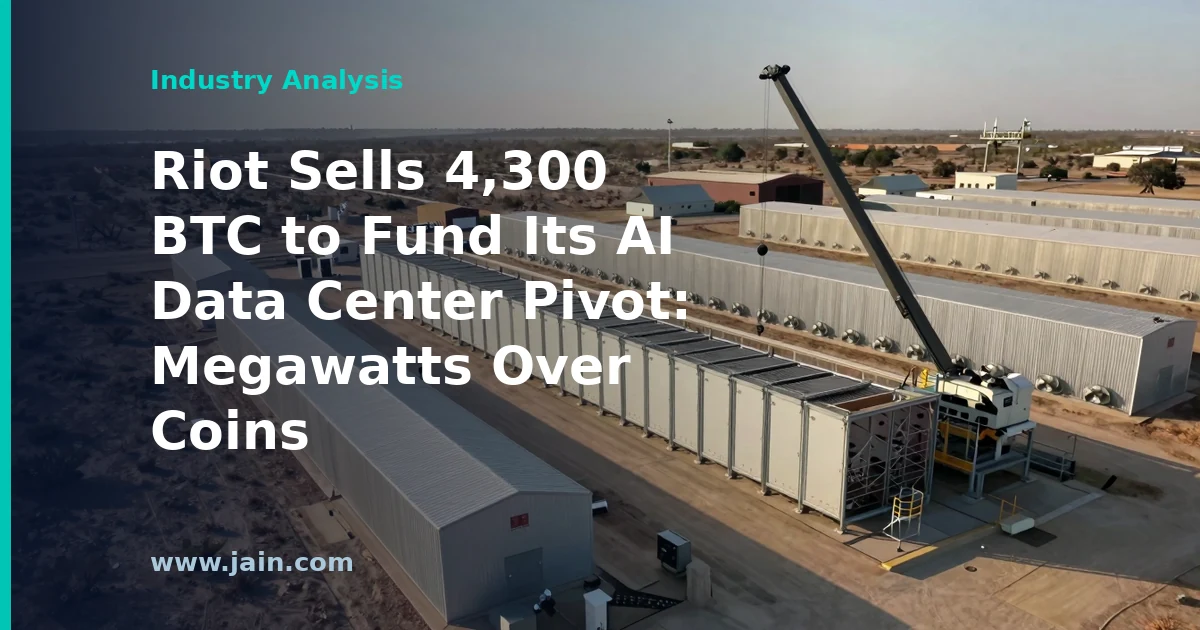
Bitcoin miner Riot has sold 4,300 BTC from its treasury to help fund the buildout of AI data center capacity, according to an April 20, 2026 report carried by TradingView. The sale converts a large slice of the company’s signature asset — its Bitcoin hoard — into construction capital for high-performance computing infrastructure.
Executive Summary
The reported transaction is notable less for its mechanics than for what it says about priorities. For years, large public Bitcoin miners treated their mined coins as a strategic reserve — a balance-sheet bet that holding Bitcoin would outperform selling it. Liquidating 4,300 BTC to pour concrete and energize halls for AI workloads inverts that logic: the scarce, appreciating asset Riot is now accumulating is powered data center capacity, not cryptocurrency.
If the report is accurate, Riot joins a growing cohort of miners redeploying their most valuable holdings — power contracts, land, substations, and now treasury coins — toward AI and high-performance computing (HPC) hosting, where demand from AI developers has made grid-connected megawatts one of the most sought-after assets in technology infrastructure.
From Strategic Reserve to Construction Budget
Bitcoin miners’ treasuries were long marketed to investors as a leveraged way to own Bitcoin: the company mines coins, holds them, and shareholders benefit if the price rises. Selling 4,300 BTC to fund a buildout is a deliberate break from that playbook. It says management believes a dollar invested in AI-ready data center capacity will return more than a dollar left sitting in Bitcoin — a striking assessment from a company whose core business is producing Bitcoin.
It is also a pragmatic financing choice. Data center construction is brutally capital-intensive, and the alternatives — issuing new shares, which dilutes existing holders, or borrowing, which adds interest costs and covenants — both carry real drawbacks. A treasury sale is the one funding source that requires no one else’s permission and creates no ongoing obligation. The trade-off is equally real: coins sold today cannot participate in any future Bitcoin rally, and shareholders who bought the stock as a Bitcoin proxy are now holding something different.
Megawatts Are the Scarce Asset Now
The deeper story is why miners are so well positioned for this pivot. AI training and inference clusters need enormous amounts of reliable electricity, and utility interconnections — the formal grid hookups that let a site draw hundreds of megawatts — can take years to secure. Bitcoin miners spent the last decade quietly assembling exactly those assets: large power contracts, energized substations, and industrial sites with cooling and fiber already in place.
That inheritance means a miner can offer AI tenants something hyperscale cloud builders often cannot: capacity that is available soon rather than after a multi-year interconnection queue. In that market, a company’s Bitcoin stack is incidental; its megawatts are the franchise. Riot converting coins into capacity is the cleanest expression yet of that repricing.
The Economics Behind the Pivot
Mining economics have tightened structurally. Bitcoin’s periodic “halvings” cut the block reward — the number of new coins miners earn — in half, which squeezes revenue per unit of computing power unless the Bitcoin price doubles to compensate. AI and HPC hosting offers a very different profile: multi-year contracts with creditworthy tenants, revenue in dollars rather than a volatile asset, and returns tied to utilization instead of a global hash-rate arms race.
But the pivot is not free money. AI hosting is a different business — different cooling densities, different reliability guarantees, different customers with demanding technical requirements — and miners must execute a conversion while incumbents like established colocation providers and hyperscalers expand aggressively. A miner that sells its Bitcoin, builds capacity, and then struggles to sign anchor tenants would have traded a volatile asset for an idle one. Execution, not vision, will decide who wins this transition.
Background
Riot Platforms grew into one of North America’s largest public Bitcoin miners by building power-hungry facilities in Texas, where it locked in substantial electricity capacity — an asset originally acquired to run mining rigs. Beginning around 2024, surging demand for AI computing collided with a shortage of grid-connected data center sites, and miners across the sector began converting or leasing their facilities to AI and high-performance computing tenants. Several of Riot’s peers struck high-profile hosting deals or announced conversions, establishing a template in which a miner’s power portfolio, rather than its coin production, drives its valuation. Riot’s reported treasury sale extends that industry-wide repositioning to the balance sheet itself.