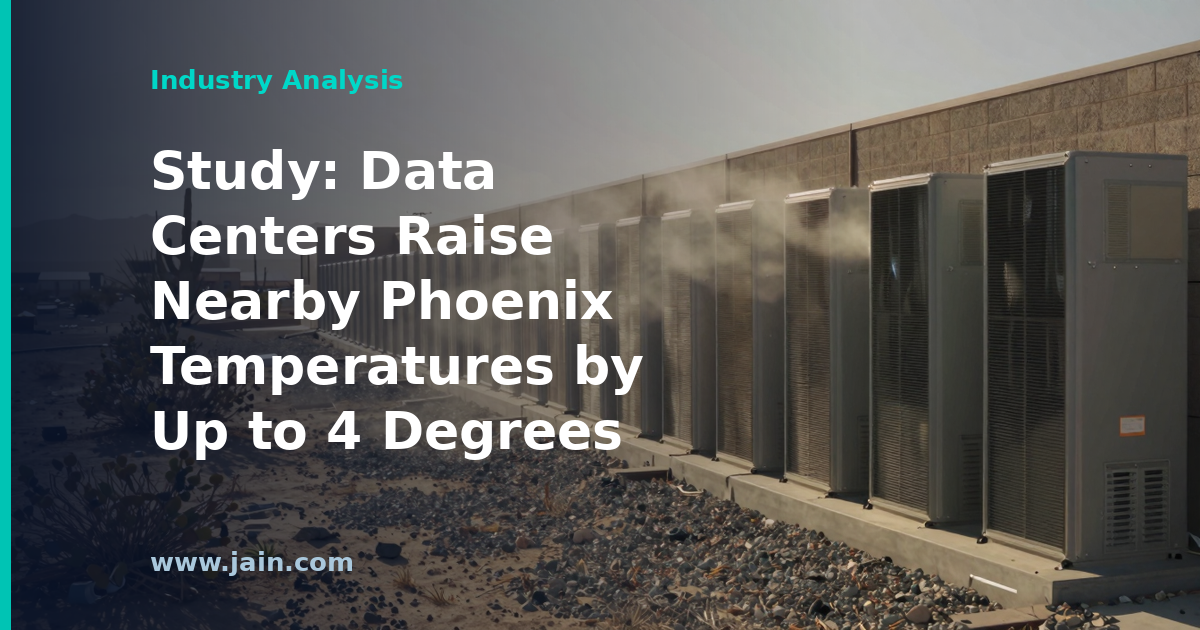
A peer-reviewed study published in ASME’s Journal of Engineering for Sustainable Buildings and Cities (Vol. 7, Issue 2) reports that data centers raise temperatures in their surrounding areas by up to 4 degrees in Phoenix, Arizona — one of the largest and fastest-growing data center markets in the United States.
The research, which frames data center waste heat as an emerging urban heat source, drew broad attention on August 19, 2026, when it reached the Hacker News front page with 267 points and more than 375 comments — a signal that the industry itself is taking the question seriously.
Executive Summary
The finding is simple to state and hard to dismiss: the electricity a data center consumes does not disappear. Nearly all of it becomes heat, and cooling systems must eject that heat into the surrounding air. In a dense cluster of facilities, that ejected heat measurably warms the neighborhood — by as much as 4 degrees, according to this study of Phoenix.
Why it matters: Phoenix is both a top-tier data center hub and the hottest major city in America, where summer heat is already a public-health and grid-reliability issue. A peer-reviewed number linking data centers to local warming gives residents, city councils, and regulators something they have not had before — citable evidence. Expect it to surface in zoning hearings, permitting conditions, and community-benefit negotiations well beyond Arizona.
For operators and their customers, the study reframes waste heat from an engineering afterthought into a siting externality alongside power draw, water use, and noise — one that will increasingly shape where and how new capacity gets built.
Heat Is the New Noise: An Externality Goes on the Record
Data center opposition has historically centered on three complaints: power consumption, water use, and the low-frequency hum of cooling plants. Localized warming now joins that list with something the others took years to acquire — a peer-reviewed citation. Once a measurable external cost is published in an engineering journal, it tends to migrate into environmental-impact reviews, zoning board testimony, and eventually permit conditions. That is how noise limits and water-reporting requirements became standard, and waste heat is positioned to follow the same path.
The practical consequence is that thermal impact modeling may become part of the pre-construction diligence package. Developers who can show — with sensors and models, not assurances — that a facility’s heat plume will not worsen conditions for adjacent neighborhoods will move through approvals faster than those who cannot. In a market where time-to-power already decides deals, an avoidable six-month permitting fight over heat is real money.
Why Phoenix Is the Stress Test for the Whole Industry
Phoenix became a data center magnet for rational reasons: comparatively cheap land, available power, low natural-disaster risk, and proximity to California customers without California costs. But the same desert climate that makes the land cheap makes cooling expensive and makes every added degree socially costly. Extreme heat is already the region’s deadliest weather phenomenon, so a study saying nearby temperatures rise by up to 4 degrees lands very differently in Phoenix than it would in a temperate metro.
There is also an economic feedback loop worth naming: hotter ambient air makes chillers and evaporative systems work harder, which consumes more electricity and water, which ejects more heat. If clustered facilities are warming their own microclimate, they are marginally degrading their own cooling efficiency — and everyone else’s. That is a classic commons problem, and commons problems invite regulation when the industry does not self-organize first.
From Liability to Asset: The Waste-Heat Reuse Question
In Nordic countries, data center waste heat is piped into district heating networks that warm homes — the externality becomes a product. The awkward truth is that this playbook works worst exactly where the U.S. is building fastest: Phoenix has essentially no heating demand for most of the year, and the low-grade heat that air-cooled facilities reject is difficult to transport or upgrade economically. Reuse candidates exist — industrial preheating, water treatment, agriculture — but none absorb hyperscale volumes in a desert.
That points the mitigation conversation toward engineering rather than reuse: liquid cooling that captures heat at higher, more usable temperatures; facility siting and airflow design that lofts exhaust away from neighborhoods; and honest accounting of the water-versus-heat trade-off, since evaporative cooling ejects less sensible heat into the air but consumes scarce water to do it. Operators who get ahead of this with published thermal data will own the narrative; those who wait will have it written for them.
Background
Metro Phoenix has spent a decade becoming one of America’s leading data center markets, attracting hyperscale and colocation development with affordable land, available power, low disaster risk, and proximity to West Coast demand. The AI buildout has accelerated that growth just as the region confronts record-breaking heat and long-term water constraints.
Urban heat island science, meanwhile, has decades of history attributing city warming to pavement, buildings, and vehicles. What is new is peer-reviewed work isolating data centers — among the most energy-dense buildings ever constructed — as a distinct and growing contributor, arriving at the exact moment communities nationwide are weighing the local costs and benefits of hosting them.
On June 4, 2026, the Wall Street Journal published a feature describing metropolitan Phoenix as a data-center mecca — and, more pointedly, as a test case for how the enormous electricity demands of artificial intelligence will be paid for. The framing places one of America’s fastest-growing data-center markets at the center of a national debate over grid-buildout economics.
Only the article’s headline and framing are accessible through the syndicated feed; the underlying reporting sits behind the Journal’s paywall. This analysis therefore examines the question the piece raises rather than details it may contain.
Executive Summary
The Journal’s framing captures a real shift in the data-center industry’s center of gravity. For two decades, the binding constraints on data-center development were land, fiber, and tax treatment. In the AI era, the binding constraint is electricity — and with it comes a question that land and fiber never posed: when a utility spends billions on new generation, transmission lines, and substations to serve a handful of very large customers, who ultimately pays?
Phoenix is a natural place to ask. The metro area has courted data centers aggressively and now hosts one of the largest concentrations of them in the United States, served principally by Arizona Public Service and the Salt River Project. How Arizona’s utilities and regulators allocate the cost of serving AI-scale loads — to the data centers themselves through special tariffs and long-term contracts, or across all customers through general rates — will be watched closely by every other market facing the same surge.
For readers, the honest caveat is that the source material available here is a headline, not a data set. The analysis below addresses the question the headline poses; the specific figures, projects, and proceedings the Journal reported on remain behind its paywall and are flagged as open items in the gaps section.
Why Phoenix Became a Data-Center Magnet
Phoenix’s rise as a data-center hub was not accidental. The region offers large tracts of developable land, very low exposure to earthquakes, hurricanes, and flooding, and network proximity to Southern California — letting operators serve West Coast users while avoiding California’s costs and permitting friction. Arizona layered on tax incentives for data-center equipment, and its utilities historically welcomed large industrial loads as a way to spread fixed grid costs over more sales.
That welcome is what the AI era is now stress-testing. A market built on the premise that big customers make the grid cheaper for everyone works when load grows incrementally. AI training and inference campuses invert the premise: they arrive in blocks so large that the grid must be expanded specifically to serve them, which means new costs rather than better utilization of existing assets. The economic-development logic that attracted the industry does not automatically survive that inversion — it has to be re-underwritten, tariff by tariff.
The ‘Who Pays’ Question, Unpacked
Serving AI-scale load requires three layers of spending: new generation capacity (or contracts for it), high-voltage transmission to move the power, and local substations and distribution upgrades to deliver it. In the regulated-utility model that covers most of Arizona, those costs are recovered through rates approved by state regulators. The allocation question is whether they land on the customers who caused them or are socialized across households and small businesses.
Utilities and regulators across the country have been converging on a middle path: dedicated large-load rate classes that require long-term commitments, minimum-demand charges, or upfront contributions to construction, so that a data center pays for the infrastructure built on its behalf even if its plans change. The unresolved tension is forecasting risk. If a utility builds for announced demand that never materializes — projects are cancelled, chips get more efficient, workloads consolidate elsewhere — someone is left holding stranded assets. Contract structure, more than load-growth headlines, determines whether that someone is the developer, the utility’s shareholders, or the ratepaying public.
Winners, Losers, and What to Watch
If Phoenix gets the allocation right, the winners are numerous: operators gain a market where power, not litigation, sets the pace; utilities gain creditworthy anchor customers; and residents gain the tax base and jobs without underwriting the buildout. If it gets the allocation wrong in either direction, the losers are equally clear. Shift too much cost onto general rates and household bills rise to subsidize some of the world’s best-capitalized companies — a politically combustible outcome. Shift too much onto new entrants and the market’s growth advantage erodes in favor of Texas, Georgia, or other hubs competing for the same projects.
The practical signals to watch are unglamorous but decisive: rate-case filings and large-load tariff proposals before Arizona regulators, utility capital-expenditure plans and their financing, and the terms — especially minimum-take and exit provisions — attached to new interconnection agreements. It is also fair to note what the Journal’s framing implicitly concedes: calling Phoenix a test case means the answers are not yet in. Anyone claiming today to know who will pay for AI’s power, in Arizona or anywhere else, is ahead of the evidence.
Background
Metropolitan Phoenix grew into one of the largest data-center markets in the United States over the past decade, first on the strength of cloud computing and enterprise colocation, and more recently on AI infrastructure. Cheap land, low disaster risk, latency-friendly proximity to California, and Arizona’s tax incentives drew hyperscalers and colocation developers alike, while the region’s broader tech expansion — including major semiconductor investment — reinforced its industrial base.
Electric service in the metro comes mainly from Arizona Public Service, an investor-owned utility regulated by the state, and the Salt River Project, a public power provider. As in other data-center hubs, the AI boom has transformed these utilities’ planning outlook from slow, steady load growth to step-change demand — pushing questions of generation buildout, transmission, and cost allocation to the top of Arizona’s regulatory agenda.