
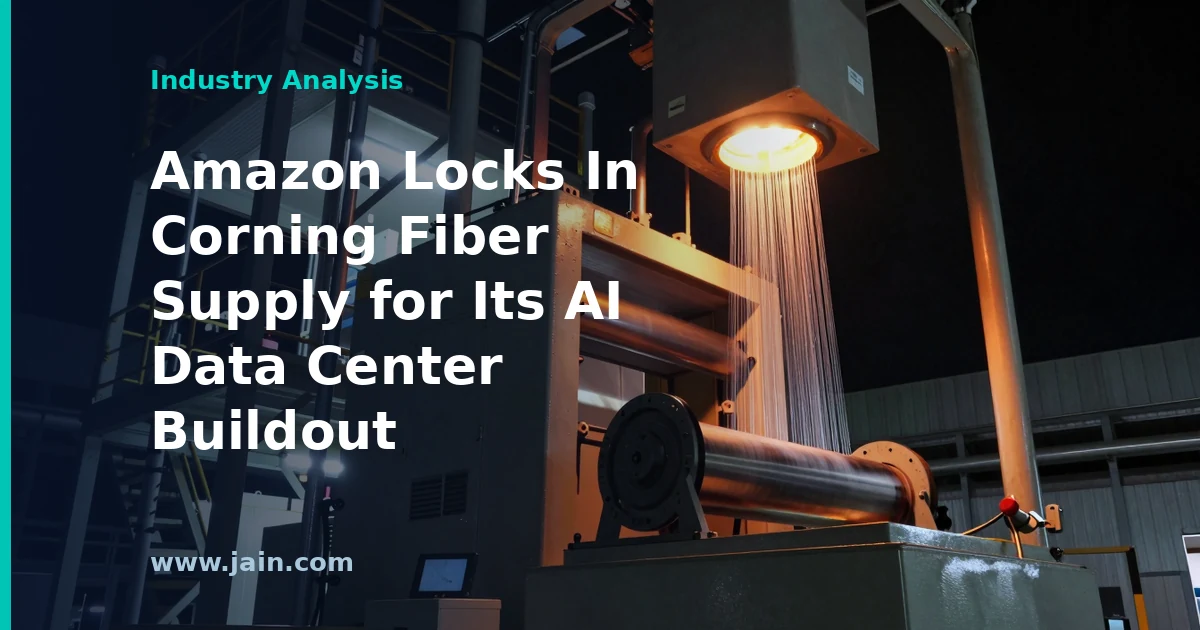
Amazon has signed a multibillion-dollar agreement with Corning to ramp up fiber-optics manufacturing, as first reported by Manufacturing Dive on June 10, 2026. The deal ties one of the world’s largest cloud and AI infrastructure builders to the world’s best-known maker of optical fiber, securing the connectivity layer — the glass strands that carry data between and within data centers — for Amazon’s ongoing AI expansion.
Executive Summary
The announcement is short on public detail but long on signal: Amazon is treating optical fiber the way hyperscalers have learned to treat power, land, and chips — as a scarce input to be locked down years in advance rather than bought on the spot market. A multibillion-dollar commitment to “ramp up” manufacturing suggests this is not a routine purchase order but a demand guarantee large enough to justify new or expanded production capacity on Corning’s side.
For the infrastructure industry, the deal matters in two directions. It confirms that AI data center construction is now pulling hard on the optical supply chain, not just on GPUs and megawatts. And it raises a practical question for every other buyer of fiber — carriers, colocation operators, and enterprises — about what capacity remains available, and at what price, once the largest customers have reserved theirs.
Fiber Is the Quiet Bottleneck of the AI Buildout
Public attention in the AI infrastructure boom goes to chips and electricity, but the third essential ingredient is optical connectivity. Modern AI training clusters link thousands of GPUs (graphics processing units, the chips that do AI computation) into what behaves like a single machine, and the traffic between those chips — so-called east-west traffic inside the data center — dwarfs the traffic going out to users. That traffic moves over optical fiber, and an AI-optimized facility can consume many times the fiber count of a conventional cloud data center, before counting the long-haul routes needed to knit multiple campuses together.
That demand profile changes the economics of fiber. Optical cable production is capital-intensive and slow to scale: drawing glass fiber requires specialized furnaces and facilities that take time to build and qualify. When demand surges faster than capacity, lead times stretch. A hyperscaler planning multi-year, multi-gigawatt campuses cannot afford to discover mid-project that cable is on allocation. Committing billions of dollars up front converts that risk into a contractual guarantee.
The Offtake Playbook Comes to Connectivity
The structure here follows a pattern hyperscalers have already applied elsewhere: long-term offtake agreements — commitments to buy future output — that give a supplier the demand certainty to invest in capacity. Amazon and its peers have signed similar multi-year deals for power generation and chip supply. Extending the playbook to fiber optics tells you the connectivity layer has crossed the threshold from commodity procurement to strategic sourcing.
For Corning, a guaranteed buyer of this size de-risks manufacturing expansion that would be hard to justify on spot demand alone — fiber makers were burned in past cycles when telecom demand collapsed after capacity had been built. For Amazon, the deal buys priority in the queue. The open question, unanswered in the initial reporting, is how much of Corning’s output this commitment effectively reserves, and for how long. Corning has struck capacity-reservation arrangements with other large buyers before, so the cumulative effect of these deals on remaining open-market supply is the number the rest of the industry would most like to see.
What Tighter Fiber Supply Means for Everyone Else
When the largest buyers pre-purchase capacity, smaller buyers face a different market. Regional carriers, colocation and interconnection providers, municipal broadband projects, and enterprises building private networks all draw on the same manufacturing base. If AI-driven hyperscale demand absorbs the industry’s expansion for the next several years, other buyers should plan for longer lead times and firmer pricing — and, like the hyperscalers, may need to move from transactional purchasing toward framework agreements of their own.
There is also a competitive-landscape angle. Corning is the most prominent name in optical fiber, but it is not the only one; other global cable makers may see openings with customers who want supply diversity, and the deal could catalyze capacity investment across the sector. Historically, that is how supply crunches resolve — though the telecom industry also remembers the early-2000s lesson that capacity built for a boom can outlive the boom. Whether AI connectivity demand proves durable enough to absorb an industry-wide ramp is the multibillion-dollar assumption embedded in deals like this one.
Background
Corning invented low-loss optical fiber in 1970 and has manufactured it through every networking cycle since — including the early-2000s telecom bust, when overbuilt fiber capacity took years to absorb, a memory that still shapes how cautiously fiber makers expand. Amazon, through Amazon Web Services, operates one of the world’s largest cloud platforms and has been investing heavily in data center capacity to serve AI workloads.
The two trends converged in the mid-2020s: AI cluster architectures multiplied the fiber content of each new data center just as hyperscale construction accelerated, and large buyers began reserving optical manufacturing capacity through long-term agreements — a market where Corning, as the sector’s most prominent supplier, sits at the center.
Source: Amazon, Corning ink multibillion-dollar deal to ramp up fiber optics manufacturing — Manufacturing Dive report, June 10, 2026, on Amazon’s fiber-optics supply agreement with Corning.