
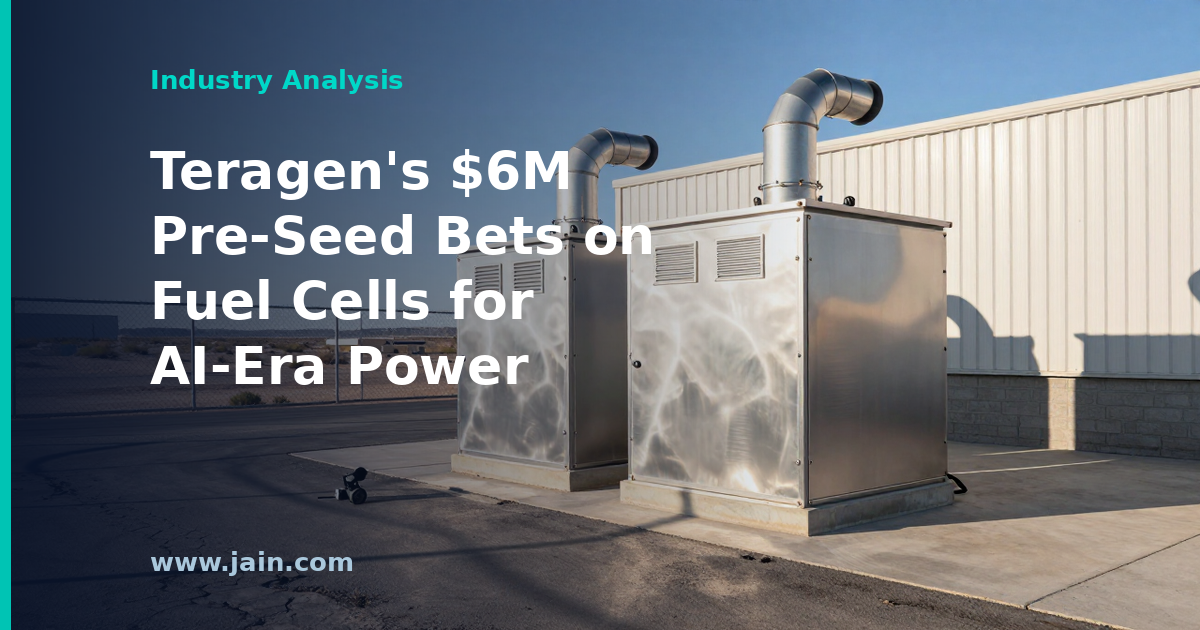
Teragen Energy, a Boston-based advanced fuel cell company, announced on August 26, 2026 that it has closed an oversubscribed $6 million pre-seed funding round. The round was co-led by BEVC and Energy Capital Ventures, with participation from AP Ventures, AIC Ventures, the Massachusetts Clean Energy Center (MassCEC) and UntroD Capital Asia.
The company builds modular onsite power systems for data centers, industrial sites and utilities using a solid oxide fuel cell architecture co-invented by chief executive Dr. Ruofan Wang at Berkeley Lab. The capital is earmarked to expand testing and manufacturing infrastructure, grow the engineering team, scale the core technology, and carry it from prototypes to first commercial pilot projects.
Executive Summary
A fuel cell is a device that converts fuel directly into electricity through an electrochemical reaction rather than by burning it to spin a turbine, which is why fuel cells can be quieter, cleaner at the point of use, and more efficient than combustion for the same fuel. A solid oxide fuel cell — the class Teragen is working in — runs hot and can accept several different fuels, which is the property the company describes as “fuel-flexible.” Teragen says its architecture also produces near-zero local pollutants and can optionally be configured for energy storage or carbon capture.
The reason a $6 million pre-seed round in this category is worth an industry reader’s attention has little to do with the dollar figure, which is small by infrastructure standards and normal by venture standards. It matters because of what the buyer side now looks like. Utility interconnection — the permission and physical connection required to draw large loads from the public grid — has become the binding constraint on new data center capacity in many markets. Operators that cannot secure an interconnect on a schedule that matches their AI deployment plans are increasingly willing to fund generation on their own site.
That shift turns behind-the-meter power from a facilities line item into a venture-backed product category. The investor syndicate here reflects it: a clean-energy state agency, a natural-gas-oriented fund, a materials-and-hydrogen specialist, and an Asia-based investor all underwriting the same early-stage hardware bet. What the release does not provide is the evidence layer — no efficiency figures, no module ratings, no named pilot customer and no pilot date.
The Interconnect Queue Is the Real Product Market
For most of the past two decades, an onsite generator at a data center was insurance. It existed to bridge the seconds and hours between a utility outage and its restoration, and its economics were judged as an insurance premium: what does it cost to never lose the load? The grid was the primary source, and nobody wrote a venture check against backup diesel.
AI training and inference capacity has inverted that logic in specific markets. When the constraint is not the price of power but the availability of a connection on a workable schedule, onsite generation stops being insurance and becomes the primary supply for some portion of the facility. That is a materially different purchase. It has to run continuously rather than a few dozen hours a year, it has to clear local air-permitting for continuous operation rather than emergency operation, and its fuel cost becomes a line in the operating model rather than a rounding error.
Teragen’s framing points directly at that market. The release argues that existing onsite options carry “high costs, high emissions, large footprints, and limited flexibility” — a fair description of why continuous-duty reciprocating engines and turbines are an awkward fit for a dense urban or suburban data center campus. Whether Teragen’s architecture actually clears those four hurdles simultaneously is exactly what a pilot is supposed to demonstrate, and the pilots have not happened yet.
What $6 Million Buys, and What It Does Not
Pre-seed is the earliest institutional stage of venture funding, typically covering the work required to prove that a technology can leave the lab. Teragen’s stated use of proceeds is consistent with that: testing and manufacturing infrastructure, engineering headcount, scale-up of the core technology, and commercialization work with partners. Those are the right things to spend early money on.
The gap between that and a data center power contract is wide, and it is worth being explicit about it rather than letting the AI-demand narrative paper over it. Power hardware sold into critical facilities is bought on demonstrated reliability over years, not on architecture claims. Buyers ask for run-hour data, degradation curves, service networks, spare-parts logistics and a balance sheet that will still exist when a warranty is called. Solid oxide systems in particular have historically had to prove out stack lifetime and thermal cycling behavior — the wear that comes from running very hot and from starting and stopping. None of that is a criticism of Teragen; it is the standard gauntlet, and $6 million is the ticket to enter it, not to finish it.
The practical read for a data center buyer is therefore patience. A pre-seed announcement is a signal about where capital and talent are moving, not a procurement option. The nearer-term relevance is to developers and investors mapping which onsite-power approaches might be commercially available in the second half of this decade.
The Syndicate Tells You What the Bet Actually Is
Investor composition in a hardware round is usually more informative than the headline number. Energy Capital Ventures’ managing general partner, Victor Pascucci III, framed the investment squarely around natural gas, describing that industry as “the backbone of the energy expansion” and calling for “more modular and scalable technology.” AP Ventures is known in the industry for hydrogen and platinum-group-metals-adjacent investing. MassCEC is a Massachusetts state clean-energy agency, which ties some of the value here to in-state development. UntroD Capital Asia brings a non-U.S. vantage point.
Read together, that syndicate is underwriting fuel flexibility itself as the asset — a machine that can run on today’s abundant gas infrastructure and, in principle, on cleaner fuels later, without replacing the installed base. That is a coherent thesis, and it is also where the environmental claims need careful parsing. The release says the technology produces “near-zero local pollutants,” which refers to things like nitrogen oxides and particulates that affect air quality around the site. That is a genuine and meaningful advantage over combustion. It is not the same as being carbon-free: burning or electrochemically converting natural gas still yields carbon dioxide, and the release describes carbon capture as an optional configuration rather than a standard one.
An even-handed summary, then: Teragen is credibly positioned as a cleaner and more flexible alternative to onsite combustion, and the release does not claim otherwise. Readers should simply avoid collapsing “near-zero local pollutants” into “zero emissions,” because those are different measurements answering different questions.
Claims Made Versus Claims Substantiated
The release asserts a “path to best-in-class cost, efficiency, power density, and responsiveness.” The word doing the work in that sentence is “path.” No efficiency percentage, module power rating, capital cost per kilowatt, or ramp-rate figure appears anywhere in the announcement. That is normal for a pre-seed company protecting its position, and it is also the reason the claim cannot yet be evaluated on its merits by anyone outside the company.
The credential that carries the most independent weight is the Berkeley Lab origin. National-laboratory co-invention means the underlying architecture went through a research environment with peer review and technology-transfer processes attached — a meaningfully higher bar than a claim asserted in a press release alone. It does not, by itself, establish manufacturability or cost at scale, which is the failure mode that has claimed a long list of promising energy hardware over the years.
For competitors, the strategic signal is straightforward. Solid oxide fuel cells already have a commercial incumbent presence in the data center market, most visibly through Bloom Energy, and gas turbine manufacturers are actively selling into the same shortage. A well-funded newcomer with a laboratory pedigree does not disturb that in the near term, but it does confirm that investors see room for a next architecture rather than treating the category as settled.
Background
Fuel cells have been commercially deployed at data centers and industrial sites for years, most visibly through solid oxide systems sold as primary or supplemental onsite power. Their appeal has always been the same: converting fuel to electricity electrochemically avoids the noise, local air pollution and efficiency losses of combustion, and modular units can be added incrementally as load grows. The persistent obstacles have been capital cost per kilowatt, the operating lifetime of the cell stacks, and the service infrastructure needed to support machines running continuously in mission-critical facilities.
What changed recently is demand. The buildout of AI compute has pushed electricity requirements for new data center campuses well beyond what many local grids can connect quickly, making the interconnection queue — the waiting line for permission and physical connection to the public grid — a gating factor on project schedules. That has reopened onsite generation as a primary supply strategy rather than a backup one, and pulled venture capital, state clean-energy agencies and gas-industry investors into the same early-stage deals. Teragen Energy, founded on Berkeley Lab research and based in Boston, is one of the companies formed against that backdrop.
Source: Teragen Energy Raises Oversubscribed $6M Pre-Seed Round to Power Today’s Frontier Industries — PR Newswire announcement of Teragen Energy’s $6 million pre-seed round, co-led by BEVC and Energy Capital Ventures, to advance its solid oxide fuel cell technology toward first commercial pilots.