

Tag: Onshoring

  • TSMC’s $100 Billion Arizona Bet: Can Leading-Edge Chipmaking Be Onshored?

    TSMC’s $100 Billion Arizona Bet: Can Leading-Edge Chipmaking Be Onshored?

    Taiwan Semiconductor Manufacturing Company (TSMC), the world’s largest contract chipmaker, is drawing fresh investor and press attention around two threads: its $100 billion expansion of manufacturing capacity in Arizona, and reports that its 1.6nm-class process technology is progressing ahead of expectations, even as its 2nm node ramps.

    The coverage — led by investment commentary at The Motley Fool and Yahoo Finance calling the stock a “no-brainer buy,” and Android Central’s report on the 1.6nm roadmap — frames TSMC as simultaneously extending its process-technology lead and deepening its US manufacturing footprint.

    Executive Summary

    Two storylines are converging. First, TSMC’s $100 billion Arizona expansion — one of the largest foreign direct investments in US history — is being cited by financial media as evidence of durable demand and strategic positioning. Second, reports claim TSMC is “surging ahead” on its 1.6nm chip technology, the node expected to follow 2nm at the leading edge of semiconductor manufacturing.

    Why it matters: every AI data-center buildout in the United States ultimately sits downstream of leading-edge fabrication. The GPUs and AI accelerators filling new halls are overwhelmingly made by TSMC. Whether the most advanced nodes can be manufactured on US soil, at volume and at competitive cost, is the linchpin question for the resilience of the entire AI infrastructure supply chain.

    A caveat up front: the source material here is media and investment commentary, not a primary TSMC disclosure. The “no-brainer buy” framing is an analyst opinion, and the 1.6nm progress claims are attributed to reports rather than confirmed company announcements. We treat both accordingly.

    The Onshoring Test Case the Whole Industry Is Watching

    For decades, the economics of chipmaking pushed leading-edge fabrication — the multi-billion-dollar plants, called fabs, that print transistors measured in nanometers — toward Taiwan, where TSMC perfected a clustered ecosystem of suppliers, engineers, and around-the-clock operations. The $100 billion Arizona program is the largest attempt yet to replicate that model in the United States.

    The open question is not whether TSMC can build fabs in Phoenix — it already operates there — but whether US-made wafers can approach Taiwan-level cost and yield. Labor, construction, permitting, and supply-chain density all historically favored Taiwan. If Arizona closes that gap, onshoring becomes a template. If it doesn’t, US production remains a strategic insurance policy that someone — customers, taxpayers, or TSMC’s margins — pays a premium for. The coverage prompting this article asserts confidence; it does not publish the cost data that would settle the question.

    1.6nm and the Widening Process Lead

    Node names like 2nm and 1.6nm are marketing shorthand for successive generations of transistor density and efficiency rather than literal measurements, but each generational step matters enormously: smaller nodes deliver more computing performance per watt, and power efficiency is now the binding constraint on AI data centers. Android Central’s report claims TSMC’s 1.6nm technology is progressing faster than expected, positioning it as the successor to the 2nm node.

    If accurate, that extends TSMC’s lead at a moment when rivals Intel and Samsung are fighting to prove their own next-generation processes can win major external customers. A widening lead concentrates the world’s AI chip supply on one company’s execution — a boon for TSMC shareholders, but a single point of dependency for everyone downstream. It is worth noting the sourcing: these are “reports claim” stories, not a TSMC roadmap announcement, and node schedules in this industry routinely shift.

    What This Means Downstream for AI Data Centers

    Data-center operators, cloud providers, and enterprises planning AI capacity should read this news through a supply-chain lens. Accelerator availability, pricing, and generational cadence all trace back to how fast TSMC can add leading-edge capacity and where that capacity sits. Arizona fabs shorten the logistical and geopolitical distance between chip production and the US facilities consuming those chips.

    But onshored fabrication is also a new demand center competing for the same scarce inputs data centers need: grid power, water, skilled construction labor, and electrical equipment. Arizona is already a major data-center market; a $100 billion fab program deepens the regional competition for those resources even as it strengthens the chip supply those data centers depend on.

    Separating the Investment Pitch from the Industrial Facts

    The headline framing — that the Arizona expansion shows the stock is a “no-brainer buy” — is a claim about valuation, and it deserves the same scrutiny we would apply to any vendor’s marketing. Capital intensity of this magnitude is a bet, not a guarantee: it assumes AI demand persists at extraordinary levels, that US fab economics prove workable, and that geopolitics neither disrupts Taiwan operations nor reshapes trade policy in ways that strand assets.

    None of that makes the bullish case wrong. TSMC’s scale, customer roster, and technology position are real and well documented. But an investment headline is not a substitute for the disclosures that would substantiate it — yield data, US cost structures, and confirmed node timelines — and readers should note that those specifics are absent from this coverage.

    Background

    TSMC pioneered the pure-play foundry model — manufacturing chips exclusively for other companies rather than selling its own — and rode it to a commanding share of global advanced-node production from its base in Taiwan. Its customers include the designers of essentially all leading AI accelerators, which has made TSMC’s capacity roadmap a proxy for the pace of the AI buildout itself.

    The company began US expansion in Phoenix, Arizona with a first fab that reached volume production in 2024, then progressively enlarged its American commitment, culminating in the $100 billion expansion program now drawing coverage. The buildout unfolds against sustained AI-driven chip demand, US industrial policy aimed at reshoring semiconductor manufacturing, and persistent strategic concern about the concentration of leading-edge production in Taiwan.

    Source: TSMC’s $100 Billion Arizona Expansion Shows The Stock Is a No-Brainer Buy — investment commentary via The Motley Fool and Yahoo Finance, alongside Android Central’s report on TSMC’s 1.6nm process progress.
  • Advantech’s New Tustin HQ Is a Bet on North American Edge AI Demand

    Advantech’s New Tustin HQ Is a Bet on North American Edge AI Demand

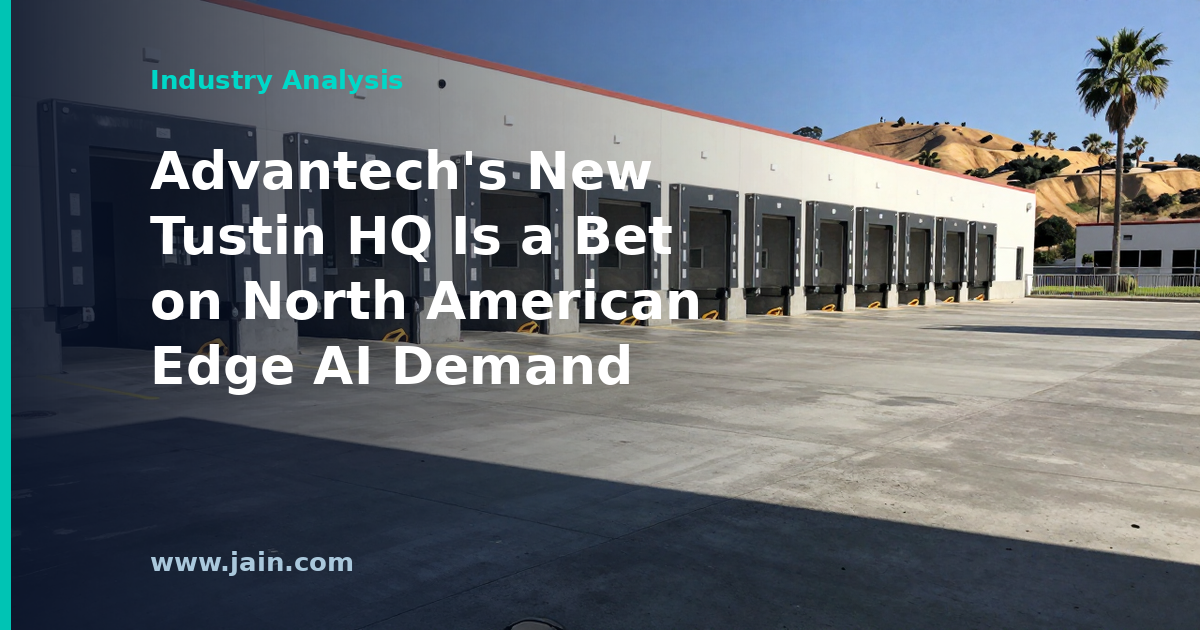
    Advantech (TWSE: 2395), the Taiwan-based edge computing and industrial IoT company, announced on August 19, 2026 the opening of its new North American headquarters in Tustin, California. The 10-acre campus at Tustin Legacy in Orange County pairs a six-story, 110,000-square-foot corporate headquarters with a 79,000-square-foot Integration & Service Center.

    The company says the site — located near the Ports of Los Angeles and Long Beach, John Wayne Airport, and major Southern California freight corridors — will anchor product innovation, customer collaboration, and expanded integration and logistics operations across the region, alongside its existing Milpitas, California and Ottawa, Illinois facilities.

    Executive Summary

    Advantech is consolidating its North American presence into a purpose-built campus that puts engineering, sales, customer experience, technical support, and executive leadership under one roof — plus an immersive AIoT showroom where customers can explore real-world applications across vertical markets. Ween Niu, General Manager of Advantech North America, framed the move as “a long-term investment in innovation, our employees, our partners, and the future of Edge AI.”

    The more strategically interesting half of the announcement is the Integration & Service Center: 79,000 square feet of dedicated integration and warehouse space with expanded dock bays, advanced scanning and routing systems, cross-dock operations supporting same-day and next-day processing, and automation infrastructure designed to scale. For a hardware company whose products — industrial PCs, embedded platforms, edge AI systems — typically require configuration before deployment, that is a statement about where value gets added: increasingly, on US soil, close to the customer.

    Why it matters: edge computing means putting processing power at or near where data is generated (a factory floor, a retail store, a cell tower) rather than in a distant cloud data center. As enterprises deploy AI at the edge in volume, the vendors who can integrate, stage, and ship configured hardware fastest gain a real advantage — and Advantech is spending to be one of them.

    Edge AI Is a Logistics Business, Not Just a Silicon Business

    Cloud AI concentrates hardware in a handful of hyperscale data centers; edge AI scatters it across thousands of customer sites. That inversion changes what wins deals. A customer rolling out AI-enabled systems across dozens of locations cares less about a spec-sheet edge and more about whether units arrive configured, imaged, and ready to mount — and whether a failed unit can be swapped quickly. Advantech’s investment in cross-dock operations, staging areas, and shipment-accuracy technology treats fulfillment and service as product features, which for industrial hardware they effectively are.

    The site selection reinforces this reading. Proximity to the Ports of Los Angeles and Long Beach — the primary gateway for trans-Pacific goods entering the US — shortens the distance between inbound manufactured hardware and outbound integrated systems. For a company headquartered in Taiwan, that positioning compresses the slowest part of the supply chain.

    Onshoring Support Capacity Without Onshoring Manufacturing

    Advantech’s move fits a broader pattern among Asia-based hardware vendors: rather than relocating manufacturing wholesale, they are onshoring the final, high-touch stages — integration, configuration, service, and warehousing — where proximity to the customer matters most. The release describes a two-hub integration footprint (Tustin, California and Ottawa, Illinois) that gives the company coverage on both the West Coast and the Midwest, while Milpitas continues supporting customers through the transition.

    This is a capital-efficient hedge. It shortens delivery times and improves responsiveness for North American buyers without the cost and complexity of standing up full production lines, and it signals commitment to a region where industrial automation, embedded AI, and IoT deployments are growth priorities for enterprise buyers.

    The Showroom as a Sales Strategy for an Invisible Product

    Edge infrastructure suffers from a demonstration problem: the product is a box in a cabinet, but the value is a transformed operation. The campus’s immersive AIoT showroom — where customers explore applications across vertical markets — is Advantech’s answer. Co-locating that experience with engineering and executive leadership turns the headquarters into a sales and co-development instrument, consistent with the company’s stated model of co-creating solutions with domain-focused partners rather than shipping components alone.

    Who Feels the Pressure

    Competing industrial PC and edge hardware vendors serving North America now face a rival with a stated same-day and next-day processing capability near the country’s busiest port complex. For customers, the practical effect — if Advantech executes — is faster deployments and shorter service loops. The risk side is equally real: a large fixed-cost campus is a bet that edge AI demand keeps growing; if enterprise edge spending slows, the company carries the overhead regardless.

    Background

    Founded in 1983, Advantech built its business on industrial computers and embedded platforms — the specialized hardware inside factory equipment, kiosks, medical devices, and network infrastructure. As industry adopted IoT (internet-connected sensors and machines), big data, and AI, the company repositioned around ‘Edge Intelligence’: hardware and software that runs analytics and AI where data is generated. It works through domain-focused partners to co-create sector-specific industrial IoT solutions rather than selling components alone.

    The Tustin campus extends a North American footprint that has included operations in Milpitas, California and integration capabilities in Ottawa, Illinois. The move lands amid broad enterprise momentum behind edge AI and industrial automation, where deployment speed and local service capacity increasingly shape vendor selection.

    Source: Advantech Announces New North American Headquarters and Service Center in Tustin, California — PR Newswire release, August 19, 2026, announcing Advantech’s 10-acre Tustin Legacy campus and Integration & Service Center.

  • Bitdeer’s $37M Bet: A First U.S. Plant to Mass-Produce Its Own Mining Rigs

    Bitdeer’s $37M Bet: A First U.S. Plant to Mass-Produce Its Own Mining Rigs

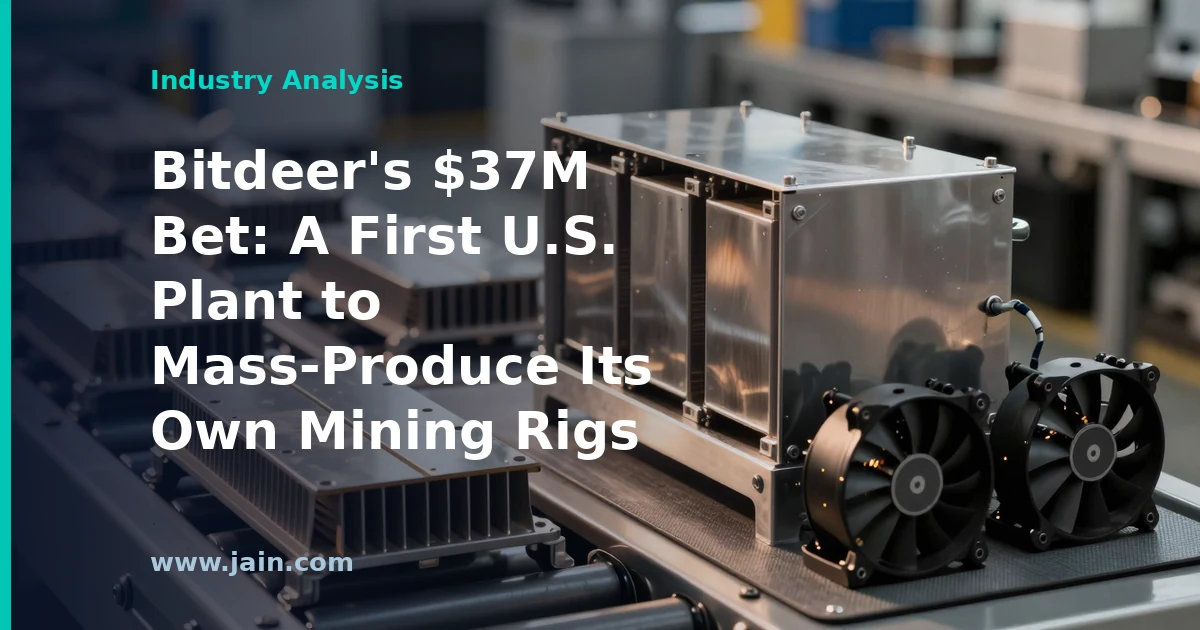
    Bitdeer Technologies Group, the Nasdaq-listed bitcoin miner and mining-hardware developer, announced on May 26, 2026 that it will invest approximately $37 million to establish its first manufacturing facility in the United States, dedicated to mass-producing its own proprietary mining machines. The company’s shares rose about 14% on the news.

    Executive Summary

    The announcement marks a notable step in a trend the mining industry has discussed for years but rarely executed: moving hardware production onto U.S. soil. Bitcoin mining machines — specialized computers built around custom ASIC chips (application-specific integrated circuits designed to do one task, in this case bitcoin’s hashing algorithm, extremely efficiently) — have historically been designed and assembled in China and Southeast Asia. A U.S. plant puts final production of Bitdeer’s rigs inside the same borders as the large American mining fleets that deploy them.

    For Bitdeer, which both operates its own mining data centers and develops its SEALMINER line of rigs, the move deepens a vertical-integration strategy: controlling the machine, not just the megawatts. The 14% share-price jump suggests investors read it as strategically meaningful, though at roughly $37 million the commitment is modest by manufacturing standards — a scale worth keeping in perspective when weighing the announcement.

    Onshoring the Rig Supply Chain

    The economics of bitcoin mining are dominated by two inputs: electricity and machines. U.S. miners have long controlled the first — cheap domestic power — while depending almost entirely on overseas suppliers for the second. That dependence became expensive and unpredictable as U.S. tariff policy toward Chinese-linked electronics hardened, and as shipping, customs, and export-control friction added cost and lead time to every container of rigs. A domestic production line is a direct hedge: machines assembled in the U.S. can reach U.S. deployment sites without crossing the tariff and logistics gauntlet.

    It also carries an industrial-policy resonance. Reshoring advanced electronics assembly aligns with the broader U.S. push to localize technology supply chains, which can translate into goodwill with regulators and utilities — intangible but real assets for a company whose core business depends on grid access and permitting.

    What $37 Million Buys — and What It Doesn’t

    It is worth being precise about scale. Roughly $37 million funds a serious assembly, integration, and testing operation; it does not fund semiconductor fabrication, which requires capital measured in billions. The ASIC chips at the heart of any mining rig will still come from offshore foundries, as they do for the entire industry. What moves onshore is the downstream work: board assembly, enclosures, hashboard integration, quality testing, and logistics. That is genuinely valuable — it shortens delivery times, reduces tariff exposure on finished goods, and improves repair turnaround — but the deepest layer of the supply chain remains abroad.

    The headline framing of “mass-producing proprietary machines” is therefore best read as a supply-chain restructuring, not full technological self-sufficiency. Investors and buyers should watch for disclosed production capacity figures to judge how much of Bitdeer’s fleet demand the plant can actually serve.

    Vertical Integration as Competitive Strategy

    Most large mining operators buy rigs from third-party giants — a market long led by China-linked manufacturers Bitmain and MicroBT. Bitdeer, whose founder previously co-founded Bitmain, is one of the few operators attempting the harder path: designing its own chips and machines while also running the data centers that consume them. If it works, the payoff is structural — capturing the manufacturer’s margin, tuning hardware to its own facilities, and insulating itself from the allocation queues and pricing power of dominant suppliers.

    The risk is equally structural. Hardware development is capital-hungry and unforgiving; a rig generation that lags competitors on efficiency (measured in joules per terahash — how much energy it takes to produce a unit of computing work) can strand the investment. A U.S. factory raises the fixed-cost base, which cuts both ways: leverage if demand holds, drag if the bitcoin cycle turns.

    Why the Market Cheered

    A 14% single-day move on a $37 million investment says the market is pricing the signal, not the sum. The plausible reading: investors see the plant as evidence that Bitdeer’s hardware business is graduating from R&D project to commercial product line, and that the company is positioning for a world where U.S.-made mining and compute hardware commands a premium. It may also reflect optimism that manufacturing capability is transferable — companies with rig-assembly lines and power-rich data centers have optionality toward adjacent high-performance-computing and AI-infrastructure work. That optionality, however, is inference, not commitment; the announcement itself concerns mining machines.

    Background

    Bitdeer was spun off from Bitmain — the world’s dominant maker of bitcoin mining hardware — and listed on Nasdaq in 2023. Unlike most mining operators, which are pure consumers of third-party machines, Bitdeer runs mining data centers across multiple countries while also developing its own SEALMINER line of rigs, a vertical-integration strategy few in the industry have attempted.

    The move lands amid a broader realignment of technology supply chains: U.S. tariff policy and export-control friction have made imported electronics costlier and less predictable, pushing companies across the compute-hardware spectrum to localize final assembly. Mining hardware, long an almost entirely Asia-manufactured category, has been among the most exposed.

    Source: Bitdeer Invests Approximately $37 Million in First U.S. Manufacturing Facility to Mass-Produce Proprietary Mining Machines — Shares Surge 14% — report on Bitdeer’s May 26, 2026 announcement, via finance.biggo.com.