Tag: on-site generation

  • Rystad: Data-Center Fuel Cell Investment to Grow Tenfold to $30B by 2030

    Rystad: Data-Center Fuel Cell Investment to Grow Tenfold to $30B by 2030

    Research firm Rystad Energy projects that investment in fuel cells by data-center operators will grow roughly tenfold, reaching $30 billion by 2030, according to a report published June 26, 2026. The forecast points to on-site power generation moving from a niche backup strategy to a mainstream way of energizing new data-center capacity as connections to the electric grid grow slower and harder to secure.

    Executive Summary

    Rystad Energy, a Norway-based energy research and intelligence firm, has put a headline number on a trend the data-center industry has been living with for several years: when the grid cannot deliver power on the timeline a project needs, operators increasingly buy their own generation. Its new forecast calls for data-center fuel cell investment to grow tenfold by 2030, reaching $30 billion — a figure that implies today’s spending is on the order of a few billion dollars a year.

    Fuel cells convert a fuel — most commonly natural gas today, potentially hydrogen in the future — directly into electricity through an electrochemical reaction rather than combustion. That gives them attractive properties for data centers: they can be deployed in modular blocks at the site, run continuously as primary power rather than just backup, and generally face lighter air-permitting burdens than combustion turbines or diesel generators. A tenfold growth call, if it materializes, would make fuel cells one of the fastest-growing categories of behind-the-meter power — generation installed on the customer’s side of the utility connection — in the broader AI-infrastructure buildout.

    The Grid Queue Is the Real Story

    The most important context for this forecast is not the fuel cell itself but the waiting line in front of it. In many major data-center markets, utilities and grid operators have quoted multi-year waits for large new interconnections — the formal process of hooking a big load up to the transmission system. For an AI data center whose revenue depends on being energized quickly, a delay of several years is often more costly than paying a premium for on-site generation. That inversion of economics — time-to-power mattering more than cost-per-megawatt-hour — is what turns a niche technology into a $30 billion market forecast.

    Fuel cells are one of several answers to that problem, alongside gas turbines, reciprocating engines, and eventually small modular nuclear reactors. Their particular appeal is speed and siting flexibility: modular units can be added in increments as a campus grows, they operate quietly with no combustion exhaust plume, and in many jurisdictions they clear environmental permitting faster than combustion alternatives. For operators, that can compress the gap between breaking ground and serving customers.

    What Tenfold Growth Would Actually Require

    Growing an equipment market tenfold in roughly four years is not just a demand question — it is a manufacturing and supply-chain question. Fuel cell systems depend on specialized components and materials, and stepping up output by an order of magnitude means new factory capacity, expanded supplier networks, and trained installation and service workforces. The release headline does not indicate whether Rystad’s forecast is constrained by manufacturing capacity or is a pure demand-side projection, and that distinction matters a great deal for whether the number is achievable.

    The fuel supply side deserves equal scrutiny. Most commercially deployed data-center fuel cells today run on natural gas, which means large deployments need pipeline capacity and gas contracts — their own version of an interconnection queue. Operators are effectively trading one infrastructure dependency for another. That trade often still makes sense, because gas infrastructure can frequently be expanded faster than high-voltage transmission, but it is not a free pass around the physical world.

    Winners, Losers, and the Emissions Question

    If the forecast is directionally right, the clearest beneficiaries are fuel cell manufacturers and the developers who package on-site generation into ready-to-run power solutions for data centers, along with gas utilities that supply the fuel. Traditional electric utilities face a more nuanced picture: behind-the-meter generation can relieve pressure on constrained grids, but it also diverts what would have been decades of steady load growth — and the revenue that comes with it — away from the regulated system.

    The environmental ledger is genuinely mixed and worth stating plainly. Natural gas fuel cells emit carbon dioxide, though generally with higher electrical efficiency and far lower local air pollutants than combustion generation. Advocates point to a future switch to hydrogen as a path to low-carbon operation; skeptics note that low-carbon hydrogen remains scarce and expensive. Buyers and communities evaluating these projects should ask which fuel is actually contracted today, not which fuel is possible in principle.

    A Forecast Is a Scenario, Not a Commitment

    It is worth being clear about what a research-firm projection is: a modeled scenario built on assumptions about data-center demand, grid-connection timelines, technology costs, and competing options. Rystad is a well-established energy intelligence firm, but the headline figure arrives without published methodology in the source at hand. If AI capacity growth slows, if utilities accelerate interconnections, or if gas turbine supply loosens, the fuel cell number could land well short of $30 billion. Conversely, if grid queues lengthen further, it could prove conservative. The forecast is best read as a signal about the direction and seriousness of the on-site power trend, not as a precise measurement of the future.

    Background

    Data-center electricity demand has surged with the AI buildout, and in several major markets the ability to get grid power — not land or capital — has become the binding constraint on new capacity. That has pushed operators toward on-site generation of many kinds, from gas turbines to fuel cells, and made “time to power” a core competitive metric. Fuel cells entered the data-center world primarily as clean backup and supplemental power, with a small number of vendors building a commercial track record over the past decade; the shift Rystad describes is their promotion to primary, at-scale power for new facilities.

    Rystad Energy, founded in Oslo in 2004, built its reputation on oil and gas market intelligence and has since expanded into power, renewables, and energy-transition research, making it one of the more frequently cited independent forecasters in the energy sector.

    Source: Fuel cell investment by data centers set to grow tenfold, reaching $30 billion by 2030 — Rystad Energy, a research forecast on data-center on-site power published June 26, 2026, via Google News.

  • Cummins to Supply Natural Gas Generators for Large-Scale West Texas Data Centers

    Cummins to Supply Natural Gas Generators for Large-Scale West Texas Data Centers

    Cummins announced on June 15, 2026 that its natural gas generators will power large-scale data centers in West Texas. The announcement, issued by the engine and power-systems maker itself, confirms a supply arrangement for on-site power generation but does not disclose the customer, the number of units, the total generating capacity, or the delivery schedule.

    Executive Summary

    Cummins, the Indiana-based manufacturer best known for diesel engines and generator sets, says its natural gas generators have been selected to power large-scale data center development in West Texas. Stripped to its substantiated core, the announcement establishes three facts: the vendor (Cummins), the fuel (natural gas), and the setting (large-scale data centers in West Texas). Everything else — megawatts, dollars, dates, and the developer’s name — is left unstated.

    Even so, the deal is worth attention because of what it represents. Data center developers are increasingly buying their own power plants rather than waiting years for utility interconnections, and West Texas — with abundant natural gas, cheap land, and a congested grid — has become the proving ground for that model. A generator manufacturer announcing data-center-scale natural gas orders is a data point in one of the most consequential shifts in how digital infrastructure gets energized.

    Why Data Centers Are Buying Their Own Power Plants

    The traditional model — build a data center, plug it into the utility grid — is breaking down under AI-era demand. Requests for new grid connections in fast-growing markets can take several years to fulfill, because utilities must study, permit, and build transmission lines and substations before energizing a large new load. For developers racing to deliver capacity to cloud and AI tenants, that queue is often the single longest item on the schedule.

    On-site generation — sometimes called behind-the-meter power, because it sits on the customer’s side of the utility meter — collapses that timeline. Reciprocating natural gas generators of the kind Cummins builds can be manufactured, shipped, and commissioned far faster than a transmission project, and they can be added in increments as a campus grows. What was once purely backup equipment, sized to ride through rare outages, is increasingly being specified as primary or bridge power that runs for thousands of hours a year.

    West Texas: Abundant Gas, Strained Wires

    West Texas is a logical setting for this model. The region sits atop the Permian Basin, one of the most productive oil and gas regions in the world, where natural gas is plentiful and pipeline infrastructure is dense. Land is inexpensive, and the area already hosts substantial wind and solar development. What the region lacks is transmission: moving power across the Texas grid, operated by ERCOT (the Electric Reliability Council of Texas), is constrained by long distances and congested lines.

    For a data center developer, that combination — fuel at the wellhead, but a bottlenecked grid — makes on-site gas generation attractive. Rather than exporting the region’s energy as electrons over strained wires, the data center effectively moves the demand to the fuel. The announcement does not say whether these facilities will also seek grid connections later, a common strategy in which on-site generation serves as a bridge until utility service arrives.

    What It Means for Cummins and the Genset Market

    For Cummins, data-center demand is reshaping a business that historically sold generators as insurance. Backup generators run perhaps a few dozen hours a year; prime-power installations run continuously, which means more units, larger service contracts, and steadier parts revenue. Major engine and turbine makers across the industry have reported stretched lead times for large power equipment as data-center orders stack up, so a manufacturer publicizing a West Texas win is competing for position in a genuinely supply-constrained market.

    The competitive backdrop matters too. Data center developers weighing on-site power can choose among reciprocating gas engines, gas turbines, and, eventually, small modular nuclear or fuel-cell options. Reciprocating engines like Cummins’ occupy a middle ground: faster to deploy and more modular than turbines, though generally better suited to incremental capacity than to single gigawatt-scale blocks. Which architecture wins at a given site depends on scale, gas supply, and air-permitting headroom — none of which this announcement details.

    The Trade-Offs the Headline Skips

    Natural gas generation is cleaner than the diesel that has long dominated data-center backup — it burns with lower particulate and sulfur emissions — but it is still a fossil-fuel source with carbon dioxide and nitrogen oxide emissions, and large installations require air-quality permits from Texas regulators. Hyperscale tenants with public net-zero commitments will want to know whether gas-powered campuses fit their carbon accounting, whether the plants are bridge or permanent solutions, and whether the equipment can later run on lower-carbon fuels.

    Reliability cuts the other way: a well-designed fleet of gas generators with firm fuel supply can rival or exceed grid reliability, and it insulates the tenant from ERCOT’s scarcity-priced energy market during extreme weather. The honest framing is that on-site gas is a pragmatic trade — speed and control in exchange for emissions and fuel-price exposure — and this release, as circulated, makes the case for the first half without quantifying the second.

    Background

    Founded in 1919 in Columbus, Indiana, Cummins built its reputation on diesel engines for trucks and heavy equipment, and its power systems division has long been a leading supplier of standby generator sets for data centers, hospitals, and industry. In recent years the company has expanded its natural gas engine lineup as customers seek lower-emission alternatives to diesel.

    The backdrop is a historic surge in electricity demand from AI and cloud computing that has outpaced utilities’ ability to connect new loads. Texas has emerged as a leading destination for this buildout, and West Texas in particular — sitting atop the Permian Basin’s gas supply but far from major transmission corridors — has become a testbed for data centers that generate their own power on-site rather than waiting for the grid.

    Source: Cummins Natural Gas Generators to Power Large Scale Data Centers in West Texas — company announcement dated June 15, 2026, stating that Cummins natural gas generators will power large-scale data center development in West Texas.

  • Ireland’s ‘Bring Your Own Power’ Message Signals a New Era for Data Centers

    Ireland’s ‘Bring Your Own Power’ Message Signals a New Era for Data Centers

    The Wall Street Journal reported on June 6, 2026 that Ireland — one of Europe’s most important data center hubs — is telling technology companies seeking new data center capacity that they should bring their own power generation rather than rely on the national grid. The report frames the stance as a response to years of mounting strain between the country’s booming digital infrastructure sector and an electricity system struggling to keep pace.

    Executive Summary

    According to the Journal’s reporting, Irish authorities are effectively shifting the burden of powering new data centers onto the companies that build them. Instead of queuing for grid connections that may not materialize for years, hyperscalers — the largest cloud and internet platforms, such as those operating massive server campuses — are being pointed toward on-site or self-procured generation as the price of admission.

    Why it matters: Ireland has long punched far above its weight in European data center capacity, and its grid has been under visible stress as a result. If the sovereign host of one of the continent’s densest cloud clusters is now telling its largest customers to power themselves, that is a signal moment for every grid-constrained market — from Dublin to Northern Virginia to Singapore. The economics, siting logic, and competitive dynamics of data center development all change when the utility is no longer assumed to show up.

    How Ireland Became the Test Case for Grid Saturation

    Ireland’s predicament is not new — it is the culmination of a decade-long collision between two national success stories. Dublin became a preferred European landing zone for American cloud providers, drawn by tax policy, connectivity, a skilled workforce, and EU market access. But data centers are extraordinarily power-dense tenants: official Irish statistics have shown them consuming roughly a fifth of the country’s metered electricity in recent years, a share without parallel among developed economies. The grid operator, EirGrid, had already moved years earlier to restrict new data center connections in the Dublin region, citing capacity and system-stability concerns.

    Seen against that backdrop, a “bring your own power” posture is less a sudden policy lurch than the logical end state of a queue that stopped moving. When a grid cannot absorb new large loads without threatening reliability for households and other industry, the choices narrow to three: build transmission and generation faster (slow and politically hard), ration connections (which Ireland has effectively done), or push the load to self-supply. Ireland now appears to be leaning into the third option.

    The Economics of Powering Yourself

    Self-generation transforms the data center cost model. A grid connection socializes enormous capital costs — power plants, transmission lines, system balancing — across all ratepayers. Bringing your own power means the developer finances generation capacity itself: on-site gas turbines or engines, batteries, contracted private-wire renewables, or some hybrid. That raises upfront capital expenditure substantially and adds fuel-supply, permitting, and emissions obligations that a simple utility contract never carried.

    For hyperscalers, this is expensive but survivable — the largest cloud companies have the balance sheets, the energy-procurement teams, and increasingly the appetite to act as their own utilities, as the global wave of data-center-adjacent generation deals demonstrates. For smaller colocation operators and enterprises, the calculus is harsher: self-generation at scale requires expertise and capital that mid-tier players often lack. The likely effect is consolidation of new Irish capacity in the hands of the very largest operators, and a widening gap between markets where power is a utility service and markets where it is a competitive weapon.

    Winners, Losers, and the Emissions Question

    The clearest near-term beneficiaries are the suppliers of behind-the-meter power: gas turbine and reciprocating-engine manufacturers, battery storage integrators, and developers of private-wire renewable projects, all of which face a customer newly compelled to buy. Grid ratepayers arguably benefit too, since new digital load stops competing with homes and factories for constrained supply. The losers are developers whose Irish pipelines were premised on eventual grid connections, and potentially Ireland’s own climate accounting — if “your own power” means on-site fossil generation, national emissions targets absorb the impact even as grid stress eases.

    That tension deserves scrutiny in both directions. Critics of data center growth will note that self-generation can amount to distributed gas plants by another name; industry advocates will counter that hyperscalers have been among the largest corporate buyers of renewable energy in Europe. Both claims can be true, and the honest answer depends on implementation details — fuel types, run hours, and whether storage and renewables are mandated alongside thermal capacity — that the reporting available at publication does not settle.

    A Template Other Grids Are Watching

    Ireland is not alone; it is simply early. Regulators and utilities in other saturated hubs — the Amsterdam region, Singapore, and parts of the United States where interconnection queues stretch years — have all experimented with pauses, caps, or conditions on data center growth. What makes the Irish stance notable is its directness: rather than saying “no,” it says “yes, if you power it yourself.” That formulation lets a small country keep courting digital investment without asking its citizens to underwrite the electricity. Expect other grid-constrained jurisdictions to study it closely, and expect site-selection teams to treat credible self-generation plans as a standard part of the pitch rather than an exotic fallback. In the AI era, the scarce input is no longer land or fiber — it is firm power, and whoever can bring their own will build first.

    Background

    Ireland became one of Europe’s foremost data center markets over the past two decades, with Dublin serving as a primary European hub for major American cloud and internet companies. That success came with an unusual burden: official Irish statistics have shown data centers consuming on the order of one-fifth of the country’s metered electricity — a share far higher than in most developed economies — prompting public debate over grid reliability, climate targets, and who should bear the cost of digital growth.

    Grid operator EirGrid responded years before this report by constraining new data center connections in the Dublin region, and national policy has since wrestled with how to reconcile continued digital investment with electricity system limits. The reported ‘bring your own power’ stance represents the sharpest articulation yet of where that debate has landed.

    Source: Bring Your Own Power, Ireland Tells Tech Titans Hungry for Data Centers — Wall Street Journal report (June 6, 2026) on Ireland directing data center developers toward self-supplied generation.

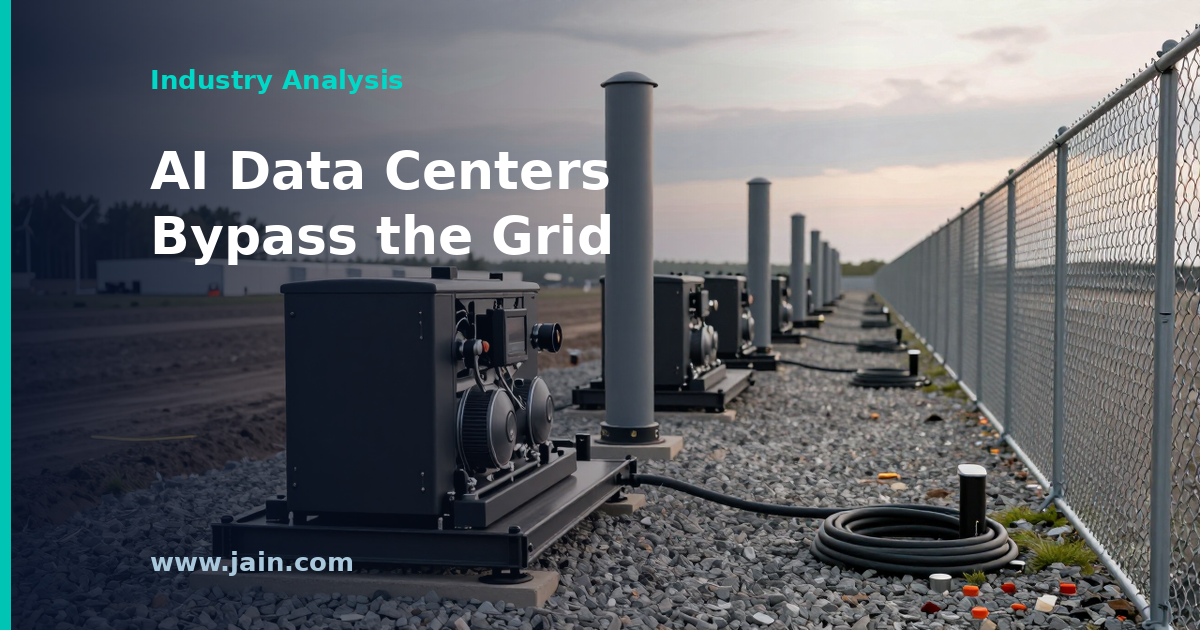
  • From Backup to Prime: AI Data Centers Bypass the Grid

    From Backup to Prime: AI Data Centers Bypass the Grid

    POWER Magazine reports that hyperscale and AI-focused data center developers are increasingly deploying on-site generation as prime power — the primary source of electricity — rather than as backup for grid supply. The shift is being driven by multi-year interconnection queues and gigawatt-scale load requests that utilities cannot serve on operators’ timelines.

    The article frames the trend as a structural change in how large computing loads are powered, not a temporary workaround while the grid catches up.

    Executive Summary

    For decades, data center diesel generators sat idle 99% of the year, insurance against a utility outage. POWER Magazine’s May 2026 piece argues that AI-era facilities are inverting that model: on-site turbines, engines, and increasingly fuel cells are being sized to carry the base load, with the grid demoted to a secondary or supplementary role.

    The change matters because it decouples data center build timelines from utility interconnection queues that now stretch five years or more in several U.S. markets. It also shifts who bears the cost of new generation, who chooses the fuel, and who is accountable for the emissions — moving decisions from regulated utility planning processes into private commercial ones.

    The article does not quantify how much AI capacity is being built this way, but treats the pattern as established enough across the industry to describe as a category shift rather than a set of one-off projects.

    Why the Grid Became the Bottleneck

    A modern AI training campus can request 500 megawatts to more than a gigawatt at a single site — roughly the draw of a mid-sized city. U.S. transmission planning, permitting, and equipment lead times were not built for loads of that size arriving in 18-month cycles. Large transformers alone now carry multi-year backlogs. Faced with utility responses measured in years, developers with hyperscaler contracts and finite construction windows are choosing to generate power themselves.

    On-site prime power is not new — industrial sites, hospitals, and remote operations have done it for a century. What is new is the scale at which general-purpose computing infrastructure is adopting it, and the willingness of tenants to accept a self-generated power product rather than wait for a utility one.

    The Fuel Question Nobody Wants to Answer Cleanly

    Prime power at data center scale currently means natural gas turbines or reciprocating engines in most cases, with fuel cells and, in a few announced projects, small modular reactors positioned as future options. Each choice carries trade-offs the industry rarely discusses in the same sentence: gas is fast and financeable but carbon-intensive; fuel cells are cleaner per kilowatt-hour but expensive and supply-constrained; nuclear is low-carbon but years from commercial deployment at the sizes being discussed.

    Operators marketing 24/7 clean energy commitments and operators building gas-fired prime power are, in some cases, the same companies. That is not necessarily hypocrisy — sustainability commitments typically cover corporate portfolios, not individual sites — but it does mean buyers and communities should read specific project disclosures carefully rather than relying on parent-company pledges.

    Winners, Losers, and Who Pays for the Grid

    The winners are gas turbine manufacturers, EPC contractors with power-plant experience, and developers who can site, permit, and finance generation alongside compute. Utilities lose a category of load they had expected to plan around; regulators lose visibility into where large new emissions sources are appearing; and ratepayers face a more complex question about who pays for grid upgrades if the largest new users bypass the system.

    There is also a quieter loser: the narrative that AI growth would automatically pull the grid toward cleaner, more flexible operation. If the largest loads leave the grid entirely, the reverse dynamic can take hold — utilities lose the anchor customers that would have justified transmission and clean generation investment.

    A Structural Shift, Not a Stopgap

    The POWER Magazine framing — from backup to prime — is the important claim. If on-site generation were a bridge until interconnections cleared, the industry would treat it as temporary infrastructure. Instead, projects are being permitted, financed, and contracted on 15- to 25-year horizons, which is how long the equipment is expected to run. That is a bet that grid-served gigawatt loads will remain hard to obtain for the foreseeable future.

    Whether that bet is correct depends on transmission reform, interconnection queue processing, and whether utilities can stand up large-load tariffs quickly enough to compete. None of those variables are moving at AI-buildout speed today.

    Background

    Data centers have historically been utility customers first and self-generators only as a fallback. Diesel backup generators, sized to carry the site through a grid outage, were standard equipment but ran only during tests and emergencies. The economics favored buying grid power because it was cheaper, cleaner in most regions, and available on request.

    The AI buildout beginning in 2023 broke that model. Single-site power requests jumped from tens of megawatts to hundreds and then to gigawatts, colliding with a U.S. transmission system that had not added significant new capacity in a decade. On-site prime power emerged as the industry’s answer — controversial on emissions grounds, but faster than waiting for the grid.

    Source: From Backup to Prime Power: How AI Data Centers Are Bypassing the Grid — POWER Magazine describes how AI-era data centers are shifting on-site generation from emergency backup to primary continuous power.

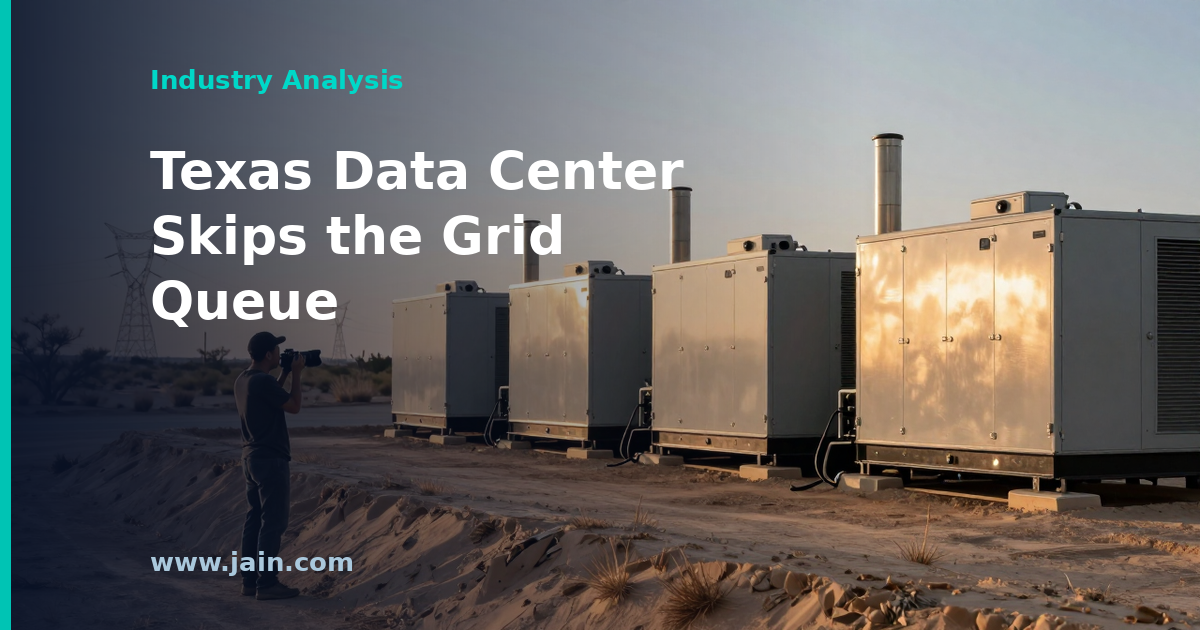
  • Texas Data Center Goes Behind the Meter Amid Grid Delays

    Texas Data Center Goes Behind the Meter Amid Grid Delays

    Data Center Knowledge reported on 9 May 2026 that a Texas data center has stopped waiting for a grid connection and will instead be served by generation sited behind the meter — industry shorthand for power that reaches the load without passing through the utility’s revenue meter, typically from plant on or adjacent to the customer’s own property. The stated trigger is delay in the interconnection queue: the study-and-approval process through which a large new load or generator is modelled, cleared and physically tied into the transmission network.

    The report as circulated to us is headline-level. It does not name the operator, the site, the megawatt capacity, the generating technology, the counterparties or the energisation date, so the size of the commitment cannot be established from this source alone.

    Executive Summary

    The substantiated claim is narrow but consequential: at least one Texas data center project has concluded that private generation is a faster route to electrons than the queue for public grid capacity. That is a decision about time, not ideology. A shell with tenants and no power earns nothing, and self-supply converts a regulatory wait into a construction schedule the operator controls.

    It matters because it inverts a fifty-year assumption in this industry. Data centers were historically sited where large, reliable, cheap grid power already existed; the operator’s job was to buy it well. When queue times stretch past the useful life of an AI hardware generation, the operator’s job becomes building a power plant as a precondition of building a data center — a different balance sheet, a different risk register and a different set of counterparties.

    Read with appropriate caution. A single trade report of a single project establishes a direction of travel, not its magnitude. What follows treats the behind-the-meter decision as reported and examines the economics and risks that any such decision entails, while marking clearly where the source is silent.

    What Behind the Meter Actually Buys — and What It Costs

    Grid power is, in ordinary conditions, the cheapest and least troublesome electricity a data center can buy. Someone else finances the plant, maintains it, holds the fuel contracts, carries the outage risk and spreads the cost across many customers. Going behind the meter means taking all of that onto your own books: capital for generating equipment, firm fuel supply, air permits, spare parts, operators on shift, and redundancy engineered to the availability level your tenants’ contracts require.

    What the operator gets in exchange is a schedule. Interconnection is an administrative queue in which the customer’s position is set by process, not by willingness to pay; on-site generation is a procurement and construction problem, and construction problems respond to money. The arithmetic that makes the swap rational is straightforward: if a leased or pre-let facility is earning nothing while it waits, the carrying cost of idle capital plus foregone revenue can exceed the premium on self-generated power for a long time. That premium is real, and it recurs every year the plant runs.

    The corollary is that this decision is much easier with contracted demand behind it. Speculative capacity rarely justifies a private power plant. Where an operator has firm hyperscale or AI tenancy, the revenue is certain enough to underwrite generation assets; where it does not, behind-the-meter economics look considerably thinner. The report does not tell us which situation applies here, and that distinction changes how much the case should be generalised.

    The Queue Became the Scarce Asset

    For most of the past decade the constraints on data center siting were land, fibre routes, water, tax treatment and labour. Power was a line item. The last few years have promoted grid access to the binding constraint almost everywhere large campuses are proposed, and the practical effect is that a credible, near-dated path to megawatts is now the asset being competed for — more than the acreage it sits on.

    That reordering creates identifiable winners. Suppliers of on-site generating equipment and the engineering firms that install it gain pricing power, because their delivery slots are what a stranded project is actually buying. Landowners with gas pipeline adjacency, existing industrial permits or brownfield interconnects become disproportionately valuable. Developers who can present a financed, permitted power solution can charge for certainty in a market where certainty is scarce.

    The losers are less visible. Developers whose principal advantage was an early queue position lose that advantage when rivals stop queuing. Utilities forgo the load growth that would have supported their own investment cases, and lose the revenue base across which fixed network costs are spread. System planners face a harder forecasting problem when significant demand exists but does not appear as grid load. None of these effects is catastrophic at the scale of one project; all of them compound if the pattern holds.

    Texas Rules, Texas Risks

    Texas is a plausible place for this to surface first. ERCOT, the grid operator covering most of the state, runs an energy-only market and sits largely apart from the two big interconnections that cover the rest of the country, which has historically made it quick to build in and attractive to load. Rapid demand growth has strained that reputation, and Texas has abundant gas infrastructure and a permitting culture that makes private generation a more available answer than it would be in many jurisdictions.

    It also lands in an unresolved policy argument that deserves scrutiny in both directions. Consumer advocates argue that very large loads which self-supply but retain grid ties for backup or standby service should still contribute to the network costs they rely on; operators argue that adding generation alongside new demand relieves rather than burdens the system. Both positions are testable and neither should be accepted on assertion: the fair questions are what the load’s actual grid interaction looks like under stress, whether the on-site plant is dispatchable to the system or purely captive, and what the standby tariff genuinely recovers. Nothing in this report answers those questions for this project.

    The risk ledger is equally concrete. Generating equipment has its own multi-year lead times, so the swap is not automatically fast. Firm fuel transport must be contracted, and fuel price exposure moves onto the operator. Air permitting can consume the schedule the queue exit was meant to save. And behind-the-meter is often a bridge rather than a destination — many operators intend to connect eventually and run private generation as an interim or hybrid arrangement. Whether that is the plan here is precisely the sort of thing the available reporting does not say.

    Background

    Data centers were traditionally sited where large, reliable grid power already existed, alongside fibre routes, water and favourable tax treatment. The rise of AI training and inference workloads has pushed campus power requirements to a scale that many transmission systems cannot absorb quickly, and the interconnection queue — the sequential study process that clears new loads and generators for connection — has become the binding constraint on when a facility can open rather than a routine administrative step.

    Texas is a focal point for that pressure. Most of the state is served by ERCOT, an energy-only market operating largely independently of the wider US interconnections, which long gave it a reputation for speed and low cost and attracted heavy data center investment. As demand growth has outpaced network build-out, operators there have increasingly explored on-site generation, co-location with power plants and other private-supply arrangements. Data Center Knowledge, which reported this case, is a long-established trade publication covering the sector.

    Source: Interconnection Delays Push Texas Data Center Behind the Meter — Data Center Knowledge, 9 May 2026, reporting that grid connection delays have led a Texas data center to adopt behind-the-meter power.