Tag: Nvidia

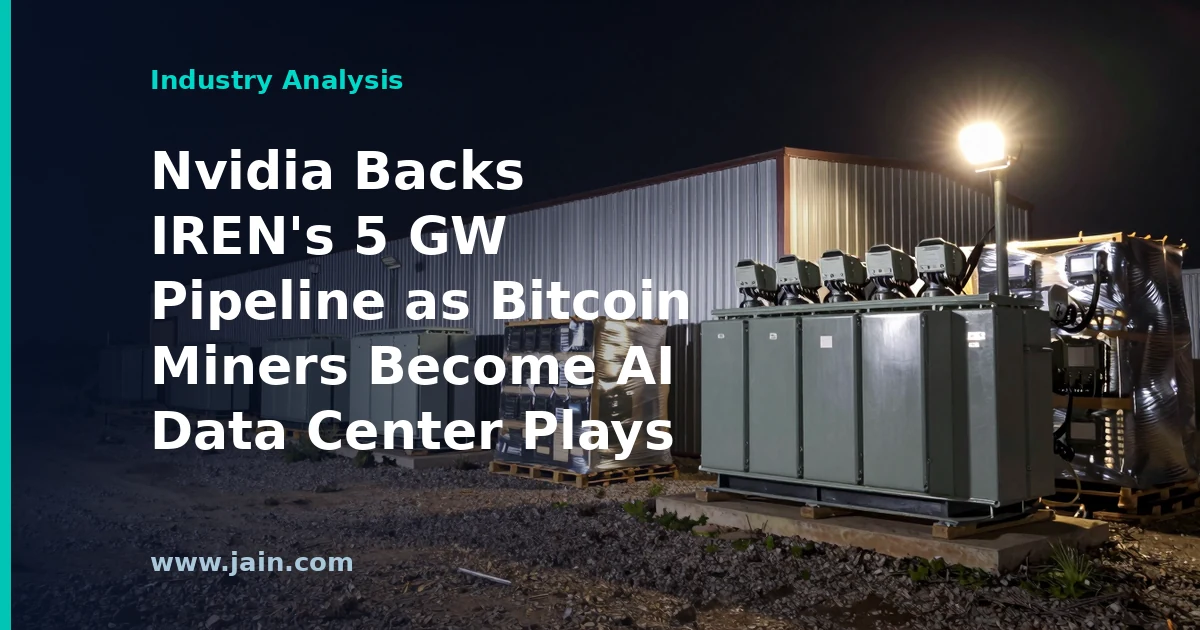
  • Nvidia Backs IREN’s 5 GW Pipeline as Bitcoin Miners Become AI Data Center Plays

    Nvidia Backs IREN’s 5 GW Pipeline as Bitcoin Miners Become AI Data Center Plays

    Nvidia is placing what Data Center Knowledge describes as a massive AI infrastructure bet on IREN, the Nasdaq-listed data center operator formerly known as Iris Energy, and its roughly 5 gigawatt (GW) power pipeline. IREN began life as a renewable-powered bitcoin miner and has been repositioning its sites for AI computing.

    The report, published May 8, 2026, frames the move as part of a broader pattern: the world’s dominant AI chip maker is increasingly underwriting former cryptocurrency miners as vehicles for deploying its GPUs at scale.

    Executive Summary

    The significance here is less about any single transaction and more about what Nvidia’s endorsement confers. In today’s AI buildout, the binding constraint is no longer chips — it is energized land: sites with grid interconnection agreements, substations, and megawatts ready to draw. Bitcoin miners spent years accumulating exactly that, and IREN’s claimed 5 GW pipeline is among the largest such positions held by any former miner.

    Nvidia backing a partner is a well-established playbook — the company took an equity stake in GPU cloud provider CoreWeave, itself a former Ethereum miner, before CoreWeave’s rise to prominence. Support from Nvidia typically signals preferential access to scarce GPU allocations, which in turn helps a company raise capital and sign customers. For IREN, that halo could be worth as much as any cash involved.

    A caveat readers should hold onto: the available source material is a headline-level report, and it does not spell out the structure of Nvidia’s commitment — whether equity, chip supply priority, purchase commitments, or some combination. We flag what is and is not substantiated throughout.

    Why Nvidia Underwrites Its Own Customers

    Nvidia sells the picks and shovels of the AI gold rush, but picks are useless without mines — physical data centers with power, cooling, and fiber. By backing infrastructure operators, Nvidia expands the universe of buyers who can actually deploy its chips, diversifies demand beyond a handful of hyperscale cloud providers (Microsoft, Amazon, Google), and gains negotiating leverage against those same hyperscalers, who are all designing in-house AI silicon.

    The strategy has precedent and critics alike. Supporting CoreWeave paid off handsomely. But analysts have raised fair questions about circularity when a chip vendor’s investment flows back to it as chip purchases: revenue is real, yet the demand signal is partly self-generated. Without the deal terms disclosed, one cannot say how much of that concern applies here — which is precisely why the terms matter.

    Power Is the Moat: The Logic of the Bitcoin-to-AI Pivot

    A gigawatt is roughly the output of a large nuclear reactor; 5 GW is enough electricity for several million homes. Grid interconnection queues in the United States now routinely run five years or more, so a company holding approved connections and built substations owns something money cannot quickly buy. That is the asset bitcoin miners stumbled into: they built low-cost, high-density power infrastructure when nobody else wanted it.

    The pivot is not trivial, however. Bitcoin mining tolerates cheap, interruptible power and minimal redundancy; AI training and inference customers demand high uptime, liquid cooling for dense GPU racks, and enterprise-grade networking. Converting a mining site into an AI-grade facility means substantial re-engineering and capital — typically an order of magnitude more per megawatt than the original mining buildout. IREN, which runs sites on renewable-heavy grids in Texas and British Columbia, has been investing in exactly this conversion, but the pace and cost of that transition are where execution risk lives.

    Reading the 5 GW Number Carefully

    “Pipeline” is a term of art in data center development, and it deserves scrutiny wherever it appears — from IREN or any competitor. A pipeline typically blends operating capacity, sites under construction, and land with power applications in varying stages of approval. The operating fraction is usually a small share of the headline figure. The report does not break down how much of IREN’s 5 GW is energized today versus contracted, queued, or aspirational.

    That distinction determines the economics. Energized megawatts can generate AI revenue within quarters; queued megawatts may be years and billions of dollars away. Nvidia’s backing suggests the company has seen enough to be confident, but investors should want the same breakdown Nvidia presumably received: megawatts by status, by site, and by expected energization date.

    Winners, Losers, and the Competitive Ripple

    If Nvidia’s model of anointing power-rich partners continues, the winners are miners with large, well-located, transferable power portfolios — and the electricity-rich regions that host them. Traditional data center developers, who must start interconnection processes from scratch, face a compressed timeline disadvantage. Hyperscalers gain another supply option but also another Nvidia-aligned competitor for the same GPUs.

    The losers may be smaller miners without convertible assets, and potentially the bitcoin-mining business lines themselves, as boards conclude AI hosting offers steadier, contract-backed returns than volatile block rewards. For enterprise buyers of AI compute, more supply entering the market from converted mining sites should, over time, ease pricing and availability — assuming these conversions deliver true data-center-grade reliability.

    Background

    IREN was founded in 2018 as Iris Energy and listed on Nasdaq in 2021 as a renewable-powered bitcoin miner, later rebranding as IREN to reflect a broader data center ambition. Like several large miners, it responded to the post-2022 AI boom by redirecting its power-rich sites toward GPU computing, buying Nvidia hardware and marketing AI cloud services alongside its mining business.

    The backdrop is an industry-wide land rush: AI demand has outstripped the electric grid’s ability to connect new data centers, turning companies with secured megawatts into acquisition and partnership targets. Nvidia, whose GPUs power most AI training, has repeatedly used investments and partnerships — most famously with CoreWeave — to cultivate infrastructure partners beyond the major cloud providers.

    Source: Nvidia Places Massive AI Infrastructure Bet on IREN’s 5 GW Pipeline — Data Center Knowledge report, May 8, 2026, on Nvidia’s backing of IREN’s AI data center expansion.
  • NVIDIA–IREN 5GW Pact: GPU Vendors Now Underwrite AI Buildouts

    NVIDIA–IREN 5GW Pact: GPU Vendors Now Underwrite AI Buildouts

    NVIDIA and IREN Limited announced a strategic partnership on May 7, 2026, aimed at accelerating the deployment of up to 5 gigawatts (GW) of AI infrastructure. IREN, a Nasdaq-listed data center operator that pivoted from Bitcoin mining to AI cloud services, becomes one of the largest publicly named partners in NVIDIA’s growing web of direct infrastructure alliances.

    The announcement, issued through NVIDIA’s newsroom, frames the deal as a build-out acceleration pact; the headline figure is capacity — power, not dollars — and the companies did not disclose financial terms in the material reviewed here.

    Executive Summary

    The world’s dominant AI chipmaker and one of the fastest-rising ‘neocloud’ operators — companies that build GPU-packed data centers and rent the computing power out — have formalized a partnership targeting up to 5GW of AI infrastructure. For scale, 5GW is roughly the output of five large nuclear reactors and exceeds the total data center capacity of most major metropolitan markets today.

    Why it matters: NVIDIA has been steadily moving beyond selling chips into shaping who gets to build the facilities that consume them — through investments, supply commitments, and named partnerships with operators like CoreWeave and now IREN. A GPU vendor putting its name directly behind a gigawatt-scale buildout compresses the traditional separation between component supplier and infrastructure developer.

    For IREN, NVIDIA’s public endorsement is arguably as valuable as any commercial term: it signals priority access to scarce GPUs, the binding constraint for every AI cloud operator, and validates the company’s multi-year pivot from cryptocurrency mining to AI compute.

    The Chipmaker Becomes the Kingmaker

    Historically, semiconductor vendors sold components and let customers worry about buildings, power, and financing. That model is inverting. NVIDIA has taken equity stakes in GPU cloud providers, arranged supply priority for favored partners, and now attaches its name to a 5GW deployment target with a single operator. When allocation of the scarcest input in the AI economy — leading-edge GPUs — flows through strategic partnerships, the vendor effectively chooses which infrastructure players scale and which wait in line.

    This has real market-structure consequences. Operators inside NVIDIA’s partnership perimeter can raise capital more cheaply, because lenders and investors treat GPU access as the key execution risk. Operators outside it face a harder story. The deal is therefore best read not just as an IREN milestone but as another data point in NVIDIA’s construction of a vertically aligned ecosystem — one that competitors, regulators, and hyperscale customers are all watching closely.

    Why IREN: Power First, Chips Second

    IREN’s core asset is not silicon — it is secured electrical capacity. The company, which began as Bitcoin miner Iris Energy, spent years assembling large, renewables-oriented power positions, including a multi-gigawatt development hub in West Texas and hydro-powered sites in British Columbia. In today’s market, grid interconnection queues stretch years and available power — not capital or land — is the gating factor for AI data centers. An operator holding contracted gigawatts is holding the scarce complement to NVIDIA’s scarce GPUs.

    The partnership logic is symmetrical: NVIDIA needs credible places to deploy the chips it sells in enormous volumes; IREN needs assured chip supply to monetize its power pipeline. IREN’s late-2025 multi-billion-dollar AI cloud contract with Microsoft — reported at roughly $9.7 billion — had already demonstrated hyperscaler demand for its capacity. A named NVIDIA partnership adds the supply-side anchor.

    Reading ‘Up to 5 Gigawatts’ Carefully

    The phrase ‘up to’ is doing significant work. A 5GW ceiling is an ambition, not a contracted delivery schedule, and the announcement as reviewed does not specify phasing, capital commitments, or who funds what. Building 5GW of AI-grade data centers would plausibly require investment on the order of hundreds of billions of dollars across facilities, chips, and grid upgrades over many years — commitments far beyond what a partnership press release itself establishes.

    That is not a criticism unique to this deal; it is the standard grammar of AI infrastructure announcements in this cycle, where headline gigawatt and dollar figures routinely describe multi-year aspirations. The substantiated core here is narrower but still meaningful: NVIDIA has publicly designated IREN a strategic deployment partner at a scale ceiling few operators can claim. Investors and customers should track converted megawatts — energized, GPU-filled capacity under contract — rather than announced ceilings.

    Winners, Losers, and the Financing Question

    Winners, if the buildout converts: IREN, whose cost of capital and customer pipeline both improve; power-rich regions like West Texas that host the load; and NVIDIA itself, which locks in demand visibility for future GPU generations. Under pressure: mid-tier colocation and cloud players without vendor alignment, and any operator whose business case assumed GPU scarcity would ration competitors’ growth.

    The open question is who carries the balance-sheet risk. GPU-backed infrastructure depreciates fast — accelerator generations turn over roughly every one to two years — and neocloud operators fund buildouts with debt secured against chips and customer contracts. If AI compute pricing softens before this capacity earns out, the pain lands on whoever financed the gap between announcement and cash flow. The release, as reviewed, does not say how that risk is allocated between the partners.

    Background

    IREN began life in 2018 as Iris Energy, an Australian-founded Bitcoin miner that differentiated itself by siting operations on low-cost, renewable-heavy power in British Columbia and later Childress, Texas. It listed on Nasdaq in 2021, and as AI demand exploded it converted its power-first playbook into an AI cloud business, buying NVIDIA GPUs and building high-density data centers — a pivot capped by a reported multi-billion-dollar cloud contract with Microsoft in late 2025.

    NVIDIA, meanwhile, has evolved from graphics chipmaker into the central supplier of AI computing and, increasingly, an active architect of the infrastructure layer: investing in cloud partners, steering GPU allocation, and publicly backing large deployments. This partnership sits squarely in that pattern — a chip vendor underwriting, at least reputationally, a gigawatt-scale buildout.

    Source: NVIDIA and IREN Announce Strategic Partnership to Accelerate Deployment of up to 5 Gigawatts of AI Infrastructure — NVIDIA Newsroom announcement, May 7, 2026.

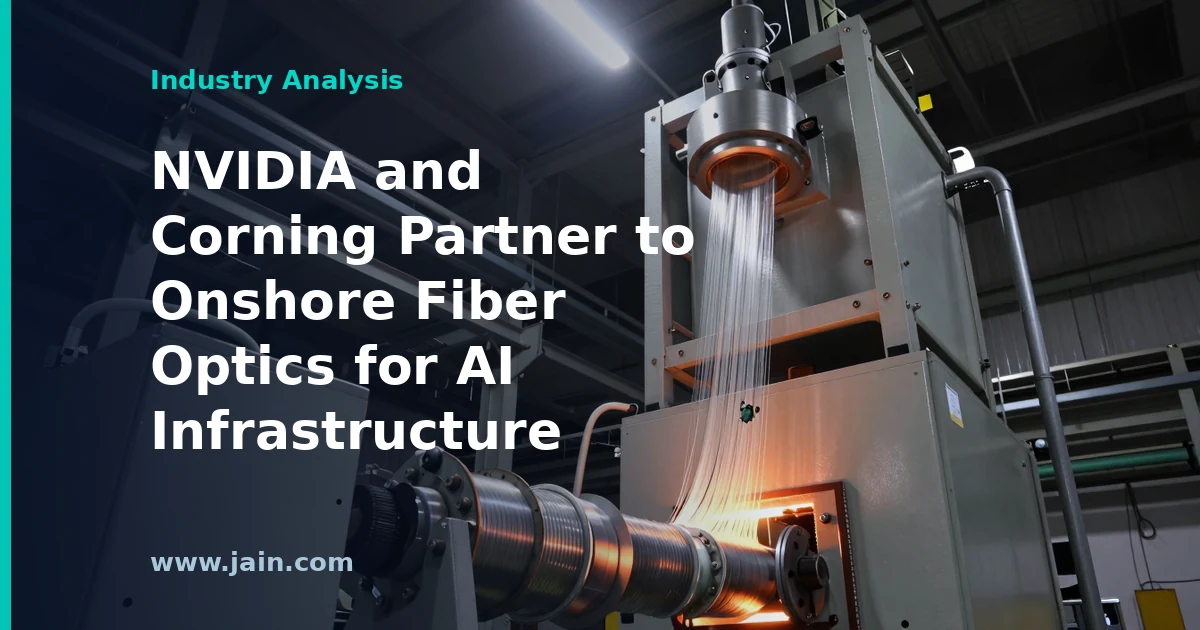
  • NVIDIA and Corning Partner to Onshore Fiber Optics for AI Infrastructure

    NVIDIA and Corning Partner to Onshore Fiber Optics for AI Infrastructure

    NVIDIA and Corning announced a long-term partnership on May 5, 2026, aimed at strengthening US manufacturing for AI infrastructure, according to a release published through the NVIDIA Newsroom. The tie-up pairs the dominant supplier of AI accelerator chips with the company that invented low-loss optical fiber and remains America’s leading producer of it.

    The announcement, as distributed, is headline-level: it frames the partnership around domestic manufacturing capacity for the optical components AI data centers consume, but the source text does not disclose financial terms, volumes, or specific facilities.

    Executive Summary

    The partnership signals something the AI build-out has made increasingly clear: the constraint on giant GPU clusters is no longer just chips. Modern AI data centers are, in a real sense, optical networks with computers attached — tens of thousands of processors stitched together by fiber links, each rack consuming far more optical connectivity than a traditional cloud facility. A chipmaker locking arms with a glass and fiber manufacturer is a recognition that the network fabric is now part of the product.

    For Corning, a long-term relationship with the largest buyer-influencer in AI infrastructure offers the kind of demand visibility that justifies factory investment. For NVIDIA, it extends a broader pattern of shoring up US-based supply for the components its platforms depend on. For everyone else — data center operators, competing optics suppliers, and policymakers pushing domestic manufacturing — the deal is a marker of where the AI supply chain is consolidating.

    What it is not, at least based on what the release makes public, is a quantified commitment. Without disclosed dollars, volumes, or timelines, the announcement is directionally significant but not yet measurable.

    Why AI Data Centers Are Suddenly a Fiber Story

    Training and running large AI models requires connecting thousands of GPUs so tightly that they behave like one machine. Every one of those connections — between chips, between servers, between rows of racks — increasingly runs over optical links, because light through glass fiber carries far more data over distance than copper wire can. The result is that an AI facility consumes multiples of the fiber, optical transceivers, and cable assemblies of a conventional data center of the same size.

    That is why an announcement between a semiconductor company and a materials manufacturer makes strategic sense. NVIDIA sells not just chips but entire cluster architectures, and those architectures are only as deliverable as their weakest supply line. Optical connectivity has repeatedly been a pinch point during the AI build-out, and securing it upstream is cheaper than discovering a shortage downstream.

    Onshoring the Optical Supply Chain

    The release’s framing — “strengthen US manufacturing” — places the deal squarely in the broader push to bring strategic component production back to American soil. Optical fiber and cable production is a global industry, and US policymakers have treated domestic capacity for critical infrastructure inputs as a national priority. A long-term partnership with an anchor customer is the classic mechanism for making onshoring economics work: manufacturers hesitate to build domestic capacity without demand certainty, and buyers hesitate to depend on capacity that does not yet exist. Pairing off resolves both hesitations at once.

    The trade-offs are real, though. Domestic manufacturing can carry higher costs than established overseas supply chains, and new capacity takes time to ramp. Whether this partnership changes the market depends on execution details the announcement does not provide — how much capacity, where, and by when.

    What It Means for Corning and the Competitive Field

    Corning brings unusual credibility to this role: it invented low-loss optical fiber in 1970 and has manufactured it in the United States for decades. A durable relationship with the central player in AI infrastructure gives it a privileged position in the fastest-growing segment of the optical market, and demand visibility that can underwrite capital spending shareholders might otherwise question.

    For competing fiber and optical component makers, the signal is more mixed. When anchor customers and suppliers pair off, remaining demand becomes more contestable but also more volatile. And for data center operators and enterprises buying connectivity, the second-order effect is worth watching: supply assurance for NVIDIA-aligned deployments could tighten availability elsewhere if overall capacity does not grow as fast as the partnership implies.

    Reading the Announcement Critically

    Corporate partnership announcements span a wide spectrum — from binding, take-or-pay purchase agreements to memoranda of understanding with no enforceable commitments. The source material here, distributed as a headline through a news aggregator, does not establish where on that spectrum this deal sits. No dollar figures, product mix, facility plans, or hiring numbers are cited in what was published.

    That does not make the announcement empty; both companies have reputations and existing US manufacturing footprints that lend it weight. But readers should treat the strategic direction as substantiated and the scale as unproven until either company attaches numbers — in capital expenditure disclosures, earnings commentary, or facility announcements — that can be verified against it.

    Background

    Corning, founded in 1851, is one of America’s oldest materials-science companies; its researchers invented low-loss optical fiber in 1970, the breakthrough that made modern telecommunications and the internet physically possible. It remains the leading US manufacturer of optical fiber, cable, and connectivity solutions for telecom carriers and data centers. NVIDIA, whose graphics processors became the workhorses of the AI boom, has grown into the central supplier of AI computing platforms and has increasingly emphasized building out US-based manufacturing for the infrastructure surrounding its chips.

    The partnership lands amid a historic wave of AI data center construction, in which optical networking — once a background utility — has become a recognized bottleneck, and amid a sustained US policy push to onshore manufacturing of strategically critical technology components.

    Source: NVIDIA and Corning Announce Long-Term Partnership to Strengthen US Manufacturing for AI Infrastructure — NVIDIA Newsroom release, May 5, 2026, announcing a long-term US manufacturing partnership for AI infrastructure optics.

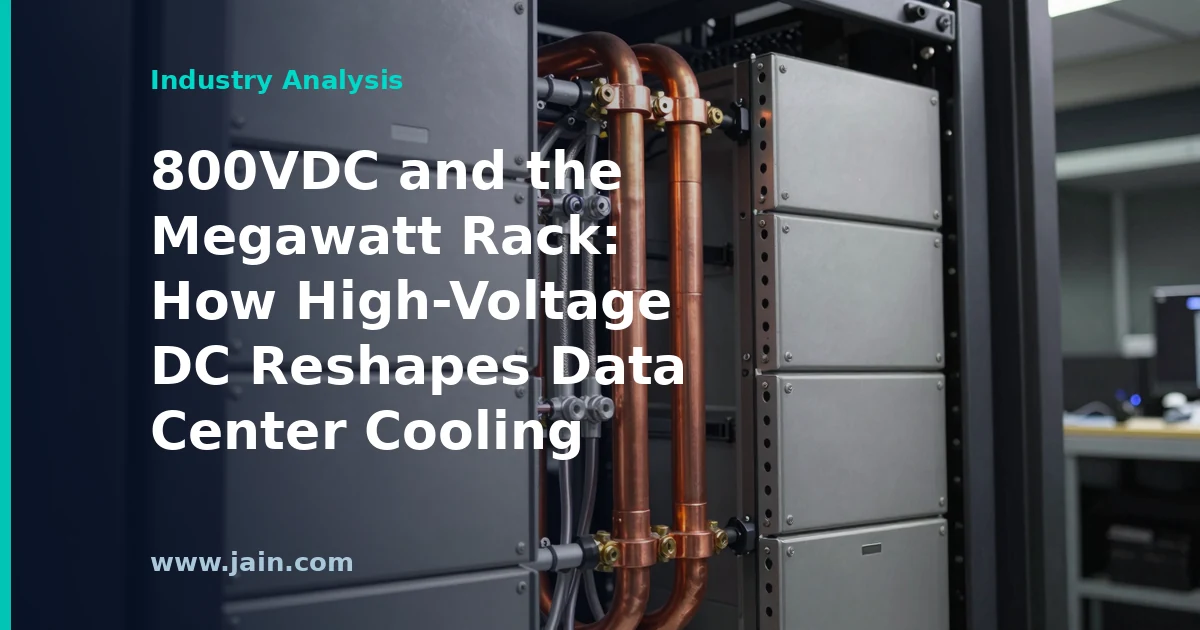
  • 800VDC and the Megawatt Rack: How High-Voltage DC Reshapes Data Center Cooling

    800VDC and the Megawatt Rack: How High-Voltage DC Reshapes Data Center Cooling

    Data Center Dynamics has published an analysis of 800-volt direct current (800VDC) power distribution and its knock-on effects for data center cooling, examining the infrastructure evolution and operational impact of the architecture now being proposed for next-generation AI racks. The piece lands as the industry debates how facilities designed around alternating current (AC) and 54-volt in-rack distribution adapt to rack power densities approaching a megawatt.

    Executive Summary

    The subject is a plumbing-and-wiring story with strategic stakes: as AI accelerator racks climb toward megawatt-class power draws, the conventional approach — converting utility AC power through multiple stages down to low-voltage DC inside the rack — runs into hard physical limits on copper, conversion losses, and space. Moving distribution to 800VDC, an approach publicly championed by NVIDIA and partners across the power-electronics ecosystem for its next-generation rack designs, promises fewer conversion stages, dramatically thinner conductors, and higher end-to-end efficiency.

    The DCD analysis focuses on the less-discussed second-order effect: what this does to cooling. Every watt saved in power conversion is a watt of heat that never has to be removed, but the racks 800VDC enables are so dense that liquid cooling becomes a prerequisite rather than an option. Power architecture and thermal architecture, historically designed by separate teams against separate budgets, are converging into a single engineering problem — and operators, colocation providers, and equipment vendors will all feel the shift.

    Why a Power Story Is Really a Cooling Story

    In a data center, electricity and heat are two views of the same quantity: essentially all power delivered to IT equipment leaves as heat that the cooling plant must reject. Every stage of power conversion — utility voltage to distribution voltage, AC to DC, high DC to the roughly one volt a chip core actually uses — wastes a slice of energy as heat, often inside the white space where cooling is most expensive. Collapsing conversion stages with 800VDC distribution reduces that parasitic load. But the same architecture exists to feed racks far denser than air can handle: at hundreds of kilowatts per rack and beyond, direct-to-chip liquid cooling with cold plates, coolant distribution units (CDUs), and facility water loops stops being an exotic option and becomes the baseline design.

    That coupling changes how facilities get engineered. Busbar routing, cold-plate manifolds, leak detection, and serviceability now compete for the same rack volume. The DCD piece’s framing — implications, infrastructure evolution, operational impact — reflects a real shift in the industry conversation from “can we power it” to “can we power and cool it as one integrated system.”

    What Actually Changes Between 54 Volts and 800

    Today’s high-density AI racks typically distribute power internally at around 54 volts DC over copper busbars. Power scales with voltage times current, so at fixed voltage, a megawatt rack demands enormous current — and current is what sizes conductors, connectors, and their resistive losses. Raising distribution to 800VDC cuts the current for the same power by an order of magnitude, which is why the approach shrinks copper requirements and frees rack space for compute and cooling hardware. It also moves bulky AC-to-DC conversion equipment out of the rack into dedicated infrastructure, a further gift of space and a relocation of its heat.

    For the thermal engineer, the ripple effects are concrete: less conversion loss inside the rack, but far more total heat per rack; new hot components (DC converters, solid-state protection devices) in new places; and coolant loops that must be designed around high-voltage conductors with appropriate creepage, isolation, and leak-response assumptions. None of this is unsolvable — electric vehicles and utility-scale solar have normalized high-voltage DC engineering — but it is genuinely new practice for most data center operations teams.

    The Operational Bill: Skills, Safety, and Serviceability

    The quiet cost of the transition is human. Data center technicians are trained on AC systems and low-voltage DC; 800VDC introduces different arc-flash behavior, different lockout and protection practices, and different failure modes, now interleaved with pressurized liquid-cooling loops in the same enclosure. Procedures for a coolant leak near an energized 800V busbar have to be written, trained, and drilled before the first rack lands. Vendors will point to sealed, engineered systems; operators will reasonably ask who is qualified to service them and on what schedule.

    There is also a monitoring and commissioning dimension. When power and cooling are co-designed, so must be their telemetry: a CDU fault and a DC bus fault can each cascade into the other’s domain within seconds at megawatt densities. Operators evaluating 800VDC-era equipment should scrutinize integration of electrical and thermal controls as closely as the headline efficiency figures.

    Winners, Losers, and the Retrofit Question

    The clearest beneficiaries are power-electronics and liquid-cooling suppliers, which gain a generational replacement cycle, and hyperscale builders designing greenfield AI factories where the whole electrical-thermal stack can be specified at once. The harder position belongs to operators of existing facilities: buildings engineered around air cooling, AC distribution, and 10–30 kW racks cannot simply be re-declared 800VDC-ready. Some will retrofit power and cooling in tandem; others will find their most valuable asset is grid connection and land rather than the building itself.

    For colocation providers and enterprise buyers, the pragmatic takeaway is sequencing. 800VDC is a roadmap item tied to next-generation rack platforms, not a description of most 2026 deployments — but cooling and electrical decisions made today have 15-to-20-year design lives. Facilities being planned now should at minimum preserve optionality: structural allowances for liquid loops, space for DC plant, and staff development that anticipates high-voltage practice.

    Background

    Data center power delivery has evolved in steps: from AC distribution to the server, to rack-level busbars at 12 and then 54 volts DC, each change driven by rising density. The AI buildout broke the curve — accelerator racks jumped from tens of kilowatts to hundreds, with roadmaps pointing toward a megawatt per cabinet, forcing the industry to revisit both how power reaches silicon and how heat leaves it. In 2025, NVIDIA and a wide ecosystem of power and cooling partners publicly outlined 800VDC distribution for next-generation rack platforms, borrowing high-voltage DC practice from electric vehicles and utility-scale solar.

    Data Center Dynamics, the trade publication behind the source analysis, has tracked the parallel rise of liquid cooling from niche to necessity. The convergence of those two threads — high-voltage power and liquid thermal management as one co-designed system — is the backdrop for this piece and for facility design decisions now being made with multi-decade consequences.

    Source: 800VDC data center cooling: Implications, infrastructure evolution and operational impact — Data Center Dynamics analysis of how 800-volt DC power architecture reshapes data center cooling design and operations, published April 24, 2026.

  • Google Unveils New AI Chips for Training and Inference in Latest Challenge to Nvidia

    Google Unveils New AI Chips for Training and Inference in Latest Challenge to Nvidia

    Google has unveiled a new generation of custom chips designed to handle both AI training — the compute-intensive process of building large models — and inference, the day-to-day work of running them, according to CNBC coverage published April 21, 2026. The announcement is the latest move in Google’s decade-long effort to reduce its dependence on Nvidia, whose graphics processing units (GPUs) dominate the market for AI accelerators.

    Executive Summary

    The announcement, as reported, positions Google’s newest silicon as a dual-purpose platform: one chip family aimed at both building frontier AI models and serving them to users at scale. That framing matters. Training has historically drawn the headlines, but inference — every chatbot reply, every AI-generated search answer — is where the industry’s recurring costs now accumulate, and where cloud providers have the strongest incentive to control their own hardware economics.

    It is worth being direct about what is and is not substantiated here. The coverage available at publication is headline-level: it confirms that new chips exist and that they target both workloads, but it does not, in the material we reviewed, disclose performance figures, availability dates, pricing, or named customers. Our analysis therefore focuses on the well-documented market context this announcement lands in, rather than on claims the source does not support.

    What is beyond dispute is the strategic direction. Google has designed its own Tensor Processing Units (TPUs) since the mid-2010s, and each new generation tightens the competitive pressure on Nvidia — not by selling chips against it, but by giving one of the world’s largest AI operators, and its cloud customers, a credible alternative.

    The Custom-Silicon Race Enters a New Phase

    Every major cloud provider now designs its own AI accelerators. Google was earliest with its TPU line, Amazon Web Services followed with Trainium and Inferentia, and Microsoft has developed its Maia chips. The motivation is the same across all three: Nvidia’s GPUs are extraordinarily capable but also expensive, supply-constrained, and sold on Nvidia’s terms. For companies spending tens of billions of dollars a year on AI infrastructure, even a modest cost or efficiency advantage from in-house silicon compounds into enormous savings.

    A new TPU generation covering both training and inference signals that Google intends to compete across the full AI lifecycle, not just in niches. That is a meaningful escalation. Custom chips that only serve inference concede the most prestigious workloads — frontier model training — to Nvidia. A chip family credibly pitched at both erodes that concession.

    Why Pairing Training and Inference Matters

    Training a large model is a massive one-time (or periodic) expense; inference is a cost that scales with every user, every query, every day. As AI products move from demos to mass deployment, industry attention has shifted toward the price of serving models — often measured in cost per token, the basic unit of AI text processing. Hardware optimized for inference can trade raw flexibility for efficiency, lowering that recurring bill.

    Announcing one platform for both workloads also simplifies the operational picture inside data centers. Operators can, in principle, shift capacity between training and serving as demand fluctuates, rather than maintaining separate fleets. Whether Google’s new chips actually deliver that flexibility is exactly the kind of claim that requires benchmarks the coverage does not yet provide.

    The Economics of Not Selling Chips

    Google’s challenge to Nvidia is structurally unusual: Google has historically not sold TPUs as merchant silicon. Instead, it rents access to them through Google Cloud and uses them to run its own services. The competitive effect is indirect but real — every workload that runs on a TPU is a workload Nvidia doesn’t monetize, and every credible TPU generation strengthens Google’s negotiating position when it does buy Nvidia hardware, which it continues to do at scale.

    The harder question is software. Nvidia’s dominance rests as much on CUDA — its mature, widely adopted programming ecosystem — as on its chips. Developers, frameworks, and years of accumulated code default to Nvidia. Google’s counter has been to optimize its own software stack for TPUs, which works well inside Google and for cloud customers willing to adapt, but keeps the broader market’s center of gravity with Nvidia. A new chip alone does not change that; sustained software investment might.

    What It Means for the Infrastructure Layer

    For data center operators and the wider infrastructure industry, chip diversity is broadly good news. A market with multiple viable accelerators eases the supply bottlenecks that have delayed AI buildouts, and competition on efficiency directly shapes facility design — modern AI accelerators drive rack power densities that increasingly demand liquid cooling and substantial electrical upgrades.

    For enterprise AI buyers, the practical takeaway is optionality. Cloud customers evaluating where to train or serve models now have a genuine multi-vendor landscape to price against, even if switching costs remain significant. The winners in that dynamic are large-scale buyers; the risk sits with anyone betting that any single vendor’s roadmap — Nvidia’s included — will define the market indefinitely.

    Background

    Google was the first hyperscaler to design its own AI accelerator, deploying Tensor Processing Units internally in the mid-2010s and offering them to cloud customers later that decade. The program began as a way to run Google’s own AI services more efficiently and has since become a strategic pillar of Google Cloud’s pitch to AI developers. Nvidia, meanwhile, transformed from a graphics-chip company into the dominant supplier of AI compute, with its GPUs powering the vast majority of large-model training worldwide and its market value soaring on AI demand.

    That dominance made Nvidia’s largest customers — Google, Amazon, Microsoft, and Meta among them — also its most motivated potential competitors. Each now invests heavily in custom silicon, not necessarily to sell chips, but to control the cost and supply of the infrastructure their AI ambitions depend on. This announcement is the latest chapter in that structural tension.

    Source: Google unveils chips for AI training and inference in latest shot at Nvidia — CNBC report, April 21, 2026, on Google’s newest custom AI accelerators.