A contractor who worked with Super Micro, an American company that builds the powerful computers used to run artificial intelligence, has admitted in court to helping send those machines to China illegally. The scheme was valued at $2.5 billion.
The computers held chips from Nvidia, whose chips power much of today’s AI. US rules bar selling those advanced chips to China without government permission.
Why it matters: the case targets the people between the chipmaker and the final buyer, not the chipmaker itself. Enforcement is reaching further down the supply chain.
A contractor tied to Super Micro Computer has pleaded guilty in a scheme to divert AI servers containing Nvidia chips to China, Reuters reported. Coverage puts the scheme’s value at $2.5 billion and describes the contractor as a co-defendant of a Super Micro co-founder.
The plea comes in the same week Super Micro disclosed board changes in an 8-K filed October 8. That filing does not mention the export case.
Executive Summary
A guilty plea in a $2.5 billion AI server diversion scheme is among the clearest signals yet of where US export-control enforcement on AI hardware is landing. The equipment at issue was not loose chips but complete servers built around Nvidia GPUs (graphics processing units, the processors that do most AI computation). The person admitting guilt is a contractor, not an employee of the chipmaker.
That matters because it shifts the compliance burden. Export restrictions on advanced AI chips follow the chip into whatever system it is installed in. That makes everyone who builds, resells or ships those systems a potential point of failure, and of liability. For server makers, distributors and the data center operators who buy from them, the case is a reminder that end-user screening is part of the product, not paperwork around it.
The plea establishes guilt only for the person who entered it. Anything alleged against other defendants remains an allegation, and no charges against Super Micro as a company have been reported.
Where a GPU Becomes a Server, Control Gets Harder
Advanced AI chips leave Nvidia in large, traceable allocations to a relatively small set of server makers and cloud buyers. Once a GPU is installed in a server, it becomes one component inside a finished system. That system can then pass through distributors, contractors and resellers before reaching its final operator. US export rules still apply to the chip inside the box, but the chipmaker’s line of sight usually ends at its direct customer.
That gap is the mechanism this case exposes. The diverted goods were Super Micro AI servers with Nvidia chips inside, and the guilty party is a contractor in the server maker’s orbit. At a reported $2.5 billion, the scheme shows how much hardware value can move through the integration and resale layer, the stage after the chip is sold but before the system is plugged in. Controls written around the chip are only as strong as the checks at that downstream stage.
Those affected are the companies that sit between foundry and data hall: server builders, value-added resellers, logistics contractors, and the compliance teams that sign off on who the end user really is. Nvidia’s chips were in the boxes, but Nvidia is not reported to be a defendant and has made no material SEC filing on the matter. The enforcement weight in this case sits downstream.
What the Channel Now Has to Prove
For server makers and their partners, export compliance means knowing the end user and the end use, not just the immediate buyer. A diversion scheme works by putting a permissible-looking customer between the seller and a prohibited destination. A plea at the contractor level gives every company in that chain reason to scrutinize intermediaries, shipping patterns and resale terms more closely.
The economic effect is friction. Legitimate buyers of AI servers, from enterprise IT departments to colocation tenants, may face more documentation about where systems will be deployed and who will operate them. For integrators competing on speed of delivery during a GPU supply crunch, slower deal reviews carry a real cost. The case makes clear that the alternative cost is higher.
What Is and Isn’t Established About Super Micro
Super Micro is one of the largest builders of Nvidia-based AI servers, so any case involving its products draws attention to the company. The facts on the record are narrower than the headlines. A contractor has admitted guilt. A co-founder is described as a co-defendant, which is an allegation, not a finding. No charges against the company have been reported.
Super Micro’s most recent disclosure is an 8-K covering the appointment of former Intel IT chief technology officer Shesha Krishnapura as an independent director and the retirement of director Judy Lin. The filing states that Lin’s departure was not the result of any disagreement with the company, and it does not reference the case. Reading a connection into the timing would go beyond what either the plea or the filing supports.
Background
Since 2022 the United States has restricted exports of advanced AI chips and the systems built around them to China, through rules administered by the Commerce Department’s Bureau of Industry and Security and tightened in later rounds. Nvidia, the dominant supplier of AI accelerators, sells its GPUs largely through server makers and large cloud buyers, which turn them into finished systems.
Super Micro Computer, based in San Jose, California, is one of the biggest of those server makers and a major builder of Nvidia-based AI systems for data centers. Its fiscal year ended June 30, 2026. In early October it announced a board change, adding former Intel IT chief technology officer Shesha Krishnapura and accepting the retirement of director Judy Lin.
SpaceX, the rocket and satellite company, is reportedly negotiating to borrow $40 billion to buy computer chips from Nvidia, the company whose chips run most artificial intelligence tools.
Apollo, a giant investment firm, would lead the lending, so the chips would be bought with borrowed money rather than money SpaceX already has.
Why it matters: when buying chips depends on loans this large, the AI boom also depends on lenders getting repaid, and AI chips lose value quickly as newer ones arrive.
SpaceX is in talks to borrow $40 billion to buy Nvidia chips, Bloomberg reported. The Financial Times, in a report relayed by Reuters, said Apollo Global Management is leading the financing. No signed agreement has been announced. SpaceX and Apollo have not disclosed terms, the chip quantities, or a timeline.
Executive Summary
The reported financing would put a $40 billion debt package, led by one of the largest private-credit managers, behind a single company’s purchase of AI chips. Private credit means loans made by investment firms rather than banks. Nvidia’s graphics processing units (GPUs) are the specialised processors that train and run most large AI models, and they are the most expensive line item in an AI data center.
It matters because of how the purchase is paid for, not only because of its size. A buyer that pays for chips from operating cash or new equity bears the risk itself. A buyer that borrows $40 billion takes on fixed repayment obligations, and its lenders take on part of the risk. If the talks conclude, how fast SpaceX adds AI computing capacity would depend partly on lender terms, collateral and repayment schedules.
Why a $40 Billion Loan Turns Compute Into a Credit Question
A company that buys AI chips with its own cash answers mainly to its shareholders. If the chips earn less than expected, the owners absorb the loss. A company that borrows $40 billion for the same purchase faces a different test. Interest and principal fall due on a schedule whether or not the hardware is fully used. The lenders, here a group led by Apollo, have to decide in advance how much the chips will earn and how quickly that cash will come in.
That changes the questions that decide the deal. Before committing, lenders typically ask what revenue the computing capacity will produce, how quickly the chips lose value, what they could recover if repayment faltered, and how long the loan runs compared with the hardware’s useful life. None of the terms have been made public. Still, at $40 billion, the answers to those questions would shape the pace and cost of SpaceX’s chip purchases as much as Nvidia’s supply would.
Several groups are exposed. SpaceX would take on fixed obligations. Apollo and any co-lenders, along with the investors whose money they deploy, would take on part of the hardware risk. Nvidia would book demand that rests partly on borrowed money rather than the buyer’s own funds.
Why a Private-Credit Manager Would Lead
Private-credit firms raise long-term capital from insurers, pension funds and other institutions. They can commit large sums to a single borrower and set terms privately, without the public pricing of a bond sale. That makes them a natural fit for a borrower seeking a very large, bespoke package. Reports describe Apollo as leading the financing, which suggests other lenders could take part, though no participants have been named.
Apollo’s balance sheet shows why insurance-linked capital matters to firms like it. In an 8-K filed October 5, Apollo said Athene, its retirement-services subsidiary, holds most of its alternative investments, and estimated third-quarter alternative net investment income of about $375 million pre-tax, an annualised return of roughly 10%. That filing previews quarterly results and does not mention SpaceX or Nvidia. Whether any of the SpaceX exposure would end up on Athene’s books has not been disclosed.
The Depreciation Problem Lenders Have to Price
AI chips lose value faster than most assets usually financed with long-term debt. Nvidia releases new GPU generations frequently, and each one cuts the market value of the last. A loan secured against chips, or repaid from the revenue they generate, is only as sound as its assumptions about how long the hardware stays competitive.
Lenders in AI financings have used the chips themselves as collateral (security that a lender can seize if a loan is not repaid). SpaceX and Apollo have not said whether this deal would be secured that way, or backed instead by SpaceX’s broader business. The difference matters. A loan backed by GPUs ties the lender’s recovery to second-hand chip prices. A loan backed by the whole company ties it to SpaceX’s overall cash flow.
What Follows Downstream: Sites, Power and Cooling
Chips bought with $40 billion of debt only start earning once they are installed and running, so delays in data center capacity become delays in repaying the loan. Each rack of high-end GPUs needs floor space, a reliable electricity supply and, increasingly, liquid cooling, because air alone cannot remove the heat dense AI hardware produces.
For data center developers, utilities and cooling suppliers, debt-financed purchases make the timetable less forgiving. Hardware that sits in a warehouse waiting for power still accrues interest. SpaceX has not disclosed where the chips would be deployed or how much electrical capacity they would require.
Background
Nvidia’s GPUs, originally built for graphics, became the default hardware for training and running large AI models. They are now the most expensive single component of an AI data center, and buyers have funded them through operating cash, equity and, increasingly, debt. SpaceX is best known for rocket launches and satellite services.
Apollo Global Management is a New York-based alternative asset manager. Its businesses include private credit and retirement services through its subsidiary Athene. Apollo is scheduled to report third-quarter results on November 3, 2026, according to its October 5 SEC filing.
Amazon is reportedly trying to sell about $8 billion worth of Nvidia computer chips (the specialized processors that power artificial intelligence services) to outside investors.
That is unusual. Big tech companies normally buy these chips and keep them. Selling them would let Amazon free up cash while someone else owns the hardware.
The catch is that these chips can lose value quickly as newer models arrive. Investors who buy in are betting the chips stay useful long enough to pay off. That bet could shape how the artificial intelligence boom gets paid for.
Amazon is seeking to sell roughly $8 billion worth of Nvidia chips to investors, Reuters reported, citing the Financial Times. The chips are graphics processing units (GPUs), the processors that train and run most large AI models. Amazon has not publicly disclosed the structure, the buyers, the pricing or the timing of the transaction, and the effort is described as being sought rather than completed.
Executive Summary
The world’s largest cloud provider is reportedly looking to move a large block of AI hardware it already owns into the hands of outside investors. At $8 billion, this would be one of the largest single transfers of GPU ownership from a hyperscaler (the industry term for the handful of giant cloud operators such as Amazon Web Services, Microsoft Azure and Google Cloud) to financial buyers.
The transaction matters less for what it does to Amazon’s AI capacity, which has not been disclosed, than for what it asks of the buyers. Anyone paying $8 billion for GPUs has to put a price on things the industry has argued about for two years: how fast these chips become obsolete, how reliably they will be rented out, and who is on the hook if they are not. The answer will show whether AI compute can be financed like aircraft or real estate, as an asset owned by one party and used by another, or whether it stays an asset that only the largest technology companies can hold.
Why a Cloud Giant Would Sell Chips It Already Owns
Hyperscalers have historically funded data center buildouts themselves, out of operating cash flow and corporate bonds, and owned the servers inside outright. Selling installed or purchased hardware breaks with that pattern. Amazon has not explained its reasons. Transactions of this kind usually serve one of two purposes. The first is capital recycling: convert hardware into cash that can be redeployed into new data centers, power contracts or newer chips. The second is balance-sheet management: shift ownership, and with it the depreciation (the accounting charge that spreads a purchase’s cost over its useful life), to another party.
Which purpose applies depends on a detail Amazon has not disclosed: whether it keeps using the chips. In a sale-leaseback, a familiar structure in real estate and aviation, the seller hands over ownership and pays rent to keep operating the asset. In an outright sale, the chips leave Amazon’s fleet entirely. The two lead to very different conclusions about Amazon’s own capacity plans, which is why the reported $8 billion figure alone does not show whether Amazon is adding flexibility or reducing exposure.
What an $8 Billion GPU Buyer Actually Has to Underwrite
This is where the transaction becomes a test of GPUs as an investable asset. A building or a jet has decades of useful life and a deep resale market. An AI accelerator has neither. Nvidia releases new chip generations on a short cycle, and each one resets the performance customers expect per dollar and per watt. An investor holding older GPUs is exposed to that curve. The hardware may still work perfectly, but the rent it can command falls as newer chips arrive.
That leaves a buyer two ways to earn a return, and each has a different risk. If Amazon leases the chips back, the investor is mostly underwriting Amazon’s promise to pay. That is a strong credit, and the deal starts to look like corporate lending with GPUs as collateral. If Amazon does not lease them back, the investor is underwriting the chips themselves: their resale value, the cost of hosting and powering them elsewhere, and the strength of demand from other cloud tenants. Pricing that second scenario at $8 billion would be a much bolder bet on GPU residual value, meaning what the hardware is worth after its first few years of use.
Either way, the price investors will pay is information the market has lacked. Little public data exists on what large blocks of used AI accelerators are worth to financial buyers. A completed transaction at this size would give lenders, insurers and equipment financiers a reference point for valuing GPU collateral elsewhere in the industry.
Who Gains if GPUs Become a Financed Asset
If investor appetite proves deep, the most immediate beneficiaries are capital-hungry builders outside Big Tech: specialist GPU cloud providers, often called neoclouds, and data center developers whose growth depends on borrowing against hardware. A market in which a hyperscaler can sell GPUs to investors is also one in which a smaller operator can borrow against them more easily. For hyperscalers, it adds a funding channel at a time when AI capital spending is large enough to draw scrutiny from shareholders.
The risks fall on the other side of the ledger. Moving hardware ownership to investors does not remove the obsolescence risk. It relocates it, possibly into funds and credit vehicles that are less able to absorb a fast drop in chip values than a cloud operator that can redeploy older chips to cheaper workloads. For Nvidia, the transaction involves chips already sold and does not by itself change its revenue. A deeper financing market could still widen the pool of buyers able to afford its next generation. That makes the terms of any completed deal more informative than the headline number.
Background
Amazon Web Services is Amazon’s cloud computing division and one of the largest buyers of AI hardware in the world. It purchases Nvidia GPUs and also designs its own AI chips, including Trainium. Nvidia is the leading supplier of the accelerators used to train and run large AI models, and it releases new chip generations on a short cycle.
Hyperscalers have traditionally financed data centers and servers themselves and owned that hardware outright. As AI spending has grown, outside capital has moved into the sector. Specialist GPU cloud providers routinely borrow against their chips, and investors have debated how quickly AI accelerators lose value. The reported Amazon transaction brings that financing model to the scale of the largest cloud operator.
An Australian company called Sharon AI has borrowed 356 million US dollars and pledged the computer chips it is buying as security, much like a mortgage uses the house.
The chips are powerful Nvidia processors that run artificial intelligence. The loan costs about 10 percent a year, and Goldman Sachs is among the lenders.
The twist: lenders get repaid from what customers pay to rent those chips. So the loan really rests on Sharon AI’s customer deals, and it is only the first of several loans behind a plan to install 68,000 chips by mid-2027.
SharonAI Holdings Inc. (NASDAQ: SHAZ), an Australian provider of AI computing infrastructure, announced on October 1, 2026 that it has entered its first GPU-backed debt facility: a US$356 million committed, senior secured loan held in a special purpose vehicle and priced at a fixed 9.95%, excluding fees. The facility is secured against the GPUs and their associated cash flows, and proceeds will fund compute capacity dedicated to customer contracts.
Lenders include Goldman Sachs and select large private credit funds alongside Australian, Asian and global investors, with Jarden Australia acting as sole financial advisor and arranger. Sharon AI called it the first in an expected series of GPU financings supporting more than 68,000 NVIDIA GPUs deployed by mid-2027, and said it has now secured more than US$2.6 billion of debt and equity capital over ten months against a customer contract book worth more than US$8.8 billion.
Executive Summary
Sharon AI has opened a new funding channel for its GPU fleet: debt secured directly by the chips and the customer revenue they generate. The US$356 million facility is modest against the company’s 68,000-GPU build-out plan, but Sharon AI presents it as the template for a series of similar financings, shifting part of its hardware funding from equity to borrowed money at a fixed 9.95% rate before fees.
The significance lies in the structure. Because the security package combines hardware and contracted cash flows, the lenders are effectively underwriting Sharon AI’s customer contracts, with GPU resale value as the fallback. That makes the quality, length and enforceability of those contracts, rather than raw chip count, the variable that determines how much Sharon AI can borrow and at what price.
The deal also lands days after Sharon AI disclosed a change of auditor to Ernst & Young and announced a confidential-computing collaboration with VAST Data aimed at regulated customers, two developments that bear on how lenders and investors will judge the company’s reporting and its contract pipeline.
The Chip Is the Collateral, the Contract Is the Repayment
Sharon AI describes the facility as senior secured and GPU-backed, held in a special purpose vehicle (SPV), a separate legal entity set up to own specific assets and borrow against them. The security is “the GPUs and associated cash flows,” and proceeds will fund compute “dedicated to customer contracts.” Senior secured means these lenders are paid first and hold a direct claim on the pledged assets.
Put those pieces together and the lenders’ position becomes clear. In normal operation, the debt is serviced from what customers pay to use the specific GPUs inside the SPV. The chips themselves matter mainly if something goes wrong: if a customer stops paying or the SPV defaults, lenders can claim the hardware and its revenue stream. From the lender’s seat, each GPU is worth largely what its attached contract is expected to earn over the life of the loan, with resale value as the backstop.
That has consequences beyond Sharon AI’s balance sheet. Graphics processors are a fast-moving asset class, and each new NVIDIA generation can change what older chips fetch on the secondary market. A lender relying on resale value alone would carry that risk directly. Tying security to contracted cash flows moves the central credit question from what a chip will be worth at the end of the loan to whether the customer will keep paying, which makes the strength and duration of the customer book the main driver of how cheaply an AI cloud operator can finance hardware.
What a Fixed 9.95% Buys, and What It Leaves Out
The 9.95% rate is fixed, so Sharon AI’s interest bill will not rise if benchmark rates do, a useful match for revenue that comes from multi-year contracts at agreed prices. The figure explicitly excludes fees, however. Arrangement and commitment fees on structured facilities can be meaningful, so the all-in cost of this borrowing is higher than 9.95% by an amount the company has not stated.
Chief Executive James Manning said the structure is “designed to enhance return on equity.” The mechanism is simple: if the GPUs earn more than the cost of debt, borrowing lets shareholders keep the difference on a smaller equity base. The arithmetic also runs in reverse. If utilization, pricing or customer payments fall short, leverage magnifies losses for equity holders, who rank behind senior lenders. Whether the claim holds depends on contract economics Sharon AI has not published.
The lender roster adds context. Goldman Sachs and “select large private credit funds” sit alongside Australian and Asian investors. Private credit, meaning lending by investment funds rather than banks, commonly provides asset-backed loans of this kind, and a committed facility (money promised up to a limit) gives Sharon AI drawable capacity as deployments come online.
$356 Million Is the Opening Tranche of a 68,000-GPU Plan
Sharon AI calls the facility “the first in an expected series of GPU financings” behind a scheduled build-out of more than 68,000 NVIDIA GPUs by mid-2027. It has not said how many of those chips this US$356 million covers, but the framing is clear: this is a repeatable structure, not the whole bill.
Two company figures set the scale. Sharon AI says it has secured more than US$2.6 billion of institutional debt and equity over the past ten months, and that its customer offtake, meaning contracted commitments to buy compute, stands at a total contract value (TCV) above US$8.8 billion. TCV sums the full value of contracts across their entire terms, so it is not annual revenue, and its worth to a lender depends on contract length, cancellation rights and counterparty strength. Sharon AI lists hyperscalers (the largest cloud platforms), AI-native companies, government, enterprise and research organizations among its customers, without naming those behind this facility.
The company is also building product features for regulated buyers. On September 23 it announced a collaboration with VAST Data to offer VAST DataEnclave, a confidential-computing environment in which, the companies say, customer data and model weights remain encrypted even from Sharon AI as operator, targeting banks, government agencies and other regulated organizations. If such features help win long-dated contracts from institutional customers, they feed directly into the cash flows that secure facilities like this one.
Reporting Discipline Matters More Once Debt Is Layered In
Lenders monitor borrowers through their financial reporting, so audit quality becomes more important as debt is added. In an 8-K filed September 24, Sharon AI disclosed that its Audit Committee approved ending HoganTaylor LLP’s engagement on September 20 and engaged Ernst & Young on September 23 for the fiscal 2026 audit, following a competitive process involving several firms.
The filing states there were no disagreements with HoganTaylor and that its audit reports for 2024 and 2025 carried no adverse or qualified opinions. It does list one reportable event: a material weakness, meaning a significant gap in internal controls over financial reporting, identified by HoganTaylor and disclosed in the 10-K filed March 31, 2026. Moving to a Big Four auditor is a common step for a growing public company, and the filing gives no indication of a dispute. It does not say whether the material weakness has been remediated, and for a borrower planning a series of GPU-backed facilities, reliable controls over cash flows and asset records are part of what lenders are underwriting.
Background
SharonAI Holdings Inc. trades on Nasdaq under the ticker SHAZ and describes itself as an Australian “neocloud,” a specialist provider that rents GPU computing power for AI rather than offering general-purpose cloud services. Through its AI Factory platform and a network of technology and co-location partners (data center operators that host its equipment), it serves organizations training and running AI models, with an emphasis on sovereign infrastructure that keeps data within national borders. It reports to the SEC as an emerging growth company.
Companies in this segment typically need large sums up front to buy GPUs before customer revenue arrives, which makes financing structure central to their growth. Sharon AI says its ambition is gigawatt-scale compute capacity across Australia, New Zealand and the broader Asia-Pacific, a gigawatt being roughly the output of a large power station.
Nvidia, the company whose chips run most of today’s artificial intelligence systems, says it will sell twice as many chips next year as it does this year.
That sounds like it means twice as many data centers, twice the electricity and twice the cooling. It may not. Nvidia’s chips include the one inside the Nintendo Switch 2, plus chips for laptops and robots, and the company does not say how many of each it sells.
The businesses that must supply the power and cooling need that breakdown before they can plan.
Nvidia chief executive Jensen Huang said on Thursday, September 17, that the company will double the number of chips it sells next year, CNBC reported. “I expect Nvidia to sell twice as many chips as this next year as we do this year,” Huang said at a summit on AI safety with King Charles III in Scotland, attended also by representatives of Google DeepMind, OpenAI and Anthropic.
The remark follows Nvidia’s forecast of 70% growth for the fiscal year ending January 2028, a figure CNBC put at about $673 billion. Nvidia does not disclose how many chips it sells in total; last fall Huang said the company had shipped 6 million Blackwell GPUs in four quarters.
Executive Summary
Huang’s forecast is a headline-friendly number: twice as many chips in a single year. For the companies that build and supply AI data centers, it reads as a demand signal for everything a chip needs to run: electricity, cooling, high-bandwidth memory and the networking that links processors together.
The number is less precise than it sounds. Nvidia sells far more than data center graphics processing units (GPUs, the accelerators that train and run AI models). Its lineup includes central processors, network switch chips, optical networking chips, laptop chips, Jetson modules for robots and cars, and the processor in Nintendo’s Switch 2. A doubling of total units says nothing on its own about how many high-power data center accelerators are in the mix.
That matters because infrastructure is planned in megawatts and racks, not in chip counts. The direction of Huang’s forecast is clear; the load it places on grids and cooling plants is not yet specified.
A Unit Count Is Not a Load Forecast
A data center’s electricity and cooling needs are set by the accelerators and servers installed in it. A Blackwell or Rubin GPU sits in a liquid-cooled rack drawing power continuously; a Switch 2 processor sits in a handheld console on battery. Both count as one chip in a total unit figure. Doubling a blended count could therefore mean data center shipments doubled, or rose less while consumer and embedded lines rose more, or any combination in between.
The people who must translate Huang’s number into physical capacity — utilities fielding interconnection requests (applications to connect new load to the grid), developers securing sites, cooling-equipment makers, and memory suppliers allocating production — plan against deliveries of data center systems. Huang’s statement does not give them that figure. It confirms that demand is rising; it does not tell them by how much in the category that consumes the power.
That is the practical risk on both sides. Suppliers who read “twice the chips” as “twice the megawatts” could overbuild if the growth skews toward low-power parts. Suppliers who discount the statement could fall short if the growth is concentrated in data center accelerators. Either error is expensive in a business where transformers, cooling plants and memory lines take long lead times to add.
The Revenue Forecast Tells a Different Story Than the Unit Forecast
Nvidia’s own dollar guidance offers a cross-check. The company expects 70% growth in the fiscal year ending January 2028, which CNBC put at about $673 billion. That fiscal year broadly overlaps calendar 2027, the “next year” Huang appears to be describing.
If the two forecasts cover comparable periods, units growing 100% while revenue grows 70% implies average revenue per chip falls. One reading is a mix shift toward lower-priced parts; another is that the two figures simply measure different things over slightly different windows. Either way, the gap between them is a reason not to treat the unit figure as a proxy for data center buildout. The revenue figure, heavily weighted to data center products, is the better, though still indirect, gauge of the infrastructure load ahead.
What Power, Cooling and Networking Suppliers Can Still Take From It
The statement is not empty. Huang tied it to broad demand — “almost every single country that we’re in, people want to invest in AI” — and it extends a run of forecasts that, CNBC noted, pushed analyst expectations up and point to continued growth over the next six quarters. Nvidia’s list of product lines also includes switch chips and optical networking chips, so growth in AI clusters carries a networking and fiber component alongside compute.
For power equipment makers, cooling vendors, memory producers and data center landlords, the sensible reading is directional: demand for AI capacity continues to grow, and at a pace Nvidia expects to exceed this year’s. The sizing — how many megawatts, how many racks, how much memory — still depends on figures Nvidia has not broken out.
Background
Nvidia began as a graphics-chip company and became the dominant supplier of the accelerators used to train and run AI models. Its data center GPU families, Blackwell and now Rubin, are deployed in dense, often liquid-cooled racks whose power and cooling needs have reshaped how data centers are designed and where they are built.
The company also sells a wide range of other semiconductors, from networking and optical chips that link AI clusters together to processors for laptops, robots, cars and Nintendo’s Switch 2. That breadth is why a company-wide chip count and a data center buildout forecast are not the same thing.
Hut 8, a company that started out mining bitcoin, has filed plans with Texas for a $399 million computer building near Corpus Christi. It would cover about as much floor space as 11 football fields.
The building is part of a much larger site built to run artificial intelligence systems, tied to about $20 billion in long-term deals involving chipmaker Nvidia and the artificial intelligence companies Lambda and Anthropic.
Why it matters: sites like this use as much electricity as a city, and Texas is now asking whether its power grid and water supply can keep up.
Construction Review reported on September 15, 2026 that Hut 8 Corp. has submitted state filings for a $399 million, 657,130-square-foot data center at its Beacon Point campus in Nueces County near Corpus Christi, Texas. The facility is designed for artificial intelligence training and inference workloads and is linked to 704 megawatts of contracted capacity that the report values at nearly $20 billion in long-term contracts. Nvidia leases the facility, according to the report, in an arrangement under which Lambda supplies AI computing power to Anthropic.
The filing lands while Texas Governor Greg Abbott has ordered a full audit of the state grid and a temporary halt to new large-load connections until developers confirm land rights, permits, water use and financial backing. The project is under regulatory review.
Executive Summary
Hut 8 has moved Beacon Point from a capacity figure to a building. The $399 million state filing describes a single large facility, purpose-built for AI rather than general-purpose colocation (renting space, power and cooling to many tenants), inside a campus whose contracted value is put at roughly $20 billion. For a company with roots in bitcoin mining, the filing is a tangible step in turning secured power into long-term, contracted AI infrastructure revenue.
The announcement matters for two reasons. First, it shows how AI capacity is now being assembled: a site developer controls land and power, a chipmaker leases the building, a cloud provider sells computing time, and an AI lab consumes it. Second, it collides directly with Texas’s new scrutiny of data centers. Contracted megawatts are only valuable if the grid can deliver them, and the state’s verification demands on land, permits, water and financing now sit squarely in Beacon Point’s path.
What $399 Million Buys, and What It Does Not
The $399 million figure is a construction value for one facility, not the price of the campus. Divided across 657,130 square feet, it works out to roughly $607 per square foot. Divided across 704 megawatts, it is under $600,000 per megawatt, which is unlikely to represent the full cost of delivering that much AI-ready power once electrical systems, cooling, grid upgrades and computing hardware are counted. Readers should treat the filing as a marker of physical progress on one building rather than a measure of total capital at stake.
The $20 billion number is a different kind of metric again: the value of long-term contracts attached to the capacity, not a construction budget. Spread across 704 megawatts, that is roughly $28 million of contracted value per megawatt, a figure that implies multi-year commitments. The distinction matters, because contract value speaks to revenue potential while construction value speaks to what must be built and financed first.
A Layered Deal That Spreads Roles and Concentrates Exposure
As described, Beacon Point runs through a chain of parties. Hut 8 develops the campus, Nvidia holds the lease and provides chips, Lambda sells computing capacity, and Anthropic is the end consumer of that capacity. This kind of structure is increasingly common in AI infrastructure: each party takes the slice of risk it is best placed to carry, and the developer gains a creditworthy tenant rather than betting on speculative demand.
The same structure also concentrates exposure. Each link depends on the next. If AI demand from a single end user shifts, or contract terms are renegotiated anywhere along the chain, the effects flow back to the landlord. For Hut 8, the strength of the arrangement ultimately rests on the specific lease terms with its direct counterparty, which have not been published. The reported figures also describe both a 704-megawatt contracted capacity and a 700-megawatt campus, and the relationship between this one building and the campus-wide total is not spelled out.
Texas Is Changing the Rules for Big Power Users
Texas has been a magnet for data centers because of available land and a grid, run by ERCOT (the Electric Reliability Council of Texas), that historically connected large customers comparatively quickly. That advantage is now under pressure. ERCOT’s interconnection queue, the waiting list of projects seeking a grid connection, holds hundreds of gigawatts of data center requests, more than the state’s entire peak demand. Many of those requests will never be built, but regulators cannot easily tell which.
The governor’s audit and connection pause is effectively a filter: prove you have the land, permits, water and money, or wait. For well-capitalized projects with real tenants, that filter could help by clearing speculative requests from the queue. For every project, it adds time and uncertainty. A 704-megawatt load needs substantial grid upgrades and firm power supply commitments, and water consumption for cooling is explicitly on the evaluation list. Beacon Point’s contracts give it a stronger story than a speculative filing, but contracts do not substitute for delivered electricity.
Who Gains, and What Could Slow It
If Beacon Point clears review, Hut 8 gains a flagship example of the developer model it has been pursuing, and the Corpus Christi area gains a major construction project and a long-lived industrial facility. Nvidia and Lambda gain dedicated capacity at a time when power-ready sites are scarce. The broader signal for the industry is that land and power alone are no longer enough in Texas; verifiable financing, permits and resource plans are becoming the price of admission.
The main risks are timing and resources. A prolonged pause, costly grid upgrades, or water constraints could push back energization, the point at which a site receives power and starts earning. Local stakeholders will reasonably want clarity on water use and grid impact, while the companies will want certainty that contracted revenue materializes on schedule. Both sets of questions deserve answers backed by specifics rather than headline figures.
Background
Hut 8 Corp. built its business on bitcoin mining, an activity that requires large amounts of cheap, reliable electricity. That experience in securing power and sites has become valuable as artificial intelligence drives demand for data centers that can draw hundreds of megawatts. Like several former miners, Hut 8 has been repositioning toward developing and leasing power-ready infrastructure for AI and high-performance computing customers.
AI data center deals increasingly involve several layers of participants: site developers, chipmakers, specialist AI cloud providers and AI labs. Texas has been a leading destination for these projects, but the scale of demand has strained the ERCOT grid’s planning process, prompting state leaders to demand proof of land, permits, water and financing before connecting new large loads.
WhiteFiber, a company that rents out computing power for artificial intelligence, is spending $60 million on two properties in North Carolina to build more data centers, which are warehouses full of computers. The sites are expected to come with enough electricity for tens of thousands of homes, and that much power is increasingly hard to get.
It already has customers. A 10-year deal worth about $865 million has started paying, and the company has signed more than $550 million in other contracts since May.
The catch: it still loses money, $15 million last quarter, and it issued new shares, so each existing share now owns a smaller slice of the company.
WhiteFiber, Inc. (WYFI), an operator of AI data centers and GPU cloud services, attached an investor presentation to an 8-K filed with the SEC on September 14, 2026. Minichart’s summary of the presentation reported that on August 16 the company signed a definitive agreement to buy two North Carolina industrial properties, designated NC-2 and NC-3, for $60 million in cash. The sites are expected to provide at least 60 MW of initial gross electrical capacity, with potential for roughly 198 MW over time. Confirmation of that capacity is a closing condition, and closing is expected in the fourth quarter of 2026.
The presentation also reported more than $550 million of new cloud contract value booked since May 2026. Billing has begun at the NC-1 campus under Nscale’s 10-year, 40 MW lease, which is worth about $865 million. WhiteFiber described a pipeline of roughly 1.5 GW, completed an August exchange that retired about 86% of its 2031 convertible notes, and reported a second-quarter net loss of $15.0 million.
Executive Summary
WhiteFiber’s September investor update shows a company reorganizing around contracted, long-duration revenue. At its core is the Nscale anchor lease at NC-1. That single contract averages about $86.5 million a year over its term, which is close to the company’s entire $94.5 million of combined revenue for the twelve months ended June 30. Around it sit five disclosed cloud contracts and a sixth undisclosed one, spread across Canada, Iceland, Paris and WhiteFiber’s own U.S. fleet.
The $60 million North Carolina purchase is the physical follow-through. WhiteFiber is using its backlog as the case for buying powered land before it has binding tenants, and it says non-binding letters of intent backed by investment-grade credit are in hand. The strategy is coherent. The open questions are about execution. Revenue depends on construction, GPU deliveries and customer acceptance. Net losses widened year over year, and the note exchange added about 6.3 million shares.
From GPU Renter to Landlord
WhiteFiber has two businesses. One rents GPU computing capacity by the hour or by contract, which is its cloud services business. The other leases data center space and power to other AI companies, which is its data center business. Cloud is still the larger segment, with $79.6 million of trailing-twelve-month revenue against $15.0 million from data centers. The data center line, however, grew 10.7 times from FY2024, and the Nscale lease is set to change the mix sharply once it ramps.
The economics of that shift are the story. A 10-year lease for 40 MW of IT load gives visibility that hourly GPU rental cannot. IT load is the power available to customers’ servers. Gross capacity, by contrast, also covers cooling and other building overhead. WhiteFiber says Phase 1 of NC-1 is fully contracted and that Duke Energy has completed work to deliver the initial 54 gross MW. Management believes the site could eventually reach 200 gross MW. If it does, NC-1’s current tenant would occupy only part of a campus that already has a utility relationship, which is a meaningful advantage when grid connections are the industry’s main bottleneck.
The presentation says initial billing began in the third quarter and that full revenue contribution is expected in the same quarter as the facility reaches contractual capacity. That timing is still subject to deployment, commissioning and customer acceptance. Whether the ramp lands on schedule is the near-term test investors will watch in the next quarterly report.
Buying Power, Not Just Buildings
At $60 million for a minimum of 60 MW of initial gross capacity, WhiteFiber is paying roughly $1 million per initial megawatt for NC-2 and NC-3. That falls to about $300,000 per megawatt if the full 198 MW materializes. The price covers the properties, not the fit-out. Turning industrial buildings into AI-ready halls with high-density power and liquid or advanced cooling costs far more than the land. The acquisition is best read as an option on scarce, electrified sites rather than as the full cost of new capacity.
Two structural protections stand out. First, the power capacity has to be confirmed as a condition of closing, so WhiteFiber should not end up owning sites without the electricity it is paying for. Second, the sites are about 55 miles from NC-1, which could let the company reuse staff, contractors and regional know-how. The target of initial ready-for-service capacity in the third quarter of 2027 is aggressive for conversions of this kind, and it depends on the deal closing on time in late 2026.
Demand support is real but not yet binding. WhiteFiber cites non-binding letters of intent backed by investment-grade credit from prospective customers. That is a stronger signal than a speculative build. It is still short of a signed lease like Nscale’s at NC-1.
How Solid Is $550 Million of Cloud Backlog?
The five disclosed contracts total about $538 million, and the unpresented July win of roughly $16 million brings the figure above $550 million. The contracts differ considerably. Terms run from two years (Hyperbolic / Modal Labs, about $17 million) to five years (the Paris deployment, over $160 million, and a Canada inference contract, about $88 million). Prime Intellect’s roughly $165 million three-year deal is the largest single item. Averaged evenly across their terms, the five contracts would add up to around $150 million a year at full run rate. That figure is simple arithmetic, not company guidance.
Most of this backlog requires new hardware: NVIDIA B300 systems in Canada and VR200 systems for WhiteFiber’s first Vera Rubin deployment in the U.S. The capital cost of those GPUs is the central economic question. The Paris contract is the most de-risked on the page, with an investment-grade customer, customer prepayments and project-level financing. The Hyperbolic / Modal Labs deal is the least capital-intensive because it uses H200s already in the fleet and needs no new GPU spending.
Contract length matters because GPU generations turn over quickly. A three-year contract on current-generation hardware can recover a large share of the equipment cost within the term. What the systems earn afterward is harder to predict. The revenue-sharing upside on the Canada inference contract adds potential gains, and it also means that part of that contract’s value depends on the customer’s success.
The Balance Sheet Behind the Build
The August note exchange raised about $298.5 million in net proceeds from new $310 million 2032 convertible notes. WhiteFiber spent roughly $118.5 million in cash to retire about 86% of its 2031 notes, leaving around $180 million net. It also issued about 6.3 million shares, roughly 16% of the 38.85 million basic shares outstanding afterward. The conversion price on about 91% of the principal involved is set at a 25% premium to a $27.07 reference price. Separately, WhiteFiber holds a zero-strike call on 5.91 million shares, bought in January 2026 for about $120 million. Arrangements of that kind are generally used to offset dilution.
The operating picture shows growth ahead of profit. Second-quarter revenue rose about 54% to $28.8 million, and adjusted EBITDA increased to $5.5 million from $3.3 million. Over the same period the net loss widened to $15.0 million from $8.8 million, which included a $5.0 million impairment of capitalized software. That pattern is common for infrastructure companies spending ahead of contracted revenue. It does mean the company’s expansion depends on continued access to capital markets and project financing.
Background
WhiteFiber is a New York-headquartered AI infrastructure company that went public in 2025 after being carved out of Bit Digital. It runs two lines of business: GPU cloud services, which rent high-end NVIDIA computing capacity to AI developers, and data center services, which lease powered space to other AI operators. Its footprint spans Canada, Iceland, the United States and a Paris region deployment, with its flagship owned campus, NC-1, in North Carolina.
WhiteFiber belongs to a group of so-called neoclouds, specialist GPU providers that have grown alongside demand for AI training and inference. Across the sector, the limiting factor has shifted from chips to electricity, because utility grid connections can take years to secure. Companies that control powered sites are therefore increasingly able to sign long-term contracts. WhiteFiber’s 10-K for 2025 was filed on March 26, 2026, and its 10-Q for the second quarter on August 12, 2026.
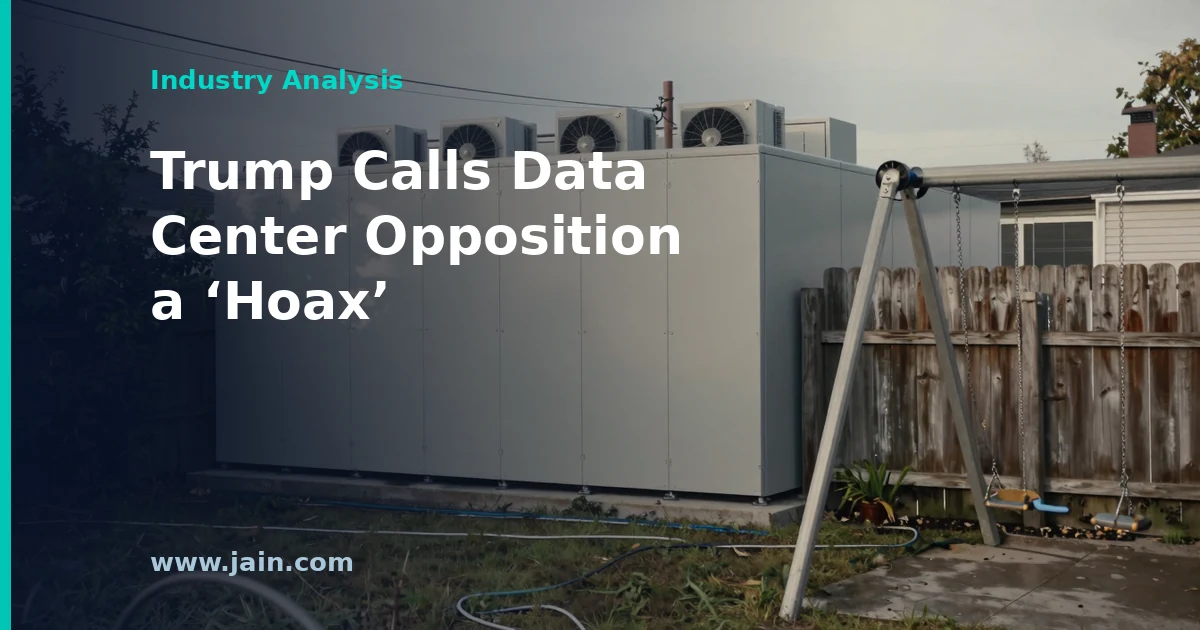
President Trump says resistance to the giant computer warehouses that power artificial intelligence is a ‘hoax’ and part of a ‘sick conspiracy.’ He made the remarks during a phone call with the head of Nvidia, the company whose chips run most of these facilities.
Why it matters to you: these buildings use as much electricity as a small city, and many neighbors worry about higher power bills, water use and noise. Those local fights are usually decided by town and state officials, not the president, so the remarks raise the temperature without settling the argument.
President Donald Trump called opposition to data centers a ‘hoax’ and said there is a ‘SICK conspiracy’ against artificial intelligence and data centers, according to reports from the Associated Press and CNBC. CNBC reported that the remarks came during a phone call with Nvidia CEO Jensen Huang at the All-In Summit, a technology and investing conference. The AP reported that the president also described AI risks as a ‘hoax.’
Executive Summary
The president has publicly placed the White House on the side of the AI build-out in one of the most active local policy fights in the United States: whether communities should accept very large data centers, the warehouse-scale buildings full of servers that train and run AI models. Opponents in many areas have raised concerns about strain on the electricity grid, water consumption, noise, land use and whether ordinary households end up paying for grid upgrades through their utility bills.
The remarks matter less for what they change legally than for what they signal. Most data center approvals run through county zoning boards, state utility regulators and local water authorities, and a presidential statement does not alter those processes. But framing the opposition as a conspiracy, delivered alongside the CEO of the world’s most important AI chip supplier, raises the political stakes for developers, utilities and local officials at a moment when several states are writing tougher rules for large power users.
A National Voice in a Local Fight
Data center siting is decided close to the ground. A developer typically needs a zoning approval from a county or municipality, an agreement with the local utility to connect to the grid, and in many cases water permits and tax-incentive deals negotiated with state or local economic development agencies. None of those decisions sits with the White House, which means the president’s remarks function primarily as political signaling rather than policy.
That signaling still has consequences. It tells developers the administration views the build-out as a national priority, and it may encourage federal agencies to favor faster permitting where they do have authority, such as on federal land or for projects requiring federal environmental review. It also risks nationalizing what have often been nonpartisan local debates, where opponents and supporters alike include residents across the political spectrum.
Testing the Claims on Both Sides
The concerns raised by local opponents are, for the most part, measurable. How much power a facility will draw, what share of grid upgrade costs it will pay, how much water its cooling system consumes, and how much tax revenue it generates after incentives can all be documented and checked. Describing those concerns collectively as a ‘hoax’ does not engage with the specifics, and a community weighing a project that would add a large new electricity load has legitimate reasons to ask those questions.
The same scrutiny applies to opposition claims. Water use, for example, varies widely depending on cooling design; some facilities use closed-loop or air-based systems that consume far less than evaporative cooling, and blanket claims about data centers draining aquifers do not hold for every project. Likewise, whether opposition in a given place is grassroots or organized is an empirical question. It can be answered with evidence such as funding disclosures, shared messaging or coordinated filings, and neither the ‘conspiracy’ label nor the ‘concerned residents’ label settles it on its own.
What It Means for Nvidia and the Builders
Nvidia’s growth depends on customers being able to build and power the facilities that house its chips. Local permitting delays and grid connection backlogs, the long waitlists utilities keep for large new power users, are among the practical limits on how fast AI capacity can come online. Public support from the White House is a tailwind for the sector’s political standing, but it does not add transmission lines, generating capacity or zoning approvals.
For developers, the risk is that polarization makes local approvals harder rather than easier. Officials who might have negotiated conditions such as community benefit agreements, dedicated power supply or water limits may face more pressure to take a side. The companies most likely to fare well are those that can show, project by project, that they are paying for their own grid impact and meeting local environmental conditions.
The Electricity Bill Question
The most politically durable concern is cost to ordinary ratepayers. When a utility builds new substations, transmission or generation to serve a large facility, regulators must decide how those costs are divided between the new customer and existing households and businesses. Several states have moved toward requiring very large power users to commit to long-term contracts or cover more of the upfront grid investment.
That is where the debate is likely to be decided, in utility commission proceedings rather than in speeches. The industry’s strongest argument is not that opposition is illegitimate but that well-structured tariffs can make data centers pay their own way. Whether that holds up will depend on the details states adopt.
Background
The rapid growth of artificial intelligence has triggered a construction boom in large data centers across the United States, driven by technology companies racing to secure computing capacity. These facilities require substantial and continuous electricity, and in many regions their projected demand has pushed utilities to plan new generation and transmission for the first time in years.
That boom has produced local resistance in a growing number of communities, where residents and officials have questioned grid impacts, water use, noise and tax incentives. State legislatures and utility regulators have responded with new rules on how large power users connect to the grid and share costs. Nvidia, as the leading supplier of AI chips, sits at the center of the build-out, and the administration has repeatedly framed AI infrastructure as a national economic and strategic priority.
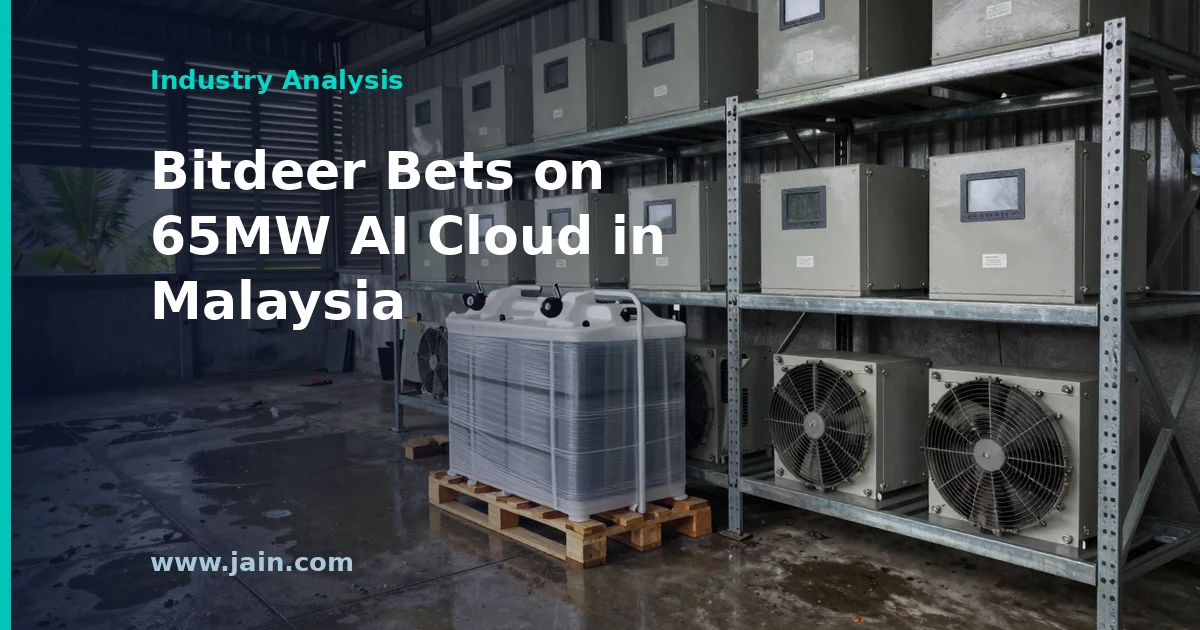
Bitdeer, a company that got its start mining bitcoin, is betting heavily on renting out powerful computers used to build and run artificial intelligence.
It signed a 10-year deal for a new building in southern Malaysia that will use enough electricity to run tens of thousands of homes. If the building earns what a similar Bitdeer site does, it could bring in about $1.1 billion a year.
That yearly figure is about two-thirds of what the whole company is worth on the stock market today. The catch: the power does not switch on until the second half of 2027.
Bitdeer Technologies Group’s AI cloud division, Bitdeer AI, has signed a 10-year service agreement for A202, a 65.1-megawatt data center in Johor Bahru, Malaysia, Cryptopolitan reported. The facility sits on the same campus as Bitdeer AI’s existing 21.7MW A201 site, bringing the campus to 86.8MW of critical IT load (the power available to the computing equipment itself, excluding cooling and other overhead). Power is expected in the third quarter of 2027, and the addition lifts Bitdeer AI’s secured AI cloud capacity to about 206.5MW, roughly 59% of its target of up to 350MW by the first quarter of 2028.
Bitdeer expects A202 to generate revenue per megawatt similar to its A102 facility, where contracts covering the next five years carry more than $800 million in expected revenue across 9.5MW. Applied to A202’s size, that works out to about $1.1 billion a year, the figure Cryptobriefing highlighted, while blockchain.news reported that the deal pushes Bitdeer’s AI pipeline toward $7 billion. Shares were quoted at $11.97, for a market capitalization of about $1.64 billion, though Stocktwits reported the stock slipped as a broader tech sell-off weighed on the sector.
Executive Summary
Bitdeer’s A202 agreement is the company’s largest single capacity addition in Southeast Asia and its clearest signal yet that a business built on bitcoin mining intends to become a long-term provider of AI computing. The 65.1MW facility is designed for liquid-cooled, rack-scale NVIDIA systems, including the GB300 NVL72 and the upcoming Vera Rubin platform, and will support both GPU cloud services (renting access to AI chips) and data-hosting workloads.
What makes the announcement significant is the combination of scale and funding model. Bitdeer says it aims to have customer prepayments cover more than half of the capital spending for each facility, with the rest financed from contracted and operating cash flow. If that works, the company can grow its AI business without leaning as heavily on new debt or share issuance. If demand or prepayments fall short, the revenue math behind the headline numbers becomes considerably less certain.
For the wider market, the deal adds another data point that operators with existing land, power and cooling infrastructure are competing hard for the next generation of AI hardware, and that Johor remains a focal point for that capacity in Southeast Asia.
The Revenue Math Behind the $1.1 Billion Figure
The headline revenue number is a derived estimate, not a disclosed contract value. Bitdeer’s A102 facility has more than $800 million in expected revenue over five years across 9.5MW, which is roughly $17 million per megawatt per year. Bitdeer says it expects A202 to earn similar revenue per megawatt; multiplied across 65.1MW, that yields approximately $1.1 billion annually once the facility is fully running.
That per-megawatt figure is high because GPU cloud is a different business from traditional data center leasing. A landlord that rents out space, power and cooling earns rent on the building. A GPU cloud operator also owns the chips and sells computing time on them, so revenue per megawatt is far higher, but so is the capital required. The comparison with Bitdeer’s roughly $1.64 billion market capitalization is striking, but it sets potential future revenue against current equity value and says nothing about the hardware costs, operating expenses or margins behind that revenue.
The estimate also rests on an assumption that A202 pricing will match A102’s. A102 is a 9.5MW deployment with contracts covering five years; A202 is nearly seven times larger, arrives in late 2027 on newer hardware, and sits inside a 10-year agreement. Pricing for AI computing can shift quickly as new chip generations arrive and supply catches up with demand.
Prepayments as the Financing Engine
Bitdeer’s stated plan is for upfront customer payments to cover more than half of each facility’s capital spending. Prepayment-funded buildouts have clear appeal: they reduce the need to raise outside capital, and a customer willing to pay in advance is signaling genuine commitment. For a company whose legacy business is exposed to bitcoin price swings, that is a meaningful source of discipline.
The trade-off is concentration risk. Prepayment structures typically depend on a small number of large customers with the balance sheets to pay ahead, and the remaining funding depends on contracted and operating cash flow materializing on schedule. Over a 10-year horizon, the hardware inside A202 will likely be refreshed at least once, raising the question of who funds the next generation of chips after GB300 and Vera Rubin systems age.
The Brownfield Advantage in Johor
A202 is being built on land Bitdeer AI already controls, next to the existing A201 facility. That lets the company extend power, liquid-cooling and network infrastructure it has already built, which Bitdeer says should shorten the time to full operation. In an industry where grid connections and specialized cooling are often the slowest parts of a project, expanding an existing campus is a genuine competitive edge.
Liquid cooling matters here because rack-scale systems like the GB300 NVL72 pack so much computing power into a single rack that air cooling cannot remove the heat effectively. Facilities built for these systems are scarcer than general-purpose data center space, which supports CFO Michael G. Potter’s claim that demand for “liquid-cooled, rack-scale AI Cloud capacity” for 2027 is outpacing supply. The claim is backed by A102 having been fully booked before it was energized; A201, by contrast, is in advanced negotiations rather than signed contracts.
From Miner to AI Landlord: Halfway There
With 206.5MW secured across Malaysia, Norway and the United States, Bitdeer is about 59% of the way toward its target of up to 350MW of AI-ready capacity by early 2028. Status as a preferred NVIDIA Cloud Partner gives it credibility in hardware allocation, a practical advantage when the newest systems are in short supply.
The company is running a hybrid model rather than abandoning mining, which keeps an existing revenue stream but also means two capital-hungry businesses competing for the same balance sheet. The market’s reaction captured the tension: a transformative-sounding pipeline, but a share price still moving with sentiment across the broader technology sector. Investors will judge the pivot less on secured megawatts than on how many of those megawatts turn into signed, paying contracts.
Background
Bitdeer Technologies Group is listed on Nasdaq under the ticker BTDR. It began as a bitcoin mining operation founded by Jihan Wu, the former CEO of Bitmain, one of the best-known makers of bitcoin mining machines. Like several miners, Bitdeer has sought to repurpose its experience securing large amounts of power and running dense computing facilities toward AI infrastructure, placing that effort in a separate division, Bitdeer AI, while continuing to mine.
Bitdeer AI’s capacity spans Malaysia, Norway and the United States, and the company has been named a preferred NVIDIA Cloud Partner. Its Malaysian campus is in Johor Bahru, across the causeway from Singapore, a location that has drawn significant data center investment as demand for AI computing in Southeast Asia has grown.
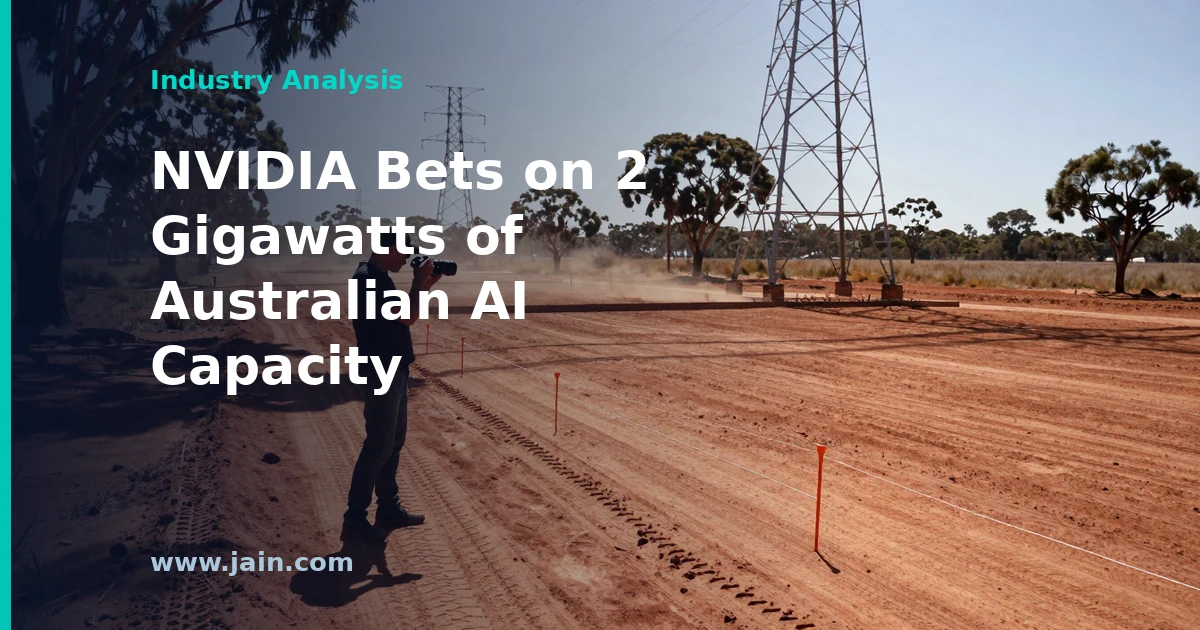
NVIDIA, the company whose chips power most artificial intelligence work, is teaming up with eight Australian data centre operators to build a large amount of new computing capacity.
The plan could draw up to two gigawatts of electricity by 2027. That is roughly the output of a very large power station, spent on machines that learn from data.
The point is that Australians could build and run these systems at home instead of renting foreign computers. What has not been said: who pays, where the electricity comes from, and who has signed up to use it.
NVIDIA said on September 9, 2026 that it is working with a group of Australian cloud and data centre partners to expand land, power and shell capacity for its DSX artificial intelligence factories, targeting what the company describes as a buildout of up to 2 gigawatts by 2027. The named partners are Firmus, Sharon AI, IREN, Megaport, ResetData, CDC, NEXTDC and AirTrunk.
Under the arrangement described in NVIDIA’s announcement, the partners operate the facilities while NVIDIA supplies the DSX platform, accelerated computing, networking, software and ecosystem support. Sharon AI said it is deploying up to 68,000 NVIDIA graphics processors, and IREN pointed to its 800-megawatt Bundey campus in South Australia as the first place it will apply the DSX reference design. On the demand side, NVIDIA named Heidi and Atlassian as Australian companies building on its Nemotron open models.
Executive Summary
The announcement is best read as a capacity envelope rather than a purchase order. NVIDIA and its partners have described land, power and “shell” capacity, meaning buildings and electrical infrastructure prepared for computing equipment that has not yet been installed. Two gigawatts is the stated ceiling for 2027, not a contracted figure, and the release does not break the total down by site, partner or year.
What is substantiated is the alignment of a whole national ecosystem behind one vendor’s reference architecture. Every significant Australian and Australasian data centre developer of scale appears on the list, alongside newer entrants building graphics-processor clouds. That matters commercially: it standardises the power, cooling and networking specification that Australian AI capacity will be built to, and it makes NVIDIA the arbiter of what qualifies.
What is not substantiated is the economics. No capital cost, financing structure, contracted offtake, grid connection agreement or customer commitment accompanies the capacity figures. Those are the variables that determine whether two gigawatts is a plan or a press release, and they are the ones the participating companies have kept to themselves.
Ceilings, Not Contracts
The phrase doing the most work in this announcement is “up to.” Up to 2 gigawatts by 2027. Up to 68,000 graphics processors at Sharon AI. In infrastructure disclosure, an upper bound is a statement of ambition constrained by permits, power and money, none of which have been detailed here. It is not a criticism of the participants to say so; it is how early-stage capacity announcements are conventionally worded.
Some of the underlying numbers are also pre-existing rather than new. CDC said it operates more than 550 megawatts across Australia and New Zealand with a further 800 megawatts under construction, and IREN’s Bundey campus in South Australia is a 800-megawatt development it was already pursuing. Neither company said how much of that capacity is earmarked for NVIDIA DSX deployments. Readers cannot tell from the announcement how much of the headline 2 gigawatts is incremental to plans already in motion, or how much overlap exists between partners counting the same grid connections.
The more concrete commitment is architectural. NVIDIA is supplying DSX as a full-stack reference design spanning facilities, compute, networking and software, and partners are building to it. That has a real effect regardless of how the gigawatt arithmetic resolves: it sets the density, cooling and interconnect standard that Australian AI capacity will be procured against, and it shortens design cycles for operators who would otherwise engineer each hall from scratch.
Two Gigawatts Meets a Constrained Grid
A gigawatt-scale computing load is an industrial electricity customer of the first rank, comparable to a large smelter or a small city, and it must be connected to a transmission network that was not planned with it in mind. Australia’s grid is in the middle of a generation transition, and large new loads compete for connection studies, network capacity and firm supply. The announcement acknowledges this obliquely, noting that expanding capacity would support “additional power generation projects,” but it names no project, no megawatt of new generation and no timeline.
The cooling detail in the announcement is the most technically specific material in it, and it is where operator differentiation actually lives. CDC described direct liquid-to-chip cooling and what it called zero water advanced cooling on 100% renewable electricity. AirTrunk described direct-to-chip liquid cooling in AI-ready powered shells, meaning buildings with power and cooling delivered but computing equipment still to come. NEXTDC described liquid-cooled, high-density halls interconnected to major clouds. Liquid cooling matters because the current generation of accelerators dissipates more heat per rack than air can economically remove, and water-free designs matter in a country where drought risk is a live planning consideration.
Location strategy is the quiet variable. South Australia, where IREN’s Bundey campus sits, has a high share of wind and solar generation and periods of surplus, which is attractive for a load that can tolerate some siting distance from population centres. Training workloads travel well; inference does not, which is why Megaport’s approach, extending access through its Latitude.sh subsidiary across a software-defined global network, is a different bet on the same demand. Where compute lands in Australia will be decided by transmission and land availability more than by customer preference.
The Fungibility Pitch and Who Carries the Risk
NVIDIA’s Raj Mirpuri framed DSX as making AI factories “more productive, fungible and durable, and a new investable asset class.” That language is aimed squarely at the people who finance data centres. Fungible means the capacity can be re-let to a different customer running a different workload; durable means software upgrades extend the useful life of hardware that would otherwise depreciate on a punishing schedule. Both properties, if they hold, raise the residual value that lenders will underwrite against.
The claim is reasonable in principle and unproven in this context. Whether an accelerator installed in 2026 remains rentable at an economic price in 2032 depends on what competitors ship in between, and no software layer fully insulates an owner from a step change in performance per watt. Investors evaluating IREN, NEXTDC or Megaport on the back of this announcement should note that the depreciation question is precisely what the announcement asserts rather than demonstrates.
Risk allocation is also unstated. The partners operate the facilities; NVIDIA delivers the platform. That division suggests the balance-sheet exposure of building shells and buying accelerators sits with the operators, but the announcement does not describe any purchase commitment, capacity reservation, revenue guarantee or equity participation flowing the other way. In a sector where vendor financing arrangements have become common enough to draw scrutiny, the absence of detail is itself the thing worth watching.
Sovereignty Runs on Open Models
The second half of the announcement is about demand, and it is the part most relevant to buyers. Capacity without applications is a stranded asset, so NVIDIA paired the buildout with named users of its Nemotron open models: Heidi, whose chief technology officer Yu Liu described post-training Nemotron 3 Ultra for clinical reasoning, and Atlassian, which is applying the models to semantic search in its Rovo product. ResetData made the sovereignty case most directly, pitching Australian data residency, meaning customer data that stays under domestic jurisdiction, to government, enterprise and research buyers.
Open models are strategically central to NVIDIA rather than incidental. In an 8-K filed with the Securities and Exchange Commission on September 3, a current report companies use to disclose material events, NVIDIA said it had entered a definitive agreement two days earlier to acquire Hugging Face, the main distribution platform for open-source models and datasets, for roughly $11.9 billion plus an equity retention program of up to about $1.0 billion, with closing expected in the first half of 2027. NVIDIA committed to keeping the platform open, including continuing to support other silicon vendors.
That same filing contains a risk disclosure that bears directly on the sovereign AI thesis. NVIDIA warned that governments may impose new requirements on the development, release, distribution and use of AI models, including open-source ones, and that restrictions on models derived from any region could materially affect its business. Sovereign capacity is often sold as insulation from exactly that kind of policy risk. It is worth being clear that domestic data centres address where data and computation sit, not which models remain legally available to run on them.
Background
Australia has built a substantial data centre industry relative to its population, anchored by operators such as NEXTDC, which is listed on the Australian Securities Exchange, hyperscale developer AirTrunk, and CDC, which serves government and critical infrastructure customers across Australia and New Zealand. Megaport, also Australian-founded, built a global software-defined network that lets customers provision connections between clouds and data centres on demand, and now extends compute through its Latitude.sh subsidiary. IREN began as a bitcoin mining business and has been redirecting its power and land portfolio toward AI data centres, a transition several miners have attempted as accelerated computing outbid hashing for electricity.
The sovereign AI idea, that countries should host the computing capacity their economies and institutions depend on rather than rent it from foreign providers, has been a policy theme for several years. It has produced far more strategy documents than energised megawatts. This announcement is notable because it puts named operators, named sites and a dated ceiling behind the concept in one market, and because it arrives while Australia’s electricity system is simultaneously absorbing a generation transition and a new class of very large industrial loads.
Primary sources: NVIDIA Corporation, Form 8-K filed September 3, 2026, disclosing the definitive agreement to acquire Hugging Face and NVIDIA’s risk disclosure on government restrictions affecting open-source models.