TL;DR · 30-second read
The Short Version
CoreWeave, a company that rents out computing power for artificial intelligence, says it has switched on several of Nvidia’s newest server cabinets and wired them together to work as one giant machine.
Each cabinet packs 72 of Nvidia’s top chips. Linking hundreds of those chips lets companies build and run bigger, more capable digital assistants.
Why it matters: machines this crowded need a lot of electricity and liquid cooling, so the buildings that house them have to change quickly. CoreWeave has not said who is using the system or when customers can rent it.
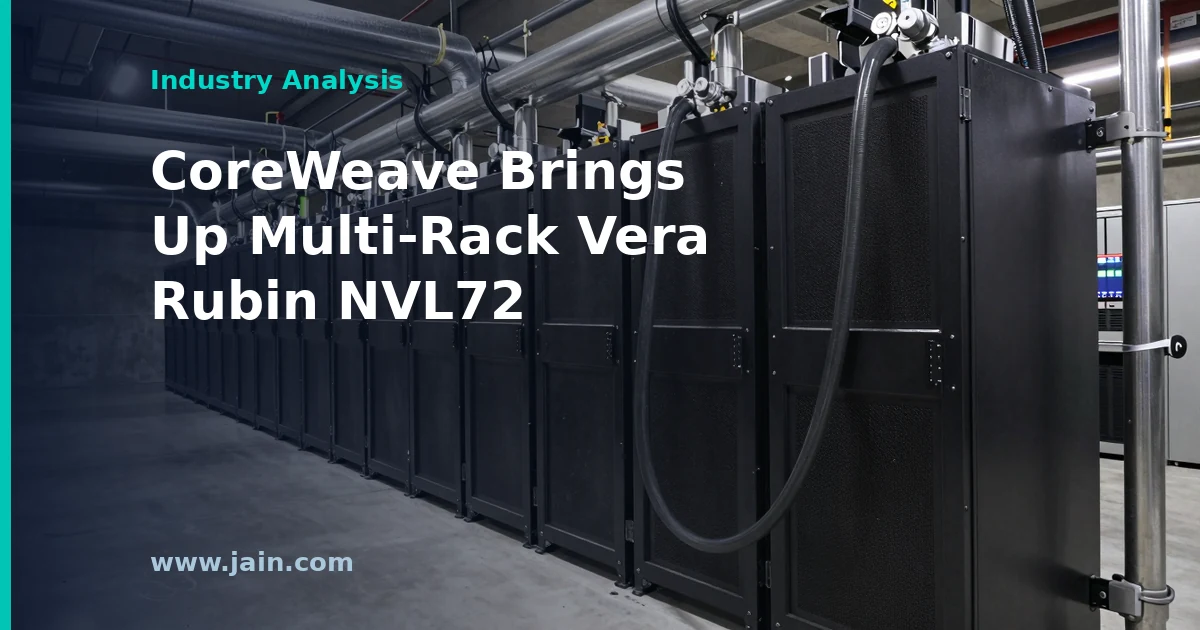
CoreWeave (Nasdaq: CRWV) has brought up a multi-rack NVIDIA Vera Rubin NVL72 cluster on CoreWeave Cloud, joining hundreds of NVIDIA Rubin GPUs into a single scale-out cluster aimed at agentic AI, Light Reading reported on September 16, 2026, publishing the company’s announcement. “Bring up” is the industry term for powering on, configuring and validating new hardware so it can run real workloads.
Alongside the compute news, CoreWeave introduced two additions to CoreWeave AI Object Storage: cross-region write acceleration, which lets a job write data locally while it is copied to another region in the background, and a new Archive tier for colder data.
Executive Summary
Each Vera Rubin NVL72 rack combines 72 Rubin GPUs, 36 Vera CPUs, NVIDIA’s NVLink 6 chip-to-chip interconnect, ConnectX-9 SuperNICs (high-speed network cards) and BlueField-4 DPUs (processors that offload networking and security tasks). CoreWeave says it has joined several of these racks over NVIDIA Spectrum-X Ethernet so they behave as one cluster for training, inference and reinforcement learning. The company attributes the result to automation in its Mission Control software, including a Rack LifeCycle Controller that handles hardware detection, firmware, validation, power and cooling.
The significance is less about any single rack than about what comes with it. Rack-scale systems shift the unit of deployment from the server to the entire cabinet, and that concentrates power, heat and networking demands in a way that tests data center design. CoreWeave is positioning itself as an early operator of NVIDIA’s next generation, and signaling that speed of bring-up is now a competitive metric in its own right.
The announcement is detailed on architecture but light on the facts that determine commercial impact: how many racks are running, where, for whom, and when customers can buy the capacity.
The Rack Is the New Computer
For most of cloud computing’s history, the basic building block was a server: a box with a few processors that could be installed, swapped and scaled one at a time. NVIDIA’s NVL72 designs change that. Inside one rack, 72 GPUs are tied together by NVLink so they can share work almost as if they were a single, very large chip. That is known as scale-up. Joining multiple racks over a network, as CoreWeave describes with Spectrum-X Ethernet, is scale-out.
The combination matters because the largest AI models and the most demanding inference jobs no longer fit comfortably inside one rack. CoreWeave frames the multi-rack cluster around agentic AI, meaning systems that chain many model calls and tool uses together to complete a task. Its argument is that delays compound across those steps, so tightly coupled compute and fast data access pay off. That reasoning is plausible, though the company did not publish benchmarks showing how much faster agentic workloads run on the new cluster.
The networking claims are ambitious. CoreWeave says each Rubin GPU gets two ConnectX-9 SuperNICs, providing 1.6 terabits per second of scale-out connectivity, and that the fabric supports roughly 128,000 GPUs per rail in a non-blocking design, meaning traffic should not queue for lack of capacity. That figure describes what the network architecture can accommodate, not what has been deployed; the cluster announced here is described as hundreds of GPUs.
Deployment Speed Becomes a Competitive Weapon
The most revealing part of the announcement is how much of it is about process rather than silicon. CoreWeave describes racks arriving as hardware that still has to be connected and validated, and says its Rack LifeCycle Controller automates that work, with software components it calls Racky handling rack control and Valvey executing cooling actions. Racks then go through NVIDIA field diagnostics plus full-rack workload testing, and only those that pass as a system move into production.
This matters economically. Every week a costly rack sits installed but unvalidated is capacity that earns nothing while its financing costs keep accruing. For GPU cloud providers competing for the same scarce next-generation hardware, the ability to turn delivered racks into billable capacity quickly can be as important as securing the allocation in the first place. Automating firmware updates, power sequencing and cooling control is how an operator compresses that interval.
The claim that “every GPU performs at its best” is marketing language and should be read as such. What the release does substantiate is a described validation workflow; it does not provide failure rates, burn-in durations or time-to-production figures that would let buyers compare CoreWeave’s process with competitors’.
What Next-Generation Racks Demand of Facilities
CoreWeave explicitly lists cooling and power among the layers that had to be engineered for the cluster to perform as one system, and it built a dedicated software component to execute cooling actions. That is a clear signal of where the operational burden now sits. Dense rack-scale AI systems of this class have relied on liquid cooling, piping coolant directly to the chips because air alone cannot remove heat fast enough.
For data center developers and colocation providers, the implication is that readiness for the rack era is not just about floor space. It requires facility cooling loops, electrical distribution designed for highly concentrated loads, and structural and networking plans that allow new racks to be added without rework. CoreWeave’s point that its modular network topology lets racks be added without redesigning the fabric at each expansion speaks to that last requirement.
Operators whose buildings were designed for traditional air-cooled servers face costly retrofits or the prospect of being passed over for this generation of hardware. Suppliers of liquid-cooling equipment, power distribution gear and high-capacity optical networking stand to benefit, while the release gives no per-rack power figures that would let facility planners size requirements precisely.
Storage Moves Closer to the Loop
The storage announcements address a less glamorous bottleneck: GPUs sitting idle while they wait for data. With cross-region write acceleration, CoreWeave says a job writes locally while replication to another region happens in the background, so intermediate results, retrieved context and outputs are not held up by long-distance transfers. The new Archive tier gives customers a place to keep colder data within the same storage service.
Background replication is a well-established technique, and its value depends on details the company has not provided, such as how far replicated copies can lag, how conflicts are handled and what happens if a region fails before replication completes. For buyers, the practical question is whether keeping training data, checkpoints and archives within one provider’s storage stack is worth the added dependence on that provider.
Background
CoreWeave is a Nasdaq-listed cloud provider (ticker CRWV) that specializes in renting GPU computing capacity for artificial intelligence workloads, marketing itself as “The Essential Cloud for AI.” Unlike general-purpose clouds, its business is built around large clusters of NVIDIA accelerators plus the networking, storage and orchestration software needed to run them for AI training and inference.
NVIDIA’s Vera Rubin platform is the successor to its Grace Blackwell generation, pairing Rubin GPUs with Vera CPUs. The NVL72 designation refers to rack-scale systems in which 72 GPUs are interconnected with NVLink, a design approach that has moved AI infrastructure from individual servers toward entire racks engineered as single units, with corresponding increases in the power, cooling and networking demands placed on data centers. Source: CoreWeave brings up multi-rack NVIDIA Vera Rubin NVL72 cluster — Light Reading, September 16, 2026: CoreWeave announces a multi-rack Vera Rubin NVL72 cluster and new AI Object Storage capabilities.Sources