
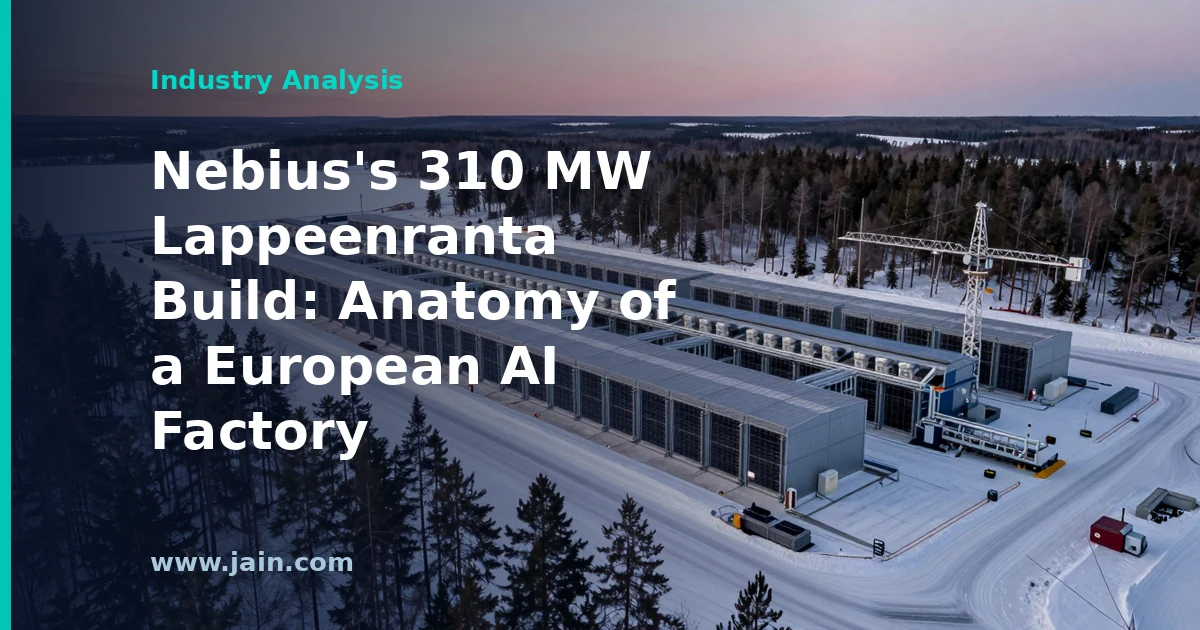
A project profile published April 25, 2026 by Northwise Project details a 310 megawatt (MW) data center in Lappeenranta, Finland attributed to Nebius Group, the Amsterdam-headquartered AI infrastructure company that trades on Nasdaq under the ticker NBIS. The report frames the facility as an “AI factory” — a data center purpose-built for training and running artificial-intelligence models rather than for general-purpose computing.
At 310 MW, the Lappeenranta site would sit firmly in the top tier of European data center projects by power capacity, and would extend Nebius’s existing Finnish footprint, anchored by its long-running campus in Mäntsälä.
Executive Summary
The headline fact is the number: 310 MW of power capacity dedicated to AI computing in a single Finnish location. Power capacity — the electricity a facility can draw and convert into computation — has become the standard yardstick for AI infrastructure because modern graphics processing units (GPUs) are constrained less by floor space than by the megawatts available to feed and cool them. A conventional enterprise data center might draw a few megawatts; 310 MW is the scale at which a facility can host tens of thousands of accelerators and compete for the largest AI training workloads.
The location is just as telling as the size. Finland offers a cool climate that slashes cooling costs, a grid that is among Europe’s most carbon-free, political stability inside the EU, and — in Nebius’s case — years of accumulated operating experience in the country. Lappeenranta, a university city in southeastern Finland, adds a local energy-engineering talent base.
What the profile does not settle is equally important: it is a single third-party report, and details on timeline, phasing, investment, power contracts, and customers are not substantiated in the source material. The scale claim is specific, but readers should treat the project’s parameters as reported rather than independently confirmed.
Why Finland Keeps Winning AI Capacity
Finland has quietly become one of Europe’s most competitive destinations for compute-intensive infrastructure, and the reasons are structural rather than promotional. Cooling is one of the largest operating costs in a data center, and Finland’s climate allows “free cooling” — using outside air or nearby water — for much of the year. The Finnish grid is also unusually clean, drawing heavily on nuclear, hydro, and wind, which matters both for operating economics and for AI customers facing sustainability reporting obligations in the EU.
Nebius knows this terrain better than most entrants. Its Mäntsälä campus, inherited from the company’s pre-2024 corporate history, is well known in the industry for piping waste heat from servers into the local district heating network — turning a cost center into community energy. A second, far larger Finnish site would suggest the company is doubling down on a playbook it has already proven, rather than experimenting in an unfamiliar market.
What 310 MW Actually Buys
For readers outside the industry: data centers are sized by power, not square footage, because electricity is the true scarce input. A 310 MW facility operates on a different plane from traditional colocation sites. Individual AI server racks now draw 100 kilowatts or more — ten times the density of conventional racks — so hundreds of megawatts translate into the tens of thousands of GPUs needed to train frontier-scale models.
The “AI factory” framing is more than marketing shorthand. Purpose-built AI facilities differ from general-purpose data centers in their electrical distribution, liquid-cooling infrastructure, and network fabric, which must move enormous volumes of data between GPUs at very low latency. Retrofitting a legacy facility to these specifications is often harder than building new — which is why the current AI cycle is producing greenfield gigascale campuses rather than expansions of existing colocation stock.
Nebius and the Neocloud Race
Nebius belongs to a category investors have taken to calling “neoclouds”: companies that rent GPU capacity for AI workloads, competing with the hyperscale clouds on price, availability, and specialization. The strategic logic of a 310 MW owned site is vertical integration — controlling land, power, and buildings rather than leasing from wholesale data center providers should yield structurally lower cost per GPU-hour, which is the metric on which this market ultimately competes.
The risk side of that logic is capital intensity. Facilities at this scale require investment in the billions of dollars before revenue arrives, and the GPU rental market is young, with demand concentrated among a relatively small set of AI labs and enterprises. A purpose-built AI factory is a leveraged bet that today’s extraordinary demand for training and inference capacity persists through the multi-year window it takes to permit, build, and fill such a site. That bet may well pay off — but it is a bet, and the source material offers no visibility into how this one is financed or contracted.
Europe’s Sovereignty Subtext
A gigascale AI facility on EU soil lands in the middle of Europe’s “sovereign AI” debate — the push to ensure European companies and governments can access frontier compute under European jurisdiction rather than depending entirely on U.S.-based capacity. An Amsterdam-headquartered operator building hundreds of megawatts in Finland fits that narrative neatly, and European AI startups and public-sector buyers are an obvious customer constituency.
Whether the project actually serves that market, or is absorbed by one or two large anchor tenants, is not something the source addresses. The distinction matters: a facility serving broad European demand changes the region’s compute landscape; a facility pre-committed to a single large customer changes one company’s supply chain. Both are legitimate businesses, but they have different implications for European AI buyers watching capacity announcements with interest.
Background
Nebius Group took its current form in 2024, when Yandex N.V. — the Dutch holding company of the Russian internet group — sold its Russia-based businesses and rebuilt itself around international assets, including a data center in Mäntsälä, Finland. Rebranded as Nebius and relisted on Nasdaq under the ticker NBIS in October 2024, the company positioned itself as a European-rooted provider of AI cloud infrastructure, backed by partnerships in the Nvidia ecosystem and an aggressive data center expansion program across Europe and beyond.
The broader backdrop is a global scramble for AI compute. Training and serving large AI models requires unprecedented concentrations of GPUs and electricity, and power availability has replaced land or fiber as the industry’s gating resource. The Nordics — with cool climates, clean grids, and supportive municipalities — have become one of the main theaters for this build-out, and Finland in particular has converted those advantages into a steady pipeline of hyperscale and AI-specialized projects.
Source: NBIS Lappeenranta Data Center: The 310 MW Finland AI Factory — Northwise Project, a project profile of the reported 310 MW Nebius AI data center in Lappeenranta, Finland, published April 25, 2026.