Tag: Nordic data centers

  • Applied Digital’s 1 GW Finland Deal Buys an AI Power Option, Not Yet a Campus

    Applied Digital’s 1 GW Finland Deal Buys an AI Power Option, Not Yet a Campus

    TL;DR · 30-second read

    The Short Version

    Applied Digital, a Dallas company that builds the huge computer warehouses used to run artificial intelligence, has signed a deal for access to a large supply of electricity in Finland. It is the company’s first project outside the United States.

    At full size, the site could use about as much power as one large nuclear reactor produces. But the first electricity is not expected until 2028, and no customer has signed yet.

    The lesson is that in this business, the electricity gets locked up first. The buildings and the paying tenants come later, if they come at all.

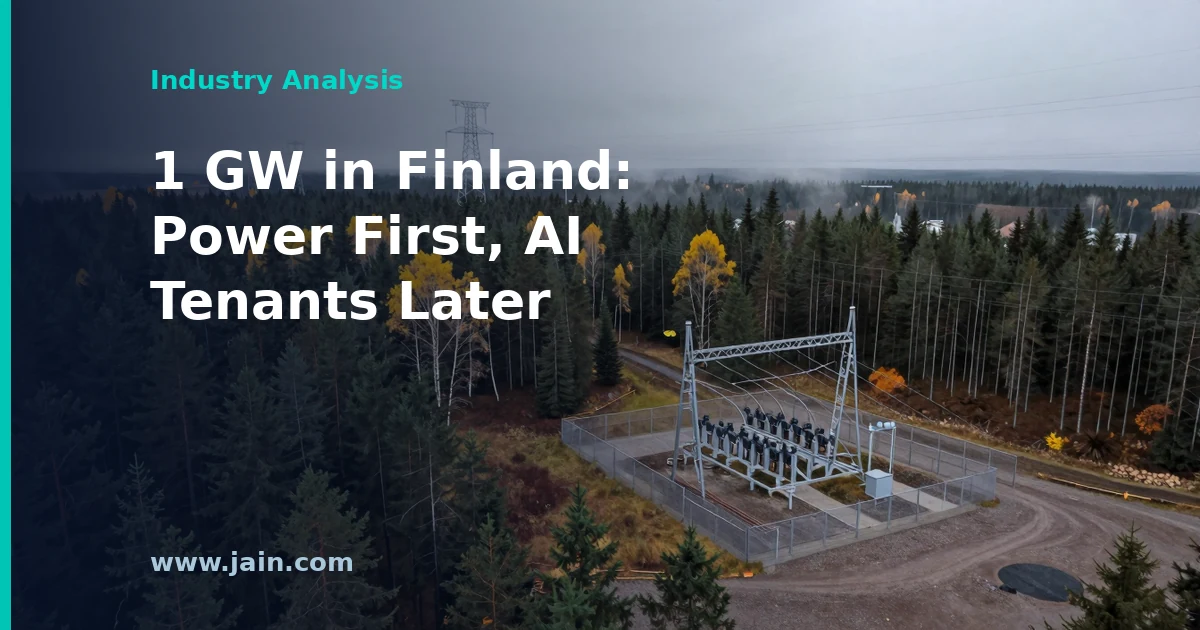
    Applied Digital (Nasdaq: APLD) announced on October 6, 2026 that it has entered into an agreement providing access to up to 1 gigawatt (GW) of potential power capacity in Finland, its first development opportunity outside the United States. The company plans a large-scale “AI Factory” campus that could scale to as much as 1 GW, with initial power availability anticipated beginning in 2028.

    Applied Digital said it has begun marketing the site and is in discussions with leading global hyperscale customers, the largest cloud and AI platform operators. It did not name the site’s location, the counterparty to the agreement, its financial terms or any prospective tenant.

    Executive Summary

    The Finland agreement gives Applied Digital a claim on a very large block of future electricity in a cool-climate market, the input that most constrains how fast AI data centers can be built. The company framed the deal as a measured first step abroad, structured to limit its initial exposure, with further investment contingent on customer demand, commercial milestones and regulatory approvals.

    That framing matters as much as the headline number. “Up to 1 GW of potential” capacity, power from 2028 and an unsigned customer base describe an option rather than a project under construction. The announcement establishes where Applied Digital wants to grow next and how it intends to manage the risk; it does not yet establish how much capacity will actually be built, when, or for whom.

    For industry readers, the deal is a test of whether a US developer’s site-selection model, built around abundant power and cold weather in North Dakota, transfers to the Nordics. For investors, it adds long-dated growth optionality while the company’s own guidance keeps near-term attention on its US pipeline.

    What “Up to 1 GW of Potential” Actually Buys

    Read closely, the release qualifies its headline figure at every step. The agreement provides access to “up to” 1 GW of “potential” power capacity; the campus is one “capable of scaling to as much as” 1 GW; and only “initial” power is anticipated, beginning in 2028. The company says future investment and development decisions will be tied to customer demand, commercial milestones and regulatory and development requirements, and that the deal was structured to limit initial exposure. Each of those statements points the same way: Applied Digital has secured the right to pursue a campus, not a commitment to build one at full scale.

    That is a rational way to buy the scarcest input in AI infrastructure. A gigawatt is roughly the output of one large nuclear reactor, and AI campuses of this size are gated less by land or buildings than by how quickly a large, reliable grid connection can be delivered. Securing power years before a tenant signs lets a developer offer hyperscalers a dated path to capacity, which is the thing those customers are shopping for. The trade-off is that the value of the option depends on terms the company has not disclosed, including what it pays to hold the capacity and what happens if no tenant materialises.

    The people most affected are prospective tenants, who gain another large-scale European option with a stated 2028 start, and shareholders, who should treat the 1 GW as a ceiling on what could be built rather than a measure of what has been contracted.

    Why Finland Fits the North Dakota Playbook

    Chief executive Wes Cummins tied the choice directly to the company’s US model: Finland “stood out because many of the characteristics that have supported our success in North Dakota are also present in the Nordics — a favorable climate, an attractive energy ecosystem, strong connectivity and the ability to develop at meaningful scale.” Each of those factors has an operational meaning. Cold ambient air reduces the energy spent removing heat from dense AI servers; a strong energy ecosystem determines whether large power blocks can be delivered; and fibre connectivity determines whether the site can serve customers beyond its immediate region.

    The release presents this as continuity, not reinvention: securing scalable power and land where AI capacity can be developed “efficiently, responsibly and repeatedly.” That is a reasonable thesis, but it is a claim to be proven. Cummins said as much, describing Finland as the chance “to begin proving that platform can travel.” The company’s own risk disclosures in the release flag what could differ abroad, including sourcing materials and labour internationally and complying with regulations outside the US.

    The 2028 Clock and the Hyperscaler Question

    With initial power not expected until 2028, the commercial work happens now. Applied Digital says it has begun marketing the site and is in discussions with leading global hyperscale customers. Large AI campuses are typically financed around long-term leases with creditworthy tenants, so the timing and size of any signed lease will largely determine whether the Finland project moves from option to construction, and how quickly it scales beyond its first phase.

    The release does not indicate how much of the 1 GW becomes available in 2028 versus later years. That phasing matters: a hyperscaler weighing the site will compare not just the headline ceiling but the megawatts deliverable in each year against competing sites. Until a tenant and a phasing schedule are disclosed, the near-term financial contribution of the Finland site should be treated as zero, consistent with the company’s own emphasis on its US projects.

    Discipline as the Message

    The release spends notable space reassuring investors. Cummins called the deal “a deliberate first step, not a change in our strategy,” and said scale “is not about planting flags in as many markets as possible.” That emphasis is consistent with the risk factors the company lists, which include its ability to raise additional capital for data center construction and to obtain financing for leases. Framing Finland as low-exposure optionality signals that the company does not intend to divert capital from US execution to fund it.

    Whether that framing holds will depend on disclosures still to come: the cost of holding the capacity, any deposits or milestone payments, and how a Finnish build would be financed if a tenant signs.

    Background

    Applied Digital, founded in 2021 and headquartered in Dallas, designs, builds and operates large data centers for high-performance computing, including artificial intelligence, cloud, networking and blockchain workloads. The company markets closed-loop cooling, a system that recirculates coolant rather than continuously consuming water, along with rapid deployment, and describes its build model as an “AI Factory” franchise. Its US development has centred on North Dakota, which the company credits for traits it now seeks in Finland: cold weather, available energy and room to scale. Datacloud named it Best Data Center in the Americas for 2025.

    Across the AI infrastructure market, developers increasingly compete to secure large blocks of electricity years ahead of construction, because access to reliable power at scale has become a principal constraint on how fast AI computing capacity can be added. The Nordics, which the company describes as an emerging European AI market, have drawn growing investment from global technology firms on the strength of their climate, energy and digital networks.

    Sources

    Source: Applied Digital Secures Up to 1 GW of Potential Power Capacity in Finland, Marking First International Development in the Nordics: Applied Digital’s October 6, 2026 announcement of its first development opportunity outside the United States.

  • At 230 MW, atNorth’s Salo Plan Treats Grid Flexibility and Heat as Part of AI Siting

    At 230 MW, atNorth’s Salo Plan Treats Grid Flexibility and Heat as Part of AI Siting

    TL;DR · 30-second read

    The Short Version

    atNorth, a company that builds and runs data centers across the Nordic countries, plans a roughly €2 billion computing campus in Salo, a Finnish town near Helsinki.

    The first stage already has 75 megawatts of power lined up, enough electricity for tens of thousands of homes, with room to grow to about three times that. The computers customers install inside could cost up to five times more than the buildings.

    The twist: atNorth says it will look at using the campus’s waste heat to warm local buildings, and wants to help keep the national power grid steady.

    atNorth, a Reykjavik-headquartered operator of high-density data centers, announced on October 5, 2026, in a release distributed by PR Newswire, that it plans to develop FIN05, a new data center campus on a 28.6-hectare site in Salo, Finland. Power for the first phase, planned at 75 MW, is secured, with a path to up to 230 MW for the wider development through a substation on the national grid operated by Fingrid.

    atNorth expects to invest approximately €2 billion in the site. Customer-owned servers and their installation, which are excluded from that figure, could add an estimated investment of up to €10 billion. The company also plans long-term power purchase agreements with local energy suppliers, grid flexibility arrangements, and heat reuse partnerships with local stakeholders.

    Executive Summary

    FIN05 is atNorth’s second large campus in Finland, after Kouvola, and its sixth major development currently under way across the Nordics. The core facts are concrete: 75 MW of secured power for phase one, a 230 MW ceiling for the full site, a transmission-level grid connection, and a combined facility and customer-hardware investment that could approach €12 billion at full build-out.

    What makes the announcement worth reading closely is how it is assembled. atNorth places power purchase agreements, flexibility services for Finland’s transmission grid and waste-heat reuse alongside the capacity figures, not after them. The site itself came from a local developer, Regant Oy, which describes having prepared it with planning readiness and a power roadmap in place. Together, these suggest that in the Nordics, a campus of this size is now being presented as an energy-system partner to its host region, not only as a large electricity customer.

    The commitments carry different weights, however. The 75 MW is secured; the power purchase agreements are planned; flexibility services could support the grid; heat reuse is to be explored. The capacity case is firm. The community dividend is, for now, a well-structured set of intentions.

    At 230 MW, the Grid Becomes a Stakeholder

    FIN05 will connect through a Fingrid substation. Fingrid is Finland’s transmission system operator, the company responsible for the high-voltage national grid and for keeping supply and demand balanced second by second. A campus that could eventually draw 230 MW is not a routine customer on a local distribution line; it is a load large enough that its behavior matters to how the national system is run. That is the context for atNorth’s plan to offer “flexibility solutions that could support the efficient operation of Fingrid’s transmission grid.” In industry practice, flexibility typically means a large consumer agreeing to shift or reduce its draw, or to make on-site equipment available, when the grid is under stress, so that the operator has another tool besides building more generation and lines.

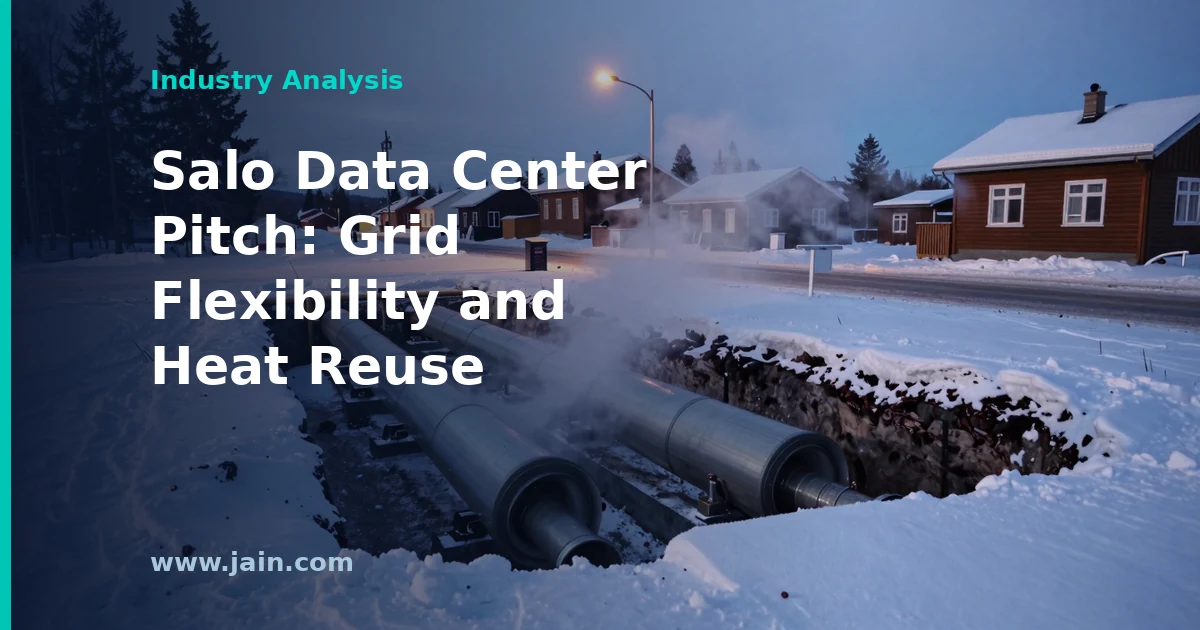
    The two other elements of the plan point the same way. Long-term power purchase agreements, contracts in which a buyer commits to take electricity from a producer for years at agreed terms, are framed as support for energy production in the region, giving local suppliers a dependable customer. Heat reuse addresses a physical fact of computing: almost all the electricity a server consumes ends up as heat. In Nordic towns with district heating, networks of insulated pipes that carry hot water to homes and businesses, that heat can have a buyer instead of being vented. atNorth points to existing heat reuse collaborations with Kesko in Finland, Stockholm Exergi in Sweden, and Vestforbrænding and Selected Group in Denmark as evidence it has executed this model before.

    The parties most affected are the Salo municipality, whose mayor emphasised construction and operating jobs; Fingrid, which gains a large load that may also offer flexibility; local power producers, who could gain a long-term buyer; and potential heat users. The measured conclusion is that, for a campus of this scale, atNorth is presenting grid support and heat value as part of the case for the site itself. Whether that case translates into delivered value depends on terms atNorth has not yet published: the power purchase agreements are planned, flexibility “could” support the grid, and heat reuse remains something to “explore.”

    Secured Power Is the Hard Asset; the Rest Is Roadmap

    The announcement uses carefully graded language, and the grades matter. Phase one power, 75 MW, is described as secured. The full 230 MW is a “path to power.” The €2 billion is an expected, approximate figure. For prospective customers, the secured first-phase power is the most bankable fact in the release: where grid connections take years to obtain, power already in hand is what turns land into a usable data center site.

    Regant Oy’s role reinforces that point. Its partner said the firm worked with atNorth and the municipality to provide a development-ready site with “the scale, planning readiness and power roadmap needed for large data center projects.” That describes a model in which a local developer assembles land, planning groundwork and a grid pathway before an operator arrives. What the operator is effectively acquiring is time-to-power, which is often the scarcest input in large data center development.

    €2 Billion of Buildings, Up to €10 Billion of Customer Hardware

    The most revealing number may be the ratio between atNorth’s estimated investment and its customers’. atNorth expects to spend about €2 billion on the site, while customer-owned servers and their installation could add up to an estimated €10 billion, as much as five times the facility spend. A ratio like that is characteristic of dense, accelerator-based computing, the specialized chip servers used to train and run AI models, where the hardware inside costs far more than the building around it. atNorth describes itself as a high-density colocation and built-to-suit provider; the announcement frames demand as high-performance digital infrastructure and does not name specific workloads or customers.

    Built-to-suit means a facility designed to one customer’s specification, and colocation means renting space, power and cooling to customers who install their own equipment. In both cases, when customers bring up to €10 billion of their own hardware, the length and credit quality of their contracts become central to the project’s economics. The €10 billion is also explicitly an upper-bound estimate, not a commitment. For Salo, the durable local value is more likely to sit in construction, operations, power sales and heat than in the hardware itself, which customers own and periodically replace.

    Another Mega Site in a Busy Nordic Slate

    FIN05 joins four mega sites atNorth already has under development, in Kouvola, Finland; Ølgod, Denmark; Sollefteå, Sweden; and Haugaland, Norway, plus a metro site in Stockholm, alongside seven operating data centers. Advancing that many large campuses at once requires capital, construction capacity and grid connections in parallel, and execution risk scales with the pipeline.

    The Nordic region’s appeal for this kind of capacity is well established: a cool climate that reduces cooling energy, grids with a high share of renewable generation, and widespread district heating that can absorb data center waste heat. The last of these is what gives Nordic operators a community offer that is hard to replicate in many other regions, and FIN05 is built around using it.

    Background

    atNorth is a Nordic data center company headquartered in Reykjavik, Iceland. It offers high-density colocation, in which customers rent space, power and cooling for their own servers, and built-to-suit facilities designed to a single customer’s specifications. It operates seven data centers across the Nordics and is developing four mega sites, in Kouvola, Finland; Ølgod, Denmark; Sollefteå, Sweden; and Haugaland, Norway, plus a metro site in Stockholm. The company says its sites run on renewable energy and support circular economy principles, including heat reuse partnerships in Finland, Sweden and Denmark.

    The Nordic countries have become a destination for large data centers because of their cool climate, which reduces the energy needed for cooling, grids with a high share of renewable generation, and extensive district heating networks that can absorb waste heat. As computing campuses grow to hundreds of megawatts, their relationship with national grid operators such as Finland’s Fingrid, and with the communities that host them, has become a central part of how projects are planned.

    Sources

    Source: atNorth to develop new data center in Salo, Finland — atNorth’s announcement of its planned FIN05 campus in Salo, including power, investment, energy partnership and heat reuse plans.

  • Nscale’s $790M Norway Financing Signals Capital Shift to Nordic AI Infrastructure

    Nscale’s $790M Norway Financing Signals Capital Shift to Nordic AI Infrastructure

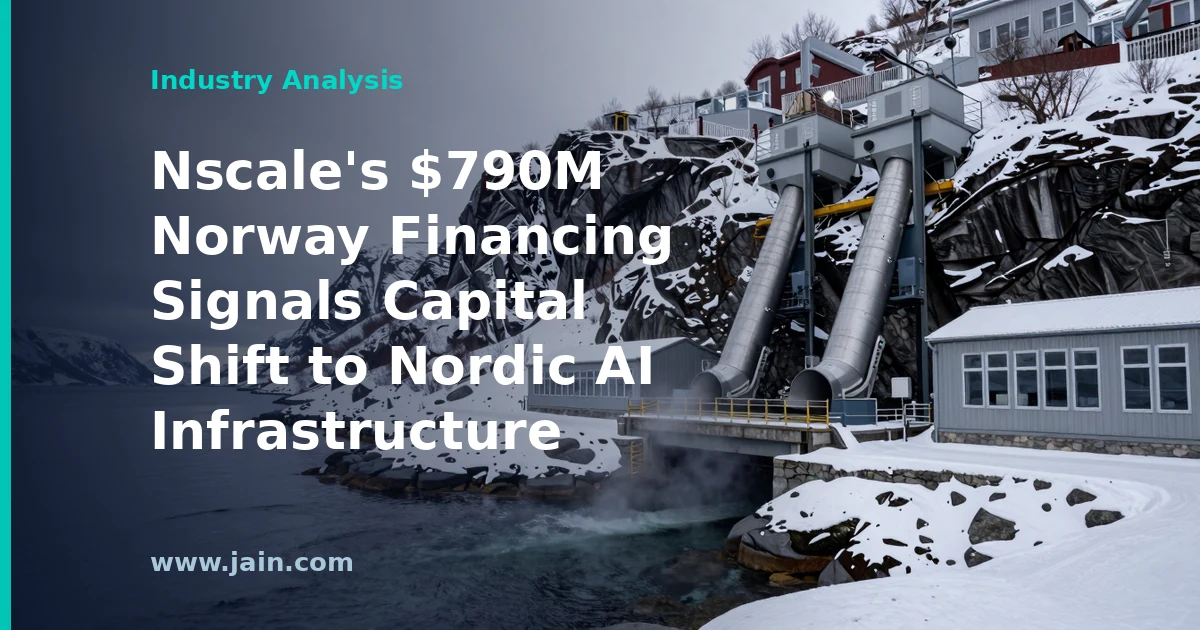
    Nscale, the London-headquartered AI infrastructure company, announced on May 10, 2026 that it has secured $790 million in financing to support its AI infrastructure buildout in Norway. The announcement, distributed via PR Newswire, did not publicly detail the structure of the financing or the specific facilities it will fund.

    The raise extends a rapid string of capital events for the two-year-old company, which operates hydropower-fed data center capacity in northern Norway and has positioned itself as a European alternative for large-scale AI compute.

    Executive Summary

    The headline fact is simple: $790 million in fresh financing, earmarked for AI infrastructure in Norway. What makes it worth analyzing is the pattern it confirms. Capital for AI data centers — both equity and, increasingly, project-style debt — is flowing toward locations selected for power and cooling economics rather than proximity to traditional internet hubs. Norway offers abundant hydroelectric power, some of Europe’s lowest industrial electricity costs, and a climate that allows servers to be cooled largely by outside air, a technique known as free cooling.

    For Nscale, the money supports a buildout strategy the company has pursued since its 2024 founding: convert stranded or under-used Nordic renewable power into GPU capacity (the graphics processors that train and run AI models) and sell that capacity to hyperscalers and AI labs. For the broader market, a financing of this size directed at a Norwegian buildout is another data point that lenders and investors now treat AI compute facilities as a financeable infrastructure asset class — provided the power story is strong.

    Why the Money Is Going North

    Traditional European data center markets — Frankfurt, London, Amsterdam, Paris, Dublin — are power-constrained. Grid connection queues stretch for years, and several jurisdictions have imposed moratoria or tight limits on new capacity. AI training workloads, which need enormous amounts of electricity but are far less sensitive to network latency than a website or trading system, break the old rule that data centers must sit near users. That decoupling is the entire Nordic thesis: build where power is cheap, renewable, and available now, and ship the model weights rather than fighting for megawatts in a congested metro.

    Norway sharpens that thesis further. Its grid is overwhelmingly hydroelectric, giving operators both low costs and a clean-energy claim that matters to hyperscale customers with public carbon commitments. Sub-Arctic ambient temperatures cut cooling energy dramatically — cooling can consume 30% or more of a conventional data center’s power budget, so free cooling flows straight to operating margin. A $790 million financing aimed specifically at Norway is capital underwriting exactly those advantages.

    From Venture Rounds to Infrastructure-Scale Finance

    Nscale’s earlier fundraising followed a venture pattern: a Series A in late 2024 and a Series B in late 2025 that ranked among Europe’s largest. The release does not specify whether the new $790 million is equity, debt, or a hybrid, but financings of this size in the sector have increasingly taken the form of asset-backed or project-level debt, where lenders advance capital against contracted future revenue and the hardware and facilities themselves. If that is the shape here, it would mark a maturation milestone — the point where a young company’s buildout is bankable on its contracts rather than purely on investor conviction in the AI boom.

    The economics explain why that distinction matters. GPU clusters are extraordinarily capital-intensive, and the chips depreciate quickly as new generations arrive. Equity alone cannot efficiently fund gigawatt-scale ambitions; the industry needs debt markets to participate, and debt markets need predictable cash flows. Every large financing that closes on a power-advantaged site lowers the perceived risk for the next one, which is how a regional buildout becomes a self-reinforcing capital cycle.

    Winners, Losers, and the Latency Trade

    The obvious beneficiaries are Nordic host communities and utilities, which convert surplus renewable generation into industrial investment and jobs, and the AI labs and cloud providers that gain a European supply of compute at competitive cost — a point with real weight as European institutions push for “sovereign AI” capacity on EU-adjacent soil. Suppliers of high-density and liquid-cooling equipment, long-haul fiber, and grid interconnection services also ride the wave.

    The trade-off is real but narrowing. Remote sites are poorly suited to latency-sensitive inference serving end users in central Europe, so Nordic capacity skews toward training and batch workloads. Competition is a second pressure: Sweden, Finland, and Iceland pitch similar advantages, and enormous buildouts in the United States and the Gulf compete for the same GPUs, transformers, and turbines. Cheap power is an advantage, not a moat — execution speed and customer contracts decide who wins.

    The Risks Behind the Momentum

    Three risks deserve sober attention. First, customer concentration: merchant AI compute providers typically depend on a small number of very large offtakers, so one renegotiated or lost contract can move the whole revenue model. Second, technology risk: financing hardware that may be economically obsolete in three to five years requires contract terms and depreciation assumptions that have not yet been tested through a full cycle. Third, local constraints: even in power-rich Norway, grid capacity in the far north is finite, and large industrial loads have drawn scrutiny over transmission upgrades and electricity-price effects for residents. None of these invalidate the buildout — but they are the variables that will determine whether today’s financings look prescient or aggressive in hindsight.

    Background

    Nscale was founded in 2024 as a spin-out of data center operator Arkon Energy, inheriting a hydropower-supplied site in Glomfjord in northern Norway. In roughly two years it moved from startup to one of Europe’s most heavily funded AI infrastructure players, raising a Series A in late 2024 and a Series B in late 2025 that ranked among the continent’s largest venture rounds, alongside major capacity agreements with hyperscale customers and a joint venture with Norwegian industrial group Aker to build AI capacity in Narvik with OpenAI as a customer.

    The company’s rise tracks a broader industry shift: as AI training demand collided with power shortages in established data center hubs, operators and their financiers turned to energy-rich regions — the Nordics chief among them — where renewable generation, cool climates, and available grid capacity make gigawatt-scale computing economically and politically feasible.

    Source: Nscale Secures $790 Million in Financing to Support AI Infrastructure Buildout in Norway — company announcement distributed via PR Newswire, May 10, 2026.