
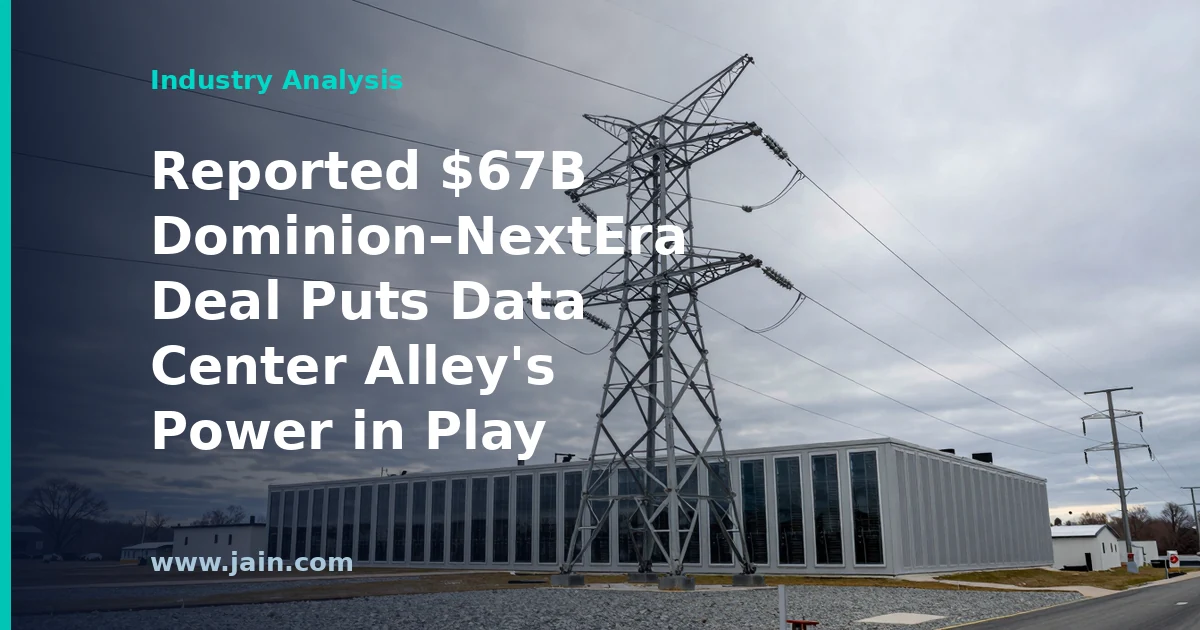
Technical.ly reported on May 17, 2026 that a $67 billion deal between Dominion Energy and NextEra Energy could reshape Northern Virginia’s data center economy — the largest concentration of data center capacity in the world. At that price, the transaction would rank among the biggest utility deals in U.S. history.
The report frames the deal around Northern Virginia’s “Data Center Alley,” the Loudoun County–centered corridor whose electricity is supplied largely by Dominion, and whose AI-driven load growth has become the defining challenge for the regional grid.
Executive Summary
According to the report, Dominion Energy — the regulated utility serving most of Virginia, including the Northern Virginia data center corridor — and NextEra Energy, the Florida-based utility holding company that is also the largest developer of wind and solar generation in the United States, are parties to a transaction valued at roughly $67 billion. The headline figure alone signals a bet that serving data center load is now the most valuable franchise in the American power sector.
Why it matters: whoever owns the wires and generation feeding Data Center Alley effectively controls the throttle on the region’s — and arguably the industry’s — AI buildout. Dominion has publicly described a contracted and requested data center pipeline measured in tens of gigawatts, an order of magnitude beyond historical utility growth rates. Pairing that captive demand with NextEra’s generation development machine is the strategic logic the market will read into a combination of this size, whatever the final structure proves to be.
A caution up front: the source available at publication is a single news headline. The deal’s structure — acquisition, merger, asset purchase, or joint venture — its financing, and its regulatory path are not described in the material we can verify, and we treat them accordingly below.
Why a Utility Deal Is Really a Data Center Deal
Northern Virginia is not just another service territory. Loudoun County and its neighbors host tens of millions of square feet of data center space, and Dominion has for years been the region’s essential supplier — its interconnection queue, transmission buildout, and rate design decisions directly set the pace at which hyperscalers and colocation providers can energize new capacity. A $67 billion transaction touching this territory is therefore less a conventional utility consolidation story than a claim on the single most concentrated pool of AI-era electricity demand on the planet.
For readers outside the power business: regulated utilities like Dominion earn a state-approved return on the infrastructure they build, which means guaranteed-growth demand — like contracted data center load — translates almost mechanically into earnings growth. That is why data center demand has turned sleepy utility stocks into growth assets, and why a buyer or partner would pay a historic premium to be attached to it.
The NextEra Logic: Generation Meets Load
NextEra brings the other half of the equation. Through NextEra Energy Resources it has built more wind, solar, and battery capacity than any other U.S. developer, and its regulated arm, Florida Power & Light, is among the country’s largest utilities. The structural problem in Northern Virginia has never been demand — it is that generation and transmission cannot be added fast enough. Marrying the nation’s most aggressive generation developer to the nation’s most demand-rich territory is a coherent industrial thesis, and it tracks the broader pattern of power and compute vertically converging: hyperscalers signing nuclear offtakes, developers co-locating generation with campuses, and utilities racing to finance multi-decade capital plans.
It also concentrates risk. AI demand forecasts are contested; utilities and grid operators have acknowledged that interconnection queues contain speculative and duplicate requests. A $67 billion valuation built on tens of gigawatts of projected load is exposed if even a fraction of that pipeline evaporates, gets self-supplied behind the meter, or migrates to cheaper-power regions.
Who Feels This: Ratepayers, Regulators, and Tenants
Any transaction involving Dominion’s Virginia franchise runs through the State Corporation Commission, and likely federal reviews as well, at a moment when data center cost allocation is already politically charged in Richmond. Virginia regulators have been actively weighing how to keep large-load infrastructure costs from spilling onto residential bills; a mega-deal gives them maximum leverage to extract commitments on rates, reliability, and clean energy timelines as conditions of approval. Expect the approval process, not the announcement, to determine what this deal actually does.
For data center operators and tenants, the practical questions are concrete: does consolidation speed up interconnection by unifying generation and delivery under deeper-pocketed ownership, or does it reduce competitive pressure and harden pricing power over a customer base with nowhere else to plug in at scale? Both outcomes are plausible, and the answer will likely be written into regulatory conditions rather than the merger agreement.
The Consolidation Signal
Step back and the deal — if consummated — marks a phase change: AI power demand is no longer being met by incremental utility capital plans but by restructuring the ownership of the grid itself. Other demand-heavy territories (Georgia, Texas, Ohio, Arizona) and the utilities that serve them become obvious candidates for similar combinations, and every hyperscaler’s site-selection calculus now has to price in who will own their utility in five years. The financing of the AI buildout is migrating from tech balance sheets and project finance into the regulated-utility capital model — with all the ratepayer politics that entails.
Background
Northern Virginia became the internet’s landlord over three decades, as early network exchange points around Ashburn attracted carriers, then cloud providers, then AI training campuses. Dominion Energy grew into the indispensable supplier of that boom, and by the mid-2020s was publicly describing data center demand — measured in tens of gigawatts of contracted and requested capacity — as the dominant driver of its capital plans, while Virginia lawmakers and regulators debated who should pay for the grid expansion it requires.
NextEra Energy took a different route to power-sector prominence: alongside its Florida utility franchise, it built the nation’s largest renewable generation fleet and has consistently argued that electricity demand from AI and electrification marks the sector’s biggest growth era in decades. A combination with Dominion, as reported, would fuse the industry’s largest generation developer with its most demand-rich territory.
Source: $67B Dominion-NextEra deal could reshape Northern Virginia’s data center economy — Technical.ly’s May 17, 2026 report on a reported $67 billion transaction between the two utilities.