Tag: New Jersey

  • Everyone Is Watching the $1.07M Fine. The AI Power Risk Is the 45-Day Clock.

    Everyone Is Watching the $1.07M Fine. The AI Power Risk Is the 45-Day Clock.

    TL;DR · 30-second read

    The Short Version

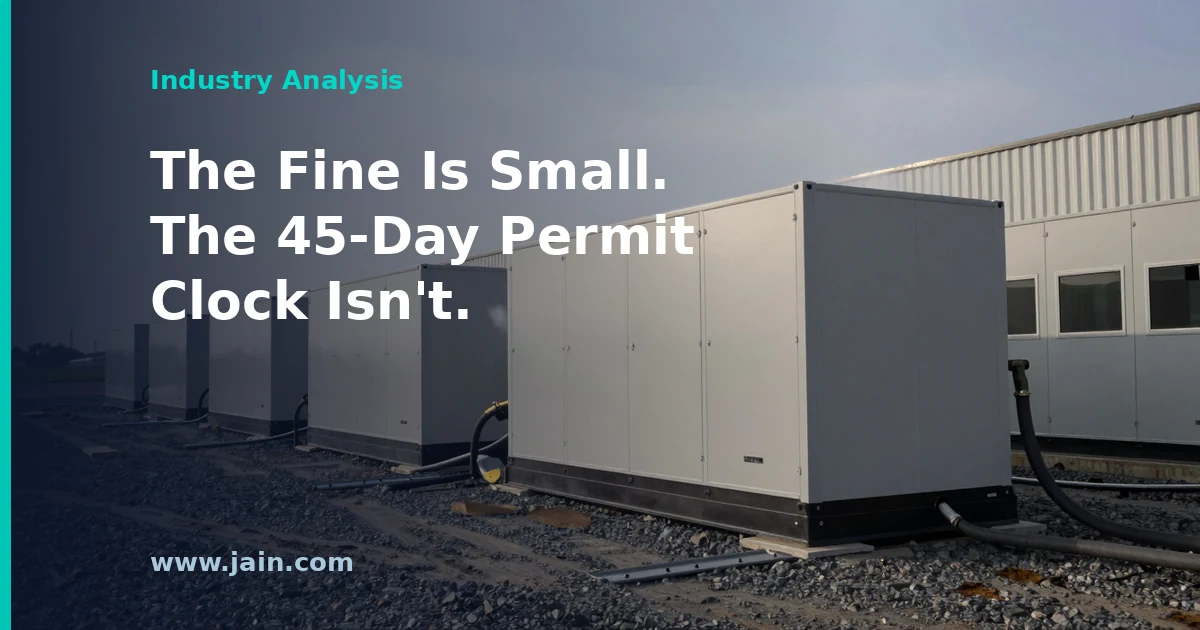
    New Jersey fined the builder of an artificial intelligence data center in the town of Vineland a record $1.07 million for running 62 portable power generators without pollution permits.

    Split across the generators, that is about $17,000 each. Neighbors called it pocket change. The real threat is a deadline: get the permits within 45 days or switch the generators off.

    The site supplies computing power for a $33 billion deal involving Microsoft, so losing its power source would be a far bigger problem than the fine.

    New Jersey has fined DataOne a record $1.07 million for running 62 unpermitted portable generators at its AI data center construction site in Vineland. The state also ordered the company to obtain air permits within 45 days or stop using the units. Tom’s Hardware reported the action on September 25, 2026, citing The New York Times. State inspectors found the generators powering the facility in late July. DataOne supplies computing capacity to Nebius, which Microsoft signed to a $33 billion deal.

    Residents have raised several other complaints:

    • the construction, without a permit, of a 1.5-million-gallon liquefied natural gas (LNG) tank;
    • night-time noise reaching homes within half a mile;
    • little public consultation before the project began.

    DataOne disputed the fine. It said it will apply for air permits for the temporary generators and is moving from portable turbines to fuel cells.

    Executive Summary

    The penalty is modest against the scale of the project. Spread across 62 generators, it comes to roughly $17,300 per unit, a point residents made bluntly. The 45-day order is what carries operational weight. Generators that were powering the site must be permitted by state regulators in that window or switched off. That puts a regulatory decision, not a construction milestone, on the critical path for a facility tied to one of the larger AI capacity contracts in the market.

    The case matters beyond Vineland. On-site generation, often called bridge power, lets developers bring their own electricity instead of waiting for a utility connection, and it is an increasingly common way to get AI capacity online quickly. New Jersey’s action and the earlier dispute over unpermitted turbines at SpaceXAI’s Colossus 2 site in Memphis point to the same limit: the workaround only moves as fast as the air-permit process allows.

    Why the 45-Day Clock Outweighs the $1.07 Million

    Divide $1.07 million by 62 generators and the penalty works out to about $17,300 per unit. Next to a $33 billion capacity contract, that is a rounding error. Residents said so directly. Longtime Vineland resident Steve Brown called it “a drop in the bucket,” and Tiffany Leone-Vespa argued the fine should have applied to each generator. As a financial deterrent, a penalty of this size does little to change the calculation behind what Brown described as a “don’t ask for permission, just ask for forgiveness later” approach.

    The shutdown order is a different kind of lever. New Jersey told DataOne to meet its permitting requirements and to stop running the generators if permits are not granted within 45 days. Inspectors found those units powering the facility. If the permits do not come through, DataOne has to replace that power on a schedule set by regulators rather than by its own construction plan. The replacement could be utility supply, the fuel cells it says it is adopting, or other permitted equipment. For a company whose product is computing capacity, a power gap is a delivery problem, not an accounting line.

    That exposure runs down a contract chain. DataOne supplies Nebius, and Nebius supplies Microsoft. The company has said it will apply for the permits. Whether regulators can review and grant them inside the window is the operative question, and it matters far more to the project’s timeline than the size of the fine.

    Bring-Your-Own Power Comes With a Permit Attached

    AI developers are bringing their own power because utility connections for very large new loads can take years, while trailer-mounted turbines and generators can be delivered and running in weeks. When a data center is built to rent out expensive AI processors, every month without power is lost revenue.

    The trade-off is that fuel-burning equipment emits pollutants such as nitrogen oxides, along with noise. That is why states require air permits, which are licenses that set emission limits, operating hours and monitoring for combustion equipment. At 62 units, a temporary generator fleet starts to resemble a small power plant, and it draws the scrutiny that comes with one. Noise complaints from homes within half a mile show the effects are felt locally, not just on paper.

    Memphis offers the closest comparison. SpaceXAI’s unpermitted turbines at Colossus 2 led to a lawsuit, and the Department of Justice asked the court to dismiss it on the grounds that the site “supports mission-critical operations.” The company ultimately agreed to remove the unpermitted turbines. It said the process would take more than a year as replacement plants totaling 1.2 gigawatts come online. Both cases end with temporary generation giving way to permanent, permitted supply. What differs is who sets the pace: more than a year in Memphis, 45 days in Vineland.

    Fuel Cells, an LNG Tank and the Replacement Question

    DataOne’s stated fix is to move from portable turbines to fuel cells. Fuel cells generate electricity through a chemical reaction rather than combustion. They are generally quieter and emit fewer local pollutants, so they address both of the neighbors’ main complaints. They still need fuel, most commonly natural gas, and they would have to match the output the 62 units were providing. DataOne has not said how much capacity it plans to install, who will supply it, or when it will be running.

    The 1.5-million-gallon LNG tank is a separate exposure. Liquefied natural gas is gas cooled until it becomes a liquid so it can be stored in bulk, and on-site storage at that scale is one way to fuel generation where pipeline supply is limited. DataOne has not explained what the tank is for. Residents say it was built without a permit, which could make its status a second regulatory question alongside the generators.

    Community Consent Is Now Part of the Power Plan

    According to residents, they learned a data center was going up in their neighborhood only after Microsoft announced its deal with Nebius. They raised concerns at a February town hall, citing satellite imagery that showed “some type of unit” on site. Inspectors had found no generators during a December visit, then found 62 in late July. When the units first arrived remains unclear, and so does how long they ran before enforcement.

    Both sides deserve a fair reading. DataOne’s commitment to seek permits and move to cleaner equipment points in the direction regulators want. Residents’ argument that a flat fine is too small for a well-capitalized operator is a legitimate question about how penalties are designed, including whether they should scale per unit. For developers, the lesson is practical. Permitting and early community engagement cost time up front, but enforcement mid-construction imposes a deadline the developer does not control.

    Background

    Nebius is an AI cloud company, sometimes called a neocloud, that rents out computing capacity built on graphics processors, the chips used to train and run AI models. It is headquartered in Amsterdam, listed on Nasdaq, and emerged in 2024 from the restructuring of Yandex’s international business. Its $33 billion deal with Microsoft makes it a major capacity supplier to one of the largest buyers of AI computing. DataOne is the developer contracted to provide computing capacity for that arrangement at Vineland, in southern New Jersey.

    AI data centers draw far more electricity than traditional facilities, and utility connections for large new loads can take years. Many developers now use on-site generation such as gas turbines, engines or fuel cells as bridge power until grid supply is ready. Under the federal Clean Air Act framework, states require air permits for fuel-burning equipment above certain size thresholds. Operating without one exposes a site to fines and orders to shut the equipment down.

    Sources

    Source: New Jersey hits Microsoft-linked AI data center with record fine for 62 unpermitted power generators, issues 45-day shutdown deadline — site tied to $33 billion deal also built illegal 1.5M-gallon fuel tank: Tom’s Hardware on New Jersey’s $1.07 million fine and 45-day permit deadline for DataOne’s Vineland AI data center.

  • Equinix Diesel Spill in Meadowlands Puts Data Center Backup Fuel in Focus

    Equinix Diesel Spill in Meadowlands Puts Data Center Backup Fuel in Focus

    TL;DR · 30-second read

    The Short Version

    About 5,000 gallons of diesel fuel leaked from a storage tank at a large computer facility in Secaucus, New Jersey. That is roughly half of what a fuel tanker truck carries. It ran into a small creek that feeds the Hackensack River.

    The facility belongs to Equinix, which rents space to companies that run websites and online services. Cleanup crews are vacuuming fuel out of the water. State officials say the fuel did not reach the river.

    It matters because buildings like this often store large amounts of fuel for emergency generators, and nearly 100 New Jersey towns have already banned new ones.

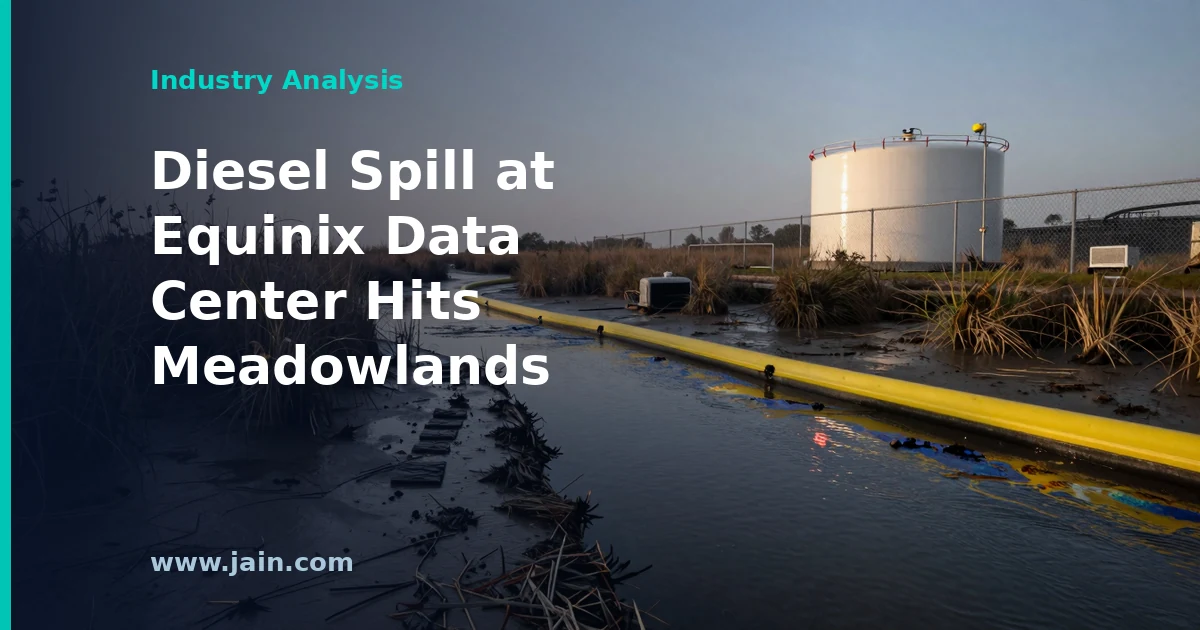
    About 5,000 gallons of diesel fuel spilled from a storage tank at the Equinix data center in Secaucus, New Jersey, and flowed into Anderson Creek, a tributary of the Hackensack River, Gothamist reported on September 14, 2026. That figure comes from the New Jersey Department of Environmental Protection (DEP). Equinix said the leak was detected on Friday evening, September 11. It has hired the environmental services contractor Clean Harbors to handle remediation.

    DEP spokesperson Larry Hajna said the creek is small and narrow where the spill occurred and that the fuel was contained before it reached the river. Crews are expected to work at the site for several days. Hackensack Riverkeeper Bill Sheehan and Secaucus Mayor Michael Gonnelli have both called for the state to pursue a natural resource damages claim against the company.

    Executive Summary

    A fuel-tank leak at one of the New York metro area’s long-established data center sites has become an environmental cleanup and a political flashpoint. Contractors placed a boom (a floating barrier) across Anderson Creek to hold the diesel in place, and vacuum trucks have been pulling a fuel-and-water mixture out for treatment and disposal offsite. Equinix said it will conduct a full investigation and is committed to resolving the situation quickly.

    The incident matters beyond Secaucus for two reasons. First, it shows a physical risk that rarely comes up in discussions of data center growth. Many facilities keep large volumes of diesel on site so that emergency generators can run during grid outages. As power availability tightens and operators lean harder on on-site backup, that fuel is a real environmental liability. Second, the spill lands in a state where close to 100 municipalities have enacted local bans on new data centers and activists are pressing the governor for a statewide moratorium.

    Local officials were measured about the facility’s history. Gonnelli said the Secaucus site had operated for 25 years without issues, and Sheehan acknowledged that data centers have been in the Meadowlands for decades without causing problems. The open questions are what caused this failure, how much fuel is recovered, and whether the state seeks penalties or restoration funding.

    The Diesel Behind the Cloud

    Data centers are usually described in terms of servers, fiber and electricity. Their resilience also depends on something far older: fuel. To stay online through a utility outage, most large facilities keep diesel generators, along with on-site storage tanks sized to run them for hours or days. Equinix has not said what the leaking tank supplied, but backup generation is the most common reason a data center stores diesel in quantity.

    That fuel is normally managed under spill-prevention rules. Typical safeguards include double-walled tanks, secondary containment berms, leak detection and regular inspections. Because roughly 5,000 gallons reached a creek, at least one of those layers did not hold. Whether the cause was a tank failure, a fueling or transfer error, damaged piping or a containment gap will determine whether this was an isolated equipment problem or a warning about practices across a fleet of aging sites.

    Grid Stress Raises the Stakes on Backup Power

    The industry’s appetite for power has grown quickly with AI workloads, and utilities in several regions have warned about constrained capacity. Generators exist to cover emergencies. But when grids run tight, operators may test them more often, keep larger fuel reserves, or run them during demand-response events, when utilities ask big users to cut grid consumption. Each of these puts more diesel on site and increases handling.

    Nothing reported so far ties this spill to increased generator use or to AI demand, and it would be unfair to draw that link without evidence. The broader point still holds for buyers and investors. The environmental risk in data center portfolios is not just carbon emissions or water use. It also includes the ordinary, local hazard of storing and moving large volumes of fuel near waterways, and that exposure grows as backup power becomes more central to operations.

    What a Damages Claim Could Mean

    Sheehan wants New Jersey to pursue a natural resource damages claim. That is a legal mechanism under which a polluter pays to restore harmed ecosystems, separate from cleanup costs or fines. He pointed to a 1994 barge spill that put 310,000 gallons of caustic soda into the Hackensack River, which he said led to dedicated funding for the restoration of Lincoln Park in Jersey City. Mayor Gonnelli said he supports that push. The DEP said it did not yet have information on potential fines or enforcement.

    Timing makes this more sensitive than a typical industrial spill. The Hackensack River was placed on the federal Superfund list, the program for the country’s most contaminated sites, in 2022, and a major cleanup is approaching. For Equinix, the direct financial exposure from remediating a contained spill is likely modest for a company of its size. The reputational and regulatory cost in a state actively debating limits on data centers could be harder to quantify.

    A Flashpoint in New Jersey’s Data Center Debate

    Opponents of data center expansion quickly cited the spill. Ben Dziobek of Climate Revolution Action Network argued that data center problems, including pollution, grid strain and higher electric bills, do not stop at municipal borders and warrant state action. Governor Mikie Sherrill’s office declined to comment and referred questions to the DEP.

    Every side’s claims deserve a fair test. This single incident, at a site local officials say ran cleanly for a quarter century, does not by itself show that data centers are environmentally unsafe. Nor does it settle the argument over electricity prices, which the spill does not bear on. At the same time, the industry’s assurances that its facilities are low-impact neighbors depend on safeguards like fuel containment actually working. Equinix’s investigation findings, and whether it shares them, will matter for more than one creek.

    Background

    Equinix is one of the world’s largest colocation data center operators. It rents secure space, power, cooling and network interconnection to enterprises, cloud providers and network carriers, and it trades on Nasdaq under the ticker EQIX. Its Secaucus facility sits in the New Jersey Meadowlands, a longtime hub for data centers serving the New York financial and media markets. Local officials say the site has operated there for about 25 years.

    The Meadowlands are a network of wetlands, creeks and tidal waterways feeding the Hackensack River, which was designated a federal Superfund site in 2022 after decades of industrial pollution. New Jersey has become a battleground over data center growth. Close to 100 municipalities have enacted local bans on new facilities, and advocacy groups are pressing for a statewide moratorium, citing pollution, grid strain and electricity costs.

    Sources

    Source: Data center spills 5K gallons of diesel into New Jersey Meadowlands (Gothamist), reporting on a diesel leak at Equinix’s Secaucus data center and the cleanup and political response.

  • With Rates Up 16%+, New Jersey Makes Grid Upgrades an AI Data Center Site Cost

    With Rates Up 16%+, New Jersey Makes Grid Upgrades an AI Data Center Site Cost

    TL;DR · 30-second read

    The Short Version

    New Jersey’s governor has signed a law that makes large data centers, the warehouse-sized buildings full of computers that run artificial intelligence and online services, pay for the power lines and equipment they need.

    Until now, families worried those costs would land on their own electric bills. Power prices in the state have already climbed more than 16 percent since 2024.

    The catch for tech companies: plugging into the grid in New Jersey now costs them more directly, and that could shape where they choose to build.

    New Jersey Gov. Mikie Sherrill signed a package of energy legislation in the week of July 6, 2026, WHYY reported. The centerpiece creates a separate electricity ratepayer class for data centers and requires them to pay for the electrical and clean energy infrastructure upgrades their projects create. The goal is to keep those costs from being passed on to households and small businesses.

    The package also includes a “Repeal ROE Adder” bill, which requires electric utilities to join the regional grid and bars them from charging customers an extra “bonus” for doing so. It also includes the Advanced Grid Technologies Act, which directs state utility regulators to scrutinize “supplemental” grid projects and speeds approval of projects that use advanced transmission technologies.

    Executive Summary

    New Jersey has written into law a principle that is fast becoming the central fight of the AI buildout: who pays when a data center needs the grid to grow. By putting data centers in their own rate class and assigning them the cost of the upgrades they trigger, the state turns what could have been a cost spread across all customers into a line item on the developer’s budget.

    The political backdrop is electricity prices. Rates in New Jersey have risen more than 16% since 2024, according to a U.S. Senate committee report, and the U.S. Energy Information Administration counted 128,828 electricity shutoffs in the state in 2024. PJM Interconnection, which runs the regional grid, has cited data center growth as one reason for higher bills.

    The Data Center Coalition says its members are committed to paying the full cost of the energy they use. Its concern is that the law’s structure could make New Jersey less predictable and less competitive. The details regulators write next will largely decide which side’s expectations prove right.

    Grid Upgrades Move From the Shared Bill to the Project Budget

    The mechanism is simple to state. A “rate class” is a group of customers that a utility bills under the same set of prices; residential, commercial and industrial users typically sit in different classes. By creating a dedicated class for data centers, New Jersey can price their energy use separately, so costs driven by data center demand stay with data centers rather than flowing into everyone else’s rates. The second provision is more consequential for builders: data centers must pay for the electrical and clean energy infrastructure upgrades they create. New substations, feeder lines and transformer capacity needed to serve a large AI campus become a cost the developer carries.

    That changes the economics of choosing a site. An AI data center developer choosing between locations weighs land, fiber, water, tax treatment and, above all, how quickly and cheaply it can get power. In New Jersey, the “cheaply” part now explicitly includes the upgrade bill. Colocation operators (companies that build facilities and lease space to tenants) and the large cloud and AI companies that lease or build capacity will price that obligation into their comparisons with other locations in the PJM region. How large the effect is depends on how regulators define the new class and calculate upgrade costs, which the law’s sponsors have not yet spelled out in public.

    The legislators’ case rests on household affordability. Assemblyman Dave Bailey, a sponsor, framed the bill as “preventing households and small businesses from paying for data centers to connect to the grid.” With rates up more than 16% since 2024 and six-figure shutoff counts, the state has chosen to make the connecting customer, not the existing customer base, absorb the risk of the upgrades.

    The Industry’s Objection Is About Design, Not Payment

    The Data Center Coalition’s response is notable for what it concedes. The trade group did not argue that data centers should avoid these costs; it said members are committed to paying the full cost of the energy they use. Its argument is that any approach should “align costs with cost causation,” meaning each customer pays for the costs it actually causes. It also argued that protections should be “evidence-based” and “grounded in specific cost risks,” warning that anything else risks “market friction” and uncertainty.

    That is a fair question to put to the law, and a fair one to put back to the industry. Supporters have pointed to PJM’s view that data centers are pushing up bills, but in their public statements they have not put a figure on how much of New Jersey’s rate increase is attributable to data centers. The coalition, for its part, cited unnamed “other markets” as a workable model without saying which rules it would accept in New Jersey. Both sides agree on the principle that data centers should pay their way. The dispute is over how precisely that is measured, and whether rules written broadly in advance will deter investment that tightly targeted rules would not.

    The Utility Half of the Package

    The package does not target only data centers. The “Repeal ROE Adder” bill addresses a feature of utility pricing. Return on equity (ROE) is the profit rate regulators allow a utility to earn on its investments, and an “adder” is a bonus on top of that rate, in this case one tied to joining the regional grid. The law requires utilities to join and removes the extra charge to customers for doing so.

    The Advanced Grid Technologies Act points in two directions at once. It tightens oversight of “supplemental” projects, the wires, poles and substations utilities build outside the regional planning process, to screen out spending that raises bills without clear need. It also speeds approval for projects using advanced transmission technologies, a broad category of equipment and software that can move more power over existing lines. For data center developers, that second provision could eventually matter as much as the cost rules: faster approval of capacity upgrades can shorten the wait for power, which is often the binding constraint on an AI project’s timeline.

    A State Law Inside a Regional Grid

    New Jersey sits inside PJM, a wholesale market and grid that spans multiple states. A state law can decide how costs are allocated among a utility’s retail customers. It cannot on its own change wholesale power prices set regionally or the capacity pressures PJM has flagged. The law is therefore best read as an allocation tool: it decides who absorbs the local costs of growth, not whether that growth strains the regional system.

    That distinction matters for residents and investors alike. Households may be shielded from the local upgrade costs a new data center triggers. They remain exposed to regional supply-and-demand pressures and weather-driven price spikes, which also drove last winter’s bills. Developers, meanwhile, now face a clearer but potentially higher cost of entry in New Jersey than in neighboring locations with different rules.

    Background

    Data centers house the servers that power online services, storage and, increasingly, artificial intelligence. They have existed since the mid-20th century, but the AI boom has driven demand for larger sites and far more electricity. In the mid-Atlantic, that demand lands on the grid run by PJM Interconnection, which has linked data center growth to higher power bills.

    New Jersey has seen electricity prices climb sharply. Last winter’s freezing weather added to bills, but rate increases have also been driven by an imbalance between supply and demand and slow construction of new generation. Supporters of data centers point to tax revenue, while some residents have raised concerns about air quality, water use and electricity costs.

    Sources

    Source: N.J. Gov. Sherrill signs legislation to make data centers pay for infrastructure, energy – WHYY, reporting on New Jersey’s new data center rate class, grid upgrade cost rules and related utility legislation.

  • New Jersey Sends Data Center Tariff Bill to the Governor’s Desk

    New Jersey Sends Data Center Tariff Bill to the Governor’s Desk

    New Jersey’s legislature has passed a bill establishing a data center tariff and sent it to the governor for signature, Utility Dive reported on July 2, 2026. The measure targets how the electricity costs of large data centers are recovered, with the aim of shielding other utility customers from grid expenses driven by data center growth.

    Executive Summary

    According to Utility Dive’s July 2, 2026 report, New Jersey lawmakers have approved legislation creating a tariff framework for data centers and forwarded it to the governor. A tariff, in utility parlance, is the regulator-approved schedule of rates and terms under which a customer class buys power — so a data center tariff bill is, at its core, a decision about who pays for the wires, substations, and generation capacity that very large computing facilities require.

    The move matters well beyond New Jersey. Electricity demand from data centers — especially AI-oriented facilities — has become the dominant growth story on the U.S. grid, and the costs of serving that growth have increasingly landed in debates over household utility bills. If signed, New Jersey would join a growing list of states acting to assign those costs to the data centers themselves rather than spreading them across all ratepayers. Notably, New Jersey is doing it through legislation rather than leaving the question to case-by-case utility rate proceedings.

    Why Data Center Power Costs Reached the Statehouse

    New Jersey sits inside PJM, the regional transmission organization that operates the grid across 13 states and procures capacity — commitments from power plants to be available — on behalf of utilities. Capacity prices in PJM have risen sharply in recent auctions, driven in part by projected data center demand, and those costs flow through to retail electric bills. That chain from AI build-out to household bill is what has turned a technical rate-design question into a live political issue in Trenton and other state capitals.

    Legislators stepping in is itself significant. Rate design is normally the province of utility regulators — in New Jersey, the Board of Public Utilities — moving deliberately through contested proceedings. A statute compresses that timeline and signals that lawmakers did not want to wait for the regulatory process to allocate these costs on its own.

    What a Data Center Tariff Actually Does

    The core principle behind large-load tariffs is cost causation: the customer whose demand triggers new infrastructure should bear its cost. Serving a single large data center campus can require new transmission lines, substations, and capacity procurement running into significant sums. Under conventional ratemaking, much of that spending enters the utility’s general rate base and is recovered from all customers. A dedicated data center rate class changes that default.

    Tariffs of this kind elsewhere have typically included features such as minimum demand charges (paying for a high share of requested capacity whether or not it is used), long contract terms, collateral requirements, and exit fees — protections against a utility building for a load that never materializes. Whether New Jersey’s bill includes these specific mechanisms is not detailed in the source report, and the final terms will determine how burdensome or benign the framework proves in practice.

    Winners, Losers, and the Competitive Map

    Residential and small-business ratepayers are the intended beneficiaries: the bill’s premise is that they should stop subsidizing infrastructure built for hyperscale computing. Utilities gain clearer cost-recovery rules and stronger protection against stranded investment, though they lose some flexibility in courting large customers with favorable terms. For data center developers, the calculus is mixed — a transparent tariff provides pricing certainty that ad hoc negotiations do not, but it likely raises the all-in cost of a New Jersey megawatt.

    The competitive question is whether developers simply build elsewhere. New Jersey offers real advantages — proximity to New York, dense fiber routes, and a deep enterprise customer base — but neighboring PJM states compete for the same projects. The counterpoint: states including Ohio and Georgia have already adopted large-load protections through their regulators, and development there has continued. Grid cost allocation is one input among many; power availability, land, latency, and tax treatment often weigh more heavily.

    The Signal to the Industry

    The larger story is a shift in the default social contract around data center growth. Through the first wave of the AI boom, states competed to attract data centers with incentives; the emerging second phase pairs that welcome with conditions, particularly on energy. For hyperscalers and colocation operators, the practical takeaway is that grid-cost responsibility is becoming a standard feature of U.S. market entry, not an outlier risk. That strengthens the case for strategies the industry is already pursuing: securing generation directly, co-locating with power sources, and engaging early with regulators rather than arriving with a load request after the fact.

    Background

    New Jersey occupies a distinctive position in the data center landscape: adjacent to New York City, laced with dense fiber routes, and home to a long-established financial-services and enterprise colocation market. Like the rest of the PJM region, it has felt the bill impacts of surging capacity prices as data center demand — increasingly driven by AI training and inference workloads — reshapes grid planning.

    The question of who pays for that growth has moved rapidly up state agendas since 2024. Utility regulators in several states have approved special rate provisions for very large loads, and legislatures have begun taking up the issue directly. New Jersey’s bill, as reported by Utility Dive, places the state among the earlier movers to address data center cost allocation by statute rather than leaving it wholly to regulatory proceedings.

    Source: New Jersey lawmakers send data center tariff bill to governor — Utility Dive’s July 2, 2026 report on the legislature passing a data center tariff measure and forwarding it for the governor’s signature.