Tag: Network Resilience

  • Starlink’s Week-Plus Throttle Makes Operator Discretion a Risk Network Buyers Must Price

    Starlink’s Week-Plus Throttle Makes Operator Discretion a Risk Network Buyers Must Price

    TL;DR · 30-second read

    The Short Version

    For more than a week, Ukraine’s soldiers found their satellite internet slowed down in the middle of a war. That internet comes from Starlink, a service run by Elon Musk’s company SpaceX, and Ukraine’s military uses it to fly drones and coordinate its defense.

    Musk has now said his company did the slowing, because he says Ukraine broke the service’s rules by using it for attack drones. Speeds are back to normal.

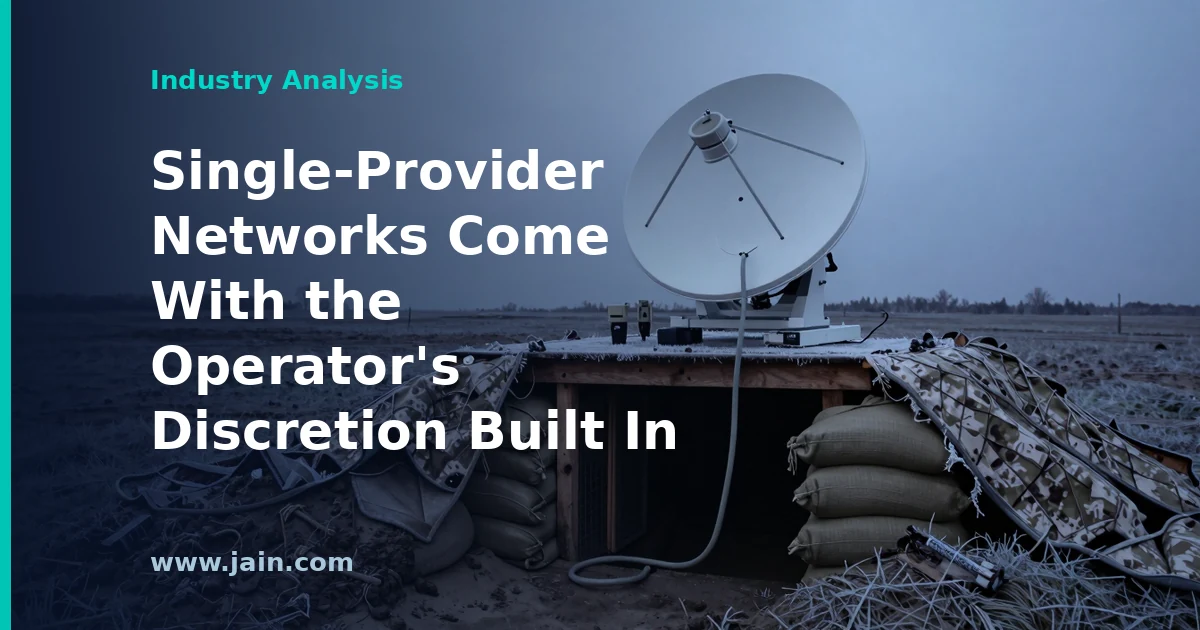
    The bigger lesson: when a country or a business runs on one company’s network, that company can change the service on its own terms.

    Elon Musk said on Saturday, October 24, that SpaceX had throttled its Starlink satellite internet service in Ukraine, the Associated Press reported. His post on X came after President Volodymyr Zelenskyy said Ukraine’s access to Starlink and Starshield, the military-grade version of the service, had been restored to the speeds it had before restrictions that disrupted front-line operations for more than a week.

    Musk said Ukraine’s military had violated Starlink’s terms of service by using it for offensive drone strikes and that “that loophole was closed last week,” while maintaining that the U.S. government controlled whatever changes happened with Starshield.

    Executive Summary

    SpaceX has acknowledged deliberately slowing — “throttling” — Starlink service in Ukraine, presenting the move as enforcement of its terms of service rather than a new policy. The restrictions, which Ukrainian commanders said cost them drones and disrupted missions, lasted more than a week before speeds were restored following what Ukraine’s defense minister called “direct dialogue” with Washington.

    For the connectivity industry, the significance goes beyond the war. The episode is a vivid demonstration that a provider’s reading of its own acceptable-use terms can be enforced by changing network performance, and that a customer — even a national government — may struggle for days to establish who made the decision. Any organization that runs critical operations on a single provider’s network carries a version of that exposure, and it is a risk that redundant equipment inside the same network cannot remove.

    The Terms of Service Turned Out to Be the Control Plane

    In networking, the “control plane” is the layer that decides how traffic is handled — which routes are open and what speed a user gets. Ukraine’s experience suggests that for a commercial satellite service, the decisive control plane is contractual as well as technical. Musk framed the throttle as enforcement: in his account, Ukraine’s military used “a civilian commercial service” for offensive drone strikes, breaching Starlink’s terms, and SpaceX closed “that loophole.” The enforcement tool was not a notice or a lawsuit but a change in service performance.

    The consequence was operational and measurable in time. Ukrainian officials said the restrictions disrupted front-line operations for more than a week, and commanders reported lost drones and disrupted missions. The customer here was a government at war, relying on the network for drone operations, logistics and communications. Whatever one concludes about SpaceX’s interpretation of its own terms, the mechanism is what matters to infrastructure buyers: a provider’s view of acceptable use was enough to degrade a national-scale dependency for over a week, and full speed returned only after head-of-state diplomacy with Washington.

    That is why operator discretion belongs on a buyer’s risk register alongside outages and capacity shortfalls. This is one case, and an extreme one — few customers use connectivity on a front line. But the underlying arrangement, a critical user dependent on a single provider whose terms reserve the right to decide what counts as permitted use, is common across satellite, cloud and network services. Duplicate terminals or extra bandwidth from the same provider do not hedge it; only contract terms and architecture do.

    A Week Without a Clear Decision-Maker

    The second lesson concerns accountability. Questions persisted for a week over who ordered the interruptions, and the public answers still do not line up. Musk acknowledged that SpaceX throttled Starlink but said the U.S. government controlled changes to Starshield, the military-grade service that is the backbone of Ukraine’s drone operations. President Donald Trump has said he did not make the call while also saying Musk should not be blamed. Vice President JD Vance hinted at White House coordination with Musk, while Secretary of State Marco Rubio and Defense Secretary Pete Hegseth denied any administration involvement.

    Those accounts are difficult to reconcile. The restrictions on Starshield were what alarmed Ukraine’s commanders, yet the company says the government controls that service, and the officials who have spoken either deny involvement or allude to coordination without detail. Whichever account proves complete, the customer spent days unable to establish who had changed its service or why.

    In commercial terms, this is a gap buyers can contract against: a named counterparty with authority to alter service, a defined notice period and an agreed escalation path. Ukraine’s remedy ran through presidential diplomacy. Most enterprises, and most smaller governments, have no comparable lever.

    Weighing the Claims on Each Side

    Musk’s justification rests on a distinction between civilian commercial service and offensive military use. That line is clear in principle and harder to apply in practice. SpaceX has not publicly set out the contractual language it relied on, how it determined that specific activity breached it, or how “offensive” strikes are distinguished from defensive operations on a network that, as Zelenskyy noted, also supports defense against Russian Shahed drones. It also raises the question of how traffic was divided between the two services, since Musk places drone operations on Starshield while describing the violation as misuse of Starlink.

    Ukraine’s claims deserve the same scrutiny. The reports of lost drones and disrupted missions came from commanders and have not been quantified publicly, and Ukrainian officials’ statements on the restoration focused on its operational benefits rather than on Musk’s specific allegation. The restoration itself is described by Zelenskyy; SpaceX has not said what was changed back, and Musk’s statement that the loophole “was closed” leaves open whether a use restriction remains even as speeds return to normal.

    What Network Buyers Should Price In

    The practical takeaways are not exotic. Buyers of critical connectivity — satellite links for remote sites, backhaul for edge facilities, primary circuits for operations centers — should know which service tier they are on and who governs it; the Starlink-versus-Starshield split shows the answer can differ between products from the same company. They should negotiate how disputes over permitted use are resolved before enforcement, not after, and insist that notice and change-control terms cover performance changes such as throttling, not only outright suspension.

    They should also treat path diversity as a hedge against policy risk, not just physical failure. A second provider, a different satellite system or a terrestrial route costs money, and that is precisely what pricing the risk means: the cost of an alternative path weighed against the cost of a week or more of degraded service at the worst possible moment.

    Background

    Starlink is SpaceX’s satellite internet service: a network of satellites that beams broadband to small user terminals on the ground, which makes it valuable where cables and cell towers are damaged or absent. Ukraine has relied on it since Russia’s full-scale invasion in February 2022, and Starshield, the military-grade version, has become the backbone of Ukraine’s drone operations and communication.

    The throttling episode unfolded during a renewed U.S. diplomatic push to end the war, including Russia’s agreement to resume three-way negotiations with Washington and Kyiv next month and a localized ceasefire around the Russian-occupied town of Oleshky brokered by first lady Melania Trump, and at a time when relations between Kyiv and Washington were already strained.

    Sources

    Source: Musk says he was behind Starlink speed restriction after service in Ukraine is restored — AP News report on Musk’s acknowledgment that SpaceX throttled Starlink in Ukraine and Zelenskyy’s statement that speeds have been restored.

  • Two of Australia’s 16 Cables Broke. For Data Centers, the Gap Is Fault Attribution

    Two of Australia’s 16 Cables Broke. For Data Centers, the Gap Is Fault Attribution

    TL;DR · 30-second read

    The Short Version

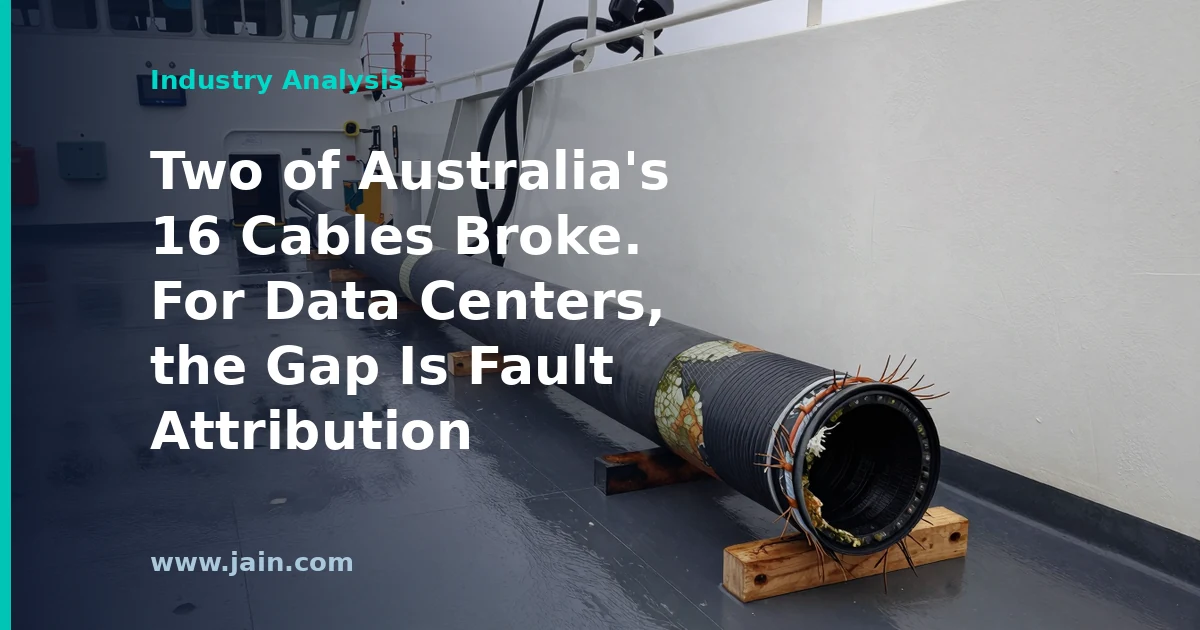
    Two of the undersea internet cables that link Australia to the rest of the world stopped working off Perth on the same weekend. Only 16 such cables connect the entire country.

    At the same time, a tanker ship managed from the United Arab Emirates was tracked sailing back and forth in loops over the protected strip of seabed where the cables lie. The cable company says this could be coincidence and has asked federal police to investigate.

    The bigger problem is that the cables had no built-in fault sensors. Nobody can say what broke them until a repair crew physically inspects them.

    The Maritime Executive reported on August 13, 2026, that fiber operator Subco lost two subsea cables back-to-back over the preceding weekend. Both breaks occurred inside a government-designated cable protection zone off Perth, Western Australia. At about the same time, a UAE-managed product tanker (a ship that carries refined fuels) sailed an unusual racetrack pattern over the charted cable area and crossed it several times. Security consultancy Windward independently validated the vessel’s presence and identity.

    Subco founder and CEO Bevan Slattery said the ship’s activity may be a coincidence. He nonetheless urged the Australian Federal Police to investigate urgently and said this could be the second such incident in a federally declared cable protection zone. The cables had no automatic diagnostic systems, so Subco will not know the root cause, including whether an anchor was dragged across the seabed, until it arranges a physical inspection.

    Executive Summary

    Australia’s international connectivity runs through 16 subsea cables, and two of them went down together off Perth. The breaks happened in a zone where anchoring and certain fishing are restricted precisely to protect cables. A tanker was moving back and forth overhead at the time, and surface conditions were benign. That combination made the operator raise the possibility of a security incident rather than treat the outage as routine maintenance.

    The more consequential detail is operational. Because the cables lacked automatic diagnostics, Subco cannot yet tell an accidental anchor drag from deliberate interference. Anchor drag alone causes about a third of cable breaks worldwide, according to the International Cable Protection Committee. Until a repair ship reaches the fault, investigators, insurers, customers and policymakers have to act without knowing which kind of event this was.

    For anyone running data centers or cloud services that depend on international routes, the difference matters. An accident is a random event that route diversity absorbs. A deliberate act can recur and can target several cables at once, and that changes how much redundancy is enough.

    Two Out of Sixteen Is Not a Rounding Error

    Subsea cables carry the overwhelming majority of intercontinental data traffic. That includes the traffic that lets Australian businesses reach cloud regions and AI services hosted overseas, and lets local data centers serve customers across the Indian Ocean and Asia. With just 16 cables linking Australia to the world, losing two at once removes a significant share of the country’s international paths. The Maritime Executive described that as a substantial security event.

    Geography sharpens the problem. Perth is Australia’s western gateway, and cables landing there take routes toward Asia and the Middle East that east-coast systems do not. When two breaks cluster in the same protected corridor, traffic has to shift onto fewer routes. That can mean longer paths, higher latency (the delay data experiences in transit) and less spare capacity if anything else fails before repairs are complete.

    The Real Gap: Nobody Can Yet Say What Happened

    The detail that should concern infrastructure operators most is that Subco’s cables had no automatic diagnostic systems. Without them, the operator knows the cables stopped carrying light but not why. It has to send a vessel to locate the fault, lift the cable and examine the damage before it can distinguish an anchor strike from a snag, a fishing gear incident or deliberate cutting. Until then, the circumstantial evidence is all anyone has: back-to-back breaks, a ship making multiple crossings in a racetrack pattern, and calm surface conditions that remove bad weather as an easy explanation.

    This attribution delay has direct consequences for data center and cloud operators. Resilience planning for subsea routes has traditionally assumed faults are independent accidents. Under that assumption, buying capacity on two or three diverse cables makes a simultaneous outage very unlikely. That math weakens if breaks can be deliberate and coordinated, because a single actor can hit several cables in one corridor, as two breaks in one protection zone illustrates. An operator that cannot tell which kind of event it is facing cannot tell whether its redundancy is adequate. It also cannot tell whether the same corridor is safe to rely on while repairs proceed.

    The same gap slows everyone downstream. Police cannot easily build a case, insurers cannot assign a cause, and governments cannot calibrate a response. Slattery asked the Australian Federal Police to move urgently, and the physical evidence on the seabed is what any investigation will ultimately depend on.

    Weighing the Evidence on Both Sides

    The case for concern is real but circumstantial. The vessel’s track and timing match the breaks, Windward validated its identity and presence, and Slattery noted this could be the second incident in a federally declared zone. Researchers are also warning about the broader pattern. ASPI’s David Brewster told ABC that many recent cable cuts in Europe and around Taiwan were, in his view, fairly obviously the work of Russia and China. A new review from the Australian National University’s National Security College concludes that state actors appear to be probing cable infrastructure in peacetime so they could degrade connectivity quickly at the start of a conflict.

    The case for caution is equally worth stating. Slattery himself twice said the ship’s behavior may be a coincidence. Anchor drag is a common, ordinary cause of cable damage. Brewster’s remarks concerned incidents elsewhere, not this one, and he acknowledged it is difficult to be certain in some cases. A tanker managed from the UAE is not evidence of any state’s involvement. Unusual vessel movements can have commercial or navigational explanations that have not yet been aired. The fair reading is that the incident warrants investigation, not that its cause is known.

    What Operators and Buyers Should Take From It

    For cable owners, the lesson is that monitoring is now part of the security posture, not just a maintenance convenience. Fault-location and fiber-sensing systems that can flag disturbances as they happen would shorten the window in which an event goes unexplained. Tracking vessel behavior over protection zones as it happens would help too. Protection zones deter accidental damage by lawful mariners, but they do not stop a ship that ignores them. Enforcement depends on noticing quickly.

    For data center and enterprise buyers of international capacity, the practical questions are about correlation, not just redundancy. Are the backup routes physically separate from the primary ones, or do they share the same seabed corridor or landing point? How quickly can capacity be restored, and how many repair vessels are available in the region? Those answers now matter as much as headline bandwidth.

    Background

    Subsea cables are bundles of optical fiber laid along the seabed that carry most of the world’s intercontinental internet and data traffic. They are built to last decades but are physically exposed. Ship anchors and fishing gear are the most common causes of damage, and repairs require specialized vessels that are in limited supply. Australia’s geographic isolation makes it unusually dependent on a small number of these systems, and the government declares cable protection zones off major landing points to restrict risky activity near them.

    Subco is an Australian subsea cable operator founded by Bevan Slattery, a long-time builder of Australian digital infrastructure. Concern about deliberate cable damage has grown since a series of incidents in the Baltic Sea and around Taiwan over the past several years. Security researchers there have pointed to state actors seeking disruption while keeping deniability, and that context is why every unexplained break now draws closer scrutiny.

    Sources

    Source: Suspicious Subsea Cable Breaks Prompt Calls for Investigation in Australia (The Maritime Executive): Subco reports two cable breaks off Perth coinciding with a tanker’s movements over a cable protection zone.

  • Gulf’s Stalled $700mn Cable Shows AI Campuses Are Only as Good as Their Routes

    Gulf’s Stalled $700mn Cable Shows AI Campuses Are Only as Good as Their Routes

    TL;DR · 30-second read

    The Short Version

    The internet travels between countries through cables on the seabed. New cable projects in the waters around the Middle East have stopped, and a ceasefire between the US and Iran has not restarted them.

    That matters because Gulf countries are spending heavily on huge computer centers for artificial intelligence, hoping to rely less on oil. Those centers need reliable links to the outside world.

    Restarting will be slow. The seabed must be checked for mines and specialist ships brought back, which could take months. Insurers also want lasting peace first.

    The Financial Times reported in June 2026 that a halt to subsea cable projects in the Middle East is set to persist despite the US-Iran ceasefire. Alan Mauldin, research director at data group TeleGeography, said all subsea cable projects in the Strait of Hormuz and the Gulf had been “delayed indefinitely.” Ryan Sher, chief operating officer of West Indian Ocean Cable Company (WIOCC), a partner on the Meta-led 2Africa network, said cable laying in the Red Sea was “on pause” until security is assured.

    Planned or partially laid systems that cross or pass through the strait include the proposed $700mn WorldLink network connecting Gulf states, Fibre in Gulf, owned by Qatari telecoms group Ooredoo, and Sea-Me-We 6, which links south-east Asia to Europe.

    Executive Summary

    New international cable capacity in and around the Gulf has stopped moving forward, and the end of active hostilities has not been enough to restart it. Resumption depends on seabed surveys, demining, the return of diverted cable-laying ships, and insurance terms that are likely to stay restrictive until there has been a sustained period of peace and security.

    The timing matters because Gulf states have invested heavily in data centers, cloud services and AI as part of their push to diversify beyond oil. Those ambitions rest on reliable connectivity as much as on capital, power and chips. Energy and geopolitical analyst Masha Kotkin said the stalled projects “put a question on the ambitions of countries in the Gulf Cooperation Council in becoming cloud computing and AI powerhouses.”

    The near-term risk is more likely to be delay than retreat. Kotkin expects companies to stay with existing investments but possibly defer new spending, leaving projects still in planning most exposed. For anyone building or buying capacity in the region, route availability has become a question to settle early rather than assume.

    A Campus Is Only as Good as Its Routes

    A data center campus can be financed, powered and filled with chips inside one country’s borders. A regional hub has a further requirement: its data must be able to reach customers beyond those borders. For much of that traffic, the path runs along the seabed, through waters that no single campus developer controls. That is the gap the current halt exposes.

    WorldLink illustrates the mechanism. At a proposed $700mn, the network was intended to connect Gulf states to one another, and it sits among the systems affected by a region-wide delay that Mauldin describes as indefinite. Its cost to the region is not limited to its price tag. A postponed route also holds back the capacity and redundancy, meaning alternative paths when one fails, that planners of the facilities around it might otherwise count on. The same logic applies at a larger scale to Sea-Me-We 6 and the Middle East links of 2Africa, which tie the region to Asia, Africa and Europe.

    Exposure will not be uniform. A campus serving mainly domestic users is less dependent on new international capacity than one whose business case rests on selling compute across regions. The second model is the one implied by hub ambitions, which is why cable delays bear directly on those plans. The people most affected are developers and cloud operators with export-oriented capacity still in planning, along with the governments that have tied economic diversification to that outcome.

    A Ceasefire Does Not Restart a Cable Ship

    The restart sequence is physical and contractual as well as diplomatic. The ocean floor must be surveyed and demined. Cable-laying ships diverted during the conflict must be reassigned to the region, which analysts say could take months. Insurance clauses that forced operators to pause are likely to stay in place until there has been a sustained period of peace and security.

    That last condition may prove the hardest to schedule, because it depends on elapsed calm rather than on a task that can be completed. Reports in March claimed that Alcatel Submarine Networks had issued force majeure notices, the contractual declarations that events beyond a party’s control prevent performance, for all operations in the Gulf. Such constraints help explain why a ceasefire and a reopened strait have not translated into renewed work at sea.

    Perception adds a slower variable. Mostafa Ahmed, senior researcher at Emirati think-tank the Al Habtoor Research Centre, said that even after the strait’s reopening, “in the eyes of infrastructure investors it now carries the reputation of a fragile digital chokepoint, and that perception will not unwind quickly.” This is a forecast about investor behavior, not yet a measured capital outflow, but it should be tested against spending decisions in the months ahead.

    Security Moves Onto the Buyer’s Checklist

    The strain extends beyond the Gulf. In 2024, three Red Sea cables were severed by an anchor dragged from a cargo ship sunk by Houthi rebels in Yemen, forcing telecoms companies to reroute data. Sher said WIOCC had made a “massive investment” in the Red Sea section of 2Africa that runs towards Europe, and that this part of the network is now “effectively not usable for us.” Iran’s threat in May to impose fees on cables passing through the strait added to the unease. Analysts doubt it could be enforced, but they read it as a sign that Tehran views such infrastructure as a strategic asset.

    Commercial priorities are shifting in response. Prysmian, an Italian cable manufacturer that operates in the Middle East, said customers are increasingly concerned about the security of subsea cables, not only their quality and price. Operators have long sought diverse routes to avoid chokepoints, and the conflict has made that search more urgent. WIOCC is examining routes through Africa that reduce reliance on the Middle East, as well as land-based options.

    The scale of the disruption should be stated carefully. Ahmed noted that only a small fraction of international telecommunications traffic passes through the strait, while calling it “a critical . . . digital artery” and warning of “ripple effects” across Africa, Asia and parts of southern Europe, with India particularly exposed. Sher’s description of a mood of “hopelessness” reflects an operator with capital tied up in affected routes, while Kotkin’s expectation that companies will stay with existing investments points to a more gradual effect. Both can hold: a contained share of global traffic can still be decisive for the region seeking to become a hub.

    Background

    Subsea cables carry data between countries and continents, and operators have long tried to spread their networks across multiple corridors so that no single chokepoint can cut them off. The Middle East has been a key junction: several major cables pass through the Strait of Hormuz, while the Red Sea provides a crucial link towards Europe. The Meta-led 2Africa network connects Africa to Europe and the Middle East, and WIOCC is among its partners.

    Countries in the Gulf Cooperation Council, the regional bloc of Gulf states, have invested heavily in data centers, cloud services and AI to diversify their economies beyond oil. Those plans have developed alongside growing concern about cable security, including the 2024 Red Sea cuts and incidents of cable sabotage in Europe in recent years, which have added to a sense among operators that subsea networks are becoming more vulnerable to geopolitical instability.

    Sources

    Source: Stalled subsea cable projects threaten Middle East digital ambitions, Financial Times: on suspended cable work in the Strait of Hormuz, the Gulf and the Red Sea, and the risk to the region’s AI and cloud plans.

  • Google-Telstra Pact on 3 Subsea Cables Shows Why AI Resilience Is Also Won Onshore

    Google-Telstra Pact on 3 Subsea Cables Shows Why AI Resilience Is Also Won Onshore

    TL;DR · 30-second read

    The Short Version

    Google and Telstra, Australia’s leading phone and internet company, have agreed to use each other’s cables.

    Google gets strands of fiber on Telstra’s new cross-country network, already more than 8,000 kilometers long, or roughly twice the drive from Sydney to Perth. Telstra gets space on three undersea cables that are part of Google’s Pacific programs, linking Australia to Japan, the Pacific Islands and the United States.

    Why it matters: if one cable is cut, internet and artificial intelligence services can reroute instead of going dark. Neither company said what the deal is worth.

    Google and Telstra announced a partnership on June 1, 2026, that connects the two companies’ networks on land and at sea. Google will secure inter-city dark fiber, which is unlit fiber that the buyer switches on with its own equipment, on Telstra’s new Aura Network backbone. In return, Telstra will use subsea fiber pairs on the Tabua, Proa and Bulikula cable systems through Google’s Pacific Connect and Australia Connect initiatives. Those cables link Australia with Japan, the Pacific Islands and the United States.

    The deal was announced jointly by Bikash Koley, Google’s Vice President of Global Infrastructure, and Steven Worrall, CEO of Telstra Digital Infrastructure. Worrall said Aura has more than 8,000 kilometers of fiber already laid, and that its Melbourne-Canberra-Sydney coastal routes launched late last year. The companies did not disclose financial terms, capacity volumes or in-service dates.

    Executive Summary

    This is a reciprocal infrastructure arrangement, and it is not a conventional supply contract. Each company takes access to the half of the network the other one is building. Google is a major builder of subsea cable, and it gains terrestrial backbone across Australia’s key inter-city corridors. Telstra owns the country’s most extensive domestic network, and it gains fiber on three international systems that reach Japan, the Pacific Islands and the United States.

    The stated goal is resilience. The companies say that joining their land and sea routes will let each of them ‘remove single points of network failure.’ The underlying argument is an operational one that often gets lost in AI-infrastructure coverage. Diverse ocean cables do not add much resilience if the traffic they carry funnels into the same stretch of fiber once it reaches shore.

    For Australian enterprises, government agencies and cloud customers, the practical promise is more redundant paths in and out of the country and between its major cities. The companies have not yet said how much capacity is involved or when it becomes usable.

    The Shoreline Is Where Diversity Is Won or Lost

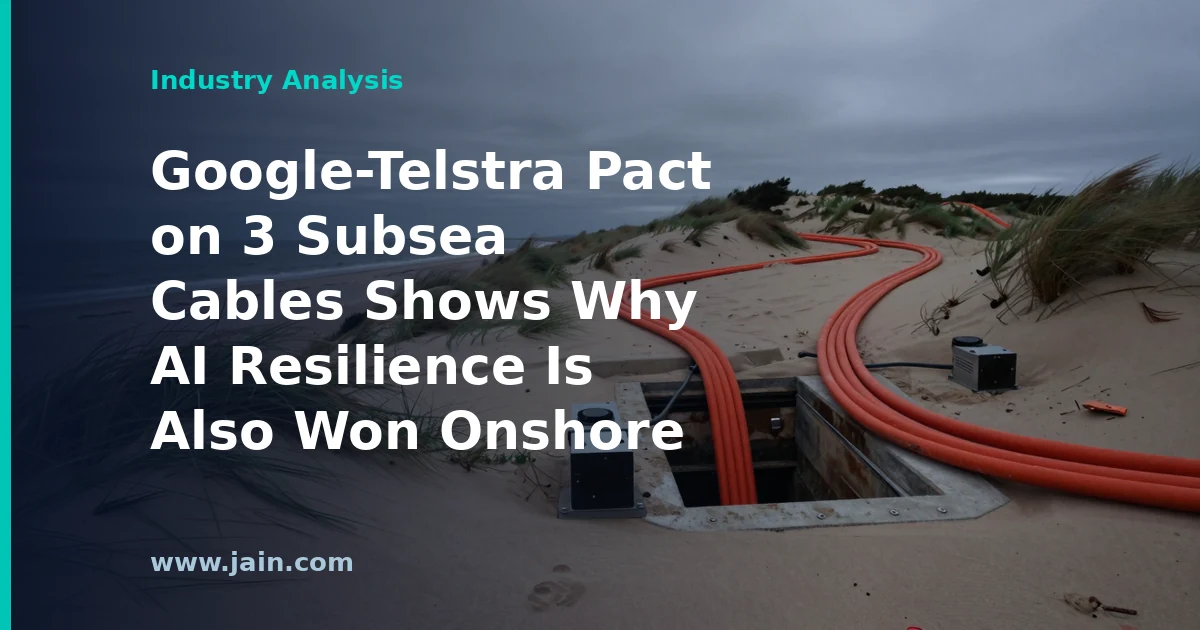
    A subsea cable comes ashore at a landing station, and from there its traffic still has to travel overland, over terrestrial fiber, to data centers, exchanges and cities. Network engineers call the full path end-to-end diversity. If two separate ocean cables land in different places but their inland backhaul runs through the same conduit or corridor, a single construction accident can cut both. The ocean diversity bought at great cost is lost a few kilometers from the beach.

    The Google-Telstra deal is built around that problem. Google already has subsea reach into the region through Tabua, Proa and Bulikula. What it lacked was inter-city capacity on land that it controls. It chose dark fiber, which means it lights the strands with its own optical equipment and sets capacity and upgrade timing itself, and it chose it on a new backbone that is physically separate from older routes. Telstra had the domestic network but wanted more international exits. The release states that integrating the two lets ‘Telstra and Google each remove single points of network failure.’ That is the substance behind the AI framing. As AI services depend more on moving data between Australian cities and overseas compute, a cable cut costs more, and the fix involves the land side as much as the sea side.

    Several groups are affected. Google’s Australian users and cloud customers get more alternative routes if a path fails. Telstra’s enterprise and government customers get more options for international traffic. Other carriers and cloud providers face a competitor pair that now controls diversity at both ends of the path. This is one deal, so it is not proof of an industry trend. It is a clear example of how a hyperscaler, meaning one of the largest cloud operators, and a national carrier can split the build instead of each duplicating the other’s half.

    A Two-Way Exchange of Scarce Assets

    The structure is notable because each company offers something that is slow and expensive to replicate. Laying new inter-city fiber across Australia takes years of trenching, permits and landholder negotiations. Building a trans-Pacific cable takes consortium financing, marine surveys and cable-ship time. By exchanging access, each company avoids building the other’s specialty. Long-haul fiber and subsea capacity commonly change hands through long-term rights of use. The companies have not said whether cash, capacity or both are involved in this deal.

    For Telstra’s Aura build, a hyperscaler taking dark fiber serves as an anchor tenant, a large customer whose commitment helps justify the network. Worrall tied the deal to Aura’s momentum and to ‘sustainable, disciplined growth.’ That suggests the company sees Google as validation for the backbone’s economics. How much of Aura’s capacity Google has taken, and on which routes, has not been said.

    What Is Substantiated and What Is Aspiration

    Some claims are concrete. These include the named cable systems and their destinations, the dark-fiber arrangement on Aura, Aura’s more than 8,000 kilometers laid, and the launch of the Melbourne-Canberra-Sydney coastal routes. The resilience mechanism is also sound network engineering.

    Other claims are broader and harder to test. These include the partnership being ‘a significant step forward in securing Australia’s digital and AI future,’ Australia’s role as a ‘regional connectivity hub,’ and the link to ‘the next industrial revolution.’ The release does not quantify AI traffic growth, capacity added, or any change in latency or availability. These are reasonable ambitions for a well-connected market. Readers should weigh them as direction rather than as measured outcomes.

    Background

    Australia’s geography makes it heavily dependent on subsea cables for international traffic. Its population is concentrated in a few coastal cities linked by long terrestrial fiber routes. That combination makes route diversity, both at sea and on land, a recurring concern for carriers, cloud providers and government. Telstra is Australia’s largest telecommunications company. Its Telstra Digital Infrastructure unit is building Aura, a new inter-city fiber backbone.

    Google, a subsidiary of Alphabet, has become one of the most active investors in subsea cables worldwide. It uses them to connect its data centers and to serve cloud and consumer products. Through its Pacific Connect and Australia Connect initiatives, it has backed new systems linking Australia with Japan, the Pacific Islands and the United States, including Tabua, Proa and Bulikula.

    Sources

    Source: Google and Telstra Partner to Connect Australia and Bolster its Digital Future: Google Cloud Press Corner announcement of the Aura dark-fiber and Tabua, Proa and Bulikula subsea partnership.