TL;DR · 30-second read
The Short Version
TAR, a Texas company started only this year, has raised $120 million from investors who now value it at $1 billion.
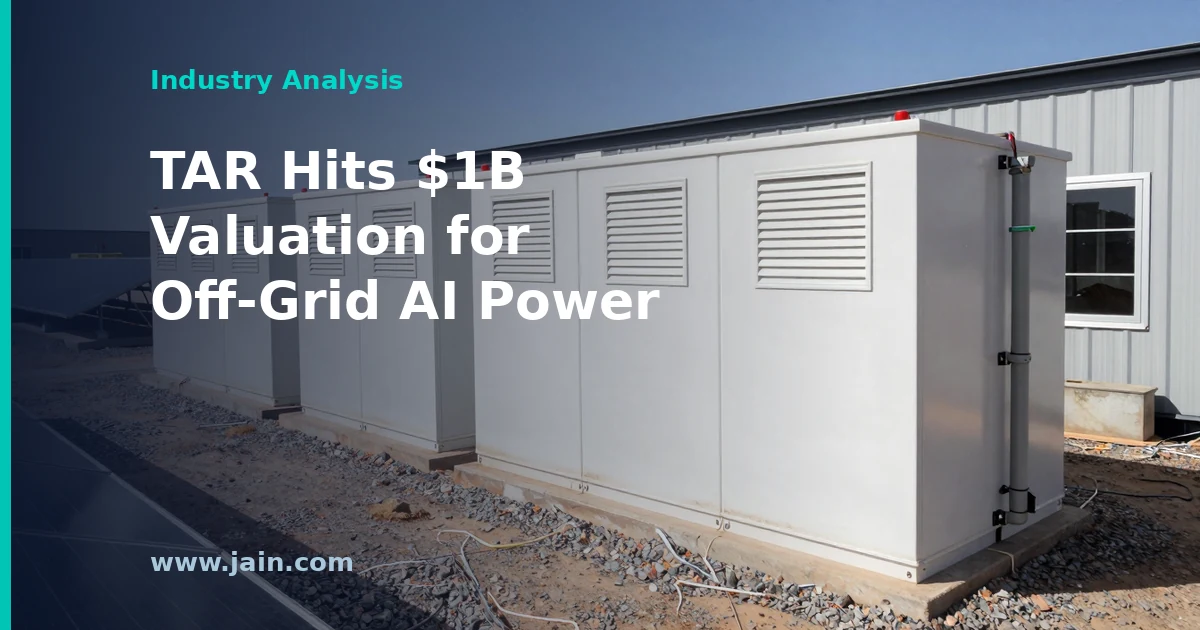
It builds private power plants for the giant computer warehouses behind artificial intelligence tools. The plants use renewable energy and huge batteries, and never plug into the public electricity grid.
Why it matters: these warehouses use so much electricity that many wait years to be connected. TAR says its approach lets them get power without competing with nearby homes and businesses for it.
Austin-based TAR has raised $120 million in Series A funding at a $1 billion post-money valuation, Pulse 2.0 reported on September 11, 2026. Spark Capital led the round. TAR was founded in 2026 by Pat Becker and Leonhard (Lenny) Soenke. It builds self-contained, modular power systems that combine renewable generation with battery storage and run independently of the electric grid, aimed at AI data centers at gigawatt scale.
The company says the money will expand its Austin headquarters and its San Francisco engineering office. It will also grow manufacturing and logistics operations in West Texas and speed up deployments already underway. Those deployments include a utility-scale project with one of the largest neoclouds, a dedicated project campus, and TAR Terminal One, a manufacturing and logistics center in West Texas.
Executive Summary
TAR’s raise is one of the clearest signs yet that investors see off-grid power for AI as a business category in its own right. It is no longer just a temporary fix for data centers waiting on a utility hookup. A company founded this year has reached unicorn status on its first institutional round by promising dedicated renewable-plus-battery generation that it designs, builds and operates itself.
The thesis rests on two claims. The first is that power, not chips, is now the binding constraint on AI computing. The second is that the fastest way to supply it is to own the whole project lifecycle and automate construction. TAR pairs energy veterans from Hut 8, AES and Vistra with robotics engineers from Zipline, GrayMatter Robotics and Lucid Motors, which suggests an attempt to treat power plant construction partly as a manufacturing problem.
What the company has not yet made public matters as much as the valuation. TAR has not disclosed installed megawatts, its customer’s name, contract terms or project timelines. The central engineering question for any off-grid system serving round-the-clock computing is how it maintains reliable supply, and TAR has not yet explained its approach.
Off-Grid Power Gets Its Own Venture Price Tag
For much of the data center boom, on-site generation has been framed as a bridge. It energizes a campus while the project waits in a utility’s interconnection queue, the line of projects awaiting approval to connect to the grid. A $1 billion post-money valuation for a company founded in 2026 suggests Spark Capital sees something more durable: a standalone category in which generation is built and run as a permanent, dedicated supply for computing.
The arithmetic is instructive. A $120 million raise at $1 billion post-money implies a pre-money valuation of roughly $880 million. TAR reached that figure without publicly disclosing completed megawatts, contracted revenue or a named customer. At that level, investors are paying for team, speed and position in a market where, as Spark’s Will Reed put it, “power is becoming the main bottleneck to scaling compute.” It is a bet on the size of the problem as much as on a track record.
The deal also points to a shift in where AI infrastructure capital goes. Energy assets have traditionally been funded by utilities, infrastructure funds and project lenders, who price them for steady, bond-like returns. A venture-style valuation for a power developer implies that some investors now treat the speed of energy delivery, and not only its cost, as a source of technology-like upside.
Owning the Whole Stack: Faster Delivery, Concentrated Risk
TAR’s strategy is vertical integration. It handles site selection, detailed engineering, procurement, logistics, civil construction, commissioning and ongoing operations itself, rather than coordinating a chain of outside contractors. The reasoning is that schedules tend to slip at the handoffs between firms. Co-founder Pat Becker said gigawatt-scale deployments (a gigawatt is a thousand megawatts, comparable to the output of a large power plant) “in tight time windows necessitate owning the full stack end-to-end.”
The company’s purpose-built deployment automation stack is meant to install generation faster, at larger scale and with less field labor than conventional construction. If it works, the limit on how fast power can be built shifts away from the supply of skilled field crews and toward factory and logistics throughput. TAR Terminal One in West Texas appears designed to supply that throughput.
The trade-off is concentration of risk. A contractor ecosystem spreads execution risk across many firms, while an integrated developer carries all of it. TAR must scale engineering, robotics, manufacturing, logistics and field operations at the same time. That is capital-intensive and operationally demanding. TAR has not yet disclosed completed projects that show its automation claims working at scale.
The Reliability Question for Renewables Plus Batteries
AI data centers run around the clock, and their customers expect very high uptime. A grid connection offers a backstop when on-site generation falls short, and an off-grid system has no such backstop. TAR describes its systems as combining renewable generation with battery storage and operating independently of the grid. The design therefore has to cover periods of weak sun or wind entirely on its own.
That problem can be solved in several ways: oversizing generation, adding longer-duration storage, or including firm backup generation. Each adds cost, equipment and land. How TAR balances these choices will largely decide whether its power competes on price and reliability with grid electricity or with gas-fired on-site plants, the other common off-grid option.
TAR’s community argument does resonate. Its systems do not draw on shared grid capacity, so the company says data center projects can add generation without competing with surrounding communities. That matters in siting debates, where the effect of very large facilities on local electricity supply and prices is a recurring concern.
Who Stands to Gain if the Model Works
Neoclouds are natural early customers. These are cloud providers that specialize in renting out GPU computing for AI, as opposed to the broad hyperscale clouds. They compete heavily on how quickly they can bring capacity online, which makes long grid timelines especially costly for them. TAR says it is already executing a utility-scale deployment with one of the largest neoclouds, a sign that its offer has found at least one buyer with urgent demand.
For utilities and grid operators, the effects are mixed. Off-grid campuses ease pressure on congested transmission lines, but they also mean large new electricity users that never become utility customers. Suppliers of batteries and generation equipment, along with West Texas manufacturing and logistics workforces, stand to benefit from any sustained buildout. TAR’s competition includes other on-site power developers and the traditional engineering and construction firms whose multi-contractor model it is explicitly positioning against.
Background
AI data centers use far more electricity than traditional facilities, and in many regions connecting a new large user to the grid means joining a long interconnection queue and waiting for new transmission and generation. That has pushed developers toward “behind-the-meter” power: generation built on or next to the site that serves the data center directly. Such projects have often been treated as temporary bridges until a grid connection arrives.
TAR, founded in 2026 in Austin, is pursuing the off-grid approach as a permanent model. It uses modular renewable generation and battery storage and manages projects end to end. Its lead investor, Spark Capital, is a venture capital firm. The company’s leadership draws on experience at energy and infrastructure companies including Hut 8, AES and Vistra, as well as robotics and hardware companies Zipline, GrayMatter Robotics and Lucid Motors. Source: TAR Raises $120 Million Series A At $1 Billion Valuation To Build Off-Grid Power For AI Data Centers (Pulse 2.0), covering TAR’s Spark Capital-led round to expand off-grid renewable and battery power systems for AI data centers.Sources