
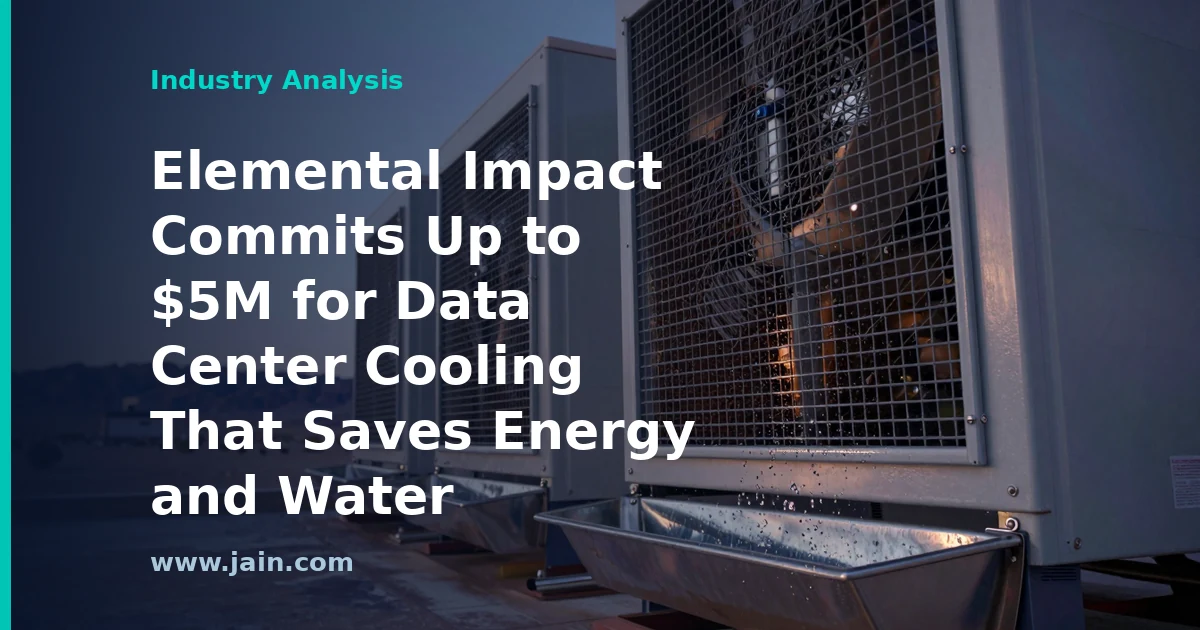
Elemental Impact, a nonprofit climate-technology investor, has launched a Data Center Innovation Initiative that will provide up to $5 million in funding for cooling technologies that reduce energy and water consumption in data centers. The announcement, reported June 15, 2026 by the trade publication Natural Refrigerants, positions the initiative squarely at the intersection of the AI-driven data center boom and growing scrutiny of the industry’s resource footprint.
Executive Summary
The headline commitment is modest by data center standards — up to $5 million — but the target is one of the industry’s most consequential engineering problems. Cooling is typically among the largest energy loads in a data center after the IT equipment itself, and many facilities also rely on evaporative systems that consume significant volumes of water. Technologies that cut both at once address the two resource concerns that most often put data center projects in conflict with host communities and utilities.
The initiative’s framing in a natural-refrigerants publication is itself a signal: it suggests interest in cooling approaches built on refrigerants such as CO2, ammonia, or hydrocarbons, which avoid the high-global-warming-potential fluorinated gases (HFCs) that regulators in the U.S. and elsewhere are phasing down. For a nonprofit investor like Elemental Impact, the play is catalytic — using relatively small, early money to help promising cooling technologies reach commercial deployment faster than conventional venture or infrastructure capital would carry them.
Cooling Is Where Efficiency Gains Are Still on the Table
A data center’s power draw splits between the computing hardware and the overhead needed to keep it running — chiefly cooling and power distribution. Operators measure this with power usage effectiveness (PUE), the ratio of total facility power to IT power, and the gap between an average facility and a best-in-class one is largely a cooling story. As AI accelerators push rack densities far beyond what traditional air cooling was designed for, the industry is being forced toward liquid cooling, advanced heat rejection, and smarter refrigeration cycles anyway. Funding aimed at this transition arrives with the market already moving in its direction.
Water is the quieter half of the problem. Evaporative cooling saves electricity precisely by consuming water, so operators often face a trade-off between energy efficiency and water efficiency. Technologies that genuinely reduce both — rather than shifting the burden from one resource to the other — are the harder engineering target, and the initiative’s dual framing suggests that is the bar Elemental Impact intends to set.
What $5 Million Can and Cannot Do
Five million dollars does not build data center infrastructure; a single large facility can represent hundreds of millions or billions in capital expenditure. But that comparison misses how catalytic capital works. Early-stage cooling hardware faces a well-known commercialization gap: pilots are expensive, data center operators are conservative buyers who rarely gamble uptime on unproven equipment, and the revenue that would fund a first deployment depends on having done a first deployment. Philanthropic and nonprofit capital is one of the few tools designed to absorb exactly that risk.
The realistic measure of success for an initiative this size is not megawatts cooled but proof points created — field data, reference customers, and validated performance claims that let follow-on investors and buyers commit with confidence. That leverage effect is the standard theory of change for organizations like Elemental Impact, which has spent years funding climate technologies through the awkward stage between lab and market.
The Regulatory Tailwind Behind Natural Refrigerants
The venue for the announcement matters. Conventional cooling systems have long depended on fluorinated refrigerants with high global warming potential, and those chemicals are now being phased down under the international Kigali Amendment and, in the United States, the AIM Act. Natural refrigerants — carbon dioxide, ammonia, propane, and similar substances — sidestep that regulatory curve entirely, but they bring their own engineering challenges around pressure, toxicity, or flammability that have slowed adoption in data centers.
If the initiative channels money toward natural-refrigerant cooling for data centers specifically, it is betting that regulatory pressure plus AI-era density demands will finally pull these systems into a market that has historically been cautious about them. That is a defensible bet, though the announcement as reported does not detail how prescriptive the initiative will be about refrigerant choice.
Winners, Losers, and Who Should Pay Attention
The most direct beneficiaries are early-stage cooling companies that need pilot funding and credibility. Data center operators benefit indirectly: a broader menu of proven, efficient cooling options lowers operating costs and eases the permitting and community-relations friction that increasingly delays projects over power and water concerns. Utilities and water authorities in data center markets gain, too, if efficiency gains materialize at scale.
The competitive question is whether small, mission-driven funding can move faster than the incumbents. Major cooling vendors and hyperscale operators are investing heavily in their own thermal management roadmaps. A $5 million initiative will not outspend them — but it can back approaches those incumbents consider too early or too unconventional, which is historically where nonprofit climate capital has earned its keep.
Background
Elemental Impact, previously known as Elemental Excelerator, is a nonprofit investing platform that has spent more than a decade funding climate technologies across energy, transportation, water, and industry, with an emphasis on getting first deployments into the ground alongside community partners. The data center initiative extends that model into digital infrastructure at a moment when the sector’s growth has made its energy and water footprint a mainstream policy issue.
Data center cooling itself is in the middle of a generational transition: AI accelerators are pushing power densities beyond what conventional air cooling handles economically, while refrigerant regulations and water scarcity are constraining the traditional fixes. That convergence has turned thermal management — long a back-of-house discipline — into one of the most actively funded corners of data center technology.
Source: Elemental Impact’s Data Center Innovation Initiative Will Provide Up to $5 Million in Funding for Cooling Tech That Reduces Energy and Water Use — Natural Refrigerants trade publication report, June 15, 2026, on the nonprofit’s new funding program for efficient data center cooling.