Tag: natural gas

  • Texas Tops the Nation in Proposed Gas Plants for Data Centers

    Texas Tops the Nation in Proposed Gas Plants for Data Centers

    Texas now leads the United States in proposed natural gas power plants intended to serve data centers, according to reporting by the Texas Tribune published July 2, 2026. The report notes that the proposed plants would emit large amounts of greenhouse gases if built.

    The finding places Texas at the center of a national trend: as AI-driven data center demand outpaces what existing grids can deliver, developers are increasingly proposing dedicated, on-site or co-located gas generation rather than waiting in utility interconnection queues.

    Executive Summary

    The Texas Tribune’s July 2026 reporting identifies Texas as the top state for proposed power plants tied to data centers — and specifically flags the greenhouse gas consequences of that pipeline. The headline fact is simple but significant: the AI infrastructure boom is no longer just a real estate and chip story; it is a power generation story, and Texas is where the most new fossil-fueled capacity is being proposed to feed it.

    Why it matters: data centers historically plugged into the existing grid and bought power like any other large customer. The scale of AI campuses — often requiring hundreds of megawatts each, comparable to a small city — has flipped that model. Developers are now proposing their own gas plants, or pairing with generation developers, to guarantee power on their construction timelines. That accelerates buildout but shifts emissions, siting, and reliability questions onto communities and regulators who are still catching up.

    For the infrastructure industry, the report is a signal of where the market has moved: speed-to-power is the binding constraint on AI capacity, and Texas — with its independent grid, comparatively fast permitting, and abundant natural gas — has become the path of least resistance.

    Why Texas Became the Epicenter of the Gas-for-AI Buildout

    Texas offers a combination no other state matches: an independent grid operated by ERCOT (the Electric Reliability Council of Texas, which runs the grid for most of the state outside federal interconnection oversight), a deregulated energy-only power market, in-state natural gas supply from the Permian Basin, and a permitting culture that moves faster than most coastal states. For a data center developer whose customers are demanding capacity in 18–24 months rather than the five-plus years a utility interconnection can take, those attributes translate directly into revenue.

    The result the Tribune documents — Texas leading the nation in proposed data-center power plants — is the logical endpoint of that competition. When the grid cannot deliver power fast enough, developers bring their own. Natural gas turbines are the default choice because they are dispatchable (they run whenever needed, unlike weather-dependent wind and solar) and can be ordered, sited, and built faster than nuclear, though turbine order backlogs have become their own bottleneck industry-wide.

    The Emissions Trade-Off Behind the AI Boom

    The Tribune’s framing highlights the tension the industry has been navigating for two years: the same hyperscale companies that made aggressive carbon-neutrality pledges are now, directly or through partners, driving a wave of new fossil-fueled generation. Gas plants emit roughly half the carbon dioxide of coal per unit of electricity, but a large fleet of new gas capacity running at high utilization to serve round-the-clock compute loads still represents a substantial, long-lived emissions commitment — these plants typically operate for 30 years or more.

    This does not mean the criticism writes itself in only one direction. Proponents argue that new, efficient gas capacity can displace older, dirtier generation, firm up a grid that is adding record amounts of solar and storage, and that some proposed plants may be bridge solutions later paired with carbon capture or displaced by nuclear. Those arguments deserve scrutiny too: bridge claims are only as good as the retirement and conversion commitments behind them, and the release-level reporting here does not indicate such commitments exist for the Texas pipeline.

    What a Proposal Pipeline Does — and Does Not — Tell Us

    A crucial caveat for readers: “proposed” is doing heavy lifting in this story. Power plant proposal pipelines everywhere are inflated by speculative filings — developers reserve interconnection positions, file air permits, and announce projects to attract customers and capital, and a meaningful fraction never get built. The same phenomenon inflates data center announcement figures. Texas leading in proposals confirms where developer intent is concentrated; it does not tell us how many megawatts will actually enter service, or when.

    That said, the direction is unambiguous. Even a partial realization of the Texas pipeline would reshape the state’s power market — affecting gas demand, electricity prices for other consumers, water use for cooling, and ERCOT’s planning assumptions. Texas legislators have already responded to large-load growth with new interconnection and curtailment rules for big electricity users, a sign that regulators expect the trend to persist.

    Winners, Losers, and the Competitive Map

    The near-term winners are clear: gas turbine manufacturers with multi-year order books, midstream companies moving Permian gas, engineering and construction firms, and landowners in transmission-adjacent counties. Data center operators who secure firm power early gain a genuine moat, because speed-to-power — not land or capital — is currently the scarcest input in AI infrastructure.

    The open question is who bears the costs. Residential and industrial ratepayers may face higher prices if large loads strain the system faster than supply arrives; communities near proposed plants absorb local air-quality and water impacts; and operators themselves carry stranded-asset risk if AI demand forecasts prove overbuilt or if more efficient chips and models bend the power curve downward. Competing states — Virginia, Georgia, Ohio, Arizona — are watching whether Texas’s speed advantage outweighs its grid-reliability reputation, still shadowed by the 2021 winter storm failures.

    Background

    Texas has spent two decades building a reputation as the country’s most market-driven electricity system: ERCOT runs an energy-only market with no capacity payments, the state leads the nation in wind generation and has surged in utility-scale solar and batteries, and its independence from federal grid oversight speeds interconnection. That same system drew scrutiny after the February 2021 winter storm, when generation failures caused days-long blackouts — a backdrop that still colors every debate about adding large new loads.

    The AI boom collided with this landscape beginning in 2023–2024, when hyperscale cloud and AI companies began announcing data center campuses at unprecedented scale and grid operators nationwide sharply raised their demand forecasts. With interconnection queues stretching years, developers turned to dedicated gas generation, and Texas — with in-state gas supply and fast permitting — emerged as the natural home for that model. The Texas Tribune’s July 2026 reporting quantifies where that trend has led: more proposed data-center power plants than any other state.

    Source: Texas leads nation in proposed power plants for data centers, which would emit large amounts of greenhouse gases — Texas Tribune reporting, July 2, 2026, on the gas-fired generation pipeline behind the state’s data center boom.

  • Chevron Eyes More Deals to Power US Data Centers, Reuters Reports

    Chevron Eyes More Deals to Power US Data Centers, Reuters Reports

    Reuters reported on June 27, 2026 that Chevron, the second-largest US oil and gas producer, is looking at more deals to supply electricity to American data centers. The report signals that Chevron intends to expand beyond its previously announced data-center power venture and treat AI-driven electricity demand as an ongoing line of business rather than a one-off experiment.

    Executive Summary

    According to the Reuters report, Chevron is actively seeking additional opportunities to power US data centers. The company had already staked out a position in this market: in early 2025 it unveiled a venture with investment firm Engine No. 1 and turbine maker GE Vernova to build natural-gas power plants co-located with data centers — so-called behind-the-meter generation that serves a facility directly rather than routing through the public grid — with a stated ambition of up to four gigawatts of capacity. A statement of appetite for “more deals” suggests that pipeline is progressing well enough for Chevron to widen it.

    Why it matters: the binding constraint on AI infrastructure has shifted from chips to electricity. Utility interconnection queues in major US markets now stretch years, and hyperscalers and data-center developers are increasingly willing to contract directly with anyone who can deliver firm power on a faster clock. An integrated oil major brings its own fuel supply, engineering capability, and balance sheet to that problem — a combination few pure-play power developers can match.

    From Barrels to Electrons: Why Oil Majors Want AI Load

    Oil and gas companies have spent the past decade searching for growth businesses that fit their existing skills. Data-center power is unusually well matched: it monetizes natural gas — which Chevron produces in large volumes, particularly in the Permian Basin — through long-term contracts with creditworthy technology counterparties, and it uses project-development muscle the industry already has. Unlike many diversification bets, it does not require the company to learn an unfamiliar trade; it moves gas one step further down the value chain, from selling the fuel to selling the electricity made from it.

    For Chevron, the strategic appeal is margin and duration. Spot gas prices are volatile, but a multi-year power contract with a data-center operator converts that volatility into something closer to an annuity. If AI demand projections hold, an oil major that locks in supply relationships now is positioning itself in one of the few large, growing markets for hydrocarbons in the developed world.

    Behind-the-Meter Power: The Speed Play

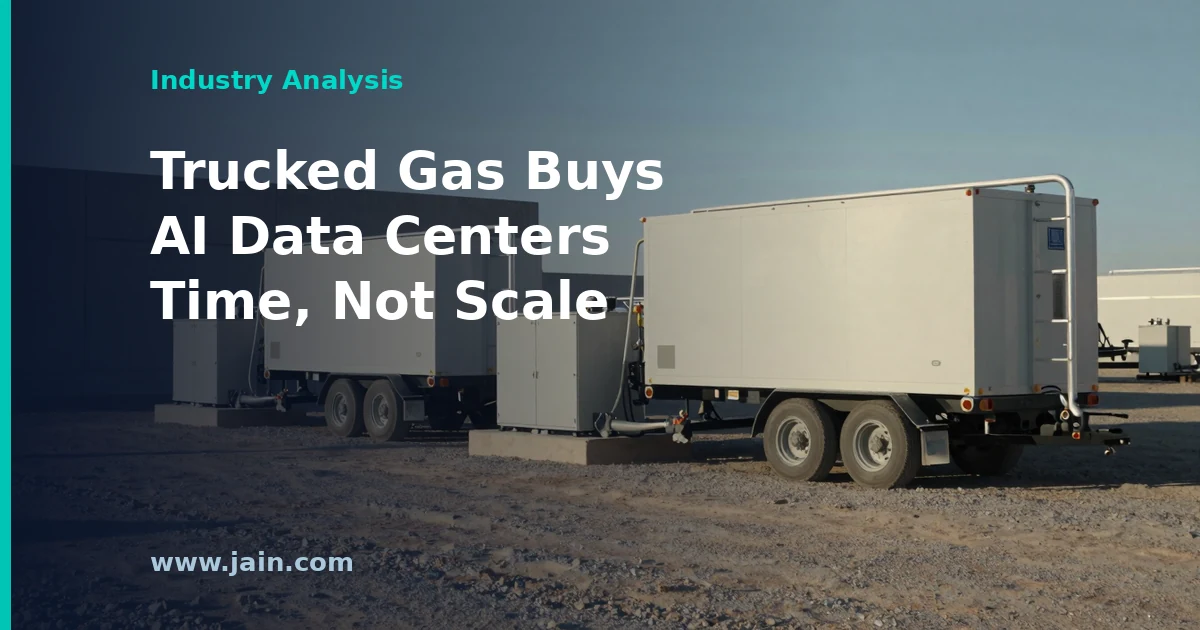
    The core product here is speed. Connecting a large new load to the grid in many US regions means joining an interconnection queue and waiting — often three to five years or more — while studies and upgrades grind forward. Behind-the-meter generation sidesteps much of that by building the power plant at the data-center site, dedicated to that customer. For an AI developer racing to energize capacity, shaving years off time-to-power can be worth paying a premium.

    The trade-offs are real, though. On-site gas generation ties the facility’s economics to fuel prices and turbine availability, and gas turbines are themselves in short supply, with manufacturers reporting multi-year order backlogs. It also raises questions for local communities and regulators about emissions, water, and whether large loads that bypass the grid still contribute fairly to shared infrastructure costs. None of these is disqualifying, but each is a live negotiation in every deal of this kind.

    The Competitive Field Is Crowding Fast

    Chevron is not alone in this pivot. Rival Exxon Mobil has discussed plans for gas-fired plants with carbon capture aimed at data centers, and a broad set of players — independent power producers, private-equity-backed developers, nuclear operators, and the utilities themselves — are all courting the same hyperscale customers. The winners will likely be those who can credibly promise firm megawatts on the shortest timeline, which favors companies with secured turbine slots, owned fuel supply, and sites already in hand.

    For data-center operators and their tenants, more competition among power suppliers is straightforwardly good news: more options, more negotiating leverage, and a wider menu of structures from full behind-the-meter islands to hybrid grid-plus-onsite designs. For utilities, it is more ambiguous — every gigawatt served behind the meter is load growth they do not capture, at a moment when load growth had finally returned to their business case.

    Background

    Chevron is one of the world’s largest integrated energy companies and the second-largest US oil and gas producer, with major positions in the Permian Basin of Texas and New Mexico. Like other oil majors, it has been searching for growth avenues as transportation-fuel demand matures; powering data centers emerged as a candidate in early 2025, when Chevron announced a venture with Engine No. 1 and GE Vernova to build gas-fired plants co-located with computing facilities.

    The backdrop is a step-change in US electricity demand. After roughly two decades of flat consumption, AI training and cloud computing have driven forecasts of sustained load growth, while grid interconnection queues and equipment shortages slow conventional responses. That gap between demand and deliverable supply is the market opening that Chevron — and a growing list of competitors — is moving to fill.

    Source: Chevron eyes more deals to power US data centers — Reuters, a June 27, 2026 report on the oil major’s plans to expand its role in supplying electricity to American data centers.

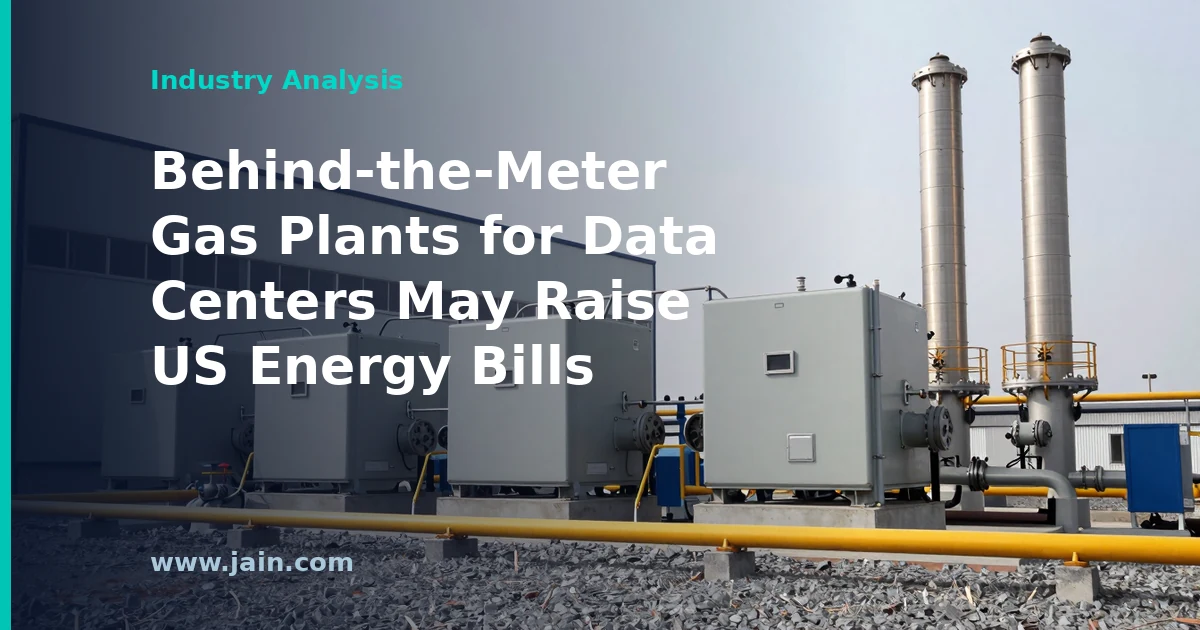
  • Behind-the-Meter Gas Plants for Data Centers May Raise US Energy Bills

    Behind-the-Meter Gas Plants for Data Centers May Raise US Energy Bills

    Utility Dive reported on June 7, 2026 that behind-the-meter gas plants — power generation built on a data center’s own site, outside the utility’s meter — will raise US energy bills. The finding lands as AI data center developers increasingly turn to on-site gas turbines to sidestep multi-year grid interconnection queues, raising the question of who ultimately pays for the workaround.

    Executive Summary

    The report’s headline claim is direct: the wave of behind-the-meter (BTM) gas generation being planned for US data centers will not insulate ordinary consumers from AI’s power demand — it will add to their bills. “Behind the meter” means the plant serves the facility directly, bypassing the utility grid for most or all of its supply, and often bypassing the retail rates, transmission charges, and regulatory review that grid-served customers face.

    Why it matters: BTM gas has been marketed as the pressure-release valve for the AI boom — a way for hyperscalers to get hundreds of megawatts energized in two or three years instead of waiting five or more for grid interconnection, without burdening other customers. If independent analysis concludes the opposite — that these plants raise systemwide costs anyway — it undercuts a central argument utilities, developers, and some policymakers have used to wave the projects through, and it strengthens the hand of regulators pushing for special large-load tariffs and cost-allocation rules.

    Why Data Centers Are Building Their Own Power Plants

    The context for this report is the collision between AI-driven load growth and a grid that cannot connect large customers quickly. Interconnection queues in major US markets stretch years, and transmission upgrades longer still. For a hyperscaler racing to deploy GPUs, a gas turbine on-site — behind the meter — converts an electricity problem into a procurement problem: buy the turbine, permit the plant, burn the fuel, skip the queue. That speed premium is why BTM gas has moved from a niche arrangement to a defining feature of the current data center buildout.

    The pitch to regulators has been that this is self-contained: the data center pays for its own generation, so other ratepayers are held harmless. The Utility Dive report’s conclusion — that these plants will raise US energy bills — challenges that framing at its core.

    How a Private Power Plant Can Raise Everyone Else’s Bill

    With only the headline finding available, the report’s specific modeling cannot be evaluated here, but the mechanisms by which BTM generation can raise systemwide costs are well understood in utility economics. First, natural gas markets are shared: a fleet of new gas plants competing for fuel, pipeline capacity, and turbines can push up gas prices, and because gas units set the marginal price of electricity in much of the country, higher gas costs flow into wholesale power prices for everyone. Second, BTM facilities typically still rely on the grid for backup and startup power while contributing little to the fixed costs of the wires — costs that get spread across remaining customers. Third, if BTM load later converts to grid service, the system must absorb a large customer it never planned for.

    Each of these is a cost-shifting channel, not a conspiracy: individually rational decisions by data center developers can still produce a collectively expensive outcome. That is precisely the kind of externality utility regulation exists to police.

    Winners, Losers, and the Regulatory Stakes

    The near-term winners of the BTM boom are clear regardless of the report’s conclusion: gas turbine manufacturers with multi-year order books, gas producers and pipeline owners, and developers who can monetize speed-to-power. The contested question is who bears the residual cost. If the report’s finding holds, the losers include residential and small-business ratepayers — and, notably, utilities’ own political capital, since public backlash over rising bills tends to land on the regulated utility whether or not it caused the increase.

    For the data center industry, the strategic risk is regulatory: findings like this one give state commissions ammunition to impose standby charges, minimum-take tariffs, exit fees, or cost-allocation rules on large loads. Several states were already moving in that direction before this report. Operators that get ahead of the issue — structuring deals that demonstrably cover their grid costs — will face less friction than those that treat BTM as a permanent regulatory bypass.

    Background

    The US data center industry entered a period of unprecedented power demand growth in the mid-2020s, driven by AI training and inference workloads. After two decades of roughly flat US electricity consumption, utilities began forecasting sustained load growth, with data centers the largest single driver. Grid interconnection processes designed for a slower era became the bottleneck, and “speed to power” replaced land and fiber as the industry’s scarcest resource.

    Behind-the-meter generation — long a niche arrangement for industrial plants with steam needs or reliability concerns — was repurposed as the fast lane: developers began pairing data center campuses with dedicated on-site gas turbines, sometimes at gigawatt scale. Utility Dive, a trade publication covering the US electric power sector, has tracked the resulting policy fight over who pays for AI’s power appetite; this report is part of that running debate.

    Source: Behind-the-meter data center gas plants will raise US energy bills — Utility Dive, a June 7, 2026 report on the ratepayer costs of on-site gas generation built for US data centers.

  • Utah Governor Rejects 100% Gas Power for World’s Largest Planned Data Center

    Utah Governor Rejects 100% Gas Power for World’s Largest Planned Data Center

    Utah’s Republican governor has publicly rejected plans to run what has been billed as the world’s largest data center entirely on natural gas, declaring the state will “never” accept a 100% gas-fired power plan for the project, according to a report published by the environmental news outlet Grist on May 29, 2026.

    The rebuke turns one of the AI era’s biggest proposed construction projects into a test case for a question hanging over the entire industry: when a data center needs power on the scale of a city, who gets to decide where that power comes from?

    Executive Summary

    According to Grist’s reporting, a data center project described as the largest in the world was planned around a 100% natural gas power supply — and Utah’s governor has now said that will not happen. The report frames a direct collision between a developer’s fastest path to energization and a state’s view of how its energy system should grow.

    The announcement matters well beyond Utah. On-site gas generation has become the default answer for AI campuses that cannot wait years in utility interconnection queues — the waiting lines to connect large new loads to the grid. A high-profile state-level veto of a gas-only design, delivered by a Republican governor in an energy-producing state, signals that political consent is now as much a project input as land, fiber, and turbines.

    For developers, utilities, and the hyperscale tenants who ultimately lease this capacity, the message is that power sourcing has become a negotiation with the state, not a private procurement decision — and that even in gas-friendly territory, “100% gas, permanently” may be a plan that cannot get to yes.

    “Bring Your Own Power” Collides With State Politics

    The past two years of AI buildout produced a clear playbook: when the grid can’t deliver gigawatts on the developer’s schedule, build generation on-site. This is called behind-the-meter power — electricity produced and consumed at the campus itself rather than drawn from the utility grid — and natural gas turbines have been the go-to technology because they are dispatchable (they run whenever needed, not just when the sun shines or wind blows) and, on paper, faster than waiting in an interconnection queue.

    Utah’s pushback exposes the flaw in treating self-supply as an end-run around public process. Even a fully private power plant still needs air-quality permits, water, land-use approvals, fuel pipelines, and — as this episode shows — the political blessing of state leadership. A governor saying “never” is a reminder that social license is a real project dependency, and one that no amount of capital can simply purchase.

    A Red-State “No” Scrambles the Expected Script

    The conventional assumption is that Republican-led, energy-producing states welcome gas-fired development. That a Republican governor is the one drawing this line is the most analytically interesting fact in the report, and it deserves a careful reading rather than a partisan one. The headline-level material available does not spell out his reasoning, so the fair questions run in every direction: Is the objection environmental, or about reserving finite gas supply and pipeline capacity for residents and existing industry? Is it about local air quality, ratepayer exposure, or a preference that a marquee project help finance next-generation resources instead?

    Utah’s state energy agenda in recent years has emphasized expanding total power production — including nuclear and geothermal alongside existing resources — which suggests the governor’s objection may be to gas as a permanent, sole source rather than to gas playing any role at all. That distinction matters enormously to the project’s fate, and the source material leaves it unresolved.

    The Economics of Gas-Only at Gigawatt Scale

    Even setting politics aside, a 100% gas design concentrates risk. Large gas turbines are the industry’s current chokepoint, with manufacturer order books stretched years out, so a gas-only campus carries delivery-schedule risk on its single critical component. A sole-fuel plant also locks decades of operating cost to one commodity price, and it must find tenants: the hyperscale cloud and AI companies that lease this kind of capacity have, to varying degrees, public carbon commitments that make gas-only sites harder to underwrite.

    If gas-only designs start failing politically, the beneficiaries are developers of firm, cleaner alternatives — geothermal, nuclear, and gas blended with storage and renewables — along with utilities that can offer structured large-load tariffs, and states that can credibly deliver clean firm power. The cost is time: every resource in that alternative set is slower or scarcer today than a gas turbine, which is exactly why developers reached for gas in the first place. The Utah standoff is, at bottom, a fight over who absorbs that time penalty.

    Background

    The AI boom has turned electricity into the data center industry’s scarcest input. Campuses that once drew tens of megawatts now plan for gigawatts, and with utility interconnection queues stretching years, developers across the U.S. have increasingly proposed building their own on-site gas generation to power sites directly. That workaround has begun colliding with state governments, which control permitting and worry about fuel supply, air quality, and electricity costs for existing customers.

    Utah has positioned itself as a growth-friendly energy state, with its leadership publicly championing a major expansion of in-state power production — including next-generation nuclear and geothermal — to attract exactly this kind of investment. That makes the governor’s reported refusal of a gas-only plan less a rejection of data centers than a statement about the terms on which the state will host them.

    Source: The world’s largest data center was supposed to run on 100% natural gas. Utah’s Republican governor says ‘never.’ — Grist’s May 29, 2026 report on Utah’s rejection of a gas-only power plan for the world’s largest planned data center.

  • Gas Plants as AI’s Bridge Fuel: Researchers Weigh Fast-Build Power for Data Centers

    Gas Plants as AI’s Bridge Fuel: Researchers Weigh Fast-Build Power for Data Centers

    RTO Insider reported on May 24, 2026 that grid researchers are examining the long-term future of natural gas plants built quickly to serve data centers — the generation category that has become the default answer to AI-driven electricity demand across U.S. power markets. The piece frames a question now central to utility and grid-operator planning: what happens to a fleet of fast-build gas plants over the decades after the immediate data-center crunch they were built to solve?

    Executive Summary

    The report, published by RTO Insider — a trade outlet covering regional transmission organizations (RTOs), the entities that run wholesale electricity markets and the high-voltage grid across much of the United States — captures a debate that has moved from the margins to the center of power-sector planning. Data-center developers facing multi-year waits for grid interconnection have increasingly turned to natural gas generation, often sited at or near the data center itself, because gas turbines can be permitted and installed faster than almost any other firm, dispatchable power source at comparable scale.

    That researchers are now asking what becomes of these plants matters because the answer shapes who bears the cost. A gas plant is a decades-long asset being built to serve a demand surge whose duration nobody can guarantee. Whether these units become permanent baseload, transition into backup and peaking roles as cleaner firm power arrives, or end up underused, will determine outcomes for utilities, ratepayers, data-center operators, and the emissions trajectory of the AI build-out. The syndicated version of the article available to us carries only the headline, so the specific researchers, markets, and findings involved are not detailed here — but the question itself is well documented across the industry, and it deserves examination on its own terms.

    Speed to Power Is the Whole Ballgame

    The reason gas keeps winning data-center deals is not ideology or even, primarily, fuel economics — it is time. In several major U.S. markets, connecting a large new load or generator to the grid can take years of interconnection study and transmission upgrades. A hyperscale AI campus that needs hundreds of megawatts cannot wait that long when the competitive race in AI is measured in quarters. Gas turbines, including smaller aeroderivative and reciprocating-engine units, can often be deployed in a fraction of the time, sometimes ‘behind the meter’ — meaning on the customer’s side of the utility connection, serving the facility directly rather than flowing through the shared grid.

    Nuclear cannot be built quickly; new large hydro is essentially unavailable; wind and solar are fast but intermittent, and pairing them with enough storage to run a 24/7 AI facility remains expensive at gigawatt scale. That leaves gas as the pragmatic default — which is precisely why researchers are scrutinizing what the industry is committing itself to by default rather than by design.

    A Bridge Needs a Far Shore

    Calling gas a ‘bridge fuel’ — a transitional energy source used until cleaner firm power scales up — embeds an assumption: that something is on the other side of the bridge. Candidates include advanced nuclear (including small modular reactors), enhanced geothermal, long-duration storage, and gas units retrofitted for carbon capture or hydrogen blending. All are promising; none is deployable today at the pace and price the AI build-out demands. If those technologies mature on schedule, fast-build gas plants can gracefully shift from running constantly to running occasionally, as peakers and reliability backstops. If they do not, the ‘bridge’ quietly becomes the destination, with the associated locked-in emissions and fuel-price exposure.

    The honest answer — and likely part of why researchers are ‘pondering’ rather than concluding — is that both outcomes are live possibilities, and the difference is worth billions of dollars and a meaningful slice of U.S. emissions.

    Who Holds the Asset Risk?

    The economics hinge on who owns the plant and who pays if demand disappoints. When a data-center developer builds its own on-site generation, the stranded-asset risk — the danger of an expensive asset losing its economic purpose before it is paid off — sits largely with a private company that chose it. When a regulated utility builds gas capacity into its rate base to serve forecast data-center load, ordinary ratepayers can end up carrying the cost if AI demand forecasts prove inflated or if a customer leaves. Grid operators and state regulators are actively developing large-load tariffs, minimum-take contracts, and exit fees to allocate that risk more explicitly, and the research attention RTO Insider describes feeds directly into those proceedings.

    Supply chains add another wrinkle: demand for heavy-duty gas turbines has surged worldwide, and lead times for new orders have stretched to several years. That erodes some of gas’s core speed advantage and pushes developers toward smaller, modular units — machines that are, conveniently, also easier to redeploy or run flexibly if the long-term role of these plants shrinks.

    What It Means for the Data-Center Industry

    For data-center operators and their customers, the takeaway is that power strategy is now inseparable from business strategy. Facilities powered by fast-build gas gain schedule certainty today but inherit questions about fuel-cost volatility, future emissions regulation, and the sustainability commitments of the tenants they serve — many large technology companies maintain public carbon-free-energy targets that on-site gas complicates. Operators that pair near-term gas with credible contracts for cleaner firm power, or that site where grid capacity genuinely exists, will have an easier story to tell enterprise customers, regulators, and communities. The infrastructure sector should welcome the scrutiny: a clear-eyed answer to ‘what happens to these plants in 2040?’ is better arrived at before the concrete is poured than after.

    Background

    After roughly two decades of flat U.S. electricity demand, the AI data-center build-out has triggered the fastest load-growth forecasts utilities have issued in a generation, with individual campuses now requesting hundreds of megawatts — and some multi-gigawatt projects proposed. Grid interconnection queues, transmission construction timelines, and generator retirements have collided with that surge, making ‘speed to power’ the defining constraint of the data-center industry. Natural gas, which already supplies the largest share of U.S. electricity generation, has emerged as the default fast answer, spawning a wave of proposed on-site and utility-scale gas projects. RTO Insider, the outlet behind this report, covers the regional transmission organizations and regulatory proceedings where the resulting cost, reliability, and emissions questions are being fought out.

    Source: Researchers Ponder Future of Gas Plants that Quickly Power Data Centers — RTO Insider report, May 24, 2026, on grid researchers’ analysis of fast-build gas generation serving data-center load.