
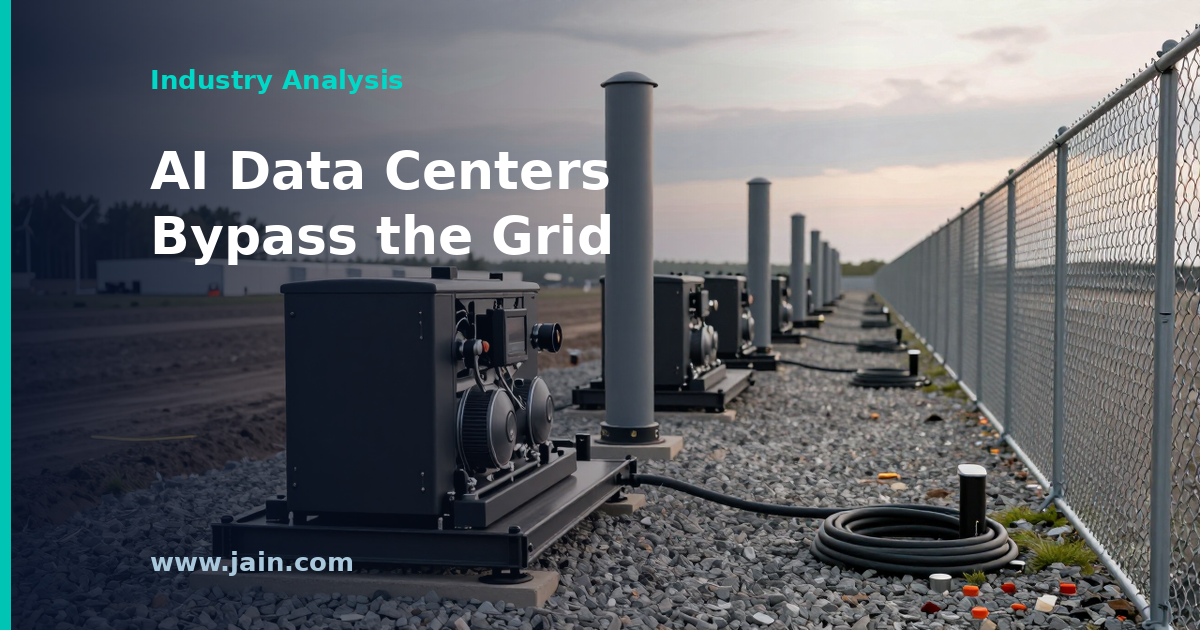
POWER Magazine reports that hyperscale and AI-focused data center developers are increasingly deploying on-site generation as prime power — the primary source of electricity — rather than as backup for grid supply. The shift is being driven by multi-year interconnection queues and gigawatt-scale load requests that utilities cannot serve on operators’ timelines.
The article frames the trend as a structural change in how large computing loads are powered, not a temporary workaround while the grid catches up.
Executive Summary
For decades, data center diesel generators sat idle 99% of the year, insurance against a utility outage. POWER Magazine’s May 2026 piece argues that AI-era facilities are inverting that model: on-site turbines, engines, and increasingly fuel cells are being sized to carry the base load, with the grid demoted to a secondary or supplementary role.
The change matters because it decouples data center build timelines from utility interconnection queues that now stretch five years or more in several U.S. markets. It also shifts who bears the cost of new generation, who chooses the fuel, and who is accountable for the emissions — moving decisions from regulated utility planning processes into private commercial ones.
The article does not quantify how much AI capacity is being built this way, but treats the pattern as established enough across the industry to describe as a category shift rather than a set of one-off projects.
Why the Grid Became the Bottleneck
A modern AI training campus can request 500 megawatts to more than a gigawatt at a single site — roughly the draw of a mid-sized city. U.S. transmission planning, permitting, and equipment lead times were not built for loads of that size arriving in 18-month cycles. Large transformers alone now carry multi-year backlogs. Faced with utility responses measured in years, developers with hyperscaler contracts and finite construction windows are choosing to generate power themselves.
On-site prime power is not new — industrial sites, hospitals, and remote operations have done it for a century. What is new is the scale at which general-purpose computing infrastructure is adopting it, and the willingness of tenants to accept a self-generated power product rather than wait for a utility one.
The Fuel Question Nobody Wants to Answer Cleanly
Prime power at data center scale currently means natural gas turbines or reciprocating engines in most cases, with fuel cells and, in a few announced projects, small modular reactors positioned as future options. Each choice carries trade-offs the industry rarely discusses in the same sentence: gas is fast and financeable but carbon-intensive; fuel cells are cleaner per kilowatt-hour but expensive and supply-constrained; nuclear is low-carbon but years from commercial deployment at the sizes being discussed.
Operators marketing 24/7 clean energy commitments and operators building gas-fired prime power are, in some cases, the same companies. That is not necessarily hypocrisy — sustainability commitments typically cover corporate portfolios, not individual sites — but it does mean buyers and communities should read specific project disclosures carefully rather than relying on parent-company pledges.
Winners, Losers, and Who Pays for the Grid
The winners are gas turbine manufacturers, EPC contractors with power-plant experience, and developers who can site, permit, and finance generation alongside compute. Utilities lose a category of load they had expected to plan around; regulators lose visibility into where large new emissions sources are appearing; and ratepayers face a more complex question about who pays for grid upgrades if the largest new users bypass the system.
There is also a quieter loser: the narrative that AI growth would automatically pull the grid toward cleaner, more flexible operation. If the largest loads leave the grid entirely, the reverse dynamic can take hold — utilities lose the anchor customers that would have justified transmission and clean generation investment.
A Structural Shift, Not a Stopgap
The POWER Magazine framing — from backup to prime — is the important claim. If on-site generation were a bridge until interconnections cleared, the industry would treat it as temporary infrastructure. Instead, projects are being permitted, financed, and contracted on 15- to 25-year horizons, which is how long the equipment is expected to run. That is a bet that grid-served gigawatt loads will remain hard to obtain for the foreseeable future.
Whether that bet is correct depends on transmission reform, interconnection queue processing, and whether utilities can stand up large-load tariffs quickly enough to compete. None of those variables are moving at AI-buildout speed today.
Background
Data centers have historically been utility customers first and self-generators only as a fallback. Diesel backup generators, sized to carry the site through a grid outage, were standard equipment but ran only during tests and emergencies. The economics favored buying grid power because it was cheaper, cleaner in most regions, and available on request.
The AI buildout beginning in 2023 broke that model. Single-site power requests jumped from tens of megawatts to hundreds and then to gigawatts, colliding with a U.S. transmission system that had not added significant new capacity in a decade. On-site prime power emerged as the industry’s answer — controversial on emissions grounds, but faster than waiting for the grid.
Source: From Backup to Prime Power: How AI Data Centers Are Bypassing the Grid — POWER Magazine describes how AI-era data centers are shifting on-site generation from emergency backup to primary continuous power.