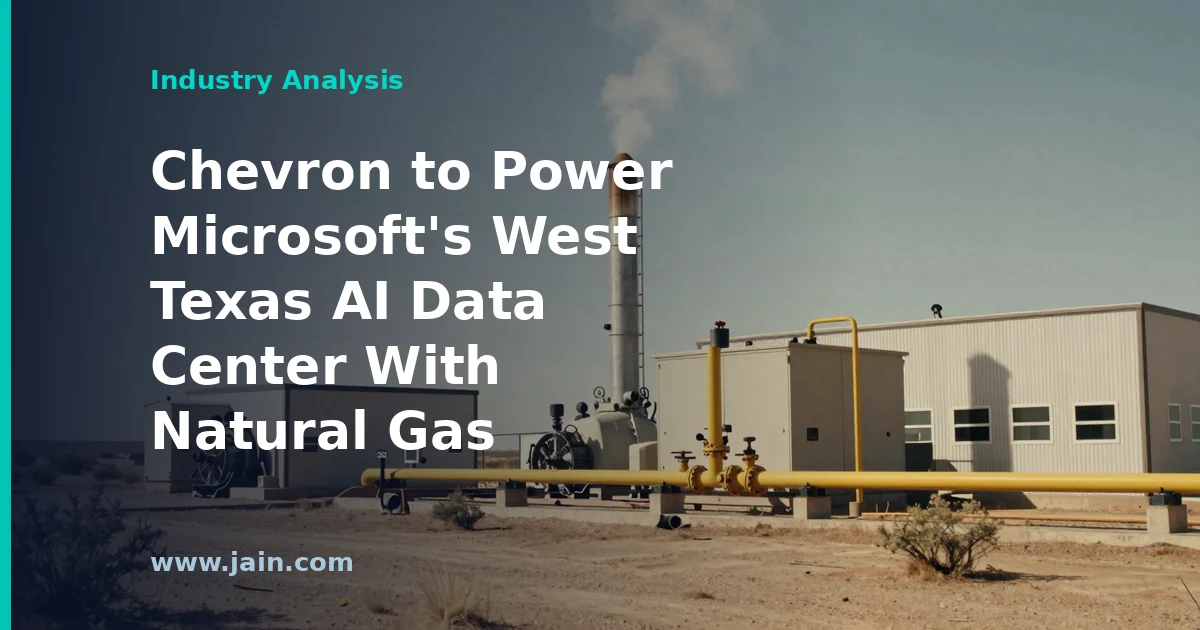
Chevron has struck a deal to supply electricity generated from natural gas to a Microsoft artificial-intelligence data center in West Texas, according to a Wall Street Journal report dated June 21, 2026. Deal terms — including capacity, pricing, and start date — were not disclosed in the source material available to us.
The agreement pairs one of America’s largest oil and gas producers with one of its largest data-center builders, and it lands in the Permian Basin region, where Chevron produces enormous volumes of natural gas close to where Microsoft needs power.
Executive Summary
The reported arrangement makes Chevron a power supplier — not just a fuel supplier — to a hyperscaler, the industry term for the handful of companies (Microsoft, Google, Amazon, Meta) that operate cloud computing at global scale. That distinction matters: selling gas molecules is Chevron’s traditional business, while selling electrons under long-term contract to a single anchor customer is a new one, and it captures more of the value chain.
For Microsoft, the deal addresses the single biggest constraint on AI expansion: getting large amounts of reliable power quickly. Utility interconnection queues — the waiting lists to plug big new loads or generators into the transmission grid — now stretch years in much of the country. Dedicated generation built by an energy company with its own fuel supply is one way to shortcut that wait.
Chevron had previously signaled this ambition: in early 2025 the company announced plans to develop gas-fired power plants co-located with data centers, in partnership with investment firm Engine No. 1 and turbine maker GE Vernova, with West Texas among the first targeted regions. The Microsoft deal, as reported, would be visible evidence that the strategy has landed a marquee customer.
Oil Majors Are Becoming Power Companies
For decades, the boundary was clean: oil and gas companies produced fuel, utilities and independent power producers turned it into electricity. AI is dissolving that boundary. Data-center operators need gigawatt-scale power on timelines utilities struggle to meet, and they are willing to sign long-dated contracts to get it. That contract structure — a creditworthy counterparty committing to buy power for many years — is exactly what makes a power plant financeable, and it is an asset profile oil majors understand from their LNG businesses.
Chevron’s advantage is vertical integration. In the Permian Basin, gas is so abundant relative to pipeline takeaway capacity that regional prices at the Waha hub have repeatedly traded near zero or even negative in recent years. Burning that gas on-site to serve a data center converts a stranded, low-value commodity into contracted electricity revenue. Few competitors can match that feedstock economics story.
Why Gas, and Why West Texas
Natural-gas turbines remain the fastest way to deliver large blocks of firm, around-the-clock power — the kind AI training clusters demand. Solar and wind are cheaper per unit of energy but intermittent; nuclear is firm but slow to build; batteries shift power in hours, not weeks. Texas adds a structural advantage: ERCOT, the state’s independent grid, has lighter interconnection processes than other U.S. regions, and state law accommodates large co-located or behind-the-meter loads — facilities that take power directly from a dedicated plant rather than through the public grid.
The tradeoff is emissions. Microsoft has a publicly stated goal of being carbon negative by 2030, and a new gas-fired power arrangement runs against that grain unless it is paired with carbon capture, offsets, or a credible transition plan. The source material does not say whether any such mitigation is part of this deal — a material omission, since how hyperscalers reconcile gas-fired AI power with climate commitments is one of the industry’s live controversies. The fair reading cuts both ways: gas power for data centers is neither the betrayal critics sometimes claim nor the bridge its promoters assert until the specifics — capture rates, contract duration, retirement plans — are on the table.
Winners, Losers, and the Competitive Map
If deals like this proliferate, the winners are gas producers with stranded Permian volumes, turbine manufacturers whose order books are already stretched to the end of the decade, and Texas jurisdictions collecting tax base. Traditional utilities lose a growth story if the largest new loads in a generation bypass them; conversely, they shed the risk of building for a demand boom that may not fully materialize.
The strategic question is whether hyperscaler-oil-major partnerships become a template. ExxonMobil has announced similar ambitions in gas-plus-carbon-capture power for data centers, and other producers are circling. If the model works, the AI buildout will have quietly created a new class of independent power producer — one with its own wells.
Background
Chevron is one of the world’s largest integrated energy companies and a top producer in the Permian Basin, the West Texas oil field whose wells also produce vast quantities of natural gas. Historically Chevron sold that gas into pipelines and export markets; in 2025 it announced a venture to build gas-fired power plants serving data centers directly, reserving turbine capacity with GE Vernova alongside investment firm Engine No. 1.
Microsoft, through its Azure cloud division and its partnership with OpenAI, has been spending tens of billions of dollars a year building AI data centers, and has pursued a wide portfolio of power deals — from renewables to the planned restart of a reactor at Three Mile Island — as electricity has replaced land and chips as the scarcest input in the AI buildout.
A large piece of southern Ohio that once made fuel for nuclear bombs is being turned into what officials call the world’s largest artificial intelligence computing center. The Japanese investment firm SoftBank is paying for it.
Across the United States, neighbors are protesting projects like this over power, water and noise. Here, many locals are cheering. The land is already industrial, the power lines were built for a plant that once used as much electricity as New York City, and the area badly needs jobs.
The hard part is still ahead: building a gas power plant and 18 small nuclear reactors to run it.
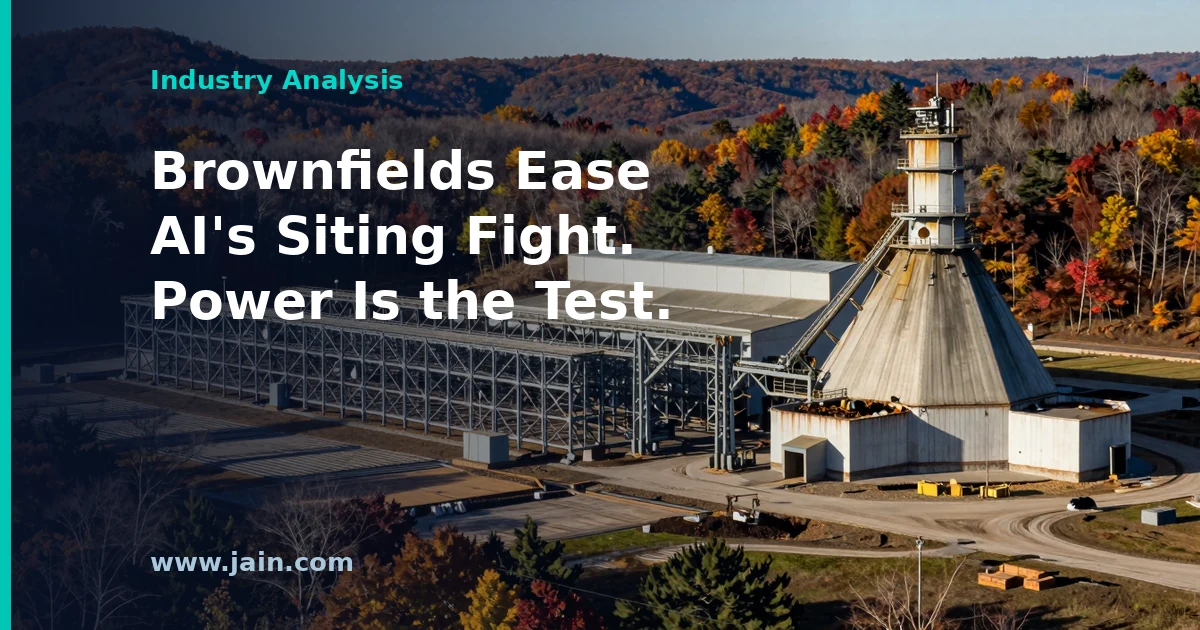
Spotlight on America reported in a June 19, 2026 story published by The National Desk that Pike County, Ohio, is embracing plans for what officials call the largest AI data center in the world. The project will be built on the site of the Portsmouth Gaseous Diffusion Plant (PORTS), a Cold War-era uranium enrichment plant, and renamed the PORTS Technology Campus.
At a March 20 announcement attended by Energy Secretary Chris Wright, Assistant Secretary of Environmental Management Tim Walsh and other officials, backers described a campus combining the data center with a $33 billion natural gas power plant and 18 small modular reactors (SMRs), compact nuclear units built to standardized designs. SoftBank is funding the project, with a budget cited at $1.5 trillion, and SB Energy co-CEO Rich Hossfeld said 35,000 workers will build it.
Executive Summary
The PORTS Technology Campus pairs a record-scale AI data center with its own dedicated generation — a $33 billion gas plant and 18 SMRs — on federal land the Department of Energy is already spending $14 billion to $18 billion to clean up. Local leaders describe the site as a “perfect fit” because it inherits water and grid infrastructure built for one of the largest industrial electricity consumers in American history.
The project matters beyond Ohio because it arrives as opposition to data centers spreads from Maine to Washington. Pike County shows why some sites draw far less resistance: the land is already industrial, some nearby residential parcels are unsafe for homes but acceptable for industry, and the county badly needs jobs. What the welcome does not settle is whether the new generation can be financed, licensed and built on a timeline that matches the computing load.
Why a Cold War Site Defuses the Usual Data Center Fight
The objections filling hearing rooms from Columbus to Scranton are specific: data centers draw water and electricity residents rely on, strain local grids, and add noise and exhaust from backup generators like those running in Northern Virginia. Pike County’s site answers several of those objections before they are raised, because the region’s heaviest industrial footprint is already there. The Portsmouth plant, according to Steve Shepherd of the Southern Ohio Diversification Initiative, used about 3% of the nation’s electricity — roughly what New York City used — and consumed 30,000 to 40,000 gallons of water a day, which he said matches what the new campus is expected to need.
Land is the second mechanism. Elsewhere, a data center often means rezoning farmland or open space next to homes. Here, the land is a federal industrial reservation being cleared with Department of Energy money, and nearby residential parcels that a recent report found carry unsafe levels of radioactive contamination are, according to local official Jennifer Chandler, acceptable for industrial use. A dozen of those properties have already been bought for the campus footprint. The project does not displace a use residents value; for some families it may offer a way off land they should not be living on.
The third mechanism is economic. Pike County ranks third-lowest in Ohio for per-capita income, and a 35,000-worker construction effort reshapes a rural economy. Together, these give substance to Shepherd’s claim that the site is “a model for the country”: legacy industrial sites with existing transmission corridors, water systems and industrial zoning face fewer of the objections now stalling greenfield projects. The limit is that few sites anywhere carry infrastructure sized like this one.
An Inherited Grid Is Not an Inherited Power Supply
The 3% figure describes what the plant drew during its operating life, not what the grid can deliver today. Existing transmission corridors and substation sites are a genuine head start — securing rights-of-way is among the slowest steps in any grid project — but the electricity itself still has to be generated. Uranium enrichment at Portsmouth ended in 2001, and whether the lines that served it remain usable at this scale has not been published.
That is why the plan pairs the data center with dedicated generation. Building a $33 billion gas plant and 18 reactors on site is the most direct answer to the grid-strain objection, because the campus would not compete with households for existing supply. But it shifts risk rather than removing it. A gas plant of that cost needs pipeline capacity and produces its own emissions, moving the air-quality question from backup generators to a primary power station.
The reactors carry the longest lead time. SMRs are still early in commercial deployment in North America, and each project requires federal licensing before it can operate; 18 units is a fleet, not a pilot. If computing capacity comes online before the reactors do, the gas plant or the regional grid would have to carry the load in the meantime. No capacity figure for the gas plant or the reactors, and no sequencing plan, accompanied the announcement. That, not local acceptance, is the test Pike County has yet to pass.
Superlatives Without Megawatts
The announcement leaned heavily on scale: “the largest AI data center on earth,” a facility “bigger than any facility ever built in world history,” a budget cited at $1.5 trillion. Those claims may prove accurate, but none came with the measures the industry uses to compare projects — megawatts of computing load, number of buildings, phase dates or named tenants.
The dollar figures illustrate the gap. The $33 billion gas plant is a small fraction of $1.5 trillion; the remainder would presumably fund reactors, buildings, computing hardware and supporting infrastructure over many years, but no breakdown was offered. For suppliers of turbines, transformers, cooling systems and chips, a headline figure without a schedule signals intent, not an order book.
None of this diminishes the site’s real advantages. It means the project is best judged on the disclosures still to come rather than on the size of the tent on announcement day.
Background
The Portsmouth Gaseous Diffusion Plant near Piketon, in Pike County, Ohio, was one of three US gaseous diffusion plants built to enrich uranium during the Cold War. Enrichment ended in 2001, and the Department of Energy is now spending $14 billion to $18 billion to decontaminate and dismantle the site. The Southern Ohio Diversification Initiative (SODI) is the local organization charged with redeveloping it.
The project arrives as opposition to AI data centers grows nationwide, driven by concerns over water use, grid strain, noise and backup-generator emissions. SoftBank, a Japanese investment group, backs the effort alongside SB Energy, its affiliated energy developer.