
TL;DR · 30-second read
The Short Version
A batch of specially made salt just changed hands in Texas. The federal Department of Energy shipped it to Natura Resources, a company building a small nuclear reactor on a university campus in Abilene.
The salt is the reactor’s coolant. Instead of water held under enormous pressure, this design runs on hot liquid salt — made from a rare, highly purified form of lithium that hardly anyone produces.
Why care: Texas needs round-the-clock electricity for the giant computer warehouses that run artificial intelligence. Reactors like this are one proposed answer, and one of their hardest-to-source ingredients is now in hand.
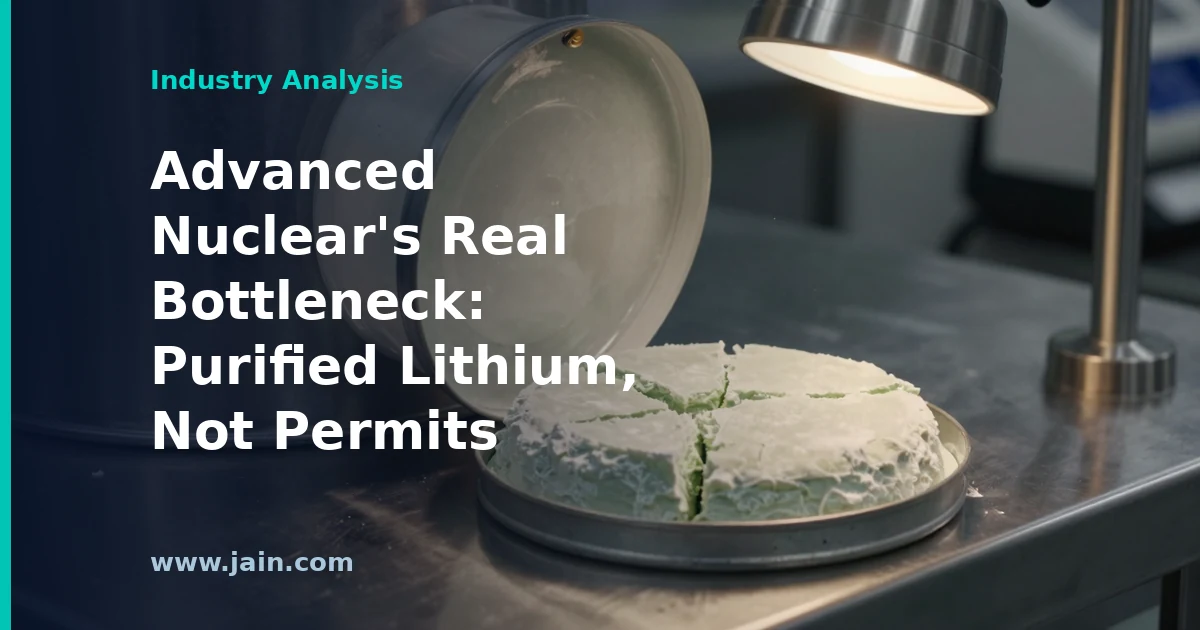
Natura Resources LLC announced on September 18 that it has received FLiBE salt — a fluoride mixture of lithium and beryllium used as a molten-salt reactor coolant — from the U.S. Department of Energy’s Oak Ridge National Laboratory, routed through Idaho National Laboratory. The material is destined for the MSR-1, a molten salt demonstration reactor the company is building at Abilene Christian University in Abilene, Texas.
Natura said it won the salt through a competitive DOE solicitation facilitated by Idaho National Laboratory and issued in August 2025. The company said the salt contains 99.99% enriched lithium-7, an isotopic purity that suppresses the formation of tritium inside the coolant loop. Natura describes itself as privately owned, with more than $120 million in private funding and a $120 million commitment from the State of Texas, and holds what it says is the first Nuclear Regulatory Commission construction permit issued for a liquid-fueled reactor.
Executive Summary
The headline event is a shipment, not a groundbreaking — but shipments are where advanced nuclear schedules actually slip. Molten salt reactors substitute a liquid salt for the pressurized water used in conventional plants, which is what lets them run hot and near atmospheric pressure. That coolant is not a commodity. Getting it right requires lithium enriched to a specific isotope, lithium-7, at a purity Natura puts at 99.99%.
The reason the purity matters is operational rather than ceremonial. Natural lithium contains a meaningful fraction of lithium-6, which absorbs neutrons and produces tritium — a radioactive hydrogen isotope that migrates readily through hot metal and creates containment, monitoring and worker-protection burdens for the life of the plant. Stripping the lithium-6 out up front converts a permanent operating problem into a one-time procurement problem. That procurement, on Natura’s own account, was resolved by winning a federal allocation rather than placing an order.
For the Texas power market the relevance is indirect but real. Data center load growth in the state has made any firm, siteable generation valuable, and advanced nuclear is one of the options developers keep on the table. The MSR-1 is a demonstration unit intended to generate data for Natura’s commercial reactors; the company disclosed no capacity rating, no in-service date and no customer alongside the salt delivery.
The Scarce Input Is the Coolant, Not the Paperwork
Advanced nuclear coverage tends to track licensing milestones, because licenses are public, dated and easy to compare. Natura has one of the notable ones — it says it holds the first NRC construction permit for a liquid-fueled reactor. But a permit authorizes construction; it does not conjure the materials the design requires. This week’s event is the quieter constraint clearing, and the structure of the transaction tells you how tight it is.
Consider what Natura describes: salt held at a national laboratory, released through a competitive solicitation issued in August 2025, facilitated by a second national laboratory, and delivered more than a year later. That is the procurement pattern of an allocated stockpile, not a supply chain. Enriched lithium-7 at 99.99% is a Cold War-era product of isotope separation programs, and a developer that wins a tranche of it has removed a risk that competitors bidding on the same solicitation did not. Natura’s own framing — that the delivery secures “one of the most specialized inputs required” and reduces supply-chain risk — is an unusually direct admission that the material was a gating item.
The downstream implication is the part that matters for anyone financing or contracting firm power. If the coolant for a first-of-a-kind unit has to come from a federal solicitation, then the question for every molten salt program is what happens at unit two, unit ten, and at commercial scale, when legacy inventory cannot cover the order book and someone has to build enrichment capacity. That is a multi-year industrial problem with its own permitting, capital and workforce constraints, and it sits upstream of every megawatt these designs promise. Developers, utilities and data center buyers evaluating molten salt timelines should be asking about lithium-7 supply with the same seriousness they ask about NRC dockets.
Texas Is Buying Optionality on Firm Power
Natura discloses a $120 million commitment from the State of Texas alongside more than $120 million in private funding. That pairing is the more revealing number in the release. Texas has watched data center interconnection requests pile up against a grid that must serve them on the hottest and coldest days, and firm generation — power that runs regardless of weather — is the scarce commodity. State money in a pre-commercial reactor developer is not an energy purchase; it is a call option on a technology that, if it works, can be sited near industrial load without a transmission build.
What the announcement does not do is connect that option to load. The MSR-1 is a demonstration reactor on a university campus, and Natura says plainly that its purpose is to generate data for commercial reactors. No capacity figure, no offtake agreement and no data center customer appears anywhere in the disclosure. Readers evaluating this as an AI-power story should hold both facts: the material bottleneck is genuinely smaller today, and the distance between a campus demonstration unit and a contracted megawatt on an industrial site remains long.
A 13,000-Hour Precedent Is Heritage, Not Qualification
Natura leans on the Molten Salt Reactor Experiment, which ran at Oak Ridge from 1965 to 1969 and logged more than 13,000 operating hours demonstrating passive safety, high-temperature performance and fuel flexibility. The lineage is real, and receiving MSRE-era salt from the laboratory that ran the experiment makes for a legitimate through-line. It is also a reason the material exists at all.
The analytical caution is that operating hours from the 1960s are evidence the physics works, not evidence that a modern commercial unit will license, build and run on schedule. The MSRE was a research reactor with no requirement to sell power, meet a modern regulatory framework, or hit a cost of capital. Sixty years of institutional memory attrition sits between that program and this one, which is precisely why demonstration units like the MSR-1 exist. The honest read of this week’s news is narrow and still meaningful: one specialized input is secured, one category of schedule risk is retired, and the rest of the program is still ahead of the company.
Background
Molten salt reactors are an old idea with a short operating record. The Molten Salt Reactor Experiment at Oak Ridge National Laboratory ran from 1965 to 1969 and accumulated more than 13,000 hours, establishing that a reactor could run with its fuel dissolved in circulating salt at high temperature and low pressure. The program ended without commercialization, and the technology sat largely dormant for decades while the industry standardized on pressurized and boiling water designs.
Natura Resources LLC, based in Abilene, Texas, is one of the developers attempting to carry the concept into commercial service. It is privately owned, reports more than $120 million in private funding plus a $120 million commitment from the State of Texas, and says it holds the first NRC construction permit granted for a liquid-fueled reactor. Its first unit, the MSR-1, is under construction at Abilene Christian University and is intended to produce the operating data that commercial designs will be built on. Jordan Robison was named chief executive officer ahead of this phase of the program. Source: Natura Receives Historic Molten Salt Reactor Coolant from Department of Energy — Natura Resources’ September 18, 2026 announcement that it received FLiBE salt from the Department of Energy’s Oak Ridge National Laboratory, via Idaho National Laboratory, for its MSR-1 demonstration reactor in Abilene, Texas.Sources