Tag: Modine

  • Modine’s $4B Backlog vs. Vertiv’s 12% Slide: Cooling Splits

    Modine’s $4B Backlog vs. Vertiv’s 12% Slide: Cooling Splits

    Two thermal-management suppliers moved in opposite directions in the same news cycle. Aggregated coverage carried by Google News reports that shares of Vertiv Holdings (NYSE: VRT), one of the largest vendors of data center power and cooling systems, fell 12%, under a headline asking whether the decline is a buying opportunity. A separate item reports that Modine Manufacturing (NYSE: MOD) gained on a $4 billion data center figure.

    The available source material is limited to those two aggregated headlines. The Modine headline is truncated in the feed as “$4B data center c…” and no underlying release text, dated filing, customer name, or delivery window accompanies either item.

    Executive Summary

    The news itself is small: one stock down 12%, another up on a large dollar figure. What makes it worth an article is the divergence. Vertiv and Modine sell into the same demand driver — the buildout of AI data centers, whose dense computing racks generate far more heat per square foot than conventional servers and increasingly require liquid cooling rather than air. If that demand were the only variable, the two share prices would tend to move together. They did not.

    The most defensible reading is that investors are no longer pricing thermal-management companies purely on demand. They are pricing the gap between demand and what is already embedded in each share price. A supplier can book record orders and still see its stock fall if the market had assumed even more; a smaller supplier can rerate sharply on a single large figure because far less was assumed to begin with.

    For infrastructure buyers, none of this changes physics or lead times. But supplier share prices influence capital costs, capacity expansion decisions and acquisition activity, so procurement teams have a legitimate reason to watch the tape — without mistaking it for operational news.

    Order Books and Share Prices Answer Different Questions

    A backlog or contract figure answers a backward-looking question: what has a customer already committed to buy? A share price answers a forward-looking one: is the expected future stream of profits better or worse than what buyers had already paid for? These can diverge for long stretches, and the reported moves are consistent with exactly that. A $4 billion data center figure at Modine is large relative to the company’s historical association with vehicular and building HVAC heat exchangers, so it plausibly resets expectations upward. Vertiv, by contrast, has been among the most visible listed proxies for AI infrastructure spending, which means a good deal of optimism can already sit inside the price before any new information arrives.

    This is the ordinary mechanics of expectations, not evidence that AI cooling demand is weakening. Nothing in the source material states why Vertiv shares fell. A 12% single-move decline in a high-expectation industrial name can follow guidance, margin commentary, a customer concentration disclosure, a sector-wide rotation, or an analyst action. Attributing it to any one cause without the underlying report would be speculation.

    Liquid Cooling Is Real Revenue, Not Just a Theme

    The substantive point beneath both headlines is that thermal management has moved from a line item to a gating factor. When a rack of AI accelerators draws many times the power of a traditional server rack, air alone stops working economically well before it stops working physically. That pushes operators toward direct-to-chip cold plates, rear-door heat exchangers and, at the extreme, immersion — all of which involve pumps, manifolds, coolant distribution units and heat rejection equipment that did not exist in volume in the previous generation of data centers.

    That shift widens the addressable market and, importantly, widens the supplier set. Cooling was historically dominated by a small group of specialists selling precision air-conditioning units. Liquid cooling draws in companies with heat-exchanger and fluid-handling engineering heritage from adjacent industries. Modine’s move is the clearest illustration in this news cycle of an adjacent-industry entrant being repriced as a data center supplier. The competitive implication for incumbents is not that demand disappears; it is that the premium for scarcity may compress as more credible suppliers qualify.

    What Procurement Teams Should Actually Do With This

    Buyers should separate two signals. The first is capacity: a supplier reporting a very large committed order book is telling you its factories and engineering teams are spoken for, which is a lead-time warning as much as a growth story. The second is durability: a supplier whose equity falls sharply is facing a higher cost of capital, which can constrain the very capacity expansion buyers are counting on. Neither headline here is severe enough to warrant requalifying vendors, but both argue for the standard disciplines — dual sourcing on long-lead thermal components, contractual delivery remedies, and design choices that do not lock a hall to a single vendor’s coolant distribution architecture.

    For investors, the fair conclusion from two aggregated headlines is narrow: the market is differentiating within a trade it previously bought as a block. Whether Vertiv’s decline is an entry point or a repricing of expectations cannot be determined from the material available, and the source headline poses that as a question rather than answering it.

    Background

    Data center cooling was for decades a specialist niche dominated by precision air-conditioning vendors serving halls of relatively uniform, air-cooled servers. The economics were stable and the engineering incremental. The arrival of high-density AI computing changed that: rack power densities rose to levels where air cooling becomes impractical, pushing operators toward liquid-based approaches and turning cooling from a supporting utility into a constraint on how much computing a site can host.

    That transition has made listed suppliers of power and thermal equipment, Vertiv among the most prominent, into widely traded proxies for AI capital spending, while opening the market to manufacturers such as Modine whose heat-exchanger engineering originated in other industries. Because both the demand and the expectations attached to it have risen quickly, share prices in this group have become sensitive to small revisions in outlook — the backdrop against which these two contrasting headlines should be read.

    Source: Vertiv Shares Slide 12%: Is the AI Data Center Play Worth Buying on the Dip? — aggregated market coverage of a 12% decline in Vertiv shares, read alongside a separate item reporting Modine Manufacturing gains on a $4 billion data center figure.

  • Modine Surges on Reported $23B Cooling Pipeline Tied to Google and Amazon

    Modine Surges on Reported $23B Cooling Pipeline Tied to Google and Amazon

    Shares of Modine Manufacturing (NYSE: MOD) jumped after Hunterbrook published a report, based on what it describes as leaked files, claiming the thermal-management company has a roughly $4 billion deal tied to Google and a data center cooling demand pipeline of about $23 billion that also links Amazon as a customer. Multiple financial outlets, including Benzinga, Proactive, and Pluang, relayed the report on August 22, 2026.

    Neither Modine, Google, nor Amazon has publicly confirmed the figures, which originate from the report rather than from any company disclosure.

    Executive Summary

    The claim at the center of the move is simple but large: a report by Hunterbrook, citing leaked documents, names Google and Amazon as customers behind a data center cooling pipeline it sizes at $23 billion, including a reported $4 billion arrangement connected to Google. For a company of Modine’s size — a century-old industrial thermal specialist rather than a hyperscale household name — numbers of that magnitude, if borne out, would represent a step-change in the scale of its data center business.

    The market’s reaction is as informative as the claim itself. Investors bid the stock up on an unverified, third-party report — a signal of how hungry the market is for pure-play exposure to data center cooling. As artificial intelligence workloads push server racks toward power densities that air cooling alone cannot handle, the companies that move heat — through chillers, coolant distribution units, and liquid cooling systems — are being repriced as strategic AI infrastructure suppliers rather than cyclical industrial vendors.

    What matters now is verification: whether the companies involved confirm, deny, or stay silent, and whether the reported pipeline reflects contracted backlog or aspirational opportunity. Those are very different things for a stock that just moved on the distinction being blurred.

    Cooling Is Becoming the Buildout’s Next Bottleneck

    For most of the data center industry’s history, cooling was a solved problem: blow enough cold air across the servers and manage the electric bill. AI has broken that model. Modern accelerator racks can draw many times the power of traditional server racks, concentrating heat beyond what air-based systems efficiently remove. The industry’s answer — liquid cooling, where coolant is piped directly to chips or to heat exchangers at the rack — requires specialized equipment, and the supplier base for that equipment is far smaller than the demand now chasing it.

    That is the structural story that makes a report like this land so hard. Investors have already repriced power equipment makers, transformer suppliers, and generator manufacturers as AI bottleneck trades. Thermal management is the logical next link in that chain: every megawatt of new AI compute is also a megawatt of heat that must go somewhere. A report naming the two largest cloud builders as anchor customers of a mid-cap cooling specialist fits a narrative the market was already primed to believe.

    What the Report Claims Versus What Is Confirmed

    It is worth being precise about the evidentiary chain here. The $4 billion and $23 billion figures come from a media report citing leaked files — not from a Modine securities filing, an earnings call, or a customer announcement. Hyperscalers rarely confirm their suppliers, and suppliers are often contractually barred from naming hyperscaler customers, so silence from Google and Amazon would be unremarkable either way. As of the coverage cited, none of the three companies had substantiated the numbers.

    The word “pipeline” also deserves scrutiny. In industrial sales, a pipeline is typically the total value of opportunities being pursued — not signed contracts, not backlog, and not revenue. If the $23 billion figure describes potential demand Modine is quoting against, the economic reality could differ substantially from what a headline reader might assume. The reports available do not make that distinction clear, and the distinction is worth billions.

    The Messenger Matters: Reading a Hunterbrook Report

    The source of the claim adds its own analytical wrinkle. Hunterbrook operates an unusual model in financial media: a newsroom paired with an affiliated investment fund that can trade on its reporting before publication. In this case the report is bullish — a departure from the short-seller-style exposés such outlets are better known for — but the incentive question cuts the same way in both directions. Readers and investors should ask of any market-moving report: who benefits from the move, and was the evidence strong enough to justify it?

    None of that makes the reporting wrong. Leaked documents can be accurate, and Hunterbrook’s work has moved markets before precisely because it is often substantive. But the fair standard is symmetrical: the same skepticism this publication would apply to an unverified vendor press release applies to an unverified media report, however sophisticated the outlet. Until Modine addresses the figures directly — in a filing, an earnings call, or a formal statement — the $23 billion number is a claim, not a fact.

    Concentration Risk Hides Inside the Opportunity

    Suppose the report is directionally right. Even then, the economics carry a caveat familiar to anyone who supplies hyperscalers: customer concentration. A supplier whose growth story rests on two buyers — however creditworthy — inherits their capital-expenditure cycles, their pricing leverage, and their willingness to dual-source or bring capabilities in-house. Hyperscalers have a long record of commoditizing their supply chains once a technology matures, from servers to networking gear.

    The competitive field is also crowding fast. Established HVAC and infrastructure giants, specialist liquid cooling firms, and well-funded startups are all racing into the same thermal market. A large pipeline today says little about margins three years from now if the bidding field triples. For buyers of cooling equipment, that competition is good news — more capacity and better pricing. For any single supplier’s shareholders, it is the risk that tempers the headline number.

    Background

    Modine Manufacturing, founded in 1916 and headquartered in Racine, Wisconsin, spent most of its history as a heat-transfer specialist serving automotive and industrial markets. In recent years it has pivoted deliberately toward higher-growth thermal businesses, with data center cooling — including chillers and precision cooling systems — becoming a centerpiece of its climate solutions segment. That repositioning has coincided with the AI-driven data center boom, which has turned formerly unglamorous supply categories like power distribution and heat rejection into some of the market’s most closely watched bottleneck trades.

    Hunterbrook, the report’s source, represents a newer breed of financial media: an investigative newsroom paired with an affiliated fund that can trade on its findings. Its reports have moved stocks in both directions before, which is why a bullish claim about Modine’s customer pipeline traveled so quickly through financial media despite lacking company confirmation.

    Source: Modine shares rise on report of $4B Google deal and $23B data center cooling demand — aggregated coverage (Pluang, Benzinga, Proactive, finance.biggo.com) of a Hunterbrook report citing leaked files naming Google and Amazon in Modine’s data center cooling pipeline.

  • Modine Lands $4 Billion Direct-to-Chip Cooling Deal With Hyperscale Customer

    Modine Lands $4 Billion Direct-to-Chip Cooling Deal With Hyperscale Customer

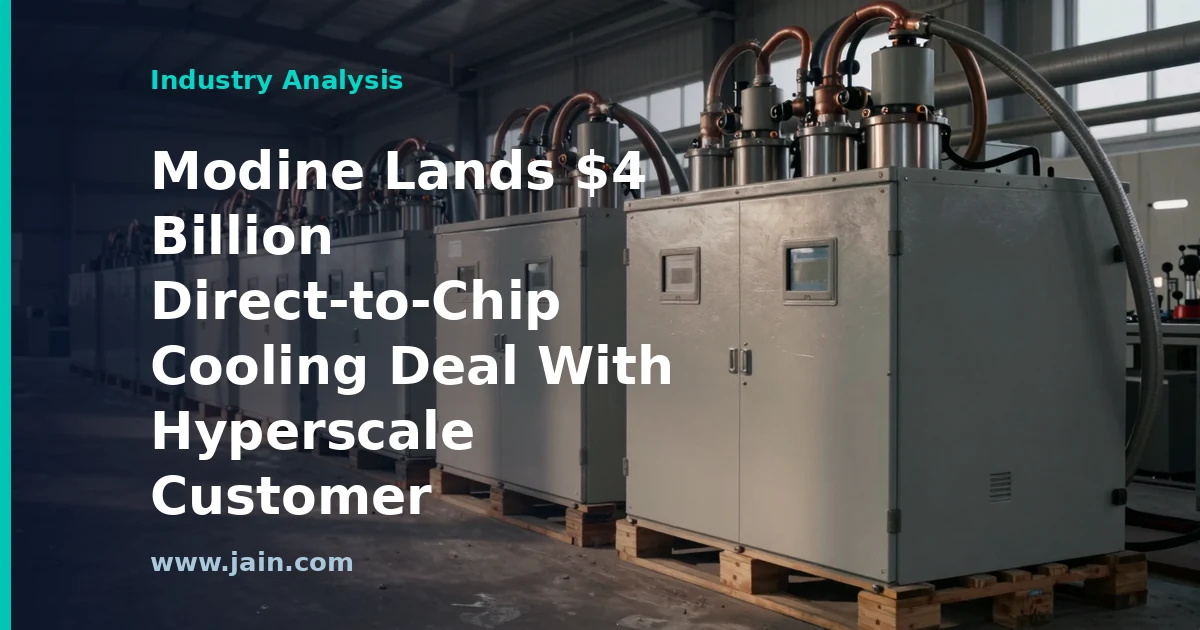
    Modine Manufacturing has signed a cooling solutions agreement valued at $4 billion with a hyperscale data center customer, as reported by BizTimes Milwaukee on May 27, 2026. The agreement centers on direct-to-chip liquid cooling — technology that removes heat from processors through cold plates mounted directly on the silicon — and ranks among the largest single cooling-infrastructure commitments ever disclosed.

    The customer was not named in the report, and details such as contract duration, delivery schedule, and the split between hardware, installation, and services were not disclosed.

    Executive Summary

    The announcement matters for two reasons. First, the sheer size: $4 billion for cooling alone would have been implausible only a few years ago, when cooling was a modest slice of data center capital budgets dominated by air-handling equipment. A commitment of this scale signals that liquid cooling has become a first-order line item in hyperscale AI buildouts, driven by processor power densities that air cooling cannot economically serve.

    Second, the counterparty structure: a single hyperscale customer writing a multi-billion-dollar cooling commitment suggests the largest cloud and AI operators are now locking up thermal-management supply the way they already lock up power, land, and chips. For Modine — a century-old thermal-management company headquartered in Racine, Wisconsin — an agreement of this magnitude is potentially transformative relative to its historical revenue base, though how the value converts to recognized revenue over time is not yet clear from the report.

    Cooling Graduates From Line Item to Mega-Contract

    Direct-to-chip cooling circulates liquid coolant through cold plates that sit directly on top of processors, carrying heat away far more efficiently than blowing chilled air across server racks. The technology exists because modern AI accelerators draw so much power — and concentrate it in so little space — that traditional air cooling hits physical and economic limits. As rack densities climb from tens of kilowatts toward 100 kilowatts and beyond, liquid cooling shifts from an exotic option to a requirement.

    A $4 billion commitment to a single cooling vendor is the clearest evidence yet of that shift. Hyperscalers historically procured cooling equipment project by project, from a fragmented field of suppliers. Consolidating that spend into one long-horizon agreement mirrors how they already contract for power and semiconductors: secure capacity early, at scale, before competitors do. If that procurement pattern spreads, the cooling industry’s competitive dynamics change — scale, manufacturing capacity, and balance-sheet strength start to matter as much as thermal engineering.

    What the Deal Could Mean for Modine

    Modine is best known as a legacy thermal-management manufacturer — its roots are in vehicle radiators — that has spent recent years repositioning toward data center cooling through its climate-solutions business and its Airedale data center cooling brand. A $4 billion agreement would be large relative to what mid-cap industrial suppliers typically book across multiple years, which is precisely why the announcement drew attention beyond the trade press.

    The caveat is that headline contract values and recognized revenue are different things. The report does not say whether the $4 billion represents a firm purchase obligation, a framework agreement with volume expectations, or a ceiling contingent on the customer’s buildout pace. Investors have learned from other AI-infrastructure announcements that multi-year framework deals can be revised as deployment schedules shift. Until Modine discloses the structure, the number is best read as a statement of intended scale rather than booked backlog.

    An Unnamed Customer and the Concentration Question

    Hyperscale operators routinely require anonymity from suppliers, so the customer’s absence from the report is normal practice, not a red flag. But it leaves open a question that matters for assessing the deal: customer concentration. A supplier whose order book is dominated by one buyer gains scale but inherits that buyer’s capital-spending cycle. If the customer slows its AI data center buildout — for reasons ranging from power availability to shifts in AI demand — the supplier feels it directly.

    The flip side is validation. Hyperscalers qualify cooling vendors through demanding technical and reliability reviews, because a cooling failure in a liquid-cooled AI cluster can take down hardware worth far more than the cooling system itself. Winning a commitment of this size implies Modine cleared that bar at scale, which itself is a competitive signal to the rest of the market.

    The Competitive Ripple Across the Cooling Market

    The direct-to-chip market has been contested by a mix of large incumbents and specialists, and a deal of this size resets expectations for what winning looks like. Rivals will face pressure to demonstrate comparable manufacturing capacity and to pursue their own anchor agreements with major operators. For buyers below hyperscale size — enterprises and smaller cloud providers — the concern runs the other way: if the biggest customers lock up vendor capacity, lead times and pricing for everyone else could tighten.

    There is also an upstream effect. Direct-to-chip systems depend on coolant distribution units, quick-disconnect fittings, cold plates, and pumps — components with their own supply chains. A $4 billion program implies significant component demand over its life, which tends to pull investment into that supplier tier. The unanswered question is timing: without a disclosed delivery schedule, it is impossible to gauge how quickly that demand arrives.

    Background

    Modine Manufacturing is a Wisconsin-based thermal-management company whose history stretches back over a century, beginning with radiators for early automobiles. Like several legacy industrial firms, it has pivoted toward data center cooling as that market’s growth outpaced its traditional vehicle business, building out a climate-solutions portfolio that includes the Airedale data center cooling brand and, more recently, liquid-cooling capabilities aimed at AI workloads.

    The backdrop is a structural shift in data center design. The AI buildout that accelerated from 2023 onward pushed rack power densities beyond what air cooling can serve, making liquid cooling — and direct-to-chip systems in particular — one of the fastest-growing segments of data center infrastructure spending.

    Source: Modine secures $4 billion cooling solutions agreement with data center user — BizTimes Milwaukee report, May 27, 2026, on Modine’s direct-to-chip cooling agreement with a hyperscale customer.

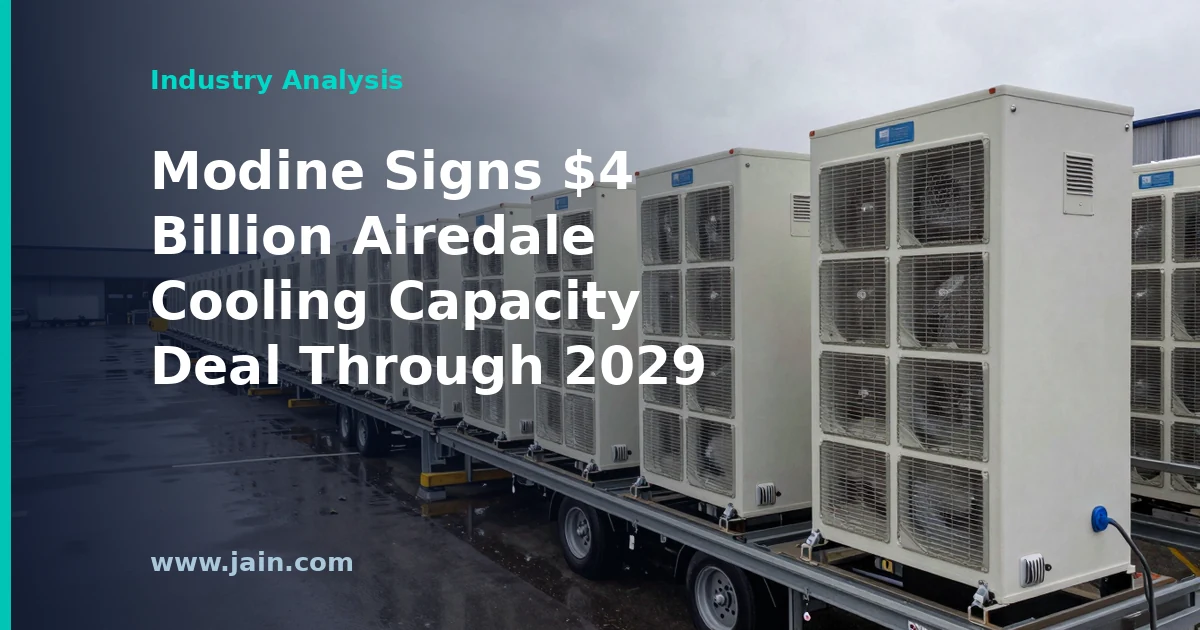
  • Modine Signs $4 Billion Airedale Cooling Capacity Deal Through 2029

    Modine Signs $4 Billion Airedale Cooling Capacity Deal Through 2029

    Modine Manufacturing announced a long-term capacity agreement valued at $4 billion, running through 2029, with an unnamed strategic data-center customer for its Airedale by Modine cooling solutions. The announcement was made May 26, 2026 via PR Newswire, which Modine itself characterized as a landmark deal.

    Executive Summary

    Modine, the Wisconsin-based thermal-management company behind the Airedale precision-cooling brand, says it has secured a long-term capacity agreement worth $4 billion through 2029 with a single strategic data-center customer. “Capacity agreement” is the operative phrase: rather than a conventional purchase order for a defined set of equipment, the customer is effectively reserving a share of Modine’s future manufacturing output for years in advance.

    That structure matters more than the headline number alone. Reserving cooling capacity years ahead is the kind of behavior the industry previously reserved for scarce inputs like advanced chips, transformers, and grid interconnection. If cooling equipment now warrants the same treatment, it confirms that thermal management — the systems that remove the enormous heat generated by dense AI computing — has moved from a routine line item to a strategic bottleneck in data-center construction.

    Cooling Joins the Reservation Economy

    AI data centers concentrate far more electrical power — and therefore heat — into each rack than traditional facilities, and every watt that goes in must be removed as heat. That has strained the supply chains for chillers, computer-room air handlers, coolant-distribution units, and related gear, with lead times for major thermal equipment stretching well beyond what developers were accustomed to. In that environment, a developer that cannot lock in cooling deliveries risks having a building, power, and chips ready with no way to keep the hardware from overheating.

    A multi-year capacity agreement is the rational response: the customer trades flexibility for certainty of supply, and the manufacturer trades some future pricing freedom for guaranteed volume. The fact that a single data-center customer is willing to commit at a reported $4 billion scale through 2029 is itself a market signal — it implies that the buyer expects its own construction pipeline to remain heavy for years and considers cooling supply a risk worth paying to retire early.

    What Locked-In Volume Does for a Manufacturer

    For Modine, the appeal of an agreement like this is visibility. Industrial manufacturers typically expand factories cautiously because demand can evaporate faster than a new production line pays for itself. A multi-year committed customer changes that calculus, giving management cover to invest in capacity, hire, and negotiate with its own component suppliers from a position of predictable demand.

    The mirror image is concentration risk. A deal this size with one customer ties a meaningful share of the Airedale business to that customer’s continued buildout. If the buyer’s AI capacity plans slow — or if the agreement contains generous rescheduling or exit provisions, which the announcement does not describe — the guaranteed volume may prove softer than the headline suggests. How much of the $4 billion is firmly committed versus a framework ceiling is the single most important unknown, and it is one investors in similar announcements across the industry have learned to probe.

    A Data Point in the AI Infrastructure Debate

    Announcements like this land in the middle of a live argument about whether AI infrastructure spending is durable or overheated. Skeptics note that multi-year, multi-billion-dollar commitments amplify the damage if demand disappoints; proponents answer that customers do not reserve factory capacity for years unless their own order books justify it. Both readings can be tested against the same evidence: the disclosed terms.

    Here, the disclosure is limited — a value, an end date, and an unnamed customer. That is not unusual for supply agreements, where customers often insist on anonymity, but it means outside observers cannot yet verify the deal’s firmness, product mix, or margin profile. The reasonable conclusion is narrower but still significant: at least one major data-center operator judged cooling supply scarce enough, for long enough, to warrant contracting for it the way the industry contracts for chips and power.

    Background

    Modine Manufacturing, founded in 1916 in Racine, Wisconsin, built its business on heat-transfer technology — radiators, heat exchangers, and HVAC equipment. Its Airedale brand, rooted in UK-based Airedale International Air Conditioning, specializes in precision cooling for critical facilities, and Modine has repositioned the company in recent years around data-center thermal management as its principal growth engine.

    That repositioning coincided with the AI construction boom, which transformed cooling from a routine building system into a supply-constrained input. Data-center operators now contend with multi-year lead times across power and thermal equipment, prompting the kind of long-term capacity reservations that this agreement exemplifies.

    Source: Modine Announces Landmark $4 Billion Long-Term Capacity Agreement through 2029 with Strategic Data Center Customer for Airedale by Modine™ Cooling Solutions — PR Newswire announcement, May 26, 2026, distributed via Google News.