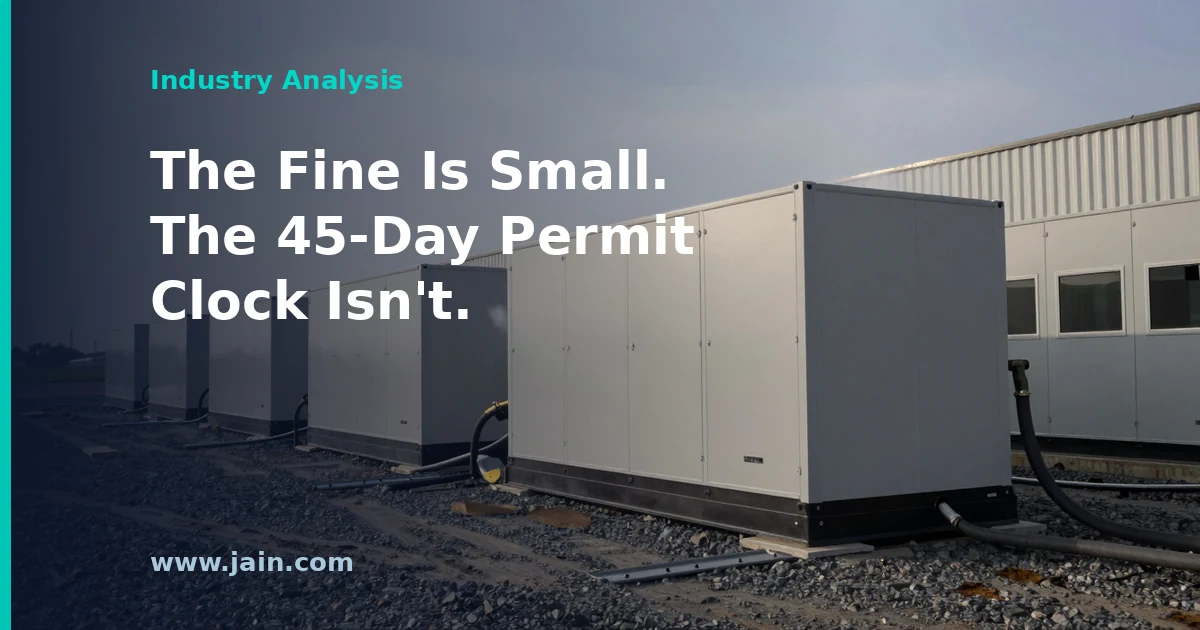
New Jersey fined the builder of an artificial intelligence data center in the town of Vineland a record $1.07 million for running 62 portable power generators without pollution permits.
Split across the generators, that is about $17,000 each. Neighbors called it pocket change. The real threat is a deadline: get the permits within 45 days or switch the generators off.
The site supplies computing power for a $33 billion deal involving Microsoft, so losing its power source would be a far bigger problem than the fine.
New Jersey has fined DataOne a record $1.07 million for running 62 unpermitted portable generators at its AI data center construction site in Vineland. The state also ordered the company to obtain air permits within 45 days or stop using the units. Tom’s Hardware reported the action on September 25, 2026, citing The New York Times. State inspectors found the generators powering the facility in late July. DataOne supplies computing capacity to Nebius, which Microsoft signed to a $33 billion deal.
Residents have raised several other complaints:
the construction, without a permit, of a 1.5-million-gallon liquefied natural gas (LNG) tank;
night-time noise reaching homes within half a mile;
little public consultation before the project began.
DataOne disputed the fine. It said it will apply for air permits for the temporary generators and is moving from portable turbines to fuel cells.
Executive Summary
The penalty is modest against the scale of the project. Spread across 62 generators, it comes to roughly $17,300 per unit, a point residents made bluntly. The 45-day order is what carries operational weight. Generators that were powering the site must be permitted by state regulators in that window or switched off. That puts a regulatory decision, not a construction milestone, on the critical path for a facility tied to one of the larger AI capacity contracts in the market.
The case matters beyond Vineland. On-site generation, often called bridge power, lets developers bring their own electricity instead of waiting for a utility connection, and it is an increasingly common way to get AI capacity online quickly. New Jersey’s action and the earlier dispute over unpermitted turbines at SpaceXAI’s Colossus 2 site in Memphis point to the same limit: the workaround only moves as fast as the air-permit process allows.
Why the 45-Day Clock Outweighs the $1.07 Million
Divide $1.07 million by 62 generators and the penalty works out to about $17,300 per unit. Next to a $33 billion capacity contract, that is a rounding error. Residents said so directly. Longtime Vineland resident Steve Brown called it “a drop in the bucket,” and Tiffany Leone-Vespa argued the fine should have applied to each generator. As a financial deterrent, a penalty of this size does little to change the calculation behind what Brown described as a “don’t ask for permission, just ask for forgiveness later” approach.
The shutdown order is a different kind of lever. New Jersey told DataOne to meet its permitting requirements and to stop running the generators if permits are not granted within 45 days. Inspectors found those units powering the facility. If the permits do not come through, DataOne has to replace that power on a schedule set by regulators rather than by its own construction plan. The replacement could be utility supply, the fuel cells it says it is adopting, or other permitted equipment. For a company whose product is computing capacity, a power gap is a delivery problem, not an accounting line.
That exposure runs down a contract chain. DataOne supplies Nebius, and Nebius supplies Microsoft. The company has said it will apply for the permits. Whether regulators can review and grant them inside the window is the operative question, and it matters far more to the project’s timeline than the size of the fine.
Bring-Your-Own Power Comes With a Permit Attached
AI developers are bringing their own power because utility connections for very large new loads can take years, while trailer-mounted turbines and generators can be delivered and running in weeks. When a data center is built to rent out expensive AI processors, every month without power is lost revenue.
The trade-off is that fuel-burning equipment emits pollutants such as nitrogen oxides, along with noise. That is why states require air permits, which are licenses that set emission limits, operating hours and monitoring for combustion equipment. At 62 units, a temporary generator fleet starts to resemble a small power plant, and it draws the scrutiny that comes with one. Noise complaints from homes within half a mile show the effects are felt locally, not just on paper.
Memphis offers the closest comparison. SpaceXAI’s unpermitted turbines at Colossus 2 led to a lawsuit, and the Department of Justice asked the court to dismiss it on the grounds that the site “supports mission-critical operations.” The company ultimately agreed to remove the unpermitted turbines. It said the process would take more than a year as replacement plants totaling 1.2 gigawatts come online. Both cases end with temporary generation giving way to permanent, permitted supply. What differs is who sets the pace: more than a year in Memphis, 45 days in Vineland.
Fuel Cells, an LNG Tank and the Replacement Question
DataOne’s stated fix is to move from portable turbines to fuel cells. Fuel cells generate electricity through a chemical reaction rather than combustion. They are generally quieter and emit fewer local pollutants, so they address both of the neighbors’ main complaints. They still need fuel, most commonly natural gas, and they would have to match the output the 62 units were providing. DataOne has not said how much capacity it plans to install, who will supply it, or when it will be running.
The 1.5-million-gallon LNG tank is a separate exposure. Liquefied natural gas is gas cooled until it becomes a liquid so it can be stored in bulk, and on-site storage at that scale is one way to fuel generation where pipeline supply is limited. DataOne has not explained what the tank is for. Residents say it was built without a permit, which could make its status a second regulatory question alongside the generators.
Community Consent Is Now Part of the Power Plan
According to residents, they learned a data center was going up in their neighborhood only after Microsoft announced its deal with Nebius. They raised concerns at a February town hall, citing satellite imagery that showed “some type of unit” on site. Inspectors had found no generators during a December visit, then found 62 in late July. When the units first arrived remains unclear, and so does how long they ran before enforcement.
Both sides deserve a fair reading. DataOne’s commitment to seek permits and move to cleaner equipment points in the direction regulators want. Residents’ argument that a flat fine is too small for a well-capitalized operator is a legitimate question about how penalties are designed, including whether they should scale per unit. For developers, the lesson is practical. Permitting and early community engagement cost time up front, but enforcement mid-construction imposes a deadline the developer does not control.
Background
Nebius is an AI cloud company, sometimes called a neocloud, that rents out computing capacity built on graphics processors, the chips used to train and run AI models. It is headquartered in Amsterdam, listed on Nasdaq, and emerged in 2024 from the restructuring of Yandex’s international business. Its $33 billion deal with Microsoft makes it a major capacity supplier to one of the largest buyers of AI computing. DataOne is the developer contracted to provide computing capacity for that arrangement at Vineland, in southern New Jersey.
AI data centers draw far more electricity than traditional facilities, and utility connections for large new loads can take years. Many developers now use on-site generation such as gas turbines, engines or fuel cells as bridge power until grid supply is ready. Under the federal Clean Air Act framework, states require air permits for fuel-burning equipment above certain size thresholds. Operating without one exposes a site to fines and orders to shut the equipment down.
IREN used to mine bitcoin. Now it rents out computing power for artificial intelligence — and Microsoft has signed on as a customer.
The company has $2.8 billion in new orders. That is money customers have agreed to pay over time, not cash sitting in the bank today.
Why an ordinary person should care: the buildings that run artificial intelligence cost enormous sums to build before they earn anything. A signed commitment from a buyer as large as Microsoft makes it far cheaper and easier to borrow the money to build them.
Moomoo reported that IREN Ltd has secured a contract with Microsoft and booked $2.8 billion in new orders, a combination the company presents as accelerating its transformation into an artificial-intelligence infrastructure provider.
IREN is a Nasdaq-listed operator that began as a bitcoin miner and has spent recent years redirecting its data center estate — land, substations and grid connections built for mining — toward hosting AI computing workloads. A named hyperscale customer and a multi-billion-dollar order figure are the two most material markers of that shift to date.
Executive Summary
Two facts carry this story: a dollar figure and a name. The $2.8 billion order book is the number that will travel; the Microsoft contract is the part that changes how the business is valued and financed.
The distinction matters because AI data center capacity gets built in one of two ways. It is built on spec, in the hope that rental rates for AI chips hold up long enough to repay the cost — or it is built against a signed, multi-year commitment from a buyer. The two look identical from the outside and cost radically different amounts of money to finance.
For the broader market, IREN is a test case for a pattern now visible across the sector: large cloud providers contracting directly with converted crypto-mining operators rather than waiting on their own construction pipelines. That arrangement transfers the demand risk off the operator’s balance sheet — and transfers a different set of risks, concentration chief among them, onto it.
The Counterparty Is the Number That Matters
The headline figure is $2.8 billion in new orders. The more consequential disclosure is the name attached to it. In AI infrastructure, capacity is either merchant — built speculatively and rented at whatever the spot market pays — or contracted, built against a signed offtake agreement. The physical racks are the same. The cost of capital behind them is not.
Here is the mechanism. A merchant fleet of AI accelerators is a commodity asset: its revenue depends on rental prices that move quickly, on hardware that depreciates fast, and on an upgrade cycle measured in quarters rather than decades. Lenders discount that cash flow heavily, so the build gets funded mostly with equity, which is the most expensive money there is. A multi-year contract with a large, creditworthy technology buyer converts the same racks into a stream of receivables, and lenders then price the risk substantially against the buyer’s credit rather than the operator’s. Nothing about the building changes; the interest rate does.
That is what makes a named hyperscaler contract structurally different from a strong quarter of rental demand, and it is why the signature is worth more analytically than the order total. The effect radiates outward. Operators with an anchor tenant can commit to chip allocations and power contracts earlier and more cheaply. Operators without one bid for the same accelerators and the same megawatts on worse terms. Chip vendors gain firmer order visibility; utilities and power developers gain load commitments they can actually plan generation and transmission around. The party squeezed is the marginal builder with capacity but no counterparty — the one whose economics depend on renting to whoever shows up.
What Transfers From Mining, and What Doesn’t
The reason converted miners are credible counterparties at all is that they already hold the genuinely scarce inputs. Bitcoin mining required cheap, abundant electricity at industrial scale, which meant acquiring land, building substations, negotiating power purchase agreements and — critically — securing a place in the interconnection queue, the multi-year waiting list to connect a large load to the electricity grid. Those assets cannot be bought quickly at any price, and they are precisely what an AI operator needs.
What does not transfer is the interior. Mining rigs tolerate heat, dust, single-feed power and interrupted service; a mining site that goes dark for an afternoon simply loses a day’s revenue. AI training runs do not tolerate any of that. They require redundant power paths, far higher rack power densities and usually liquid cooling, high-bandwidth low-latency networking between thousands of chips acting as one machine, and contractual uptime guarantees with financial penalties attached. Retrofitting a mining shed into that is substantial capital expenditure the mining business never had to carry.
The practical read, then, is that a converted site is a head start rather than a finished product — and that a hyperscaler signing a contract is meaningful third-party evidence that specific sites cleared that engineering bar. That is a stronger signal than any self-described transformation, because the buyer had every incentive to inspect before committing.
An Order Book Is a Promise, Not a Profit
An order book is contracted future revenue, and its meaning depends almost entirely on the term over which it is delivered. The same $2.8 billion is a very different business spread across three years than across ten, and the annualised figure implied by each is not something a reader can derive from the total alone. Orders also convert to revenue only as capacity is delivered, which means the recognition schedule follows a construction timeline, not a sales announcement.
The corresponding obligation is capital. Serving AI contracts means buying accelerators, energising power and installing cooling ahead of the revenue those contracts will eventually produce. In this business, a growing order book and rising cash consumption arrive together; the relevant question is the size and funding of the gap between them, not the size of the backlog.
Stated even-handedly: what is substantiated here is a named customer, a headline order figure and a clear strategic direction — all three are material and none are trivial. What is not yet substantiated is the margin profile, the contract term, the contracted capacity or the delivery schedule, and those four variables determine whether $2.8 billion is a transformative book or a demanding one.
Concentration Is the Price of Credibility
The anchor tenant that makes capacity financeable also concentrates the business. A contract large enough to move a company’s valuation is, by definition, a customer whose departure at renewal would move it just as far in the other direction — and large buyers know that when renewal terms are negotiated. Cheap capital today and pricing leverage against you later are two faces of the same agreement.
There is a second-order consideration worth stating plainly rather than dramatically. Hyperscalers lease third-party capacity alongside building their own, and the leased portion is a flexible variable in their planning: it can expand when their construction pipeline lags demand and contract when it catches up. That is a legitimate procurement strategy, not a criticism of any buyer. But it means operators in this position are underwriting capacity against a demand source that has an alternative and they do not. The mitigation is diversification of the order book, which is exactly why the split between the Microsoft contract and the remainder of the $2.8 billion is the most useful single disclosure still outstanding.
Background
IREN Ltd was founded in Australia as a bitcoin miner and listed on Nasdaq, building its business around securing large volumes of low-cost, largely renewable electricity and constructing its own data center sites to consume it. That model required the company to become, in practice, a power and land developer — acquiring sites, building substations and working through grid interconnection processes — with mining as the initial use of the capacity.
Since 2023, a broad reordering has pulled that asset base toward artificial intelligence. Demand for AI computing outran the supply of energised, grid-connected data center space faster than new construction could respond, while bitcoin mining economics tightened. Operators holding power capacity found that the same sites could host far higher-value workloads, and a number of listed miners repositioned as AI hosting providers. The competitive question across that group has been which of them can pair their power advantage with the engineering and the customer relationships that AI workloads actually require — which is why a contract with a named hyperscale buyer reads as a milestone rather than a routine sale.
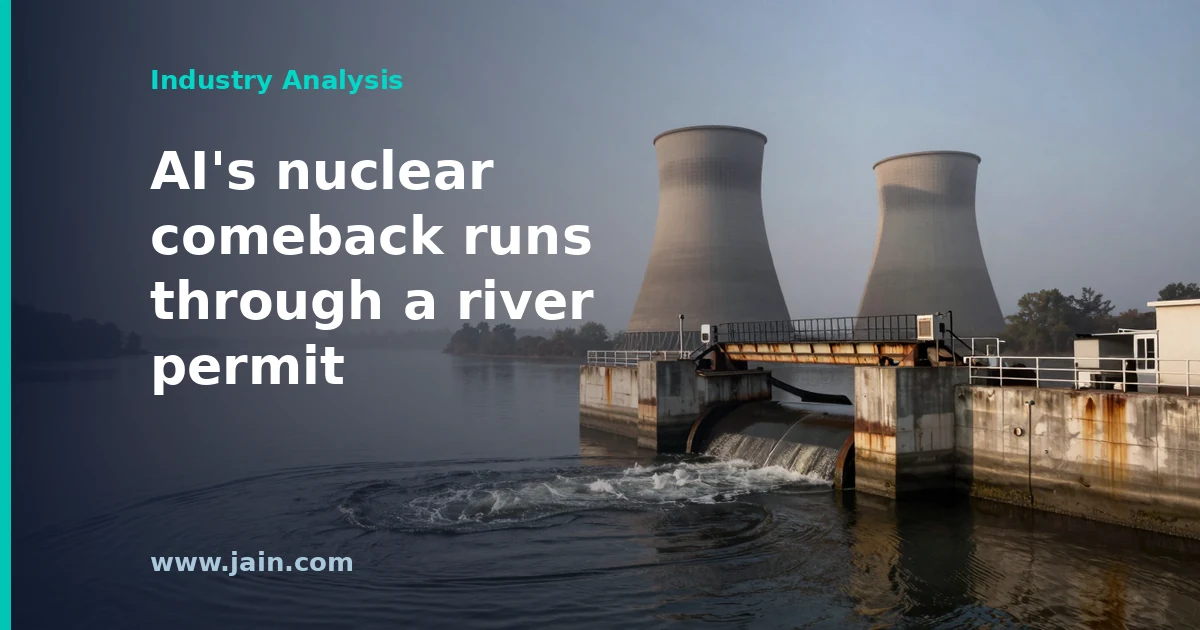
Pennsylvania’s environmental regulator has approved how the Three Mile Island nuclear plant may use river water if it restarts. The plant’s power has been promised to Microsoft to help run its computer centers.
On its busiest days the plant could draw up to 73 million gallons from the Susquehanna River, enough to fill more than 100 Olympic swimming pools. About 21 million gallons a day would turn to steam and not return.
The takeaway: reviving old nuclear plants for artificial intelligence depends on rivers and fish, not just reactor safety.
The Pennsylvania Department of Environmental Protection (DEP) has issued a Section 401 Water Quality Certification for restarting Constellation Energy’s Three Mile Island nuclear plant in Londonderry Township, Dauphin County, PA Environment Digest reported on September 18, 2026. Notice of the decision appears in the September 19 edition of the Pennsylvania Bulletin, the state’s official register.
The certification covers water withdrawals from the Susquehanna River of up to 73.2 million gallons per day on a peak day, consumptive use of up to 21 million gallons per day, and heated-water discharges back to the river at a maximum of 110°F. Anyone aggrieved by the decision has 30 days from the notice to appeal to Pennsylvania’s Environmental Hearing Board.
Executive Summary
A Section 401 certification is the state’s formal finding that a federally licensed project will meet state water quality standards. For a nuclear plant, the federal license comes from the Nuclear Regulatory Commission (NRC), and under the federal Clean Water Act that license cannot take effect for an activity discharging into U.S. waters unless the state certifies it or waives its right to do so. DEP’s action therefore removes a state-level condition on the path to restarting Unit 1, the reactor Constellation has agreed to run for Microsoft under a 20-year power purchase agreement announced in 2024.
The certification also puts hard numbers on the restart’s physical footprint. The plant expects to withdraw up to 73.2 million gallons a day at peak and consume up to 21 million gallons, water lost to evaporation in cooling towers rather than returned to the river. DEP concluded that closed-cycle cooling will minimize harm to fish drawn into or trapped against the intake.
The decision is not yet final in a practical sense: the 30-day appeal window is open, and the certification is one of several approvals a restart needs. But it shows that the fastest route to firm, carbon-free power for AI, reviving a plant that already exists, still runs through water regulators.
Why a Water Permit Gates a Reactor Restart
Most coverage of nuclear power for AI focuses on the NRC, which judges whether a reactor is safe to operate. The Three Mile Island certification highlights a second, parallel track. A steam-cycle power plant is, in large part, a machine for moving heat into water: it pulls water from a river, uses it to condense steam, and either evaporates it through cooling towers or sends it back warmer. Every one of those steps touches state water quality law.
DEP’s notice identifies three impacts it had to weigh: withdrawal from the Susquehanna, consumptive use, and thermal discharge into a river designated for warm water fishes and migratory fishes. The figures are specific. Peak withdrawal of up to 73.2 million gallons a day, consumptive use of up to 21 million gallons a day, and a discharge temperature ceiling of 110°F. Those numbers define what the restarted plant is permitted to do, and they are set by the state, not by the NRC or the power buyer.
This is the mechanism behind the headline. A restart deal with a technology customer creates the demand; a reactor license makes operation legally possible; but without the water certification, the federal license cannot rest on a finding that state water standards will be met. For the developers, utilities and hyperscalers (the largest cloud operators) counting on restarts to bridge the AI power gap, water approvals belong on the critical path alongside nuclear safety reviews.
The Consumptive-Use Number Is the One to Watch
The 73.2-million-gallon withdrawal figure is the larger number, but the 21-million-gallon consumptive-use figure is arguably the more consequential. Consumptive use is water that does not return to the river, mostly because it evaporates from cooling towers. In a closed-cycle system, the plant recirculates water through towers instead of passing river water through once and discharging it, which sharply cuts withdrawals and the number of fish pulled into the intake (entrainment) or pinned against screens (impingement). The trade-off is that evaporation is built into the design.
That matters most in dry, hot periods, when river flows drop and every user of the basin competes for the same water. The release does not describe any low-flow conditions attached to the certification, which is why the full certification document, available from DEP’s Southcentral Regional Office, will be of interest to other water users downstream and to anyone modeling the plant’s summer availability.
Pennsylvania’s Grid Stress Raises the Stakes
The certification arrives in a week that illustrates why firm generation is valuable in Pennsylvania. PJM Interconnection, the grid operator for Pennsylvania and 12 other states plus Washington, D.C., issued maximum generation and load management alerts for September 17 amid hot weather and 35,000 megawatts of maintenance outages, and a Pennsylvania Public Utility Commission study warned that rapid data center growth could cause PJM to fail a reliability standard in 2027 absent further action. The same week, DEP opened comment on a water quality permit for an Amazon Data Services campus in Luzerne County and on stormwater permits for PPL Electric transmission projects intended to serve large loads.
Against that backdrop, a restart that returns an existing nuclear unit to service is one of the few supply additions that can arrive on a data-center timeline. But the pattern across these permits is consistent: whether the project is a reactor, a data center or a transmission line, state environmental permits for water and land disturbance are a gating step. Buyers of AI capacity who treat power as purely a contracting or interconnection question are likely to underestimate schedule risk.
Background
Three Mile Island, on the Susquehanna River south of Harrisburg, is best known for the 1979 partial meltdown at Unit 2, the most serious accident in U.S. commercial nuclear history. Unit 2 never reopened, but Unit 1 continued operating until 2019, when it closed for economic reasons. In 2024 Constellation Energy, the largest U.S. operator of nuclear plants, announced a 20-year power purchase agreement with Microsoft tied to restarting Unit 1, renamed the Crane Clean Energy Center.
The deal became a reference point for a broader trend: technology companies seeking around-the-clock, carbon-free electricity for AI data centers are turning to existing nuclear assets because new reactors take many years to build. Pennsylvania sits inside PJM, the largest U.S. grid region, where data center demand growth has become a central reliability and cost concern for regulators.
On 26 August 2026 in Riyadh, HUMAIN — an artificial-intelligence company owned by Saudi Arabia’s Public Investment Fund (PIF) — announced what it calls the first milestone of a long-term strategic collaboration with Microsoft. Two workstreams open the partnership: making HUMAIN’s ALLAM family of Arabic large language models available through Microsoft Foundry and the Microsoft 365 Copilot ecosystem, and pairing HUMAIN’s AI specialists with Microsoft’s forward-deployed engineers (FDEs) to help customers put AI into production.
The announcement was issued via PR Newswire in German, English and Spanish, and carries quotes from HUMAIN chief executive Tareq Amin, Microsoft vice chair and president Brad Smith, and Naim Yazbeck, Microsoft’s president for the Middle East and Africa. No contract value, capacity figure, customer name or delivery date was disclosed; Amin points to the LEAP technology conference in Riyadh as the venue where more will be shown.
Executive Summary
Stripped to its verifiable core, the announcement is a distribution-and-services agreement. HUMAIN gets its Arabic-language models in front of Microsoft’s global developer and enterprise base through Foundry — Microsoft’s platform for building, customising and deploying AI models and agents — and potentially inside Microsoft 365 Copilot, the assistant layer embedded in Word, Outlook, Teams and the rest of the Office suite. Microsoft, in return, gets a credible Arabic-language capability and a local partner with in-Kingdom engineering depth at exactly the moment Gulf enterprises and government bodies are moving from AI pilots to procurement.
It matters because HUMAIN is not an ordinary software vendor. It is a sovereign-wealth-backed national champion whose stated remit spans next-generation data centres, high-performance compute and cloud platforms, frontier Arabic models, and applied industry solutions. When an entity built to give a country its own AI stack chooses to route its flagship model through a US hyperscaler’s catalogue, that is a statement about where enterprise demand actually sits — and about how hard it is to build distribution from scratch.
The equally important observation is what the release does not say. The language throughout is conditional: the companies intend to make ALLAM available, enterprises could build agents with it, and infrastructure is listed among areas the two sides will explore. That is a memorandum-of-intent posture dressed in product vocabulary, and readers evaluating it as a purchasing or investment signal should weigh it accordingly.
Language Is the Wedge, Distribution Is the Prize
The commercial logic here is straightforward. General-purpose frontier models handle Arabic competently but not natively — dialectal variation, right-to-left formatting, Islamic and legal terminology, and government document conventions are where generic models tend to degrade. A model family tuned for Arabic has a defensible niche in exactly the workloads Gulf institutions want to automate first: correspondence, case files, customer service, regulatory filings.
But a niche model is worth little without a route to buyers. Foundry is that route. Model catalogues inside hyperscaler platforms have become the default procurement channel for enterprise AI, because they arrive pre-attached to identity, billing, logging and compliance plumbing the customer already trusts. For HUMAIN, listing in Foundry converts a national research asset into something a bank in Jeddah or a ministry in Riyadh can turn on inside an existing Azure commitment. For Microsoft, it is a low-capital way to answer the localisation question that regional buyers ask in every deal.
The asymmetry is worth naming plainly, without judgement: the party that owns the catalogue owns the customer relationship, the telemetry and the renewal. Model providers inside such catalogues generally capture a slice of inference revenue; platform providers capture the account.
Forward-Deployed Engineers Are the Underrated Half
The second workstream may be more consequential than the first. Forward-deployed engineers are exactly what the name suggests — engineers embedded with the customer rather than sitting behind a support queue, tasked with finding high-value use cases, wiring AI into existing workflows, tuning deployments and shepherding projects from pilot to production. The release describes this as a co-engineering model spanning Microsoft technologies broadly, not just ALLAM.
This addresses the real bottleneck in enterprise AI. The industry’s persistent failure mode is not model quality; it is the gap between a working demo and a system that survives contact with legacy data, procurement rules and staff who did not ask for it. Services capacity, not GPU capacity, is what converts that gap into revenue. Microsoft has spent two decades building a partner channel for precisely this reason, and HUMAIN supplying regional engineering talent into that motion is a sensible division of labour.
It also carries a strategic subtext for Saudi Arabia: capability transfer. Yazbeck’s quoted framing — that the work builds skills in the Kingdom relevant across the region — describes the outcome the state presumably wants most, since imported models depreciate but trained engineers compound. Whether the arrangement delivers that, or simply staffs Microsoft deployments with local hires, will depend on contract terms the release does not disclose.
Sovereign Ambition, Hyperscaler Dependency
Sovereign AI is usually pitched as control: control of the compute, the model weights, and the data. This announcement touches all three concepts and commits to none of them. Infrastructure appears only in the forward-looking paragraph, alongside productivity, devices, models and joint go-to-market, as an area the companies will explore. There is no disclosed in-Kingdom capacity build, no stated hosting region for ALLAM when served through Foundry, and no description of where weights reside or who may access them.
Brad Smith’s quoted line — that the combination meets the security and governance requirements of enterprise and public-sector customers, in the German release’s phrasing — is the closest the document comes to a residency assurance, and it is a characterisation rather than a specification. Public-sector buyers in regulated markets do not procure on characterisations; they procure on named regions, contractual data-processing terms and audit rights. Those will presumably exist. They are simply not in this release.
The even-handed reading is that this is an early, genuine partnership announced at the earliest defensible moment, which is normal practice and not a criticism of either party. The sharper reading is that a national AI champion’s first major milestone being listing in someone else’s catalogue illustrates how much of the AI stack remains concentrated: the models can be sovereign, the applications can be local, and the platform, the tooling and much of the silicon still are not.
What Buyers and Competitors Should Take From It
Several Gulf states have pursued state-backed AI programmes with similar full-stack ambitions, and all face the same constraint — accelerator supply, export-control exposure and power availability are set outside their borders. Partnerships with US hyperscalers are the pragmatic response, and each such deal narrows the differentiation between national champions while widening the platform incumbents’ regional footprint. Competing clouds now face a straightforward answer from Microsoft on Arabic-language capability, and will likely respond in kind.
For enterprise buyers, the practical guidance is to treat this as a signal of direction, not availability. The questions that determine whether ALLAM-in-Foundry is procurable are: which Azure regions, at what token pricing, under what indemnity for model output, with what benchmark evidence against alternatives on the buyer’s own Arabic corpus, and with what exit path if the partnership’s scope changes. None are answered today.
For investors, the honest framing is that this is immaterial to Microsoft’s near-term financials and potentially material to HUMAIN’s positioning. Microsoft is adding one model family and a partner engineering pool to an ecosystem that already contains many of both. HUMAIN is attaching its principal intellectual-property asset to the largest enterprise software distribution network in the world — a meaningful validation, and also a dependency.
Background
Saudi Arabia’s Public Investment Fund is the state’s sovereign wealth vehicle and the primary funder of the country’s economic diversification programme, which treats technology capability as national infrastructure rather than a discretionary purchase. HUMAIN was established as a PIF company to give the Kingdom an end-to-end AI stack — data centres, compute and cloud, models, and applied solutions — instead of consuming those layers entirely from abroad. Arabic language models are the most visible piece of that strategy, because language is where imported systems most obviously fail to fit local context.
Microsoft, meanwhile, has spent the current AI cycle assembling a platform play: Azure for compute, Foundry as the model and agent development layer, and Microsoft 365 Copilot as the distribution surface reaching hundreds of millions of existing Office users. Adding regionally specialised models to that catalogue — rather than building them in-house — is a well-established pattern, and it lets the company answer localisation and sovereignty questions in markets where those questions decide deals. This announcement sits at the intersection of those two strategies, at the point where a national programme and a global platform each need something the other has.
Maryland Governor Wes Moore announced on August 12, 2026 that AI platform company Cloudforce will expand its headquarters at National Harbor in Prince George’s County, leasing an additional 15,000 square feet of office space — roughly doubling its footprint — while retaining more than 130 employees and committing to add 250 new Maryland jobs over the next five years.
To support the project, Cloudforce is eligible for a $1.25 million conditional loan through the state’s Advantage Maryland program, a $125,000 conditional loan from the Prince George’s County Economic Development Corporation, and potentially state and local tax credits including the Job Creation Tax Credit.
Executive Summary
Cloudforce, which grew from a Microsoft cloud consultancy into what the release calls a “frontier AI platform company,” says it evaluated expansion sites across the DC-Metro region before choosing to stay in Maryland. Its flagship product, nebulaONE, gives universities and public-sector organizations governed access to leading AI models — meaning institutions can offer students and staff AI tools inside a controlled, private environment rather than sending them to open consumer services. Named customers include the University of Maryland, UCLA, London Business School, and the University of Oxford, and Cloudforce was Microsoft’s 2025 global Education Partner of the Year.
The announcement matters less for its physical scale — this is an office lease, not a data center — than for what it signals: the software layer of the AI boom is creating conventional white-collar jobs in metro markets, and states are competing for those jobs with comparatively small, conditional incentive packages rather than the nine-figure deals attached to AI infrastructure projects. It is also a data point for the growing “governed AI” market serving education and government buyers, a segment defined by security and compliance requirements rather than raw compute.
An Asset-Light Expansion in an Asset-Heavy Boom
Most AI expansion headlines in 2026 involve gigawatts, water permits, and construction cranes. This one involves 15,000 square feet of office space — a useful reminder that the AI economy has two very different layers. Cloudforce sits in the platform layer: it does not build or operate the underlying compute, but packages access to models running on hyperscaler infrastructure (its roots are as a Microsoft cloud specialist) into a product institutions can govern and audit. That business scales with headcount in sales, engineering, and customer success rather than with land and power, which is why its expansion looks like a traditional corporate office deal.
For economic developers, that trade-off cuts both ways. An office expansion of this kind promises far more jobs per dollar of incentive than a data center, and jobs of a different character — the release emphasizes career pathways for interns, Service Year members, and recent graduates. On the other hand, an office lease is inherently more portable than a substation-anchored campus. The retention framing in the release — Cloudforce says it had “every option on the table, including markets across state lines” — makes clear Maryland was competing to keep a company that could plausibly have moved.
The Governed-AI Niche in Higher Education
nebulaONE’s pitch, as described in the release, is “private, secure, and equitable AI access at scale” — governed access to leading models and agentic workflows (AI systems that can carry out multi-step tasks, not just answer questions). For universities, the appeal is concrete: they face student demand for AI tools, faculty concern about academic integrity and data privacy, and procurement rules that make consumer AI subscriptions awkward. A governed platform lets an institution offer one sanctioned front door to multiple models, with usage policies attached. The customer list — Maryland, UCLA, Oxford, London Business School — and the Microsoft Education Partner of the Year award suggest real traction in that niche.
The strategic question the release does not address is durability. Cloudforce’s position depends on model providers and hyperscalers continuing to leave room for an intermediary layer. Microsoft, whose ecosystem Cloudforce grew up in, sells its own education-focused AI offerings, and model vendors increasingly court universities directly. Aggregation platforms thrive when the underlying market is fragmented and compliance-heavy — both true today in higher education — but a 250-job, five-year hiring plan is implicitly a bet that this intermediary role persists. That is a reasonable bet, not a guaranteed one.
What $1.375 Million in Conditional Money Buys
The incentive package is notably modest: a $1.25 million conditional loan from Advantage Maryland, a $125,000 conditional county loan, and possible eligibility for tax credits such as the Job Creation Tax Credit. Against a promise of 250 jobs, the headline loan math works out to roughly $5,500 per pledged job — a small fraction of what states routinely commit per job for capital-intensive AI infrastructure projects. Conditional loans of this type also typically convert to grants only if hiring milestones are met, which gives the state some downside protection, though the release does not spell out the conditions.
The honest read is that incentives were probably not decisive. Cloudforce’s stated reasons — technical talent, proximity to universities it both sells to and hires from, and an existing rooted workforce — are the kinds of factors that dominate site selection for a company whose main asset is people. The University of Maryland relationship is particularly interesting: the university is simultaneously a customer, a talent pipeline, and a philanthropic partner. That triple relationship is a genuine competitive moat locally, though it also concentrates a lot of the company’s Maryland story in a single institution.
A Data Point in the DC-Metro Talent Contest
Cloudforce says it ran an “extensive analysis of potential expansion sites across the DC-Metro region,” which frames this as a win for Maryland over Virginia and the District in the ongoing regional contest for technology employers. Northern Virginia has dominated the region’s data center buildout; Maryland landing an AI software headquarters plays to a different strength — its university system and federal-adjacent talent pool — and the state clearly intends to market it that way.
One cultural detail is worth noting for real estate watchers: CEO Husein Sharaf explicitly tied the expansion to “a company culture rooted in bringing our people together in one place.” A software company doubling physical office space in 2026 is a small but real counterpoint to the remote-first assumptions that have weighed on office demand, and a welcome signal for a mixed-use development like National Harbor, whose landlord Peterson Companies was given prominent billing in the announcement.
Background
Cloudforce is a Prince George’s County, Maryland company that started as a Microsoft cloud consultancy and repositioned itself around AI platform services as institutional demand for controlled AI access grew. Its nebulaONE product found a niche in higher education, where universities want to give students and staff AI capabilities without surrendering control over data, privacy, and usage policy — traction that earned Cloudforce Microsoft’s global Education Partner of the Year award in 2025.
The expansion lands amid an intense economic-development contest across the DC-Metro region. While Northern Virginia has captured most of the area’s AI data center investment, Maryland has courted the software and talent side of the AI economy, leaning on its university system and programs like Advantage Maryland, the Department of Commerce’s conditional-loan tool for business expansion and retention.
On July 14, 2026, 3M and Microsoft announced a strategic partnership focused on advancing AI data center infrastructure and enterprise transformation. The announcement was carried on Microsoft’s own newsroom (Microsoft Source).
The headline positions the collaboration around AI-era infrastructure — a domain where 3M has historically supplied materials, adhesives, films and thermal management products, and where Microsoft is one of the world’s largest hyperscale operators.
Executive Summary
The release frames a tie-up between an industrial materials incumbent and a hyperscale cloud operator at a moment when AI compute is straining the physical envelope of data centers. Power density per rack, heat rejection, and materials that can survive higher junction and coolant temperatures have all become gating factors for GPU deployments.
What is substantiated in the headline is intent: a strategic partnership, AI data center infrastructure as the target, and enterprise transformation as a secondary theme. What is not yet substantiated — at least in the excerpt available to us — is scope: which 3M product lines, which Microsoft facilities, on what timeline, and under what commercial structure.
For readers evaluating the announcement, the useful posture is neither dismissal nor hype. Materials science is a genuine bottleneck for AI infrastructure, and 3M has relevant portfolios. Whether this specific partnership delivers meaningful capacity or is primarily a marketing framing will depend on details the release, as published, does not spell out.
Why Materials Suddenly Matter to Hyperscalers
For most of the cloud era, hyperscale data centers were an integration problem: racks of commodity servers, air cooling, and steady incremental efficiency gains. AI training and inference clusters have changed the physics. Modern GPU accelerators dissipate hundreds to over a thousand watts each, and racks are moving from the 10–20 kW range typical of general-purpose cloud toward 50–100 kW and beyond. At those densities, the materials in contact with silicon — thermal interface materials, dielectric fluids for immersion cooling, cold-plate seals, and vapor-barrier films — become first-order engineering constraints rather than commodity inputs.
3M’s historical relevance here is real: the company has long supplied fluorinated dielectric fluids used in two-phase immersion cooling, thermal interface products, and specialty films and tapes used inside servers and networking gear. Microsoft, for its part, has publicly experimented with immersion cooling in prior years. A partnership badged as targeting AI data center infrastructure sits squarely in this well-established technical overlap, even if the announcement itself does not enumerate specific product families.
What a Strategic Partnership Actually Buys
"Strategic partnership" is one of the more elastic phrases in corporate communications. In practice, such arrangements range from joint marketing and preferred-supplier status at the light end, to co-development agreements, capacity reservations, and equity or offtake commitments at the heavy end. The release headline as available does not disclose where on that spectrum this deal sits.
For 3M, a formal alignment with a top-three hyperscaler is commercially valuable regardless of the exact contract structure: it validates its materials portfolio for AI workloads at a moment when the company has been repositioning after divesting parts of its business and navigating environmental litigation around per- and polyfluoroalkyl substances (PFAS). For Microsoft, tying a materials supplier more closely into its infrastructure roadmap is consistent with a broader hyperscaler trend of pushing further down the stack — into custom silicon, custom racks, and now, plausibly, custom materials specifications.
Enterprise Transformation: The Ambiguous Second Leg
The headline also references enterprise transformation, a phrase that in Microsoft’s usage typically implies Azure adoption, Microsoft 365, and Copilot-branded AI products. Read literally, it suggests 3M is also a customer — modernizing its own IT and manufacturing operations on Microsoft’s stack — not only a supplier.
Two-way arrangements of this kind are common in hyperscaler deal-making: the supplier commits materials or capacity, and in return standardizes on the buyer’s cloud and AI platforms. Whether that reciprocity is present here, and on what scale, is not stated in the available excerpt. Buyers and investors should treat the enterprise-transformation framing as a signal to look for future disclosures around Azure commitments or Copilot deployments at 3M.
Risks and Open Questions on Both Sides
Any materials-heavy AI infrastructure story now runs into the PFAS question. Several of the dielectric and thermal fluids historically associated with immersion cooling belong to fluorochemical families that are under increasing regulatory scrutiny in the United States and European Union. 3M has publicly stated it intends to exit PFAS manufacturing by the end of 2025. A partnership announced in mid-2026 targeting AI infrastructure therefore raises a legitimate, non-inflammatory question: what chemistries are in scope, and how does the roadmap reconcile with that exit commitment? The release excerpt does not answer this.
On Microsoft’s side, the risk is narrative. Hyperscalers have announced many AI-era infrastructure partnerships in the past two years — with utilities, nuclear developers, chipmakers, and cooling specialists. Each individually is plausible; collectively, they can create an impression of capacity certainty that specific contracts may not yet support. The measured read is that this announcement adds one more supplier relationship to that mosaic, and its weight will be visible only when product-level or facility-level detail follows.
Background
3M is a diversified U.S. industrial company whose materials science portfolio has long included products used inside data centers — thermal interface materials, films, adhesives, filtration and, historically, dielectric fluids associated with immersion cooling. The company has been repositioning in recent years, including a stated intent to exit PFAS manufacturing by the end of 2025 amid regulatory and litigation pressure.
Microsoft is among the top three hyperscale cloud operators globally and has publicly committed to a large multi-year build-out to support AI training and inference workloads. That build-out has surfaced physical constraints — power, cooling, and materials — that were secondary concerns in the pre-AI cloud era, prompting a wave of supplier and infrastructure partnerships across the industry.
Microsoft is claiming water positivity across its data center operations, according to a June 27, 2026 report from Data Center Dynamics. Water positivity means an operator replenishes more water to stressed watersheds than its facilities consume — a milestone Microsoft first committed to reaching by 2030 when it announced its water-positive pledge in 2020.
The claim spans one of the world’s largest cloud footprints, and it arrives at a moment when AI-driven capacity growth has put data center water consumption under intense public and regulatory scrutiny. The available report is headline-level, so the scope, accounting method, and verification behind the claim remain to be detailed.
Executive Summary
Microsoft has publicly positioned its data center operations as water positive — consuming less water, net of replenishment projects, than it returns to the watersheds where it operates. If the claim holds up under scrutiny, it would represent the first time a hyperscale cloud operator has asserted that its fleet, as a whole, has crossed that line, and it would land years ahead of the company’s stated 2030 target.
Why it matters: water has become the second front, after power, in the fight over data center siting. Communities from Arizona to the Netherlands have pushed back on facilities that draw millions of gallons for evaporative cooling, and regulators increasingly ask for water commitments alongside grid commitments. A credible water-positive benchmark from the market’s second-largest cloud provider would reset expectations for every operator negotiating a site — including colocation and wholesale providers who compete for the same land, power, and permits.
The operative word is credible. Water positivity is an accounting construct, not a physical description of any single site, and its value depends entirely on scope, measurement, and where the replenishment actually happens. The source reporting available at publication does not yet answer those questions, and they are the right ones to ask of any operator making a similar claim.
What “Water Positive” Actually Means — and What It Doesn’t
Water positivity is a ledger claim: over a defined period, the volume of water an operator restores — through wetland restoration, leak-repair programs, irrigation efficiency projects, aquifer recharge, and similar investments — exceeds the volume its operations consume. Consumption here typically means water evaporated or otherwise not returned to the source, which for data centers is dominated by evaporative cooling, the technique of cooling air or water by letting some of it evaporate, trading water for large electricity savings.
What the construct does not mean is that any individual data center stopped drawing water. A facility in a drought-stressed basin can keep consuming while the corporate ledger balances with a restoration project elsewhere. That is not inherently bad-faith accounting — carbon markets work on a similar logic — but water is far more local than carbon. A gallon replenished in one river basin does nothing for the aquifer under a different one. The strongest version of a water-positive claim is basin-matched: replenishment in the same watersheds where consumption happens, weighted toward the most stressed ones. Whether Microsoft’s claim is basin-matched is exactly the kind of detail the headline-level reporting leaves open, and it is the difference between a milestone and a marketing line.
The Cooling Economics Behind the Claim
Data centers face a three-way trade among water, energy, and capital. Evaporative cooling is cheap and energy-efficient but water-hungry. Closed-loop and air-cooled designs eliminate most on-site water consumption but raise electricity use or capital cost, and in hot climates they can strain the power budget that operators are already fighting to secure. Microsoft has spent several years publicizing designs that move toward zero-water cooling for new builds, alongside efficiency metrics like WUE — water usage effectiveness, the liters of water consumed per kilowatt-hour of IT load.
A fleet-level water-positive result, if achieved early, most plausibly reflects three levers working together: newer builds consuming less per megawatt, replenishment portfolios scaling faster than consumption, and — the uncomfortable variable — how fast AI capacity growth adds consumption to the denominator. The AI buildout cuts both ways here. High-density AI halls increasingly use direct liquid cooling, which circulates coolant in a closed loop and can actually reduce on-site water consumption per unit of compute, but the sheer volume of new capacity can swamp per-unit gains. Any operator’s water math in 2026 is a race between those two curves.
A Benchmark With Teeth — If the Methodology Is Public
The industry consequence of this claim depends less on Microsoft than on procurement. Enterprise cloud buyers and public-sector tenders already ask for carbon disclosures; a hyperscaler asserting water positivity gives sustainability teams a new line item to demand from every provider. Google and Amazon have announced their own 2030-era water goals, so competitive pressure to demonstrate progress — not just pledge it — will rise. Colocation operators, who often lack the balance sheet for large replenishment portfolios, may feel the squeeze most: their water story is largely their cooling design, not an offsetting ledger.
For communities and regulators, the useful move is to treat the claim as an invitation to standardize. Today there is no universally accepted audit standard for water positivity comparable to the frameworks maturing around carbon. Claims are only comparable across operators if consumption scope (owned versus leased capacity, construction water, upstream power-generation water), replenishment crediting rules, and basin matching are disclosed. An early, well-documented claim from a market leader could seed that standard. A thinly documented one would invite the same greenwashing skepticism that has dogged renewable energy certificates — and would make life harder for operators doing the work rigorously.
Background
Microsoft is one of the world’s largest data center operators, running cloud infrastructure across dozens of countries to serve its Azure, Microsoft 365, and AI businesses. In 2020 the company pledged to become water positive by 2030 as part of a broader sustainability program that also targets carbon-negative operations, and it has since promoted lower-water cooling designs for new facilities alongside a portfolio of watershed replenishment projects.
The claim lands in an industry racing to build AI capacity while facing growing scrutiny over resource consumption. Water has joined electricity as a gating factor for new data center permits, and no common audit standard yet exists for corporate water-positivity claims — which makes the methodology behind any such announcement as consequential as the announcement itself.
Microsoft’s AI data center campus in Mount Pleasant, Wisconsin is now fully operational, according to a June 24, 2026 report from Data Center Knowledge. The milestone marks the completion of the commissioning phase for one of the most closely watched hyperscale AI sites in the United States — a campus Microsoft has publicly positioned as a flagship of its AI infrastructure program since announcing a $3.3 billion investment there in May 2024.
Executive Summary
The report that Microsoft’s Wisconsin campus has gone fully operational converts years of announcements into working capacity. “Fully operational” in hyperscale terms means the facility has moved past construction and phased commissioning — the staged process of energizing electrical systems, validating cooling loops, and bringing compute halls online rack by rack — into steady-state production service.
It matters for three reasons. First, the site is a bellwether: Microsoft branded its Mount Pleasant build “Fairwater” and described it as among the most powerful AI data centers in the world, purpose-built for training large AI models on massive GPU clusters. Second, the location carries unusual economic symbolism, occupying land originally assembled for Foxconn’s largely unrealized 2017 manufacturing project. Third, it is a data point on whether the AI capital-expenditure cycle is delivering finished, revenue-generating infrastructure on schedule — a question investors and utilities are asking with increasing urgency.
One caveat readers should hold onto: the source is a headline-level trade report. Specific operational figures — megawatts energized, GPU counts in service, final headcount — are not independently confirmed in it, and we flag below what remains unverified.
From Foxconn’s Ghost Site to an AI Flagship
Few parcels of American industrial land carry as much narrative weight as Mount Pleasant. In 2017, Foxconn pledged a $10 billion LCD manufacturing campus there with talk of up to 13,000 jobs; the project was dramatically scaled back, leaving the village and Racine County with prepared land, water infrastructure, and unmet expectations. Microsoft’s arrival in 2023–2024 — culminating in the $3.3 billion commitment announced in May 2024 — recast the site as AI infrastructure rather than manufacturing.
Full operation closes that redemption arc, at least physically. For local officials who financed roads, water mains, and land assembly for Foxconn, a running hyperscale campus finally puts heavy, long-lived capital on the tax rolls. It is worth being precise about what changed, though: a data center campus employs far fewer people per dollar of investment than the factory once promised. The win for the region is tax base, grid and fiber investment, and anchor-tenant credibility — not mass employment.
What “Fully Operational” Actually Means at Hyperscale
Hyperscale campuses do not flip on like a light switch. They are commissioned in phases: substations and switchgear are energized, cooling plants are load-tested, and data halls are accepted one at a time, often over 12 to 24 months. A “fully operational” declaration means the last planned phase of the current build has passed acceptance and is carrying production workloads — in this case, most likely AI training and inference for Microsoft’s own models and its Azure cloud customers.
Microsoft has said the Wisconsin facility was designed around dense GPU clusters — the specialized processors that do the mathematical heavy lifting of AI — networked into effectively one giant computer for training large models. That design choice matters commercially: a training-oriented campus is measured less by how many customers it hosts and more by how fast it lets its owner iterate on frontier models. Full operation here is capacity Microsoft has been publicly hungry for throughout the AI demand surge.
Power and Cooling: The Real Constraints on the AI Buildout
The binding constraints on AI infrastructure are no longer chips alone but electricity and heat. Microsoft has described the Mount Pleasant design as using closed-loop liquid cooling — water is filled once and continuously recirculated to carry heat away from densely packed GPUs, rather than being evaporated and replaced as in traditional cooling towers. If it performs as described, that design substantially reduces ongoing water draw, a sensitive issue in any community hosting a large data center near the Lake Michigan basin.
Electricity is the harder question. Facilities of this class draw utility-scale power measured in the hundreds of megawatts, and Wisconsin utilities have been planning generation and transmission additions with data center demand explicitly in view. Who pays for that grid expansion — hyperscalers through special tariffs, or ratepayers broadly — is one of the live policy debates of the AI era, in Wisconsin as elsewhere. A fully operational campus moves that debate from the hypothetical to the measurable: actual load data now exists, even if it is not yet public.
A Bellwether for the AI Capex Cycle
The AI buildout is one of the largest private capital deployments in history, and skeptics reasonably ask whether announced projects become working assets or stall in permitting, power queues, and supply chains. Mount Pleasant going fully operational is evidence for the “it’s getting built” side of the ledger — a site that went from announcement to full operation in roughly two years, and which Microsoft subsequently doubled down on with a second announced facility that pushed its stated Wisconsin commitment past $7 billion.
For competitors and suppliers, the milestone sharpens the map. Rivals racing to stand up comparable training capacity now face a Microsoft with another flagship online. For the ecosystem of electrical contractors, cooling vendors, and fiber providers, a completed phase means crews and supply chains roll to the next site — including, presumably, the second Wisconsin building. And for enterprise buyers of AI services, more training capacity upstream generally translates, with a lag, into more capable models and more available GPU capacity downstream.
Background
Microsoft is one of the world’s largest cloud and AI providers, and since 2023 it has led one of the largest infrastructure buildouts in corporate history to supply computing capacity for AI model training and services delivered through its Azure cloud. Data centers — warehouse-scale buildings packed with servers, specialized AI processors, power distribution, and cooling — are the physical foundation of that effort, and Microsoft has announced multibillion-dollar campuses across the United States and abroad.
The Mount Pleasant, Wisconsin site carries particular history. It was assembled for Foxconn’s heavily subsidized 2017 manufacturing project, which largely failed to materialize. Microsoft began acquiring land there in 2023, announced a $3.3 billion AI data center investment in May 2024, later unveiled the campus under the “Fairwater” banner as a flagship AI training facility with closed-loop liquid cooling, and announced a second Wisconsin data center that raised its stated commitment in the state above $7 billion. The June 2026 report that the campus is fully operational marks the completion of that first flagship build.
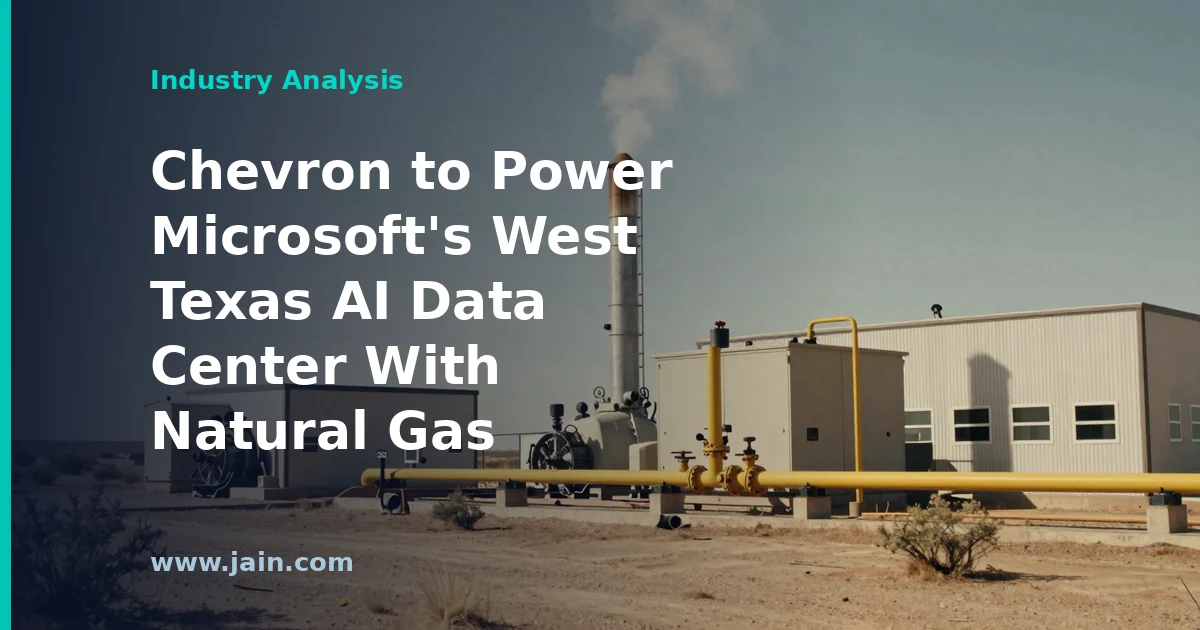
Chevron has struck a deal to supply electricity generated from natural gas to a Microsoft artificial-intelligence data center in West Texas, according to a Wall Street Journal report dated June 21, 2026. Deal terms — including capacity, pricing, and start date — were not disclosed in the source material available to us.
The agreement pairs one of America’s largest oil and gas producers with one of its largest data-center builders, and it lands in the Permian Basin region, where Chevron produces enormous volumes of natural gas close to where Microsoft needs power.
Executive Summary
The reported arrangement makes Chevron a power supplier — not just a fuel supplier — to a hyperscaler, the industry term for the handful of companies (Microsoft, Google, Amazon, Meta) that operate cloud computing at global scale. That distinction matters: selling gas molecules is Chevron’s traditional business, while selling electrons under long-term contract to a single anchor customer is a new one, and it captures more of the value chain.
For Microsoft, the deal addresses the single biggest constraint on AI expansion: getting large amounts of reliable power quickly. Utility interconnection queues — the waiting lists to plug big new loads or generators into the transmission grid — now stretch years in much of the country. Dedicated generation built by an energy company with its own fuel supply is one way to shortcut that wait.
Chevron had previously signaled this ambition: in early 2025 the company announced plans to develop gas-fired power plants co-located with data centers, in partnership with investment firm Engine No. 1 and turbine maker GE Vernova, with West Texas among the first targeted regions. The Microsoft deal, as reported, would be visible evidence that the strategy has landed a marquee customer.
Oil Majors Are Becoming Power Companies
For decades, the boundary was clean: oil and gas companies produced fuel, utilities and independent power producers turned it into electricity. AI is dissolving that boundary. Data-center operators need gigawatt-scale power on timelines utilities struggle to meet, and they are willing to sign long-dated contracts to get it. That contract structure — a creditworthy counterparty committing to buy power for many years — is exactly what makes a power plant financeable, and it is an asset profile oil majors understand from their LNG businesses.
Chevron’s advantage is vertical integration. In the Permian Basin, gas is so abundant relative to pipeline takeaway capacity that regional prices at the Waha hub have repeatedly traded near zero or even negative in recent years. Burning that gas on-site to serve a data center converts a stranded, low-value commodity into contracted electricity revenue. Few competitors can match that feedstock economics story.
Why Gas, and Why West Texas
Natural-gas turbines remain the fastest way to deliver large blocks of firm, around-the-clock power — the kind AI training clusters demand. Solar and wind are cheaper per unit of energy but intermittent; nuclear is firm but slow to build; batteries shift power in hours, not weeks. Texas adds a structural advantage: ERCOT, the state’s independent grid, has lighter interconnection processes than other U.S. regions, and state law accommodates large co-located or behind-the-meter loads — facilities that take power directly from a dedicated plant rather than through the public grid.
The tradeoff is emissions. Microsoft has a publicly stated goal of being carbon negative by 2030, and a new gas-fired power arrangement runs against that grain unless it is paired with carbon capture, offsets, or a credible transition plan. The source material does not say whether any such mitigation is part of this deal — a material omission, since how hyperscalers reconcile gas-fired AI power with climate commitments is one of the industry’s live controversies. The fair reading cuts both ways: gas power for data centers is neither the betrayal critics sometimes claim nor the bridge its promoters assert until the specifics — capture rates, contract duration, retirement plans — are on the table.
Winners, Losers, and the Competitive Map
If deals like this proliferate, the winners are gas producers with stranded Permian volumes, turbine manufacturers whose order books are already stretched to the end of the decade, and Texas jurisdictions collecting tax base. Traditional utilities lose a growth story if the largest new loads in a generation bypass them; conversely, they shed the risk of building for a demand boom that may not fully materialize.
The strategic question is whether hyperscaler-oil-major partnerships become a template. ExxonMobil has announced similar ambitions in gas-plus-carbon-capture power for data centers, and other producers are circling. If the model works, the AI buildout will have quietly created a new class of independent power producer — one with its own wells.
Background
Chevron is one of the world’s largest integrated energy companies and a top producer in the Permian Basin, the West Texas oil field whose wells also produce vast quantities of natural gas. Historically Chevron sold that gas into pipelines and export markets; in 2025 it announced a venture to build gas-fired power plants serving data centers directly, reserving turbine capacity with GE Vernova alongside investment firm Engine No. 1.
Microsoft, through its Azure cloud division and its partnership with OpenAI, has been spending tens of billions of dollars a year building AI data centers, and has pursued a wide portfolio of power deals — from renewables to the planned restart of a reactor at Three Mile Island — as electricity has replaced land and chips as the scarcest input in the AI buildout.
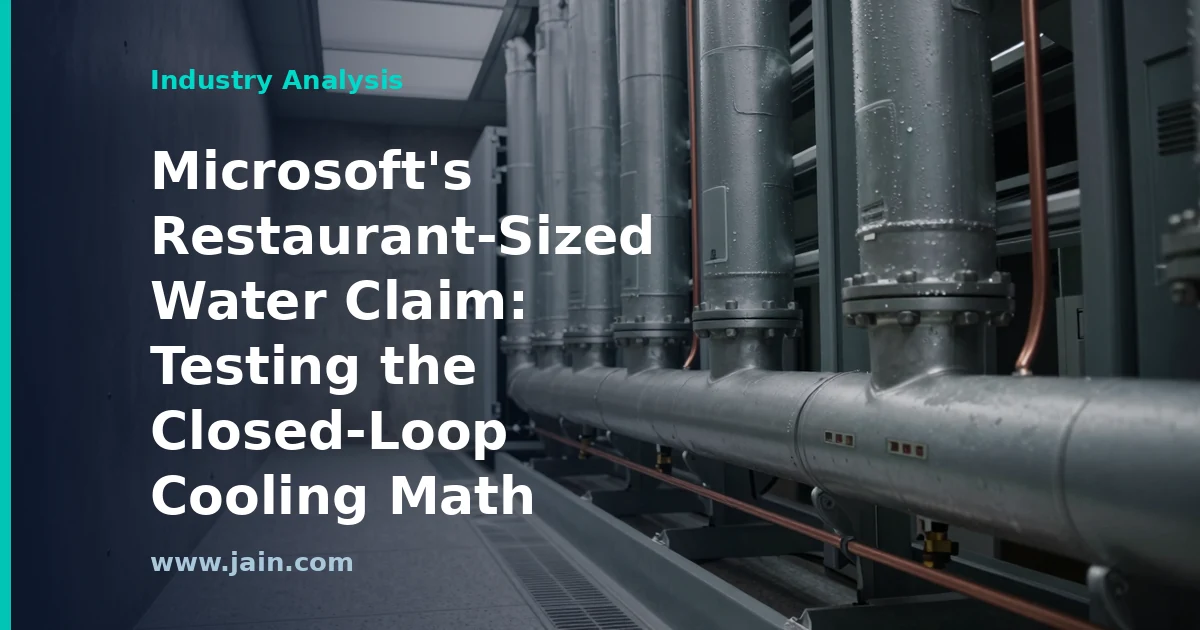
Microsoft’s chief executive said the company’s newest AI data centers consume as little water annually as a typical restaurant, crediting a closed-loop cooling design that recirculates the same fluid indefinitely rather than evaporating fresh water to reject heat. The claim, reported June 3, 2026, positions the design as a step-change from conventional facilities that can draw millions of gallons per year.
Executive Summary
The comparison is striking by design: restaurants are among the most water-intensive small businesses people intuitively understand, and equating a hyperscale AI facility to one reframes the water debate around data centers. The engineering behind the claim is real and well understood — closed-loop (or liquid-to-chip, sealed-circuit) cooling fills the system once and rejects heat to the outside air through dry coolers or chillers, eliminating the continuous evaporation that makes traditional cooling towers thirsty.
Why it matters: water has become a genuine siting constraint for AI infrastructure. Communities from the American Southwest to drought-prone regions abroad have pushed back on data center projects over aquifer draw, and utilities increasingly ask about consumptive water use before power. If Microsoft can credibly demonstrate restaurant-scale water budgets at gigawatt-scale campuses, it changes the permitting conversation for the whole industry.
The caveat: the claim as reported applies to new facilities built to the closed-loop design, not Microsoft’s existing fleet, and the reported remarks do not specify how many sites qualify, how the restaurant benchmark is defined, or whether the figure counts the water embedded in the extra electricity that dry heat rejection typically requires.
The Engineering Is Credible — the Accounting Is the Question
Closed-loop cooling is not a moonshot; it is a design choice with known trade-offs. In a conventional data center, cooling towers chill water by evaporating a portion of it — that evaporation is the “consumption” that shows up in the millions-of-gallons figures. A sealed circuit avoids this entirely: coolant is filled at commissioning, circulates across cold plates or heat exchangers at the servers, and dumps heat to ambient air. On-site water use then falls to domestic needs — restrooms, humidification, kitchens — which is plausibly restaurant-scale.
The honest question is boundary-drawing. Site water use is only one ledger. Dry heat rejection generally consumes more electricity than evaporative cooling, especially in hot climates, and most grid electricity has its own water footprint at the power plant. A facility that saves water on site but draws more thermally generated power may shift consumption upstream rather than eliminate it. The reported remarks, as relayed, do not say whether Microsoft’s restaurant comparison is site-only or includes that indirect water. Neither answer would be wrong — but they are very different claims.
Water Is Becoming the Second Currency of AI Siting
For years, the binding constraint on data center development was power: megawatts available, interconnection queue position, substation timelines. Water has quietly become the second gate. Local opposition to AI campuses increasingly centers on aquifer and municipal-supply impacts, and several jurisdictions now require consumptive-use disclosures in permitting. A hyperscaler that can walk into a county hearing with a restaurant-equivalent water budget has a materially easier approval path — and that is worth real money in schedule terms, since permitting delay is often costlier than construction premium.
This creates competitive dynamics beyond Microsoft. If closed-loop designs become the de facto community expectation, operators running evaporative plants may face pressure to retrofit or to defend designs that were unremarkable five years ago. Cooling vendors, dry-cooler manufacturers, and liquid-cooling integrators stand to gain; regions that marketed abundant water as a siting advantage lose a differentiator.
Marketing Benchmarks Deserve the Same Scrutiny as Critics’ Numbers
The water debate around AI has featured loose numbers on all sides — viral estimates of water “per chatbot query” have often rested on contested assumptions, and industry rebuttals have sometimes cherry-picked their best sites. A restaurant comparison is vivid but imprecise: restaurant water use varies enormously by size and type, and the reported claim does not state which benchmark Microsoft used. The fair posture is symmetrical skepticism. Critics’ worst-case figures should be tested against actual metered data; Microsoft’s best-case figure should be tested against fleet-wide averages, third-party verification, and the full indirect footprint. Until per-site water data is published, both the alarm and the reassurance rest partly on trust.
Background
Microsoft is one of the largest builders of AI infrastructure in the world, expanding data center capacity at historic pace to serve AI training and cloud workloads. The company has long publicized environmental commitments — including goals around water stewardship — and in recent years began promoting data center designs that minimize or eliminate evaporative water use, as rising rack densities pushed the industry from air cooling toward liquid cooling.
The water question grew alongside the AI boom: as hyperscale campuses multiplied in water-stressed regions, consumptive use became a flashpoint in local permitting battles and media coverage. The June 2026 remarks land in that context — an industry seeking to prove that AI growth and water stewardship are compatible, before regulators decide the question for it.