Tag: Michigan

  • Hyperscale Data’s 20 MW AI Contract Still Needs Bitcoin to Get Built

    Hyperscale Data’s 20 MW AI Contract Still Needs Bitcoin to Get Built

    TL;DR · 30-second read

    The Short Version

    A small company building a data center for artificial intelligence in Michigan is paying for it partly by selling bitcoin.

    Hyperscale Data sold about 100 bitcoin and set up a loan that uses its remaining coins as a guarantee, at roughly 4.5% to 5% interest. The building already has a customer lined up, under a deal that could bring in more than $1.2 billion over 20 years.

    The surprise is that a signed customer does not pay for construction. The money has to be found first.

    Hyperscale Data, Inc. (NYSE American: GPUS) said on July 30, 2026 that it has sold approximately 100 bitcoin and put the proceeds directly into its Michigan AI data center campus. It has also set up a credit facility that lets it borrow at variable rates, expected at about 4.5% to 5.0%, with bitcoin pledged as collateral.

    The money will fund construction and long-lead equipment for a previously announced master services agreement with an unnamed neocloud customer. That agreement covers about 20 megawatts of critical AI compute capacity for an initial 10-year term. The company says it could exceed $1.2 billion in revenue if the customer exercises two five-year extensions, and $3.0 billion if the customer also takes an optional 32 additional megawatts.

    Executive Summary

    Hyperscale Data is turning part of its bitcoin treasury into data center capacity. It is doing this in two ways: selling some coins outright and borrowing against the rest. Management calls the Michigan campus one of its highest-priority long-term investments. It presents the plan as a way to avoid issuing new shares at what Executive Chairman Milton “Todd” Ault III calls the company’s current market valuations.

    The announcement matters beyond one small-cap company because of what it shows about how AI infrastructure gets funded. Hyperscale Data already has a signed long-term customer, yet it still reached for its most liquid asset to pay for construction. The company says the alternatives were dilutive equity or “onerous” debt. A contract with a customer and the capital to build for that customer are separate problems, and the second one sets the pace.

    The trade-off is real. Borrowing against bitcoin is cheap only while bitcoin holds its value. The company has not disclosed the facility’s size, terms or collateral requirements, the campus’s total budget, or a delivery date.

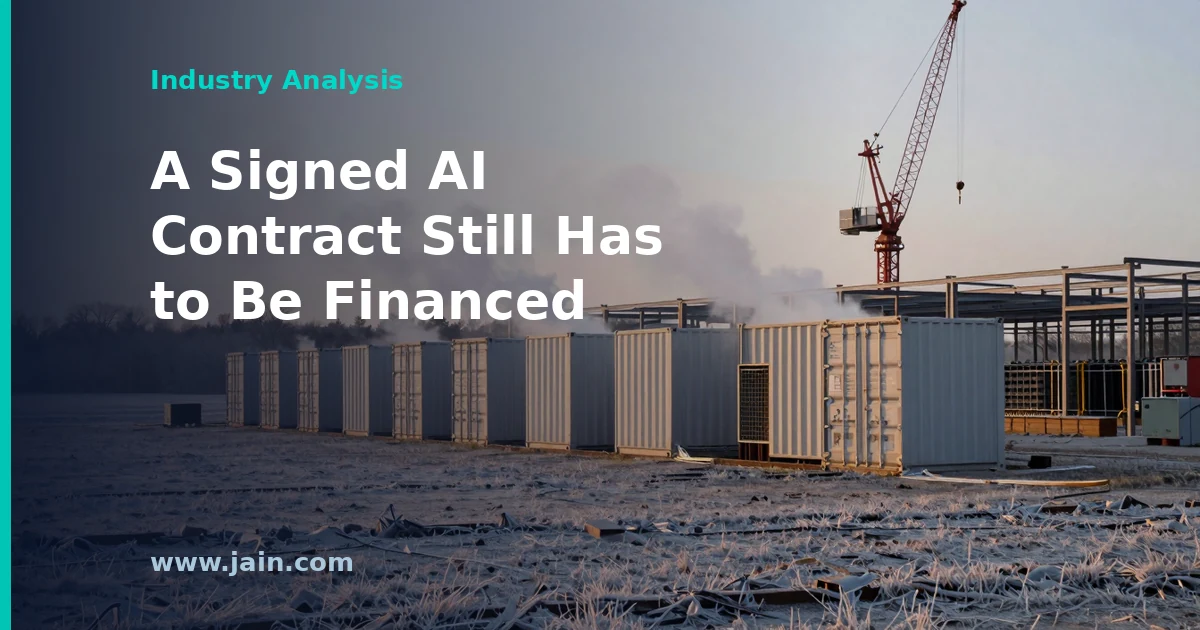
    A Signed AI Customer Is Not a Construction Budget

    The master services agreement at the center of this plan is substantial on paper. It covers about 20 megawatts of critical AI compute capacity, meaning the power delivered to the computing equipment itself, excluding cooling and other overhead. The initial term is 10 years, and the customer may choose to add two five-year extensions. The contract reaches the “in excess of $1.2 billion” the company cites only if both extensions are exercised. Spread across 20 years and 20 megawatts, that is roughly $3 million per megawatt per year, or about $250 per kilowatt per month.

    That revenue arrives only after the capacity is built and handed over. Before then, the landlord has to pay for the building, the electrical and cooling plant, and what the release calls “long-lead equipment.” These are items such as large transformers and switchgear that typically must be ordered well in advance. Hyperscale Data says proceeds from the roughly 100 bitcoin it sold are being invested “directly” into this work, and that the credit facility will help fund it further.

    The telling detail is how the company describes its alternatives. It says the bitcoin route reduces reliance on “third party short-term equity financing or onerous debt financing.” Ault says that at current valuations, bitcoin is a more attractive source of capital than issuing stock. A neocloud is a cloud provider that specializes in renting out GPU computing for AI. Having signed one as a customer had not, by itself, made construction money cheap enough for management. The company has not said whether it sought project debt secured by the contract itself. For smaller developers the operational lesson is that the customer queue and the capital queue are separate. The company’s own word for what the new funding does is “accelerate,” which means the capital queue is what sets the build schedule.

    Why Bitcoin Became the Cheaper Money

    The credit facility carries variable rates expected at about 4.5% to 5.0%, secured by pledged bitcoin. For comparison, the company’s listed 13.00% Series D Cumulative Redeemable Perpetual Preferred Stock pays holders 13% a year. Against that benchmark, and against selling common shares at a valuation management considers unattractive, borrowing against an asset already on the balance sheet looks inexpensive.

    Lenders accept bitcoin as collateral because it trades around the clock in deep markets and can be sold quickly if a loan goes bad. That lets them lend on terms closer to secured lending than to speculative construction debt. The company keeps most of its coins and their potential upside. Ault calls the treasury, which the company recently said had reached approximately $71 million in bitcoin, “a significant source of financial flexibility.” Chief Executive Officer William Horne describes the move as “shifting one balance sheet asset for another.”

    That description is accurate as far as it goes. The company is converting a liquid, volatile asset into an illiquid, long-lived one that is meant to produce contracted cash flow. Whether the exchange creates value depends on the build cost, the delivery date and whether the customer exercises its extensions. The release quantifies none of these.

    Volatile Collateral Behind a Long-Lived Asset

    Bitcoin-backed loans typically advance only a fraction of the collateral’s market value. They usually require the borrower to post more collateral or repay if the price falls far enough. Hyperscale Data has not stated the facility’s size, lender, loan-to-value ratio or margin terms, so the scale of that exposure cannot be measured. The structural mismatch is clear, though. A data center takes years to pay back, while the collateral behind its funding is repriced every minute.

    The variable rate adds a second moving part. The 4.5% to 5.0% range is an expectation, not a fixed cost. Rising rates would increase the cost of carrying debt that funds an asset whose revenue is locked into a long-term contract. Neither risk is unusual alone. Together, they are what investors should weigh against the stated benefit of avoiding dilution.

    Why Speed Carries a Premium

    The contract gives the customer a right to 32 additional megawatts. If that right is exercised within the first two years and the contract runs through both extensions, the company expects total revenue above $3.0 billion across about 52 megawatts. That is roughly the same per-megawatt economics as the base deal. Because the expansion window is limited in time, any delay on the first 20 megawatts shortens the period in which the larger deal can materialize. That is a concrete reason to pay for speed with the most readily available capital.

    The company is also narrowing its focus. It expects to divest Ault Capital Group, its private equity and operating-company arm, in the second quarter of 2027. What remains would own and operate data centers and hold digital assets. The Michigan campus is the asset that narrower company will be judged on, which helps explain why management ranks it at the top of its capital priorities.

    Background

    Hyperscale Data, Inc. trades on NYSE American under the ticker GPUS and describes itself as an AI data center company anchored by bitcoin. Its subsidiary Sentinum owns and operates a data center where it mines digital assets and offers colocation and hosting. Its other subsidiary, Ault Capital Group, is a hybrid private equity firm and operating company with holdings in financial services, industrial, defense, hospitality and other sectors. The company expects to divest Ault Capital Group in the second quarter of 2027, leaving a business centered on data centers and digital assets.

    A number of public companies now hold bitcoin as a treasury asset, and some bitcoin miners have been repurposing power and sites for AI computing. AI workloads need dense electrical and cooling infrastructure, and specialized GPU cloud providers, often called neoclouds, increasingly lease that capacity from third-party landlords under long-term contracts.

    Sources

    Source: Hyperscale Data Repurposes Bitcoin Treasury Strategy to Accelerate Development of Michigan AI Data Center (PR Newswire, July 30, 2026): Hyperscale Data announces a bitcoin sale and a bitcoin-backed credit facility to fund its Michigan AI campus.

    Primary sources: Hyperscale Data Form 8-K (filed September 18, 2026); Exhibit 99.1: Hyperscale Data Declares Monthly Cash Dividend on 13.00% Series D and 10.00% Series E Preferred Stock (September 18, 2026).

  • Michigan’s 2M-Gallon Water Cap Would Push Data Centers to Closed-Loop Cooling

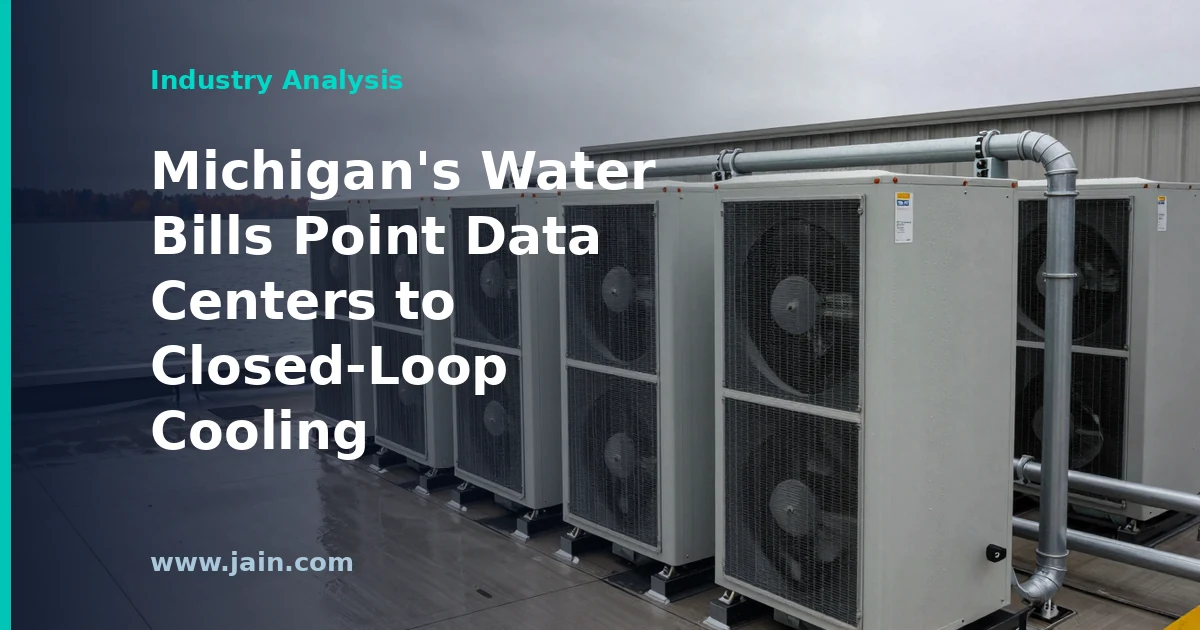
    Michigan’s 2M-Gallon Water Cap Would Push Data Centers to Closed-Loop Cooling

    TL;DR · 30-second read

    The Short Version

    Michigan lawmakers have proposed a set of rules for data centers, the giant warehouses of computers that run apps, cloud services and artificial intelligence.

    The biggest of these buildings can use up to 5 million gallons of water a day, about seven Olympic swimming pools. One bill would limit the water a site can permanently use up to about three pools’ worth a day. Another would require cooling systems that reuse the same water over and over.

    Developers would also need a signed deal with the local town before they could build or connect to the power grid.

    Michigan Democrats introduced a package of bills in early July 2026 to regulate data centers’ energy use, water use, noise, labor standards and use of nondisclosure agreements, MultiState reported. The centerpiece would require operators to sign legally binding community benefit agreements with local governments before they receive site plan approvals, permits or utility interconnection. An interconnection is the approval to connect a facility to the power grid.

    The package contains competing Senate and House versions on energy and water. Senate Bill 1047 would require 20-year utility contracts and 90% clean energy procurement. House Bill 6135 would create a new large-load rate class with 15-year contracts and no clean energy mandate. On water, Senate Bill 1046 would cap consumptive use at 2 million gallons per day. The House is considering a requirement for closed-loop cooling or municipal water only.

    Executive Summary

    Michigan’s package goes beyond one-off siting fights. It would write conditions on energy, water, labor and local benefits into state law. Most permitting disputes are settled project by project in township meetings. These bills would instead set a statewide floor that every large facility would have to clear. None of the bills has passed, and the Senate and House versions differ in important ways.

    The water provisions matter most for how facilities are designed. Large data centers can use up to 5 million gallons a day. The Senate would cap consumptive use at 2 million gallons, and the House would require closed-loop cooling or municipal water. The two chambers take different routes, but both would steer developers toward cooling that evaporates less water. The community benefit agreement requirement would change the order of development. A signed local deal would come before the grid connection, not after it.

    Michigan is not alone. Six other states have considered community benefit agreement mandates this year. Twelve have weighed closed-loop cooling requirements, and twelve have weighed decommissioning rules. What stands out in Michigan is how many of these ideas arrive together in a single package.

    Two Competing Water Bills, One Direction

    Senate Bill 1046 would create a new state permit for anyone using, or expecting to use, 550,000 gallons of water or more per day. Applicants would have to hold at least three public hearings before they apply. Permit holders would face a cap of 2 million gallons per day of consumptive use. Consumptive use means water that leaves the local supply and is not returned, mostly through evaporation in cooling towers. For comparison, large data centers can use up to 5 million gallons a day. At that scale, a design that depends on evaporating large volumes of water would struggle to fit under the cap.

    The House approach is blunter. New data centers would have to use closed-loop cooling, which recirculates the same water instead of drawing and discharging fresh supply. The only alternative would be to take water solely from a municipal system. The mechanisms differ: the Senate sets a volume limit, while the House mandates a technology or a water source. The engineering result is similar. Developers planning large campuses in Michigan would be pushed toward low-evaporation cooling, whichever version prevails.

    This follows a shift the industry has already started. Operators are actively adopting less water-intensive cooling. The effects spread beyond the building itself. Cooling equipment suppliers would gain a more predictable market. Municipal water utilities could become the default supplier under the House option. Closed-loop and dry cooling generally save water but use more electricity. That puts water policy in direct contact with the energy bills moving alongside it.

    The Local Deal Would Come Before the Grid Connection

    House Bill 6137 and Senate Bill 1050 would reorder the development process. No local site plan approval, no local permit and no Public Service Commission approval of an interconnection could be issued until the local government approves a community benefit plan. For developers, the negotiation with the host community would move onto the critical path, ahead of the utility process that usually sets project timelines.

    The agreements would have to cover at least half of five listed topics, which in practice means three. The topics are local hiring, water use, cost allocation for electrical or water upgrades, community investment funding, and home efficiency improvements. A separate pair of bills, House Bill 6140 and Senate Bill 1049, would bar elected officials and operators from signing nondisclosure agreements about construction when a project receives a tax incentive. Intellectual property could still be redacted. Together, these bills would make the terms of the local negotiation largely public for subsidized projects.

    Two Chambers, Two Ways to Price Power

    The energy bills share one principle: data centers should pay for their own power, so that other ratepayers do not absorb the cost. Senate Bill 1047 would set firm terms. Contracts would run at least 20 years, customers would be billed for at least 90% of their contracted demand whether they use it or not, and applications would cost $100,000. That billing floor is aimed at the risk of a utility building for a large load that never fully arrives. The Senate bill would also require operators to procure clean energy equal to 90% of their annual usage and to join a demand response program, which pays or credits large users for cutting consumption when the grid is strained.

    House Bill 6135 would create a large-load commercial rate class with contracts of at least 15 years. Its financial terms are less strict, and it has no clean energy requirement. On the House side, House Bill 6142 would require every Public Service Commission-approved data center contract to include a decommissioning plan. The plan would need financial assurance, meaning money set aside, sufficient to cover dismantling the facility, and it would be reviewed every three years. Developers comparing states would treat the choice between these two frameworks as a real cost difference, not a technicality.

    Labor Standards, and No Moratorium

    House Bill 6141 and Senate Bill 1048 would bar the Public Service Commission from approving data center contracts unless construction and maintenance work is done under a labor agreement or collective bargaining agreement. The International Brotherhood of Electrical Workers has urged members to oppose moratorium legislation. The union argues that data centers bring well-paid construction jobs and long-term union employment. That position helps explain the package’s shape: it regulates how data centers are built, not whether they can be built.

    The package contains no moratorium and no tax incentive changes. Those questions are being handled in separate Michigan bills. They include proposals to repeal incentives, to exclude data centers from certain property tax exemptions, and to extend a brownfield-zone exemption. The package’s premise is that data centers will keep coming to Michigan and the state should set the terms, which is a middle position between welcoming them unconditionally and blocking them.

    Background

    Data centers house the servers behind cloud computing, streaming and artificial intelligence. The largest require power on the scale of a small city, and some draw millions of gallons of water a day for cooling. As construction has spread into new regions, state legislatures have moved from offering incentives to setting conditions. States considered hundreds of data center bills last year. This year, six states other than Michigan have weighed community benefit agreement mandates, twelve have weighed closed-loop cooling requirements, and twelve have considered decommissioning rules.

    Michigan’s legislature has been active on the issue throughout 2026. Separate bills address data center tax incentives: some would repeal them, one would narrow property tax exemptions, and others would extend a brownfield-zone exemption. The July package is the state’s broadest attempt yet to set operating conditions for the industry. At the federal level, a proposal from Representative Robert Bresnahan would tie federal data center tax credits to community benefit agreements.

    Sources

    Source: Michigan Data Center Legislation Targets Energy Use and Community Benefits (MultiState), an overview of Michigan’s proposed data center bills on energy, water, community benefits, noise, nondisclosure agreements and labor standards.

  • Blackstone Financing for Saline Township Data Center: Who Bears the Power Risk

    Blackstone Financing for Saline Township Data Center: Who Bears the Power Risk

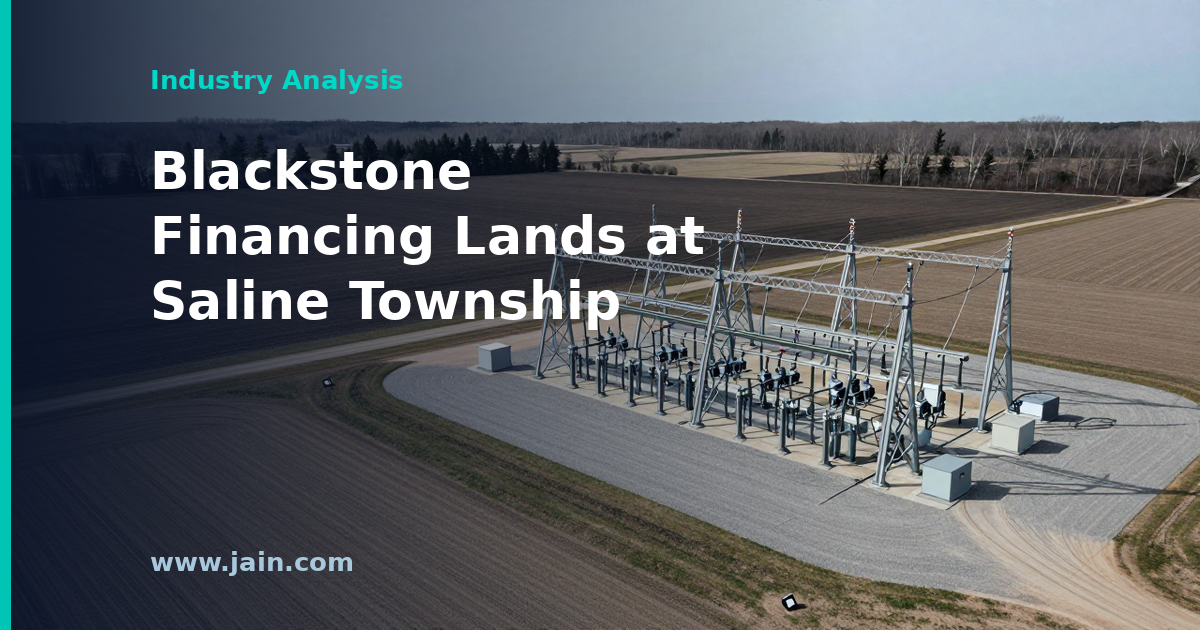
    MLive reported on April 25, 2026 that the large data center campus planned for Saline Township, in Washtenaw County, Michigan, has secured financing through Blackstone, the world’s largest alternative-asset manager and a major private-credit lender. Saline Township is a rural farming community roughly south of Ann Arbor, and the site has been the subject of local debate since the project was first proposed.

    The report is headline-level. The coverage available to us does not state the size of the facility, the amount or structure of the financing, the identity of the anchor tenant, or the construction schedule. What is established is the fact of a financing commitment from a private-capital provider rather than from a bank syndicate or a utility-led arrangement.

    Executive Summary

    A financing close is the moment a data center stops being a land-use argument and becomes a construction project. Site control, zoning approvals and power studies can all exist without a single dollar of committed capital; a lender writing a check is the first hard signal that a third party with money at risk believes the project will generate cash. That is why this particular disclosure matters more than its length suggests.

    The identity of the lender matters as much as the event. Blackstone has become one of the largest financiers of digital infrastructure through its credit and real-assets platforms, and its involvement places Saline Township inside a broader shift: the capital funding America’s AI-era compute buildout is increasingly private credit — money lent directly by asset managers — rather than utility balance sheets, investment-grade bonds, or traditional construction lending. Private credit moves faster, tolerates more complexity, and prices that flexibility into the interest rate.

    The consequence is a redistribution of risk. When a regulated utility builds generation and transmission for a large customer, cost overruns and demand shortfalls can end up in rate cases, where regulators decide how much lands on other ratepayers. When a private lender funds a merchant campus, the first loss sits with the sponsor’s equity and the lender’s loan. Which of those two models Saline Township follows is the single most consequential question the reporting does not yet answer.

    Why a Private-Credit Lender, Not a Utility, Is the Story

    For most of the last century, the entity that financed heavy electrical load in a place like Washtenaw County was the local utility. It raised capital, built the wires and the plants, and recovered the cost from customers over decades under a regulator’s supervision. The model was slow, but it was durable, and it socialized risk across a large base of ratepayers who had little say in the matter.

    Data centers built for artificial-intelligence workloads do not fit that rhythm. The demand signal arrives in months, not decades, and it is concentrated in a handful of hyperscale buyers whose plans can change. Private credit — non-bank lending in which asset managers lend directly from their own funds — has filled the gap because it can underwrite an idiosyncratic asset quickly, structure around construction milestones, and accept collateral that a bank credit committee would struggle with. The borrower pays for that speed in spread.

    The trade is real in both directions. A sponsor who takes private credit gets certainty of execution and avoids the political timeline of a rate case. It also accepts covenants, tighter reporting, and a lender that can enforce quickly if lease-up or delivery slips. Reading Blackstone’s involvement as validation of the Saline Township site is reasonable; reading it as a guarantee of completion is not, because financing commitments are typically conditioned on milestones that have not been disclosed here.

    The Capital Structure Decides Who Eats the Power Risk

    Whether a campus of this scale is financially safe depends less on the headline amount than on what sits behind it. Two structures dominate the sector. In the first, the developer signs long-term leases with a creditworthy tenant before drawing debt; the lender is effectively underwriting the tenant’s credit, and power costs are passed through under the lease. In the second — a merchant or speculative build — the developer takes capacity risk, betting that demand will appear at attractive rates. The interest cost of the two differs sharply, and so does the consequence of being wrong.

    Power is where those structures are tested. A large campus needs a firm interconnection, a tariff that sets what it pays per megawatt-hour, and often a commitment to pay for a minimum volume whether or not the servers are drawing it. That last provision — a take-or-pay or minimum-demand charge — is the mechanism by which regulators try to ensure that a large customer, not the general ratepayer base, funds the network upgrades built on its behalf. Whether such terms exist here, and how strict they are, is not in the reporting.

    The winners in the current arrangement are relatively easy to identify: landowners who sell into a rising market, contractors and electrical trades, lenders earning wide spreads on secured assets, and local governments that collect property tax on very expensive equipment. The exposed parties are harder to see in advance. They include equity holders if AI compute demand normalizes before the campus is leased, and residential ratepayers if grid investment is later judged to have been undersubscribed by its intended customer. Neither outcome is predictable from a financing headline, which is exactly why the terms matter.

    Michigan’s Calculation: Tax Base Now, Load Growth Later

    Michigan has actively courted data center investment as part of a broader effort to attract capital-intensive industry, and southeast Michigan offers a genuine set of advantages: cool climate for much of the year, abundant fresh water in the Great Lakes basin, existing transmission built for a manufacturing economy that has shrunk, and proximity to engineering talent around Ann Arbor and Detroit. Those are structural, not promotional.

    The fiscal case for a rural township is also real but narrow. A hyperscale campus generates substantial property tax relative to farmland and comparatively few permanent jobs — typically technicians, security and facilities staff, against a much larger but temporary construction workforce. Communities that evaluate these projects as employment engines are usually disappointed; those that evaluate them as tax-base plays are usually not, provided the assessment holds and abatements are modest. The distinction is worth making plainly because it is where local expectations most often go wrong.

    The longer-term question for Michigan is load. Adding gigawatt-scale demand to a grid changes generation planning, transmission queues and reserve margins for everyone connected to it. That can be managed well — with large-load tariffs, staged energization, and on-site or contracted generation — or managed poorly. The financing announcement tells us capital has arrived. It tells us nothing about which of those paths the electricity side is on.

    A Contested Site, and How to Read Both Sides

    The Saline Township project has drawn organized local opposition, as most large rural data center proposals now do. Residents raise farmland conversion, water use, noise from cooling equipment, traffic during construction, and the durability of tax promises. These are legitimate, checkable questions, and dismissing them as reflexive opposition would be lazy — several of them have been substantiated at other sites, particularly noise complaints near residential parcels.

    The same standard applies to opposition claims. Water consumption varies by an order of magnitude depending on whether a facility uses evaporative cooling or a closed-loop design, so a figure quoted without the cooling architecture attached is not informative. Ratepayer-impact estimates depend entirely on the tariff, which is a public document once filed. And in a national debate where template campaigns circulate between communities, it is fair to ask of any local group — as of any developer — who is speaking, what the specific local evidence is, and whether the numbers cited come from this project’s filings or from someone else’s. Asking is not an accusation, and there is no basis here for speculating about anyone’s funding.

    The most even-handed reading is that both sides are currently arguing about a project whose material terms are not public. The developer has not, in the reporting available, published capacity, water design, or power arrangements; opponents cannot fully assess impact without them. A financing close usually precedes more disclosure, not less, because lenders require documentation that eventually surfaces in permits and utility filings. That is where the argument should be settled.

    Background

    Blackstone is the world’s largest alternative-asset manager, with major platforms in real estate, infrastructure and private credit. It has become one of the most significant financiers of digital infrastructure globally, lending to and owning data center assets as demand from cloud and artificial-intelligence workloads has outpaced what traditional bank and utility financing could supply on the required timeline.

    Saline Township sits in Washtenaw County, southeast Michigan, an agricultural community adjacent to a metropolitan corridor with legacy industrial transmission. Large data center proposals in such places have become a recurring national pattern over the past several years: developers seek land, power and water at rural prices near urban fiber, while residents weigh tax revenue against land use, noise and grid effects. The Saline Township project has been locally contested since it was proposed, and the April 2026 financing report is the point at which the debate moved from land-use approvals toward committed capital.

    Source: Massive data center in Saline Township secures financing through Blackstone — MLive.com. Local reporting that the Saline Township, Michigan data center campus has secured financing through Blackstone; terms were not detailed in the coverage available.