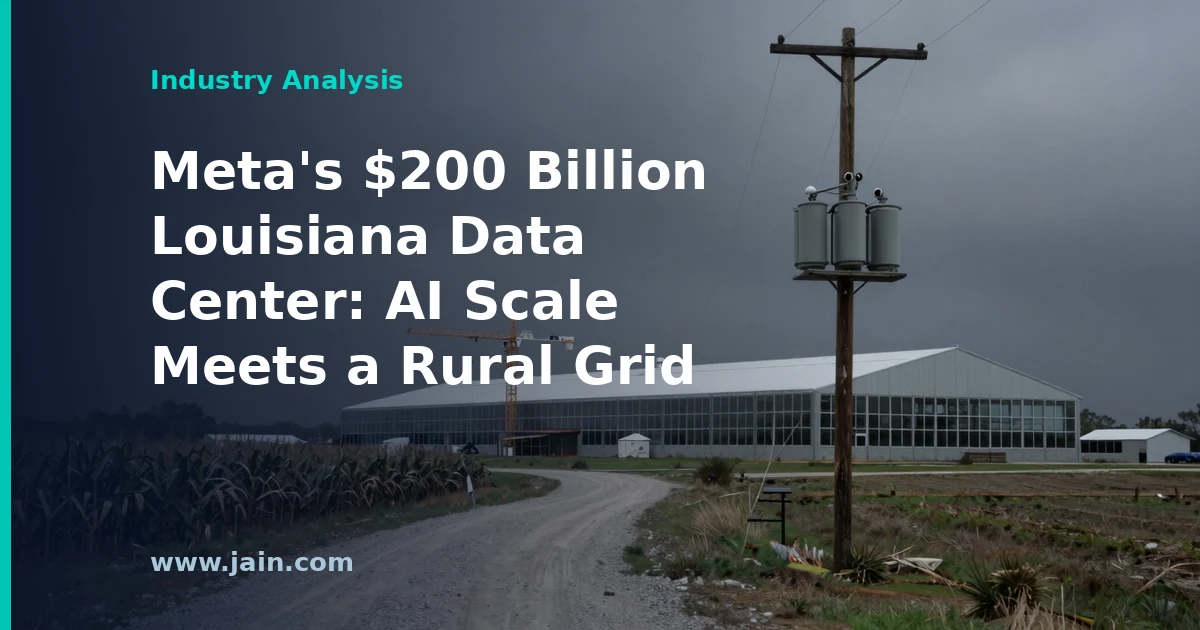
Bloomberg reports that Meta’s data center campus in rural Louisiana — the AI supercomputing site the company calls Hyperion — now represents a commitment on the order of $200 billion, a figure that would make it the largest single data-center investment ever reported. The project, located in Richland Parish in northeast Louisiana, began as a $10 billion announcement in December 2024 and has grown alongside Meta’s escalating artificial-intelligence ambitions.
The May 17 report frames the build as transformative for the surrounding rural region, where a campus designed to scale toward multiple gigawatts of computing power is reshaping the local economy, the electric grid, and the land itself.
Executive Summary
The headline number is staggering even by hyperscale standards. When Meta first announced the Richland Parish project, its roughly $10 billion price tag and four-million-square-foot footprint already made it the company’s largest data center. A $200 billion figure — twenty times the original commitment — reflects how quickly the economics of frontier AI have escalated: the cost of a leading AI campus is no longer set by buildings and land but by the accelerator chips, networking, and power infrastructure packed inside them, refreshed on a fast cycle.
Why it matters: a single company concentrating that much capital at a single rural site is a new phenomenon in American infrastructure. It tests the capacity of a regional utility (Entergy Louisiana is building new gas-fired generation to serve the load), the absorptive capacity of a small rural parish, and the balance sheets of even the world’s most profitable companies. Meta has already turned to outside capital for this site, including a reported joint-venture financing arrangement with Blue Owl Capital — a sign that AI infrastructure at this scale is becoming its own asset class.
The caveat: the source is a single report, and it does not spell out what the $200 billion covers — committed construction capital, cumulative spending including chips over the site’s life, or a long-range projection. Those distinctions matter enormously, and we flag them below.
From $10 Billion to $200 Billion in Eighteen Months
Meta announced the Richland Parish campus in December 2024 as a $10 billion, four-million-square-foot facility — at the time, the largest in its fleet. By mid-2025, CEO Mark Zuckerberg had rebranded the site as Hyperion and described plans to scale it toward five gigawatts of computing capacity, part of a stated intent to spend hundreds of billions of dollars on AI infrastructure. A $200 billion characterization of the site is therefore less a sudden announcement than the visible endpoint of a steady escalation.
The driver is the changed composition of data-center cost. In a conventional facility, the building and electrical plant dominate. In an AI campus, the servers and GPUs (the specialized chips that train and run AI models) can represent the large majority of total investment — and unlike the building, they are replaced every few years. That is how a single site’s lifetime cost can plausibly reach twelve figures, and it is also why headline totals for AI campuses should be read carefully: they often blend one-time construction with years of recurring hardware spending.
What a Gigawatt-Class Campus Asks of a Rural Grid
Richland Parish is farm country in one of the poorer corners of Louisiana. A campus targeting multiple gigawatts — a gigawatt is roughly the output of a large power plant, enough for hundreds of thousands of homes — cannot draw on spare capacity, because rural grids do not carry spare capacity at that scale. Entergy Louisiana’s answer has been new natural-gas generation built substantially to serve this one customer, an arrangement approved by state regulators.
That model raises questions every state hosting hyperscale AI now faces. Who bears the cost if the load does not materialize or the customer leaves early — the company, or ratepayers? What happens to local reliability while multi-year grid upgrades catch up to the load? And how does a build dependent on new gas plants square with Meta’s long-standing renewable-energy commitments? These are not gotcha questions; they are the standard underwriting questions for single-customer generation, and the answers sit in regulatory filings and contract terms that headline coverage rarely reaches.
The Economics of Concentrating $200 Billion at One Site
Even for Meta, which generates tens of billions of dollars in annual free cash flow, this scale of spending strains a corporate balance sheet. The company’s reported use of joint-venture and private-credit financing for Hyperion — bringing in outside investors such as Blue Owl to own and fund data-center assets Meta then uses — signals a broader industry shift: AI infrastructure is being financed like power plants and pipelines, with long-lived structures and external capital, rather than expensed casually from operating profits.
Concentration is the risk that comes with it. A single-site bet of this magnitude assumes AI demand keeps compounding, that the chips installed are not stranded by faster successors, and that power arrives on schedule. The winners if it works: Meta, which gets training capacity rivals must match; Louisiana, which collects taxes and jobs; and the contractors, utilities, and lenders in the build chain. The losers if it doesn’t are harder to name in advance — which is precisely why the financing structures, and who holds which risk, deserve as much attention as the square footage.
Rural Transformation Cuts Both Ways
For Richland Parish, the project brings thousands of construction workers, a permanent operational workforce Meta originally described in the hundreds of jobs, and a tax base transformation few rural counties ever see. It also brings housing pressure, road and water demands, and a local economy newly tethered to one company’s AI strategy — a dependency small communities historically know from mills and plants, with mixed long-term results.
The fair reading is that both the boosters and the skeptics have real evidence. The investment, employment, and utility upgrades are concrete. So are the open questions about what the region retains if AI economics shift. Communities negotiating with hyperscalers elsewhere will study Louisiana’s terms closely — which makes transparency about those terms a matter of more than local interest.
Background
Meta operates one of the world’s largest data-center fleets, built over two decades to serve Facebook, Instagram, and WhatsApp. The generative-AI race changed the shape of that fleet: training frontier AI models requires enormous clusters of GPU chips concentrated at single sites with gigawatt-scale power. In 2025 Meta reorganized its AI efforts around ‘superintelligence’ and announced titan-scale campuses — Hyperion in Louisiana and Prometheus in Ohio — while raising capital spending to historic levels and signaling that hundreds of billions of dollars would follow.
The December 2024 Louisiana announcement landed in Richland Parish, a rural farming area, accompanied by state incentives and an Entergy plan for new gas-fired generation. The project has since become a national reference case for how AI infrastructure interacts with rural grids, utility regulation, and small-town economies.
The Public Service Commission of Wisconsin has approved a power-supply arrangement between Alliant Energy and Meta to serve a planned data center in the utility’s Wisconsin territory, according to Wisconsin Watch reporting published May 6, 2026. Commissioners signed off on the deal but publicly criticized its ‘black box’ approach — a reference to confidential contract terms that keep key details, including those bearing on ordinary ratepayers, out of public view.
Executive Summary
State approval of a utility-hyperscaler power contract is normally a routine milestone. What makes this one notable is the regulators’ own commentary: the commission approved the Alliant-Meta arrangement while simultaneously faulting how much of it is shielded from public scrutiny. That dual message — yes to the deal, no to the process — captures the bind facing utility commissions across the country as AI data centers arrive with unprecedented power demands and equally unprecedented confidentiality requirements.
For the data center industry, the approval clears a regulatory hurdle for one of Wisconsin’s marquee technology projects. For utilities and their customers, the ‘black box’ criticism is the more consequential signal: commissioners are telegraphing that future large-load contracts may face demands for greater transparency, standardized tariff structures, or explicit ratepayer-protection findings before they get a vote.
Approve Now, Object Later: What a Split Verdict Signals
Regulators rarely attach public criticism to a deal they are approving. When they do, it usually means they concluded the underlying project serves the state’s interest — jobs, tax base, grid investment — but want to put the utility and its counterparties on notice for the next filing. The ‘black box’ language, as reported by Wisconsin Watch, suggests commissioners felt they were asked to vote on an arrangement whose economics they could describe to the public only in outline. That is an uncomfortable position for a body whose core mandate is protecting captive ratepayers, the households and small businesses who cannot shop for another electric utility.
The practical takeaway for developers and utilities is that approval-with-a-rebuke is a warning shot, not a victory lap. Commissions in several states have begun moving from one-off confidential contracts toward published large-load tariffs — standardized rate schedules for very big customers — precisely because case-by-case secrecy erodes public confidence. Wisconsin’s commissioners appear to be signaling sympathy with that direction, even as they let this deal proceed.
Who Pays for the Grid AI Needs?
The central economic question in any hyperscale power deal is cost allocation: does the data center pay the full cost of the generation, transmission, and distribution built to serve it, or do some costs land in the general rate base that all customers fund? Special contracts typically include minimum-take commitments, exit fees, and contributions toward infrastructure, but when those terms are confidential, outside parties cannot verify that the protections are adequate. That verification gap — not any specific allegation of subsidy — is what a ‘black box’ complaint is really about.
The stakes are larger than one contract. A single hyperscale campus can draw hundreds of megawatts, comparable to a small city, and utilities nationwide are proposing major generation and grid buildouts on the strength of data center demand forecasts. If a big customer later scales back, cancels, or negotiates better terms, stranded costs can migrate to everyone else’s bills. Transparent, verifiable contract structures are the primary tool regulators have to prevent that outcome — which is why their absence draws pointed language even from commissioners voting yes.
Wisconsin’s Bid for the AI Buildout
Wisconsin has emerged as a genuine contender in the Midwest data center race. Microsoft is developing a major campus in Mount Pleasant in We Energies territory, and Meta has publicly committed to a large data center project in Alliant Energy’s service area, announced in late 2025. Competitive electricity, available land, water, fiber routes, and an aggressive economic-development posture have put the state on hyperscaler shortlists that once defaulted to Virginia, Ohio, or Iowa.
That competitive dynamic cuts both ways in regulatory proceedings. States courting these projects have an incentive to accommodate confidentiality, since hyperscalers guard site economics closely and can take their capital elsewhere. But the same growth concentrates demand risk on local utilities and their customers. The commission’s approach here — approve the project, criticize the opacity — is an attempt to hold both goals at once, and other state commissions facing similar filings will likely study how Wisconsin manages that balance.
Background
The approval lands amid a national surge in data center electricity demand driven by AI computing, which has made utility commissions unlikely gatekeepers of the technology buildout. Wisconsin’s share of that surge includes Microsoft’s multi-billion-dollar campus in Mount Pleasant and Meta’s late-2025 announcement of a major data center in Alliant Energy’s service territory — the project behind this power deal. Meta, the parent of Facebook and Instagram, operates one of the world’s largest data center fleets and typically negotiates dedicated energy arrangements, often paired with renewable-power procurement, for each new campus.
Special contracts between utilities and very large customers have existed for decades, but the scale of AI-era loads has intensified scrutiny of them. Regulators in several states have questioned whether confidential, negotiated deals adequately insulate ordinary customers from the cost of new generation and grid capacity built for a single tenant — the same tension the Wisconsin commission voiced in this decision.
Meta has confirmed that it will operate a hyperscale data center in east Tulsa, Oklahoma, according to the Tulsa World on 21 April 2026. The confirmation resolves the identity of the operator behind a large industrial computing project in the city’s eastern industrial corridor.
The report establishes the operator and the general location. It does not, in the material available to us, attach a published megawatt figure, capital investment number, employment commitment, construction schedule or incentive package to the project — all of which remain the substantive questions for Tulsa residents, ratepayers and suppliers.
Executive Summary
The news is the confirmation itself. Large data center projects are routinely assembled under placeholder corporate names and non-disclosure agreements while land is optioned, utility service is negotiated and incentives are cleared; the operator’s name is often the last thing to surface. Meta putting its name to an east Tulsa campus turns a speculative local story into a fixed point that utilities, contractors, county assessors and competing site selectors can now plan around.
It matters because “hyperscale” is not a small industrial category. A single modern hyperscale campus can become one of the largest electricity customers in its host utility’s territory, reshaping load forecasts, transmission planning and the economics of new generation for everyone else on the system. Whatever this specific site’s final size, its arrival changes the planning assumptions in northeastern Oklahoma.
It also matters for Oklahoma’s position in the national compute map. The state already hosts one of Google’s long-running campuses at Pryor, roughly an hour from Tulsa. A second major operator in the same region begins to look less like an isolated deal and more like a cluster — with the labor pool, contractor base and transmission attention that clusters attract, and the concentration risks that come with them.
What “Hyperscale” Confirms — and What It Doesn’t
“Hyperscale” describes an operating model, not a unit of measurement. It means a facility built and run at the scale of the largest cloud and platform companies: standardized building templates, tens of thousands of servers, custom networking, and power delivered at transmission voltage rather than the distribution voltage a typical factory takes. It says nothing precise about how many megawatts the site will draw or how many buildings will eventually stand on it.
That distinction matters here because the confirmation carries no published capacity figure. Industry framing around new campuses has drifted toward gigawatt-class language — a gigawatt being roughly the output of a large power plant, or the demand of a mid-sized city — and the largest recent US announcements have been in that range. But an unstated capacity is an unstated capacity. The honest reading on 21 April 2026 is that Meta has confirmed an operator and a location, and that anyone quoting a wattage for east Tulsa is extrapolating from the industry’s recent pattern rather than from the announcement.
The same caution applies in the other direction. Absence of a headline number is not evidence the project is modest; hyperscale campuses are typically phased, with each phase authorized against demand that does not yet exist when ground breaks. The realistic expectation is a site that grows in steps over years, with the final footprint set by demand and by how much power the local grid can actually deliver.
Tulsa’s Grid Math: PSO, SPP and the Wind Belt
Tulsa is served by Public Service Company of Oklahoma, an American Electric Power subsidiary, inside the Southwest Power Pool — the regional grid operator covering much of the central plains. That footprint has two relevant characteristics. It has abundant wind generation, which has historically made Oklahoma power cheap and carbon-light on an annual-average basis, and it has the classic wind-region problem that supply peaks when the wind blows rather than when a data center is drawing its steady, around-the-clock load.
Hyperscale load is close to flat: high utilization, day and night, largely indifferent to weather. Marrying that profile to a wind-heavy system means firm capacity, storage, transmission upgrades, or some combination — and the question of who pays for them is the central regulatory issue in nearly every large-load interconnection in the country right now. Utilities increasingly seek special large-load tariffs with minimum take obligations and exit fees, precisely so that if a campus is cancelled or shrinks, the infrastructure built for it does not land on residential bills.
Nothing in the confirmation tells us which structure applies here. That is the thing worth watching: the utility filings and any state regulatory dockets will disclose more about the real terms of this project than any ribbon-cutting will. If the arrangement is well designed, a very large customer paying full freight for its own upgrades can spread fixed system costs across more kilowatt-hours and mildly benefit other ratepayers. If it is poorly designed, the transfer runs the other way. Both outcomes are common enough that the question is not rhetorical.
Water, Land and the Terms of the Bargain
Water is the second recurring flashpoint, and it turns almost entirely on cooling design. Evaporative cooling is efficient with electricity but consumes water continuously; closed-loop and air-cooled designs consume far less water while drawing more power for the same heat rejection. Operators have moved toward lower-water designs in dry regions, and several publish water-use figures, but a design choice for east Tulsa has not been stated. Tulsa’s municipal supply comes from northeastern Oklahoma reservoirs and is not the constrained desert supply that has made this a crisis issue elsewhere — which lowers the temperature of the question without settling it.
On the fiscal side, Oklahoma has long used sales-tax exemptions on qualifying computing equipment and local property-tax abatements to compete for capital-intensive facilities. These tools work as intended: they lower the effective cost of the single most expensive input in a data center, the servers and electrical plant. They also produce the familiar asymmetry that makes such deals contentious. Construction employment is large and temporary — often well over a thousand trades workers at peak on a big campus — while permanent operations staffing at even very large sites is measured in the low hundreds. The durable local benefit is usually the property tax base after abatements expire, plus utility revenue and construction spending, not headcount.
That is an argument to be had on specifics, and the specifics have not been published. A fair assessment of this deal requires the abatement schedule, the assessed valuation assumptions, any clawback provisions, and the wage and hiring commitments. Until those are on the table, both boosterish jobs claims and blanket assertions that the community gets nothing are running ahead of the evidence.
A Second Oklahoma Cluster, and Who Gains From It
The clearest beneficiaries are regional and immediate: electrical and mechanical contractors, civil and earthworks firms, switchgear and transformer suppliers, fiber builders, and the trades unions and training pipelines that staff them. Data center construction is unusually equipment-heavy and schedule-driven, which tends to pull skilled labor from a wide radius and bid up local rates for the duration. Tulsa’s existing industrial and aerospace workforce is a reasonable base for that.
The second-order winner is Oklahoma’s site-selection story. Google’s long presence at Pryor gave the state a reference customer; a Meta campus near Tulsa gives it two independent validations, which is what site selectors for the next tenant actually look for. Clusters compound — transmission gets built, permitting staff get experienced, suppliers open local branches. The corresponding risk is concentration: a region that leans on a handful of very large loads inherits their capital cycles, and the AI build-out that is driving current demand is not guaranteed to hold its present pace.
The parties with the most at stake and the least information right now are residential and commercial ratepayers, and the neighborhoods nearest the site. Their exposure runs through utility tariffs, transmission cost allocation, construction traffic and noise, and the local tax base. Those are all decided in public proceedings — utility commission filings, county assessor records, municipal permits — and that is where scrutiny is best directed, by supporters and critics alike.
Background
Meta operates a global fleet of company-built data centers supporting its social platforms and, increasingly, large-scale AI training and inference. Like other hyperscalers, it typically develops campuses in phases on large rural or industrial parcels chosen for power availability, land, fiber routes and tax treatment, and it has expanded that program substantially through the current AI infrastructure cycle.
Oklahoma has competed for these projects on cheap land, a wind-heavy generation mix within the Southwest Power Pool, and long-standing tax exemptions for computing equipment. Google’s Pryor campus in the MidAmerica Industrial Park has been the state’s anchor example for over a decade. Tulsa itself brings an industrial and aerospace workforce and a metro-scale utility system, which is what distinguishes it from the small rural sites that have hosted most recent hyperscale announcements in the region.