Tag: mergers and acquisitions

  • Flex Bets $4.4B That Power Conversion Is AI’s Bottleneck

    Flex Bets $4.4B That Power Conversion Is AI’s Bottleneck

    TL;DR · 30-second read

    The Short Version

    Flex, a company that builds and assembles products for other big brands, is paying $4.4 billion in cash for EPC Power, a California maker of equipment that converts electricity into the exact form computers can use.

    Why care? The machines that run artificial intelligence swallow enormous amounts of electricity, and the unglamorous boxes that deliver it cleanly have become the hard part to get. Flex is betting the shortage is in the electrical plumbing, not the chips.

    The deal is expected to be completed by the end of 2026.

    Flex Ltd. (NASDAQ: FLEX) has agreed to acquire EPC Power Corp., a Poway, California designer and manufacturer of power conversion systems, for $4.4 billion in cash. The parties signed a Stock Purchase Agreement on September 3, 2026, under which Flex subsidiary ACS Acquisitions, Inc. buys all equity in EPC Power from Charge Parent, LLC, the holding vehicle for controlling shareholders Goldman Sachs Alternatives and Cleanhill Partners. Flex disclosed the agreement in an 8-K filed with the SEC on September 4, and is a party to the contract solely to guarantee its subsidiary’s obligations.

    Flex’s announcement puts EPC Power’s calendar 2026 revenue at approximately $800 million, with roughly 40% organic growth expected in 2027 and EBITDA margin expanding by double-digit percentage points to approximately 30% that year. EPC Power says it has more than 15 GW deployed across 62 countries, and that annual U.S. manufacturing capacity will surpass 30 GW in 2027. The transaction is expected to close in the fourth quarter of 2026, subject to Hart-Scott-Rodino antitrust clearance and other customary conditions, after which EPC Power joins Flex’s Cloud and Power Infrastructure segment.

    Executive Summary

    This is a contract manufacturer paying a technology-company price. Flex has built its business designing and building hardware for other brands; EPC Power builds the equipment that sits between the grid and the server rack — rectifiers, DC-DC converters and grid-forming inverters, with solid-state transformers described in Flex’s announcement as planned development. Flex’s stated thesis, in CEO Revathi Advaithi’s words, is that “a generational shift in power architecture is underway,” and that owning the conversion layer lets Flex sell data center infrastructure as an integrated system rather than as parts.

    The financial architecture matters as much as the strategic one. The 8-K describes a “locked box” structure in which EPC Power’s enterprise value was fixed as of June 30, 2026, with contractual protections against value leakage until closing — a mechanism common in private equity exits that gives the seller price certainty. Flex simultaneously signed a commitment letter with Citigroup Global Markets, Bank of America and BofA Securities for a senior unsecured 364-day bridge facility of up to $4.4 billion, a backstop it expects to replace with a permanent mix of debt and equity.

    The timing is the sharpest detail. Flex states in both the 8-K and its announcement that EPC Power will land inside the Cloud and Power Infrastructure business, which Flex plans to separate into an independent public company in the first calendar quarter of 2027 — weeks after the acquisition is expected to close. Flex is, in effect, buying a $4.4 billion asset and then handing it to shareholders in a new vehicle.

    The Bottleneck Moved Downstream of the Chip

    For three years the constraint on AI buildouts was accelerators. The constraint discussed in this transaction is different: getting utility power into a building fast, and then converting it into something a rack of GPUs can drink without destabilizing the neighborhood grid. AI training and inference clusters draw power in large, fast swings — thousands of processors ramping together — which is closer to an industrial arc furnace than to the steady hum of a traditional colocation hall. EPC Power’s marketing centers on exactly this problem, and Flex is paying for the claim that solving it is a durable business rather than a moment.

    The technical hook is the shift toward 800-volt DC distribution inside the data center. Conventional facilities step voltage down repeatedly and convert between alternating and direct current several times before power reaches a chip, losing a slice at each stage; higher-voltage DC architectures cut the number of conversions and the copper needed to carry the current. Flex’s announcement says EPC Power’s platform is engineered for these architectures with capabilities across rectifiers and DC-DC conversion. The grid-forming piece is complementary: most inverters follow the grid, matching a frequency someone else sets, while grid-forming units can establish voltage and frequency themselves, which is what lets a site run on batteries through a disturbance or energize before the utility interconnection is fully mature.

    What $4.4 Billion Buys, Priced Against Flex’s Own Forecast

    Work the disclosed numbers and the price becomes legible. Against approximately $800 million of calendar 2026 revenue, $4.4 billion is roughly 5.5 times sales. Apply the stated 40% organic growth and 2027 revenue lands near $1.1 billion; at the stated approximately 30% EBITDA margin, that implies something in the neighborhood of $330 million of 2027 EBITDA, or about 13 times forward earnings before interest, taxes, depreciation and amortization. Those multiples are derived arithmetic from Flex’s own projections, not company-stated figures, and they hold only if both projections land.

    The margin guidance contains its own admission. If EBITDA margin expands by “double-digit percentage points” to reach approximately 30%, the 2026 margin is by definition 20% or below. Flex is paying today for a profitability structure that does not yet exist, on the expectation that mix shift toward data center product and scale in U.S. manufacturing delivers it. That is a defensible bet in a supply-constrained market — pricing power tends to follow scarcity — but it is a bet, and it is the single assumption most worth revisiting when the combined business reports actual results.

    Buying an Asset You Plan to Give Away

    Flex has told investors it will separate its Cloud and Power Infrastructure portfolio into an independent public company in the first quarter of 2027. EPC Power is being bought into that segment in the fourth quarter of 2026. The sequencing is deliberate: it makes the entity that goes public materially larger, faster-growing and more differentiated than it would otherwise be, and it moves the story of that company from “builds infrastructure hardware to order” toward “owns the power conversion layer.”

    It also raises a capital-structure question that the filings flag rather than answer. Flex says it is evaluating financing alternatives and expects a combination of debt and equity, with committed financing from Citi and Bank of America standing behind it. Which balance sheet ultimately carries that debt — Flex’s or the new company’s — shapes both entities. Flex’s own forward-looking statement language lists the ability to achieve anticipated capital structures, credit ratings and financing in connection with the spin-off among its risks, which is an unusually direct acknowledgment that the two transactions are financially entangled. There is also a calendar risk: the purchase agreement’s outside date is December 31, 2026, subject to two automatic three-month extensions, meaning a slow antitrust review could push closing past the intended separation date.

    Domestic Manufacturing as the Second Product

    EPC Power’s pitch is not only technical. Flex describes U.S.-based engineering and manufacturing, and EPC Power’s own announcement says it expanded its domestic manufacturing footprint nearly tenfold under Goldman Sachs Alternatives and Cleanhill Partners, which first invested in 2021. In a market where electrical equipment lead times are a scheduling input and where tariff exposure and procurement rules increasingly favor domestic content, capacity located in the United States is a commercial asset in its own right, distinct from the merits of the hardware.

    For buyers, the practical consequence is consolidation of the supply chain. A hyperscaler or colocation developer that previously bought conversion equipment, cooling and IT integration from separate vendors can, in principle, buy a larger integrated block from one supplier — faster to specify, but a heavier dependency. For other electronics manufacturing services firms, the transaction sets a marker: this asset was priced as differentiated intellectual property, not as assembly capacity, and the pool of independent power conversion specialists available to buy is not deep. For established power-equipment vendors, a well-capitalized new competitor now sits inside a manufacturing organization with a footprint spanning 30 countries.

    Background

    Flex Ltd. is one of the largest electronics manufacturing partners in the world, designing and building products for other brands across a footprint spanning 30 countries. In recent years it has pushed beyond assembly into data center power, cooling and IT infrastructure, organizing that work in a Cloud and Power Infrastructure segment that it has told investors it intends to separate into a standalone public company in the first quarter of 2027. Acquiring a power conversion specialist into that segment shortly before separation changes what the new company will look like on its first day of trading.

    EPC Power was founded in 2010 in California and spent most of its life supplying inverters to the utility-scale battery storage market. Cleanhill Partners invested in 2021 on the thesis that power conversion would become critical as renewables, grid modernization and digital infrastructure converged; Goldman Sachs Alternatives later joined as a controlling shareholder. AI data centers then arrived as a second, larger market for the same core competence, because a building drawing power in large, rapid swings needs the same conversion and grid-stabilization hardware that a battery plant does — which is the convergence Flex is paying for.

    Sources

    Source: EPC Power Announces Sale to Flex for $4.4 Billion — the seller’s September 3, 2026 announcement of its definitive agreement to be acquired by Flex.

    Primary sources: Flex Ltd. Form 8-K filed September 4, 2026, describing the Stock Purchase Agreement, the locked box mechanism, the closing conditions and outside date, and the $4.4 billion bridge facility commitment letter; Exhibit 99.1 — Flex to Acquire EPC Power, Adding Leading Power Conversion Capabilities for AI Data Centers and Grid Applications, containing the revenue, growth and EBITDA margin expectations and the deployed and manufacturing capacity figures; and Exhibit 99.2 — Flex investor materials, setting out the forward-looking statement risks tied to the transaction and the planned spin-off.

  • SoftBank’s $4B DigitalBridge Deal Buys the AI Buildout a Landlord

    SoftBank’s $4B DigitalBridge Deal Buys the AI Buildout a Landlord

    TL;DR · 30-second read

    The Short Version

    • SoftBank, the Japanese investment giant behind some of the largest bets on artificial intelligence, is paying $4 billion for DigitalBridge — a firm that owns and finances the buildings, cables and towers that computers run on.
    • The surprise: the boss of the company being sold is publicly saying this moment feels like the late 1990s, just before the internet stock crash.
    • Why care? The same buildings will host the artificial intelligence tools you use. If the money behind them is nervous, that is worth knowing.

    Crypto Briefing reported that SoftBank Group has struck a deal to acquire DigitalBridge Group (NYSE: DBRG) for $4 billion, and 24/7 Wall St. reported that DigitalBridge’s chief executive — having just agreed to sell the digital-infrastructure firm — is publicly likening current market conditions to a late-1990s moment.

    DigitalBridge is one of the few pure-play investment platforms built entirely around digital infrastructure: the data centers that house computing equipment, the fiber-optic networks that connect them, the cell towers that carry mobile traffic, and the small edge facilities that sit close to end users. A sale at $4 billion would move that platform under the control of a buyer that has already committed enormous sums to artificial-intelligence compute.

    Executive Summary

    The transaction, as reported, is a vertical move rather than a financial one. SoftBank already owns chip designer Arm, has taken positions across the AI model and semiconductor stack, and is a named partner in large-scale AI data center ventures. What it has lacked is a permanent, in-house capability for originating, financing and operating the physical layer — land, power, buildings, fiber routes and tower sites. DigitalBridge is precisely that capability, staffed and running.

    The second element of the story is harder to price. The executive selling the business is, at the same time, drawing a comparison to the late 1990s — the period when telecom and internet capital expenditure ran far ahead of demand, before a severe correction. Sellers are not disinterested commentators, but neither are they usually inclined to talk down the sector they just monetized. That tension is the most interesting thing in the announcement.

    For buyers of capacity, for limited partners in DigitalBridge’s funds, and for competing infrastructure managers, the practical questions are about structure: what transfers, what needs consent, and what SoftBank intends to do with the platform once it controls it. Those questions have not yet been answered publicly.

    What $4 Billion Actually Buys

    There is a meaningful difference between buying assets and buying a platform. An asset is a building with power and tenants; it produces rent. A platform is an origination machine — the relationships with utilities, the land bank, the permitting expertise, the construction teams, the leasing pipeline and, critically, the ability to raise other people’s money against all of it. DigitalBridge is the second kind of business. Its portfolio companies have included large-scale data center operators, fiber networks and tower platforms, but its core product is the capability to assemble and fund such businesses repeatedly.

    For SoftBank, which has committed capital to AI compute at a scale few institutions can match, owning that capability changes the arithmetic. Instead of negotiating with landlords and developers on each project, it can direct an in-house team at the constraint. It also gains something scarcer than capital in this market: people who have already sat through interconnection queues, substation upgrades and multi-year entitlement fights, and know which sites are real and which are brochures.

    The strategic logic, in other words, is stack completion. Chip design, model-layer exposure, and now the physical estate that both depend on. Whether $4 billion is a good price for that depends on terms not yet public — but the intent is legible.

    A Seller’s Bubble Warning, Read Two Ways

    The late-1990s analogy is a specific one, and it deserves to be handled precisely rather than as a headline. In that period, telecom carriers laid fiber far in excess of near-term demand, financed it with cheap debt and equity, and a great many of them did not survive the reckoning. The nuance usually omitted: the fiber itself was not wasted. It was bought cheaply out of bankruptcy and carried the next two decades of internet traffic. The infrastructure was right; the capital structures and the timing were wrong.

    Applied to today, that reading is neither bullish nor bearish so much as a statement about who absorbs the risk. If AI compute demand arrives more slowly than current construction schedules assume, the buildings and power interconnections will still be valuable — but the equity and debt raised at 2025–2026 assumptions may not be. That is a solvency and duration question, not a technology question.

    It is also fair to note what the warning is not. As reported, it is a characterization of market conditions, not a forecast attached to numbers, a demand model or a timeline. A comparison to a prior era is a useful frame for readers; it is not evidence about occupancy, lease terms or capital costs at any specific operator. Readers should weigh it as informed commentary from someone with an unusually good view of infrastructure financing — and also as commentary from a party who has just agreed to sell.

    The Fee Stream Is the Asset — and the Complication

    An investment manager’s value sits substantially in contracted management fees and in the expectation of raising the next fund. Those fees rest on relationships with limited partners — the pension funds, sovereign wealth funds and insurers whose money is actually deployed. Fund agreements typically contain change-of-control provisions and key-person clauses precisely so that investors are not silently handed a new owner or a new management team.

    That makes the human and contractual side of this transaction more consequential than in a straightforward asset purchase. If a corporate parent with its own large AI ambitions controls the manager, limited partners will reasonably ask how deal allocation works: when an attractive site emerges, does it go into a third-party fund, or to the parent? Managing that conflict is routine in the industry, but it has to be documented, and investors have to accept the documentation.

    For competitors — the large private-markets firms that have built digital-infrastructure practices of their own — the read-through is competitive rather than existential. A DigitalBridge aligned with a single strategic owner may become a harder counterparty for some clients and a more aggressive bidder for others. Independent managers may find that independence is itself a selling point to limited partners who want no ambiguity about whose interests come first.

    Power, Not Money, Is the Binding Constraint

    The reason infrastructure platforms command premiums right now has less to do with construction and more to do with electricity. A large data center campus needs a grid connection measured in hundreds of megawatts — a megawatt is roughly the continuous power draw of several hundred homes — and utilities in most major markets have multi-year queues for connections of that size. Capital is abundant; energized land is not.

    This is why buying a platform beats buying buildings. Positions in interconnection queues, options on land near transmission capacity, and standing relationships with utilities and regulators are slow to build and cannot be conjured with a cheque. If SoftBank’s intent is to accelerate its own compute buildout, the acquired pipeline may matter more than the acquired earnings.

    It is also where the bubble warning bites hardest. Power constraints delay revenue but not interest expense. A project financed on the assumption of a 2027 energization date and a signed tenant behaves very differently if either slips. Neither company has disclosed the contracted capacity or delivery schedules that would let outsiders judge that exposure.

    Background

    DigitalBridge traces its lineage to Colony Capital, a real estate investment firm that repositioned itself around digital infrastructure and rebranded as DigitalBridge in 2021. It wound down legacy real estate exposure and rebuilt as a specialist manager focused on the physical layer of the internet, with portfolio businesses spanning wholesale and edge data centers, long-haul and metro fiber, and communications towers. It trades on the New York Stock Exchange under the ticker DBRG.

    SoftBank Group is a Japanese holding company founded by Masayoshi Son, known for the Vision Fund and for concentrated, large-scale technology bets. It owns chip designer Arm, whose architectures underpin most mobile devices and a growing share of data center silicon, and has taken significant positions across the artificial-intelligence ecosystem, including participation in large multi-party data center ventures. Its recent acquisitions have leaned toward compute infrastructure rather than consumer internet.

    Sources

    Source: SoftBank acquires DigitalBridge for $4B as CEO warns of dot-com bubble echoes — report on SoftBank’s agreement to acquire digital-infrastructure manager DigitalBridge Group, alongside the seller’s chief executive drawing a late-1990s comparison.

    Related coverage: CEO Who Just Sold His Data Center Firm to SoftBank for $4 Billion Is Warning of a Late 1990s Moment (Yahoo Finance) and the same report (24/7 Wall St.).

  • Nvidia’s $13B Hugging Face Deal Moves It Up the AI Stack

    Nvidia’s $13B Hugging Face Deal Moves It Up the AI Stack

    TL;DR · 30-second read

    The Short Version

    Nvidia, the company that makes the chips nearly all artificial intelligence runs on, is buying Hugging Face for roughly $13 billion. Hugging Face is best described as a public library for artificial intelligence: developers everywhere go there to download, share and reuse free models and data.

    Nvidia says it will keep that library open, including to models built for rival chips. The deal needs government approval and is not expected to be final until sometime in the first half of 2027.

    Why care? The company that sells the engines just bought the shelf the software sits on.

    NVIDIA has entered into a definitive agreement to acquire Hugging Face, Inc., the company disclosed in a Form 8-K filed with the Securities and Exchange Commission on September 3, 2026, reporting an earliest event date of September 2. The filing puts the purchase price at approximately $11.9 billion payable to Hugging Face stockholders, subject to certain adjustments, plus an equity-based retention program of up to approximately $1.0 billion for Hugging Face employees joining NVIDIA — the roughly $13 billion total reported by Bloomberg.

    NVIDIA describes Hugging Face as a platform and community for developing, sharing and deploying open-source models, datasets and applications. The transaction is expected to close in the first half of 2027, subject to customary closing conditions including required regulatory approvals. In the same filing, NVIDIA committed to keeping the platform open — continuing to let model makers, developers and users upload and download models and datasets of their choosing, and to support other silicon vendors.

    Executive Summary

    For most of the AI boom, NVIDIA’s dominance has been described in hardware terms: accelerators, networking, racks, and the software layer — CUDA — that locks developers to them. The Hugging Face acquisition is a different kind of move. It reaches past the compiler and the driver into the distribution layer, the place where an open model is published, discovered, benchmarked and pulled down by the developer who will eventually need somewhere to run it.

    The economic logic is straightforward and NVIDIA states it plainly in the 8-K’s new risk factor: demand for open-source foundation models “promotes the use of our products worldwide.” Every open model that gets fine-tuned and deployed is downstream compute demand. Owning the shelf that model sits on is a cheap way to stay close to the moment a workload is born — cheap, at least, relative to NVIDIA’s own scale. The company reported $96.2 billion of revenue in the quarter ended July 26, 2026, per its August 26 results release, and guided to $108 billion for the following quarter. The entire Hugging Face price is roughly a fortnight of revenue at that run rate.

    The complication is that a neutral commons owned by the largest interested party is no longer obviously neutral. NVIDIA anticipated this and pre-committed in the filing to keeping the platform open and supporting other silicon vendors. That commitment is the most consequential sentence in the document, and its durability — how long it binds, who enforces it, what “support” means in practice — is what regulators, rival chipmakers and the open-model community will spend the next several quarters testing.

    Buying the Shelf, Not Just the Engine

    The AI stack has a chokepoint at every layer. NVIDIA already owns two of them: the accelerator itself and CUDA, the programming toolkit that makes those accelerators worth buying and makes switching expensive. What it has not owned is the layer where the artifacts of AI — trained models and the datasets behind them — are actually distributed. That is the layer Hugging Face occupies, and the 8-K’s own description of it as a “platform and community” is telling. Communities are hard to build and harder to replicate; you can copy a file repository, but you cannot copy the habit of a million developers going to the same place first.

    The strategic value is positional rather than financial. NVIDIA disclosed no revenue, margin or user figures for Hugging Face in the filing, and at roughly $11.9 billion for the equity plus up to $1.0 billion to keep the staff, this is not a deal justified by near-term earnings contribution. It is justified by proximity — being present at the moment a developer chooses a model, and therefore implicitly at the moment they choose the hardware, cloud and runtime to serve it. In a quarter where NVIDIA’s Data Center segment alone produced $89.0 billion, up 117% year over year, a $13 billion option on where the next generation of workloads originates is a rounding error with leverage.

    The Openness Pledge Is the Load-Bearing Wall

    NVIDIA did something unusual in the 8-K: it wrote its behavioural commitments into a securities filing before anyone asked. The company states it has committed to keep Hugging Face’s platform open “consistent with Hugging Face’s existing practices,” to continue permitting uploads and downloads of models and datasets of users’ choosing, and to “support other silicon vendors.” Read that last clause carefully — it means models optimised for AMD, Google’s TPUs, Amazon’s Trainium and the rest remain welcome on a platform their competitor owns.

    What the filing does not do is specify how long the commitment runs, what mechanism enforces it, or what counts as support. Those are exactly the terms that regulators reviewing the deal will want defined, and the reason the pledge appears at all is almost certainly anticipatory: NVIDIA’s last attempted large acquisition, of Arm, collapsed in 2022 under precisely this class of objection — that a dominant supplier acquiring a neutral point in the ecosystem cannot credibly promise to stay neutral. The lesson NVIDIA appears to have taken is to lead with the remedy rather than negotiate it later.

    There is a fair counterargument on the other side, and it deserves stating without cynicism. Hugging Face’s value to NVIDIA depends on it remaining the default destination for the whole field. Degrading support for rival hardware would push model publishers toward alternatives and destroy the asset being bought. Self-interest and the pledge point the same direction — for now. The question is what happens in a future where those interests diverge, and nothing disclosed so far answers it.

    The Regulatory Bet Hidden in the Risk Factor

    The most analytically interesting passage in the filing is not about the deal mechanics at all. NVIDIA added a risk factor headed “Government restrictions may negatively impact our business and the Hugging Face platform,” and it says two things worth pausing on. First, that other parties are “actively lobbying the U.S. Government and other stakeholders worldwide” for measures that would restrict or disadvantage open-source models. Second, that “many of the world’s most popular and successful open-source models originated in China” and are then downloaded and fine-tuned by developers worldwide — and that any restriction on serving models derived from any region, China included, could materially affect both the platform and NVIDIA’s business.

    That is a company telling investors it has just bought an asset whose value is partly hostage to open-model policy, and simultaneously declaring which side of that policy fight it is on. It is also a candid acknowledgement of an uncomfortable dependency: an American chipmaker’s open-model distribution business runs in significant part on weights that originate outside the United States. NVIDIA does not quantify the exposure, and no figures are given for how much platform activity involves models of any particular origin.

    For enterprise buyers, this converts an abstract policy debate into a procurement variable. If your inference stack is built on openly published weights pulled from a public hub, the regulatory treatment of those weights — export rules, provenance requirements, licensing conditions — is now part of your supply chain risk, and one of your suppliers has said so in writing.

    A Software Deal Amid an Extraordinarily Capital-Heavy Buildout

    The acquisition lands in the middle of a spending posture that reframes what $13 billion means. In CFO commentary filed alongside the August 26 results, NVIDIA disclosed that supply commitments rose from $119 billion in the prior quarter to $279 billion, primarily for memory procurement; that it holds land, power and shell guarantees for AI cloud partners’ lease obligations with maximum gross exposure of $3.5 billion; and that in August 2026 it entered guarantees capped at $105 billion to support roughly 4.25 gigawatts at SB Energy’s PORTS-Pike Technology Campus in Ohio, a site that will exclusively host NVIDIA infrastructure under 20-year leases to OpenAI, subject to limited exceptions. A gigawatt is roughly the output of a large nuclear reactor.

    Against those numbers, Hugging Face is inexpensive, and the contrast is the point. NVIDIA is now underwriting the physical constraints of the buildout — land, power, shells, memory supply — while separately buying the software surface where demand originates. The company frames the infrastructure arrangements as helping customers who are “growing faster than their balance sheets and long-term credit profiles can support.” That is an honest description of a market where the chip vendor increasingly finances, guarantees and now curates the demand for its own product.

    For the data center and connectivity industry, the second-order effects matter more than the headline. If open models remain freely distributed and cheap to obtain, inference demand disperses — toward enterprise colocation, regional and sovereign clouds, and edge deployments, rather than concentrating solely in a handful of frontier training campuses. That dispersion is good for operators outside the hyperscale tier. Whoever owns the distribution point has meaningful influence over how fast it happens.

    Background

    NVIDIA has spent the AI cycle converting a graphics-processor business into the default substrate for machine learning, pairing its accelerators with CUDA, the software toolkit that makes them usable and makes leaving costly. Its fiscal 2027 second-quarter results, reported August 26, 2026, showed $96.2 billion in revenue with $89.0 billion from the Data Center segment, alongside disclosures that the company is now underwriting parts of the physical buildout itself — memory supply commitments, multi-decade data center leases, and guarantees on land, power and shell capacity for AI cloud partners.

    Hugging Face grew up in a different part of the stack. As open-weight models proliferated — released publicly rather than served only through an API — the field needed somewhere to publish, version, document and discover them. Hugging Face became that place, the shared repository where researchers, startups and enterprises both contribute and consume. Its position depended on being unaligned: every hardware vendor, cloud and lab used it because none of them owned it. That is the assumption this transaction changes, and the reason NVIDIA wrote an openness commitment into its regulatory filing on day one.

    Sources

    Source: Nvidia Acquires AI Platform Hugging Face for About $13 Billion — Bloomberg’s report of the transaction value.

    Primary sources: NVIDIA Corporation, Form 8-K filed September 3, 2026 (Item 8.01, Hugging Face acquisition and related risk factor); NVIDIA Corporation, Form 8-K filed August 26, 2026 (Q2 fiscal 2027 results); NVIDIA Announces Financial Results for Second Quarter Fiscal 2027 (Exhibit 99.1); CFO Commentary on Second Quarter Fiscal 2027 Results (Exhibit 99.2); NVIDIA Corporation, Form 10-Q for the quarter ended July 26, 2026.

  • Tusker Buys Fortress SRM, Adding 50 Staff and a 24/7 SOC

    Tusker Buys Fortress SRM, Adding 50 Staff and a 24/7 SOC

    TL;DR · 30-second read

    The Short Version

    A Chicago technology company called Tusker has bought Fortress SRM, a Cleveland firm of about 50 people whose job is keeping businesses from being hacked.

    Fortress runs an operation staffed around the clock, every day of the year, where analysts watch customers’ computer networks for intruders and step in when one gets through. Most mid-sized companies cannot afford to staff that themselves, so they rent it from firms like this one.

    It is Tusker’s fifth purchase since 2017, and the company says more are planned.

    Tusker, a Chicago-headquartered technology solutions provider, announced on September 2, 2026 that it has acquired Fortress SRM, a Cleveland cybersecurity firm founded in 2018. According to Tusker’s announcement, the deal adds roughly 50 cybersecurity professionals, a 24/7 Security Operations Center, and a sixth regional hub covering the Ohio Valley. Financial terms were not disclosed.

    Fortress SRM serves customers across Ohio, northern Michigan and Wisconsin, with services spanning security consulting and advisory work, virtual CISO leadership, managed security, incident response and digital forensics. The transaction is Tusker’s fifth acquisition since 2017 and its first since the company consolidated its portfolio businesses under a single brand earlier this year. Tusker says it now has more than 400 employees and hubs in Chicago, Boston, Green Bay, Duluth, Eau Claire and Cleveland, and that further acquisitions are planned.

    Executive Summary

    The headline asset in this deal is not the customer list — it is the round-the-clock watch floor. A Security Operations Center, or SOC, is a team that monitors customer networks continuously for signs of intrusion and coordinates the response when something is found. Building one is a fixed-cost exercise: you need enough trained analysts to staff three shifts, weekends and holidays before you can credibly answer a single alert at 3 a.m. That cost only makes sense when it is spread across many customers, which is precisely why regional security firms that have already paid it are attractive to acquirers who have not.

    Tusker’s position is a common one in the mid-market channel. It has scale in the things that are hard to differentiate — hardware, deployment, help desk, lifecycle management — and comparatively thin capability in the thing customers are currently most anxious about. Buying a 50-person security practice with an operating SOC, a virtual CISO bench and a digital forensics capability is a faster route to that capability than hiring into a labor market where experienced detection-and-response analysts are scarce and expensive.

    For the wider market, the deal is a small but legible data point in an ongoing consolidation: independent regional managed security providers are being absorbed into broader IT services platforms, because mid-market buyers increasingly want detection and response as a subscription rather than a staffing problem. What Tusker’s announcement does not establish is how large or how profitable that practice is, or on what terms it changed hands.

    The Economics of Watching a Network at 3 a.m.

    Continuous security monitoring has an unforgiving cost structure. Coverage that is genuinely 24 hours a day, seven days a week, requires multiple analyst shifts plus slack for holidays, illness and turnover — before any tooling, threat intelligence feeds or escalation playbooks are paid for. A mid-sized manufacturer or hospital system that tried to build this in-house would be hiring a team it can keep busy only intermittently. The managed model works because that same team’s attention is sold in slices to dozens of organizations at once, and because attacks against one customer generate detection knowledge that protects the rest.

    That arithmetic is what makes an existing SOC a genuine asset rather than a line item. Fortress SRM’s described capability set — consulting and advisory, virtual CISO leadership, managed security, incident response and digital forensics, and the SOC itself — maps onto a full customer lifecycle: assess, advise, monitor, and respond when monitoring finds something. A firm that can only do the assessment half sells projects; a firm that can do the monitoring half sells contracts. Recurring revenue is the reason security practices command attention from acquirers, though Tusker has not said what portion of the acquired business is recurring.

    The Cross-Sell Case Cuts Both Ways

    Jess Walpole, president of Fortress SRM, framed the deal around customer convenience: security clients who also want help with desktops, servers, networks and modernization now get it from one partner. That is a real benefit, and it reflects a genuine mid-market preference for fewer vendors. But the more consequential flow probably runs the other direction. Tusker reports more than 400 employees and clients across the country; selling managed detection and response into an installed base that already trusts the provider with its infrastructure is a cheaper path to growth than winning security deals cold.

    Consolidation of this kind does raise a question buyers should ask openly, and it is a question about structure rather than about either company’s intentions. When the same organization advises on security strategy, supplies the hardware and manages the environment, the advisory function loses some of its natural independence. Virtual CISO services — essentially a fractional security executive rented by organizations too small to employ one — are valuable precisely because they are supposed to represent the customer’s interests. Providers that combine advisory with product and managed services can manage that tension well, through separate reporting lines, transparent product economics or a willingness to recommend third-party tooling, but customers should ask how it is being handled rather than assume.

    A Great Lakes Roll-Up Reaches the Ohio Valley

    Look at Tusker’s hub map — Chicago, Boston, Green Bay, Duluth, Eau Claire and now Cleveland — and the strategy reads clearly. With one East Coast exception, this is a Great Lakes and Upper Midwest platform assembled around mid-sized regional markets rather than the coastal metros where national systems integrators concentrate. Those markets have plenty of manufacturers, healthcare providers, municipalities and school districts that face the same regulatory and insurance pressure on cybersecurity as larger firms, with none of the in-house staff. Cleveland extends that footprint into the Ohio Valley and, per the announcement, into a service territory already covering Ohio, northern Michigan and Wisconsin.

    The risk in any roll-up is that the acquired capability degrades in transit. Tusker’s stated asset here is people: roughly 50 specialists whose value is entirely portable if they choose to leave. Integration also has to reconcile monitoring platforms, ticketing systems, escalation procedures and service-level commitments across organizations that built them independently — work that is invisible to customers when it goes right and very visible when it does not. Tusker has done this four times before and completed a brand unification earlier this year, which is evidence of a repeatable process rather than proof of a smooth outcome. The company also says more acquisitions are planned, which means integration capacity, not deal flow, is likely to be the binding constraint.

    Background

    Tusker began as a Chicago IT hardware distributor and has since assembled a broader technology services platform through acquisition, adding capabilities in advisory, professional services, managed services and lifecycle support. Formerly operating as ACP CreativIT, the company brought five regional firms under the single Tusker brand earlier in 2026 and has been named to the Channel Futures MSP 501 list of top managed service providers for 2026, its second appearance. The Fortress SRM deal is its fifth acquisition since 2017.

    The market context is a mid-market squeeze. Organizations of a few hundred to a few thousand employees now face the same ransomware exposure, cyber insurance questionnaires and regulatory expectations as large enterprises, without the budget for a standing security team. That gap created a generation of regional managed security providers — Fortress SRM among them, founded in 2018 — and those firms have in turn become acquisition targets for full-stack IT providers seeking recurring security revenue and capabilities that are slow and costly to build from scratch.

    Source: Tusker Acquires Fortress SRM to Expand Cybersecurity Services — Tusker’s September 2, 2026 announcement of its acquisition of the Cleveland cybersecurity firm, including headcount, service capabilities and regional hub details.

  • Vertiv Buys UtilityInnovation Group for Up to $2.6B: Power, Not Cooling, Is the Constraint

    Vertiv Buys UtilityInnovation Group for Up to $2.6B: Power, Not Cooling, Is the Constraint

    TL;DR · 30-second read

    The Short Version

    Vertiv is best known for keeping data centers cool. It is now spending up to $2.6 billion on a six-year-old North Carolina company that helps computing sites generate and manage their own electricity.

    The reason: getting connected to the electricity grid has become the slowest part of building a facility for artificial intelligence. Waiting years for a utility hookup can cost more than building power on site.

    The deal is expected to be completed by the end of 2026, if regulators clear it.

    Vertiv Holdings Co (NYSE: VRT) announced on September 2, 2026 that its subsidiary Vertiv Corporation has agreed to acquire Utility Innovation Holdings, Inc. — which trades as UtilityInnovation Group, or UIG — a designer of microgrid controls, switchgear and behind-the-meter power architecture for data centers. Under the merger agreement dated September 1 and disclosed in an 8-K filed with the Securities and Exchange Commission, UIG equity holders, including holders of vested options and outstanding warrants, will receive approximately $1.45 billion in upfront cash at closing, subject to customary adjustments, plus up to $1.15 billion in additional cash payable in two tranches if EBITDA targets are met.

    Vertiv’s announcement states the earnout is measured over 12- and 24-month periods and that the upfront price represents roughly 13 times UIG’s expected 2027 EBITDA. The company expects the transaction to be accretive to adjusted earnings per share in the first year after completion and says in the 8-K that it will fund the deal from existing resources. Closing is subject to customary conditions including expiration or termination of the Hart-Scott-Rodino antitrust waiting period, and is expected in the fourth quarter of 2026.

    Executive Summary

    Vertiv sells the power and cooling equipment that keeps data centers running — uninterruptible power supplies, switchgear, liquid cooling, and the service network behind them. The UIG acquisition extends that portfolio in a direction Vertiv has not previously owned: upstream of the building, to the point where a site meets the utility grid, and to the on-site generation and battery storage that increasingly sit alongside it.

    The strategic argument in Vertiv’s announcement is that power availability, not thermal capacity, now sets the pace of AI data center construction. CEO Gio Albertazzi framed it as the time from “site selection to first token” — the moment a facility produces its first unit of AI model output. UIG’s technology is the coordination layer for that problem: proprietary controls software, customized microgrid switchgear and energy storage that can balance load and frequency in real time across on-site sources and utility-connected resources.

    For buyers, the deal signals consolidation of a fragmented layer of the stack — power architecture has historically been assembled from separate engineering firms, switchgear vendors and generation suppliers. For investors, the disclosed multiple of roughly 13 times expected 2027 EBITDA on a business founded in 2020 makes this a growth purchase, with more than 40 percent of the potential headline value deferred into an earnout that pays only if that growth arrives.

    The Bottleneck Moved From the Rack to the Interconnect

    For most of the last decade, the hard engineering problem in a data center was heat. Denser servers meant more watts per rack, and the industry’s capital went into airflow, then into liquid cooling delivered directly to the chip. Vertiv built a large business on that transition. The constraint has now shifted one step further out. A modern AI campus can require more electricity than a mid-sized town, and in many markets the local utility cannot deliver that connection for years — developers join an interconnection queue, the waiting list utilities and grid operators maintain for large new loads, and the queue, not the construction schedule, sets the opening date.

    Vertiv’s announcement names three deployment modes UIG’s technology is meant to serve, and they map neatly onto how operators are working around that queue: grid-connected sites, “bridge-to-grid” deployments where on-site generation carries the load until the utility connection arrives, and fully islanded sites running on their own generation. The common requirement across all three is control — software and switchgear that can balance generation, storage and load in real time, and that can disconnect from or support the grid as conditions demand. That is the capability Vertiv is buying, and it is a genuinely different discipline from selling a cooling distribution unit.

    The framing also explains why the announcement stresses that decisions are “moving earlier in the planning process.” Whoever is in the room when a developer chooses a power architecture influences a long tail of downstream equipment specifications. Vertiv is paying for a seat at that earlier meeting.

    What 13x Buys, and What the Earnout Actually Says

    The disclosed valuation is unusually informative. Vertiv states that approximately $1.45 billion represents about 13 times UIG’s expected 2027 EBITDA — earnings before interest, taxes, depreciation and amortization, a rough proxy for operating cash generation. That arithmetic implies expected 2027 EBITDA in the region of $110 million for a company founded in 2020. Vertiv has not published UIG’s revenue, backlog or margin profile, so the implied figure is the only quantitative anchor on the target’s scale that the disclosure provides.

    The earnout is the more revealing structure. Up to $1.15 billion in additional cash is payable in two tranches against EBITDA targets over 12- and 24-month periods, and Vertiv says the effective multiple would be “significantly lower” if the full earnout is paid. That statement only holds if the earned EBITDA is materially higher than the base — for a $2.6 billion total to price at a meaningfully lower multiple than 13x, the acquired business would need EBITDA well above $200 million, more than double the level implied by the upfront price. Vertiv has not spelled that out, but it follows from the two figures it did disclose.

    Structurally, this is risk allocation working as intended: Vertiv pays a defensible price for the business as it stands and pays a premium only against results that arrive. It also concentrates the seller’s incentives into a 24-month window, which is a familiar tension in founder-led acquisitions — the metric that maximizes a two-year earnout is not always the investment that maximizes value in year five. Vertiv’s statement that it will fund the purchase from existing resources, and its declaration of a $0.0625 quarterly dividend in a separate 8-K the same day, together indicate the company does not view the upfront cash as balance-sheet-straining.

    Buying the Conductor, Not the Instrument

    The most deliberate choice in this deal is what Vertiv did not buy. It has not acquired a turbine manufacturer, an engine maker or a fuel cell developer. It bought controls software, microgrid switchgear and storage orchestration, and both executives quoted in the announcement went out of their way to stress technology-agnostic architecture — Albertazzi’s phrasing was “without tying customers to a single generation technology or supplier,” and UIG founder and CEO Sidney Hinton described flexible, technology-agnostic architectures as the company’s founding premise.

    That positions Vertiv as the integration layer above a generation market whose winning technology is genuinely unsettled, with gas turbines, reciprocating engines, fuel cells and large battery installations all competing for the same on-site role. Selling the conductor rather than the instrument avoids betting on the outcome, and it preserves Vertiv’s ability to sell into projects where the generation vendor has already been chosen by someone else. It also puts Vertiv into more direct contact with electrical-infrastructure incumbents and with the engineering firms that have historically owned power architecture as a services engagement rather than a product.

    The competitive question this raises for the wider market is whether power architecture becomes a productized, vendor-integrated layer — the direction Vertiv is clearly betting on — or remains a bespoke engineering exercise per site. If the former, early consolidation of scarce controls expertise is valuable. If the latter, Vertiv has bought a specialist consultancy at a product-company multiple.

    Where the Risks Sit

    Most of the $1.45 billion is a claim on future performance rather than on assets in place. UIG is six years old, with manufacturing in North Carolina and New Jersey and a European base in Dublin; scaling physical switchgear production to serve global hyperscale demand is a manufacturing problem, not only a software one, and neither company has described current capacity or lead times. The transaction also remains conditional: the merger agreement requires expiration or termination of the Hart-Scott-Rodino antitrust waiting period and other customary approvals before the expected fourth-quarter 2026 close.

    The deeper exposure is to the thesis itself. Vertiv is paying a growth multiple for scarcity — specifically, the scarcity of fast grid connections. If interconnection timelines improve through regulatory reform or utility investment, or if AI infrastructure spending decelerates, the premium customers will pay for speed compresses, and with it the earnout Vertiv has agreed to fund. That is a defensible bet on the evidence currently available about grid constraints, but it is a bet on a constraint persisting, which is a different thing from a bet on demand persisting.

    Investors should also note what the filing itself cautions: the representations and warranties in the merger agreement were negotiated to allocate risk between the parties, not to establish facts, and Vertiv explicitly says they should not be read as disclosures about either business.

    Background

    Vertiv Holdings Co (NYSE: VRT), headquartered in Westerville, Ohio and formerly the Emerson Network Power business, supplies the power, cooling and IT infrastructure that keeps data centers, communication networks and industrial facilities running, together with software, analytics and services, and does business in more than 130 countries. Its growth over recent years has been closely tied to data center construction, and particularly to the shift toward denser, higher-power computing that made advanced thermal management a mainstream requirement rather than a specialty.

    The market context for this deal is the emergence of electricity supply as the gating factor in that construction. Large new computing loads must be approved and connected by utilities and grid operators, a process that can take years in constrained regions, which has pushed developers toward on-site generation, battery storage and microgrid architectures that let a site operate before — or partly independent of — its utility connection. UIG, founded in 2020, sits squarely in that niche, supplying the controls, switchgear and storage orchestration that make such systems balance load and frequency in real time.

    Source: Vertiv drops $1.45B to acquire microgrid specialist UIG as AI data center power demand surges — report on Vertiv’s agreement to acquire UtilityInnovation Group amid rising AI data center power demand.

    Primary sources: Vertiv Holdings Co, Form 8-K filed September 2, 2026 (merger agreement dated September 1, 2026); Exhibit 99.1 — “Vertiv Announces Agreement to Acquire UtilityInnovation Group to Accelerate Time to Power for AI Data Centers”; Vertiv Holdings Co, Form 8-K filed September 2, 2026 (quarterly dividend declaration); Exhibit 99.1 — “Vertiv Declares Quarterly Dividend”.

  • nVent’s $1.75B Maverick Power Deal Targets AI’s Real Bottleneck

    nVent’s $1.75B Maverick Power Deal Targets AI’s Real Bottleneck

    nVent Electric (NYSE: NVT) has agreed to acquire Maverick Power for $1.75 billion, according to a deal roundup published by Benzinga and distributed via Google News. Maverick Power is positioned in the market as a maker of modular, factory-assembled power distribution equipment — the switchgear and enclosures that take utility-scale electricity and split it safely into the feeds a building actually uses.

    The item appeared in a multi-company “Deal Dispatch” column that also noted Carets Corp exploring strategic alternatives, a formal phrase companies use when they open a review that can end in a sale, merger, spin-off or nothing at all. Beyond the buyer, the target and the headline price, the aggregated summary carries no further detail: no closing date, no financing structure, no management commentary and no stated revenue or earnings contribution.

    Executive Summary

    The transaction, as reported, is a straightforward statement of strategic intent. nVent’s core business is electrical connection and protection — enclosures, cable management, thermal management and electrical fastening. Adding a modular power distribution manufacturer moves the company further up the value chain, from housing and protecting electrical equipment toward supplying the switching and distribution gear itself, pre-integrated at a factory rather than assembled on site.

    Why it matters is a question of sequencing. For three years the popular account of the AI buildout has centred on accelerators and high-bandwidth memory. Increasingly, the binding constraint sits earlier and lower in the stack: interconnection queues, transformers, breakers and medium-voltage switchgear. A campus with chips on order and no energised switchgear is not a data center; it is a warehouse. Capital is flowing accordingly, and a $1.75 billion cheque for distribution equipment capacity is a clear expression of that repricing.

    A caution on evidence. The source here is a wire-service roundup, not a full company release, and the aggregated headline renders the price as “$1.75” without a unit; the billion-dollar reading is the one carried in the market framing of the deal. Everything in this article about strategic rationale, synergies and market position is analysis of a thinly documented item, not a summary of disclosed company statements. Readers should treat the price and parties as the reported facts and the rest as interpretation pending nVent’s own filings.

    The Bottleneck Moved Downstream From the Chip

    Every data center is, electrically, a funnel. High-voltage power arrives from the grid, a substation steps it down, medium-voltage switchgear divides and protects the resulting circuits, and transformers and low-voltage gear deliver usable power to racks. Medium voltage — broadly, the range between utility transmission levels and the volts running to equipment — is where a campus is actually carved into feeds. That equipment is heavy, custom-configured, safety-critical and made by a small number of qualified manufacturers.

    AI campuses have made this segment structurally scarce in a way ordinary commercial construction never did. Density is the driver: an AI hall draws far more power per square foot than a traditional enterprise facility, so a given plot of land now demands vastly more switching apparatus. Demand for gear scaled with power draw, while the factories that build it scaled with the slower rhythms of industrial capital expansion. When order books lengthen faster than plants can be added, buying an existing manufacturer is often quicker than building one — which is a reasonable read of the logic behind a deal of this size.

    The honest caveat is that no lead-time or backlog figures accompany this report. The scarcity argument is well established across the electrical equipment sector, but the specific pressure inside Maverick Power’s order book is not disclosed here, and it is the single number that would most affect how the price should be judged.

    Why Factory-Built Beats Site-Built in a Labour-Constrained Market

    The modular element deserves more attention than the price tag. Traditional electrical rooms are built on site: gear is delivered as components, and licensed electricians assemble, wire and commission it in place. Modular power distribution inverts this. Equipment is integrated, wired and tested in a controlled factory, then shipped as a completed unit — often an “e-house” or skid, essentially a prefabricated power room delivered on a truck — and connected on arrival.

    The economics are compelling wherever skilled labour is the constraint rather than capital. Factory environments allow parallel production, repeatable quality control and testing before shipment; site work is sequential, weather-exposed and dependent on trades that are in demand across every construction sector simultaneously. For a hyperscale developer racing to energise capacity, compressing months of on-site electrical work into a delivery and a connection has value that can exceed the equipment premium several times over.

    There is a trade-off buyers should weigh. Modular units are standardised by design, which limits customisation, concentrates dependency on a single supplier’s engineering, and shifts risk toward logistics — a delayed or damaged e-house is a bigger single point of failure than a delayed pallet of breakers. Whether prefabrication genuinely shortens total schedules also depends heavily on utility interconnection, which no manufacturer controls.

    What nVent Gains, and What It Now Has to Prove

    Strategically, the acquisition would broaden nVent from a components-and-enclosures supplier into a provider of larger integrated power blocks. That matters commercially because it changes who nVent sells to and how. Components are typically specified by engineers and bought through distribution; integrated power rooms are sold into capital projects, negotiated with developers and EPC firms — the engineering, procurement and construction contractors that build facilities — with longer cycles, larger orders and closer customer relationships.

    Larger content per project also means larger exposure per project. Component suppliers are diversified across thousands of buildings; integrated-equipment suppliers concentrate revenue in a smaller number of very large customers. If AI capital expenditure moderates, or if a handful of hyperscalers reschedule campuses, that concentration cuts both ways. The premium being paid across the electrical equipment sector implicitly assumes that today’s demand curve holds long enough to earn it back.

    The competitive backdrop is a field of much larger diversified electrical firms — the established switchgear incumbents — alongside specialist modular builders that emerged specifically to serve data center schedules. nVent’s plausible claim is speed and focus rather than scale. Validating it requires evidence not yet in the public record: production capacity, qualification status with major buyers, and whether the acquired plants can be expanded faster than competitors can add their own.

    Reading a Thin Source Carefully

    This story arrives through an aggregated deal column rather than a company announcement, and the difference is worth stating plainly for readers who track infrastructure capital flows. What is reported is the buyer, the target and a price. What is not reported — and therefore not something any analysis should assume — includes consideration mix, expected close, regulatory conditions, retained management, financial contribution and any stated synergy targets.

    None of that implies anything is amiss; roundup formats simply compress. But it does mean the appropriate posture is provisional. The clean test of the thesis advanced here will be nVent’s own disclosure: if the company frames the deal around data center power capacity and order visibility, the scarcity reading is supported. If it frames it around channel breadth or industrial end markets, the AI-bottleneck framing is the market’s interpretation more than the buyer’s.

    Background

    nVent Electric became a standalone public company in 2018 when Pentair separated its electrical business, and it has since grown through acquisitions in enclosures, thermal management and electrical infrastructure. Its products are the unglamorous connective tissue of electrified buildings — the cabinets, mounts, heat-tracing and protection systems that let power reach equipment safely — which places it directly in the path of two structural trends: electrification of industry and transport, and the power-intensive expansion of computing.

    The wider context is a repricing of the electrical supply chain. Data center construction historically consumed a modest share of global electrical equipment output; AI training and inference clusters changed that by raising power density per rack sharply. Manufacturers of transformers, breakers and switchgear moved from a slow-growth industrial category to one facing extended order books and rising valuations, prompting an active period of consolidation as suppliers buy capacity rather than wait to build it.

    Source: Deal Dispatch: Carets Corp Explores Strategic Alternatives, nVent Electric Buys Maverick Power for $1.75 — a Benzinga deal roundup, distributed via Google News, reporting nVent’s agreement to acquire Maverick Power alongside other corporate transactions.

  • Ecolab Closes $4.75B CoolIT Deal for AI Cooling

    Ecolab Closes $4.75B CoolIT Deal for AI Cooling

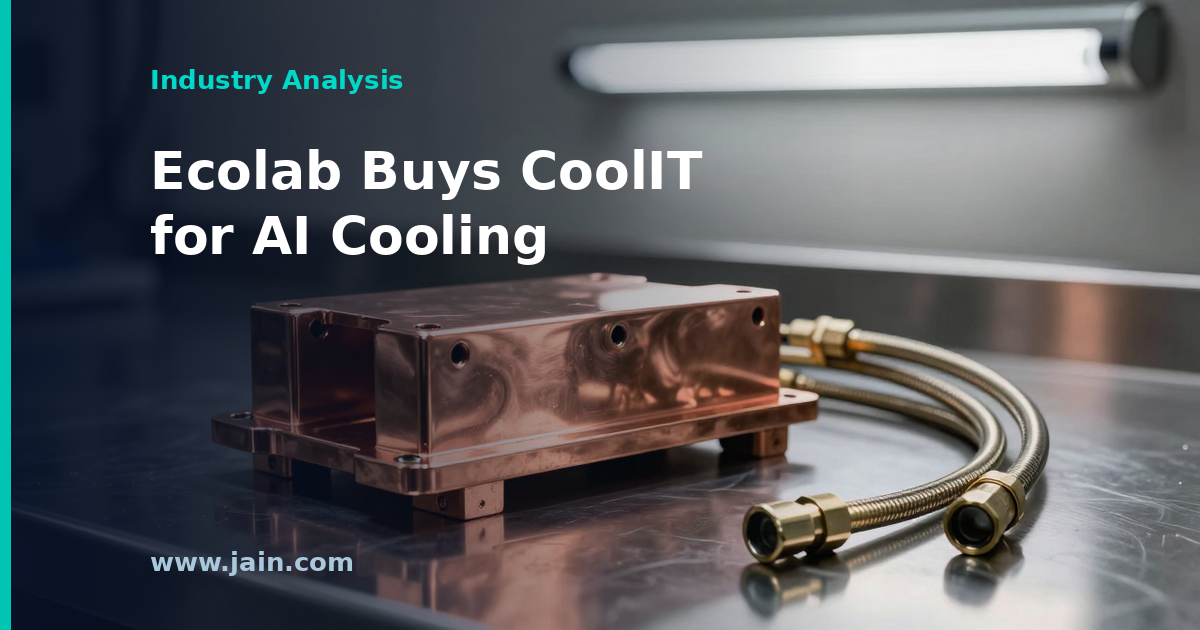
    Ecolab, the Minnesota-based water, hygiene and industrial services company, has closed its $4.75 billion acquisition of CoolIT Systems, a Calgary-based specialist in liquid cooling for high-density computing. The deal, reported by Electronics360 on July 7, 2026, gives Ecolab a foothold in direct-to-chip cooling technology used in AI training clusters.

    Executive Summary

    The acquisition places Ecolab, historically known for cleaning chemicals and water treatment, squarely inside one of the fastest-growing subsegments of data center infrastructure: liquid cooling for AI workloads. CoolIT’s direct-to-chip (DTC) systems circulate coolant across cold plates mounted on processors, removing heat that increasingly cannot be shed with air alone.

    At $4.75 billion, the price signals that Ecolab views AI-driven thermal management as a durable industrial category rather than a cyclical bet. It also consolidates a market that, until recently, was populated largely by specialist engineering firms. For buyers of AI infrastructure, the transaction raises questions about supplier concentration; for competitors, it raises the bar for the scale of balance sheet needed to serve hyperscale customers.

    Why Liquid Cooling, and Why Now

    Modern AI accelerators, such as the GPUs used to train large language models, dissipate hundreds to over a thousand watts per chip. Once rack densities exceed roughly 30-50 kilowatts, forced-air cooling becomes impractical: fans cannot move enough air, and the room-level heat load overwhelms conventional CRAC (computer room air conditioning) units. Direct-to-chip liquid cooling, which CoolIT sells, moves a fluid across a cold plate bolted to each chip and carries heat out of the rack via a coolant distribution unit. It is more efficient than air, but demands new plumbing, materials expertise, and long-term service contracts — precisely the kind of recurring industrial work Ecolab is built to sell.

    The timing reflects a broader shift. Hyperscale operators and colocation providers are retrofitting existing halls and designing new campuses around liquid-ready racks. That transition creates a decade-long tail of installation, chemistry, monitoring and maintenance revenue, which fits Ecolab’s route-based service model more naturally than one-off equipment sales.

    Industrial Services Meets Silicon

    Ecolab’s core competency is delivering water, cleaning and process chemistry to industrial customers at scale, with technicians on site and consumables on subscription. CoolIT’s core competency is engineering cold plates, manifolds and coolant distribution units for demanding compute environments. The strategic thesis is that these are complementary: CoolIT gets access to a global services organization and enterprise procurement relationships; Ecolab gets a defensible product line in a growth market where its existing water-treatment expertise — corrosion, biofouling, fluid chemistry — is directly relevant.

    The risk in that thesis is cultural and technical integration. Data center customers demand tight change control, rapid engineering iteration, and validated compatibility with each new generation of chip. Industrial-services firms historically operate on slower cycles. Whether Ecolab preserves CoolIT’s engineering cadence, or slows it in pursuit of scale efficiencies, will shape the deal’s outcome.

    Market Structure and Competitive Response

    Liquid cooling has been an active acquisition target across the infrastructure industry, with mechanical, electrical and chemical majors all seeking exposure. Ecolab’s $4.75 billion outlay is large enough to reset valuation expectations for remaining independent cooling specialists, and to encourage rival strategics to accelerate their own moves. For hyperscalers standardizing on multi-vendor supply chains, further consolidation could narrow sourcing options and increase reliance on a small number of large suppliers.

    Competitors — including established thermal management vendors and newer entrants building rear-door heat exchangers or immersion systems — now face a rival with a global service footprint they cannot easily replicate. Immersion cooling, which submerges entire servers in dielectric fluid, remains a parallel approach that this deal does not directly address, leaving room for differentiated bets.

    Background

    Ecolab has spent decades building a global route-based industrial services business, selling water treatment, cleaning chemistry and related engineering to manufacturers, hospitals, food processors and utilities. CoolIT Systems, founded in Calgary, grew from PC cooling into an established supplier of liquid cooling hardware for enterprise and high-performance computing, expanding sharply as AI training clusters drove rack power densities beyond the limits of air cooling.

    Liquid cooling itself is not new — mainframes used it decades ago — but the surge in AI-driven demand has turned a niche into a strategic infrastructure category. Direct-to-chip systems are now standard in new hyperscale AI builds, and retrofits of existing data halls are underway across the industry.

    Source: Ecolab closes $4.75B CoolIT acquisition to corner AI data center cooling – Electronics360 reports the closing of Ecolab’s acquisition of liquid cooling specialist CoolIT Systems.

  • Vertiv Buys ThermoKey as AI Cooling Supply Chains Consolidate

    Vertiv Buys ThermoKey as AI Cooling Supply Chains Consolidate

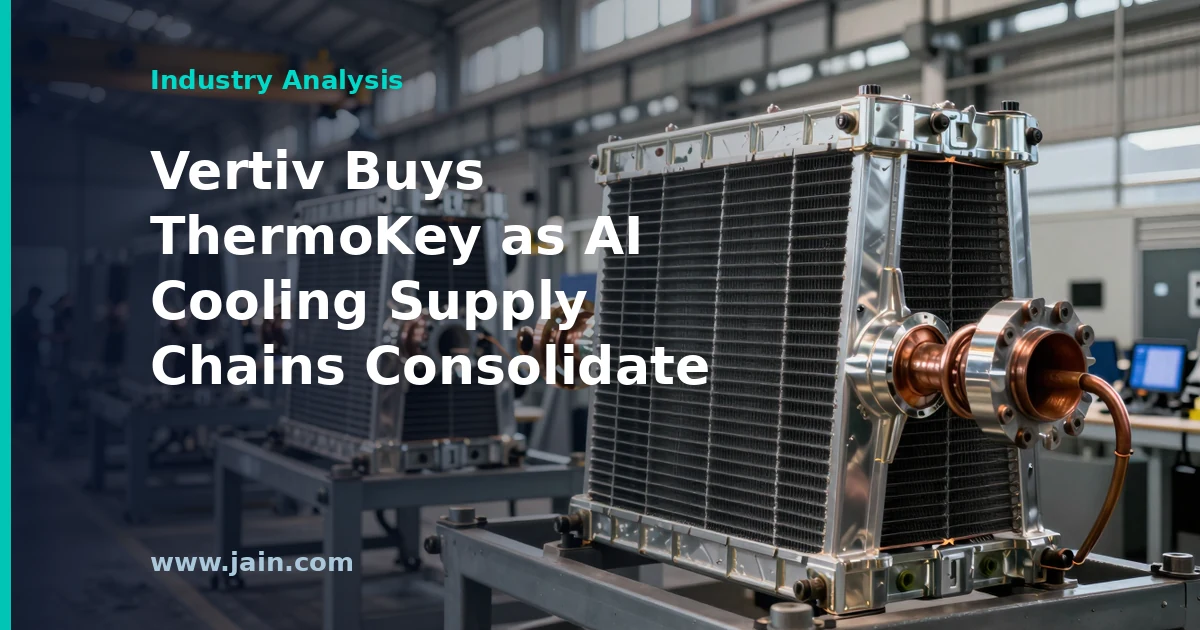
    Vertiv, the NYSE-listed data center power and cooling vendor, announced a deal to acquire ThermoKey, an Italy-based heat-exchanger manufacturer, in a move the company frames as expanding its AI data center cooling capabilities. The announcement was reported on June 14, 2026; Vertiv’s shares slipped on the news. Financial terms were not detailed in the source report.

    Executive Summary

    The acquisition extends a clear pattern: as AI compute densities climb, the large data center infrastructure vendors are buying their way down the thermal supply chain rather than relying on third-party component makers. Heat exchangers — the coils and dry coolers that ultimately move server heat into outside air or water loops — are an unglamorous but capacity-constrained link in every cooling system, whether air-cooled or liquid-cooled.

    For Vertiv, owning that link means more control over lead times, cost, and engineering integration at a moment when hyperscalers and colocation operators are ordering thermal equipment years ahead. The market’s muted reaction — shares slipped on the announcement — is a reminder that investors are weighing acquisition spending and integration risk against the strategic logic, particularly with no publicly detailed deal terms to anchor the math.

    Why Heat Exchangers Matter in the AI Era

    Every watt a GPU consumes becomes heat that must be rejected outdoors. Whatever technology sits at the rack — air handlers, rear-door heat exchangers, or direct-to-chip liquid cooling — the chain ends at heat-rejection hardware: coils, dry coolers, and condensers of the kind ThermoKey manufactures. As rack densities move from tens of kilowatts toward 100 kW and beyond, that heat-rejection stage scales in direct proportion, and it is built from metal, fabrication capacity, and factory floor space that cannot be conjured quickly.

    By acquiring a heat-exchanger maker outright, Vertiv converts a supplier relationship into owned capacity. That matters less in a slack market and enormously in a tight one — and the AI buildout has made thermal equipment a long-lead-time item across the industry.

    Vertical Integration Follows the GPU Buildout

    This deal fits a broader consolidation wave. Vertiv itself has been assembling a fuller thermal stack for years, including its 2023 move on liquid-cooling specialist CoolTera, and competitors across the cooling landscape have pursued similar component-level acquisitions. The strategic logic is consistent: hyperscale customers increasingly want one accountable vendor for an integrated thermal chain, from the cold plate on the chip to the dry cooler on the roof, with matched controls and warranties.

    For independent component makers, that creates a squeeze. Remaining suppliers may find their largest customers are now also their competitors’ owners — which historically pushes further consolidation, as remaining independents either scale up, specialize, or sell.

    Reading the Share-Price Slip

    The headline pairing — an expansion deal and a stock decline on the same day — deserves an even-handed reading. A slip on acquisition news is common and can reflect many things: general market movement, questions about price paid, or wariness about integration workload during a demand boom. Without disclosed terms, none of these can be confirmed from the source material, and a one-day move is a weak signal of a deal’s long-term merit.

    What can be said is that investors are applying more scrutiny to AI-infrastructure spending across the board in 2026, and vendors announcing acquisitions now carry the burden of showing how each deal converts into margin or capacity rather than merely into breadth. Vertiv’s task is to demonstrate that owning heat-exchanger manufacturing shortens its lead times or improves its unit economics in ways customers and shareholders can measure.

    Background

    Vertiv became an independent company in 2016 when private equity firm Platinum Equity carved Emerson Network Power out of Emerson Electric, and it listed on the NYSE in 2020. It has since ridden the data center construction wave as one of the leading suppliers of the power distribution, thermal management, and enclosure systems that sit around the servers themselves, competing with firms such as Schneider Electric and a field of specialist cooling vendors.

    The AI boom that accelerated in 2023 transformed cooling from a mature, slow-growth product line into a strategic battleground. Heat-exchanger manufacturing — historically a fragmented, regional business serving HVAC and industrial refrigeration as well as data centers — has become a supply chain chokepoint, setting the stage for component-level acquisitions like this one.

    Source: Vertiv Expands AI Data Center Cooling With ThermoKey Deal And Shares Slip — Yahoo Finance report, June 14, 2026, on Vertiv’s acquisition of heat-exchanger maker ThermoKey.

  • Reported $67B Dominion–NextEra Deal Puts Data Center Alley’s Power in Play

    Reported $67B Dominion–NextEra Deal Puts Data Center Alley’s Power in Play

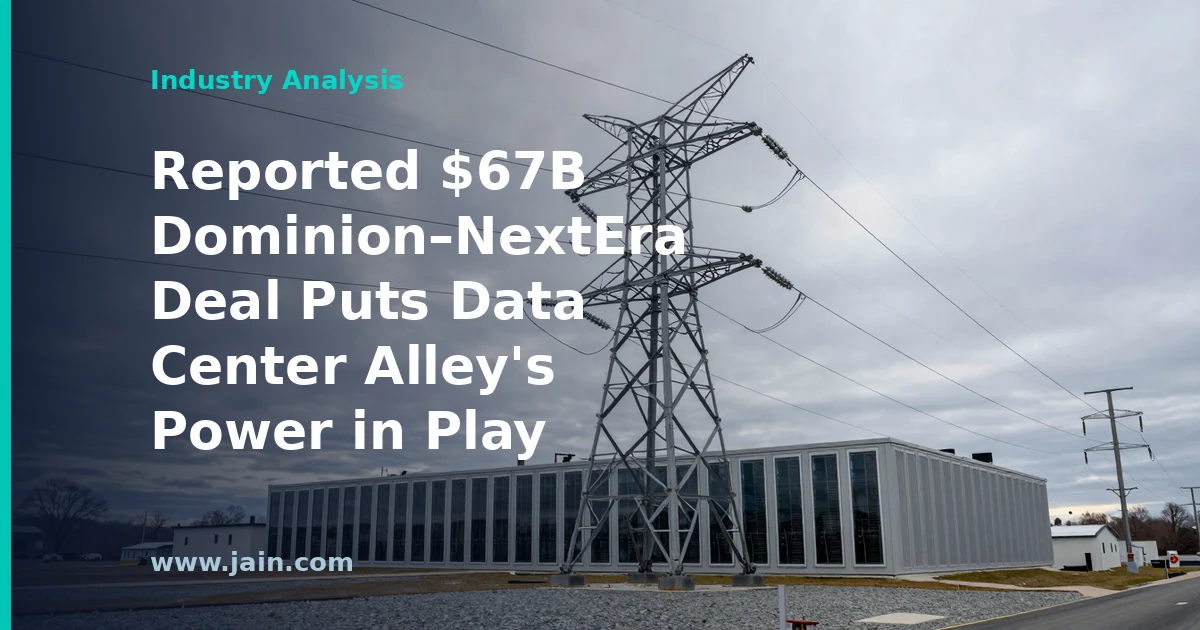
    Technical.ly reported on May 17, 2026 that a $67 billion deal between Dominion Energy and NextEra Energy could reshape Northern Virginia’s data center economy — the largest concentration of data center capacity in the world. At that price, the transaction would rank among the biggest utility deals in U.S. history.

    The report frames the deal around Northern Virginia’s “Data Center Alley,” the Loudoun County–centered corridor whose electricity is supplied largely by Dominion, and whose AI-driven load growth has become the defining challenge for the regional grid.

    Executive Summary

    According to the report, Dominion Energy — the regulated utility serving most of Virginia, including the Northern Virginia data center corridor — and NextEra Energy, the Florida-based utility holding company that is also the largest developer of wind and solar generation in the United States, are parties to a transaction valued at roughly $67 billion. The headline figure alone signals a bet that serving data center load is now the most valuable franchise in the American power sector.

    Why it matters: whoever owns the wires and generation feeding Data Center Alley effectively controls the throttle on the region’s — and arguably the industry’s — AI buildout. Dominion has publicly described a contracted and requested data center pipeline measured in tens of gigawatts, an order of magnitude beyond historical utility growth rates. Pairing that captive demand with NextEra’s generation development machine is the strategic logic the market will read into a combination of this size, whatever the final structure proves to be.

    A caution up front: the source available at publication is a single news headline. The deal’s structure — acquisition, merger, asset purchase, or joint venture — its financing, and its regulatory path are not described in the material we can verify, and we treat them accordingly below.

    Why a Utility Deal Is Really a Data Center Deal

    Northern Virginia is not just another service territory. Loudoun County and its neighbors host tens of millions of square feet of data center space, and Dominion has for years been the region’s essential supplier — its interconnection queue, transmission buildout, and rate design decisions directly set the pace at which hyperscalers and colocation providers can energize new capacity. A $67 billion transaction touching this territory is therefore less a conventional utility consolidation story than a claim on the single most concentrated pool of AI-era electricity demand on the planet.

    For readers outside the power business: regulated utilities like Dominion earn a state-approved return on the infrastructure they build, which means guaranteed-growth demand — like contracted data center load — translates almost mechanically into earnings growth. That is why data center demand has turned sleepy utility stocks into growth assets, and why a buyer or partner would pay a historic premium to be attached to it.

    The NextEra Logic: Generation Meets Load

    NextEra brings the other half of the equation. Through NextEra Energy Resources it has built more wind, solar, and battery capacity than any other U.S. developer, and its regulated arm, Florida Power & Light, is among the country’s largest utilities. The structural problem in Northern Virginia has never been demand — it is that generation and transmission cannot be added fast enough. Marrying the nation’s most aggressive generation developer to the nation’s most demand-rich territory is a coherent industrial thesis, and it tracks the broader pattern of power and compute vertically converging: hyperscalers signing nuclear offtakes, developers co-locating generation with campuses, and utilities racing to finance multi-decade capital plans.

    It also concentrates risk. AI demand forecasts are contested; utilities and grid operators have acknowledged that interconnection queues contain speculative and duplicate requests. A $67 billion valuation built on tens of gigawatts of projected load is exposed if even a fraction of that pipeline evaporates, gets self-supplied behind the meter, or migrates to cheaper-power regions.

    Who Feels This: Ratepayers, Regulators, and Tenants

    Any transaction involving Dominion’s Virginia franchise runs through the State Corporation Commission, and likely federal reviews as well, at a moment when data center cost allocation is already politically charged in Richmond. Virginia regulators have been actively weighing how to keep large-load infrastructure costs from spilling onto residential bills; a mega-deal gives them maximum leverage to extract commitments on rates, reliability, and clean energy timelines as conditions of approval. Expect the approval process, not the announcement, to determine what this deal actually does.

    For data center operators and tenants, the practical questions are concrete: does consolidation speed up interconnection by unifying generation and delivery under deeper-pocketed ownership, or does it reduce competitive pressure and harden pricing power over a customer base with nowhere else to plug in at scale? Both outcomes are plausible, and the answer will likely be written into regulatory conditions rather than the merger agreement.

    The Consolidation Signal

    Step back and the deal — if consummated — marks a phase change: AI power demand is no longer being met by incremental utility capital plans but by restructuring the ownership of the grid itself. Other demand-heavy territories (Georgia, Texas, Ohio, Arizona) and the utilities that serve them become obvious candidates for similar combinations, and every hyperscaler’s site-selection calculus now has to price in who will own their utility in five years. The financing of the AI buildout is migrating from tech balance sheets and project finance into the regulated-utility capital model — with all the ratepayer politics that entails.

    Background

    Northern Virginia became the internet’s landlord over three decades, as early network exchange points around Ashburn attracted carriers, then cloud providers, then AI training campuses. Dominion Energy grew into the indispensable supplier of that boom, and by the mid-2020s was publicly describing data center demand — measured in tens of gigawatts of contracted and requested capacity — as the dominant driver of its capital plans, while Virginia lawmakers and regulators debated who should pay for the grid expansion it requires.

    NextEra Energy took a different route to power-sector prominence: alongside its Florida utility franchise, it built the nation’s largest renewable generation fleet and has consistently argued that electricity demand from AI and electrification marks the sector’s biggest growth era in decades. A combination with Dominion, as reported, would fuse the industry’s largest generation developer with its most demand-rich territory.

    Source: $67B Dominion-NextEra deal could reshape Northern Virginia’s data center economy — Technical.ly’s May 17, 2026 report on a reported $67 billion transaction between the two utilities.

  • Vertiv Acquires Strategic Thermal Labs as AI Racks Outgrow Air Cooling

    Vertiv Acquires Strategic Thermal Labs as AI Racks Outgrow Air Cooling

    Vertiv, one of the largest suppliers of data center power and cooling infrastructure, has acquired Strategic Thermal Labs, a liquid cooling vendor, according to an April 26, 2026 report from Channel Dive. Financial terms and the scale of the target were not disclosed in the report.

    The deal adds another liquid cooling specialist to Vertiv’s thermal management portfolio at a moment when AI computing is pushing rack power densities beyond what conventional air cooling can practically handle.

    Executive Summary

    The announcement itself is brief: Vertiv has bought a liquid cooling company. But the context is what matters. Liquid cooling — circulating fluid directly to hot components, or immersing hardware in it, rather than blowing chilled air across servers — has moved in just a few years from a niche technique to a central requirement for AI data centers. Racks built for AI accelerators draw many times the power of traditional enterprise racks, and the heat they produce increasingly exceeds what air can remove economically, or at all.

    Vertiv has been assembling liquid cooling capability for years, and its largest competitors have been doing the same through their own acquisitions. Strategic Thermal Labs is the latest specialist to be absorbed into a major platform. For data center operators, the pattern points toward a market where liquid cooling is sold as part of an integrated infrastructure stack — power, racks, coolant distribution, and heat rejection from one vendor — rather than as a standalone specialty product.

    What the report does not tell us is significant: no purchase price, no revenue or headcount figures for Strategic Thermal Labs, and no detail on which products or technologies motivated the deal. The strategic logic is clear; the economics are not yet visible.

    Why Liquid Cooling Became a Must-Own Technology

    For decades, data centers were cooled almost entirely by air: chillers and air handlers pushed cold air to server intakes and carried the exhaust heat away. That model works well when each rack draws modest power. AI changes the arithmetic. Racks packed with GPUs and other accelerators concentrate far more power — and therefore far more heat — into the same physical footprint, and at the densities modern AI hardware demands, air cooling becomes inefficient, then impractical.

    Liquid is a far better heat conductor than air, which is why the industry has shifted toward direct-to-chip cold plates (metal plates with fluid channels mounted on processors) and, in some designs, full immersion cooling. Chip roadmaps from the major accelerator vendors increasingly assume liquid cooling as the default, meaning every serious data center infrastructure supplier needs credible liquid cooling products to stay relevant in AI buildouts. That makes specialist firms with proven technology natural acquisition targets.

    Consolidation Follows the Thermal Money

    This acquisition fits an established pattern rather than starting a new one. Vertiv previously bought coolant distribution specialist CoolTera to strengthen its liquid cooling line. Rival Schneider Electric acquired liquid cooling maker Motivair; electronics manufacturer Flex bought cold-plate specialist JetCool. The large infrastructure platforms are racing to own the full thermal chain — from the cold plate on the chip, through coolant distribution units, to the heat rejection equipment outside the building — because hyperscale and colocation customers increasingly want that chain engineered and warrantied as one system.

    For the remaining independent liquid cooling vendors, consolidation cuts both ways. Acquisition interest validates their technology and offers a path to scale manufacturing quickly. But competing against integrated giants for large AI projects becomes harder, since those buyers value single-vendor accountability when a cooling failure can idle tens of millions of dollars of computing hardware. The likely trajectory is a market with a handful of full-stack thermal platforms and a shrinking field of independents serving specialized niches.

    What Vertiv Gains — and What Remains Unproven

    For Vertiv, the strategic appeal of bolt-on liquid cooling acquisitions is straightforward: they can add engineering talent, patents, and product lines faster than internal development, in a market where speed matters because AI capacity is being contracted years ahead. Thermal management is also attractive business territory — it is specified early in a data center’s design and generates ongoing service revenue over the facility’s life.

    That said, the report substantiates very little beyond the fact of the deal. Without disclosed terms or information about Strategic Thermal Labs’ size, technology focus, or customer base, it is impossible to judge whether this is a significant capability acquisition or a small technology and talent tuck-in. Acquisitions in fast-moving hardware categories also carry integration risk: specialist engineering teams do not always thrive inside large product organizations, and overlapping product lines can create rationalization decisions that unsettle existing customers. Those are open questions, not criticisms — but they are the questions on which the deal’s value will ultimately turn.

    Background

    Vertiv traces its roots to Emerson Network Power, the data center infrastructure arm of Emerson Electric, which was spun off and renamed Vertiv in 2016. The company supplies the physical backbone of data centers — uninterruptible power supplies, power distribution, racks, and thermal management — and has ridden the AI infrastructure boom as one of its most direct beneficiaries, since every megawatt of new AI computing requires matching power and cooling equipment.

    The liquid cooling market it is buying into has grown rapidly alongside AI deployment. A field once dominated by small specialists serving supercomputing labs is consolidating quickly as hyperscale AI buildouts turn liquid cooling into mainstream, high-volume business — a shift that has made those specialists prime acquisition targets for infrastructure giants like Vertiv, Schneider Electric, and large electronics manufacturers.

    Source: Vertiv snaps up liquid cooling vendor — Channel Dive report, April 26, 2026, on Vertiv’s acquisition of Strategic Thermal Labs.