
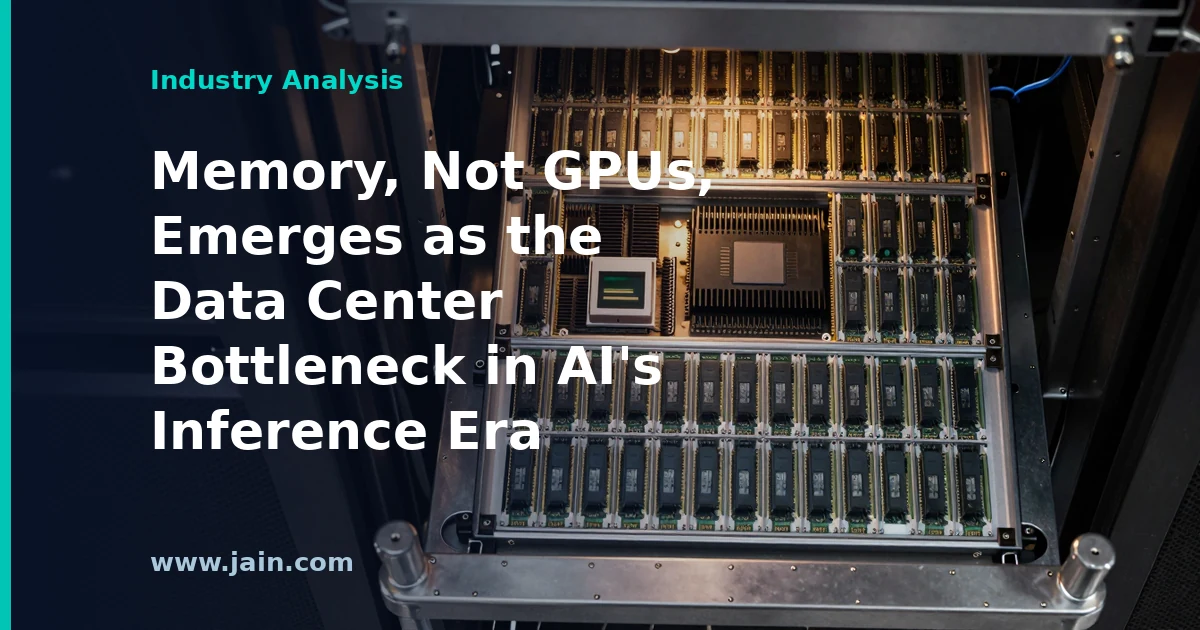
Data Center Knowledge reports that the AI industry’s next major data center challenge is scaling memory for the inference era. As of June 13, 2026, the trade publication frames memory — its capacity, bandwidth, and cost — rather than GPU supply alone as the constraint that will shape how AI infrastructure is built and operated as workloads shift from training models to serving them at scale.
Executive Summary
For the past several years, the AI infrastructure conversation has been dominated by one question: can you get enough GPUs? Data Center Knowledge’s report signals a maturing of that conversation. As deployed AI systems move from the training phase — where a model is built once on a massive cluster — to the inference phase — where that model answers millions of user requests every day — the binding constraint increasingly shifts toward memory: how much data an accelerator can hold close to its processors, and how fast it can move that data in and out.
This matters because inference is where AI meets its users and its revenue. Training is an episodic capital project; inference is a continuous operating workload whose economics are set by how efficiently each request can be served. If memory is the gating factor on that efficiency, then memory — not just compute — becomes a first-order design variable for chipmakers, server vendors, and the data center operators who house them. That has implications for procurement, facility design, and where the industry’s next supply-chain pressure points appear.
Why Inference Stresses Memory Differently Than Training
Training and inference are both AI workloads, but they stress hardware in different ways. Training is a throughput problem: enormous batches of data are pushed through a model in parallel, and the industry has optimized clusters, networks, and cooling around it. Inference is a latency and concurrency problem: a served model must hold its parameters — and, for modern conversational systems, the working context of many simultaneous user sessions — in fast memory, ready to respond in fractions of a second.
That is why the framing in this report resonates. A GPU with idle compute cycles but exhausted memory is, for inference purposes, a smaller GPU. The practical ceiling on how large a model you can serve, how long a context you can support, and how many users you can handle per accelerator is often set by memory capacity and bandwidth — the rate at which data moves between memory and processor — rather than by raw arithmetic performance. In industry shorthand, many inference workloads are ‘memory-bound’ rather than ‘compute-bound.’
From a GPU Supply Story to a Memory Supply Story
If the industry’s constraint migrates from processors to memory, the competitive map shifts with it. High-performance accelerators depend on specialized memory stacked directly alongside the processor — high-bandwidth memory, or HBM — which is produced by a small number of manufacturers and is among the most complex components in the server supply chain. A world in which inference demand keeps compounding is a world in which memory suppliers, packaging capacity, and memory-rich system designs command growing strategic attention.
It also opens the door to architectural alternatives. When fast on-package memory is scarce or expensive, system designers look for ways to tier it: pooling memory across servers, offloading less-frequently-accessed data to slower but larger stores, and caching repeated work so it need not be recomputed. Which of these approaches wins at scale is one of the genuinely open questions of the inference era, and the answer will influence everything from server bills of materials to network design inside the rack.
What It Means for Data Center Operators
For facility operators, the shift is subtler but real. Inference fleets are provisioned for sustained, user-facing demand, which favors availability, geographic distribution, and predictable power draw — a different profile from the concentrated, campus-scale training builds that have dominated recent headlines. Memory-heavy server configurations also change the calculus per rack: the balance of power, cooling, and floor space allocated to a given amount of useful serving capacity depends on how much memory ships alongside each accelerator.
The measured takeaway for buyers and operators is to treat memory as a first-class capacity-planning metric. Contracts, density assumptions, and refresh cycles built purely around GPU counts may misestimate what an inference-era fleet actually needs. That is not a crisis; it is the normal maturing of a young industry learning which of its inputs is truly scarce.
A Claim Worth Testing, Not Taking on Faith
It is worth being clear about the nature of this story: it is an analytical trend piece from a trade publication, not an announcement with commitments attached. The thesis — that memory becomes the bottleneck as inference scales — is directionally consistent with how served AI workloads behave, but its strength depends on variables the headline alone cannot settle: how fast inference demand actually grows, how quickly memory supply and packaging capacity expand, and whether software techniques blunt the constraint faster than hardware demand compounds. Readers should treat ‘memory is the next bottleneck’ as a well-founded hypothesis to plan against, not a settled fact.
Background
The AI infrastructure boom that accelerated from 2023 onward was defined first by a scramble for GPUs — the specialized processors used to train large AI models — and then by a scramble for the power and data center capacity to house them. As trained models moved into production across consumer and enterprise applications, the industry’s center of gravity began shifting from building models to serving them, a phase widely called the inference era.
That shift changes which hardware inputs are scarce. Modern accelerators pair their processors with high-bandwidth memory, a stacked, tightly integrated memory type made by only a few manufacturers worldwide. Because a served model’s size, context length, and concurrent user count are all bounded by available memory, industry attention has increasingly turned to memory supply, advanced packaging capacity, and architectures that stretch scarce fast memory further — the backdrop against which Data Center Knowledge’s June 2026 report was published.
Source: AI’s Next Data Center Challenge: Scaling Memory for the Inference Era — Data Center Knowledge’s June 13, 2026 report on memory becoming the scaling constraint for AI inference infrastructure.