
Tag: medium voltage

  • GE Vernova’s Medium-Voltage UPS Targets the AI Data Center Power-Density Wall

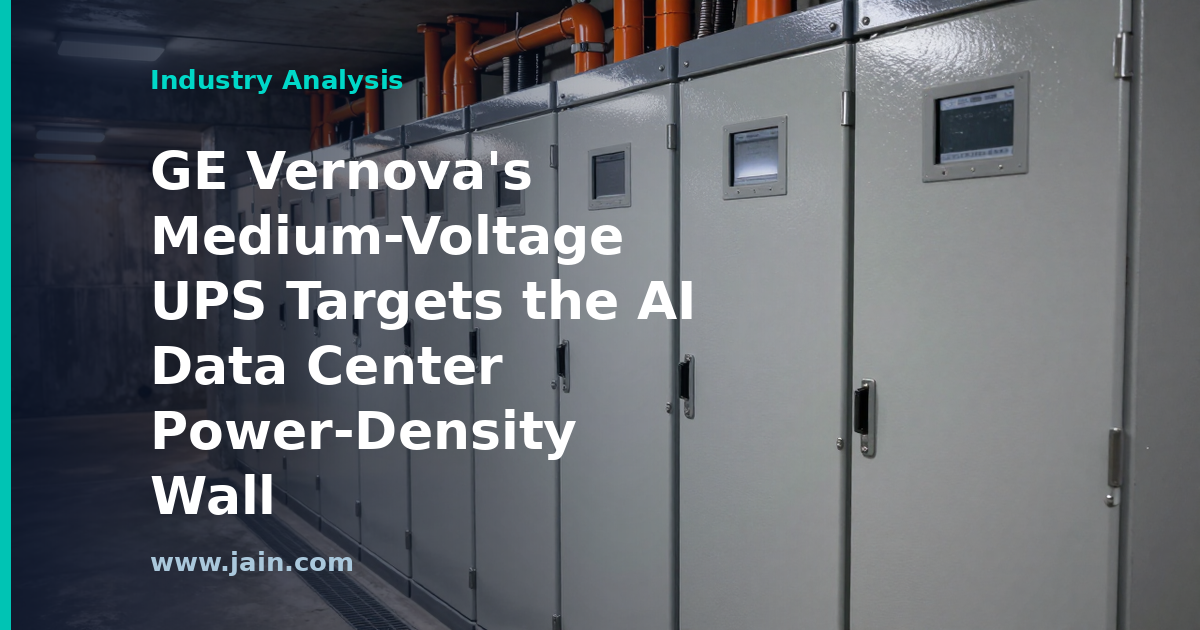
    GE Vernova’s Medium-Voltage UPS Targets the AI Data Center Power-Density Wall

    GE Vernova, the energy-equipment company spun off from General Electric in 2024, has introduced a medium-voltage uninterruptible power supply (UPS) aimed at AI data centers and other energy-intensive industries, according to coverage by ARC Advisory Group in August 2026. A UPS is the equipment that keeps critical loads powered during the seconds-to-minutes gap between a grid failure and backup generators taking over.

    The significance is architectural: UPS systems for data centers have traditionally operated at low voltage (below 1,000 volts), and moving that protection layer up to medium voltage — typically the 1kV–35kV range — signals that vendors now see AI campuses as too large for the conventional approach to scale gracefully.

    Executive Summary

    The announcement positions GE Vernova’s Electrification business in one of the fastest-growing corners of the power-equipment market: backup power for AI data centers. Training clusters have pushed individual racks toward and past 100kW, and hyperscale and neocloud operators are now planning campuses measured in the hundreds of megawatts. At that scale, the traditional pattern — dozens or hundreds of paralleled low-voltage UPS modules, each protecting a slice of the load — multiplies floor space, copper, conversion losses, and points of failure.

    A medium-voltage UPS protects the load higher up the electrical distribution chain, where the same power flows at higher voltage and therefore lower current. Fewer, larger protection blocks can replace fleets of smaller ones. GE Vernova is not alone in reading the market this way, but a product launch from one of the largest grid-equipment manufacturers is a meaningful signal that medium-voltage protection is moving from niche to mainstream consideration.

    Readers should note the limits of what has been disclosed: the source material available to us is headline-level, and we could not verify power ratings, topology, efficiency figures, availability dates, or customer commitments. Our analysis below addresses the strategy; the specification questions remain open.

    Why Backup Power Is Hitting a Voltage Ceiling

    Power equals voltage times current, so delivering more power at a fixed low voltage means proportionally more current — and current is what sizes conductors, breakers, and busway. A conventional data center UPS operates around 400–480 volts, and at that voltage a single system is practically limited to a few megawatts. Protecting a 100MW campus this way requires very large fleets of paralleled units, each with its own batteries, switchgear, cabling, and maintenance schedule.

    AI has broken the assumptions this architecture was built on. When racks drew 5–15kW, carving a facility into small low-voltage protection zones was sensible. With accelerated-computing racks drawing many times that, and single buildings approaching the load of a small city, the low-voltage approach consumes an increasing share of the floor area, capital budget, and construction timeline. Copper procurement alone has become a visible constraint on data center schedules.

    Moving the UPS to medium voltage — the tier utilities and campuses use for distribution, roughly 1kV to 35kV — cuts current by an order of magnitude for the same power. That means fewer conversion stages between the utility feed and the protected bus, less conductor mass, and protection blocks sized in tens of megawatts rather than single digits.

    The Trade-offs: Fewer, Bigger Blocks Cut Both Ways

    The efficiency and footprint logic is genuine, but consolidation concentrates risk. A campus protected by a handful of large medium-voltage blocks has fewer failure points, yet each failure affects more load — so redundancy design, fault isolation, and maintainability become the make-or-break engineering questions. The release headline does not tell us how GE Vernova’s design addresses concurrent maintainability or fault ride-through, and those answers will matter more to buyers than the voltage class itself.

    Operations change too. Medium-voltage equipment demands different technician qualifications, arc-flash procedures, and service ecosystems than the low-voltage gear most data center facilities teams know. Medium-voltage rotary UPS systems — machines that store energy in a spinning mass rather than batteries — have existed for years from specialist vendors, and they earned a reputation as robust but operationally distinct. Whether GE Vernova’s offering is static (power-electronics-based) or rotary is not stated in the material we reviewed, and it materially changes the competitive comparison.

    There is also a granularity cost. Small modular UPS units let operators grow capacity with demand; large blocks force bigger capital steps. For hyperscalers building entire campuses at once that is a fair trade. For enterprises and smaller colocation operators, it may not be — which suggests this product aims squarely at the top of the market.

    GE Vernova’s Position in a Crowding Field

    Since its April 2024 spin-off from General Electric, GE Vernova has ridden two demand waves: grid modernization and data center electrification. Its Electrification segment sells the transformers, switchgear, and power-conversion equipment that AI campuses consume in bulk, and the company already has relationships with the utilities and hyperscalers making these purchasing decisions. A medium-voltage UPS extends that portfolio one layer closer to the IT load — territory historically held by Schneider Electric, Vertiv, Eaton, and ABB in low-voltage UPS, and by specialist rotary vendors at medium voltage.

    The strategic logic favors integrated suppliers: an operator buying medium-voltage switchgear, transformers, and backup protection from one vendor simplifies interface engineering and accountability. But incumbency in grid equipment does not automatically translate to credibility in mission-critical backup power, where buyers weight field-proven reliability data heavily. The burden of proof — reference deployments, third-party certification, demonstrated availability numbers — sits with any new entrant to this layer, regardless of parent-company scale.

    Background

    GE Vernova was created in April 2024 when General Electric completed its three-way split, separating its energy businesses from aerospace and healthcare. The company spans gas and wind power generation, nuclear technology, and an Electrification segment covering grid solutions and power conversion — the segment most directly leveraged to data center construction. Demand for transformers, switchgear, and backup power has surged with AI buildouts, producing extended lead times across the industry.

    The data center UPS market, meanwhile, has been dominated for decades by low-voltage static systems that convert utility power through batteries via power electronics. As individual AI campuses have grown from tens to hundreds of megawatts, the industry has begun rethinking the entire power chain — higher distribution voltages, direct-current architectures, and now medium-voltage protection — to reduce losses, copper use, and construction time. ARC Advisory Group, which covered this announcement, is an industry-analyst firm focused on industrial and infrastructure technology.

    Source: GE Vernova Introduces Medium-Voltage UPS for AI Data Centers and Energy-Intensive Industries — ARC Advisory Group coverage of GE Vernova’s product introduction, August 2026.
  • ABB Takes UPS to 34.5kV to Cut AI Data Center Losses

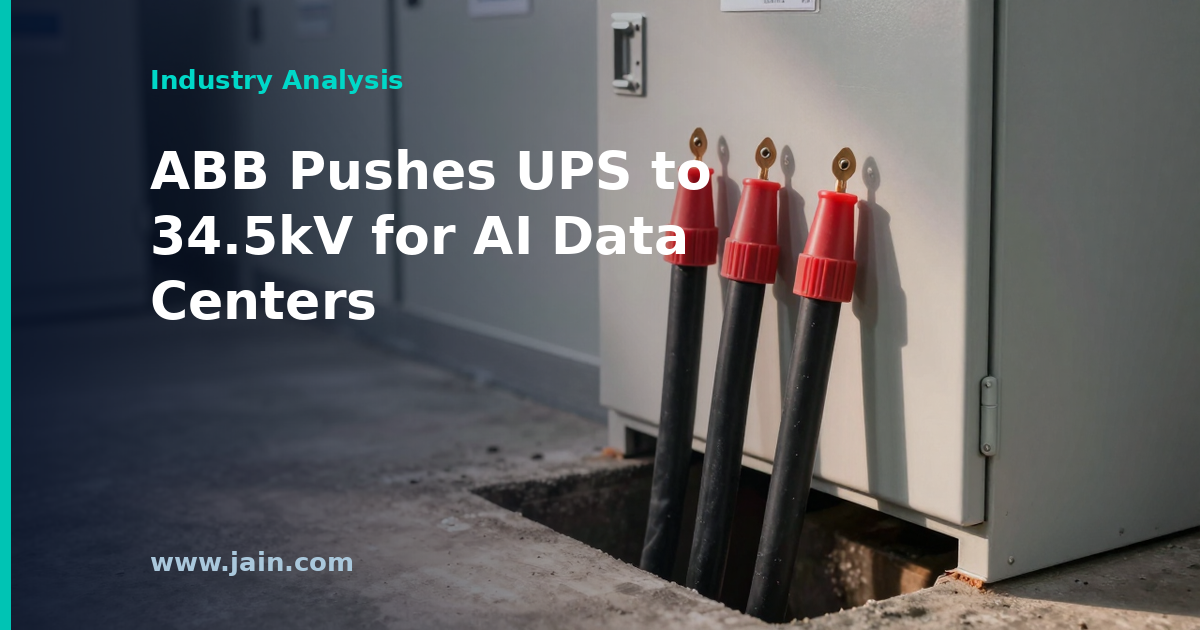
    ABB Takes UPS to 34.5kV to Cut AI Data Center Losses

    ABB has introduced a 34.5kV version of its HiPerGuard medium-voltage uninterruptible power supply, announced on 22 April 2026. The company positions the product as connecting directly to a medium-voltage grid feed, eliminating conversion steps between the utility connection and the data center’s power train, and says the result is lower power costs for AI data centers.

    At 34.5kV, the unit sits at the top of the medium-voltage distribution class commonly used by North American utilities. The announcement is a product-capability disclosure rather than a customer deployment: the material published alongside the headline does not name sites, buyers, delivery dates or measured efficiency gains.

    Executive Summary

    An uninterruptible power supply is the equipment that keeps a data center’s servers running through a grid disturbance, bridging the seconds or minutes until generators take over. Conventionally, that equipment lives at low voltage — typically a few hundred volts — which means utility power arriving at medium voltage must first be stepped down through transformers, then protected, then distributed. Every one of those stages costs a percentage of the power passing through it, and each percentage becomes heat that must itself be cooled.

    ABB’s claim with the 34.5kV HiPerGuard is that the UPS can sit further upstream, taking the medium-voltage feed directly and removing conversion stages from the chain. The commercial argument is straightforward: fewer stages mean fewer losses, less transformer and switchgear capacity to buy, and less floor space consumed by electrical rooms that could otherwise hold revenue-generating IT equipment.

    The timing matters more than the voltage number. AI training and inference racks have moved from tens of kilowatts to the hundreds, with megawatt-scale racks on vendor roadmaps. At those densities the electrical distribution system, not the building shell, becomes the constraint. Medium-voltage UPS is one of several architectural responses to that constraint — and this announcement is a claim about a direction of travel that the released material does not yet quantify.

    Voltage Is the New Density Lever

    Power density in data centers has historically been solved by moving air and water more cleverly. That era is ending. When a single rack draws hundreds of kilowatts, the limiting factor shifts to how much current the distribution system can carry without unmanageable conductor sizes, losses and fault energy. Physics is unhelpful here: for a given amount of power, halving current requires doubling voltage, and copper cost and resistive loss scale with current, not with power.

    Raising the voltage at which protected power is handled is therefore one of the few structural levers available. Doing it at the UPS means the medium-voltage feed can travel deeper into the facility before being stepped down close to the load, shortening the low-voltage runs that dominate conductor spend. It also compresses the equipment chain: each transformation stage carries its own footprint, maintenance regime, failure modes and efficiency penalty. Removing stages removes all four at once.

    The counterpoint worth stating plainly is that this is a re-architecture, not a component swap. Medium-voltage equipment brings different clearance requirements, different arc-flash considerations, different qualification standards for the technicians who work on it, and a smaller pool of contractors able to commission it. Operators who adopt it are trading one set of engineering problems for another, and the trade only pays at scale.

    Where the Savings Actually Come From

    The headline frames the benefit as lower power costs. In a data center’s cost structure, electrical losses are compounded rather than linear: a watt lost in a transformer or rectifier is a watt bought from the utility and also a watt of heat that the cooling plant must remove, at further energy cost. Small efficiency percentages at the front of the power chain therefore multiply through the operating budget over a facility life measured in decades.

    The capital side may matter as much. Eliminating conversion stages means fewer step-down transformers, less associated switchgear, and less electrical room area — space that, in a market where construction timelines and grid connections are the binding constraints, converts directly into deployable IT capacity per site. For operators who cannot get more megawatts from their utility, extracting more usable compute from the megawatts already contracted is the highest-value optimization available.

    None of that is quantified in the material accompanying this announcement. There is no published efficiency figure, no comparison baseline, no total-cost-of-ownership model and no pricing. The mechanism ABB describes is sound engineering and widely understood in the industry; the specific magnitude of the benefit is, on the evidence released so far, an assertion rather than a demonstrated result. Buyers should treat it accordingly and ask for the numbers.

    A Crowded Answer to a Real Problem

    ABB is not alone in reading the AI power problem this way. Medium-voltage UPS lines, solid-state transformer research, and the broader industry push toward higher-voltage direct-current distribution inside the rack are all attacking the same bottleneck from different points in the chain. Chip and system vendors have been pushing rack-level power architectures upward in voltage for similar reasons. These approaches are complementary rather than mutually exclusive — a facility could plausibly take medium voltage deep into the hall and then distribute at high-voltage DC to the racks.

    The likely winners are hyperscale and large colocation operators building new capacity, where greenfield design allows the electrical architecture to be chosen rather than retrofitted, and where volume justifies training staff on medium-voltage practice. The likely losers are smaller enterprise sites and retrofit projects, which carry the complexity without the scale to amortize it. For ABB, the strategic value is defending a position in the electrification supply chain against competitors selling into the same buildings.

    The risk to watch is supply chain rather than technology. Medium-voltage switchgear, transformers and related equipment have been in constrained supply across the electrical industry, with lead times that already shape data center schedules. A product that reduces the count of such components could ease that pressure; one that simply relocates demand to a differently scarce component would not. The announcement does not address lead times or manufacturing capacity.

    Background

    ABB is a long-established electrification and automation supplier whose portfolio spans switchgear, transformers, drives and power protection. Its HiPerGuard line is a medium-voltage UPS family aimed at large industrial and data center loads, positioned against the conventional approach of stepping utility power down to low voltage before it reaches protection equipment.

    The market context is the rapid escalation of data center power requirements driven by AI workloads. As rack densities climb, operators face constrained utility connections, long grid interconnection queues and shortages of electrical equipment. That has pushed power architecture — historically a settled part of data center design — back into active competition among vendors, with voltage levels, conversion topologies and distribution schemes all under reconsideration.

    Source: New 34.5kV HiPerGuard UPS: direct grid connection cuts AI data center power costs – ABB — ABB’s 22 April 2026 announcement of a 34.5kV medium-voltage UPS positioned to remove conversion stages between the grid and AI data center loads.