Tag: Maryland

  • Only 190 of Amazon’s 690 Nuclear MW Are New. The Bigger AI Stake Is a 2034 License.

    Only 190 of Amazon’s 690 Nuclear MW Are New. The Bigger AI Stake Is a 2034 License.

    TL;DR · 30-second read

    The Short Version

    Amazon has signed a 20-year deal to buy about a third of the electricity from Calvert Cliffs, Maryland’s only nuclear power plant, which today produces enough for more than 1.3 million homes. The plant’s owner, Constellation Energy, says the deal unlocks more than $3 billion of investment.

    The twist: most of that power already exists. Just over a quarter of Amazon’s share will come from new equipment, due between 2030 and 2032. The plant’s two reactors have federal operating licenses that expire in 2034 and 2036, long before the contract ends. The power also stays on the shared grid rather than being walled off for Amazon.

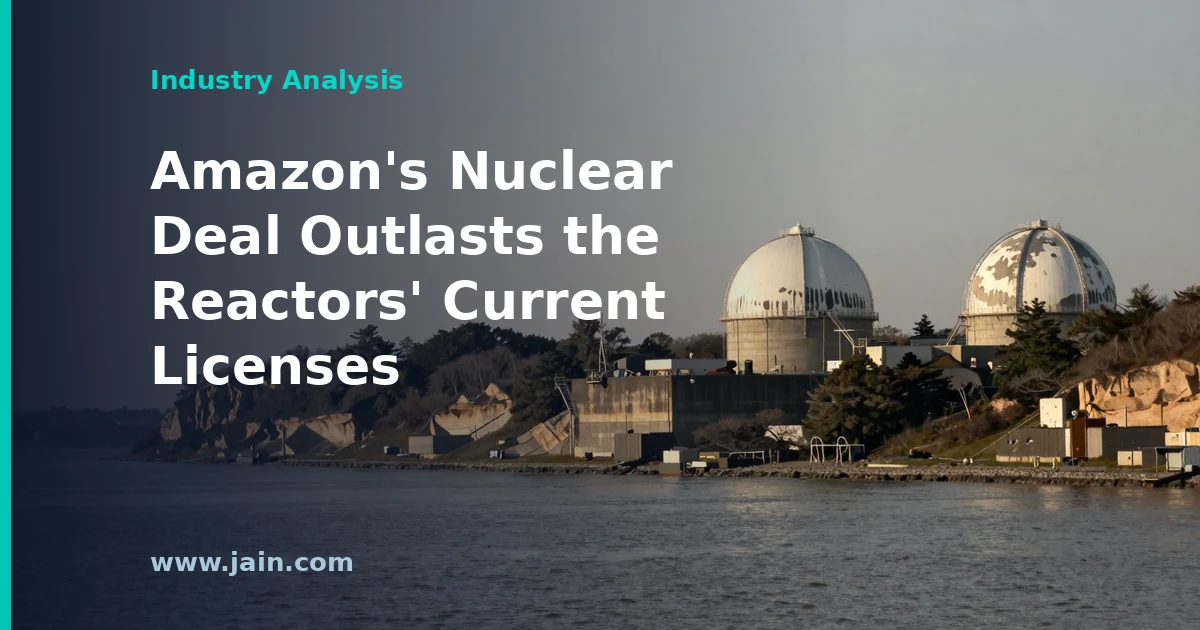
    Constellation Energy and Amazon signed a 20-year agreement on Sept. 30, 2026 under which Amazon will buy 690 megawatts (MW) of output from the Calvert Cliffs Clean Energy Center in Maryland, Mugglehead Investment Magazine reported. The 690 MW includes a planned 190 MW capacity increase at the 1,790 MW station, expected to come online between 2030 and 2032. Constellation says the agreement is expected to enable more than $3 billion in Maryland infrastructure investment.

    Amazon said electricity from Calvert Cliffs will continue flowing to the PJM regional grid. The companies also signed a separate retail supply agreement covering Amazon operations across PJM’s 13 states and the District of Columbia. Constellation did not disclose a price per megawatt-hour or a spending schedule for the investment.

    Executive Summary

    Amazon, one of the hyperscalers (the largest cloud and AI computing operators), has committed to two decades of nuclear power from Maryland’s only nuclear plant. The contract covers 690 MW, roughly a third of the station’s output once a planned 190 MW uprate is complete. Constellation ties the deal to more than $3 billion of state investment, to relicensing the plant for another 20 years, and to potential new clean energy plants at the site.

    The deal is less about new megawatts than the headline suggests. About 500 MW of the contract comes from reactors already running, and the new 190 MW will not arrive until 2030 to 2032. The larger consequence is financial: a 20-year revenue stream for a station whose two reactor licenses expire in 2034 and 2036 strengthens the case for keeping all 1,790 MW running into the 2050s. The structure matters too. The plant stays connected to the shared grid instead of being dedicated to an Amazon campus built on site.

    What remains open is the economics. There is no disclosed price, start date, investment schedule, or relicensing application date. Constellation has also named no design or budget for the new plants it says the deal will help advance.

    Most of the 690 Megawatts Already Exists

    A megawatt measures generating capacity. Calvert Cliffs’ current 1,790 MW supplies the equivalent of more than 1.3 million homes and about 80 per cent of Maryland’s clean energy, by Constellation’s count. Amazon’s 690 MW contract includes the planned 190 MW increase, so roughly 500 MW of it is output from reactors that are already operating. The 190 MW is an uprate, meaning engineering changes that let existing reactors produce more power. It is not a newly ordered reactor.

    For anyone modeling new electricity supply for data center growth in PJM, the timing is the point. In the near term, the deal assigns existing carbon-free output to a named buyer. The net addition to the grid, about a tenth more capacity at the station, arrives between 2030 and 2032.

    Amazon’s earlier PJM nuclear agreement follows a similar pattern. Talen Energy’s June 11, 2025 contract covers 1,920 MW from the existing Susquehanna plant in Pennsylvania, reaching full quantity no later than 2032 and running through 2042. Talen treats any extra output from uprates as a separate possibility. Two contracts with one buyer do not make a market-wide trend. Still, both of Amazon’s disclosed PJM nuclear deals are anchored on reactors that already exist, with new capacity small or optional.

    Why the 2034 License Date Is the Bigger Stake

    The U.S. Nuclear Regulatory Commission (NRC) lists Unit 1’s operating license as expiring July 31, 2034 and Unit 2’s as expiring Aug. 13, 2036. Both licenses were renewed in 2000. A 20-year contract signed in 2026 runs into the mid-2040s at the earliest. If deliveries begin soon after signing, more than half of the term falls after Unit 1’s current license ends. The contract can be fully performed only if the NRC grants subsequent license renewal. That process extends reactor operation from 60 to 80 years and requires its own safety and environmental reviews.

    The arithmetic shows where the stake lies. The uprate adds 190 MW. Operation beyond the mid-2030s depends on relicensing for all 1,790 MW, more than nine times as much capacity. Constellation says the agreement helps provide the revenue certainty needed to relicense the plant for another 20 years. That is the mechanism: long-dated contracted revenue is what justifies the cost of a renewal application and the plant investment that goes with it. “Amazon’s commitment supports the long-term operation of Calvert Cliffs for generations to come,” chief executive Joe Dominguez said.

    Several parties depend on that outcome. Amazon needs the plant running to receive its contracted supply. Maryland gets most of its clean electricity from this one station. PJM would lose far more capacity if the plant closed than the uprate adds. A power sale does not renew a license, though, and Constellation has given no date for an application. The deal’s most consequential effect is a stronger financial case for keeping the station open. The regulatory decision is still years away.

    A Hyperscaler Pays for Nuclear Without Taking It Off the Grid

    Amazon said Calvert Cliffs’ electricity will keep flowing to PJM, the operator of the regional grid serving 13 states and Washington, D.C. That footprint includes Northern Virginia, the world’s largest data center market. The main alternative is co-location, in which a data center is built at the plant and draws power directly, “behind the meter,” before it reaches the grid. Co-location has drawn regulatory scrutiny in PJM over its effect on other customers.

    Calvert Cliffs instead uses what the industry calls a grid-side power purchase agreement (PPA), a long-term contract to buy a plant’s output. The plant sends its electricity into the grid, and Amazon’s facilities are served through a separate retail supply agreement. Under a structure like this, the buyer underwrites the plant’s revenue while its output stays available to the regional system. That reduces the friction co-location attracts.

    The trade-off is that Amazon’s sites still depend on the grid’s ability to deliver power where its data centers are located. The nuclear contract secures a source of electricity, but it does not settle questions of local grid connections or transmission capacity.

    The $3 Billion Figure Still Needs a Schedule

    Constellation says the deal will “enable” more than $3 billion of Maryland investment. That figure is not described as Amazon’s direct spending, and no spending timeline was given. It is also unclear how the sum divides among the uprate, relicensing work, and the potential new clean energy plants, for which Constellation named no design, equipment order, budget, or completion date.

    Without a price per megawatt-hour, outside observers cannot compare the contract with market power prices or judge how much of the plant’s future revenue it locks in. Constellation’s shares rose after the announcement, which suggests investors value the long-term revenue certainty. Overall, the announcement is concrete on duration, volume, and the uprate window, and thin on economics.

    Background

    Constellation Energy, spun off from Exelon in 2022, operates the largest fleet of nuclear plants in the United States. Calvert Cliffs, on Maryland’s Chesapeake Bay shore, has two reactors totaling 1,790 MW. The company is also working to restart an 835 MW reactor in Pennsylvania under a separate long-term agreement with Microsoft. That unit received an NRC environmental finding on Sept. 25, 2026.

    Since 2024, hyperscalers have turned to existing nuclear plants for around-the-clock, carbon-free power for cloud and AI data centers. Many of these deals sit inside PJM, the grid serving 13 states and Washington, D.C., where data center demand has grown fastest. Amazon’s 1,920 MW contract with Talen Energy’s Susquehanna plant, signed in June 2025, is the closest comparable.

    Sources

    Source: Constellation Energy signs 20‑year Amazon deal for 690 MW at Calvert Cliffs (Mugglehead Investment Magazine): report on the Sept. 30, 2026 Constellation–Amazon power purchase agreement covering Calvert Cliffs’ output and a planned 190 MW uprate.

  • Cloudforce Doubles Maryland HQ, Pledging 250 New Jobs in AI Platform Expansion

    Cloudforce Doubles Maryland HQ, Pledging 250 New Jobs in AI Platform Expansion

    Maryland Governor Wes Moore announced on August 12, 2026 that AI platform company Cloudforce will expand its headquarters at National Harbor in Prince George’s County, leasing an additional 15,000 square feet of office space — roughly doubling its footprint — while retaining more than 130 employees and committing to add 250 new Maryland jobs over the next five years.

    To support the project, Cloudforce is eligible for a $1.25 million conditional loan through the state’s Advantage Maryland program, a $125,000 conditional loan from the Prince George’s County Economic Development Corporation, and potentially state and local tax credits including the Job Creation Tax Credit.

    Executive Summary

    Cloudforce, which grew from a Microsoft cloud consultancy into what the release calls a “frontier AI platform company,” says it evaluated expansion sites across the DC-Metro region before choosing to stay in Maryland. Its flagship product, nebulaONE, gives universities and public-sector organizations governed access to leading AI models — meaning institutions can offer students and staff AI tools inside a controlled, private environment rather than sending them to open consumer services. Named customers include the University of Maryland, UCLA, London Business School, and the University of Oxford, and Cloudforce was Microsoft’s 2025 global Education Partner of the Year.

    The announcement matters less for its physical scale — this is an office lease, not a data center — than for what it signals: the software layer of the AI boom is creating conventional white-collar jobs in metro markets, and states are competing for those jobs with comparatively small, conditional incentive packages rather than the nine-figure deals attached to AI infrastructure projects. It is also a data point for the growing “governed AI” market serving education and government buyers, a segment defined by security and compliance requirements rather than raw compute.

    An Asset-Light Expansion in an Asset-Heavy Boom

    Most AI expansion headlines in 2026 involve gigawatts, water permits, and construction cranes. This one involves 15,000 square feet of office space — a useful reminder that the AI economy has two very different layers. Cloudforce sits in the platform layer: it does not build or operate the underlying compute, but packages access to models running on hyperscaler infrastructure (its roots are as a Microsoft cloud specialist) into a product institutions can govern and audit. That business scales with headcount in sales, engineering, and customer success rather than with land and power, which is why its expansion looks like a traditional corporate office deal.

    For economic developers, that trade-off cuts both ways. An office expansion of this kind promises far more jobs per dollar of incentive than a data center, and jobs of a different character — the release emphasizes career pathways for interns, Service Year members, and recent graduates. On the other hand, an office lease is inherently more portable than a substation-anchored campus. The retention framing in the release — Cloudforce says it had “every option on the table, including markets across state lines” — makes clear Maryland was competing to keep a company that could plausibly have moved.

    The Governed-AI Niche in Higher Education

    nebulaONE’s pitch, as described in the release, is “private, secure, and equitable AI access at scale” — governed access to leading models and agentic workflows (AI systems that can carry out multi-step tasks, not just answer questions). For universities, the appeal is concrete: they face student demand for AI tools, faculty concern about academic integrity and data privacy, and procurement rules that make consumer AI subscriptions awkward. A governed platform lets an institution offer one sanctioned front door to multiple models, with usage policies attached. The customer list — Maryland, UCLA, Oxford, London Business School — and the Microsoft Education Partner of the Year award suggest real traction in that niche.

    The strategic question the release does not address is durability. Cloudforce’s position depends on model providers and hyperscalers continuing to leave room for an intermediary layer. Microsoft, whose ecosystem Cloudforce grew up in, sells its own education-focused AI offerings, and model vendors increasingly court universities directly. Aggregation platforms thrive when the underlying market is fragmented and compliance-heavy — both true today in higher education — but a 250-job, five-year hiring plan is implicitly a bet that this intermediary role persists. That is a reasonable bet, not a guaranteed one.

    What $1.375 Million in Conditional Money Buys

    The incentive package is notably modest: a $1.25 million conditional loan from Advantage Maryland, a $125,000 conditional county loan, and possible eligibility for tax credits such as the Job Creation Tax Credit. Against a promise of 250 jobs, the headline loan math works out to roughly $5,500 per pledged job — a small fraction of what states routinely commit per job for capital-intensive AI infrastructure projects. Conditional loans of this type also typically convert to grants only if hiring milestones are met, which gives the state some downside protection, though the release does not spell out the conditions.

    The honest read is that incentives were probably not decisive. Cloudforce’s stated reasons — technical talent, proximity to universities it both sells to and hires from, and an existing rooted workforce — are the kinds of factors that dominate site selection for a company whose main asset is people. The University of Maryland relationship is particularly interesting: the university is simultaneously a customer, a talent pipeline, and a philanthropic partner. That triple relationship is a genuine competitive moat locally, though it also concentrates a lot of the company’s Maryland story in a single institution.

    A Data Point in the DC-Metro Talent Contest

    Cloudforce says it ran an “extensive analysis of potential expansion sites across the DC-Metro region,” which frames this as a win for Maryland over Virginia and the District in the ongoing regional contest for technology employers. Northern Virginia has dominated the region’s data center buildout; Maryland landing an AI software headquarters plays to a different strength — its university system and federal-adjacent talent pool — and the state clearly intends to market it that way.

    One cultural detail is worth noting for real estate watchers: CEO Husein Sharaf explicitly tied the expansion to “a company culture rooted in bringing our people together in one place.” A software company doubling physical office space in 2026 is a small but real counterpoint to the remote-first assumptions that have weighed on office demand, and a welcome signal for a mixed-use development like National Harbor, whose landlord Peterson Companies was given prominent billing in the announcement.

    Background

    Cloudforce is a Prince George’s County, Maryland company that started as a Microsoft cloud consultancy and repositioned itself around AI platform services as institutional demand for controlled AI access grew. Its nebulaONE product found a niche in higher education, where universities want to give students and staff AI capabilities without surrendering control over data, privacy, and usage policy — traction that earned Cloudforce Microsoft’s global Education Partner of the Year award in 2025.

    The expansion lands amid an intense economic-development contest across the DC-Metro region. While Northern Virginia has captured most of the area’s AI data center investment, Maryland has courted the software and talent side of the AI economy, leaning on its university system and programs like Advantage Maryland, the Department of Commerce’s conditional-loan tool for business expansion and retention.

    Source: Governor Moore Announces Cloudforce Chooses Maryland for Major AI Platform Expansion, Bringing 250 New Jobs to the State — press release from the Office of Maryland Governor Wes Moore, August 12, 2026.

  • Amazon’s 2.4M Sq Ft Calvert Cliffs Exit Shows a Nuclear Plant Can’t Shortcut Zoning

    Amazon’s 2.4M Sq Ft Calvert Cliffs Exit Shows a Nuclear Plant Can’t Shortcut Zoning

    TL;DR · 30-second read

    The Short Version

    Amazon has dropped plans to build a large group of data centers on the grounds of a nuclear power plant in southern Maryland. Data centers are warehouse-sized buildings full of computers that run apps, websites and artificial intelligence. This one would have covered roughly 40 football fields of floor space.

    Having a giant power plant next door was not enough. Local voters removed three county leaders who had resisted pausing these projects, and the county is now considering a six-month freeze. Amazon calls it a business decision. Either way, local approval proved as important as electricity.

    Amazon Web Services (AWS), Amazon’s cloud computing arm, has abandoned its proposal to build data centers on the campus of the Calvert Cliffs Nuclear Power Plant near Lusby, Maryland, Maryland Matters reported on August 4, 2026, citing a Calvert County government news release. The proposal, submitted to the county in early May, called for “multiple data center campuses” covering 2.4 million square feet.

    The withdrawal follows the June 23 primary election, in which all three Calvert County commissioners who had voted against a pause on data centers lost their races. The county has scheduled an August 18 public meeting on a temporary six-month moratorium on site plan approvals for data center projects. Amazon described the move as a business decision; plant owner Constellation Energy said the opportunity at the site continues.

    Executive Summary

    AWS has walked away from what was, on paper, one of the most attractive data center sites in the Mid-Atlantic: land beside a nuclear plant that Constellation calls Maryland’s largest source of clean, reliable energy. Co-locating a data center with a power plant is the siting strategy much of the industry has pursued to secure the large, round-the-clock electricity that AI and cloud computing demand.

    The Calvert Cliffs outcome shows the limit of that strategy. Power next door does not remove the need for local land-use approval, and in Calvert County the politics of that approval shifted sharply between Amazon’s May filing and its August exit. Amazon’s own statement names development timelines as a deciding factor — the variable a county moratorium directly controls.

    For developers, utilities and investors, the lesson extends well beyond one county. Much of Maryland’s population now lives under some form of data center moratorium, according to a regional climate advocacy group, and state lawmakers may take up statewide proposals in 2027.

    Power Next Door Did Not Replace the Permit

    Data center developers have spent the past two years chasing power, not land. Large facilities that train and run AI models draw electricity continuously, and securing that supply through a crowded regional grid can take years. Building beside a nuclear plant — often called co-location — is attractive because the plant produces large amounts of steady, carbon-free power on site. Calvert Cliffs, with Units 1 and 2 near Lusby, offered exactly that.

    But a site plan still has to be approved by the county. Amazon filed its 2.4 million-square-foot proposal in early May. On June 23, voters removed commission president Todd Ireland, vice president Mark C. Cox Sr. and commissioner Earl F. “Buddy” Hance, the three commissioners who had voted against a data center pause, in favor of candidates critical of the county’s data center trajectory. On August 4, the county announced both Amazon’s withdrawal and a hearing on a six-month moratorium on data center site plan approvals, intended to allow time for new zoning rules and studies.

    Amazon says the decision was a business one, and nothing public contradicts that. Its statement, however, lists the factors it weighs: “development timelines, operational requirements, and our ability to deliver quickly for customers.” A six-month pause followed by a zoning rewrite is a timeline risk that no amount of nearby generation can offset. The mechanism is straightforward: the power advantage of a nuclear site is realized only after the building exists, while the permitting clock starts first. For hyperscalers — the largest cloud operators — that measure value in speed to capacity, an uncertain local calendar can outweigh a favorable power position.

    Maryland’s Moratorium Map Is Now a Siting Input

    Calvert County is not an isolated case. The Chesapeake Climate Action Network (CCAN), an advocacy group that supports moratoriums, said in July that nearly 77% of Maryland’s population lives under some kind of data center moratorium. That figure comes from an interested party, but the underlying measures are matters of public record: Prince George’s County enacted a two-year hold in July, Harford County has a ban with no time limit, Montgomery County, Baltimore County and Baltimore City have adopted measures, and Queen Anne’s and Washington counties have one-year pauses.

    The political signal is also visible in Frederick County, where voters ousted council chair Brad Young after the council expanded a data center zone in Adamstown. County Executive Jessica Fitzwater then paused data center development through year-end — while county leaders still intend to proceed with a planned 2,500-acre campus. That combination matters: it suggests the backlash is producing delays and new process rather than blanket rejection everywhere, which is a different risk for developers to price.

    CCAN’s Maryland director expects the General Assembly to consider statewide moratorium bills in 2027. That is a forecast, not a filed bill, but for anyone evaluating Maryland sites it turns a county-by-county patchwork into a possible statewide variable.

    What Constellation and the Next Applicant Are Left Holding

    Constellation, which owns Calvert Cliffs, loses a named tenant but not its thesis. It said the opportunity remains to “create jobs, grow the economy and support in-state federal agencies” and that this can be done “responsibly while protecting and expanding” the plant. Those are claims about future projects that have yet to be specified; the county’s proposed review of zoning and heavy industrial use is where they would be tested.

    Opponents have their own case to make. Petition organizer Melissa Emmal, whose Change.org petition has passed 10,000 signatures, and the nonprofit Save Lusby Inc. are asking for studies and zoning changes before any project proceeds. The June results suggest broad local support for that position, though the scope of the studies and the criteria for lifting a pause remain undefined — questions the county will need to answer if a moratorium is meant to lead to rules rather than indefinite delay.

    Meanwhile, the pipeline has not emptied. Natelli Holdings has proposed a separate data center nearby along Route 4, near Calvert Cliffs State Park, an existing landfill, a wastewater treatment facility and a county-owned gun range. Amazon could also resubmit. Whoever moves next will face the same question Amazon did: not whether the power is there, but how long approval will take.

    Background

    Calvert Cliffs Nuclear Power Plant, with Units 1 and 2 near Lusby in Southern Maryland, is owned by Constellation Energy, which describes it as the state’s largest source of clean, reliable energy. Amazon Web Services is one of the hyperscalers — the handful of companies that build and operate the largest cloud and AI data centers — and has been pursuing sites with reliable access to large amounts of electricity.

    Maryland has become a focal point for local resistance to data center development. Through 2026, counties including Prince George’s, Montgomery, Harford, Baltimore County, Queen Anne’s and Washington adopted pauses or bans, and data center policy became a deciding issue in county primaries in Calvert and Frederick counties.

    Sources

    Source: Amazon abandons plans for data center campus at Calvert Cliffs — Maryland Matters on AWS withdrawing its Calvert Cliffs data center proposal after a county primary centered on data centers.