
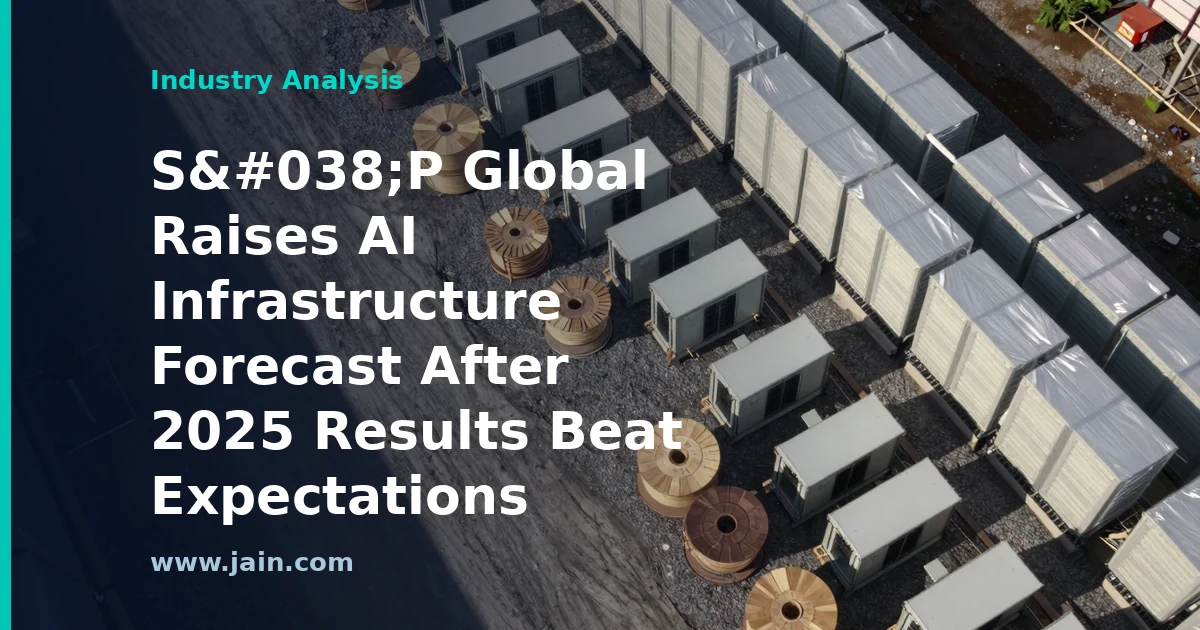
S&P Global, the ratings and market-intelligence firm, reported that AI infrastructure results for 2025 topped its expectations and, on the strength of those results, has upgraded its forecast for the sector. The announcement, published May 7, 2026, signals that one of the most closely watched independent forecasters now sees more AI-driven data center, compute, and power investment ahead than it previously modeled.
Executive Summary
Forecast upgrades come in two flavors: those driven by sentiment and those driven by results. S&P Global’s revision belongs to the second category — the firm says actual 2025 outcomes in AI infrastructure exceeded what its prior models anticipated, and it has raised its outlook accordingly. That distinction matters. A results-based upgrade means the checks cleared: capital was deployed, capacity was delivered or contracted, and revenue showed up in reported financials rather than in investor-day slideware.
For the infrastructure ecosystem — data center operators, connectivity providers, power utilities, and the vendors that supply them — an independent forecaster moving its baseline upward extends the planning horizon for an already historic buildout. It also raises the stakes: the higher the consensus forecast climbs, the more painful any eventual shortfall in demand, power availability, or financing would be. The syndicated headline, however, carries no figures, so the size of the beat and the magnitude of the upgrade remain to be read in the underlying report.
An Upgrade Anchored in Results, Not Hype
Throughout the AI investment cycle, skeptics have argued that spending projections rest on circular enthusiasm — model builders forecasting demand for their own models. What distinguishes this announcement is its direction of inference: S&P Global is looking backward at 2025 actuals and concluding its earlier numbers were too low. When realized results outrun a forecast, the forecaster faces a choice between treating the beat as a one-time pull-forward of demand or as evidence the underlying trend is steeper. By upgrading, S&P Global has chosen the second interpretation.
That said, extrapolation is exactly how forecasters get caught at cycle peaks. Strong 2025 results confirm that money was spent and capacity absorbed; they do not by themselves prove that the returns on that spending will justify the next round. Readers should distinguish between the fact of the beat — which is evidence — and the upgraded projection, which remains a model.
What More Capex Means for Power and Land
AI infrastructure is shorthand for a physical supply chain: chips, servers, the data centers that house them, the fiber that connects them, and — increasingly the binding constraint — the electricity that powers them. A raised forecast implies more of all of it. For data center markets already contending with multi-year utility interconnection queues, transformer lead times, and community pushback on siting, an upgraded demand outlook translates directly into more competition for powered land and grid capacity.
For utilities and power developers, a higher independent forecast strengthens the case for generation and transmission investment that regulators must approve. For enterprise and colocation buyers, it points the other way: sustained demand above prior expectations tends to keep vacancy low and pricing firm, meaning tenants who deferred capacity decisions waiting for the market to loosen may be waiting longer than they planned.
Winners, Losers, and the Widening Gap
A rising forecast does not lift all boats equally. Operators with secured power, entitled land, and access to capital can convert an upgraded outlook into pre-leased expansion. Smaller players without those ingredients face the same rising input costs — power, equipment, construction labor — without the contracted revenue to offset them. The upgrade also sharpens the divide between markets: regions that can deliver megawatts on credible timelines will absorb a disproportionate share of the incremental demand the new forecast implies.
The risk ledger deserves equal attention. Every upward revision embeds assumptions about continued hyperscaler spending, stable financing conditions, and AI applications generating enough end-customer revenue to sustain the cycle. If any of those assumptions weakens, capacity ordered against the upgraded forecast could arrive into a softer market. S&P Global’s own ratings business exists precisely because leverage built in good times gets tested in bad ones — a useful lens to apply to its market forecasts as well.
Background
The AI infrastructure buildout accelerated sharply after generative AI reached mass adoption, with hyperscale cloud providers and AI developers committing historic sums to chips, data centers, and power. Throughout 2024 and 2025, a running debate pitted those who saw the spending as a durable platform shift against those who warned of overbuild, with independent forecasters like S&P Global serving as referees between the narratives.
S&P Global occupies an unusual vantage point in that debate: its ratings arm evaluates the creditworthiness of the utilities, data center operators, and technology firms doing the spending, while its market-intelligence arm models the demand itself. When a firm with exposure to both sides of the ledger raises its outlook based on realized results, it carries more weight than promotional projections — which is precisely why the details behind this upgrade merit close reading.
Source: AI infrastructure results in 2025 top expectations, forecast upgraded — S&P Global, announcing an upgraded AI infrastructure forecast after 2025 sector results exceeded the firm’s expectations.