TL;DR · 30-second read
The Short Version
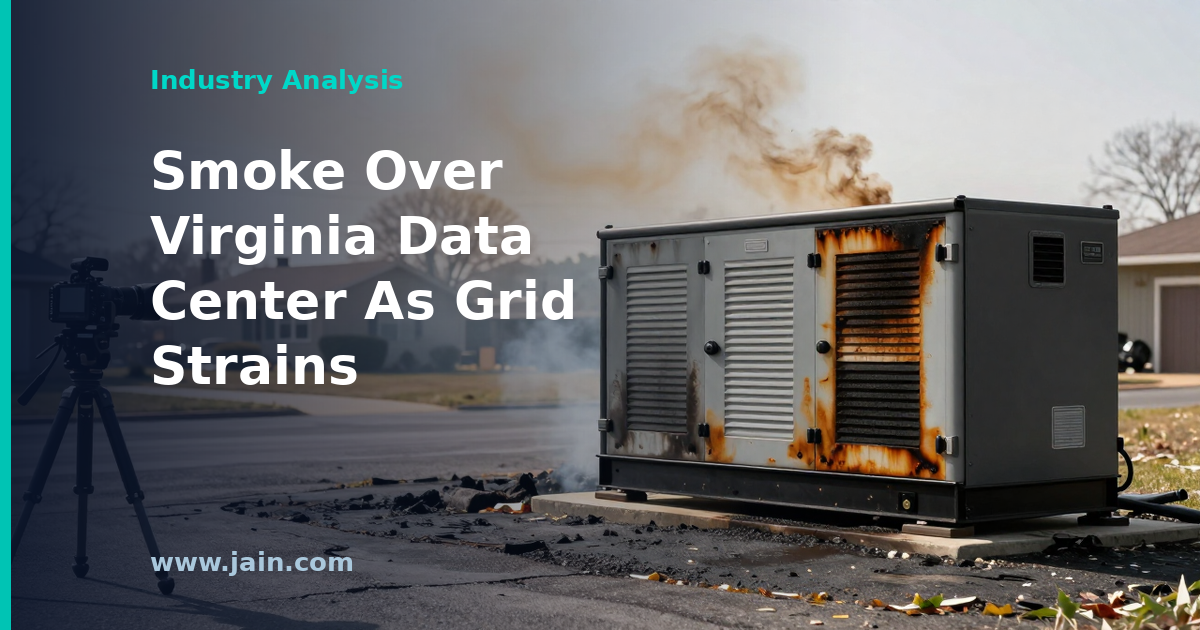
A data center in Virginia makes its own electricity with eight gas-burning turbines, each about the size of a bus, close to people’s homes.
A Harvard researcher estimated its air pollution could cause tens of millions of dollars a year in health harm. Virginia’s environmental regulator moved quickly to challenge that estimate, even though one of its own experts said judging health effects was outside his training.
Why it matters: more of the buildings that run artificial intelligence want their own power plants, and fights like this one will decide where they can be built.
Politico reported on July 25 that internal emails, obtained through a public records request, show Virginia’s Department of Environmental Quality (DEQ) organized a rebuttal to a health analysis of Vantage Data Centers’ self-powered facility in Sterling, Loudoun County, before that analysis was published. DEQ Director Michael Rolband forwarded the Piedmont Environmental Council’s report to seven air-permitting staff within five minutes of receiving it in early March. He asked for “a defensible critique that will stand the test of public and critical review.”
The Piedmont-commissioned study estimated that soot from the facility’s eight natural gas turbines could cause $53 million to $99 million a year in health costs, and 3.4 to 6.5 premature deaths, if the site emitted the maximum its permit allows. DEQ’s own report, released in late April, said actual emissions were 28 to 69 percent of permitted levels. The agency has said its staff “did not collaborate with PEC, Vantage or any other external participants” in its assessment.
Executive Summary
This dispute centers on the only data center in Virginia that generates its own electricity. Its on-site power system combines eight bus-sized natural gas turbines with dozens of backup diesel generators, and it sits in a residential area. DEQ’s 2023 permits allow up to 95 tons a year of nitrogen oxides (gases that help form smog) and more than 56 tons of soot, meaning fine particles that lodge in the lungs. Both pollutants are linked to asthma and heart attacks. Those limits are typical for a minor pollution source. The dispute arose because of where the facility sits, not because of how large the limits are.
It matters beyond one building because self-generation is becoming the industry’s answer to grid congestion. Dominion Energy disclosed in February that it receives about 10 new connection requests a month from large-load customers. It also disclosed that dozens of projects requesting a combined 70 gigawatts are waiting to connect, three times the utility’s all-time peak load. Vantage itself described its turbines to DEQ as “a temporary solution given the current power constraints of the grid.”
The episode shows how the health case against on-site generation gets built. Critics model the legal ceiling in the permit, not the meter reading. Even when actual emissions come in well below that ceiling, the permit keeps the higher figure in play.
The Permit Ceiling Is the Number That Gets Modeled
Michael Cork, a biostatistics research fellow at Harvard’s T.H. Chan School of Public Health, did not have Vantage’s operating data when Piedmont hired him. He used the only public figures available, which were the permitted maximums. That produced the headline range of $53 million to $99 million in annual health costs. Vantage objected that this was a “worst case scenario,” and DEQ’s report made the same point: measured emissions of soot, volatile organic compounds and nitrogen oxides ran at 28 to 69 percent of what the permit allows.
The correction lowered the estimate but did not end the argument. Cork reran his model with DEQ’s actual-emissions figures and arrived at $33 million to $63 million a year and two to four premature deaths. He also noted that nothing in the permit prevents the facility from increasing output back toward its ceiling. That is the mechanism the headline refers to. A permit is a legal right to emit, so outside analysts can reasonably treat it as the facility’s potential footprint, whatever the current meter shows.
This matters for developers planning on-site generation. Operators often seek permit headroom so they can run harder when the grid is strained or when load grows. That headroom has operational value. It is also, in effect, a published number that critics can model. A project that wants its real-world performance to count in public debate may need to make that performance binding, through enforceable limits closer to expected output or regular public reporting of actual emissions, rather than relying on a regulator to vouch for it after the fact.
Why Self-Power Keeps Spreading Anyway
The economics pushing data centers toward their own power plants are not easing. A 70-gigawatt connection backlog at a single utility means many projects face long waits for grid power. On-site gas turbines offer a way to start operating sooner. They also answer the political charge that data centers raise household electricity bills. The federal government has encouraged the model too: President Donald Trump promoted a wave of power plants for new data centers at a White House meeting with technology companies in early March.
The Vantage case shows the trade-off. Self-generation moves the power question off the utility’s books and onto the local air-permit docket. The cost stops appearing in rate cases and starts appearing in health-damage estimates for the neighborhood downwind. The more facilities follow this path, the more often permitting agencies will be asked to rule on disputes that go beyond their traditional remit.
A Regulator’s Rebuttal Is Not a Health Finding
The emails show disagreement inside DEQ about how far the agency should go. Michael Kiss, a manager in the Office of Air Quality Assessments, wrote that the magnitude of impacts was “relatively low” and not surprising. He also said he had “absolutely no comments on the health study” because “we aren’t qualified to do that review.” Robert Burnley, who led DEQ from 2002 to 2006, said the conventional defense of a permit is narrower: that the emissions do not cause a violation of air quality standards.
Several claims in DEQ’s final report are open to challenge on their own terms. The report said health impacts were “unlikely” because Loudoun County soot levels are below EPA standards. Health experts, including former EPA air quality official Michael Koerber, said soot can harm health even at EPA-approved levels, and the World Health Organization’s guideline is nearly half the EPA figure. The report also cited 2023 state health data, collected before Vantage began operating, to describe Loudoun as one of Virginia’s healthiest localities. That data says little about the facility’s effect.
For the industry, the lesson is practical rather than partisan. The Data Center Coalition circulated DEQ’s report to reporters and lawmakers as evidence that the Piedmont analysis was wrong. A rebuttal whose health reasoning is contested gives less protection than it appears to. The most useful thing DEQ published was arguably the actual-emissions data. It narrowed the dispute to a real number, even though that number still produced a substantial estimate.
Siting Near Homes Is Where the Costs Land
DEQ’s permits for Vantage are in line with other minor-source permits in the state. The concern stems from the facility’s location in a residential area. Neighbors report constant noise as well as air pollution. Vantage says it has taken steps to reduce the noise. Health-cost models of the kind Cork used scale with the number of people in a plume’s path, so the same turbines sited away from housing would generate a very different estimate.
Virginia has more than 600 data centers, and many future self-powered sites will compete for land in areas that are already developed. Where generation sits relative to homes is likely to be as consequential for permitting risk as how many tons it is allowed to emit.
Background
Northern Virginia, and Loudoun County in particular, hosts the world’s largest concentration of data centers, and Virginia is home to more than 600 of them. Dominion Energy, the region’s largest utility, has struggled to keep pace with demand. Large projects now wait in a queue that is far larger than anything the utility has ever served. In response, developers have begun planning facilities that generate their own electricity on site, usually with natural gas turbines.
Vantage Data Centers’ Sterling facility came before that trend. DEQ issued its air permits in 2023. The Piedmont Environmental Council, a Virginia conservation group, has been active on data center land-use and environmental impacts. The Data Center Coalition is the industry’s trade group. Source: Emails show how Virginia regulators downplayed data center health concerns — Politico’s report on internal DEQ emails concerning Vantage’s self-powered Loudoun County data center.Sources