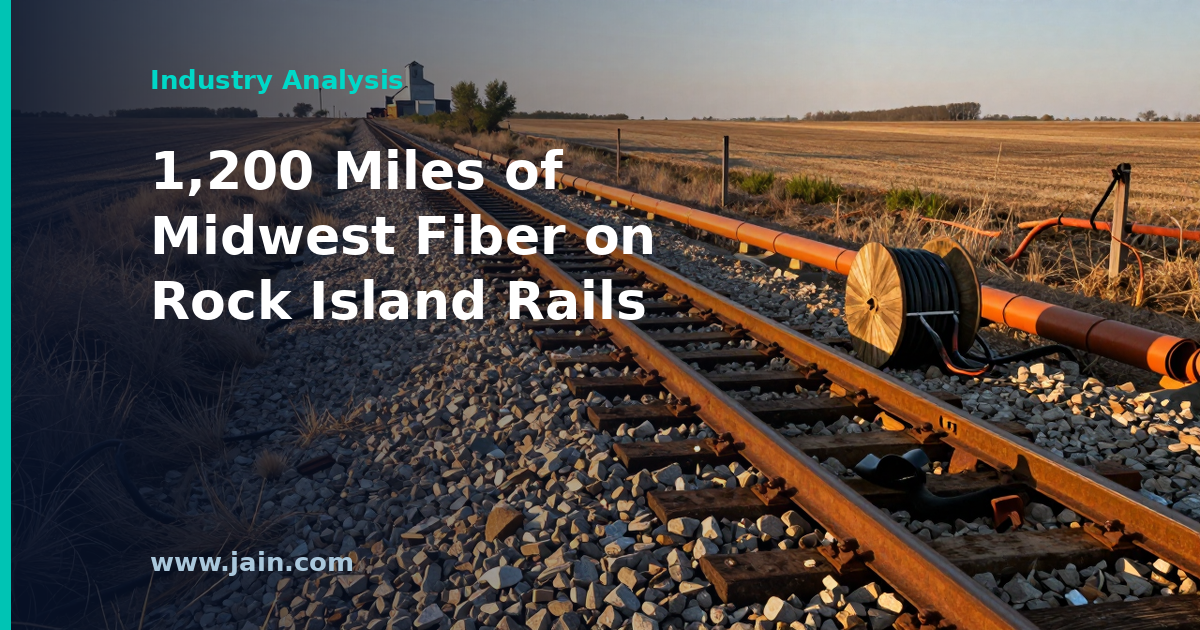
Midwest Fiber Networks (MWFN) and Midwest Fiberpath, LLC, together with Fiberpath partner Hawkeye Land Co., announced on August 27, 2026 an agreement to develop and commercialize approximately 1,200 miles of fiber corridors connecting Chicago, Omaha, Minneapolis and Kansas City. The announcement was issued from Glendale, Wisconsin and Cedar Rapids, Iowa.
Under the agreement, MWFN becomes the key provider supporting commercialization and delivery of connectivity services across Hawkeye’s right-of-way corridor, with planned offerings spanning conduit, dark fiber and scalable lit services for carriers, hyperscalers, data centers, enterprises, utilities, and public- and private-sector organizations. Construction is anticipated to begin in Spring 2027; the parties say the project is in advanced engineering and materials procurement, with shipments scheduled before the end of 2026.
Executive Summary
The headline number is 1,200 miles of long-haul fiber route across the middle of the country. The more interesting number may be 106 — the count of Midwest counties in four states where Hawkeye Land Co. says it holds the exclusive, perpetual right to grant easements along former Rock Island Railroad corridors. That includes rail corridors running from Council Bluffs to Joliet and from Minneapolis to Kansas City. In long-haul fiber, the hardest thing to buy is not glass or conduit; it is a continuous, legally clean path across hundreds of separate landowners and jurisdictions. This agreement is essentially an attempt to convert a 40-year-old land-rights portfolio into a telecom platform.
Why it matters: the AI buildout is pushing compute into secondary and tertiary markets — places chosen for power availability and land, not for network density. Those sites are only as useful as the routes that connect them, and in the Midwest a large share of legacy long-haul capacity funnels through Chicago. A route system with north–south and east–west legs that meet somewhere in the middle of Iowa rather than in Cook County changes the shape of what buyers can procure, and gives network planners a genuinely distinct path to price against.
What is not yet established: the release discloses no capital cost, no financing structure, no anchor customers, no conduit or fiber counts, and no in-service date. It describes an agreement and an intent, backed by a stated procurement position. Those are meaningful signals — materials orders are harder to fake than a press release — but they are not the same as a funded, contracted build. Buyers should treat this as a credible route under development, not as available inventory.
Route Diversity Is the Quiet Half of the AI Buildout
Most coverage of AI infrastructure focuses on the compute: the campuses, the megawatts, the cooling. The connectivity layer gets less attention because it is less photogenic, but it constrains the same outcomes. A training cluster needs to ingest and checkpoint enormous datasets; an inference site needs low, predictable latency to the users and applications it serves. Both need to reach the interconnection points where carriers and cloud providers exchange traffic. Put a facility in a secondary market with cheap land and available power, and you have solved the expensive problem while creating a new one — the site is stranded unless multiple physically separate fiber paths reach it.
“Route diversity” is the industry term for that separation. Two circuits sold as redundant are only redundant if they ride different physical paths; if both traverse the same bridge, the same conduit bank, or the same metro chokepoint, one backhoe or one building fire takes out both. In the Midwest, a great deal of legacy long-haul was engineered to converge on Chicago, historically the region’s dominant interconnection hub. That concentration is efficient until it isn’t. The announced corridor is pitched squarely at this problem, and the endpoint pairs Hawkeye names — Council Bluffs to Joliet, Minneapolis to Kansas City — describe an east–west leg and a north–south leg that cross well outside the Chicago metro.
It is worth being precise about the claim, though. Chicago is explicitly one of the four markets the corridor connects, and the Council Bluffs–Joliet leg terminates in the Chicago area. The value proposition is not “avoid Chicago”; it is “reach Chicago on a path other people are not using, and reach Minneapolis or Kansas City without going through Chicago at all.” That is a narrower but more defensible pitch, and it is the one that matters to a network planner filling out a diversity matrix.
The Asset Is the Right-of-Way, Not the Glass
Fiber cable is a commodity. Splicing crews are a commodity. Continuous, permitted, long-term access to a linear path across four states is not. Hawkeye Land Co. has been in the business of selling crossing and longitudinal easements along former Rock Island corridors since 1985, which means the entitlement work that usually dominates a greenfield long-haul schedule — negotiating with hundreds of landowners, counties and agencies, one parcel at a time — is substantially pre-solved. That is the economic core of this deal, and Hawkeye’s CEO Rick Stickle framed it in exactly those terms, calling the partnership “the highest and best” use of the company’s property rights.
The structure also explains the division of labor. Hawkeye holds the land rights but is not a telecom operator. Fiberpath is positioned as the corridor platform developer — a managed right-of-way system built for blank conduit and dense fiber deployments. MWFN brings the operating side: regional carrier relationships, service delivery, and the customer-facing commercial motion. Each party contributes the thing it would otherwise have to spend years and considerable capital acquiring. That is a sensible structure, and it is a common one in digital infrastructure, where land-rights holders increasingly partner rather than build.
The risk in this shape is coordination. Three parties, three balance sheets, and revenue that arrives over decades in the form of long-dated capacity contracts. The release does not describe how economics are shared, whether MWFN’s role is exclusive, or what happens if one party wants to sell. None of that is unusual to withhold, but all of it affects how much confidence a large customer can place in a 20-year commitment on this route.
Three Products, Three Different Businesses
The announced service set — conduit, dark fiber, and lit services — reads as one offering but is really three businesses with different capital profiles and different buyers. Empty conduit is the rawest form: a buried plastic pipe a customer can blow its own cable through, typically sold to hyperscalers and large carriers who want to control their own fiber and upgrade it on their own schedule. Dark fiber is unlit strand: the customer supplies the optical electronics and gets full control of capacity, latency and encryption, which is why it appeals to operators building at scale. Lit services are finished bandwidth — the provider runs the equipment and sells a circuit at a stated speed.
The economics run in the opposite direction from the sophistication. Conduit and dark fiber sales, often structured as long-term indefeasible-right-of-use agreements with substantial payment up front, are how corridor projects fund construction; they convert future revenue into present cash at the moment it is most needed. Lit services carry higher margins over time but require ongoing equipment investment, network operations, and a sales motion into a fragmented enterprise market. A route system that can sell all three has more ways to monetize each mile — but the first and largest deals almost always come from the conduit and dark-fiber end, which is exactly where hyperscaler demand currently sits.
What Is Substantiated, and What Is Framing
Two things in this release carry real weight. First, the Hawkeye rights are specific and checkable: an exclusive, perpetual easement-granting position across named corridors, held and commercially exercised for more than 40 years. Second, the procurement statement — advanced engineering and materials shipments scheduled before the end of 2026, ahead of a Spring 2027 construction start — implies committed spending. Companies do not typically order long-lead fiber and conduit materials for routes they are not serious about.
Other elements are framing rather than fact. This release does not mention AI at all; the AI positioning comes from a companion Fiberpath announcement describing the same 1,200 miles as a “center-noded, multi-direction AI backbone.” That is a legitimate market read — AI demand is genuinely reshaping long-haul procurement — but readers should note it is the same asset described twice for two audiences, not two separate developments. Similarly, phrases like “key provider supporting the commercialization” describe a commercial role without defining its scope or exclusivity.
An even-handed summary: this is a well-structured deal built on an unusually strong underlying asset, announced at the agreement stage with normal commercial confidentiality. It is not thin marketing — there is a real land-rights position and a stated procurement commitment behind it. It is also not yet a proven route. The distance between “agreement to advance” and “lit and sellable” is measured in years, and the milestones that would close that gap have not been published.
Background
The Chicago, Rock Island and Pacific Railroad ceased operations in 1980, and its corridors were broken up and sold. Hawkeye Land Co. was formed in 1985 around a durable piece of that estate: the exclusive, perpetual right to grant easements along the former Rock Island corridors across 106 Midwest counties in four states. For four decades that position has generated revenue from utilities and municipalities buying crossing and longitudinal easements. Railroad rights-of-way have long been prime telecom real estate for the same reason they were good railroad routes — they are straight, continuous, gently graded, and already assembled.
The current interest in Midwest long-haul reflects where compute is going. Power availability, land cost and cooler climates have pushed data center development into Iowa, Nebraska, Wisconsin and the Dakotas, away from the coastal and Northern Virginia clusters. Those sites need long-haul routes that did not exist when the region’s fiber map was drawn around Chicago in the late 1990s and early 2000s. Several developers are now trying to monetize legacy linear rights-of-way to serve that demand; this agreement is one of them.
Source: Midwest Fiber Networks and Midwest Fiberpath Announce Agreement to Advance 1,200-Mile Midwest Fiber Corridor — PR Newswire release dated August 27, 2026, announcing an agreement to develop and commercialize approximately 1,200 miles of fiber corridors across the Midwest.