
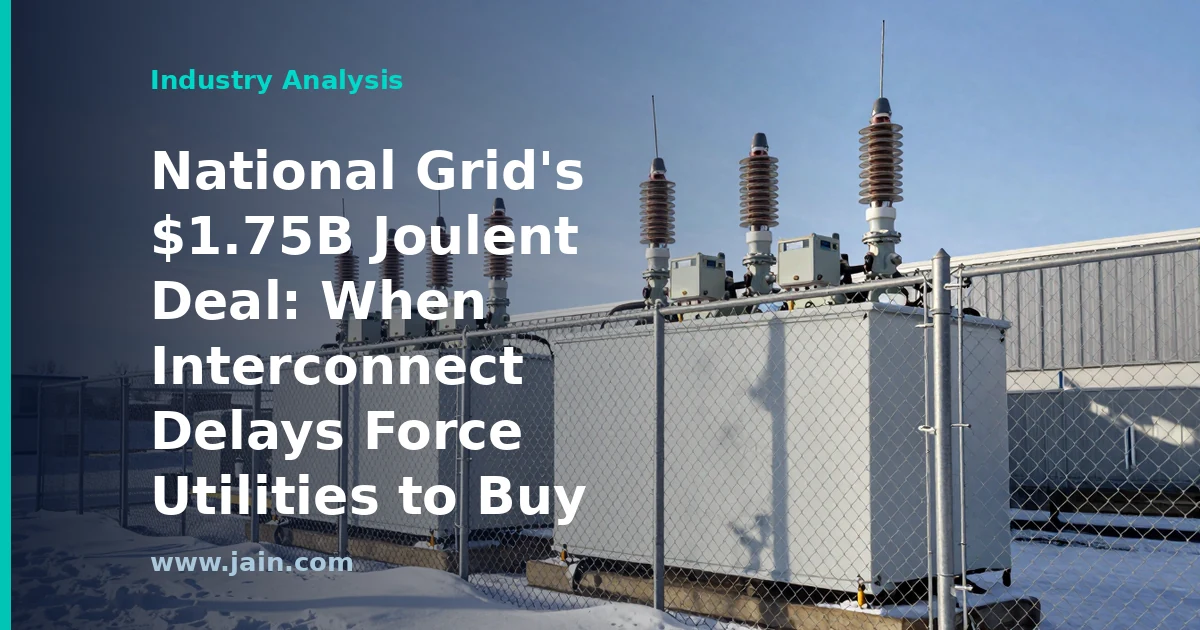
National Grid has struck a $1.75 billion deal with Joulent, according to a Data Center Knowledge report published July 1, 2026. The report frames the transaction as a response to mounting interconnection delays driven by AI data center demand — utilities, unable to connect new load fast enough through conventional build-out, are increasingly spending to acquire capacity and capability rather than queue for it.
Executive Summary
The reported transaction pairs one of the world’s largest electricity transmission and distribution operators with Joulent in a deal valued at $1.75 billion. The headline framing is the important part: the deal is attributed not to routine portfolio strategy but to AI interconnect delays — the growing backlog of requests to connect large new loads and generation to the grid, a process that in many regions now takes years.
Why it matters: if the reporting’s framing holds, this is a data point in a broader shift. Utilities have historically grown connection capacity by building — new substations, transformers, transmission lines — on regulated timelines. When AI-driven demand outruns those timelines, acquisition becomes the faster path. A $1.75 billion commitment suggests National Grid sees the capacity crunch as durable, not a passing spike. That said, the available source is a single news headline; the deal’s structure, scope, and closing conditions are not detailed in the material we can verify, and readers should treat specifics beyond the reported figure and parties with appropriate caution.
Why Buying Beats Building When the Queue Is the Bottleneck
Interconnection — the engineering and regulatory process of physically wiring a new data center, factory, or power plant into the grid — has become one of the defining constraints of the AI build-out. Studies, permitting, equipment procurement, and construction stack into multi-year waits in many markets, and lead times for critical hardware such as large power transformers and high-voltage switchgear have stretched dramatically since the early 2020s. In that environment, anything that already exists — installed equipment, an established delivery capability, a workforce, a manufacturing slot — carries a scarcity premium.
A utility that spends $1.75 billion to acquire capacity or capability it would otherwise wait years to build is making a straightforward time-for-money trade. The economics can work because the cost of delay is now enormous on both sides of the meter: hyperscale customers measure the cost of a stranded, unpowered data center shell in the millions per month, and utilities that cannot connect large customers forgo years of revenue from their fastest-growing load class.
National Grid’s Position in the AI Load Story
National Grid sits at the center of this dynamic in two major markets. It operates the high-voltage transmission network in England and Wales — where grid connection queues became a widely acknowledged national bottleneck and the subject of regulatory reform efforts — and it owns large regulated electricity and gas utilities in New York and Massachusetts, in the demand path of the US Northeast’s data center and electrification growth. Few companies feel interconnection pressure from as many directions at once.
That context makes the reported deal legible even without full details: a transmission-heavy utility facing connection backlogs on two continents has clear motives to secure capacity, equipment supply, or delivery capability by acquisition. It also carries risk. Large deals struck during a scarcity cycle can look expensive if the cycle turns — if AI load forecasts moderate or supply chains normalize, capacity bought at peak-crunch prices may earn a thinner return than capacity built patiently through the regulated process.
What $1.75 Billion Signals — and What It Doesn’t
The figure itself is the strongest signal in the reporting. Utilities are conservative, regulated businesses; a commitment of this size typically requires board conviction that the underlying driver — here, sustained AI-driven demand outpacing conventional grid expansion — will persist long enough to pay back the investment. In that sense the deal is a vote of confidence in continued data center growth, made by a party with unusually good visibility into actual connection requests rather than press-release pipelines.
What the number does not tell us is the mechanism. “Buying your way to capacity” can mean acquiring a company outright, purchasing assets, locking up equipment manufacturing capacity, or securing services under a long-term contract — and each has very different implications for competitors, regulators, and customers. The single-source material available does not specify which of these the National Grid–Joulent transaction is, what Joulent brings to the arrangement, or how the spend will be recovered. Those distinctions matter: an acquisition that removes a supplier or contractor from the open market can tighten conditions for every other utility shopping in it, while a capacity contract merely reallocates near-term supply.
Background
National Grid built its position over decades as the operator of Great Britain’s electricity transmission backbone before expanding into the US Northeast, where it serves millions of electricity and gas customers in New York and Massachusetts. In both markets it entered the mid-2020s facing an unprecedented problem: connection requests from data centers, electrified transport, and new generation arriving faster than networks could be studied, permitted, and built, prompting queue-reform efforts by regulators on both sides of the Atlantic.
The AI boom sharpened that squeeze into a defining industry constraint. Transformer and switchgear lead times stretched, hyperscale campuses began requesting connections measured in hundreds of megawatts, and ‘time to power’ displaced real estate as the data center industry’s scarcest resource — the backdrop against which a utility paying $1.75 billion to shortcut the queue becomes a rational, if notable, move.
Source: AI Interconnect Delays Spur $1.75B National Grid-Joulent Deal — Data Center Knowledge report, July 1, 2026, on National Grid’s $1.75 billion deal with Joulent amid AI-driven grid interconnection backlogs.