Tag: Johnson Controls

  • Johnson Controls’ Up-to-97MW Guide Shows On-Site Power’s Waste Heat Is AI Capacity

    Johnson Controls’ Up-to-97MW Guide Shows On-Site Power’s Waste Heat Is AI Capacity

    TL;DR · 30-second read

    The Short Version

    Artificial intelligence data centers, the warehouse-sized buildings packed with computers, are running short of electricity. Many now build their own power plants on site.

    Those generators give off a lot of leftover heat. Johnson Controls, a large maker of building cooling equipment, has published a design guide for machines that turn that heat into cooling, instead of powering the cooling with electricity.

    The company says this can free up to 97 megawatts, enough electricity for tens of thousands of homes, to run more computers.

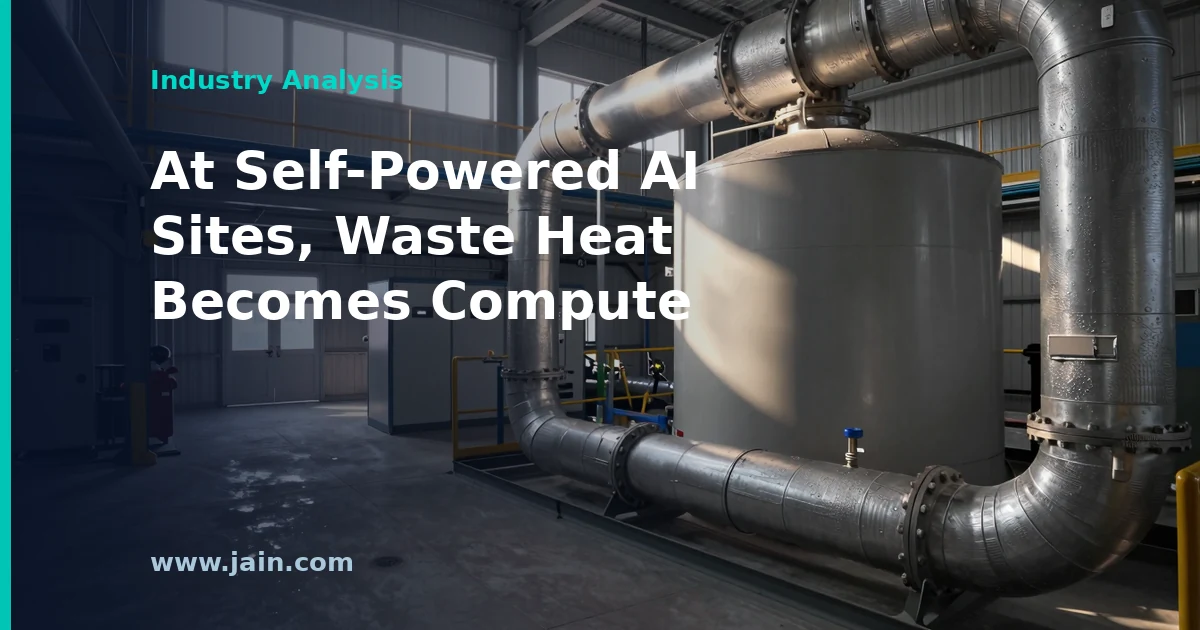
    Johnson Controls on July 29, 2026 introduced an Absorption Chiller Reference Design Guide aimed at AI data centers that generate their own electricity on site. According to the company’s announcement, the design can unlock up to 97MW of additional AI capacity. It does this by using waste heat from on-site generation to drive the facility’s cooling, which frees electricity that conventional electric chillers would otherwise consume.

    The guide is separate from the AI factory cooling reference design that Johnson Controls published earlier.

    Executive Summary

    A data center’s power supply is split between the computers themselves and everything that keeps them running, and cooling is one of the largest parts of that second share. Johnson Controls’ new guide targets that split. Absorption chillers produce chilled water using heat as their main energy input rather than an electric compressor. At a site that already burns fuel to make its own electricity, the exhaust and jacket heat from that generation can supply the chillers, so the electricity the cooling plant would have drawn can go to servers instead.

    The headline figure is an upper bound: up to 97MW. Johnson Controls has not tied that number publicly to a specific site size, generator type or climate. The strategic point stands even so. As AI developers move generation behind the meter to avoid long grid-connection waits, the heat those plants produce becomes an asset to design around, not a byproduct to vent. By publishing a dedicated guide for that scenario, separate from its broader AI factory cooling design, Johnson Controls is treating on-site power as its own design category.

    Why Waste Heat Becomes Compute Capacity

    A power-constrained AI campus has a fixed electrical budget, and every megawatt spent on cooling is a megawatt not spent on GPUs. Conventional data center cooling relies on vapor-compression chillers, the same basic principle as a household refrigerator, which run large electric compressors. Absorption chillers work differently. They use a heat source, such as hot water, steam or engine exhaust, to drive a refrigeration cycle, and they need only modest electricity for pumps and controls.

    Every fuel-burning generator, whether a gas turbine, a reciprocating engine or some fuel cell types, turns only part of its fuel into electricity. The rest leaves as heat. If that heat drives absorption chillers, much of the cooling load moves off the electrical budget and onto a thermal budget that was otherwise going to waste. The electricity released can power IT load. That is the mechanism behind Johnson Controls’ claim of up to 97MW of additional AI capacity. The pairing of generation with heat-driven cooling, long known as combined cooling, heat and power or trigeneration, is not new. What is new is framing it as a way to add AI compute capacity rather than as a way to save energy.

    The people most affected are developers building campuses with behind-the-meter generation, and the investors financing them. For those projects, capacity is often capped by how much power the site can produce, not by floor space or chip supply. Recovering cooling power from waste heat raises the ceiling on revenue-generating compute without adding generators.

    On-Site Power Changes the Cooling Question

    Grid interconnection, the process of getting a utility to connect a large new load, has become one of the slowest steps in AI data center development. That has pushed developers toward generating their own electricity, at least as a bridge until grid power arrives. Once a site makes its own power, its cooling design no longer has to assume that all energy arrives as electricity. Heat is available too, and a reference design that shows how to use it addresses a question these projects now face.

    This also explains why Johnson Controls kept the absorption guide separate from its earlier AI factory cooling reference design. A grid-fed facility and a self-powered facility start from different energy inputs, so a single template would fit one of them poorly. Splitting the guidance by power strategy lets engineers start from the case that matches their site.

    What “Up To” Leaves Open

    The benefit depends on several variables. It scales with how much recoverable heat the generation plant produces and at what temperature. It also scales with how much mechanical cooling the facility needs to begin with. Many new AI halls use direct liquid cooling with relatively warm water, which can reduce how many hours electric chillers must run. In those designs, the electricity an absorption system saves may be smaller than in a facility that relies heavily on chillers.

    There are physical trade-offs too. Absorption chillers are typically larger and heavier than electric chillers of similar cooling output. They also reject more total heat, which usually means bigger cooling towers and possibly more water use. The cooling supply becomes tied to generator operation, so designers must plan for backup cooling when generators are down for maintenance. None of this undermines the concept. It does mean the up-to-97MW figure is a best case, and actual gains will vary from site to site.

    Reference Designs as a Sales Channel

    For an equipment maker, a reference design is both engineering guidance and a way to get specified early. Developers under schedule pressure tend to adopt pre-engineered architectures instead of designing mechanical plants from scratch, and the vendor behind the template benefits. Johnson Controls, which sells chillers under its York brand, is positioning itself at the point where cooling decisions become inseparable from power strategy. That link matters more as on-site generation spreads across AI projects.

    Background

    Johnson Controls is one of the largest suppliers of commercial heating, ventilation and air conditioning equipment. Its York-brand chillers are widely used in large buildings and data centers. As AI workloads have driven sharp increases in rack power density, cooling vendors have released AI-specific reference architectures. Johnson Controls had already published an AI factory cooling reference design before this absorption chiller guide.

    Absorption cooling is a mature technology that has long been paired with on-site generation at universities, hospitals and industrial plants. Its relevance to data centers has grown as AI developers, facing slow grid connections, increasingly build their own generation and look for ways to get more compute out of every megawatt they produce.

    Sources

    Source: Johnson Controls introduces Absorption Chiller Reference Design Guide, unlocking up to 97MW of additional AI capacity from on-site power generation. Johnson Controls’ announcement of a reference design that uses on-site generation waste heat to cool AI data centers.

  • Johnson Controls Q2 Sales Rise 8% on Data Center Cooling Demand

    Johnson Controls Q2 Sales Rise 8% on Data Center Cooling Demand

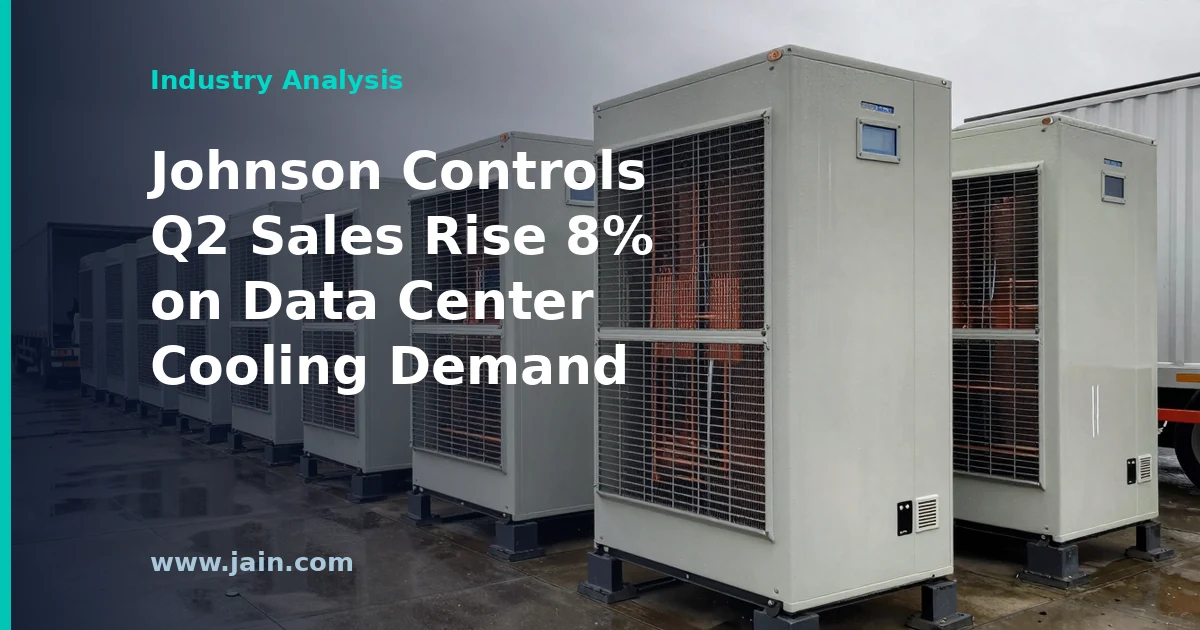
    Johnson Controls, one of the world’s largest building-technology and HVAC companies, reported an 8% year-over-year increase in sales for its fiscal second quarter, with data center cooling demand cited as a principal driver, according to a May 7, 2026 report by Facilities Dive. Because Johnson Controls’ fiscal year ends in September, its second quarter covers roughly January through March 2026.

    Executive Summary

    The headline number — 8% sales growth at a company of Johnson Controls’ scale — is notable less for its size than for its attribution. When a diversified industrial that sells everything from fire-suppression systems to building controls credits data center cooling as the engine of a quarter, it quantifies something the industry has sensed for two years: AI-driven data center construction has become a primary demand source for the industrial HVAC sector, not a niche vertical.

    Cooling is the second-largest consumer of power and capital in a data center after the IT equipment itself, because nearly every watt a server draws becomes heat that must be removed. As hyperscale operators — the companies running the largest cloud and AI facilities — race to add capacity, the vendors who make chillers, air handlers, and thermal-management systems are seeing that race show up directly in their revenue lines. Johnson Controls’ quarter is one of the cleaner public data points yet on how large that effect has become.

    From Building Controls to AI Infrastructure Supplier

    Johnson Controls has spent recent years narrowing its portfolio toward commercial buildings and applied HVAC — the large, engineered cooling systems used in campuses, hospitals, and data centers — including divesting its residential and light-commercial HVAC business to Bosch and acquiring Silent-Aire, a maker of modular cooling and hyperscale data center equipment, in 2021. A quarter in which data center cooling is called out as the growth driver suggests that repositioning is doing what it was designed to do: concentrate the company’s exposure where capital spending is heaviest.

    That matters for how investors and customers should read the company. Johnson Controls is increasingly priced and evaluated not as a building-products conglomerate but as a supplier to AI infrastructure buildouts — a category that commands different growth expectations, and different scrutiny, than traditional construction-linked HVAC.

    The Economics of the Cooling Boom

    Data center cooling is attractive business for industrial vendors for structural reasons. The equipment is large, engineered-to-order, and often sold with long-term service contracts — chillers (machines that produce chilled water to absorb heat from server halls) run continuously for decades and require ongoing maintenance. Hyperscale projects are also ordered in fleets rather than units, which fills factory backlogs years ahead and gives manufacturers unusual visibility and pricing power compared with the one-building-at-a-time commercial construction cycle.

    The industry is simultaneously navigating a technology transition. As AI chips grow denser, air cooling reaches physical limits, and liquid cooling — circulating coolant directly to the chips or their racks — is taking a growing share of new deployments. That transition is an opportunity for incumbents with liquid-capable portfolios and a risk for anyone whose installed strength is concentrated in legacy air-based systems. The source report does not break down how much of Johnson Controls’ growth came from which technology, a distinction that matters for judging how durable the growth is.

    A Rising Tide Across the Vendor Field

    Johnson Controls is not alone in reporting data-center-driven strength; the same demand wave has lifted results across thermal-management and power-equipment vendors, and competitors such as Vertiv, Carrier, Trane Technologies, Schneider Electric, Munters, and Daikin all compete for slices of the same buildouts. The significance of this quarter is corroborative: each vendor that attributes measurable growth to data centers adds evidence that hyperscale capital spending is flowing through to the industrial supply chain broadly, rather than pooling with one or two specialists.

    For data center operators and enterprises planning capacity, the flip side of vendor prosperity is procurement reality: strong vendor demand typically means longer lead times and firmer pricing for large cooling equipment. Buyers who plan orders early, standardize designs, and lock delivery slots hold the advantage in a seller’s market.

    The Concentration Question

    The risk embedded in an 8% quarter driven by one end market is the same as its appeal: concentration. Data center demand is ultimately a derivative of a handful of hyperscalers’ AI capital-expenditure decisions. If AI infrastructure spending decelerates — because of monetization pressure, power-availability constraints, or efficiency gains that reduce cooling intensity per unit of compute — the vendors that re-oriented toward this vertical would feel it quickly. Nothing in the source report suggests that is imminent, but a growth story built on one customer class deserves to be monitored as one.

    The even-handed reading: this quarter substantiates real, current demand flowing to a major HVAC vendor. It does not, by itself, establish how long the cycle runs, and the headline-level detail available leaves the durability question open.

    Background

    Johnson Controls traces its roots to 1885, when Warren S. Johnson commercialized the electric room thermostat, and grew over the following century into one of the world’s largest building-technology companies, spanning HVAC equipment (including the York chiller brand), building automation, and fire and security systems after its 2016 merger with Tyco. In recent years the company has deliberately narrowed toward commercial and engineered building systems, selling its residential and light-commercial HVAC business to Bosch and investing in data center capabilities, most visibly through the 2021 acquisition of hyperscale cooling specialist Silent-Aire.

    That repositioning coincided with the AI infrastructure boom, in which data center construction — and the power and cooling systems it requires — became one of the fastest-growing capital-spending categories in the global economy, reshaping demand for the entire industrial HVAC sector.

    Source: Data center cooling drives Johnson Controls’ Q2 sales up 8% — Facilities Dive report (May 7, 2026) on Johnson Controls’ fiscal second-quarter results and the role of data center cooling demand.

  • Johnson Controls Publishes Second AI Factory Cooling Reference Design Guide

    Johnson Controls Publishes Second AI Factory Cooling Reference Design Guide

    Johnson Controls announced on May 5, 2026 the release of its second data center reference design guide, aimed at advancing cooling for industrial-scale AI factories — the very large, GPU-dense data centers built to train and run artificial intelligence models. The guide follows the company’s earlier reference design publication and continues its effort to give data center developers pre-engineered, repeatable cooling blueprints rather than one-off custom designs.

    Executive Summary

    The announcement itself is straightforward: a major cooling and building-technology vendor has published a second installment in a series of reference design guides for AI data center thermal management. A reference design, in this context, is a validated engineering template — equipment selections, piping and airflow topologies, controls logic — that a developer can adopt largely as-is instead of engineering a cooling plant from scratch for every project.

    Why it matters is the industry moment. AI computing has pushed rack power densities far beyond what traditional air cooling handles economically, forcing a rapid shift to liquid cooling. That shift has collided with a shortage of engineers who have actually designed liquid-cooled facilities at scale. Vendors who can package proven designs stand to compress project timelines and, not incidentally, lock their own equipment into the template. Johnson Controls publishing a second guide signals both that the first found an audience and that the company sees standardized, productized cooling design as a durable competitive front — not a one-off marketing exercise.

    Reference Designs Are the Industry’s Answer to a Speed Problem

    The binding constraints on AI data center construction are power, equipment lead times, and engineering hours — in roughly that order. Every hyperscaler and colocation developer is trying to shorten the time from land acquisition to energized racks, and bespoke mechanical design is one of the slowest, most error-prone stages. A reference design guide attacks that stage directly: if the cooling plant is pre-engineered and pre-validated, developers can order long-lead equipment earlier, permit faster, and reuse the same design across multiple sites.

    This mirrors what happened in earlier infrastructure waves. Hyperscale data centers of the 2010s converged on repeatable electrical and mechanical templates, which is a large part of how build times fell even as facilities grew. AI factories reset that progress because liquid cooling — circulating fluid directly to chips or to rear-door heat exchangers instead of relying on chilled air — changed the entire mechanical architecture. Reference designs are how the industry rebuilds its muscle memory for the new architecture.

    Standardization Is Also a Land Grab

    A vendor-published reference design is not a neutral standard. It is a template built around the publisher’s own chillers, coolant distribution units, controls, and services. If a developer adopts the guide, Johnson Controls equipment becomes the default bill of materials, and switching components later means re-validating the design. That is the same playbook chip vendors use with their own data center reference architectures: publish the blueprint, become the default.

    Seen that way, a second guide is a competitive statement aimed at the other large thermal players — the established chiller and precision-cooling manufacturers all racing to publish AI-ready architectures — and at engineering firms whose custom-design business a good-enough template partially displaces. For buyers, the trade-off is real but usually favorable: some vendor lock-in in exchange for schedule certainty and a design someone else has already de-risked. The buyers with the least to gain are those with strong in-house engineering; the biggest beneficiaries are the second wave of AI data center developers — enterprises, sovereign projects, smaller colocation firms — who lack liquid-cooling experience entirely.

    What a Guide Can and Cannot Prove

    It is worth being clear-eyed about what a design document demonstrates. Publishing a guide shows engineering investment and market intent; it does not by itself prove field performance, energy efficiency, or delivery capacity at the scale AI factories demand. The metrics that ultimately matter — cooling capacity per megawatt, water and energy consumption, equipment lead times, uptime in operation — are established by built projects, not publications. The announcement, as reported, is a step in productizing AI cooling; the evidence of success will be reference customers and operating facilities that used the designs. That is not a criticism of the release so much as the correct lens for reading any vendor reference architecture.

    Background

    Johnson Controls traces its history to the 19th-century invention of the room thermostat and has grown into one of the world’s largest building-technology companies, spanning HVAC equipment, industrial chillers, controls, and services. Over the past several years it has leaned hard into data centers as a growth market, positioning its chiller lines, coolant distribution equipment, and controls for the AI buildout.

    The market context is a structural shift: the AI boom has driven rack power densities beyond air cooling’s practical limits, making liquid cooling a requirement rather than a niche option and setting off a race among thermal-management vendors to publish standardized, repeatable designs. Reference architectures — long a fixture in chip and server ecosystems — have become the mechanism through which cooling vendors compete to define how AI factories get built.

    Source: Johnson Controls releases second data center reference design guide to advance industrial-scale AI factory cooling — PR Newswire announcement, May 5, 2026, of the company’s second cooling reference design guide for AI data centers.