Tag: inverters

  • A 2% Premium Shows the Inverter Switch for AI-Era Power Hinges on Time, Not Price

    A 2% Premium Shows the Inverter Switch for AI-Era Power Hinges on Time, Not Price

    TL;DR · 30-second read

    The Short Version

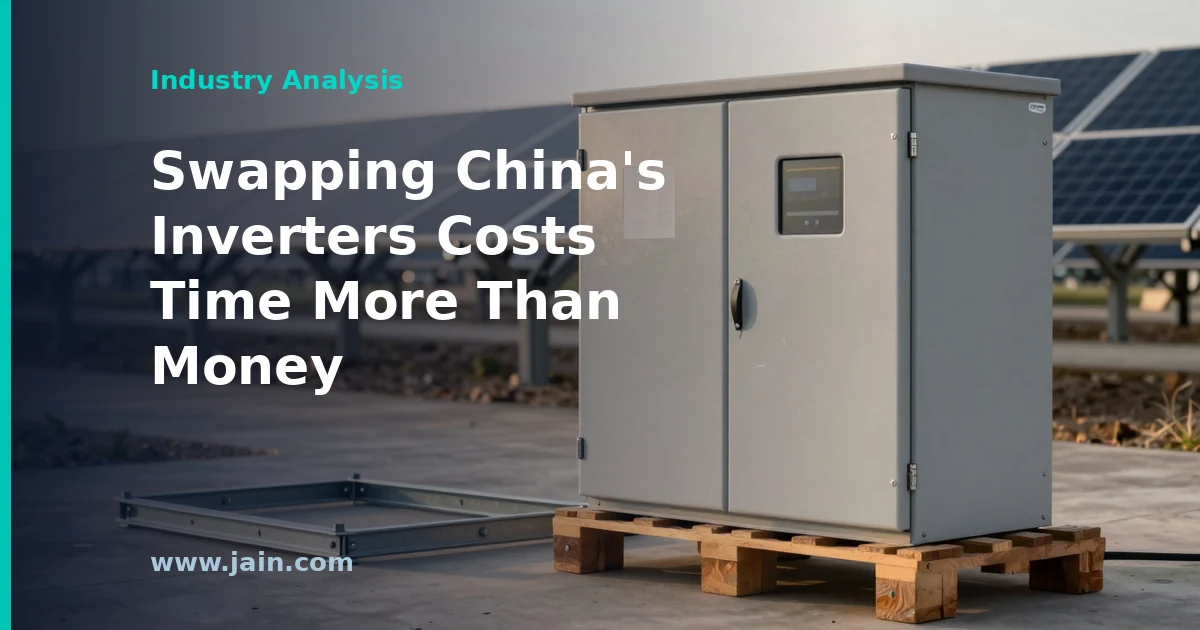
    Every solar panel and battery farm needs a box called an inverter, which turns its power into the kind your sockets use. Many are connected to the internet, so a hacker could in theory take control of them.

    China has the factories to make about four in every five of the world’s inverters. Europe plans to stop funding big solar and battery farms that use inverters from countries it considers risky, including China.

    The International Energy Agency found switching adds only about 2% to a large solar farm’s cost. The harder part is time, as factories retool while artificial intelligence data centers need ever more power.

    In a commentary published July 29, 2026, the International Energy Agency (IEA) reported that China accounted for around 80% of global manufacturing capacity for the inverters used in solar and battery installations in 2025, and assessed the cost of moving away from suppliers that governments now classify as security risks. The analysis follows a European Commission decision to restrict EU funding, including through the European Investment Bank and European Investment Fund, for solar, wind and storage projects that use inverters from “high-risk” countries: China, Russia, Iran and North Korea.

    The IEA estimates that buying a utility-scale inverter from a manufacturer headquartered in the EU or another non-high-risk country costs about USD 13/kW more, roughly 75% above Chinese pricing, but adds just under 2% to total project cost. Europe’s inverter factories, at around 95 GW a year, already exceed its roughly 90 GW of annual shipments, though the IEA warns the models built locally may not match the models in demand.

    Executive Summary

    Inverters are the control layer of modern renewable power: the electronics that convert direct current from solar panels, batteries and many wind turbines into grid-ready alternating current, and that manage power flow, monitoring and grid safety. Because most are networked and remotely controllable, governments increasingly treat them as a cybersecurity exposure, with risks ranging from compromised passwords to back doors planted during manufacturing or malicious software updates.

    The policy response is spreading. Beyond the new EU funding restrictions, the US National Defense Authorization Act passed in December 2025 bars its funds from buying inverters from designated Foreign Countries of Concern, including China; Lithuania restricts remote control of inverters and now applies those rules to existing installations; and India requires inverters in a subsidised rooftop scheme to send data only to servers in India.

    The IEA’s central finding is that the price of de-risking is modest at the project level. That matters for anyone financing or buying power from new solar and storage, including the large electricity buyers behind AI data center growth: the binding constraint looks less like cost and more like whether the right inverter models can be produced in time.

    The Premium Is Real, but It Shrinks at Project Scale

    On a per-unit basis, the gap between Chinese and non-Chinese inverters is large. The IEA puts the average global inverter shipment price at around USD 28/kW, with high-power three-phase units near USD 25/kW and microinverters near USD 180/kW. For the systems typically used in utility-scale projects, shipments in key EU markets carried a premium of about USD 13/kW (EUR 12/kW) over Chinese prices, roughly 75% higher. The IEA attributes China’s lower prices to economies of scale, higher automation and intense price competition.

    Measured against the whole project, though, that premium is small. Utility-scale solar in the EU cost around USD 760/kW in 2024, so a USD 13/kW inverter premium works out to just under 2%. Small residential and commercial systems are more exposed: at around USD 1,000/kW installed, the IEA estimates a 3-4% premium for string inverters and about 20% for hybrid inverters and microinverters. In other words, the cost burden of the security push falls most heavily on rooftop segments the EU rules are not expected to cover, and least heavily on the utility-scale projects they are.

    Why the Constraint for AI-Era Power Is Timing, Not Price

    The headline aggregate looks comfortable: Europe could make around 95 GW of inverters a year in 2025, against total shipments of about 90 GW. Inverters are the one step of Europe’s solar supply chain where capacity exceeds demand, compared with just 33 GW of module capacity, 10 GW of cells and 1.5 GW of wafers against roughly 70 GW of module demand. Even adding around 17 GW of stationary battery deployment, which needs bidirectional power conversion, the IEA judges domestic capacity to be in excess of demand.

    The catch is fit. The IEA expects a likely mismatch between the models Europe produces and the models its market wants, noting that string and microinverters are often imported from China, and that retooling production lines to close those gaps is possible but would take some time. It says the mismatch could lead to project delays and cost increases. For utility-scale solar and storage developers, that is the operational risk: a sub-2% cost line is easy to absorb in a financial model, but a procurement delay on a power-conversion package can push back energisation dates.

    That sequencing matters to the buyers of that power. Data center operators expanding capacity for AI workloads are among the largest contracted buyers of new utility-scale solar and battery output, and utility-scale projects are expected to make up around half of global capacity additions over the coming decade in the IEA’s exploratory scenario projections. Where those projects rely on EU financing, the practical question for a data center’s power team is not whether compliant inverters cost more, but whether suppliers can deliver the specific models on schedule. The IEA points to partial relief: redistributing European output between exports and domestic demand, and higher imports from non-high-risk producers, notably in Southeast Asia.

    Security Rules Are Landing Where Controls Are Already Strongest

    The IEA describes how an attacker who gains access to an inverter could control and alter the equipment connected to it, with consequences ranging from localised disruption to lengthy blackouts. The threat can come through weak online connections and passwords, through back doors built in at the factory, or through malicious software updates from the manufacturer.

    The anticipated scope of the EU rules raises a fair question about fit between risk and remedy. Based on currently available information, the restrictions are widely expected to apply directly only to EU-funded utility-scale projects, which the IEA notes are professionally operated under stringent cybersecurity protocols. Most smaller rooftop installations in homes and businesses are not expected to be covered. Existing EU instruments, including the NIS2 directive, the Cyber Resilience Act and the Network Code on Cybersecurity, already address equipment security; how the new funding rule adds to them will depend on details the Commission has yet to publish.

    A Trade Dispute Layered on an Engineering Problem

    China is the only major inverter supplier among the four countries the EU designates as high-risk, and on May 8, 2026, China’s Ministry of Commerce criticised the restrictions, warning they could damage trade relations, supply chain security and Europe’s energy transition. Other markets face sharper exposure than Europe: Korean inverter manufacturers have raised concerns about the country’s more than 90% dependence on Chinese suppliers.

    The policy tools differ. The US approach restricts federally funded procurement, the EU’s restricts funding eligibility, Lithuania’s governs remote control and requires retrofits of some existing installations, and India’s targets where data is stored. For developers and equipment buyers operating across several markets, the likely outcome is not one standard but a patchwork of compliance regimes, each with its own implications for vendor selection and project timelines.

    Background

    Solar power has become one of the largest sources of new electricity worldwide: the IEA counts almost 3 TW of installed solar capacity supplying nearly 9% of global electricity, none of which could function without inverters. Battery storage and many modern wind turbines depend on the same power-conversion electronics, and inverters increasingly coordinate with connected loads such as electric car chargers, heat pumps and air conditioners.

    Chinese manufacturers have come to dominate inverter production through scale, automation and price competition, offering what the IEA describes as typically the lowest-cost option in most major markets with high performance and reliability. Europe is the second-largest producer, with about 8% of global capacity, and inverters are the one stage of its solar supply chain where domestic manufacturing exceeds demand.

    Sources

    Source: Inverter supply chains and cybersecurity – Analysis (International Energy Agency), an IEA commentary on inverter supply concentration, new EU sourcing restrictions and the cost of switching suppliers.

  • Grid Emergency Order Puts Data Center Power Procurement in Play

    Grid Emergency Order Puts Data Center Power Procurement in Play

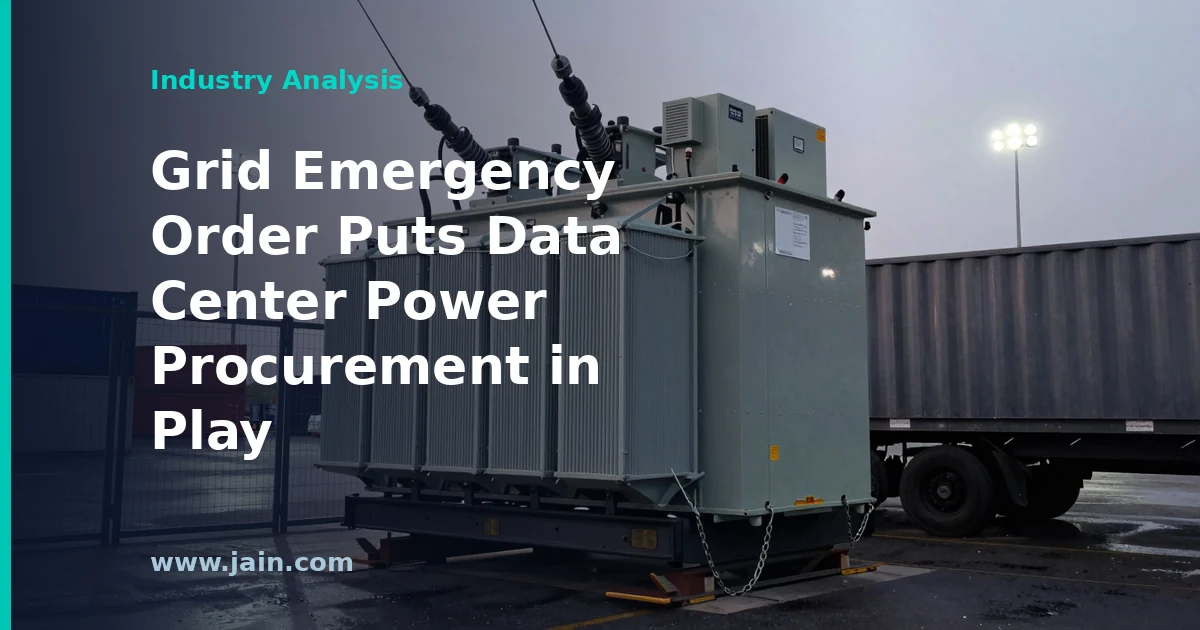
    President Trump has declared a national emergency covering the U.S. electric grid and moved to block certain foreign-made equipment from being installed on it, according to a report published by Utility Dive on May 2, 2026. The action is framed as a national-security measure aimed at hardware installed in the bulk power system — the high-voltage backbone that moves electricity from generators to local distribution networks.

    The report available to us is a headline-level summary rather than a full text of the declaration, so the operative details — which equipment classes are covered, which countries or vendors are implicated, when restrictions take effect, and whether orders already in transit are exempt — are not established by the source. What is established: an emergency has been declared, and a prohibition on some foreign-made grid equipment is being pursued.

    Executive Summary

    Emergency declarations matter in the power sector because they unlock authorities that ordinary rulemaking does not. Depending on the statute invoked, a declared emergency can let federal agencies restrict procurement, direct generation to stay online, or waive certain permitting and environmental review steps. The same declaration can therefore both accelerate some projects and constrain others — which is precisely the tension for anyone buying electrical infrastructure right now.

    For data-center developers, the constraint side is the one to watch. Large power transformers, medium-voltage switchgear, high-voltage breakers, and grid-tied inverters are long-lead items with a globally concentrated supply base. Any restriction that narrows the pool of qualified suppliers pushes demand toward domestic manufacturers whose order books are already committed to utilities. The binding constraint on a campus is rarely the servers; it is the substation.

    The measured read is that this is a supply-side policy event with delivery-schedule consequences, not a demand-side one. It does not change how much power AI and cloud buildouts need. It changes who is legally permitted to sell the hardware that delivers it, and how long the queue is to get it.

    What a Grid Equipment Lockdown Actually Touches

    “Grid equipment” is a broad phrase covering a narrow set of physically enormous objects. The category most exposed is the large power transformer — a custom-built unit, often weighing hundreds of tons, that steps voltage up or down between transmission and distribution. These are not catalog items. They are engineered to a utility’s specification, built to order, and shipped by specialized heavy haul. A second category is power electronics: grid-tied inverters that convert direct current from solar and battery systems into alternating current the grid can accept, along with the control and communications gear that supervises them.

    The security argument for scrutinizing this hardware is not exotic. Modern transformers and inverters contain embedded firmware, remote monitoring links, and control interfaces. A component installed on the bulk power system sits inside the trust boundary of critical infrastructure for decades. Whether the current declaration reflects a specific, documented threat or a precautionary posture is exactly what the underlying record would need to show — and the summary source available here does not show it either way. That is a gap in what has been published, not evidence for or against the policy.

    The counter-consideration deserves the same seriousness. Restricting suppliers on a compressed timeline can degrade reliability through a different mechanism: utilities that cannot source replacement units carry thinner spares inventories, and thin spares turn ordinary equipment failures into extended outages. A durable policy has to weigh the security risk of a compromised component against the reliability risk of a component that cannot be obtained at all. Neither risk is hypothetical, and the release as reported does not tell us how the administration balanced them.

    The Procurement Math for Data Center Developers

    Data-center power procurement is a queue problem before it is a price problem. A developer signs an interconnection agreement with a utility, and that agreement typically requires new or upgraded substation equipment. Some of that equipment the utility buys; increasingly, on large campuses, the customer buys it — sometimes ordering transformers years ahead and holding them as owner-furnished equipment. That practice exists precisely because lead times for heavy electrical gear have been the industry’s chronic bottleneck for several years, well before this declaration.

    Narrowing the approved supplier list reprices that queue in two ways. First, orders redirect toward domestic and allied manufacturers whose capacity is already substantially spoken for, extending waits for everyone in line. Second, buyers with the balance sheet to place speculative orders, pay expedite premiums, and absorb schedule slippage gain a relative advantage. That asymmetry favors hyperscalers and the largest developers over regional colocation operators and enterprise self-builds. The policy is neutral on its face; its practical incidence is not.

    The winners are more predictable than usual. Domestic transformer and switchgear manufacturers, and firms with U.S. or allied-country assembly footprints, gain pricing power and a stronger case for capacity expansion. Whether that translates into new domestic factories depends on whether they believe the restriction will outlast the administration that issued it — a genuinely open question given that grid-equipment restrictions have been issued, suspended, and revisited across previous administrations. Manufacturers finance multi-hundred-million-dollar plants on decade horizons, not on executive actions that can be reversed by the next signature.

    Interconnection Timelines and the Risk of Both Directions

    The most consequential detail, and the one the reported summary does not settle, is retroactivity. If restrictions apply only to future purchase orders, developers with equipment already ordered are largely insulated and the market effect is gradual. If they reach equipment already manufactured, in transit, or installed but not yet energized, the effect is immediate and disruptive: projects near completion could face requalification, re-sourcing, or replacement of units that cost millions and take years to rebuild. The gap between those two scenarios is the difference between a manageable procurement adjustment and a wave of schedule failures.

    Emergency authorities cut both ways here, which is why the declaration should not be read as purely restrictive. The same posture that constrains sourcing can also be used to expedite approvals, keep retiring generation available, or prioritize allocation of scarce equipment to critical loads. Whether data centers are treated as a critical load or as discretionary demand competing with residential and industrial customers is a policy choice that has not been publicly resolved — and it materially affects who gets a transformer first.

    The practical response for anyone with capital committed to a site is unglamorous: audit the country of origin and component provenance of every long-lead electrical item on order, confirm with suppliers whether their units and subassemblies would fall inside a plausible restriction, and revisit contractual force-majeure and schedule-relief language with counsel. Those steps are cheap relative to the exposure, and they are worth taking before the operative text is fully known rather than after.

    Reading a Thin Source Honestly

    One editorial note is warranted. The material available for this article is a headline and a trade-press attribution, not the text of the declaration or an accompanying order. That supports reporting the fact of the action and analyzing the mechanisms it plausibly engages. It does not support claims about scope, covered nations, dollar impacts, or effective dates, and readers should treat any coverage asserting those specifics without citing the operative document with corresponding caution.

    It also means the policy deserves evaluation on its published record once that record exists. Supporters will argue that supply-chain provenance in critical infrastructure is a legitimate and long-standing security concern that prior administrations of both parties have engaged with. Critics will argue that emergency authorities are a blunt instrument for a structural manufacturing problem, and that capacity is built by sustained industrial policy rather than by prohibition. Both arguments are testable against the actual order — its findings, its exemptions, and its waiver process. Neither is testable against a headline.

    Background

    Concern about foreign-manufactured equipment on the U.S. bulk power system predates this action. A 2020 executive order sought to restrict bulk-power-system equipment associated with foreign adversaries; it was suspended under the subsequent administration and the underlying policy question revisited, with the Energy Department separately addressing certain equipment serving critical defense facilities. The recurring theme across those efforts is that transmission-class hardware is long-lived, software-controlled, and sourced from a globally concentrated manufacturing base.

    That base has been strained independently of security policy. Sustained demand from grid modernization, renewable interconnection, electrification, and — most recently — AI and cloud data-center buildouts has pushed lead times for transformers and switchgear well beyond historical norms, making electrical equipment rather than land, capital, or chips the practical gating factor on many campuses. Any policy that changes who may supply that equipment therefore lands on a market that already had little slack.

    Source: Trump declares emergency, moves to block some foreign-made equipment from grid — Utility Dive, published May 2, 2026, reporting a national emergency declaration covering the U.S. electric grid alongside a move to prohibit certain foreign-made grid equipment.