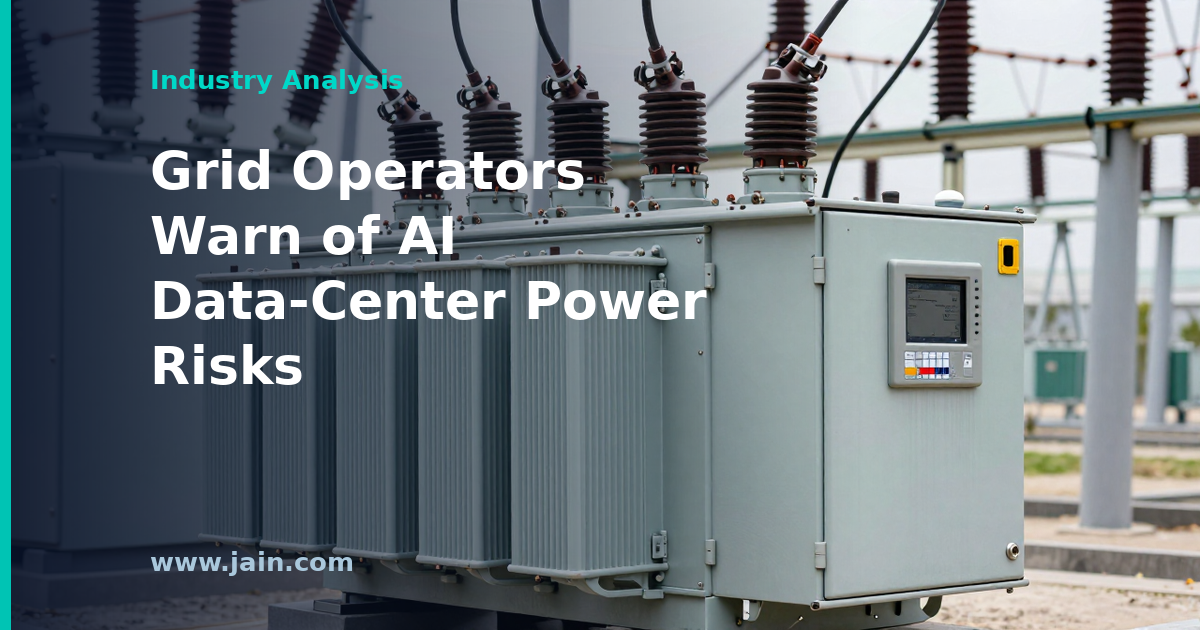
E&E News by POLITICO reported on May 4, 2026 that the AI boom has prompted a rare formal warning of “significant risks” to the electric grid. The warning, attributed to grid operators, centers on the reliability challenges created by rapid AI data-center load growth — the surge in electricity demand from facilities built to train and run artificial-intelligence models.
Executive Summary
According to the report, the organizations responsible for keeping the lights on have moved beyond quiet concern to an explicit, on-the-record caution: the pace and scale of AI-driven data-center demand now pose “significant risks” to grid reliability. In the deliberately understated language of the power sector, where public warnings are infrequent and carefully worded, a formal statement of this kind is a notable escalation.
Why it matters: grid operators and reliability bodies are the institutions that decide whether new large loads can connect, how much generation and transmission must be built, and what margins the system must hold in reserve. When they formally flag a risk, that assessment flows into planning studies, interconnection decisions, and regulatory proceedings. For data-center developers, utilities, and the AI companies driving demand, the message is that electricity availability — not land, chips, or capital — may be the binding constraint on the buildout, and that the institutions controlling that constraint are now on notice.
Why a Formal Warning Is a Turning Point
Grid reliability institutions are structurally conservative communicators. Their public assessments are consensus documents, reviewed by member utilities and regulators, and they rarely single out a demand-side trend as a named risk. That is what makes the reported warning newsworthy: the characterization of AI data-center load growth as posing “significant risks” is the kind of language that, once issued, becomes a reference point in rate cases, interconnection disputes, and legislative hearings.
The practical effect of such warnings is less about any single blackout scenario and more about institutional permission. Utilities that want to slow-walk large interconnection requests, regulators that want to impose cost-allocation conditions on data centers, and states weighing incentives for the industry can all now cite an authoritative reliability finding. In power planning, the paper trail matters.
The Mismatch Behind the Alarm
The underlying tension is one of timescales. A large data center can be designed, financed, and built in roughly two to three years, and AI developers are announcing capacity at an unprecedented cadence. The grid assets needed to serve that load — high-voltage transmission lines, large generators, transformers — routinely take far longer to permit and construct. When demand arrives faster than supply infrastructure can, the system’s cushion shrinks, and reliability planners see exactly the kind of risk the reported warning describes.
Compounding the problem is forecasting uncertainty. Utilities plan around load forecasts, and data-center demand is uniquely hard to forecast: projects are speculative, developers often file duplicate interconnection requests in multiple territories while shopping for power, and a single hyperscale campus can rival the demand of a small city. Planners face risk in both directions — underbuilding invites shortfalls, while overbuilding for phantom load can leave other customers paying for stranded infrastructure.
Winners, Losers, and the New Power Calculus
If reliability concerns harden into policy, the advantage shifts to data-center operators who bring solutions rather than just load: projects with secured long-term power contracts, on-site or co-located generation, meaningful backup capacity, or genuinely flexible demand that can reduce consumption during grid stress. Flexibility is emerging as a currency — a data center that can curtail (temporarily reduce) its draw during peak hours is a far easier interconnection decision than one requiring firm power around the clock.
The losers in a constrained environment are late-arriving projects in saturated markets, and potentially ordinary ratepayers if the costs of grid expansion are not allocated cleanly to the loads driving it. For utilities, the moment cuts both ways: data centers represent the largest load-growth opportunity in decades — and therefore revenue — but also a source of operational and political risk if reliability suffers. How regulators referee that tension will shape power planning for the rest of the decade.
Background
For roughly two decades before the AI boom, electricity demand in the United States was essentially flat, and grid planning settled into a routine of modest, predictable adjustments. That era ended when the generative-AI wave set off a race to build data centers at unprecedented scale, pushing utilities to revise load forecasts sharply upward and filling interconnection queues — the waiting lists for connecting new facilities to the grid — across multiple regions.
Grid reliability in North America is overseen by a layered system: regional grid operators run the transmission network day to day, while reliability organizations set standards and publish periodic assessments of whether the system can meet projected demand. Those assessments had grown increasingly pointed about surging data-center load in the years before this reported warning, making the May 2026 statement the continuation — and apparent sharpening — of a trend the power sector has watched closely.
The North American Electric Reliability Corporation (NERC) — the regulatory body responsible for the reliability of the bulk power system in the United States and Canada — has issued a warning that the rapid growth of data-center electricity demand risks overtaxing the grid, according to reporting by Latitude Media published May 3, 2026. The alert places the AI-driven data-center build-out squarely among the leading reliability risks facing the North American power system.
Executive Summary
NERC is not a trade group or an advocacy organization: it is the FERC-certified Electric Reliability Organization whose standards are mandatory and enforceable for grid operators across North America. When NERC elevates a risk, utilities, regional transmission organizations, and regulators are expected to respond. The reported warning frames unchecked data-center load growth — the wave of large, concentrated electricity demand from AI and cloud facilities — as a material threat to grid reliability, not merely a planning challenge.
The significance lies less in the observation itself, which grid planners have discussed for several years, than in the messenger and the framing. Reliability warnings from NERC historically precede changes in interconnection rules, resource-adequacy requirements, and planning standards. For data-center developers and their customers, that means the era of assuming the grid will simply absorb new campus-scale loads is closing, and the terms of grid access are likely to tighten.
Why the Messenger Matters More Than the Message
Grid strain from data centers is not a new story — utilities in Virginia, Texas, Georgia, and elsewhere have reported unprecedented interconnection queues for years, and NERC’s own long-term reliability assessments have repeatedly flagged accelerating demand growth after two decades of roughly flat US electricity consumption. What changes when NERC issues a pointed warning is the institutional weight behind it. NERC’s assessments feed directly into how utilities justify infrastructure spending before state regulators and how regional grid operators set reserve requirements — the buffer of spare generating capacity kept available for peak conditions.
A reliability warning of this kind typically functions as a forcing mechanism. It gives utilities cover to demand stricter commitments from large-load customers, gives regulators grounds to scrutinize speculative interconnection requests, and gives grid operators justification to slow or condition approvals. The practical effect is that a NERC alarm tends to translate, over the following quarters, into new rules rather than remaining rhetoric.
The Core Problem: Speed, Scale, and Concentration
Data-center load is difficult for grid planners for three compounding reasons. First is speed: a large data-center campus can be built in two to three years, while new high-voltage transmission lines and large power plants routinely take seven to ten years to permit and construct. Second is scale: modern AI campuses request power in the hundreds of megawatts — a single facility can draw as much electricity as a mid-sized city. Third is concentration: developers cluster where fiber, land, and power intersect, so the demand lands on a handful of regional grids rather than spreading evenly across the country.
There is also a planning-data problem that reliability bodies have wrestled with publicly: developers frequently submit interconnection requests to multiple utilities for the same project, a practice sometimes called phantom load. Grid planners cannot easily distinguish which requests represent real, committed demand, which makes forecasting — the foundation of reliability planning — genuinely harder. A warning about “unchecked” growth is, in part, a warning about growth that planners cannot see clearly.
Winners, Losers, and the Coming Rule Changes
If NERC’s warning hardens into policy, the likely instruments are familiar: stricter financial commitments and deposits for interconnection requests, minimum-take or ramp-schedule contracts for large loads, requirements for on-site or contracted generation, and curtailment provisions that let grid operators reduce a data center’s draw during system emergencies. Each of these shifts risk from ratepayers and the grid back onto the load itself.
The relative winners in that world are developers who already control their power story — those with signed long-term supply agreements, on-site generation, flexible-load capability, or sites in regions with surplus capacity. Speculative developers banking on cheap, unconditional grid access face longer timelines and higher costs. Utilities gain leverage but also face a genuine dilemma: overbuild for demand that may not materialize and ratepayers foot the bill, or underbuild and reliability suffers. That asymmetry is precisely why an independent reliability body raising the flag matters — it pushes the debate from utility earnings calls into the formal reliability-standards process.
What a Reliability Warning Does Not Say
It is worth being precise about what a warning like this does and does not establish. It does not mean blackouts are imminent, and it does not assign blame to any individual company or project. Reliability risk is probabilistic: it means the margin between available supply and projected peak demand is narrowing faster than infrastructure is being added, raising the odds of emergency measures during extreme conditions. Nor does the warning settle the policy question of who should pay for grid upgrades — that fight is playing out state by state in rate cases and large-load tariff proceedings, and NERC’s role is to describe the risk, not to allocate its costs.
Background
NERC was formed in 1968 after the 1965 Northeast blackout and became the enforceable Electric Reliability Organization for the United States under the Energy Policy Act of 2005, with the Federal Energy Regulatory Commission (FERC) as its overseer. It publishes seasonal and long-term reliability assessments that grid operators and utilities treat as authoritative, and in recent years those assessments have tracked a historic shift: after two decades of essentially flat US electricity demand, consumption is rising again, driven by AI and cloud data centers, manufacturing reshoring, and electrification.
Data centers sit at the center of that shift because their demand is large, fast-arriving, and geographically concentrated, while the transmission and generation needed to serve them move on much slower permitting and construction timelines. The May 2026 warning reported by Latitude Media extends a line of increasingly direct statements from reliability authorities that the gap between load growth and infrastructure build-out is itself becoming a systemic risk.
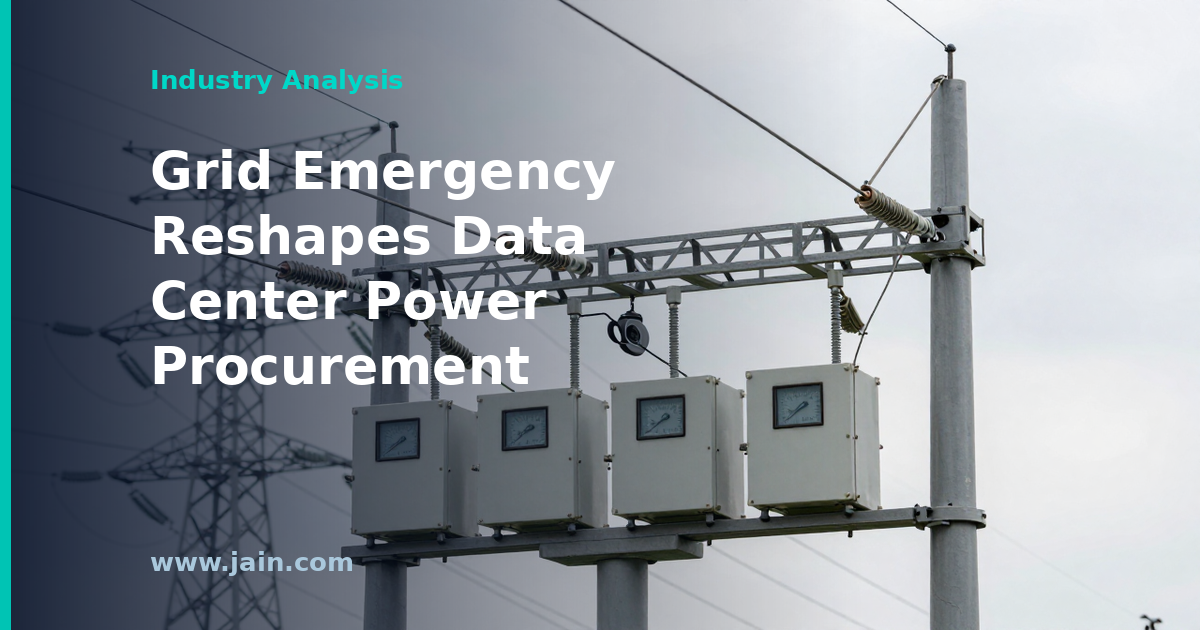
President Trump has declared a national emergency covering the U.S. electric grid and moved to block certain foreign-made equipment from being installed on it, according to a report published by Utility Dive on May 2, 2026. The action is framed as a national-security measure aimed at hardware installed in the bulk power system — the high-voltage backbone that moves electricity from generators to local distribution networks.
The report available to us is a headline-level summary rather than a full text of the declaration, so the operative details — which equipment classes are covered, which countries or vendors are implicated, when restrictions take effect, and whether orders already in transit are exempt — are not established by the source. What is established: an emergency has been declared, and a prohibition on some foreign-made grid equipment is being pursued.
Executive Summary
Emergency declarations matter in the power sector because they unlock authorities that ordinary rulemaking does not. Depending on the statute invoked, a declared emergency can let federal agencies restrict procurement, direct generation to stay online, or waive certain permitting and environmental review steps. The same declaration can therefore both accelerate some projects and constrain others — which is precisely the tension for anyone buying electrical infrastructure right now.
For data-center developers, the constraint side is the one to watch. Large power transformers, medium-voltage switchgear, high-voltage breakers, and grid-tied inverters are long-lead items with a globally concentrated supply base. Any restriction that narrows the pool of qualified suppliers pushes demand toward domestic manufacturers whose order books are already committed to utilities. The binding constraint on a campus is rarely the servers; it is the substation.
The measured read is that this is a supply-side policy event with delivery-schedule consequences, not a demand-side one. It does not change how much power AI and cloud buildouts need. It changes who is legally permitted to sell the hardware that delivers it, and how long the queue is to get it.
What a Grid Equipment Lockdown Actually Touches
“Grid equipment” is a broad phrase covering a narrow set of physically enormous objects. The category most exposed is the large power transformer — a custom-built unit, often weighing hundreds of tons, that steps voltage up or down between transmission and distribution. These are not catalog items. They are engineered to a utility’s specification, built to order, and shipped by specialized heavy haul. A second category is power electronics: grid-tied inverters that convert direct current from solar and battery systems into alternating current the grid can accept, along with the control and communications gear that supervises them.
The security argument for scrutinizing this hardware is not exotic. Modern transformers and inverters contain embedded firmware, remote monitoring links, and control interfaces. A component installed on the bulk power system sits inside the trust boundary of critical infrastructure for decades. Whether the current declaration reflects a specific, documented threat or a precautionary posture is exactly what the underlying record would need to show — and the summary source available here does not show it either way. That is a gap in what has been published, not evidence for or against the policy.
The counter-consideration deserves the same seriousness. Restricting suppliers on a compressed timeline can degrade reliability through a different mechanism: utilities that cannot source replacement units carry thinner spares inventories, and thin spares turn ordinary equipment failures into extended outages. A durable policy has to weigh the security risk of a compromised component against the reliability risk of a component that cannot be obtained at all. Neither risk is hypothetical, and the release as reported does not tell us how the administration balanced them.
The Procurement Math for Data Center Developers
Data-center power procurement is a queue problem before it is a price problem. A developer signs an interconnection agreement with a utility, and that agreement typically requires new or upgraded substation equipment. Some of that equipment the utility buys; increasingly, on large campuses, the customer buys it — sometimes ordering transformers years ahead and holding them as owner-furnished equipment. That practice exists precisely because lead times for heavy electrical gear have been the industry’s chronic bottleneck for several years, well before this declaration.
Narrowing the approved supplier list reprices that queue in two ways. First, orders redirect toward domestic and allied manufacturers whose capacity is already substantially spoken for, extending waits for everyone in line. Second, buyers with the balance sheet to place speculative orders, pay expedite premiums, and absorb schedule slippage gain a relative advantage. That asymmetry favors hyperscalers and the largest developers over regional colocation operators and enterprise self-builds. The policy is neutral on its face; its practical incidence is not.
The winners are more predictable than usual. Domestic transformer and switchgear manufacturers, and firms with U.S. or allied-country assembly footprints, gain pricing power and a stronger case for capacity expansion. Whether that translates into new domestic factories depends on whether they believe the restriction will outlast the administration that issued it — a genuinely open question given that grid-equipment restrictions have been issued, suspended, and revisited across previous administrations. Manufacturers finance multi-hundred-million-dollar plants on decade horizons, not on executive actions that can be reversed by the next signature.
Interconnection Timelines and the Risk of Both Directions
The most consequential detail, and the one the reported summary does not settle, is retroactivity. If restrictions apply only to future purchase orders, developers with equipment already ordered are largely insulated and the market effect is gradual. If they reach equipment already manufactured, in transit, or installed but not yet energized, the effect is immediate and disruptive: projects near completion could face requalification, re-sourcing, or replacement of units that cost millions and take years to rebuild. The gap between those two scenarios is the difference between a manageable procurement adjustment and a wave of schedule failures.
Emergency authorities cut both ways here, which is why the declaration should not be read as purely restrictive. The same posture that constrains sourcing can also be used to expedite approvals, keep retiring generation available, or prioritize allocation of scarce equipment to critical loads. Whether data centers are treated as a critical load or as discretionary demand competing with residential and industrial customers is a policy choice that has not been publicly resolved — and it materially affects who gets a transformer first.
The practical response for anyone with capital committed to a site is unglamorous: audit the country of origin and component provenance of every long-lead electrical item on order, confirm with suppliers whether their units and subassemblies would fall inside a plausible restriction, and revisit contractual force-majeure and schedule-relief language with counsel. Those steps are cheap relative to the exposure, and they are worth taking before the operative text is fully known rather than after.
Reading a Thin Source Honestly
One editorial note is warranted. The material available for this article is a headline and a trade-press attribution, not the text of the declaration or an accompanying order. That supports reporting the fact of the action and analyzing the mechanisms it plausibly engages. It does not support claims about scope, covered nations, dollar impacts, or effective dates, and readers should treat any coverage asserting those specifics without citing the operative document with corresponding caution.
It also means the policy deserves evaluation on its published record once that record exists. Supporters will argue that supply-chain provenance in critical infrastructure is a legitimate and long-standing security concern that prior administrations of both parties have engaged with. Critics will argue that emergency authorities are a blunt instrument for a structural manufacturing problem, and that capacity is built by sustained industrial policy rather than by prohibition. Both arguments are testable against the actual order — its findings, its exemptions, and its waiver process. Neither is testable against a headline.
Background
Concern about foreign-manufactured equipment on the U.S. bulk power system predates this action. A 2020 executive order sought to restrict bulk-power-system equipment associated with foreign adversaries; it was suspended under the subsequent administration and the underlying policy question revisited, with the Energy Department separately addressing certain equipment serving critical defense facilities. The recurring theme across those efforts is that transmission-class hardware is long-lived, software-controlled, and sourced from a globally concentrated manufacturing base.
That base has been strained independently of security policy. Sustained demand from grid modernization, renewable interconnection, electrification, and — most recently — AI and cloud data-center buildouts has pushed lead times for transformers and switchgear well beyond historical norms, making electrical equipment rather than land, capital, or chips the practical gating factor on many campuses. Any policy that changes who may supply that equipment therefore lands on a market that already had little slack.
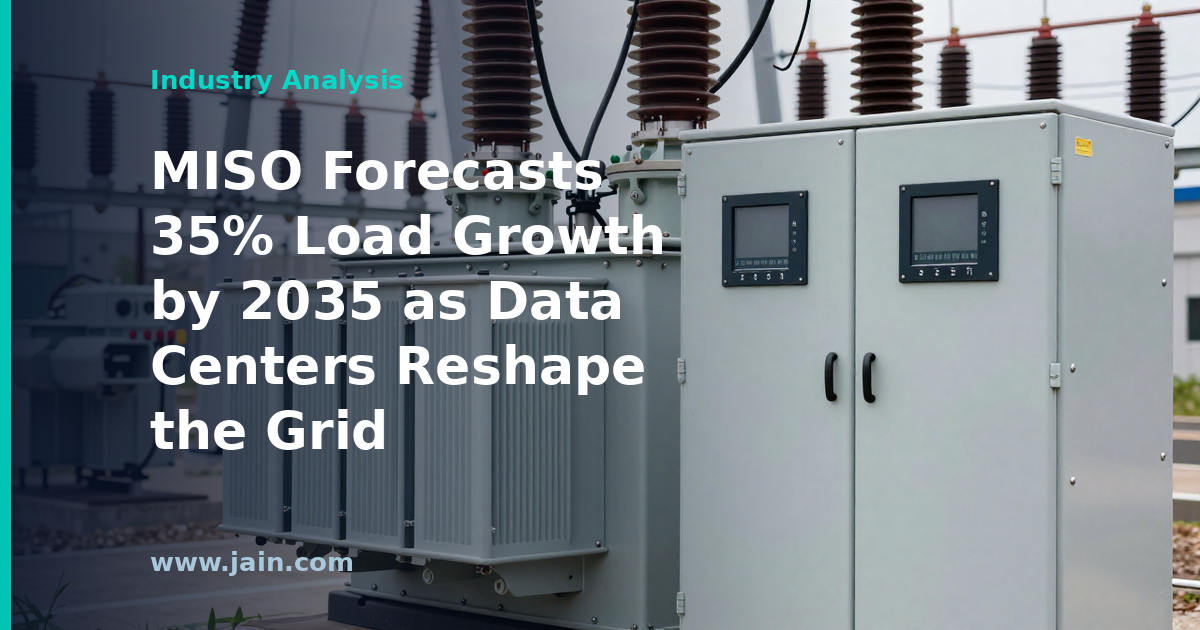
The Midcontinent Independent System Operator (MISO) — the grid operator coordinating electricity across a footprint spanning 15 U.S. states and the Canadian province of Manitoba — expects electric load to jump roughly 35% by 2035, according to an April 2026 report from Utility Dive. The primary driver named in the forecast is data center growth.
A 35% increase over roughly a decade represents a dramatic break from the era of essentially flat U.S. electricity demand that prevailed from the late 2000s through the early 2020s, and it puts one of the largest grid operators in North America on record quantifying the scale of the AI-and-cloud buildout.
Executive Summary
MISO’s forecast is a planning document, not a press release from a company selling something — which makes it one of the more consequential data points in the ongoing debate over how much electricity the data center boom will actually consume. Regional transmission organizations (RTOs) like MISO exist to keep supply and demand balanced in real time and to plan the wires and generation needed years ahead. When an RTO raises its ten-year demand outlook by more than a third, that number flows directly into transmission planning, capacity auctions, and the resource plans of dozens of utilities.
The significance is twofold. First, it validates what individual utilities across the Midwest and Gulf South have been reporting piecemeal: hyperscale data center projects are arriving in interconnection queues at a pace with no modern precedent. Second, it sets up a decade of hard trade-offs. Meeting 35% growth requires new generation, new transmission, and new large-load interconnection rules — all on timelines that historically run slower than the two-to-three-year construction schedule of a data center campus.
For the infrastructure industry, the headline number is both an opportunity signal and a warning: the grid is now the binding constraint on digital infrastructure growth, and the regions that solve power delivery fastest will win the next wave of siting decisions.
The End of Flat Demand Is Now Official Planning Doctrine
For roughly fifteen years, U.S. grid planners could assume that efficiency gains — LED lighting, better HVAC, industrial offshoring — would offset economic growth, keeping total electricity demand nearly flat. That assumption underpinned everything from utility rate cases to power plant retirement schedules. A 35% load-growth forecast from MISO formally retires it for one of the largest grid footprints in North America.
What makes an RTO forecast different from a consultant’s projection is accountability: MISO must plan transmission and resource adequacy against this number. If the forecast is right and the buildout lags, the result is capacity shortfalls and price spikes. If the forecast is wrong and infrastructure is overbuilt, ratepayers carry stranded costs. Either error is expensive, which is why the assumptions behind the number — how much announced data center load actually materializes — deserve as much scrutiny as the number itself.
Data Centers as the Marginal Buyer of Power
A data center is, from the grid’s perspective, an unusual customer: it demands large blocks of power (often hundreds of megawatts per campus), runs at high utilization around the clock, and wants to connect years faster than traditional industrial load. When such customers become the dominant source of demand growth, they effectively set the terms of grid expansion — and grid operators, utilities, and regulators are still working out who pays for the upgrades those connections require.
The economics cut in several directions. Utilities in MISO territory gain a growth story they have not had in a generation, which supports investment in wires and generation. Existing ratepayers face the risk of subsidizing infrastructure built for loads that may not fully arrive — a concern regulators in several states are already addressing through special large-load tariffs and financial-commitment requirements. Data center developers, meanwhile, face the reality that power availability, not land or fiber, now determines where and when they can build.
Winners, Losers, and the Speed Mismatch
The core tension in a 35%-by-2035 scenario is timing. Gas turbines face multi-year order backlogs, new nuclear operates on decade-plus horizons, and large transmission projects routinely take seven to ten years from planning to energization. Data center campuses go from groundbreaking to load in two or three. That mismatch favors whoever can bridge it: developers with early interconnection positions, utilities with spare capacity or fast-track large-load processes, suppliers of grid equipment, and operators pursuing on-site or co-located generation.
It also raises competitive stakes between regions. MISO’s footprint — stretching from the upper Midwest to the Gulf Coast — competes with PJM, ERCOT, and the Southeast for hyperscale siting. A credible, well-executed plan to serve 35% more load is itself an economic-development asset; a forecast without matching buildout is a queue of frustrated customers who will site elsewhere.
Forecast Versus Reality: The Phantom Load Question
Every load forecast in the current environment must grapple with duplicate and speculative requests. Developers commonly file interconnection requests in multiple jurisdictions for the same project, and some announced campuses will never be built. Grid operators know this and apply screening assumptions, but the industry has little historical data on what fraction of AI-era announced load converts to actual consumption. The honest read of any 35% figure is that it is a planning scenario with meaningful uncertainty in both directions — actual growth could undershoot if projects evaporate, or overshoot if AI demand keeps compounding.
That uncertainty is not a reason to dismiss the forecast; it is a reason to watch how MISO and its member utilities structure commitments. Mechanisms that require large customers to put capital at risk — minimum-take contracts, collateral requirements, contribution to network upgrades — are the market’s way of separating real load from phantom load, and their adoption across the footprint will be a better indicator of true demand than any single projection.
Background
MISO was founded in 1998 and became the first FERC-approved regional transmission organization in the United States in 2001. It coordinates generation and high-voltage transmission across a footprint stretching from the upper Midwest down through the Gulf South, serving tens of millions of people through its member utilities. Like other RTOs, it does not own power plants or lines; it operates markets and plans the system that its members build.
The forecast arrives amid a broader U.S. re-acceleration of electricity demand after more than a decade of stagnation, driven by AI and cloud data center construction, manufacturing reshoring, and electrification. Grid operators across the country have been revising load outlooks upward repeatedly since the early 2020s, and interconnection queues for both large loads and new generation have swelled to historic levels — making forecasts like this one central to the industry debate over how much of the announced boom is real.