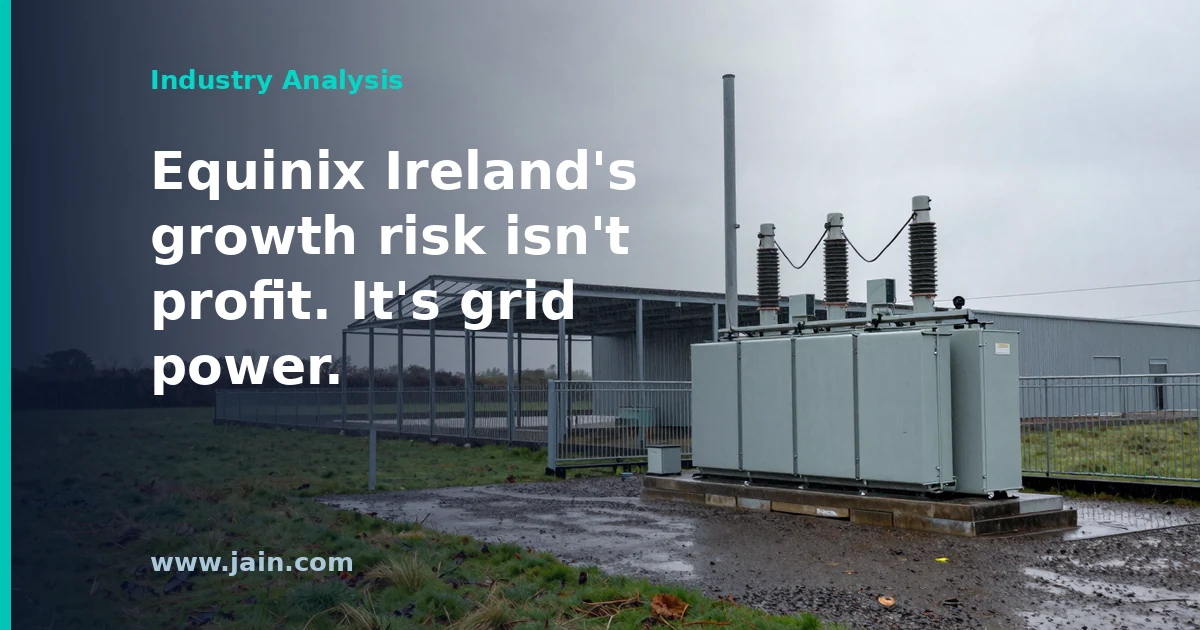
Equinix runs giant buildings full of computers that firms like Microsoft, Google and Amazon use. Its Irish business saw profit before tax fall by more than a third last year, to 4.4 million euros.
That sounds alarming, but the drop mostly reflects a one-off payment the company received the year before. Sales actually grew 9%.
The real worry is electricity. The company’s own directors warn that power suppliers may not be able to give it more in the places it wants to grow.
In Ireland, where these computer buildings already lean heavily on the national grid, power may decide how fast they can expand.
RTÉ reported that newly published accounts for Equinix (Ireland) Ltd, the Irish arm of the California-based data centre operator, show pre-tax profit fell 36% to €4.4m in 2025, even as revenue rose 9% from €75.3m to €82.4m. The decline was due mainly to €2.9m of dividend income booked in 2024 that did not recur. Operating profit fell 6% to €5.43m, gross margin rose from 23% to 25%, and EBITDA (earnings before interest, tax, depreciation and amortisation) came to €13.2m.
During the year, Equinix bought BT Group’s Irish data centre business, including facilities in Citywest and Ballycoolin, Dublin, for €61.27m, a deal the Competition and Consumer Protection Commission cleared in August 2025. Headcount rose from 101 to 110, and the directors flagged the risk that electricity providers may not be able to supply further capacity where the company expects to expand.
Executive Summary
Equinix’s Irish subsidiary reported a sharp fall in pre-tax profit for 2025, to €4.4m from the prior year, on revenue that grew 9% to €82.4m. The directors attribute the fall mainly to a €2.9m dividend received in 2024 that was not repeated. The operating business tells a steadier story: gross margin improved to 25% on growth in recurring colocation and interconnection revenue, and operating profit slipped only 6% to €5.43m.
That steadier story carries a cost signal. Staff costs rose by about a quarter, from €14.18m to €17.8m, while headcount grew 9%, absorbing roughly half the year’s €7.1m revenue gain and thinning the operating margin even as gross margin widened. The company also added capacity through its €61.27m purchase of BT’s Irish data centre business.
The most consequential line in the accounts is not a number. The directors say they intend to keep increasing capacity, and they name electricity supply as the risk to doing so. In Dublin, where grid connections for new data centres have been restricted for years, that makes power availability, not customer demand, the variable to watch for Equinix, its customers and anyone pricing data centre capacity in Ireland.
A Dividend Explains the Headline, Not the Business
The 36% headline compares two years that are not like for like. In 2024, Equinix (Ireland) Ltd booked €2.9m of dividend income, money received rather than earned by running data centres, and that income did not recur in 2025. The directors identify it as the main reason for the fall. Measured on operations alone, the business held up: operating profit fell 6% to €5.43m, and after €1m of net interest the company reported pre-tax profit of €4.4m.
The cash-generation picture is firmer still. EBITDA, a rough proxy for the cash the operations throw off before financing and accounting write-downs, was €13.2m. The gap between that figure and operating profit is mostly €7.7m of depreciation, the non-cash charge that spreads the cost of buildings, generators and cooling plant over their working lives. Heavy depreciation is normal in a capital-intensive asset class like data centres and says little about demand, which the directors describe as having “remained solid.”
Wider Gross Margins, Thinner Operating Margins
Gross margin rose from 23% to 25%, which the directors credit to growth in recurring interconnection and colocation revenue. Colocation, renting space, power and cooling so customers can house their own servers, brought in €67.25m, more than four-fifths of revenue. Interconnection, directly linking customers to networks, clouds and each other inside the same building, contributed €9.44m, about 11%. Managed infrastructure added €3.6m and non-recurring revenue €1.85m, so nearly all income is recurring. Interconnection is valued in the colocation model because each new link adds revenue while using little extra floor space or power.
Below the gross line, costs grew faster than sales. Revenue rose by about €7.1m, while staff costs rose by €3.6m, roughly 25%, against a 9% rise in headcount, from 101 to 110 people (79 engineering and technical, 29 sales and administration, two directors). On the reported figures, operating margin fell from roughly 7.7% to about 6.6%. The accounts do not break down the staff cost increase; the year also included the integration of BT’s Irish data centre business, but the company has not linked the two.
Power, Not Demand, Sets the Pace of Expansion
The 9% revenue growth matters less than what it takes to repeat it. The directors say the company “intends to continue to increase its capacity,” and in the same accounts they name the risk that electricity providers may not be able to provide further capacity in locations where it expects to expand. In Dublin that is a live constraint: Ireland’s grid operator, EirGrid, has for several years restricted new data centre connections in the region, and the energy regulator has moved toward requiring new large energy users to bring their own generation or storage. For an operator that wants to grow, a grid connection, not a customer contract, is the scarce input.
The link to the AI buildout runs through power density. Equinix markets its 282 data centres worldwide as “AI-ready,” and the Irish directors list rising “requirements for power and cooling” among the market’s growth drivers. Denser computing, of which AI training and inference are the leading example, draws more electricity per rack, so customer growth consumes grid capacity faster than it consumes floor space. The Irish directors do not attribute demand to AI specifically; they cite internet traffic, financial services computing, cloud and software-as-a-service. But whatever the workload, more compute per site pushes power to the front of the queue.
Two consequences follow for the people who buy and finance this capacity. First, capacity that is already connected and powered becomes more valuable, which is consistent with the directors calling theirs “premium” and with the widening gross margin; buying BT’s operating Citywest and Ballycoolin facilities added capacity without waiting on a new connection, though the company has not framed the deal that way. Second, energy costs are moving toward customers: the directors say price increases are embedded in the budget and partly hedged, that “communication has started towards the customers,” and that a task force is looking for ways to cut primary energy use. Dublin tenants should expect power terms, not just space, to drive renewals.
Background
Equinix Inc., headquartered in California and listed under the ticker EQIX, owns and operates 282 data centres in 75 locations worldwide. Its model centres on colocation, renting secure, powered and cooled space for customers’ servers, and interconnection, which lets those customers link directly to networks, cloud platforms and one another inside the same facility. Its client list includes Oracle, Nvidia, Google Cloud, Microsoft, Dell Technologies and Amazon Web Services.
Dublin is one of Europe’s main data centre hubs, home to large cloud and technology operations, and also one of its most power-constrained. Ireland’s grid operator has restricted new data centre connections in the Dublin region for several years, making existing grid capacity a strategic asset. Equinix’s Irish subsidiary runs five Dublin sites and, in 2025, added BT Group’s Irish data centre business, including facilities in Citywest and Ballycoolin.
Equinix rents out space, electricity and network connections inside the buildings where companies keep their computers. It says it now plans to spend 5 to 7 billion dollars every year building more of them, because demand for artificial intelligence computing is climbing.
That is bridge-and-power-plant money, not server-room money. And the hard part is no longer pouring concrete. It is finding enough electricity, the heavy gear that delivers it, and the cooling for machines that run far hotter than the ones they replace.
Yahoo Finance reported that Equinix plans an annual data center buildout of $5 billion to $7 billion, citing accelerating artificial intelligence demand as the driver. Equinix is one of the largest operators of carrier-neutral data centers worldwide, and the figure describes a sustained annual rate of construction spending rather than a single project.
No individual site, market, customer or completion date accompanied the spending range. The disclosure sets a capital pace; it does not yet say where the capital lands.
Executive Summary
A $5 billion to $7 billion annual construction budget is a statement about build rate, not about any one building. For a company whose historical identity is retail colocation — selling cabinets and cross-connects to thousands of enterprises, carriers and cloud on-ramps inside dense interconnection hubs — spending at that tempo implies a different physical product: fewer, larger, denser halls built for accelerated computing.
That matters because retail colocation and artificial-intelligence-scale capacity consume capital in opposite ways. Retail capacity is built incrementally and monetised through recurring interconnection revenue that compounds as ecosystems thicken. AI-scale capacity is built in large power blocks with long lead items and is monetised mainly through space and power. Committing this much annually pushes the mix toward the second without abandoning the first.
For the rest of the market, the number functions as a pace-setter. Interconnection density is a cumulative advantage: the value of being inside a hub rises with how many networks and clouds are already there. An operator that builds through the AI cycle at this rate is also defending that density. Competitors that build more slowly risk seeing new ecosystems form somewhere else.
The Bottleneck Moves From Cabinets to Megawatts
Colocation growth used to be gated by commercial motion: sales cycles, fit-out of cabinets, provisioning of cross-connects — the short patch cables that link one tenant to another inside a facility and generate high-margin recurring revenue. Those constraints scale with people and process. At a $5 billion to $7 billion annual spend, they are no longer the binding limit. The limits become physical and external: grid interconnection, where a site waits in a utility queue for the right to draw large loads; long-lead electrical equipment such as transformers, switchgear and generators; land that already has power or a credible path to it; and the plumbing, heat-rejection and manufacturing capacity behind liquid cooling, which accelerated servers increasingly require because air cannot carry the heat away fast enough.
The mechanism is straightforward. Capital converts into revenue only when a hall is energised. If a company can deploy several billion dollars a year but its sites cannot be energised on that schedule, the money queues rather than compounds. That is why a spending number of this size is best read as a procurement commitment: to sustain it, an operator has to be placing equipment orders and power arrangements well in advance of demand it has not yet contracted.
The people affected sit downstream. Utilities and grid operators see a customer asking for large, firm, long-duration load. Electrical-equipment manufacturers and engineering and construction firms see order books extended. Cooling vendors see demand shift from air handling toward liquid distribution. And enterprise buyers of ordinary colocation may find that in the most power-constrained metros, the scarce resource they are competing for is no longer floor space but the megawatts behind it.
What a Build Rate Says That a Project Never Does
Single-project announcements are easy to make and easy to quietly defer. A recurring annual range is a harder statement, because it implies a pipeline of land, power and permits deep enough to absorb that capital every year. It also implies a funding plan that repeats annually rather than once.
This is where structure matters. Equinix operates as a real estate investment trust, a tax structure that requires distributing most taxable income to shareholders. That limits how much cash can simply be retained and recycled into construction, and pushes large sustained programmes toward some combination of debt, equity issuance, asset recycling and joint ventures with institutional partners — the model the industry has used for hyperscale-scale halls, where a partner supplies much of the capital and the operator supplies development and management.
The economics then hinge on the spread between the cost of that capital and the stabilised yield on newly built capacity. AI-scale halls generally sell power at scale with less interconnection revenue attached per megawatt than a mature retail hub produces. Building a lot of them can raise revenue while diluting the blended margin profile, unless the operator uses that capacity to pull more networks and tenants into the same campuses. Whether this spend is accretive is a question about yields and funding mix, not about the headline figure.
Interconnection Density Is the Asset Being Defended
The strategic logic behind spending through an AI cycle is not only that AI capacity is rentable. It is that where compute lands, networks follow, and where networks concentrate, the next tenant has a reason to choose the same campus. Interconnection density compounds: each additional carrier, cloud on-ramp and peering participant makes the location more valuable to the next arrival. It is slow to build and correspondingly slow to erode.
Artificial intelligence workloads complicate that picture because training clusters can sit far from population centres, chasing cheap power rather than low latency. Inference — running trained models for users — behaves more like traditional cloud traffic and rewards proximity to networks and data. An operator with existing dense hubs has a real advantage in the second category, provided it can add power-dense capacity in or near those hubs rather than only in remote, power-rich locations.
For competitors, including other large global platforms and the wholesale developers serving hyperscale demand, the practical consequence is timing. Power in the strongest metros is allocated years in advance. A rival that matches this pace later does not merely arrive late to the same opportunity; it arrives to a smaller pool of available grid capacity in exactly the places where interconnection value is highest.
Background
Equinix is one of the largest carrier-neutral data center operators in the world, with facilities across major metropolitan markets in the Americas, Europe and Asia-Pacific. Carrier-neutral means it is not owned by a telecom operator, so tenants can connect to any network present in the building. That neutrality is the foundation of its interconnection business: over decades, the densest sites accumulated carriers, internet exchanges, cloud on-ramps and enterprise tenants, each arrival making the next one more likely.
The industry’s demand base has shifted repeatedly — from enterprise server consolidation, to cloud, and most recently to accelerated computing for artificial intelligence, which consumes power at densities the previous generations of halls were never designed for. That shift has changed the economics of construction: the scarce inputs are increasingly electricity, long-lead electrical equipment and cooling capacity rather than land or building shell, and capital commitments are being made years ahead of the demand they serve.
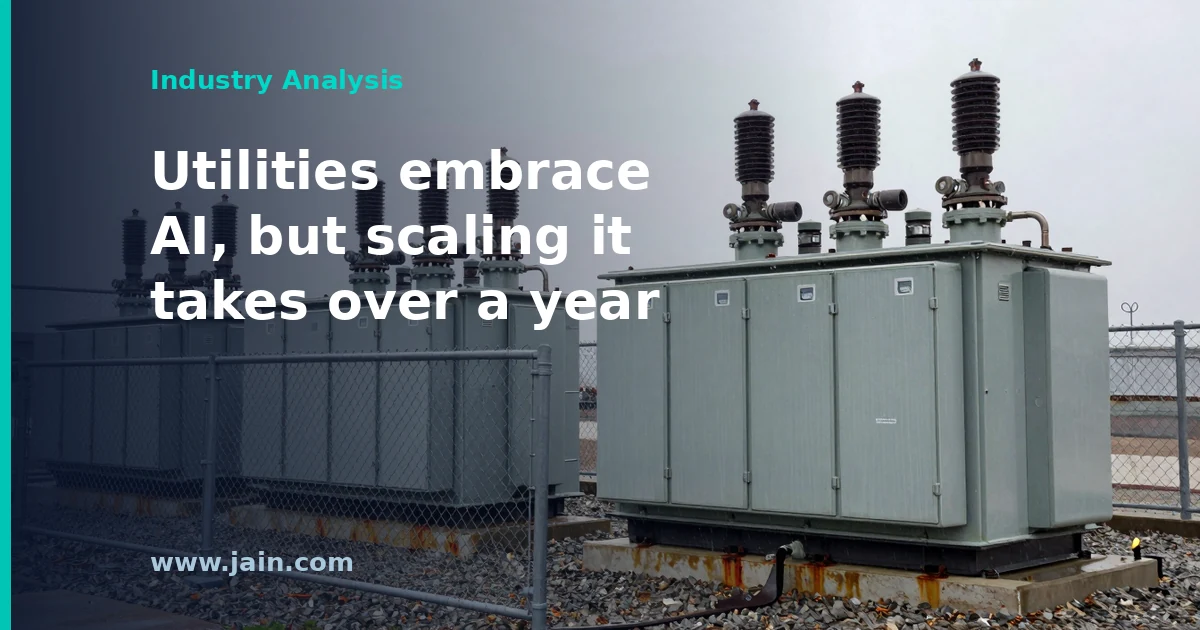
Power companies across America are racing to keep up with the giant computer warehouses that run artificial intelligence, which use enormous amounts of electricity.
A new survey of 134 innovation chiefs at American power companies found that most now use artificial intelligence themselves to manage that demand. The catch: 84% say turning a small trial into something used across the whole company takes more than a year, and that delay is getting longer.
Why it matters to you: 83% of those leaders say the cost of serving these warehouses is showing up in household electricity bills.
National Grid Partners, the venture capital and innovation arm of UK and US energy company National Grid, released its third annual Utility Innovation Survey on September 18, 2026, at the NextGrid Alliance Summit in Boston. The survey of 134 innovation leaders at U.S. utilities, collected between May 20 and July 7, 2026, found that 78% are deploying or operationalizing at least one AI application to manage interconnection demand, while 74% say AI-driven data center load growth is affecting grid reliability.
The survey also found that 84% of organizations take more than a year to move projects from pilot to full rollout, up from 66% in 2024, and that grid reliability has overtaken net zero as a top-three priority. National Grid Partners also announced investments in two startups, Terragrit and LineVision, and noted that National Grid has joined the newly formed AI Energy Management Alliance as a founding member.
Executive Summary
The headline number is adoption: nearly four in five U.S. utility innovation leaders say they are putting AI to work on the flood of requests to connect new load, much of it from AI data centers. That is the industry using the technology driving its demand problem as part of the answer to it.
The more consequential numbers sit underneath. Innovation budgets rose at 72% of respondents, yet the share needing more than a year to scale a pilot has climbed for three consecutive surveys, from 66% to 78% to 84%. Most spending (59%) goes to incremental improvements, only 16% to transformational projects, and 87% say regulatory and rate-case frameworks written before the AI demand boom limit returns on innovation.
Taken together, the survey describes an industry that has accepted AI as a grid-planning tool but cannot yet deploy it at the pace data-center load is arriving. For data-center developers, utilities, regulators and ratepayers, the practical constraint is increasingly how fast utilities can change the way they plan, not only how much they build.
The Constraint Is Speed, Not Willingness
The survey rules out the easy explanation that utilities are reluctant to adopt AI. Seventy-eight percent say they are deploying or operationalizing at least one AI application to manage interconnection demand, meaning the queue of customers waiting for permission and capacity to plug into the grid. Seventy-two percent report bigger innovation budgets this year, and only 1% say they have no plans to work with early-stage technology companies.
What has not improved is the time it takes to turn an experiment into standard practice. Eighty-four percent of organizations now need more than a year to move a project from pilot to full rollout, up from 78% in 2025 and 66% in 2024. The trend has worsened for three straight surveys even as money has flowed in, which points to a structural bottleneck rather than a funding one. Respondents cite a shortage of workers skilled in AI and the industry’s traditionally cautious culture, and spending patterns reinforce the picture: 59% of innovation dollars go to incremental improvements against 16% for transformational initiatives.
That matters downstream because 74% of the same leaders say AI data center load is already affecting grid reliability. The pressure is present now; the tools meant to relieve it face a year-plus path to scale at most utilities. Data-center developers waiting in interconnection queues, utility planners fielding large-load requests, and the software vendors selling into utilities all operate on that clock. A tool that could, for example, help a utility study or approve a connection faster only helps once it is embedded in how the utility actually works.
Reliability Moves Ahead of Net Zero
The sharpest year-over-year shift in the survey concerns priorities. Asked to rank organizational priorities, 73% of utility leaders placed reliability in their top three, up from 43% in 2025. Net-zero goals fell from 54% to 16% over the same period.
This is a forced ranking of top-three priorities, so it measures relative emphasis rather than abandonment of climate commitments. Still, a swing of that size in one year is a clear signal about what is occupying planning attention. When a single data-center campus can represent a large new load on a regional system, keeping the lights on becomes the dominant planning question, and decarbonization targets compete for a smaller share of management focus.
Rate Cases Written for a Slower Era
Utilities in the U.S. generally recover investment through rate cases, the regulatory proceedings in which state commissions decide what a utility can charge customers and what return it may earn. Eighty-seven percent of respondents say those frameworks, developed before the current demand boom, are limiting returns on innovation investment. If a software tool that frees up grid capacity earns a utility less than building new poles, wires and substations, the incentive structure itself slows adoption, which is consistent with the lengthening pilot timelines.
The cost question cuts the other way for households. Eighty-three percent of respondents say the cost of building infrastructure to serve AI data centers is being passed on to residential customers through higher bills. That is the view of the utility leaders surveyed rather than a measured cost allocation, and the survey does not quantify it, but it is a notable admission coming from inside the industry, and it frames why regulators are likely to scrutinise who pays for data-center grid upgrades.
Flexible Data Centers as a Grid Resource
National Grid’s answer, alongside its investment activity, is flexibility. The company has become a founding member of the AI Energy Management Alliance, whose announced members include Google, NVIDIA, Anthropic, Emerald AI, RWE, Constellation and NRG. The group says it will push for policies encouraging flexible data centers that automatically reduce power use during peak demand, buffering nearby communities from price spikes.
The supporting evidence cited is a UK pilot last December involving Emerald AI, a National Grid Partners portfolio company, together with National Grid and NVIDIA, which found AI software could cut data center energy use by more than a third in under a minute during simulated grid strain while protecting critical workloads. That is a meaningful proof of concept, though it was a single pilot under simulated conditions. Whether flexibility becomes a dependable planning resource depends on data-center operators contractually committing to curtail, and on utilities trusting those commitments enough to connect load sooner, which brings the question back to how fast planning practices and rules can change.
Background
National Grid supplies electricity and natural gas to more than 80 million people in the UK, New York and Massachusetts, and is running major transmission programmes including the Great Grid Upgrade in the UK and the Upstate Upgrade in New York. Its venture arm, National Grid Partners, launched in 2018, is based in Silicon Valley with offices in Boston, London and New York, and describes itself as the utility industry’s only Silicon Valley-based corporate venture capital group.
National Grid also founded the NextGrid Alliance, which says it includes more than 1,000 senior decision-makers from over 170 utilities in 25 countries and has facilitated more than 500 introductions between utilities and startups. The survey arrives as U.S. utilities face surging requests to connect large AI data centers, a demand shift that is pressing on grid planning, reliability and how infrastructure costs are allocated among customers.
Hut 8 used to make most of its money running rooms full of computers that create bitcoin. It is now renting that electricity and space to artificial intelligence companies instead.
It has signed a 15-year lease worth $9.8 billion for a site in south Texas. The chipmaker Nvidia is the tenant; the AI firm Anthropic is the end user.
Hut 8 has also lined up $7.5 billion in borrowing to build it. The shares jumped 19 percent in a day.
Why it matters: electricity, not computers, is now the scarce ingredient in artificial intelligence — and whoever already has it can charge a premium.
Hut 8 Corp. (Nasdaq: HUT) is converting its bitcoin mining power base into leased artificial-intelligence capacity, anchored by a 15-year lease at its Beacon Point campus in Nueces County, Texas with a base term valued at US$9.8 billion. The site is to be leased by Nvidia under Nvidia’s very large computing agreement with Anthropic, and the campus is planned for 1,000 megawatts of total capacity. Dealroom reported that Hut 8 secured $7.5 billion in financing as the pivot accelerated; the lease terms and a 19.0% single-session share move were reported by Simply Wall St on September 7, 2026.
The transaction reframes Hut 8 from a company whose revenue rose and fell with the bitcoin price into one selling long-duration, contracted access to energized land and grid capacity — the same asset, sold on a different contract.
Executive Summary
The headline number is the lease, not the loan. A 15-year base term worth US$9.8 billion averages roughly $650 million a year of contracted rent — the kind of cash-flow profile that lenders underwrite against, and the reason a company still reporting large losses can raise billions. The financing is the consequence; the lease is the cause.
That is the structural shift worth noting. For most of the last decade, a bitcoin miner’s power portfolio was valued as an input cost — cheap electricity that made hashing marginally profitable. Under an AI lease, the same substation, the same interconnection agreement and the same acreage become collateral: a contracted, investment-grade-adjacent revenue stream that can be pledged. Miners are not being revalued because mining improved. They are being revalued because someone else needs their grid position.
The corollary is less flattering to the miners. When roughly $7.5 billion of debt sits against a $9.8 billion base term, the counterparty’s credit and the lease’s covenants — not the operator’s ambitions — set the cost of capital and the order of claims on the cash. Hut 8 has traded volatility for visibility, and a measure of control with it.
The Asset Was Never the Bitcoin. It Was the Interconnect.
Hut 8 describes itself as an energy infrastructure platform integrating power, digital infrastructure and compute across the United States and Canada. That description has been true for years; what changed is the buyer. Bitcoin mining was an application that could tolerate cheap, interruptible, badly located power because the output was a fungible commodity produced anywhere. AI training and inference cannot — but it will pay handsomely for the one thing miners accumulated by accident: sites that are already connected to the grid at scale.
Connecting a large load to a transmission network requires an interconnection agreement, and the queue for one — the utility’s study-and-approval process for new large customers — commonly runs for years in the busiest US markets. An operator holding an executed interconnection and an energized substation is holding a scarce option, and the Beacon Point lease is what that option is worth once a hyperscale tenant bids for it. This is why the repricing is spreading across the mining sector rather than being specific to one company: the balance sheet item being revalued is grid position, and several miners hold it.
The Texas Gulf Coast location matters too. Nueces County sits in a market with abundant generation and industrial land, and Texas has become the default destination for very large new loads. It is also a region where firm power, water availability and summer grid stress are live operational questions rather than settled ones.
A 15-Year Lease Is a Credit Instrument Before It Is a Building
A $9.8 billion base term is not revenue in hand; it is the undiscounted sum of contracted rent over 15 years, before any renewal or escalation, and before Hut 8 spends the capital required to deliver the facility. Averaged evenly, that is on the order of $650 million a year. What makes the figure bankable is who is on the other side of it: the campus is to be leased by Nvidia under its computing agreement with Anthropic, which puts a large, well-capitalised technology company in the tenant position rather than a start-up burning venture funding.
That structure is the point of the whole trade. A tenant of that quality converts a speculative construction project into something closer to a contracted infrastructure asset — the same reason toll roads and fibre routes get financed on the strength of their offtake agreements. It also concentrates risk. The lease reportedly covers a campus planned at 1,000 megawatts, but the disclosed figures do not establish how much of that 1,000 megawatts the $9.8 billion actually contracts. If the lease covers a portion, the remainder is a speculative build that must be leased separately; if it covers the whole campus, then the implied rent per unit of capacity is the number every competing developer will be modelling.
There is a delivery risk that no counterparty credit can eliminate. Rent on a data center lease typically begins when capacity is delivered, not when the ink dries. Between now and then sit permits, transformers, switchgear, long-lead electrical equipment and construction labour — the same constraints slowing every other campus in the market.
$7.5 Billion Against $9.8 Billion: Who Sets the Terms Now
Put the two numbers side by side and the balance of power becomes visible. Roughly $7.5 billion of financing sits against $9.8 billion of base-term rent — meaning a large majority of the contracted cash flow over 15 years is, in effect, spoken for by capital providers before equity holders see anything. Whether that debt sits at the project level or at the parent, what it costs, when it matures, what covenants it carries and whether it comes with warrants or convertible features are the variables that determine how much of this deal’s economics Hut 8 actually keeps. None of that has been laid out publicly.
This is the sharper version of the story than “miner pivots to AI.” In a mining business, the operator controlled the dials: turn machines off when power prices spike, sell coins when it suits, defer capital expenditure. Under a long-dated lease funded by multi-billion-dollar structured debt, the dials belong to the documents. Delivery dates are contractual. Debt service is fixed. The flexibility that made miners resilient through crypto drawdowns is the specific thing being exchanged for revenue visibility.
The market’s uncertainty about how that trade lands is unusually wide. Third-party modelling published alongside the news projects Hut 8 reaching roughly $1.7 billion of revenue and $194.2 million of earnings by 2029 — which would require about 74.6% annual revenue growth and roughly a $793 million swing from a current trailing loss of $599.2 million — and derives a fair value of $161.78. More cautious estimates in the same set assume about $1.0 billion of 2029 revenue and land near $65. These are analyst and community model outputs rather than company guidance, and a spread of that magnitude on the same asset base is itself the finding: the disagreement is not about whether the lease exists, but about whether it gets built, financed and repeated.
Nvidia Is Now in Everyone’s Capital Stack
Nvidia’s role here is worth isolating, because it is no longer simply the company selling accelerators into these buildings. At Beacon Point it appears as the leaseholder, standing between the landlord and the ultimate AI workload. That is a chip vendor underwriting real estate risk to make sure its own hardware has somewhere to run.
The breadth of that posture is visible elsewhere in Nvidia’s disclosures. In an 8-K filed September 3, 2026, Nvidia reported that it had entered a definitive agreement on September 2 to acquire Hugging Face, the open-model platform, for a purchase price of approximately $11.9 billion plus an equity-based retention program of up to roughly $1.0 billion, with closing expected in the first half of 2027. The filing also flags a specific vulnerability: government restrictions on open-source models, including models originating in China, could materially affect the platform and Nvidia’s results. A company deploying capital simultaneously into model distribution and into leased data center capacity is building demand for its silicon at both ends of the stack.
For infrastructure buyers and investors, that has a practical implication. The creditworthiness underpinning a growing share of new US data center capacity increasingly traces back to a small number of very large technology balance sheets. Concentration of that kind is what makes projects financeable today, and it is also the correlation that would matter most if AI capital expenditure plans were ever revised downward.
Background
Hut 8 Corp. trades on Nasdaq as HUT and describes itself as an energy infrastructure platform that integrates power, digital infrastructure and compute at scale for energy-intensive uses across the United States and Canada. Historically its revenue came from bitcoin mining — running specialised computers that earn newly issued bitcoin — through its self-mining fleet and American Bitcoin operations. That business is transaction-driven: revenue moves with the bitcoin price, mining difficulty and power costs, which makes forecasting cash flow difficult.
The wider shift began when AI compute demand collided with a shortage of grid capacity. Miners had spent years assembling sites with executed interconnection agreements and substations already in place, precisely the constraint slowing new AI data centers. Since 2024 several miners have moved to lease that capacity to AI and cloud tenants under multi-year contracts, trading commodity exposure for contracted rent. Hut 8’s Beacon Point lease in Nueces County, Texas is one of the largest examples of that conversion to date.
Primary sources: NVIDIA Corporation, Form 8-K filed September 3, 2026 (SEC EDGAR) — disclosing the September 2, 2026 definitive agreement to acquire Hugging Face, Inc. for approximately $11.9 billion plus an equity-based retention program of up to approximately $1.0 billion, with closing expected in the first half of 2027, and setting out related regulatory risks to open-source model distribution.
The scarce ingredient in artificial intelligence may not turn out to be powerful chips. It may be the wiring.
Equinix runs the buildings where networks, cloud providers and companies physically plug into one another. It has announced a service built for the moment an artificial intelligence program answers a question, rather than the months it spends learning — and has attached early quantum computing to the same offering.
Fast answers need computers close to the people asking. Equinix is betting that the connection points it already owns, not sheer computing horsepower, become the thing everyone competes for.
Simply Wall St reported that Equinix has introduced an AI and quantum inference fabric, a productised way for customers to run inference workloads — the stage at which a trained model actually answers queries — across the company’s interconnection footprint, with quantum computing named alongside it. Yahoo Finance separately framed the move as Equinix doubling down on AI data centers, and posed it as a question for holders of EQIX, the company’s Nasdaq-listed shares.
Equinix has not published capacity figures, launch metros, pricing, availability dates or named customers for the offering. What is on the record at this stage is the strategic direction and the product name, not the commercial scale behind either.
Executive Summary
The announcement matters less for what it adds to Equinix’s estate than for where it points. Almost every headline in AI infrastructure over the past two years has been about training capacity: gigawatt campuses, accelerator supply, power procurement in remote counties where electricity is cheap and land is plentiful. An inference fabric is an argument that the next constraint sits somewhere else entirely — in dense, network-rich metro facilities where the distance between a model and its user is measured in milliseconds rather than megawatts.
That argument plays to Equinix’s structural strength. The company’s durable advantage has never been raw square footage; it has been the density of networks, clouds and enterprises inside the same buildings, and the cross-connects between them. If inference does migrate toward metro edges, interconnection-rich colocation becomes a choke point that is genuinely difficult to replicate, because it is built from accumulated tenancy rather than capital alone.
The caution is that a strategic thesis and a revenue line are different things. Bundling quantum into an inference product is a forward-looking positioning move, and the offering has been described without the contracted capacity, customer names or economics that would let buyers or investors size it. The thesis is credible; the evidence that it is already converting into demand has not yet been put on the table.
Inference Rewrites the Map That Training Drew
Training a large model is a batch job. It can happen anywhere the power is cheap and abundant, because nobody is waiting on the other end of the wire. Inference is the opposite: it is a live transaction, and every network hop between the user and the model shows up as lag. That single difference pulls compute back toward population centres, toward the metro facilities where carriers, cloud on-ramps and enterprise networks already terminate — precisely the sites carrier-neutral colocation providers have spent decades assembling.
This is why an inference-oriented fabric is a more interesting signal than another announcement of remote megawatts. It implies a view that AI capacity will bifurcate: enormous, power-hungry training campuses in the hinterland, and a distributed layer of smaller, latency-sensitive inference footprints in cities. The second layer is smaller in energy terms but far more valuable per square foot, because what customers are buying is proximity and connectivity rather than bulk.
For enterprise buyers, the practical consequence is that AI deployment starts to look like a network design problem rather than a procurement problem. Where the model sits relative to the data it consumes, and how many private connections separate the two, determines both response time and egress cost. That is a familiar conversation for anyone who has architected hybrid cloud — which is, not coincidentally, the conversation Equinix is best positioned to have.
The Choke Point Argument, and Its Limits
The strongest version of Equinix’s case is that interconnection is a compounding asset. A cross-connect — a physical cable between two tenants in the same facility — is cheap to provision and expensive to leave behind, because the value of being in a building rises with everyone else already in it. Accelerator supply, by contrast, is a commodity that reprices with each hardware generation. If inference genuinely disperses to the metro edge, the party controlling the meeting points captures a toll that does not depreciate on a chip cycle.
The weaker version is the assumption that no one else can occupy that position. Hyperscalers have been extending their own edge and local-zone footprints for years. Carriers own metro real estate and fibre routes. A cohort of specialist GPU cloud operators is building latency-sensitive capacity of its own, and content delivery networks already run inference at points of presence closer to users than most colocation halls. Interconnection density is a real moat, but it is a moat around a market whose boundaries several well-capitalised competitors are actively redrawing.
There is also a power question that no product announcement dissolves. Metro data centres are the hardest places to add electrical capacity and the slowest to get through utility interconnection queues — the waiting list for a new grid connection, which in constrained markets can run for years. High-density inference racks draw far more per cabinet than the legacy network gear that defines many urban facilities, and retrofitting for that density involves cooling and electrical work, not just a new commercial wrapper.
Quantum in the Product Name: Option Value or Optics?
Pairing quantum with inference is the part of this announcement that deserves the most careful reading, and the fairest way to read it is as positioning rather than deception. Providing network-adjacent access to quantum hardware is a coherent thing for an interconnection operator to do: quantum processors are scarce, physically finicky and best consumed as a remote service, which makes a neutral facility with dense connectivity a sensible place to reach them from. Several operators have hosted quantum systems on exactly that logic.
What is not established by the product name is any claim about quantum performing inference at commercial scale. Today’s quantum machines are experimental instruments, and the phrase invites a parsing question the company has not resolved in public: whether inference is meant to attach to both AI and quantum, or whether quantum access simply sits alongside an AI inference service under one banner. Those are materially different propositions, and buyers evaluating the offering should ask which one they are being sold.
Treated as option value, the inclusion is defensible and cheap. Treated as evidence of near-term demand, it is unsupported. The honest assessment is that Equinix has claimed a category label early — a familiar and often rational move in infrastructure — and that the label will be worth something only if hardware partners and workloads eventually arrive behind it.
What the Stock Framing Tends to Miss
Equinix is structured as a real estate investment trust, meaning it distributes most of its taxable income to shareholders and therefore funds growth largely from debt and equity issuance rather than retained earnings. That structure shapes how any AI build-out must be judged: the relevant question is not whether AI demand exists, but whether the returns on capital deployed into denser, more power-intensive facilities clear a cost of capital that has risen materially since the last data centre cycle.
An inference fabric is, in that light, an attractive kind of AI exposure precisely because it is capital-light relative to greenfield gigawatt campuses. Selling connectivity and dense colocation into existing buildings monetises assets already on the balance sheet. But it is also a smaller prize than the training build-out, and describing a product without disclosing contracted capacity or pricing leaves investors unable to distinguish a new revenue engine from a repackaging of services the platform already sells.
The reasonable posture for both buyers and shareholders is interest without recalibration. The strategic logic — that interconnection becomes scarce as inference decentralises — is sound and consistent with how this company has made money for two decades. Whether this specific offering is the vehicle that captures it is a question the disclosed facts do not yet answer.
Background
Equinix was founded in 1998 as a carrier-neutral interconnection business: a place where competing networks could meet on neutral ground and exchange traffic directly, rather than paying an intermediary to carry it. That model expanded into a global platform of colocation facilities in which internet exchanges, cloud on-ramps and enterprise infrastructure sit side by side, connected by cross-connects between tenants. The company converted to a real estate investment trust structure in 2015 and trades on the Nasdaq as EQIX.
The AI build-out has so far favoured a different asset class — very large, power-intensive campuses in locations chosen for cheap electricity and available land, purpose-built for model training. Metro colocation providers have consequently faced a strategic question about where they fit. An inference-oriented offering is one answer: the argument that as models move from being built to being used at scale, the value shifts back toward the network-dense urban facilities that were the industry’s original franchise.
Digital Realty, a global company that builds the warehouses full of computers that run the internet, has opened its second data center in Nairobi, Kenya.
The interesting part is not its size — it is small — but who is already inside: more than 100 phone and internet carriers that customers can plug straight into, plus a dish link to satellites for places cables do not reach.
For Kenyan businesses, that means their data can stay in the country and still reach the rest of the world quickly.
Digital Realty (NYSE: DLR) announced on September 7 that it has opened Nairobi Two (NBO2), a 6.4-megawatt data center built alongside its existing Nairobi One (NBO1) facility, expanding the company’s Nairobi campus. According to the company’s announcement, customers on the campus can connect to more than 100 networks, two internet exchange points and a satellite teleport — a ground station that routes traffic via satellite where terrestrial fibre is limited.
The opening coincides with iColo, Digital Realty’s East African operation, transitioning to the Digital Realty brand in Kenya and Mozambique and folding its local ecosystem into PlatformDIGITAL, the company’s global data center platform. Digital Realty describes its footprint as more than 300 facilities across 55-plus metros in over 30 countries.
Executive Summary
The headline number — 6.4 megawatts, a measure of the electrical capacity available to customers’ servers — is modest by the standards of Digital Realty’s recent announcements elsewhere. What is being sold in Nairobi is not raw scale but adjacency: the ability to sit in the same building as more than 100 carriers, two internet exchange points and a satellite uplink, and to reach any of them with a short cable rather than a long-haul circuit.
That distinction matters commercially. In colocation, an operator rents space, power and cooling; in interconnection, it monetises the density of parties already present. Interconnection revenue tends to carry higher margins and stickier tenancy, because moving out means severing every connection a customer has built. Nairobi Two extends a campus where that density already exists rather than starting one from scratch.
The simultaneous rebranding of iColo in Kenya and Mozambique is the second half of the story. It converts a respected regional operator into a node on a global platform, which changes how multinational buyers can contract for African capacity — and raises questions, so far unanswered publicly, about pricing, contracted capacity and how much further the company intends to build on the continent.
Interconnection, Not Megawatts, Is the Product Here
A useful way to read any data center announcement is to ask what the operator is actually selling. Some facilities sell power and floor space at scale, aimed at customers who need very large blocks of compute. Others sell proximity to networks. Nairobi Two is plainly the second kind. Digital Realty leads with 100-plus networks, two internet exchange points — neutral switching platforms where networks swap traffic directly instead of paying transit providers to carry it — and a satellite teleport, and treats the 6.4 MW as supporting detail.
The economics behind that emphasis are well understood in the industry. A carrier-neutral campus, meaning one that favours no single telecom provider, becomes more valuable to each tenant as more tenants arrive: content providers want to be near eyeball networks, banks want to be near clouds, carriers want to be near both. Once a customer has provisioned dozens of cross-connects, the switching cost of leaving is high. Interconnection density is, in effect, a moat built by other people’s cabling.
For Kenyan and regional enterprises, the practical benefit is latency and cost. Traffic that can be exchanged locally does not have to transit Europe and back, which shortens round trips and reduces international bandwidth spend. That is a real operational improvement, and it is the most substantiated claim in the announcement — the ecosystem figures are specific and verifiable by any prospective customer touring the site.
What the iColo Rebrand Buys, and What It Costs
Folding iColo’s Kenyan and Mozambican sites into the Digital Realty brand and PlatformDIGITAL is more than signage. For a multinational evaluating African capacity, a global brand means a single master agreement, familiar service-level terms, consistent operational standards and access through a sales channel that already serves the customer elsewhere. That materially lowers the procurement friction that has historically slowed enterprise commitments in frontier markets.
Wanja Muriithi, Digital Realty’s Country General Manager for Kenya, framed the opening and the rebrand as “one story” — local ecosystem plus global platform. Marcel Louw, Managing Director for Africa, positioned the campus as a gateway for customers serving Kenya, Africa or global markets. Both framings are consistent with how platform operators typically integrate regional acquisitions, and neither is quantified in the announcement.
There is a trade-off worth naming without overstating it. Regional operators often win on price flexibility, local relationships and responsiveness to smaller customers; global platforms standardise, which can be a benefit or a constraint depending on the tenant. Whether existing iColo customers see changed commercial terms is not addressed in the announcement, and it is a fair question for buyers to put to the company directly at renewal.
Sovereignty and the Case for a Satellite Route
Digital Realty cites data sovereignty — the requirement, whether legal or contractual, that certain data physically remain within a country’s borders — as one of the forces reshaping infrastructure decisions in East Africa. That demand driver is credible and increasingly common globally: regulated sectors such as banking, health and government are usually the first movers, because their supervisors write the rules. Local capacity paired with dense interconnection is precisely the configuration that lets an organisation keep data in-country while still reaching global cloud platforms.
The satellite teleport is the less conventional element and deserves a plain explanation. It is a ground facility that sends and receives traffic via satellite, offering a path to locations where terrestrial fibre is sparse, and an alternative route when a terrestrial or subsea path is unavailable. In a region where long-haul connectivity concentrates on a limited number of physical routes, having a diverse path inside the same interconnection campus is a genuine resilience feature rather than a marketing flourish — though its usefulness depends on capacity and cost, neither of which the company has disclosed.
Does 6.4 MW Answer the AI Capacity Question?
The stated editorial question — whether African markets can support AI-era capacity — is not settled by this facility, and the announcement does not claim it is. Training large models is a power problem measured in tens to hundreds of megawatts, with rack densities that typically require liquid cooling. Digital Realty’s own recent announcements show where that class of capital is going: the company said in August it had been selected to develop 50 megawatts in Singapore, roughly eight times the capacity of Nairobi Two, and broke ground on a facility in Switzerland.
The more plausible near-term African AI story is inference and delivery rather than training: running already-trained models close to users, serving content locally, and keeping the resulting data resident. That workload profile is far better matched to a dense interconnection campus of this size than to a hyperscale training campus, and building in increments of a few megawatts is a defensible way to follow demand rather than front-run it — capital discipline, not timidity.
The constraint to watch is power. Interconnection density can be assembled through commercial relationships; grid capacity, reliability and cost cannot. Any credible expansion of this campus toward AI-relevant scale would require the company to speak publicly about power procurement, cooling design and rack density, none of which appears in this announcement. Until it does, Nairobi Two is best read as a well-targeted connectivity asset — a gateway play — rather than evidence that the region is ready for AI-era compute at scale.
Background
Digital Realty is a US-listed real estate investment trust (NYSE: DLR) that owns and operates data centers globally, describing itself as the world’s largest cloud- and carrier-neutral data center platform with more than 300 facilities in over 55 metros across 30-plus countries on six continents. Its business combines colocation — renting secure, powered, cooled space for customers’ servers — with interconnection, the higher-margin business of enabling customers to connect directly to the carriers, clouds and content providers sharing the building.
Nairobi has developed as one of East Africa’s principal digital infrastructure markets, and Digital Realty’s campus there operates through iColo, the East African business now taking the Digital Realty brand in Kenya and Mozambique. The campus already housed Nairobi One before this week’s addition of Nairobi Two. The company’s wider 2026 activity has included being selected to develop 50 megawatts in Singapore in August, a groundbreaking in Switzerland, and leadership appointments across regional markets including Iberia.
A company called Gimlet Labs has raised $300 million from investors, who now put the value of the whole business at $3 billion. It builds the computing systems that run artificial intelligence.
Two things stand out. It plans to use six different kinds of computer chip instead of relying on a single supplier. And it wants several hundred megawatts of electricity, roughly what a small city consumes.
That second part is the hard part. Getting power, not getting chips, is now the main thing holding new artificial intelligence sites back.
Ascendants.in reported that Gimlet Labs has raised $300 million at a $3 billion valuation, and that the company is scaling a six-chip artificial intelligence strategy toward several hundred megawatts of capacity. A megawatt is a unit of electrical demand; several hundred of them is the scale of a mid-sized data center campus rather than a single leased hall.
The report does not name the investors in the round, the six silicon platforms the strategy spans, or the sites where the power would be delivered. What it does establish is the shape of the company’s pitch: multi-vendor compute, sold at a scale measured in electricity rather than in racks.
Executive Summary
The headline number is the $300 million. The more interesting number is the megawatts. A startup describing its roadmap in units of power rather than units of silicon is telling investors that its scarcest input is grid capacity, and that it believes it has secured, or can secure, a claim on some.
The six-chip element is a second signal. Most AI compute providers have built their businesses on a single accelerator family, which makes them fast to deploy and hostage to one vendor’s allocation, pricing and product cadence. Spanning six platforms is a deliberate trade: more engineering overhead and a harder software story, in exchange for supply optionality and the ability to match different workloads to different silicon economics.
Together, the two claims describe a company positioning itself between the merchant AI cloud operators and the traditional colocation landlords, and asking to be valued at ten times the capital it just raised on that positioning.
Power Procurement Is Now the Product Roadmap
For most of the last decade, an AI compute company’s competitive position was a function of chip allocation. Whoever could get accelerators first could sell capacity first. That constraint has not disappeared, but a second one has moved ahead of it in many markets: interconnection, the process by which a new large load is granted a connection to the electricity grid. In congested regions, the queue for that connection is measured in years, and it is not something a funding round can shorten.
This is why a several-hundred-megawatt figure functions as a credential. It implies the company has done, or is doing, the unglamorous work that separates announced capacity from energized capacity: site control, substation and transformer procurement, utility load studies, and in many cases some form of on-site or contracted generation. None of that is visible in a valuation, but all of it determines whether the valuation is underwritten by anything.
The corollary is a genuine risk. Megawatt figures in this sector are quoted at very different stages of certainty. There is capacity under a signed power agreement, capacity in an interconnection queue, capacity in a letter of intent with a landlord, and capacity that is simply a planning target. Until a company distinguishes among them, a several-hundred-megawatt claim describes an ambition rather than an asset.
Why Six Chips Instead of One
Running six accelerator platforms is harder than it sounds. Each has its own software stack, its own compiler and libraries, its own memory architecture and its own thermal and power profile. Supporting all of them means either forcing customers to port their models repeatedly or building an abstraction layer that hides the differences, which is one of the more demanding pieces of systems engineering in the field. It also fragments spare-parts inventory, firmware management and the staff expertise needed to operate the fleet.
The payoff is negotiating position and workload fit. A buyer with six qualified suppliers is not exposed to any one vendor’s allocation decisions or lead times, and can place inference work, which is often cost- and latency-sensitive, on cheaper or more power-efficient parts while reserving the largest chips for training. In a market where accelerator supply and pricing have both moved sharply, that flexibility has real option value.
Whether it is worth the overhead depends on something the company has not put a number to: how much of its fleet is actually diversified versus how much is a single dominant platform with five qualified alternatives. Those are very different businesses with the same description.
What a $3 Billion Valuation Has to Underwrite
AI compute at this scale is a capital-intensive, thin-margin business dressed in software multiples. Servers depreciate on a schedule shorter than the buildings that house them; power contracts and leases run longer than most customer commitments; and the residual value of a given accelerator generation is difficult to forecast when the next generation is announced annually. The companies that have made this work have generally done so by matching long-dated contracted revenue against long-dated obligations.
A $3 billion mark on a $300 million round therefore raises a specific question rather than a rhetorical one: what fraction of the several hundred megawatts is contracted, to whom, and for how long? Take-or-pay commitments from creditworthy customers turn a power position into an annuity. Uncontracted capacity turns it into inventory with a carrying cost.
The strategic logic is nonetheless coherent. If power is the binding constraint and silicon is the fungible input, then the durable asset in AI infrastructure is the energized site, and the chips inside it are a refresh cycle. A company that internalizes that ordering early, and can genuinely operate heterogeneous fleets, is building something less exposed to any single vendor’s roadmap. The valuation is a bet that it can execute on both halves at once.
Background
AI compute providers — sometimes called neoclouds — emerged as a distinct category as demand for accelerated computing outran what established cloud platforms could deliver. They buy or lease power and space, fill it with AI accelerators, and sell that capacity to model developers and enterprises. The model is capital-intensive: hardware depreciates faster than the buildings and power contracts that support it, so operators typically try to match long-term customer commitments against long-term obligations.
Over the past two years the sector’s binding constraint has shifted. Early on, the scarce resource was accelerator allocation. Increasingly it is electricity — specifically, the ability to secure a grid connection for a large new load in a reasonable timeframe. That shift has changed how these businesses describe themselves, with megawatts replacing rack counts as the headline metric, and has pushed some operators toward multi-vendor silicon strategies to reduce dependence on any single chip supplier’s roadmap and allocation decisions.
Equinix rents out the buildings where companies keep their computers and where the world’s networks plug into each other. Now it wants to sell the computing itself.
With the chipmaker NVIDIA and a startup called Together AI, Equinix has launched a service that runs artificial-intelligence models inside those buildings, close to the businesses using them. The pitch: faster answers, and your data stays where you put it.
What it costs, how much of it exists, and who has signed up have not been made public.
Equinix has launched Inference Exchange, a distributed artificial-intelligence inference platform developed with NVIDIA and Together AI, W.Media and Telecompaper reported this week, alongside a new connectivity service. The offering is intended to let enterprises run trained AI models inside Equinix’s metro data centers rather than in a distant public cloud region.
The companies have not published the platform’s scale. There is no disclosed figure for dedicated capacity, no list of launch metros, no pricing model and no named customers, and Equinix did not accompany the announcement with a material filing to the U.S. Securities and Exchange Commission.
Executive Summary
The announcement is a move up the value chain. Equinix’s core business is selling space, power and cross-connects — the physical patch cables that let a bank’s network meet a cloud provider’s network inside the same building. Inference Exchange proposes selling the workload instead: NVIDIA accelerators and Together AI’s serving software, operated in Equinix facilities and reachable over the interconnection fabric its customers already buy.
The timing tracks the industry’s center of gravity. NVIDIA’s second-quarter fiscal 2027 results, filed with the SEC on August 26, reported revenue of $96.2 billion, up 106% from a year earlier, with data center revenue of $89.0 billion, up 117%. Founder and CEO Jensen Huang framed the quarter around consumption rather than construction: “AI has reached its inflection point. It’s doing useful work. Its tokens are productive and profitable. Now, compute is revenue.” Inference — running models in production — is where that revenue is generated, and unlike training it has to happen near users and near data.
What matters for buyers and investors is that the strategic logic is clearer than the commercial substance. A partnership among three named companies is real; a contracted, revenue-generating utility is not the same thing, and neither Equinix nor its partners has yet put a number, a date or a customer against it.
Why Metro Colocation Is the Natural Home for Inference
Training and inference want different real estate. Training a frontier model is a batch job: it can run anywhere power is cheap and abundant, which is why the largest commitments in the market point at greenfield megasites. NVIDIA’s own CFO commentary describes credit support for roughly 4.25 gigawatts at SB Energy’s PORTS-Pike campus in Ohio — a gigawatt being roughly the output of a large power station — under twenty-year leases to OpenAI. Nobody puts that in a city center.
Inference is the opposite. It is interactive, it runs continuously, and its latency budget is measured in the tens of milliseconds a user will tolerate before an assistant feels sluggish. It also carries regulatory weight, because the prompts and documents flowing into a model are frequently the customer data a bank or hospital is not permitted to move across a border. Equinix’s asset is precisely metro adjacency plus interconnection density: its facilities are where carriers, clouds and enterprises already meet, so an inference endpoint sited there is a private hop away from a customer’s own network rather than a trip across the public internet.
The economics of the shift are less settled than the logic. Colocation is a rent business — long leases, predictable yields, capital spent on shells, power and cooling that depreciate over decades. Accelerated computing is not: graphics processing units are expensive, they depreciate fast, and their returns depend on high utilization. Whether Inference Exchange is a capital-intensity story for Equinix or a channel arrangement depends entirely on who buys and owns the hardware, and that has not been stated.
What NVIDIA’s Record Quarter Says About the Timing
NVIDIA’s August 26 results give the backdrop unusual clarity. Data center revenue of $89.0 billion grew 117% year over year, and the company guided to $108.0 billion in total revenue for the current quarter while assuming no data center compute revenue from China. The quarter’s own highlights lean hard toward inference: the company said its Groq 3 LPX interactive inference accelerator has entered full production, and disclosed that NVIDIA GPUs with confidential computing are used for confidential inference in Apple’s Private Cloud Compute — a design in which the operator cannot see the data being processed.
Read together, those signals describe a distribution problem more than a silicon problem. Frontier labs already buy directly and at scale. The next tranche of demand is thousands of enterprises that will never operate a GPU cluster and want inference delivered as a service, in a location they can name, with a contract their compliance team recognizes. Equinix supplies the geography and the enterprise relationships; Together AI supplies the serving layer; NVIDIA supplies the silicon and, critically, keeps those workloads inside its software ecosystem rather than migrating to a rival accelerator.
The quarter closed on July 26, before this launch, so its silence on Equinix is chronological rather than meaningful. It does, however, set the scale against which the partnership should be read: an arrangement neither party has sized is unlikely to be financially material to NVIDIA in the near term. Its value to NVIDIA is positional. Its value to Equinix, whose revenue base is far smaller than NVIDIA’s data center line, could be proportionally much larger — if it converts.
Who Gains, Who Gets Squeezed
Together AI is arguably the clearest beneficiary. An independent AI cloud can win developers on price and model breadth but struggles to reach regulated enterprises that require a named facility, an auditable network path and a counterparty with a balance sheet. Distribution through Equinix’s footprint addresses all three without Together AI building data centers.
The pressure lands on operators selling undifferentiated GPU hours. If enterprise inference migrates toward venues chosen for latency, data residency and network adjacency, then raw capacity in a remote low-cost region competes on price alone — a difficult position when supply is expanding. Content delivery and edge networking vendors, which have marketed proximity as their advantage, now face a colocation incumbent making the same argument with more power per site. Hyperscale clouds are less exposed: their hold on enterprise inference rests on data gravity, identity systems and developer tooling, none of which a colocation platform replicates. But they are also Equinix tenants, which makes this a partner-adjacent product and raises a channel question Equinix has not addressed publicly.
Wholesale developers building megawatt campuses are not the losers here. They serve a different workload. The genuine contest is over which layer captures enterprise inference margin — the landlord, the model-serving vendor, or the cloud — and this launch is Equinix’s claim that the landlord can move up rather than be disintermediated.
What the Launch Substantiates, and What It Doesn’t
Substantiated: three named companies, a named product, and a second connectivity service announced alongside it. Equinix has the metro sites, the interconnection fabric and the enterprise account base to make the concept credible, and NVIDIA’s disclosed financials confirm that inference demand is real and growing rather than aspirational.
Not substantiated: everything a buyer would need to price the thing. No capacity figure, no availability date, no commercial model, no customer, no statement of who funds the hardware. That is a common shape for infrastructure platform announcements, where logos typically precede contracted revenue by several quarters, and it is a fair criticism of the disclosure rather than of the strategy.
One further piece of context deserves attention without overreach. NVIDIA’s filings show an ecosystem in which vendor financial support has become structural: supply commitments rose from $119 billion in the prior quarter to $279 billion; the company disclosed partnerships with Apollo, BlackRock, Blackstone, Brookfield, Goldman Sachs and KKR intended to mobilize over $500 billion of third-party capital over time, subject to definitive agreements; and it reported a maximum gross exposure of $3.5 billion under guarantees for AI cloud partners’ lease obligations, plus the separately capped $105 billion Ohio guarantee. None of that is stated to apply to this partnership. But investors evaluating any NVIDIA-adjacent infrastructure announcement in 2026 are entitled to ask whether hardware is being sold, financed, consigned or revenue-shared — and here, no one has said.
Background
Equinix, founded in 1998 and structured as a real estate investment trust since 2015, built its business on carrier-neutral colocation: buildings where any network can connect to any other without favoring an owner’s own transit. That neutrality made its facilities natural meeting points for carriers, cloud providers and enterprises, and interconnection — the cross-connects and virtual links between tenants — became the high-margin core of the model rather than the floor space itself.
The AI buildout initially looked like a threat to that positioning, because training clusters favor vast, remote, power-rich campuses of a kind Equinix does not principally build. The counter-argument, which this launch embodies, is that once models move into production the workload shifts toward inference, and inference rewards exactly what Equinix already owns: presence in dozens of business metros, dense network adjacency and existing enterprise contracts. NVIDIA’s most recent quarterly disclosures show both halves of that market running at once — gigawatt-scale campus commitments for training on one side, and production-grade inference accelerators and confidential inference deployments on the other.
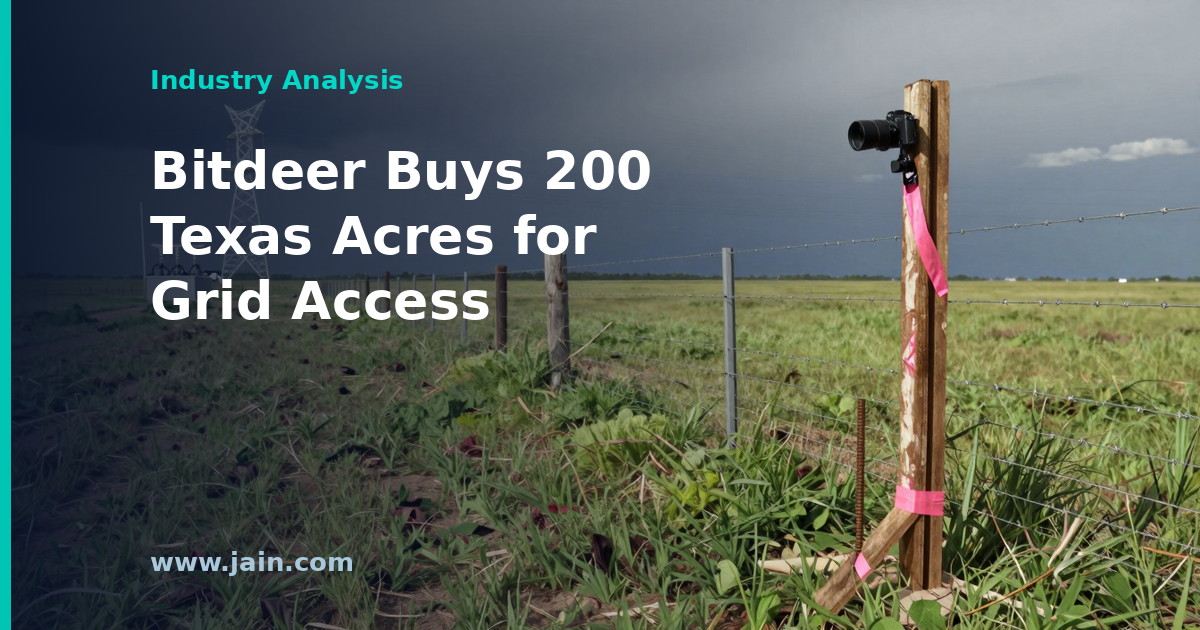
Bitdeer paid about $100 million for 200 acres of empty land in rural Texas — roughly half a million dollars an acre. The land itself is not really what it bought.
What it bought is a spot on the electricity grid. The site sits next to a plant the company already runs near Rockdale, about 70 miles from Austin, where the utility has already agreed to deliver enough power to run a small city.
Getting that kind of power hookup can take years of waiting. Land next to one that already exists is worth paying up for.
Bitdeer Technologies Group (NASDAQ: BTDR) said on September 1 that it has completed the fee simple purchase of approximately 200 acres of greenfield land in Milam County, Texas, for total consideration of approximately $100 million, paid in cash. The parcel sits near the company’s existing Rockdale facility, roughly 70 miles from Austin, and is intended to support development of AI and high-performance computing (HPC) infrastructure. The announcement was furnished to the U.S. Securities and Exchange Commission as an exhibit to a Form 6-K filed September 2.
In the release, Bitdeer says the Milam County sites, including the new parcel, currently feature approximately 563 megawatts (MW) of interconnected grid capacity with existing plans expected to scale to 742 MW, plus a dedicated water supply. After the deal, the company says it owns and/or operates roughly 255 acres and 742 MW of existing and pipeline power capacity in the county, against approximately 3.0 gigawatts of total power capacity across a global portfolio spanning the United States, Norway, Bhutan, Canada, Malaysia and Ethiopia.
Executive Summary
The headline number is land, but the substance is electricity. Bitdeer disclosed a cash purchase of about 200 acres next to a campus that already holds a large-load grid connection — the utility-approved right to draw power at scale, which in Texas and most other markets is now the slowest and scarcest input in data center development. Land can be bought in weeks. An interconnection typically cannot.
Chief Financial Officer Michael G. Potter framed the deal as a control decision rather than a capacity decision, saying outright ownership “eliminates the renewal risk associated with a lease” and gives the company flexibility to keep running Bitcoin mining while it develops the new property. That matters commercially: hyperscale and AI tenants signing decade-plus leases underwrite the landlord’s title as well as its power, and a developer building on leased dirt carries a financing discount its owned-land peers do not.
The wider context is a Bitcoin miner converting itself into a data center landlord. In its July operations update, filed August 26, Bitdeer pointed to a $4.7 billion, 16-year AI/HPC lease announced in early August as “a key milestone in converting our power portfolio into contracted, long-term revenue,” alongside approximately 76.7 exahashes per second of self-mining hash rate and a 9.5 MW facility in Malaysia fully committed under long-term offtake agreements. The Texas purchase extends that conversion strategy to the company’s best-connected North American site — without, so far, a disclosed customer, budget or construction timeline attached to the new parcel.
Half a Million Dollars an Acre Is a Price for the Queue, Not the Dirt
Divide the disclosed consideration by the disclosed acreage and the arithmetic is stark: roughly $500,000 per acre for greenfield land in a rural Texas county. No one pays that for soil. They pay it for adjacency — proximity to an energized campus with established transmission and substation infrastructure, which is what Bitdeer says the Rockdale location already has.
The mechanism worth understanding is the interconnection queue. Before a large facility can draw meaningful power, the grid operator must study the request and the utility must build or upgrade the lines and substations to serve it. For loads measured in hundreds of megawatts, that process is measured in years, and in the current AI buildout the queue — not capital, not chips, not construction labour — is the binding constraint on delivery dates. Buying land beside a site that has already cleared much of that path is a way of buying time, and time is the input in shortest supply.
A rough yardstick: measured against the 742 MW of existing and pipeline capacity Bitdeer attributes to its Milam County sites, $100 million works out to about $135,000 per megawatt. Treat that number carefully — the company assigns the capacity to the sites collectively, not to the new parcel alone, and it has not said how much of it the new land would serve. But even on the most conservative reading, land is a small line item next to the cost of building AI-ready halls on it.
The Conversion Trade: From Hash Rate to Lease Rate
Bitcoin miners and AI data centers want the same thing — cheap, abundant, interruptible power — and differ sharply in everything else. Mining tolerates modest reliability and rough-and-ready buildings because the revenue is a commodity output. AI and HPC tenants want redundancy, dense power per rack, sophisticated cooling and contractual guarantees, and they pay for it in long-dated leases. That gap is why so many mining campuses are being re-underwritten as data center real estate.
Bitdeer is explicit that this is the direction of travel. The August 26 filing quotes Potter describing the $4.7 billion, 16-year lease as converting the power portfolio “into contracted, long-term revenue,” and the Malaysia facility as fully committed under offtake agreements representing expected contracted revenue exceeding $800 million. The September release goes further in a place readers often skip: its forward-looking-statements paragraph flags expectations about “the potential reallocation of existing interconnected capacity.” In plain terms, some of the 563 MW now serving mining machines could be redirected to AI tenants. That is the cheapest megawatt in the industry — one already connected — and it is also the one whose reallocation the company has not yet quantified.
The company’s claim that the purchase “removes one of the principal constraints on AI/HPC data center development at the location” is defensible as far as it goes. Land tenure was a real constraint, and it is now resolved. It is worth being precise about what remains: the power allocation beyond 563 MW is described as planned, not granted; the water supply is described as dedicated but not quantified; and no tenant, capital budget or energization date has been attached to the new parcel.
Why a Landlord Buys Instead of Leases
Fee simple ownership — outright title, as opposed to a lease — sounds like a legal footnote and is in fact a financing question. A developer signing a 16-year lease with a creditworthy compute tenant will typically want to borrow against that lease. Lenders and rating agencies look at whether the ground beneath the building could revert to someone else, at what price, and on whose terms. Ground-lease renewal risk sits directly in that analysis, and Potter’s language about eliminating it reads as written for that audience.
Ownership also buys sequencing freedom. Bitdeer says the purchase lets it “maintain our existing Bitcoin mining operations while we develop the newly acquired property” — that is, build the AI campus next door rather than demolishing a revenue-producing mining site to make room. For a company whose mining business was still scaling to roughly 76.7 EH/s (exahashes per second, a measure of total mining computation) in July, keeping both revenue streams live during a multi-year construction programme has real value.
One quiet detail deserves attention. Bitdeer says it owns and/or operates approximately 255 acres in Milam County after the transaction — implying the pre-deal footprint was on the order of 55 acres. For a site holding a 563 MW interconnection, that is a very small land base, and it explains the price: the company was power-rich and land-poor at exactly the location where it most wants to build.
Concentration, and What It Costs to Get It Wrong
After this deal, Milam County accounts for 742 MW of Bitdeer’s roughly 3.0 GW global capacity — close to a quarter of the portfolio, in one county, on one grid. Concentration of that kind cuts both ways. It delivers scale, shared substation infrastructure and a single operating team, which is how campuses get built cheaply. It also stacks regulatory, weather and grid-policy exposure in one place, and Texas has been actively revisiting how very large flexible loads are treated on its system.
The diversification argument runs the other way for Bitdeer’s international sites in Norway, Bhutan, Canada, Malaysia and Ethiopia, which spread jurisdictional risk but sit further from the North American enterprise and hyperscaler demand that AI leases are written against. Proximity to Austin — the company cites 70 miles — matters less for latency than for labour, construction supply chains and the simple willingness of a customer’s engineering team to visit the site.
For buyers of capacity, the practical read is that powered land next to energized campuses is now being priced as a scarce financial asset rather than as real estate, and that miners with existing large-load interconnections are among the few holders of it. For investors, the disclosure is a genuine, cash-settled commitment rather than a memorandum of understanding — but a $100 million land purchase is a call option on development, not development itself. The value depends entirely on the power allocations and tenant contracts that follow.
Background
Bitdeer Technologies Group is a Singapore-headquartered company listed on Nasdaq under BTDR that describes itself as a technology company for AI and Bitcoin mining infrastructure. It handles equipment procurement, logistics, data center design and construction, and daily operations, and also sells cloud capacity to AI customers. Its data centers span the United States, Norway, Bhutan, Canada, Malaysia and Ethiopia, and it reported approximately 76.7 EH/s of self-mining hash rate in its July 2026 operations update.
Milam County, in central Texas, has been a magnet for very large electricity consumers because of established transmission and substation infrastructure and a grid that has historically welcomed flexible industrial load. That drew Bitcoin miners first; the same attributes — abundant interconnected power and available land — now make such campuses candidates for AI and HPC conversion. Bitdeer has been moving in that direction through 2026, announcing a $4.7 billion, 16-year AI/HPC lease in early August and a fully committed 9.5 MW facility in Malaysia representing expected contracted revenue above $800 million. The company also said in August that it would shift infrastructure updates from monthly to quarterly disclosures issued with earnings.
A Republican U.S. senator has introduced a bill that would give the federal government authority over data centers’ access to the electric power grid, NBC News reported on June 15, 2026. The measure targets the fast-growing AI and cloud data center sector, whose interconnection requests have become a flashpoint in state utility proceedings across the country.
Executive Summary
The proposal, as summarized by NBC News, would insert a federal role into what has historically been a state- and regional-utility matter: deciding when, where, and on what terms large data centers can plug into the grid. The senator’s office has framed the bill as a response to concerns that hyperscale AI campuses are absorbing scarce generation and transmission capacity ahead of residential and industrial customers.
For the data center industry, the stakes are meaningful even if the bill never becomes law. A federal review layer — depending on scope — could add time, cost, and uncertainty to interconnection, the process by which a new load or generator is approved to connect to the grid. It would also reopen a long-settled jurisdictional question about who governs retail electric service.
Why Washington Is Suddenly Interested In Interconnection Queues
Interconnection — the technical and contractual process of hooking a large customer up to the transmission system — used to be a sleepy engineering topic. AI has changed that. Single hyperscale campuses now request hundreds of megawatts, and in some regions gigawatts, of firm capacity. That has produced multi-year queues, contested rate cases, and political pressure on governors and public utility commissions. A federal bill directed specifically at data center grid access is a signal that the issue has migrated from utility filings to national politics.
The measure appears to target a genuine coordination problem: individual state regulators approve individual interconnections, but the cumulative effect ripples across multi-state grid operators such as PJM, MISO, and ERCOT. Whether a federal gatekeeper is the right fix, or would simply add a layer on top of existing FERC and regional transmission organization processes, is the substantive question the bill will have to answer.
Who Wins And Who Loses If A Federal Role Is Added
Incumbents with signed interconnection agreements and energized sites are the clearest short-term winners of any friction added to new connections: their capacity becomes scarcer and more valuable. Developers still in queue — particularly speculative sites without anchor tenants — face the most exposure, because a federal review could reshuffle priority or impose siting criteria unrelated to a project’s engineering readiness.
Utilities are harder to place. Some have complained that speculative data center requests inflate their planning forecasts; a federal filter could relieve that pressure. Others rely on large-load growth to spread fixed costs across more kilowatt-hours and would resist anything that slows revenue. Residential ratepayer advocates, who have argued that AI loads are effectively cross-subsidized by households, may find themselves unusual allies of a bill from across the aisle.
What The Bill Would Have To Overcome
Retail electric service — the sale of power to end customers, including data centers — has traditionally been a state matter under the Federal Power Act, with FERC’s jurisdiction limited to wholesale sales and interstate transmission. A federal veto over data center grid access would test that boundary and likely draw legal challenge from states that have aggressively courted the industry, as well as from operators with existing contracts.
The politics are also non-obvious. A Republican-led bill imposing federal oversight on a private industry cuts against the party’s usual deregulatory posture, suggesting the sponsor sees data center power consumption as a constituent-facing affordability and reliability issue rather than a market question. Whether that framing attracts bipartisan support or stalls in committee will determine if this is a serious legislative vehicle or a marker bill.
Background
Data centers house the servers that run cloud computing, streaming, and AI workloads. Historically they consumed a manageable share of U.S. electricity, but the training and deployment of large AI models since 2023 has driven exceptional growth in individual site sizes and total sector demand. That has collided with a slower-moving power system, where new generation and transmission routinely take five to ten years to build.
Grid access for large customers has traditionally been a state matter, with utility regulators approving special contracts and rates. Federal involvement has been limited to wholesale markets and interstate transmission, primarily through the Federal Energy Regulatory Commission. Proposals to expand that federal role, from either party, mark a departure from decades of practice.