The Electric Reliability Council of Texas (ERCOT), the operator of the grid serving most of the state, said it plans to complete an audit of data centers ordered by the governor by December, according to a May 8 report from Houston Public Media. The commitment puts a public deadline on one of the most closely watched regulatory reviews of AI-era electricity demand in the United States.
Executive Summary
ERCOT has attached a timeline to a politically charged assignment: auditing the data centers connecting to, or seeking to connect to, the Texas grid. The review was directed by the governor’s office, and ERCOT now says it expects to finish the work by December. While the report offers few details on the audit’s scope or methodology, the deadline itself is meaningful — it tells developers, utilities, and investors that the current period of ambiguity around large-load treatment in Texas has an end date.
The stakes are hard to overstate. Texas has become one of the world’s most active data center markets, drawn by comparatively fast interconnection, abundant land, and a deregulated power market. But that same openness has produced an interconnection queue crowded with speculative large-load requests, and state officials have grown increasingly focused on separating real projects from phantom ones — and on understanding what AI-scale demand means for a grid that must also keep the lights on for 27 million Texans.
Why a Grid Operator Is Auditing Its Own Customers
Grid operators do not normally audit the businesses that buy power across their wires. That ERCOT is doing so — at a governor’s direction — reflects how much data centers have changed the load-planning problem. A traditional factory or subdivision adds demand in predictable, modest increments. A single AI data center campus can request as much power as a mid-sized city, and developers routinely file interconnection requests at multiple sites while intending to build at only one. The result is a planning fog: the grid operator cannot easily tell how much of the demand in its queue is real, which makes every downstream decision — transmission buildout, generation adequacy, reliability modeling — harder.
An audit, in this context, is essentially a truth-finding exercise. If ERCOT can establish which projects are financed, contracted, and actually advancing, it can plan against genuine demand rather than paper demand. For serious developers, that is arguably good news: credible projects benefit when speculative ones stop distorting the queue and inflating the apparent scarcity of grid capacity.
The December Deadline Sets a Clock for the Market
Deadlines discipline both regulators and markets. By committing to finish by December, ERCOT is signaling that developers and capital allocators should expect findings — and potentially policy consequences — on a knowable schedule rather than an open-ended one. Regulatory uncertainty is itself a cost: projects in the ERCOT queue must decide whether to commit capital now or wait to see whether the audit reshapes interconnection rules, cost allocation, or curtailment expectations for large flexible loads.
The likelier near-term effect is informational. Audit findings could give Texas policymakers their first authoritative picture of AI-driven load growth in the state, which in turn feeds legislative and regulatory processes already underway. Texas lawmakers have in recent sessions moved to give regulators more visibility into and authority over very large loads, and an audit completed in December would land squarely in the window when such policies are being refined and implemented.
Texas as the Test Case for AI Load Governance
ERCOT’s situation is distinctive: its grid is largely isolated from the rest of the country, meaning it cannot lean on neighboring regions when supply runs short. That isolation, which contributed to the severity of the February 2021 winter storm blackouts, makes Texas unusually sensitive to demand growth that outpaces generation and transmission. It also makes Texas the natural test case for a question every U.S. grid region now faces: how should the power system verify, prioritize, and integrate enormous new computing loads?
Other states and regional grid operators are watching. If the Texas audit produces a workable framework — for instance, distinguishing committed projects from speculative ones, or clarifying expectations for load flexibility during grid stress — versions of it will likely be replicated elsewhere. If it becomes a bottleneck that slows legitimate development, that too will be instructive, and competing markets will use it in their pitches to site-selection teams.
Winners, Losers, and the Cost of Scrutiny
For well-capitalized operators with signed customers and real construction schedules, tighter scrutiny is mostly upside: it thins out queue competition and firms up the planning environment. For speculative land-and-power plays that bank megawatt allocations to flip later, an audit is an existential threat. Utilities and transmission developers gain a clearer demand signal to build against. Ratepayer advocates get a lever for a question they have pressed nationally: who pays for the grid upgrades that giant loads require? The audit will not settle that question, but the data it produces will shape how Texas answers it.
Background
Texas has become one of the most active data center markets in the world, propelled by the AI boom’s demand for computing capacity and by the state’s comparative advantages: land, energy resources, a competitive wholesale power market, and interconnection timelines faster than many other U.S. regions. ERCOT, which operates the grid serving most of the state, has watched its large-load interconnection queue swell with data center requests — a mix of committed projects and speculative filings that is difficult to disentangle.
Grid reliability carries particular political weight in Texas. The February 2021 winter storm caused days-long blackouts and made the ERCOT grid a permanent subject of legislative attention. Since then, state officials have pursued greater oversight of both supply and demand, including measures targeting very large electricity users. The governor’s data center audit, which ERCOT now says it will complete by December, is the latest expression of that scrutiny as AI-driven load growth accelerates.
American Electric Power is publicly weighing withdrawal from two of the country’s largest wholesale power markets — PJM Interconnection and the Southwest Power Pool — citing the slow pace at which new generation gets studied, approved and connected to the grid, according to a report published by Utility Dive on 6 May 2026.
AEP is among the largest transmission owners in PJM and a long-standing SPP member through its Oklahoma, Arkansas, Louisiana and Texas operating companies. The available source material is headline-level: it indicates AEP is examining an exit, not that the company has filed a withdrawal notice with federal regulators or set a date.
Executive Summary
Regional transmission organizations, or RTOs, are the independent bodies that run the high-voltage grid and wholesale power markets across most of the eastern United States. Utilities join them voluntarily, and once inside, they hand over control of transmission planning and the queue that determines when new power plants can plug in. AEP saying out loud that it may leave two of them is unusual. Utilities have migrated between RTOs before, but a large incumbent threatening to step outside organized markets entirely is a governance event, not a routine filing.
The stated grievance is generation interconnection: the multi-year engineering and cost-allocation process every new power plant must clear before it can energize. Queues across the country have lengthened as developers filed far more projects than the grid can absorb, and as demand forecasts — driven heavily by data centers and industrial electrification — moved faster than the studies designed to serve them. For a utility trying to build or contract generation to match load growth in Ohio, Indiana, Virginia, West Virginia and Oklahoma, the queue is the bottleneck between a signed customer and a served customer.
What matters for buyers of digital infrastructure is not whether AEP ultimately leaves. It is that a utility of this size considers the market structure itself a liability worth reopening. Data centers are sited on ten- to twenty-year horizons; the assumption that the rules governing power supply are stable for that period is now a live question in a meaningful part of the eastern grid.
Two Markets, One Complaint — and What That Implies
The most analytically interesting feature of the report is that AEP names both PJM and SPP. These are very different institutions. PJM coordinates a largely restructured, competitive footprint across the Mid-Atlantic and parts of the Midwest, where merchant generators compete and a capacity market pays for future reliability. SPP spans mostly vertically integrated territory in the Plains and South, where utilities still own their generation and recover costs through state rate cases. If the same utility finds the interconnection process unworkable in both, the diagnosis pointing only at PJM’s design is incomplete.
That cuts in two directions, and both deserve equal scrutiny. It strengthens the argument that queue processing is a systemic failure of the current model rather than one operator’s mismanagement — a fair reading. It also weakens the implicit premise that leaving would solve the problem, because a utility outside an RTO still runs an interconnection process under federal rules, still needs system impact and facilities studies, and still faces the same constrained supply of turbines, transformers, high-voltage breakers and skilled labor that is throttling projects industry-wide. Neither AEP nor the RTOs have, in the material available, shown how much of the delay is queue administration versus physical supply chain. That distinction is the whole argument, and it is unresolved.
What Leaving an RTO Actually Requires
Exit is not a decision a utility makes alone. Withdrawal from an RTO typically requires approval from the Federal Energy Regulatory Commission, compliance with notice provisions in the RTO’s governing agreements, and in practice the acquiescence of state regulators in every state where the utility operates — states that have their own views on reliability, rates and whether their consumers benefit from a larger market. FERC has historically been attentive to whether a departure strands costs on the members left behind, and obligations for transmission projects already approved under regional plans generally do not evaporate on the way out.
Then there is the operational bill. An RTO provides centralized dispatch, reserve sharing across a wide area, and a resource adequacy framework. A departing utility must replicate those functions or buy them, either by running its own balancing authority or joining another market. It also inherits seams — the friction at the borders between neighboring grids, where power that used to flow on a single set of rules now needs contracts, scheduling and duplicated reserves. Seams cost real money and, historically, are the argument that built RTOs in the first place. Precedent from past migrations, such as the moves of several Midwestern utilities from MISO into PJM last decade, suggests a timeline measured in years, not quarters.
None of that makes the threat empty. A large transmission owner signalling that the exit math is being run changes the bargaining table inside RTO stakeholder processes, where votes are weighted and reform packages are negotiated among generators, load-serving entities, states and consumer advocates. Observers are entitled to ask whether this is leverage, intent, or both — and to note that leverage is a legitimate governance tool, not a scandal. The honest answer is that the available reporting does not distinguish between them.
The Data Center Angle Is Real but Frequently Misstated
Two clarifications matter here. First, the process AEP is reportedly complaining about is generation interconnection — plugging power plants in — which is a separate queue from large load interconnection, the process a hyperscale campus goes through to plug demand in. Developers care about both, because a load request is only as good as the supply behind it, but they are governed by different rules and different disputes.
Second, the geography deserves precision. Northern Virginia’s Data Center Alley sits in Dominion Energy’s service territory, not AEP’s, so an AEP withdrawal would not remove Loudoun County from PJM. What it would do is shrink the footprint across which PJM plans transmission, shares reserves and allocates costs — and a smaller pool changes the arithmetic for everyone still inside, including the utilities serving the Alley. AEP’s own data center exposure is concentrated elsewhere: central Ohio, which has attracted substantial hyperscale and semiconductor investment, plus growing interest across Appalachian Power’s Virginia and West Virginia footprint and Indiana Michigan Power’s territory.
For site selection, the practical effect is a new diligence line item. A campus reaching commercial operation in 2030 or later, in AEP territory, may be energized under a market structure, capacity obligation and cost-allocation regime different from the one modelled at underwriting. That is not a reason to avoid the region; central Ohio’s fundamentals — land, fiber, water, workforce, existing anchor tenants — are unchanged. It is a reason to price structural risk explicitly rather than assume it away.
Winners, Losers and the Claims That Remain Unproven
If AEP stayed and secured faster queue treatment, the winners would be its own generation plans and the customers waiting on them, and the loser would be the principle that all developers queue on equal terms — a principle merchant generators and independent power producers defend precisely because it protects them from incumbent preference. If AEP left, it would gain control over the sequencing of its own build-out and lose the reserve-sharing and market-depth benefits of a wide area. Consumers could plausibly land on either side depending on whether seams costs exceed the value of faster capacity additions. Anyone claiming certainty about that outcome, in either direction, is ahead of the evidence.
The RTOs have a defensible record to point to. Both operate under FERC Order 2023, which replaced serial, project-by-project studies with cluster analysis and first-ready, first-served rules, and PJM has stood up expedited pathways for shovel-ready projects. It is reasonable for PJM and SPP to argue that reforms adopted only recently have not had time to show results. It is equally reasonable for a utility facing near-term load commitments to say that a reform which pays off in 2029 does not help a customer energizing in 2027. Both claims can be true; neither is proven by assertion.
The fair-minded conclusion is narrow. This is a credible signal of strain in RTO governance from a participant with standing to know, reported at a level of detail too thin to adjudicate. It should raise the priority of queue reform on every regulator’s docket. It should not, on this evidence, be read as a verdict that PJM or SPP have failed, nor as a commitment by AEP to go anywhere.
Background
American Electric Power is one of the largest electric utility holding companies in the United States, headquartered in Columbus, Ohio, operating regulated utilities across a footprint that stretches from Michigan and Ohio through Appalachia into Oklahoma, Arkansas, Louisiana and Texas. That geography is unusual: it straddles three separate wholesale market structures — PJM in the east, SPP in the west, and ERCOT in Texas — which gives the company direct comparative experience of how different market designs handle new generation.
PJM and SPP both emerged from the federal push in the late 1990s and 2000s to separate grid operation from utility ownership and create competitive wholesale markets. The bargain was that utilities would cede control of transmission planning and dispatch in exchange for a larger, more efficient pool. That bargain has come under strain since 2023 as electricity demand began growing again after two decades of flat consumption, driven substantially by data centers, and as interconnection queues filled with more projects than could be studied or built. The result is a widening gap between how quickly load can be signed and how quickly supply can be connected — the gap at the centre of AEP’s reported complaint.
PJM Interconnection, the grid operator serving the largest electricity market in the United States, has reopened its interconnection queue — the formal waiting line new power plants must join before they can connect to the grid — and gas-fired generation leads the intake at 106 gigawatts (GW), according to an April 30, 2026 report by Utility Dive. The queue had been closed to new entrants for years while PJM worked through a massive backlog under reformed study rules.
Executive Summary
The reopening of PJM’s queue is one of the most consequential grid events of the decade for the data-center industry. PJM’s territory — spanning 13 states and the District of Columbia, including the Northern Virginia corridor that hosts the world’s densest concentration of data centers — has been the epicenter of the load-growth crunch. For years, developers of new generation could not even get in line, while demand forecasts climbed relentlessly on the back of AI and cloud expansion.
That 106 GW of gas-fired capacity leads the new intake is the headline signal: developers are betting that dispatchable, fuel-based generation is what the market will pay for. For context, 106 GW of proposed gas alone approaches the scale of PJM’s entire historical peak load — a striking statement of intent, even acknowledging that interconnection requests are proposals, not power plants, and that historically only a fraction of queued projects reach commercial operation.
The Queue Reopens Into a Seller’s Market
An interconnection queue is the study pipeline through which a grid operator evaluates whether a proposed generator can connect safely and what network upgrades it must fund. PJM froze new entries while it transitioned from a first-come, first-served process — which had become clogged with speculative projects — to a clustered, first-ready, first-served model. The reopening is therefore a pressure release: years of pent-up development interest arriving all at once.
The market these projects are entering is unusually favorable to generators. PJM’s recent capacity auctions have cleared at elevated prices, reflecting tightening reserve margins as older coal and gas plants retire faster than replacements arrive and as data-center load grows. High capacity prices are precisely the signal designed to attract new steel in the ground — and 106 GW of gas proposals suggests the signal is being heard.
Why Gas Leads — Economics, Not Ideology
Gas-fired turbines dominate this intake for practical reasons. They are dispatchable — able to run on demand rather than when the weather cooperates — which is what capacity markets and 24/7 data-center loads reward most. They site on relatively small footprints near existing gas pipelines and transmission. And developers can point to a revenue stack (capacity payments, energy sales, and potentially direct contracts with large loads) that pencils today.
But the gas wave faces its own bottlenecks. Turbine manufacturers are reporting multi-year order backlogs industry-wide, EPC (engineering, procurement, and construction) labor is scarce, and gas pipeline expansion in parts of PJM’s eastern footprint has historically faced permitting resistance. Proposing 106 GW is easy; procuring turbines, pipe, and crews for even a fifth of it is the hard part. The queue position is now arguably the cheapest asset in the whole development chain.
What This Means for Data-Center Developers
For hyperscalers and colocation operators stuck in multi-year utility interconnection waits, a generation-heavy queue is cautiously good news: more supply eventually means faster load interconnection and less severe capacity-price escalation. It also strengthens the case for co-location deals, in which a data center sites directly alongside a new plant and contracts for its output — a structure regulators in PJM have been actively wrestling with.
The timing mismatch remains the industry’s core problem. Data centers can be built in 18–24 months; a new combined-cycle gas plant typically takes four or more years from queue entry through studies, permitting, and construction. Even under PJM’s reformed process, the bulk of this 106 GW cannot plausibly serve load until late this decade. Buyers planning capacity for 2027–2028 should not count on this queue cycle to bail them out.
The Decarbonization Tension Nobody Should Ignore
A gas-led buildout sits uneasily beside the carbon-neutrality pledges of the very customers driving the demand. Most major cloud providers maintain public net-zero or carbon-free-energy targets, and a decade of gas additions in PJM would make those targets harder to reconcile with grid reality — unless paired with offsets, carbon capture, or an eventual nuclear and storage wave. The honest framing is that the market is prioritizing reliability and speed-to-power first and emissions second. Whether that ordering persists will depend on state policy in PJM’s footprint, federal rules, and how loudly corporate energy buyers push back through their procurement.
Background
PJM Interconnection grew out of a 1927 power pool among Pennsylvania and New Jersey utilities and today operates the largest wholesale electricity market in the United States. Its territory contains Northern Virginia’s “Data Center Alley,” which by itself consumes more data-center power than most countries. Over the past several years PJM became the poster child for the interconnection bottleneck: thousands of proposed projects — predominantly renewables in earlier cycles — languished in multi-year study backlogs, prompting a federally approved overhaul of its queue process and a temporary halt to new applications.
The reopening lands amid record demand forecasts, plant retirements, and capacity prices that have drawn political scrutiny across PJM’s member states. The resource mix of this new intake — and how much of it survives to construction — will shape the region’s reliability, emissions trajectory, and data-center growth capacity into the 2030s.
PJM Interconnection, the grid operator for the largest wholesale electricity market in the United States, has closed the application window for the first cycle of its reformed interconnection queue with 811 project applications totaling roughly 220 gigawatts (GW) of proposed capacity, according to an April 30, 2026 report in POWER Magazine. The interconnection queue is the formal process through which new power plants, storage facilities, and other resources apply to connect to the high-voltage grid.
The cycle is the first to run entirely under PJM’s overhauled “first-ready, first-served” cluster study rules, replacing the serial, first-come-first-served process that had produced multiyear backlogs.
Executive Summary
The headline numbers are striking on their own terms: 811 projects and about 220 GW of proposed capacity entered a single study cycle — a volume on the same order as the entire existing generating fleet serving PJM’s 13-state-plus-D.C. footprint. That developers are willing to post the deposits and demonstrate the site control the reformed process demands, at that scale, is a concrete market signal rather than a speculative one.
The timing matters. PJM has spent recent years warning of tightening supply as older plants retire while demand — led by AI and data center load growth concentrated in places like Northern Virginia — climbs after decades of flat consumption. A deep pipeline of proposed generation is the necessary first step toward closing that gap.
The essential caveat is that a queue application is not a power plant. Historically, only a fraction of projects that enter U.S. interconnection queues ever reach commercial operation, and the reformed process is designed to study projects faster, not to guarantee they get financed and built. The 220 GW figure measures developer appetite and process throughput — not committed steel in the ground.
A 220-GW Referendum on Electricity Demand
For most of the 2010s, U.S. electricity demand was essentially flat, and grid planning was an exercise in managing retirements and replacement. The 220 GW that flowed into PJM’s first reformed cycle reflects a different era: hyperscale data centers, AI training and inference clusters, electrified transport, and reshored manufacturing have turned load growth from a rounding error into the central planning problem in the nation’s largest power market.
Because the reformed process requires real financial commitments and demonstrated site control up front, this cycle’s volume is a cleaner demand signal than the old queue ever provided. Under the prior serial process, speculative placeholder projects could sit in line for years at little cost, inflating queue totals. A 220-GW cycle under stricter entry rules suggests developers see durable, creditworthy demand — much of it from data center operators willing to sign long-term commitments — rather than a bubble of free options.
What Queue Reform Fixed — and What It Cannot
PJM’s old process studied projects one at a time in the order they arrived, so a single stalled or withdrawn project could force costly restudies of everyone behind it. The reformed approach, approved by federal regulators as part of a broader national shift toward cluster studies, batches projects into cycles, studies them together, and allocates shared network-upgrade costs across the group. Projects that are not ready — lacking land rights or deposits — are filtered out early instead of clogging the line.
What reform cannot do is build anything. Study speed is only one bottleneck among several: transformer and switchgear lead times remain long, skilled-labor markets are tight, local permitting is contested, and network upgrade costs identified in cluster studies can still kill marginal projects. The queue’s completion rate — nationally, often cited at roughly one in five projects historically — is the number that ultimately matters, and this announcement tells us nothing about it yet.
Winners, Losers, and the Shape of the Pipeline
The reformed rules structurally favor well-capitalized developers who can post deposits, secure land early, and absorb study-phase risk — utilities, large independent power producers, and infrastructure-fund-backed platforms. Smaller and more speculative developers, who thrived under the low-cost old queue, face a higher bar. That consolidation cuts both ways: it should raise the fraction of queued projects that actually get built, but it also concentrates the development pipeline in fewer hands.
For large power buyers — data center operators above all — a deep, better-qualified queue is medium-term good news, since it is the raw material for future supply. But the near-term picture is unchanged: projects entering study now are years from commercial operation, so tight capacity conditions and elevated prices in PJM are likely to persist until this pipeline starts delivering. The gap between when demand arrives and when supply can physically connect remains the defining tension in the market.
Background
PJM traces its roots to 1927, when utilities in Pennsylvania and New Jersey first pooled their generation, and it has grown into the largest wholesale power market in North America. In the early 2020s its interconnection queue became a symbol of national gridlock: thousands of projects languished in a serial study process while wait times stretched toward half a decade, prompting a federally approved overhaul that paused new entries while PJM worked through the backlog and transitioned to clustered, readiness-based study cycles.
The reform arrives just as PJM’s supply-demand balance has tightened. Plant retirements, sharply rising data center load, and record-setting capacity market results have made the pace of new generation buildout the market’s defining question — which is why the volume of this first reformed cycle is being read as a bellwether well beyond PJM’s borders.
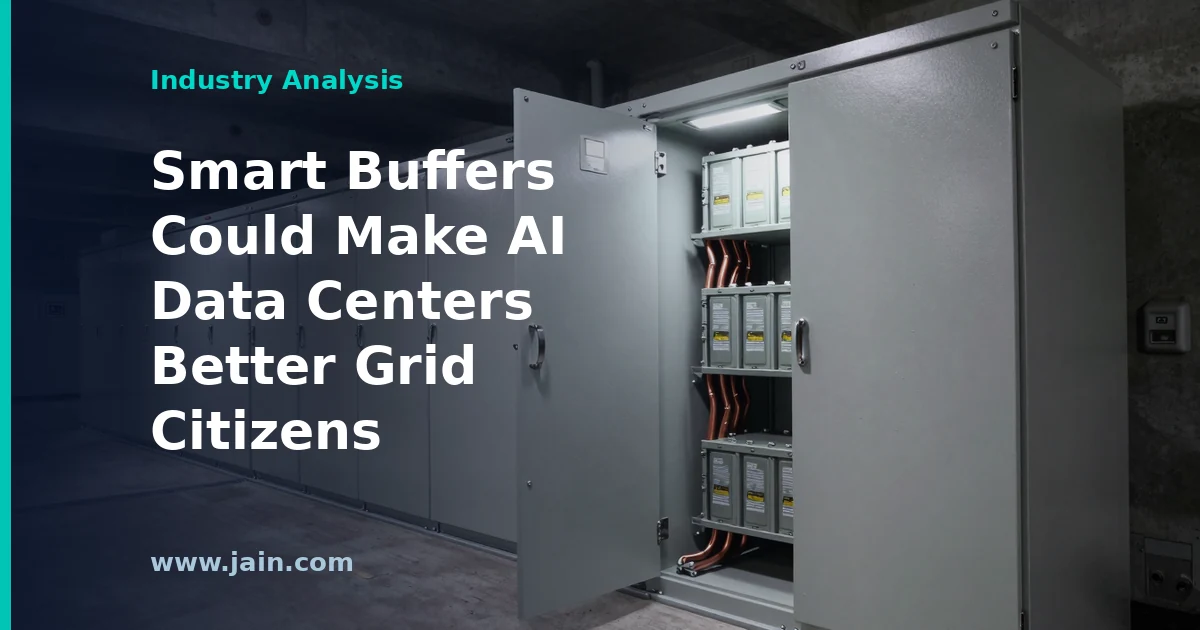
IEEE Spectrum reported on April 29, 2026 that AI data center operators are adopting “smart buffer” technologies — on-site energy storage and power-management systems that sit between the utility grid and racks of GPUs — to smooth the sharp swings in electricity demand that large AI workloads create. The framing is notable: rather than another story about AI’s appetite for power, this one covers an emerging engineering fix that could make AI facilities “better grid citizens.”
Executive Summary
The problem being solved is real and increasingly well documented. When thousands of GPUs start or pause a synchronized AI training run, a facility’s power draw can swing by tens of megawatts in seconds — behavior that looks, to a utility, less like a steady industrial customer and more like a giant load that lurches unpredictably. Grid operators plan around stable, forecastable demand; loads that spike and sag rapidly can stress local equipment, complicate frequency regulation, and slow interconnection approvals.
Smart buffering attacks the problem at the meter. By placing fast-responding energy storage and intelligent power electronics between the grid connection and the compute floor, an operator can present the utility with a flattened, predictable demand profile while the GPUs behind the buffer surge and idle as the workload demands. If the approach matures, it addresses one of the sharpest objections utilities and communities raise against new AI capacity — and could shorten the interconnection waits that have become the industry’s biggest bottleneck.
Why AI Loads Misbehave on the Grid
Traditional data centers — the kind running websites, databases, and enterprise applications — are prized utility customers precisely because their demand is boringly flat. AI training clusters break that model. A large training job synchronizes thousands of accelerators: they compute in lockstep, pause together to exchange data, and can drop to a fraction of peak power in an instant if a job checkpoints or fails. The result is a load that oscillates on timescales of seconds to minutes, at magnitudes utilities historically associated with arc furnaces or industrial motors starting up.
Utilities engineer their networks — transformers, voltage regulation, frequency response — around expected load behavior. A customer whose demand swings violently forces conservative planning: bigger margins, more spinning reserve, longer studies before a connection is approved. That conservatism shows up for data center developers as multi-year interconnection queues, which today gate AI buildouts more tightly than chips or capital do.
Buffering as a Peace Treaty With Utilities
The smart-buffer concept is conceptually simple: put a shock absorber between the grid and the GPUs. Batteries, ultracapacitors, or other fast storage charge when the compute load dips and discharge when it spikes, so the grid sees a smooth draw while the cluster behind the buffer does whatever the workload requires. Layer in intelligent controls, and the same hardware can go further — capping peak demand, riding through brief grid disturbances, or even reducing draw on request when the grid is stressed, a capability utilities call demand response.
The business logic is compelling on paper. An operator that can credibly promise a flat or flexible load profile becomes a customer utilities want rather than one they study for years. That can translate into faster interconnection, access to sites previously deemed grid-constrained, and lower demand charges — the fees utilities levy based on a customer’s peak draw. In a market where time-to-power is the dominant competitive variable, anything that compresses the utility approval cycle has direct commercial value.
The Economics Cut Both Ways
Buffering is not free. Batteries sized to absorb tens of megawatts of swing add meaningful capital cost, consume space and cooling, introduce their own fire-safety and permitting considerations, and degrade with heavy cycling — and the rapid charge-discharge duty cycle of load smoothing is exactly the kind of use that ages battery cells fastest. Operators will weigh those costs against the value of faster grid access and lower peak charges, and the answer will differ by site: buffering pencils out most clearly where the grid is congested and interconnection is the binding constraint.
There is also a partial software alternative. Some of the same smoothing can be achieved by scheduling workloads intelligently — staggering job starts, injecting dummy computation to prevent sudden power drops, or throttling training slightly during grid stress. Software costs less than batteries but sacrifices some compute efficiency and cannot deliver the instantaneous response hardware can. The likely end state is hybrid: firmware and schedulers doing coarse smoothing, with electrical buffers handling the fast transients. Vendors of batteries, power electronics, and data-center power-management software all stand to gain if buffering becomes a standard requirement rather than an exotic add-on.
A Narrative Shift Worth Watching
Coverage of AI and electricity over the past two years has been dominated by alarm: rising demand forecasts, delayed fossil-plant retirements, and disputes over who pays for grid upgrades. A story centered on data centers becoming better grid citizens signals a maturing conversation — one where the industry is expected not merely to consume power but to actively support grid stability. Regulators are already moving in this direction; several jurisdictions have proposed requiring large new loads to be curtailable or to bring their own flexibility.
The strategic implication for operators is that grid behavior is becoming a design specification, not an afterthought. Facilities engineered from day one to present flexible, well-mannered load profiles will find friendlier utilities, faster approvals, and possibly favorable tariff treatment. Those that show up asking for hundreds of firm megawatts with volatile draw will increasingly wait at the back of the queue. Buffering technology, in that light, is less a gadget than an admission ticket.
Background
The collision between AI computing and the electric grid became one of the defining infrastructure stories of the mid-2020s. Data centers historically earned reputations as ideal utility customers — large but remarkably steady loads. Generative AI changed both variables at once: individual campuses grew from tens to hundreds of megawatts, and the synchronized nature of GPU training made demand volatile in ways the grid had rarely seen from digital infrastructure. Utilities responded with longer interconnection studies, and communities with growing skepticism about hosting new facilities.
IEEE Spectrum, the flagship publication of the IEEE (the world’s largest technical professional organization for engineering), has covered this tension extensively. Its April 2026 report on smart buffering reflects the industry’s response phase: rather than simply requesting ever more firm power, operators are investing in storage, power electronics, and workload-management techniques that make AI facilities easier for grids to accommodate — a shift from consuming grid capacity to actively managing their footprint on it.
On April 28, 2026, RAND — the nonprofit, nonpartisan policy research institution — published an analysis titled “How Much More Power Can the U.S. Grid Provide for AI? Projections and Policy Implications for 2030.” The work models the gap between surging AI-driven electricity demand and the grid’s realistic ability to serve it this decade, and maps the policy choices that will widen or narrow that gap.
Executive Summary
The question in RAND’s title is arguably the central resource question of the AI buildout. Data centers running artificial-intelligence workloads have become one of the fastest-growing sources of new electricity demand in the United States, and every hyperscale campus announcement ultimately depends on an answer to the same question: can the grid actually deliver the power, and by when?
What makes a RAND treatment notable is the framing. Rather than starting from what AI developers say they need — the demand-side forecasts that dominate industry discourse — the title starts from what the grid can provide, a supply-side constraint analysis. Pairing “projections” with “policy implications” signals that the answer is not a fixed number but a range whose outcome depends on decisions about generation, transmission, and interconnection that federal and state policymakers are making right now.
Because our source is the publication listing rather than the full report, this article analyzes the question RAND is posing and the market context around it, and flags below what the listing alone does not tell us about the report’s specific findings.
Why the Supply-Side Framing Matters
Most public numbers in the AI-power debate come from the demand side: forecasts of how many gigawatts AI data centers will request. Those forecasts are genuinely uncertain — utilities have reported that the same prospective data center project often applies for service in multiple territories, which can inflate aggregate demand figures if requests are summed naively. A supply-side analysis flips the question to the binding constraint: how much new load the existing fleet of power plants, transmission lines, and distribution infrastructure can absorb by 2030 under realistic buildout assumptions.
That reframing matters commercially. If credible headroom estimates exist region by region, they become a de facto siting map — telling developers where power is available and telling investors which announced projects face energization risk. It also disciplines the conversation: a project announcement is not capacity until a utility can serve it.
The Bottleneck Is Delivery, Not Just Generation
For readers new to the topic: connecting a large new power plant or a large new customer to the grid requires an engineering study process called interconnection, and in much of the country those study queues have stretched to multiple years. High-voltage transmission lines — the long-distance wires that move bulk power — routinely take the better part of a decade from proposal to operation because they cross many permitting jurisdictions. Meanwhile, a modern AI campus can be requesting hundreds of megawatts, the scale of a small city, on a two-to-three-year construction schedule.
That timing mismatch, not any absolute shortage of energy resources, is the crux of the 2030 question. It explains why data center operators are increasingly pursuing workarounds: siting at retired industrial locations with existing grid connections, contracting directly with power plants, adding on-site generation, and offering demand flexibility — agreeing to reduce draw during grid stress in exchange for faster hookups.
The Policy Levers on the Table
The “policy implications” half of RAND’s title points at a live agenda. The levers most commonly debated in this space include: reforming interconnection queues so viable projects move faster; accelerating transmission permitting and cost allocation; deciding who pays for grid upgrades triggered by large loads, a question with direct consequences for other ratepayers’ bills; and setting rules for large flexible loads and behind-the-meter generation. Each lever sits with a different actor — federal regulators, regional grid operators, state commissions — which is why national demand projections translate so unevenly into local reality.
For the infrastructure industry, the stakes cut both ways. Faster interconnection and transmission buildout expands the addressable market for data center development. But cost-allocation decisions that shift upgrade costs onto large loads change project economics, and jurisdictions that move slowly will simply watch capacity — and the tax base that comes with it — land elsewhere. An evenhanded, nonpartisan modeling effort that quantifies these tradeoffs is useful precisely because most numbers in circulation come from parties with a commercial or advocacy position.
Background
US electricity demand was roughly flat for about two decades before data centers — accelerated sharply by the generative AI boom that began in late 2022 — joined electrification and reshored manufacturing in pushing load growth back onto utility planning agendas. Since then, hyperscale campus announcements measured in the hundreds of megawatts or more have become routine, and access to power has displaced land and fiber as the primary siting constraint for the data center industry.
RAND, founded in 1948, is a nonprofit research institution known for quantitative analysis of defense, infrastructure, and technology policy. Its entry into the AI-and-grid debate adds an independent modeling voice to a discussion otherwise dominated by utilities, developers, and advocacy groups, each with a stake in how big the numbers are said to be.