Tag: India

  • Meta Taps Reliance to Build Its First AI Data Center in India

    Meta Taps Reliance to Build Its First AI Data Center in India

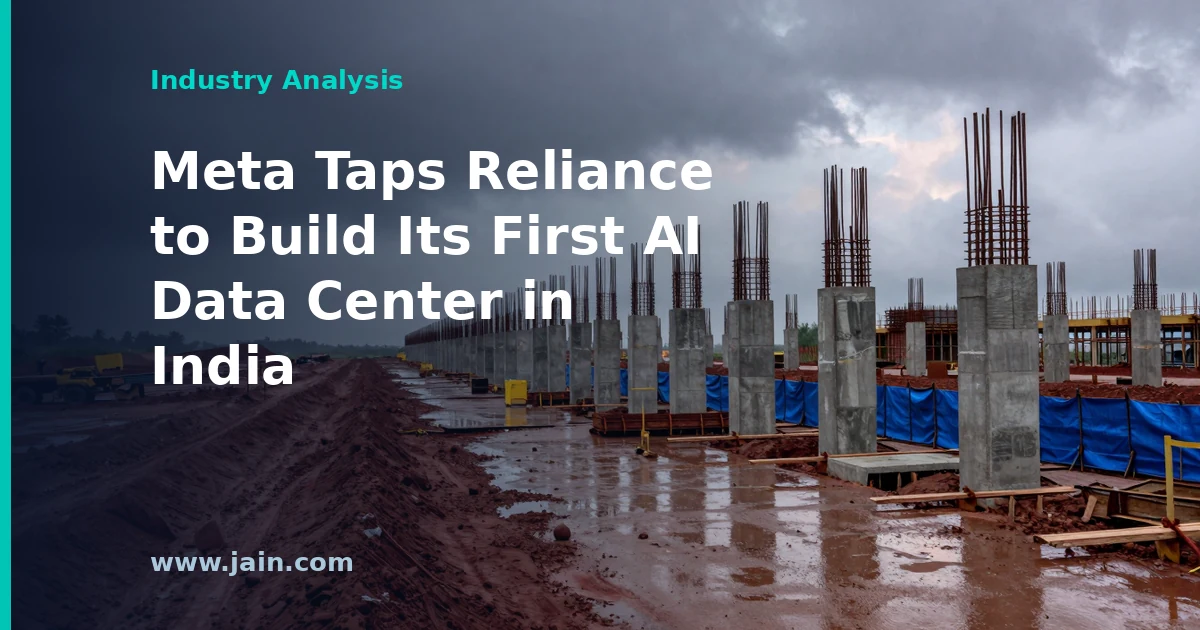
    Meta Platforms is building its first AI data center in India in partnership with Reliance, according to a report surfaced by Yahoo Finance on June 20, 2026. The announcement marks the first time the social media and AI giant has committed to dedicated AI compute capacity on Indian soil, working alongside the conglomerate that operates Jio, India’s largest telecom network.

    The initial report is light on specifics: no capacity figures, site location, investment amount, or completion date accompanied the headline. What is clear is the strategic shape of the deal — a US hyperscaler pairing with India’s most powerful industrial group to localize AI infrastructure in one of the world’s largest internet markets.

    Executive Summary

    The announcement, as reported, is straightforward: Meta will build its first India-based AI data center with Reliance as its partner. For Meta, whose Facebook, WhatsApp, and Instagram platforms count India as one of their largest user bases anywhere, this moves AI compute closer to hundreds of millions of users for the first time rather than serving them from facilities abroad.

    Why it matters is bigger than one building. Hyperscale AI infrastructure has so far concentrated in the United States, with secondary clusters in Europe, the Gulf, and East Asia. A Meta AI facility in India signals that the AI buildout is entering a genuinely global phase — and that the entry route into complex markets runs through local partners who control power, land, connectivity, and regulatory relationships. Reliance checks every one of those boxes.

    The caveat: this is a single dated report, and the material terms — megawatts, money, location, timeline, and who owns what — were not disclosed in the source. The direction is significant; the details remain to be substantiated.

    Why India, and Why Now

    India is arguably the most consequential untapped market in the AI infrastructure story. It has one of the world’s largest internet populations, among the cheapest mobile data anywhere, and a government that has pushed data localization — rules encouraging or requiring certain data about Indian users to be stored and processed within the country. For a company like Meta, whose products are woven into daily Indian life, serving AI features from data centers on another continent adds latency (the delay users experience) and regulatory friction. Local AI capacity addresses both.

    The timing also tracks the broader industry pattern. Hyperscalers — the handful of companies that build computing infrastructure at massive scale — spent the first years of the AI boom concentrating capacity near cheap power and familiar regulatory regimes at home. As those sites mature and demand globalizes, the buildout is following users abroad. India, with its market size and its infrastructure and permitting complexity, is the natural test of whether the hyperscale playbook travels.

    What Reliance Brings to the Table

    Reliance Industries is not a conventional data center landlord. It is India’s largest private conglomerate, spanning energy, retail, and telecom, and its Jio unit upended Indian telecom by making mobile data radically cheap and signing up hundreds of millions of subscribers. That gives Reliance three assets any AI data center needs: access to power at industrial scale, a nationwide fiber and mobile network to move data, and deep experience navigating Indian land acquisition and regulation.

    There is also history here. Meta invested roughly $5.7 billion in Reliance’s Jio Platforms in 2020 for a minority stake — at the time one of the largest technology investments ever made in India. This AI data center partnership extends a relationship that has been building for half a decade, which matters: hyperscalers rarely entrust first-in-country infrastructure to untested partners. For Reliance, hosting Meta’s AI workloads validates its ambition to become India’s digital infrastructure backbone, not merely its telecom operator.

    The Partnership Model Goes Global

    In its home market, Meta overwhelmingly builds and owns its data centers outright. Abroad, and especially in markets where land, energy, and licensing are hard for a foreign company to secure alone, the calculus shifts toward partnership. This deal fits a pattern visible across the industry: hyperscalers entering complex markets through joint structures with local champions who de-risk the ground game while the tech company supplies capital, compute design, and workload demand.

    The winners in this model are reasonably clear. Local partners like Reliance capture anchor tenancy and technology transfer. Indian enterprises and consumers get lower-latency AI services and, potentially, capacity that seeds a domestic AI ecosystem. The competitive pressure lands on other operators courting hyperscale tenants in India — and on rival hyperscalers, who must now weigh whether serving India remotely remains tenable when a peer is building in-country.

    The Hard Parts: Power, Heat, and Unknowns

    Enthusiasm should be tempered by physics and by what the report does not say. AI data centers are extraordinarily power-hungry, and India’s grid, while improving, still contends with reliability challenges and a generation mix in transition. Much of India’s climate is hot and humid, which makes cooling — often the largest operating cost after electricity — more expensive and, where water-based cooling is used, more contentious. How this facility will be powered and cooled is unstated, and those answers will determine both its economics and its public reception.

    It bears repeating that the source is a single report with no disclosed capacity, cost, site, or schedule. Announcements in this industry sometimes precede permits, power agreements, and financing by years. The partnership is a credible and strategically coherent step for both companies — but until the material terms surface, it should be read as a declaration of direction rather than a fully specified project.

    Background

    Meta operates one of the world’s largest private data center fleets, historically concentrated in the United States and Europe, and has been spending heavily on AI compute as it builds large language models and AI features across its apps. India is central to Meta’s user base — it is among the biggest markets globally for WhatsApp, Facebook, and Instagram — yet until this announcement Meta had no dedicated AI data center in the country.

    Reliance Industries, led by Mukesh Ambani, is India’s largest private conglomerate. Its Jio telecom venture, launched in 2016, made mobile data dramatically cheaper and brought hundreds of millions of Indians online, and Meta’s roughly $5.7 billion investment in Jio Platforms in 2020 established the commercial relationship between the two companies. Reliance has since pursued digital infrastructure ambitions beyond telecom, making it the most frequently named local partner for global technology firms entering India at scale.

    Source: Meta (META) Builds Its First India AI Data Center With Reliance — Yahoo Finance report, June 20, 2026, on Meta’s partnership with Reliance for its first AI data center in India.

  • Schneider Electric: India Data Center Growth Now Outpaces Its Core Business

    Schneider Electric: India Data Center Growth Now Outpaces Its Core Business

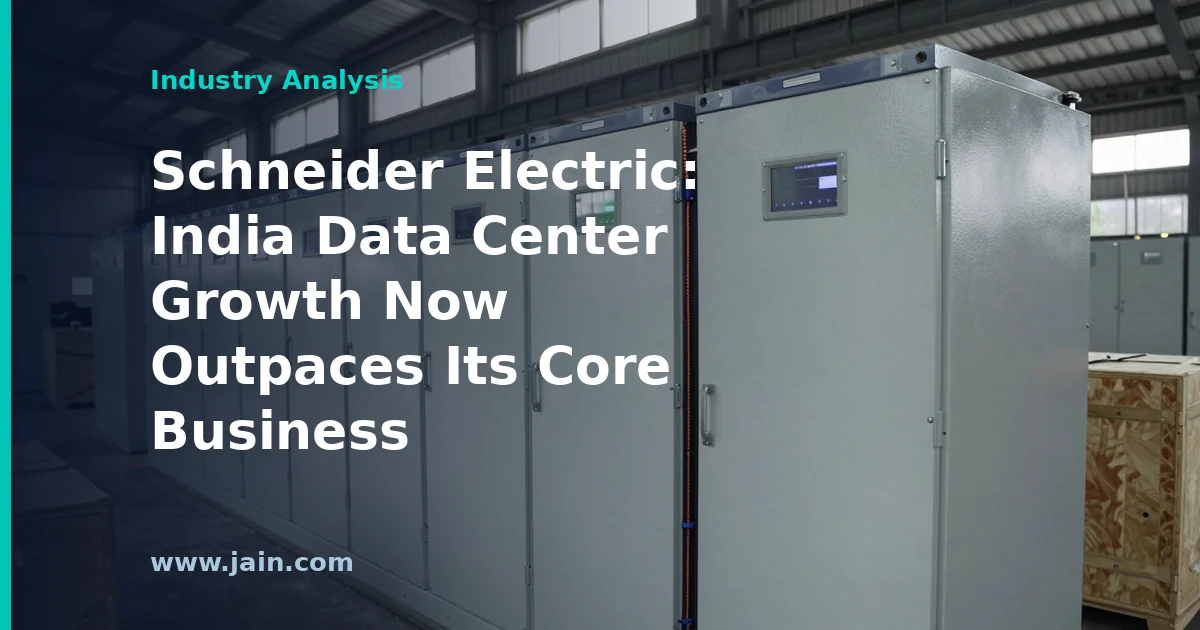
    Reuters reported on May 24, 2026 that Schneider Electric — the French energy-management and industrial-automation group — says its data center business in India is now growing faster than its core business, propelled by the country’s AI-driven data center buildout. The comment positions India as one of the standout markets in a global surge of demand for the electrical equipment that powers AI computing.

    Executive Summary

    The substance of the report is a growth signal, not a contract or a capacity announcement: Schneider Electric, one of the world’s largest suppliers of the switchgear, uninterruptible power supplies (UPS — the battery-backed systems that keep servers running through grid disturbances), and power-distribution equipment that data centers depend on, says demand from India’s data center sector is expanding faster than the rest of its business there.

    That matters for two reasons. First, it is a read on where the AI infrastructure wave is spreading: hyperscale-style demand is no longer confined to the United States and a handful of established hubs. Second, it comes from the supply side. Data center operators announce ambitions; equipment vendors see purchase orders. When a major electrical supplier says one segment is outgrowing everything else it does in a market, that is a comparatively hard signal that capital is actually being spent.

    The caveat is proportionality: “outpacing core growth” describes a rate, not a size, and the report as available does not quantify either. A fast-growing segment can still be a small one.

    The AI Boom Is Really an Electrical Equipment Boom

    Every AI data center is, underneath the servers, an electrical engineering project. Racks of AI accelerators draw several times the power of conventional servers, and that power has to be received from the grid, transformed, distributed, conditioned, and backed up — all with equipment from a fairly short list of global vendors, of which Schneider Electric is one of the largest alongside the likes of ABB, Siemens, Eaton, and Vertiv. This is why the AI cycle has been felt so strongly by electrical suppliers: compute demand converts almost directly into orders for switchgear, transformers, UPS systems, busway, and cooling infrastructure.

    Schneider’s India comment extends a pattern the industry has watched for two years in the US and Europe: the constraint on AI capacity is increasingly power delivery, not chips alone. When equipment vendors describe data centers as their fastest-growing segment in a new geography, it signals that the buildout — and potentially the associated equipment lead-time pressure — is going global.

    Why India Is the Market to Watch

    India combines several ingredients that data center investors look for: a very large and growing base of internet users, data-localization rules that encourage storing Indian data in-country, comparatively low construction costs, and government interest in domestic AI capability. Global cloud providers and regional operators have all announced Indian expansion in recent years, concentrated around hubs such as Mumbai, Chennai, and Hyderabad.

    For an equipment vendor, India offers something else: Schneider Electric has a long-established manufacturing and commercial presence there, so local data center demand can be served substantially from local operations. If AI-driven orders are now growing faster than the company’s traditional Indian business — which spans buildings, industry, and grid infrastructure — it suggests the data center segment is becoming a structural growth pillar rather than a side market.

    Supply-Side Signals Deserve Attention — and Context

    It is worth being precise about what this report does and does not establish. A vendor saying a segment is “outpacing core growth” is a directional claim about relative growth rates. As reported, it does not disclose the segment’s revenue, its share of Schneider’s India business, order backlog, or a forecast horizon. Growth from a small base can outpace a large core for years without changing the overall business mix, so the claim is credible but not yet quantified in the material available.

    It is also a statement any vendor has an interest in making during an AI investment cycle: data center exposure is currently rewarded by investors. That does not make the claim wrong — Schneider’s global results through this cycle have consistently shown genuine data center strength — but buyers and investors should look for the numbers behind the narrative when the company next reports segment detail. For data center operators, the practical takeaway is less about Schneider specifically and more about the market it describes: if India’s buildout is accelerating, competition for equipment, grid connections, and skilled electrical contractors in that market will accelerate with it.

    Background

    Schneider Electric traces its roots to 1836 in France and has evolved from heavy industry into a global leader in energy management and automation. Its data center relevance deepened with the 2007 acquisition of APC, a leading UPS maker, and the company now supplies integrated power, cooling, and management systems to hyperscale and colocation operators worldwide. Throughout the current AI investment cycle, data centers have been among the strongest demand drivers across the electrical equipment industry.

    India’s data center market has expanded rapidly since the country’s 2020s push on data localization and digital infrastructure, attracting investment from global cloud providers and domestic operators alike. The AI wave has added a second demand layer on top of that cloud-driven growth, with power availability widely viewed as the buildout’s key constraint.

    Source: Schneider Electric sees India data center business outpacing core growth on AI boom — Reuters, reporting the company’s comments on AI-driven data center demand in India, May 24, 2026.