
TL;DR · 30-second read
The Short Version
A company planning California’s largest data center, a huge building full of computers like the ones that run AI tools, was refused the water it needs to keep those machines cool. It is now suing the public agency that controls the local water.
The water comes from the Colorado River. About 40 million people in seven states depend on that river, and drought has strained it. The company wants to take over water that farms use today.
The court case could help decide whether water, not only electricity, limits where the AI boom can be built.
BGR reported on August 12, 2026 that Imperial Valley Computer Manufacturing has sued the Imperial Irrigation District (IID), the public agency that delivers Colorado River water to California’s Imperial Valley. IID had denied the developer’s request to use the district’s water supply and wastewater to cool a planned 330-megawatt data center, which would be the largest in California. The facility is expected to require 287 million gallons of water.
The developer plans to source that water by reallocating it from farmland. Its lawsuit argues there is “no rational basis” for IID to bar an industrial company from combining several fields into a single unit for water reallocation while allowing agricultural users to do the same.
Executive Summary
Most debate about where AI data centers can be built focuses on electricity: whether the grid can deliver hundreds of megawatts, and how fast. The Imperial Valley dispute puts a different constraint in front of a court. The developer’s cooling plan depends on moving existing farm water allocations to an industrial user, and the agency that controls those allocations has said no.
The legal question is narrow, whether an industrial user may aggregate and transfer water the way farmers already can. The practical stakes are broad. If water rules can block a 330-megawatt project in one of the most water-contested basins in the country, developers eyeing arid regions will have to treat water rights as a gating item on par with a power connection, not as a permit to settle later.
Sebastian Rucci, the figure leading the project, argues the data center would use about as much water as a 160-acre farm and would benefit the local economy. Critics counter that reallocating farm water puts rural communities at risk, and local residents broadly favor a moratorium on new data center construction.
Why Water Rights, Not Just Megawatts, Gate This Project
A data center’s electrical rating, here 330 megawatts, describes how much power its computers and support systems can draw. Nearly all of that electricity ends up as heat, which has to be removed continuously. Many large facilities do this with evaporative cooling, in which water is evaporated in cooling towers to carry heat away. That design is efficient on electricity but consumes water in proportion to the heat load, which is why a 330-megawatt campus arrives with a 287-million-gallon water requirement attached.
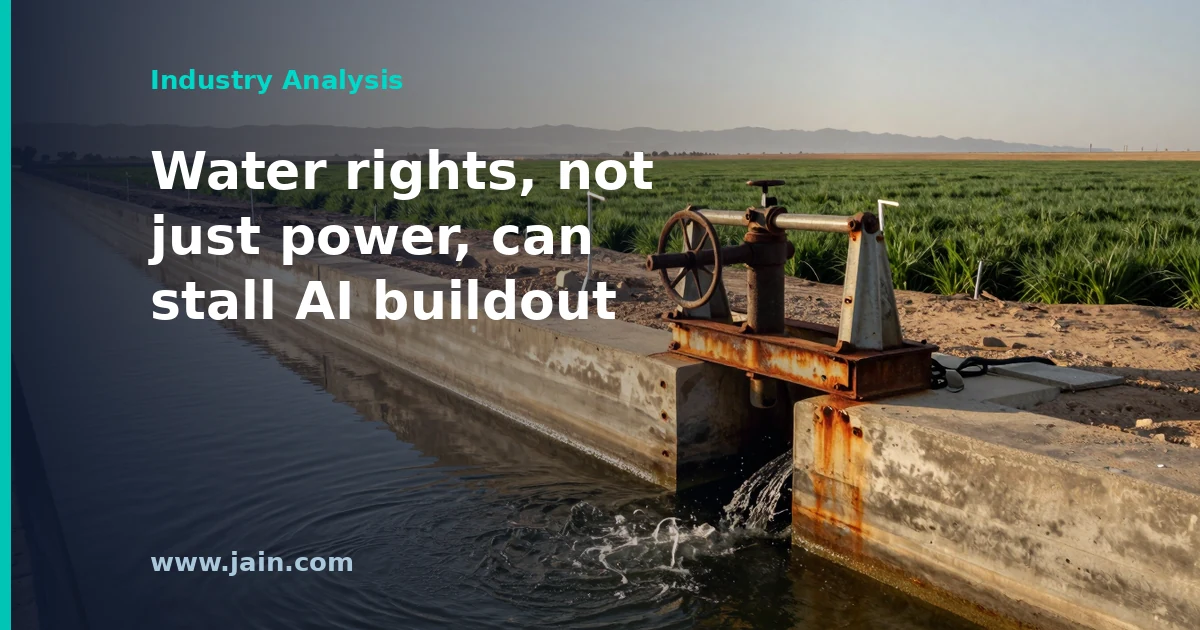
In the Imperial Valley, that water has to come from somewhere already spoken for. IID delivers Colorado River water to the region, and the developer’s plan is to reallocate water currently tied to farmland. IID’s denial covered both its water supply and its wastewater, closing off reclaimed water as well as fresh. As things stand, the project’s cooling design cannot proceed on the terms the developer proposed, whatever its power situation. That is the mechanism the title points to: a local water agency’s allocation rules, not the grid, are the decision point currently holding up this capacity.
The people affected extend beyond one developer. Anyone siting large facilities in the arid Southwest, where land and solar power are attractive, now has a live example of water access acting as a hard stop. Water agencies are affected too, since a ruling will signal how much discretion they have to treat industrial and agricultural transfers differently.
The Legal Question: Can Industry Aggregate Water Like Farms Do?
The lawsuit’s core argument is about equal treatment. According to the complaint as described, IID lets agricultural users combine multiple fields into a single unit for water reallocation but refused to let an industrial company do the same. The developer says there is “no rational basis” for the distinction.
That phrasing echoes a well-established legal standard under which a government body’s line-drawing generally survives if any reasonable justification exists. It is typically a demanding standard for challengers. IID may point to its mandate to serve agriculture, drought conditions on the Colorado River, or the difference between water that stays in farming and water permanently moved to a new industrial use. The developer will argue that water is water and that the district cannot favor one class of user without a principled reason.
Either outcome sets a marker. A win for the developer would suggest farm water allocations in the district can be assembled and redirected to data centers, which would change land and water economics in the valley. A win for IID would confirm that water agencies can effectively decide whether water-intensive data centers get built in their service areas.
Testing the 160-Acre Farm Comparison
Rucci’s claim that the facility would have as much impact as a 160-acre farm can be checked against the stated figure. Dividing 287 million gallons across 160 acres works out to roughly 1.8 million gallons per acre, or about 5.5 acre-feet, the unit water managers use, where one acre-foot covers an acre of land a foot deep. Whether that matches a typical Imperial Valley farm depends on the crop and on whether 287 million gallons is an annual figure, which has not been specified.
The comparison also answers a different question from the one critics are asking. Their objection is less about the total volume than about where it comes from: water moved out of farming, in a region where agriculture sustains rural livelihoods, from a river that serves 40 million people across seven states. It also leaves open how much of the data center’s water would be consumed through evaporation versus returned to the system, a distinction that matters for downstream users.
Local Opposition Is Part of the Siting Math
Residents in the area generally favor a strict moratorium on new data center construction, according to the reporting, reflecting concerns about utility prices and water strain that have followed data center projects in other regions. Rucci has argued the project would bring economic benefits, but the specifics of jobs, tax revenue or community agreements have not been laid out.
For the industry, the lesson is that community sentiment and water governance are converging into a single siting risk. A project that must win both a court case over water allocation and a skeptical local public faces a longer and less predictable path than one that secures water and community support before it announces its scale.
Background
The Imperial Valley sits in California’s southeastern desert and depends on Colorado River water delivered by the Imperial Irrigation District, much of it for farming. The Colorado River supplies roughly 40 million people across seven U.S. states and has faced years of drought, making any new large draw on it contentious.
Data centers have become one of the fastest-growing sources of industrial demand for both electricity and water as companies build capacity for artificial intelligence. Their water use comes mainly from cooling, and communities in several regions have pushed back on new facilities over utility costs and water strain, making water sourcing an increasingly visible part of the siting process. Source: The Largest Data Center In California Has Been Denied Water For Cooling — Now It’s Suing A Public Agency (BGR), on Imperial Valley Computer Manufacturing’s lawsuit against the Imperial Irrigation District over cooling water for a planned 330 MW data center.Sources