Tag: immersion cooling

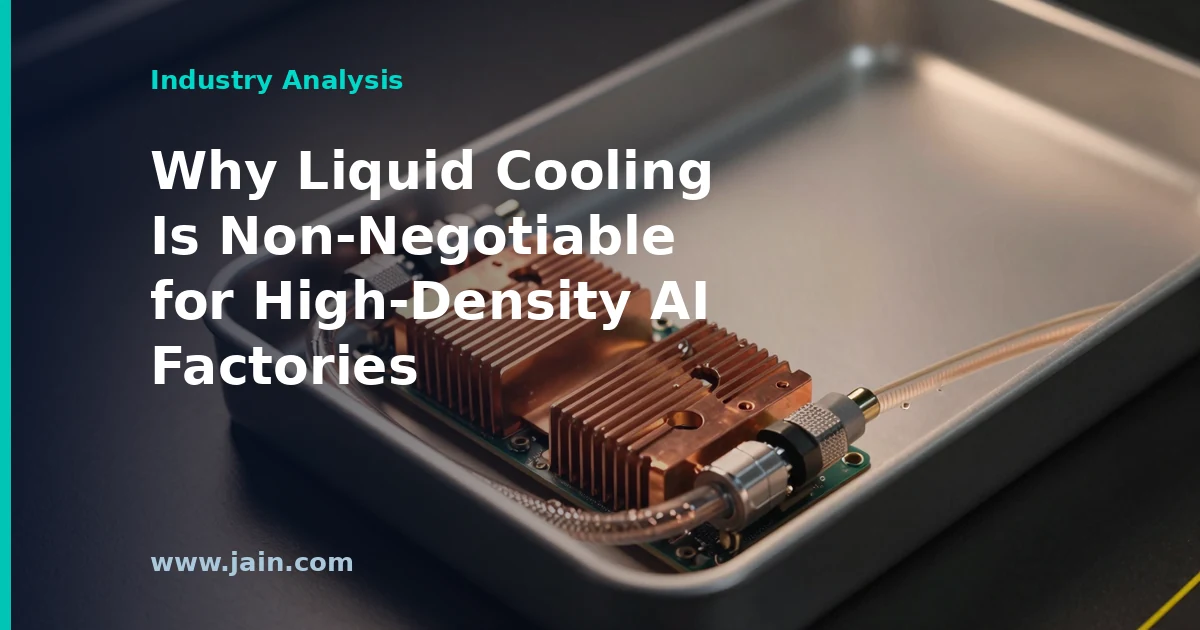
  • Why Liquid Cooling Is Non-Negotiable for High-Density AI Factories

    Why Liquid Cooling Is Non-Negotiable for High-Density AI Factories

    Data Center Dynamics published an analysis on 25 June 2026 contrasting the cooling demands of AI factories — facilities purpose-built for dense GPU training and inference clusters — with those of conventional cloud data centers, arguing that liquid cooling is now essential for high-density AI workloads rather than an optional upgrade.

    The piece lands amid an industry-wide retooling: operators worldwide are redesigning halls, mechanical plants, and supply chains around direct-to-chip and other liquid cooling approaches as accelerated computing outgrows the air-cooled designs that served the cloud era.

    Executive Summary

    The core claim is straightforward: the data center designs that carried the cloud computing era are hitting a physical ceiling. Conventional cloud halls were engineered around air cooling — moving chilled air through racks drawing power in the single-digit-to-low-double-digit kilowatt range. AI training clusters concentrate far more power in each rack, because modern GPU systems pack accelerators tightly together to keep them on fast, short interconnects. At those densities, air simply cannot carry heat away fast enough, and liquid — which is far denser and holds vastly more heat per unit volume than air — becomes the only practical medium.

    Why it matters: cooling is no longer a back-of-house mechanical detail but a gating factor for who can host AI workloads at all. Operators with liquid-ready facilities can court the highest-value tenants; operators with legacy air-cooled halls face expensive retrofits or a narrowing addressable market. For enterprises buying AI capacity, a provider’s cooling architecture is now a proxy for whether it can actually deliver current-generation GPU infrastructure.

    The analysis frames this as a structural divide — ‘AI factory’ versus ‘cloud hall’ — rather than a spectrum, which is a useful lens even if real-world facilities often blend both.

    The Physics Sets the Deadline, Not the Marketing

    Air cooling works by blowing large volumes of conditioned air through servers, and it has a well-understood practical ceiling: as rack power climbs, the airflow, fan energy, and temperature gradients required become unmanageable. Liquid cooling — most commonly direct-to-chip cold plates, where coolant flows across a metal plate bonded to the processor, or immersion, where hardware is submerged in a dielectric (electrically non-conductive) fluid — removes heat at the source with far greater efficiency. This is not a vendor preference; it is thermodynamics. Water-based coolants can absorb on the order of thousands of times more heat per unit volume than air, which is why every leading accelerated-computing platform roadmap now assumes liquid at the high end.

    The important nuance is that the ceiling is not a single number. Well-engineered air systems with hot-aisle containment can stretch surprisingly far, and many inference and enterprise workloads will remain comfortably air-coolable for years. The ‘non-negotiable’ framing applies specifically to dense training clusters, where chips must sit physically close together for interconnect performance. Density is a networking decision as much as a thermal one — and that is precisely why it cannot be relaxed just to make cooling easier.

    Economics: Liquid Costs More Up Front and Less to Run

    Liquid cooling shifts spending from operations to capital. Cold plates, coolant distribution units, manifolds, leak detection, and plumbing add up-front cost and engineering complexity that air systems avoid. In exchange, operators typically get lower fan energy, better power usage effectiveness (PUE — the ratio of total facility power to IT power, where closer to 1.0 is better), and the ability to run warmer coolant loops that reduce or eliminate energy-hungry chillers. Heat captured in liquid at useful temperatures is also far easier to reuse — for district heating or industrial processes — than diffuse warm air.

    The strategic consequence is that cooling architecture now shapes site selection and facility economics together. A liquid-cooled AI factory can put more revenue-generating compute on the same power envelope, which matters enormously when grid connections — not land or capital — are the scarcest input in the industry. That said, buyers should treat sweeping efficiency claims with care: realized PUE depends on climate, design discipline, and utilization, and figures quoted for flagship builds do not automatically transfer to retrofits.

    Winners, Losers, and the Retrofit Question

    The clearest winners are operators and builders that committed early to liquid-ready designs — reinforced floors for heavier racks, space for coolant distribution, higher-capacity power delivery — along with the supply chain behind them: cold-plate and CDU manufacturers, fluid suppliers, and mechanical contractors with liquid experience. Chipmakers benefit too, since liquid cooling removes a constraint on how much power their next generations can draw.

    The harder story is the installed base. Thousands of existing air-cooled halls cannot be casually converted: adding liquid means new piping, floor loading analysis, leak-management protocols, and often a rethink of the entire mechanical plant. Some facilities will be retrofitted profitably, some will serve the still-large market for air-coolable workloads, and some will be stranded relative to AI demand. For colocation providers, the honest question customers should ask is not ‘do you support liquid cooling?’ but ‘how many megawatts of it can you deliver, at what density, and by when?’

    Operational Risk: New Skills, New Failure Modes

    Bringing liquid into the white space introduces failure modes the air-cooled era rarely faced: leaks near live electronics, coolant chemistry maintenance, and the coordination of facility water loops with IT equipment loops. None of these are exotic — mainframes were water-cooled decades ago, and modern systems are engineered with negative-pressure loops and leak detection — but they demand skills that many data center operations teams are still building. Expect certification programs, standardized quick-disconnect fittings, and reference designs to matter as much as raw technology in determining who executes this transition smoothly. The industry’s real constraint may be trained people, not parts.

    Background

    Data center cooling has followed computing density for decades: water-cooled mainframes gave way to air-cooled commodity servers in the client-server and cloud eras, when racks drawing modest power made air the cheap, simple choice. The generative AI boom reversed the trend — modern accelerator systems concentrate unprecedented power in single racks, and leading GPU platform roadmaps now assume liquid cooling at the high end, pulling the entire industry’s mechanical design along with them.

    Data Center Dynamics, the publication behind this analysis, is a long-established trade outlet covering data center design and operations. Its framing of ‘AI factories’ versus conventional cloud facilities echoes terminology popularized by the accelerated-computing industry to describe purpose-built AI infrastructure — a sign of how thoroughly that vocabulary has permeated the sector.

    Source: AI factory cooling vs cloud data centers: Why liquid cooling is essential for high-density AI workloads — a Data Center Dynamics analysis, published 25 June 2026, on why liquid cooling has become a baseline requirement for dense AI infrastructure.

  • Dow’s Liquid Cooling Support Network Signals a Maturing AI Cooling Supply Chain

    Dow’s Liquid Cooling Support Network Signals a Maturing AI Cooling Supply Chain

    Dow, one of the world’s largest materials science companies, has launched a liquid cooling support network for data centres, according to a report published by Data Centre Magazine on 18 May 2026. The reported launch positions Dow — a supplier of silicones, fluids, and specialty chemistries — as an organized participant in the fast-growing market for cooling the dense computing racks that power artificial intelligence.

    Executive Summary

    The announcement, as reported, is simple in outline: Dow is standing up a formal support network around liquid cooling for data centres. Support or partner networks in the materials world typically bundle products with validation, compatibility guidance, and access to a vetted ecosystem of collaborators — though the source report does not detail which of these Dow’s network includes.

    Why it matters is larger than the announcement itself. Liquid cooling — circulating fluid to chips or immersing hardware in it, instead of relying on air — has moved from niche to necessity as AI servers pack more power into each rack than air can practically remove. When a company of Dow’s scale builds formal structure around that market, it signals that liquid cooling is graduating from a collection of point products into an industrial supply chain, with the materials layer — coolants, silicones, seals, thermal interfaces — treated as critical infrastructure rather than a commodity input.

    Why a Chemicals Giant Is Organizing Around Server Cooling

    Air cooling has a physics problem. Modern AI accelerators concentrate so much power in each rack that moving enough air through them becomes impractical, which is why the industry has shifted toward direct-to-chip liquid cooling (piping coolant across a cold plate mounted on the processor) and, in some deployments, immersion cooling (submerging entire servers in a non-conductive fluid). Every one of those approaches depends on chemistry: the coolant itself, plus the hoses, seals, gaskets, and thermal interface materials that keep fluid where it belongs for years at a time.

    That is Dow’s home turf. Materials suppliers have historically sold into this market indirectly, through the vendors that build cooling hardware. A formal support network — if it follows the usual shape of such programs — moves the materials maker closer to the operators and equipment builders who actually deploy the technology, which matters because coolant compatibility failures (degraded tubing, fouled cold plates, additive breakdown) are among liquid cooling’s most feared operational risks.

    Formalizing the Supply Chain Is the Real Story

    The editorial significance here is less any single product and more the institutional signal. Liquid cooling’s early years were characterized by fragmented suppliers, proprietary fluids, and limited interoperability guidance. Buyers — hyperscale cloud providers, colocation operators, enterprises — have been pushing for validated, multi-vendor supply chains before committing facilities designed to run for decades. Ecosystem programs are how industrial suppliers answer that demand: they convert one-off product sales into standing relationships with documented compatibility.

    Dow is not moving into an empty field. Fluid and chemistry players including Chemours, Shell, and Castrol have courted the data centre cooling market, while 3M’s announced exit from PFAS manufacturing by the end of 2025 removed a prominent supplier of certain engineered fluids and sharpened questions about fluid chemistry choices across the industry. Against that backdrop, a structured support offering from a major materials company is a bid for trust as much as for revenue: operators want assurance that the fluid in their loops will be supported, supplied, and compliant for the life of the facility.

    What Buyers Should Watch For

    For data centre operators and cooling equipment makers, the practical questions are concrete. Does the network provide compatibility validation across pumps, cold plates, and piping from multiple hardware vendors? Does it address regulatory exposure — notably the tightening scrutiny of per- and polyfluoroalkyl substances (PFAS) that affects some classes of engineered cooling fluids? And does it shorten the qualification cycle, which today can add months to a liquid cooling deployment?

    The source report does not answer these questions, and it would be premature to credit the network with capabilities it has not publicly detailed. What can be said fairly is that the direction of travel — materials incumbents building formal, supported ecosystems around data centre liquid cooling — is exactly what a maturing market looks like, and buyers benefit when more credible suppliers compete to underwrite reliability.

    Background

    Dow traces its roots to 1897 and today ranks among the world’s largest materials science companies, supplying silicones, fluids, and specialty chemistries across dozens of industries. Its materials have long appeared inside electronics and thermal management applications, though typically sold through intermediaries rather than under a data centre-branded program.

    The data centre cooling market has been reshaped by the AI build-out: rack power densities have climbed beyond what air cooling comfortably handles, pushing direct-to-chip and immersion cooling from experimental to mainstream. That shift has drawn fluid and chemistry suppliers — and their partner ecosystems — into a market once dominated by mechanical and HVAC vendors.

    Source: Dow Launches Liquid Cooling Support Network for Data Centres — Data Centre Magazine report, 18 May 2026, on Dow’s launch of a liquid cooling support network for data centres.

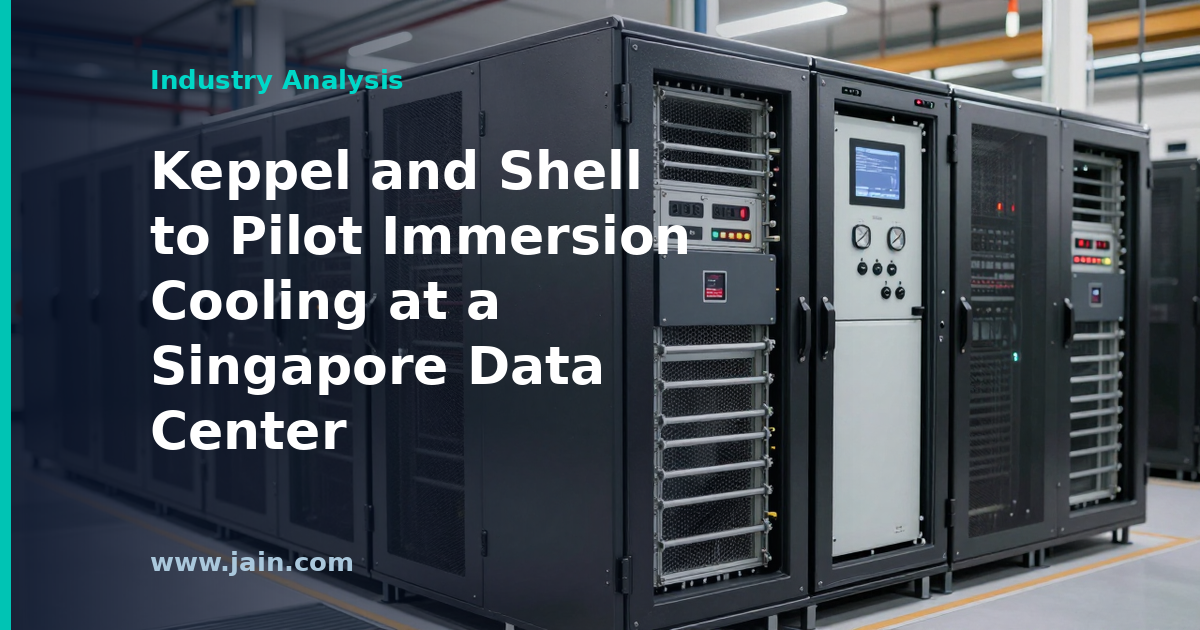
  • Keppel and Shell to Pilot Immersion Cooling at a Singapore Data Center

    Keppel and Shell to Pilot Immersion Cooling at a Singapore Data Center

    Keppel and Shell will launch an immersion cooling pilot at a data center in Singapore, according to an April 2026 report by Data Center Dynamics. Immersion cooling submerges servers in a non-conductive (dielectric) liquid instead of blowing chilled air across them, and the pilot pairs one of Asia’s most established data-center operators with an energy major that has been developing cooling fluids as a specialty product line.

    Executive Summary

    The announcement is short on specifics — no facility name, timeline, capacity, or fluid specification was reported — but the pairing itself is the story. Keppel is a longtime data-center developer and operator headquartered in Singapore, and Shell is one of several oil-and-gas majors that have built immersion cooling fluids into their lubricants and specialty-chemicals portfolios. A pilot puts that product in a live operator environment, which is the step fluid vendors need before operators will commit production workloads.

    It matters because the industry’s cooling assumptions are shifting. AI accelerators have pushed per-rack power draws well beyond what conventional air cooling handles economically, and Singapore — a tropical, land- and power-constrained market that conditions new data-center capacity on efficiency — is one of the most demanding places to prove out an alternative. If immersion works commercially anywhere, a Singapore pilot is a credible proving ground.

    Why Air Cooling Is Running Out of Headroom

    For decades, data centers were cooled the same basic way: chill air, push it through server racks, and exhaust the heat. That model works well at the rack densities of the cloud era — roughly 5 to 15 kilowatts per rack — but AI training and inference hardware has driven densities several times higher, and air simply cannot carry heat away fast enough at those levels without extreme airflow and energy cost. Liquid conducts heat far more effectively than air, which is why the industry is moving toward direct-to-chip liquid cooling and, at the more radical end, full immersion.

    Immersion cooling takes the concept to its logical conclusion: the entire server is submerged in a bath of dielectric fluid — a liquid engineered not to conduct electricity — so every component sheds heat directly into the liquid. Proponents cite lower cooling energy, reduced fan power, and quieter, denser halls. The trade-offs are real too: servicing a submerged server is messier, hardware warranties and supply chains are built around air, and the fluid itself is a new consumable with its own cost and lifecycle. A pilot is precisely how an operator quantifies those trade-offs on its own workloads rather than a vendor’s test bench.

    An Oil Major’s Route Into the Data-Center Thermal Stack

    Shell’s participation reflects a broader pattern: oil-and-gas companies repositioning parts of their refining and lubricants expertise toward digital infrastructure. Immersion fluids are, at bottom, specialty chemistry — the same competency that produces engine oils and transformer fluids — and Shell has marketed immersion cooling fluids for several years as part of its lubricants business. For an energy major, data-center cooling offers a growth market tied to AI demand at a time when traditional fuel demand faces long-term uncertainty.

    For operators, the entry of large chemical producers addresses a practical adoption barrier: fluid supply at scale, with the quality control, safety documentation, and global logistics that hyperscale procurement requires. A niche fluid from a small vendor is a harder bet for a facility designed to run twenty years. That said, the release as reported does not disclose the commercial structure here — whether Shell is supplying fluid, co-developing the system, or simply lending its name to a joint trial — and those are very different depths of commitment.

    Singapore Is a Deliberately Hard Test Bed

    Singapore is one of the world’s most important data-center hubs and also one of its most constrained. The city-state paused new data-center approvals for several years over energy concerns, and when it resumed allocations it tied new capacity to stringent efficiency standards. Add a tropical climate — where conventional cooling works hardest and free-air economization is largely unavailable — and Singapore becomes a stress test: cooling technology that pencils out there has cleared a high bar.

    That context cuts both ways for this pilot. It gives the results credibility if they are published, and it aligns with Keppel’s interest in squeezing more compute from a fixed power and land envelope. But it also means the pilot’s findings may flatter immersion relative to temperate markets, where cheap outside-air cooling narrows the efficiency gap. Operators elsewhere should read any results with their own climate and power costs in mind.

    What a Pilot Proves — and What It Doesn’t

    A pilot answers engineering questions: real-world efficiency, serviceability, fluid behavior over time, and how existing operational teams adapt. It does not answer the commercial questions that determine adoption — total cost of ownership at fleet scale, hardware-vendor warranty support, insurance treatment, and whether tenants will accept immersed infrastructure. The history of data-center cooling includes many well-run pilots that never converted to production deployments because the economics or the supply chain wasn’t ready.

    The measured read is that this announcement signals direction, not destination. Keppel gains hands-on data for future builds in a market that rewards efficiency; Shell gains an operator reference in a marquee hub. Whether it becomes more than that depends on results neither company has yet reported.

    Background

    Keppel has been building and operating data centers for over two decades and is one of Asia’s most established players in the sector, with Singapore as its home market. Singapore itself paused new data-center approvals for several years over energy concerns before resuming allocations under strict efficiency conditions, making cooling performance a gating factor for growth there. Shell, like several energy majors, has extended its lubricants and specialty-chemicals expertise into immersion cooling fluids as demand for high-density computing rises — part of a broader repositioning of oil-and-gas capabilities toward digital infrastructure.

    Source: Keppel and Shell to launch immersion cooling pilot at Singapore data center — Data Center Dynamics report, April 25, 2026, on a planned immersion cooling trial at a Keppel data center in Singapore.

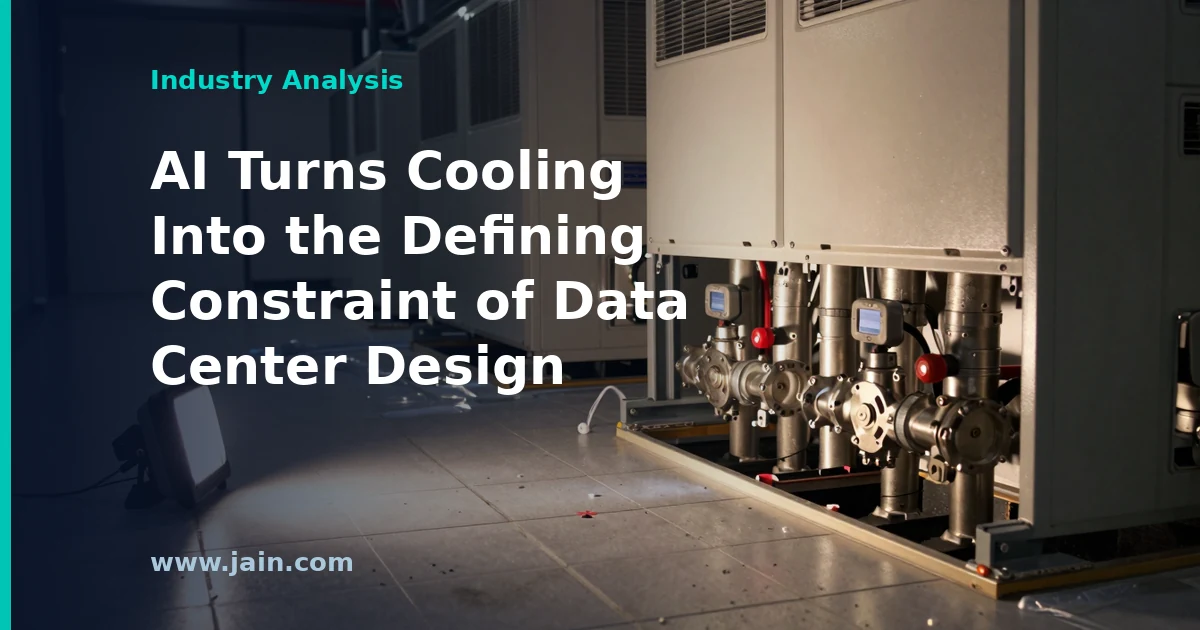
  • AI Turns Cooling Into the Defining Constraint of Data Center Design

    AI Turns Cooling Into the Defining Constraint of Data Center Design

    Data Center Knowledge reported on April 23, 2026 that cooling has moved to the forefront of data center design challenges, driven by the power density of AI computing. The trade publication’s framing captures a shift the industry has been living through: thermal management, once a back-of-house engineering detail, now shapes where facilities are built, how they are architected, and how quickly they can serve AI demand.

    Executive Summary

    The report’s core argument is structural rather than incremental: artificial intelligence has changed the physics of the data hall. Traditional enterprise servers could be cooled with chilled air pushed through raised floors and contained aisles. AI training and inference clusters concentrate far more electrical power — and therefore far more heat — into each rack than air can economically remove, forcing designers to treat heat rejection as a first-order constraint alongside power availability and land.

    Why it matters: when cooling becomes the binding constraint, it stops being a line item and starts being a strategy. Choices between air, direct-to-chip liquid cooling (circulating coolant through cold plates mounted on processors), rear-door heat exchangers, and immersion systems now determine a facility’s compatibility with next-generation chips, its water and energy footprint, and its retrofit economics. Operators, colocation providers, and their customers are all repricing those decisions in real time.

    When Air Runs Out of Headroom

    Air cooling served the industry for decades because server heat loads were modest and evenly distributed. AI accelerators break that model: they pack extraordinary computation — and heat — into small silicon footprints, and operators deploy them in dense clusters to keep chip-to-chip communication fast. Past a certain density, moving enough air through a rack becomes physically impractical and economically punishing, because fan energy and airflow engineering costs rise steeply while cooling effectiveness plateaus.

    Liquid is the natural successor because water and engineered coolants carry heat far more efficiently than air. But switching thermal mediums is not a component swap. It changes piping, floor loading, leak detection, maintenance procedures, and the skills a facilities team needs. That is why the trade press now describes cooling as a design challenge rather than an operations task: the decision has to be made before concrete is poured, and it constrains everything after.

    The Retrofit Divide: Winners and Losers

    The shift creates a two-tier market. New builds designed liquid-ready from day one can court the highest-value AI tenants. Older facilities — the majority of the world’s installed base — face a harder calculus: retrofitting liquid cooling into a live building is disruptive and expensive, but declining to retrofit risks ceding AI workloads entirely and competing for a shrinking pool of conventional enterprise demand.

    The beneficiaries are visible across the supply chain: cooling equipment manufacturers, mechanical engineering firms, and colocation providers with modern, high-density-capable inventory. The squeezed parties are operators of legacy stock and, potentially, customers who signed long leases in facilities that cannot follow the density curve. For buyers of data center capacity, a facility’s thermal architecture is becoming as important a diligence question as its power contract.

    Cooling as a Sustainability and Siting Question

    Cooling choices also carry environmental and community consequences. Evaporative systems trade energy efficiency for water consumption — a sensitive issue in drought-prone regions where many data center clusters sit. Closed-loop liquid systems can reduce water draw and, in some designs, make waste heat recoverable for district heating or industrial reuse. As municipalities scrutinize data center growth, thermal design is increasingly part of the permitting and public-acceptance conversation, not just the engineering one.

    That elevates cooling from a cost center to a siting variable. A design that minimizes water use or enables heat reuse can be the difference between a fast permit and a contested one — a dynamic worth watching as AI capacity expansion collides with local resource politics.

    Background

    For most of the industry’s history, data center design was governed by power and space, with cooling treated as a solved problem: chilled air, raised floors, and hot-aisle containment handled the modest, evenly distributed heat of enterprise servers. The AI buildout that accelerated after 2022 broke that assumption. Training and serving large models requires dense clusters of power-hungry accelerator chips, and each hardware generation has pushed per-rack heat loads further beyond what air-based systems were designed to handle.

    The result has been a rapid industry pivot toward liquid-based thermal architectures — direct-to-chip cold plates, rear-door heat exchangers, and immersion systems — and a re-sorting of the market between facilities that can host high-density AI workloads and those that cannot. Trade coverage like this Data Center Knowledge report reflects a consensus that has hardened across operators, chipmakers, and engineers: cooling is no longer downstream of design; it is design.

    Source: AI Pushes Cooling to the Forefront of Data Center Design Challenges — Data Center Knowledge’s April 23, 2026 report on how AI rack densities are making thermal management a primary data center design constraint.