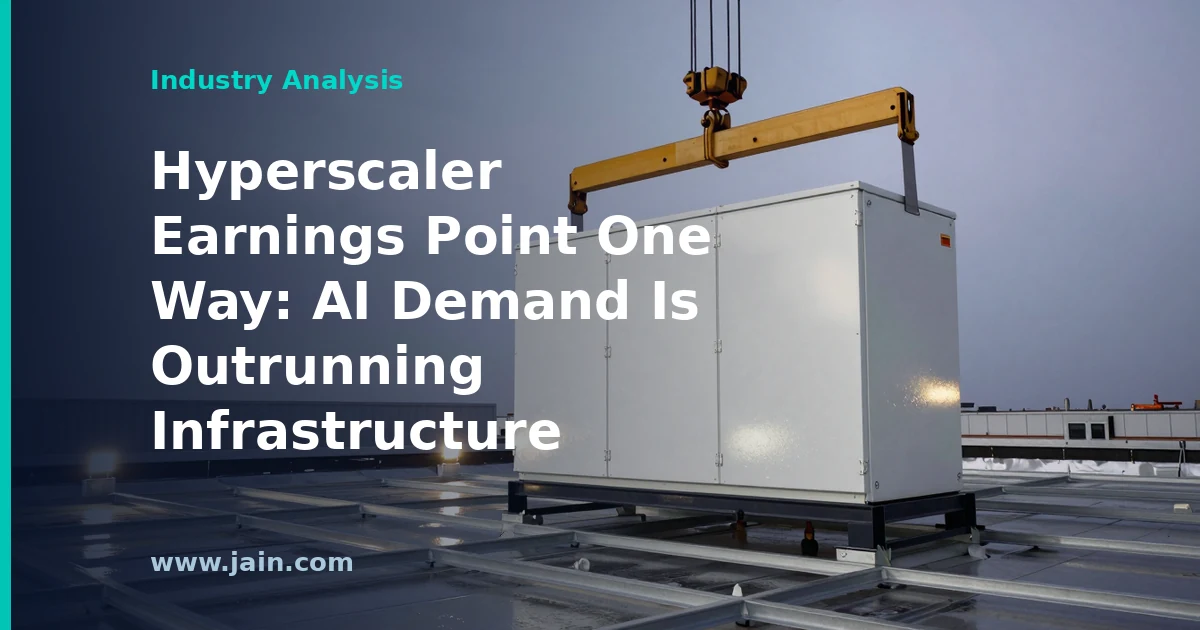
Data Center Knowledge published an analysis on May 1, 2026, arguing that the latest round of hyperscaler earnings reports tells a single consistent story: demand for AI computing is growing faster than the infrastructure — data centers, chips, power, and network capacity — available to serve it. According to the piece’s framing, capital expenditure (capex) guidance from the major cloud platforms continues to rise rather than plateau, signaling that the buildout is far from over.
Executive Summary
The analysis, as framed by its headline, synthesizes a quarter of hyperscaler earnings — the results reported by the largest cloud and AI platform operators, a group that conventionally includes Microsoft, Amazon, Alphabet, and Meta — into one thesis: AI demand is outrunning supply, and spending guidance shows no ceiling. “Capex guidance” here means the forward-looking spending plans these companies disclose to investors, most of which now flows into data centers, AI accelerator chips, and the power and land beneath them.
Why it matters: when every major buyer of digital infrastructure reports demand ahead of capacity in the same quarter, the constraint moves downstream. Data center developers, utilities, chipmakers, and network operators become the pacing items for the entire AI economy. That is a materially different market than one where cloud growth is decelerating and operators are digesting capacity — and it shapes pricing, lead times, and investment decisions across the sector.
When the Constraint Is Supply, Not Demand
For most of cloud computing’s history, the operative question was whether demand would materialize to fill the capacity being built. The thesis in this analysis inverts that: hyperscalers are reportedly selling AI capacity faster than they can stand it up. In that regime, revenue growth is gated by how quickly new data centers can be energized — a function of construction schedules, chip deliveries, and above all electrical power — rather than by customer appetite.
That inversion changes behavior across the supply chain. Buyers pre-commit years ahead, developers build speculatively with more confidence, and utilities face interconnection queues measured in years. It also concentrates risk: if capacity is the bottleneck, whoever controls powered land and grid access holds pricing leverage, from wholesale data center landlords down to regional colocation providers.
What ‘No Ceiling’ on Capex Actually Signals
Capex guidance is one of the few forward-looking, board-approved signals hyperscalers publish. Guidance that keeps rising — the piece’s “no ceiling” characterization — implies these companies believe the return on AI infrastructure still exceeds its enormous cost, and that under-building is the bigger risk than over-building. That is a bet on sustained AI monetization: model training, inference services, and AI features embedded across their product lines.
The counterweight, which any even-handed reading should hold onto, is that capex guidance measures conviction, not proof. Spending plans confirm what executives believe about future demand; they do not confirm that end-customer revenue will ultimately justify the outlay. Prior infrastructure cycles — telecom fiber in the late 1990s being the canonical example — show that synchronized, conviction-driven buildouts can overshoot even when the underlying technology trend is real.
Winners, Losers, and the Long Tail
If the thesis holds, the near-term beneficiaries are the picks-and-shovels layer: data center developers and REITs, power equipment manufacturers, cooling vendors, fiber and interconnection providers, and utilities positioned to serve large loads. Enterprises buying AI capacity face the flip side — tighter availability, longer lead times, and less negotiating leverage, which pushes some toward multi-cloud strategies, regional providers, or on-premises deployments where economics allow.
The long tail of the market matters too. When hyperscalers absorb the available supply of chips, transformers, generators, and skilled construction labor, smaller operators compete for what remains. A demand-outrunning-supply cycle at the top of the market tends to propagate scarcity, and therefore pricing power, through every tier beneath it.
Background
Hyperscaler capital spending has been the dominant force in digital infrastructure since generative AI reached mass adoption. Each earnings season, the spending plans of the largest cloud platforms — which fund data center construction, AI accelerator purchases, and power procurement — are scrutinized as a barometer for the whole sector, because these few companies represent an outsized share of global demand for data center capacity, advanced chips, and utility-scale power connections.
Through 2024 and 2025, successive quarters brought upward revisions to those plans, alongside recurring commentary that available capacity, not customer demand, was the limiting factor on AI revenue. The May 2026 analysis discussed here sits in that context: it reads the latest earnings cycle as continued confirmation of a supply-constrained market rather than an inflection toward moderation.
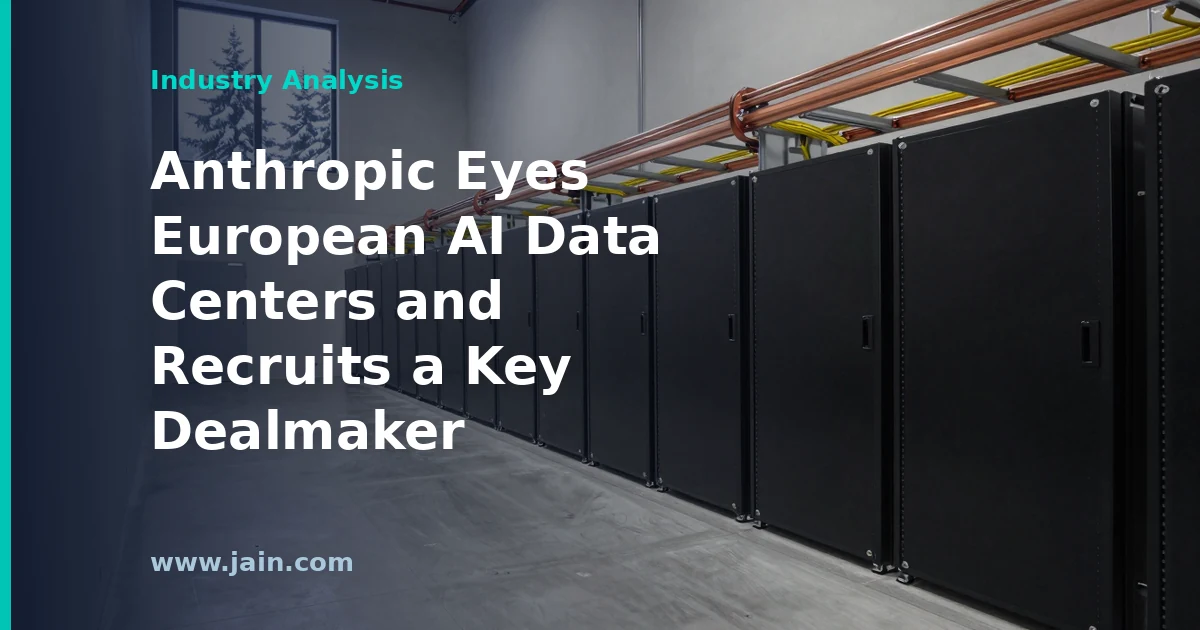
Anthropic, the AI lab behind the Claude family of models, is pursuing a push into European AI data centers and is recruiting for a key dealmaking role to drive it, according to a CNBC report published April 26, 2026. The report signals that Anthropic intends to secure compute capacity in Europe directly, rather than relying solely on its cloud partners — though no sites, capacity figures, or financial commitments have been disclosed.
Executive Summary
According to CNBC, Anthropic is working to expand its AI data center footprint in Europe and is hiring for a senior dealmaker position to lead infrastructure negotiations. A “dealmaker” hire in this context typically means someone who structures large, complex transactions — capacity leases, joint ventures, land and power agreements — rather than a conventional corporate development role.
The move matters because it marks a broader industry shift: frontier AI labs, which historically consumed compute through hyperscale cloud providers, are increasingly acting like infrastructure buyers in their own right. If Anthropic contracts European capacity directly, it becomes a new class of anchor tenant — or even developer — in a market already straining under power and land constraints. For data center operators, utilities, and governments courting AI investment, that changes who sits across the negotiating table.
From Tenant to Buyer: Frontier Labs Are Changing Seats at the Table
Until recently, the division of labor in AI infrastructure was clean: labs trained models, cloud providers built and operated the data centers. Anthropic has historically run its workloads on partner infrastructure, backed by deep compute relationships with Amazon and Google. Recruiting a dedicated dealmaker for a European push suggests the company wants direct agency over where its capacity sits and on what terms — the same trajectory other frontier labs have followed as training and inference demand outgrew what standard cloud contracts comfortably deliver.
The economics explain the shift. AI compute is now the dominant cost line for a frontier lab, and multi-year capacity commitments are effectively infrastructure finance decisions. Negotiating directly with data center developers, power providers, and governments can secure capacity earlier and potentially on better terms than consuming it through an intermediary — but it also requires skills labs did not traditionally employ: site selection, power procurement, and structured real-estate-style dealmaking. A dealmaker hire is the organizational tell that this capability is being built in-house.
Why Europe: Sovereignty Demand Meets a Supply-Constrained Market
Europe is a logical but difficult target. On the demand side, European enterprises and public-sector buyers increasingly want AI workloads processed in-region — a mix of data-protection law, the EU AI Act’s compliance regime, and a broader political push for “sovereign AI” capability. A lab that can offer European customers inference served from European soil holds a genuine commercial and regulatory advantage over one that cannot.
On the supply side, however, Europe’s prime data center markets — Frankfurt, London, Amsterdam, Paris, Dublin — are among the most power-constrained in the world, with grid-connection queues stretching years and some jurisdictions having imposed moratoria on new builds. That scarcity is precisely why a dealmaker matters: available large-scale capacity in Europe is won through early, creative transactions — secondary markets, powered-land deals, partnerships with utilities — not by placing an order. Anthropic entering that hunt adds a well-capitalized bidder to an already competitive field.
Ripple Effects: Operators, Hyperscalers, and Governments
For European data center operators and developers, a frontier lab shopping directly is attractive: AI labs sign large, long-duration commitments that can anchor entire campuses and underwrite new construction. Utilities and grid operators face the harder version of the same news — more gigawatt-scale demand arriving in systems already juggling electrification and renewable-integration timelines.
For the hyperscalers, the picture is nuanced rather than adversarial. Anthropic’s cloud partnerships remain central to its compute story, and a European buildout could well be executed with or through those partners. But every direct deal a lab signs shifts some negotiating leverage and some margin away from the cloud intermediary. Governments, meanwhile, gain a new courtship target: expect member states competing for AI investment to treat frontier labs, not just hyperscalers, as strategic accounts.
Background
Anthropic was founded in 2021 by former OpenAI researchers and has grown into one of the leading frontier AI labs, best known for its Claude models. Its compute has historically come through deep partnerships with Amazon — which has committed roughly $8 billion in investment — and Google, both of which also serve as cloud infrastructure providers for its training and inference workloads.
The European data center market it is now reportedly entering is large but supply-constrained: the established FLAP-D hubs (Frankfurt, London, Amsterdam, Paris, Dublin) face power scarcity and permitting friction, pushing new AI capacity toward secondary markets such as the Nordics, Iberia, and Southern Europe. European policymakers, for their part, have been actively courting AI infrastructure investment as part of a broader push for regional AI capability.
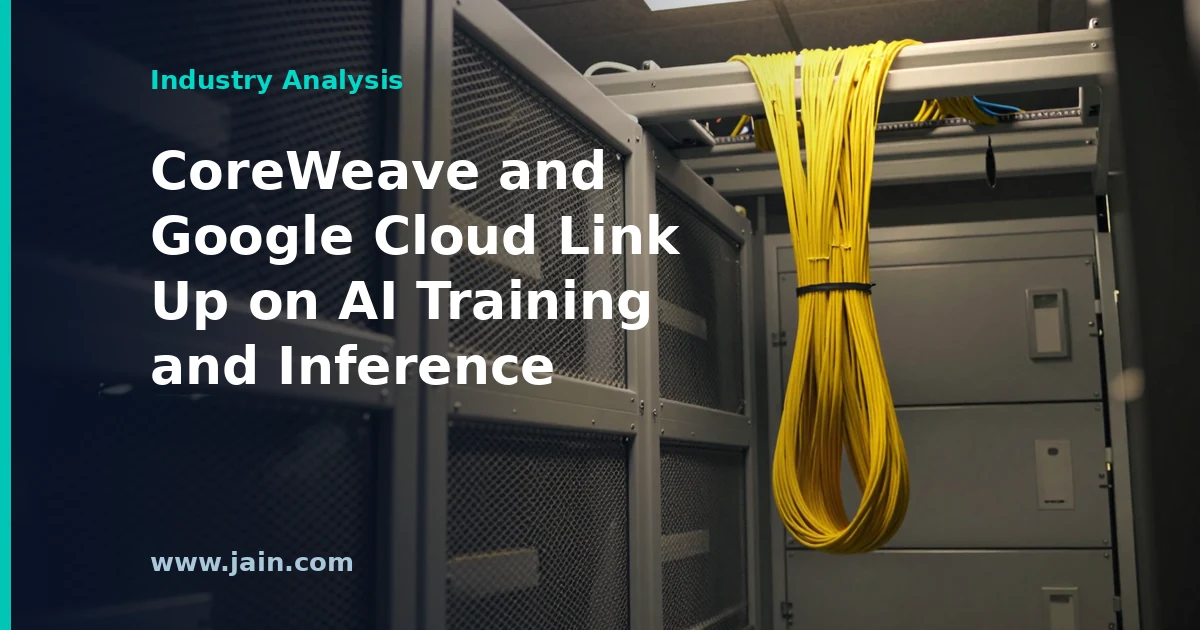
CoreWeave, the GPU-focused cloud provider, and Google Cloud have announced a partnership covering AI training and inference workloads, according to an April 21, 2026 report by CIO Dive. The tie-up pairs one of the world’s three largest hyperscale cloud platforms with the most prominent of the so-called “neoclouds” — specialist providers that rent out large fleets of Nvidia GPUs for artificial-intelligence computing.
Executive Summary
The reported arrangement positions CoreWeave as a capacity partner to Google Cloud for AI training (the compute-intensive process of building machine-learning models) and inference (running those models to answer user requests). For a hyperscaler with its own global data-center footprint and custom TPU silicon to lean on an outside GPU specialist is a notable signal: demand for AI compute is outrunning even the largest builders’ ability to bring capacity online.
It matters for a second reason. CoreWeave has been a watchlist name since its March 2025 IPO — admired for its growth, questioned for its debt-financed expansion and customer concentration. Landing Google Cloud as a partner is the kind of validation that speaks directly to those questions, because it adds a marquee counterparty and suggests the GPU-rental model works at hyperscale, not just for AI labs. That said, the report available at publication is brief: no dollar value, duration, or capacity figures were disclosed, so the deal’s true weight cannot yet be assessed.
When Hyperscalers Rent Instead of Build
Google operates one of the largest data-center estates on earth and designs its own AI accelerators, the TPU line. That it would still contract with an outside GPU landlord says less about Google’s engineering and more about the physics of the moment: data centers take years to permit, power, and build, while AI demand compounds quarterly. Renting ready capacity from CoreWeave converts a construction problem into a procurement problem — faster, more flexible, and off Google’s capital-expenditure line.
There is precedent. Microsoft has been CoreWeave’s largest customer, effectively subcontracting part of its AI buildout, and OpenAI signed a multibillion-dollar capacity contract with CoreWeave in 2025. If Google is now sourcing capacity the same way, the pattern hardens into an industry structure: hyperscalers as demand aggregators, neoclouds as overflow capacity, and the grid and supply chain as the real constraint. The headline’s pairing of “training” and “inference” is worth noting too — inference is the recurring, revenue-linked workload, and contracts that include it tend to be stickier than one-off training rentals.
Validation for a Watchlist Stock
CoreWeave’s story invites scrutiny. The company began life in 2017 as a cryptocurrency-mining operation, pivoted to GPU cloud services, and grew at extraordinary speed on the strength of Nvidia hardware access and heavy borrowing secured against its chips and contracts. Skeptics have focused on two risks: customer concentration — a large share of revenue from a handful of counterparties — and the treadmill of financing new GPU generations before the old ones are paid off.
A Google Cloud relationship addresses the first risk directly by diversifying the customer base with a counterparty of unimpeachable credit quality. It also functions as technical due diligence by proxy: hyperscalers audit partners’ facilities, networking, and operations before routing customer workloads to them. What it does not do — absent disclosed terms — is tell investors how much revenue is involved, for how long, or on what margin. A validation signal is not the same as a valuation input, and the two should not be conflated until numbers appear.
What It Means for the Rest of the Market
For enterprise buyers, hyperscaler–neocloud deals cut both ways. In the near term they can ease GPU waiting lists, since capacity reaches customers through whichever storefront has it. Over time, though, consolidation of neocloud capacity under hyperscaler contracts could reduce the independent spot supply that gave smaller AI companies negotiating leverage. Competing neoclouds — Lambda, Crusoe, Nebius, and others — now face a clearer bar: land an anchor hyperscaler or lab contract, or compete on price in the remaining open market.
For the infrastructure sector jain.com covers, the through-line is unchanged: every one of these agreements ultimately resolves into megawatts, cooling, fiber, and land. Whoever the logo on the contract, the binding constraints are power interconnection queues and data-center construction timelines — which is why capacity already built, like CoreWeave’s, commands a premium at all.
Background
CoreWeave was founded in 2017 and originally mined cryptocurrency before repurposing its GPU expertise into a cloud business aimed at AI workloads. Backed in part by Nvidia and fueled by debt raised against its hardware and contracts, it grew into the flagship of the neocloud category and completed a closely watched Nasdaq IPO in March 2025. Its rise tracked the broader AI infrastructure boom, in which demand for GPU compute from model developers and hyperscalers persistently exceeded the industry’s ability to build powered data-center capacity.
Google Cloud is the third-largest hyperscale cloud platform, behind Amazon Web Services and Microsoft Azure, and is distinctive for fielding its own custom AI accelerators (TPUs) alongside Nvidia GPUs. Hyperscaler–neocloud capacity deals emerged as a defining feature of the AI buildout, with Microsoft’s use of CoreWeave the template this reported Google partnership now appears to follow.