On 2026-07-09, CNBC published a ranking of the ten U.S. states it judges best positioned to land new artificial-intelligence data center deals despite a rising tide of public opposition to large campuses. The list frames a national contest for hyperscale investment against the backdrop of grid strain, water concerns and local political pushback.
Executive Summary
The CNBC feature is essentially a state-by-state scorecard for AI data center attractiveness at a moment when siting has become the single hardest problem in the industry. Where a decade ago the debate was about tax abatements and fiber routes, it now turns on interconnection queues, gas turbine availability, water withdrawals and whether a county commission will approve a rezoning after a packed public hearing.
For infrastructure buyers, the ranking matters less as a definitive verdict than as a signal of where the pipeline is likely to concentrate. For host communities, it is a reminder that the states judged most ‘winnable’ by capital are precisely the ones facing the loudest local debates about who benefits from a multi-billion-dollar build.
What a ‘Best Positioned’ Ranking Actually Measures
Rankings of this kind typically blend a handful of durable inputs: available and dispatchable power, transmission headroom, permitting speed, tax treatment, land availability, workforce, fiber density and climate suitability for cooling. None of those variables is new, but their relative weight has shifted sharply. Power availability — measured in years to interconnect, not megawatts on paper — has overtaken tax policy as the binding constraint for gigawatt-scale AI campuses.
That reordering changes which states look attractive. Jurisdictions with vertically integrated utilities, permissive siting rules for gas peakers or nuclear uprates, and cooperative public utility commissions have a structural edge over states with congested interconnection queues, regardless of how generous their incentives look on a spreadsheet.
The Opposition Curve Is Bending
The CNBC framing — ‘despite rising public opposition’ — reflects a real inflection. Data center opposition, once confined to a few Northern Virginia counties, is now a recurring feature of local politics in Georgia, Texas, Arizona and the Midwest. Residents cite noise from cooling equipment, transmission line routing, water use, property tax abatements and the perception that grid costs are being socialized while benefits accrue to a handful of hyperscalers.
The important business question is not whether opposition exists, but whether it changes outcomes. So far the evidence is mixed: some projects have been delayed or downsized, others have proceeded largely on schedule after community benefit agreements. States that develop clearer siting rules and cost-allocation frameworks may quietly pull ahead of nominally cheaper jurisdictions where every hearing becomes a referendum.
Winners, Losers and the Second Tier
A top-ten list implicitly names losers — states that were competitive for cloud-era builds but are structurally disadvantaged for AI-scale campuses. The likely laggards are jurisdictions with tight grids, aggressive decarbonization timelines that constrain new gas generation, or moratoria under active consideration. That does not mean those markets go dark; they will still host inference, edge and enterprise workloads. But the trillion-dollar question of where training capacity lands is increasingly being answered elsewhere.
For the second tier — states that did not make the list — the strategic response is unglamorous: shorten interconnection timelines, publish transparent siting criteria, and negotiate cost-allocation rules that survive contact with a local newspaper. Incentive stacking alone no longer moves the needle.
What the Ranking Cannot Tell You
Any state-level scorecard obscures the fact that AI siting decisions are made at the substation, not the statehouse. Two counties within the same ‘winner’ state can face wildly different interconnection timelines, water availability and community sentiment. Investors reading the list should treat it as a starting filter, not a site selection tool. And host communities should recognize that being on such a list is a leading indicator of proposals to come, not a guarantee of net benefit.
Background
The U.S. data center industry has spent two decades clustering around a handful of markets — Northern Virginia, Dallas, Phoenix, Silicon Valley, Chicago and Atlanta — chosen for fiber, power and tax treatment. The AI training boom that accelerated after 2023 broke that pattern by demanding campuses an order of magnitude larger, with power needs measured in gigawatts and lead times measured in years.
As those requirements collided with congested grids and slow permitting in legacy markets, developers began scouting states with spare generation, cooperative utilities and available land. That shift, in turn, exported the siting debate to communities with little prior experience of large-scale digital infrastructure — and produced the public opposition the CNBC ranking now takes as its backdrop.
The Wall Street Journal reported on July 7, 2026 that Nokia, the Finnish company once synonymous with mobile phones, is staging a “new act”: supplying networking equipment to the AI data center buildout. The framing marks a strategic shift for a firm whose revenue has long depended on telecom operators, toward the hyperscale cloud and AI companies now driving the industry’s largest capital-spending wave.
Executive Summary
The story here is a repositioning, not a product launch. Nokia has spent the past two years assembling the pieces of a data center strategy: it closed its roughly $2.3 billion acquisition of optical-networking specialist Infinera in early 2025, installed Justin Hotard — previously head of Intel’s data center and AI business — as CEO in April 2025, and in late 2025 announced a partnership with Nvidia that included Nvidia taking an approximately $1 billion equity stake. The WSJ’s July 2026 feature treats these threads as a coherent identity change: legacy telecom vendor becomes AI-infrastructure supplier.
Why it matters: telecom-carrier capital spending — Nokia’s traditional market alongside rival Ericsson — has been stagnant for years, while spending on AI data centers has exploded. Every AI campus needs high-capacity switching inside the facility and optical links between facilities, and that is precisely the equipment Nokia now sells. Whether the pivot moves Nokia’s financial needle, however, is a claim the headline asserts more than the available material proves.
Why a Telecom Giant Is Chasing Data Centers
Nokia’s core customers — mobile and fixed-line network operators — buy equipment in cycles tied to generational upgrades like 5G, and that cycle has matured. Carriers worldwide have trimmed capital budgets, leaving suppliers fighting over a flat market. Data centers present the opposite picture: hyperscalers (the largest cloud and AI companies, such as the major U.S. cloud platforms) are committing historic sums to new AI capacity. For a networking vendor, following the capital is rational; the buildout needs exactly the routing, switching, and optical transport gear Nokia’s network-infrastructure division makes.
The strategic logic is also defensive. If AI workloads keep pulling investment away from traditional telecom networks, a supplier that stays carrier-only shrinks with its customers. Diversifying the customer base toward cloud and enterprise buyers reduces Nokia’s dependence on a concentrated, slow-growing set of operators.
The Infinera Bet and the Optical Opportunity
The most concrete evidence behind the “new act” narrative is the Infinera acquisition, completed in early 2025. Infinera builds optical transport systems — the technology that pushes enormous data volumes over fiber between sites — and counted cloud providers among its customers, something Nokia’s carrier-heavy optical business had less of. Data center interconnect, the fiber links that stitch AI campuses into distributed clusters, is one of the fastest-growing corners of optical networking, because AI training increasingly spans multiple buildings and even multiple regions.
Leadership reinforces the signal. Hiring a CEO from Intel’s data center and AI unit, rather than a telecom veteran, told the market where Nokia thinks its growth lives. The Nvidia partnership announced in late 2025 — spanning AI-powered radio networks and data center networking, with Nvidia’s equity stake attached — gave the strategy a marquee endorsement, though partnerships of that kind announce intent, not revenue.
A Crowded Field of Entrenched Rivals
The hard part is that data center networking has incumbents with deep roots. Ethernet switching inside AI facilities is dominated by established players such as Arista Networks and Cisco, with Nvidia itself selling networking gear alongside its chips, and merchant-silicon suppliers like Broadcom powering much of the market. Hyperscalers are demanding, technically sophisticated buyers who qualify vendors slowly and negotiate hard on price. Nokia is not starting from zero — it has long sold IP routing and optical gear — but winning share inside the AI cluster, as opposed to the links between facilities, means displacing suppliers the hyperscalers already trust.
That competitive reality is why the pivot should be judged by design wins and revenue mix over time, not by strategic announcements. A vendor can be genuinely present in the AI buildout while capturing only a modest slice of its economics.
Reinvention Is Nokia’s Oldest Habit — and Its Hardest Trick
Nokia has reinvented itself before: from a 19th-century paper and rubber business, to the world’s dominant handset maker, to a network-equipment company after selling its phone business to Microsoft in 2014 and absorbing Alcatel-Lucent in 2016. That history cuts both ways. It shows an organization capable of wholesale change, and it shows how brutal such transitions are — the handset collapse remains a business-school case study in losing a platform shift. The AI pivot asks Nokia to serve a customer type with different buying behavior, faster product cycles, and thinner tolerance for legacy overhead than the carriers it grew up with. The company’s ability to keep funding its telecom base while investing to hyperscaler speed is the execution question that will decide whether this act succeeds.
Background
Nokia, founded in Finland in 1865, has cycled through several corporate identities: industrial conglomerate, dominant mobile-phone maker, and — after selling its handset business to Microsoft in 2014 and acquiring Alcatel-Lucent in 2016 — a network-equipment supplier competing chiefly with Ericsson and Huawei for telecom-operator spending. That carrier market has stagnated as the 5G investment cycle matured, pressuring Nokia and its peers to find new growth.
The AI boom reshaped the equipment landscape: hyperscale cloud and AI companies became the industry’s biggest spenders, building data center campuses that consume vast amounts of networking gear. Nokia moved toward that demand with its Infinera optical acquisition (closed early 2025), the appointment of former Intel data center chief Justin Hotard as CEO (April 2025), and a late-2025 Nvidia partnership with an accompanying equity investment — the sequence of moves the WSJ’s July 2026 feature frames as the company’s “new act.”
Source: Nokia’s New Act: Supplying the AI Data Center Boom — Wall Street Journal feature on Nokia’s strategic shift from telecom-carrier equipment toward supplying the AI data center buildout, published July 7, 2026.
Amazon has launched a $25 billion bond sale to help fund its artificial-intelligence infrastructure buildout, according to a report published by SiliconANGLE on July 6, 2026. The offering ranks among the largest corporate debt raises of the year and is aimed squarely at the data centers, chips, and power capacity behind Amazon’s AI ambitions.
Executive Summary
The announcement itself is simple: Amazon is borrowing $25 billion in the investment-grade bond market, and the stated purpose is AI infrastructure. What makes it significant is what it says about scale. Bond sales of this size were once reserved for blockbuster acquisitions; here, the “acquisition” is compute — data center campuses, accelerator chips, networking, and the electricity to run them.
It also confirms a structural shift in how the AI buildout is financed. The largest cloud providers, long famous for funding expansion out of their own operating cash flow, are increasingly turning to debt markets because annual capital spending has grown beyond what even their formidable cash generation comfortably covers. When the world’s biggest companies must borrow tens of billions to keep pace, AI infrastructure stops being just a technology story and becomes a fixed-income story — one that credit investors, utilities, and data center operators all have a stake in.
From Cash Machine to Serial Borrower
For most of the cloud era, hyperscalers — the handful of companies operating cloud platforms at global scale, such as Amazon, Microsoft, and Google — were net generators of cash. Capital expenditure was enormous but sat inside operating cash flow, so bond issuance was occasional and opportunistic. The AI cycle broke that pattern. Late 2025 saw a wave of jumbo hyperscaler bond deals, including a roughly $15 billion Amazon offering — its first major issuance in years — and even larger raises by peers. A $25 billion follow-on just months later suggests this is not a one-off top-up but a financing model: recurring, large-scale debt issuance to fund a multi-year infrastructure program.
That model is rational. Debt is well suited to long-lived physical assets — buildings, substations, cooling plants — and investment-grade borrowers of Amazon’s standing can raise it cheaply relative to the returns they project on AI services. The open question is duration matching: much of AI capex is not thirty-year buildings but accelerator chips (specialized AI processors) that may be economically competitive for only a handful of years. Borrowing long against assets that depreciate fast is a bet that AI revenue arrives on schedule.
Big Enough to Move the Bond Market
A $25 billion deal is not just large for Amazon; it is large for the market it lands in. Offerings at this scale absorb a meaningful share of investment-grade demand in the weeks they price, influence credit spreads (the extra yield investors demand over government bonds) for other issuers, and increase the weight of technology names in bond indexes that pension funds and insurers track. In effect, AI infrastructure is becoming an asset class within corporate credit — a bundle of quasi-utility bonds backed by the cash flows of cloud computing.
That has two second-order effects. First, it gives fixed-income investors — a far larger pool of capital than equity or venture markets — direct exposure to the AI buildout, which deepens the funding available for it. Second, it concentrates risk: if AI demand disappoints, the losses would no longer be confined to stock prices but would show up in credit portfolios that are meant to be the conservative part of institutional balance sheets. Nothing in this offering suggests distress — Amazon remains among the strongest credits in the market — but scale itself changes the risk picture.
Where the $25 Billion Actually Goes
“AI infrastructure” is shorthand for a long supply chain. Bond proceeds at this scale ultimately flow to chipmakers, to construction firms building data center shells, to electrical and cooling equipment vendors, to fiber and networking suppliers, and to utilities contracting new generation and transmission. For the data center industry, sustained debt-funded hyperscaler capex is demand visibility: it signals that orders for land, power, and capacity should continue well beyond the current fiscal year.
It also sharpens the competitive divide. Operators and regions that can deliver powered land — sites with grid connections, water or alternative cooling, and permits already in hand — are positioned to capture this spending. Those that cannot will watch it flow elsewhere. And because the hyperscalers can borrow at scale that colocation providers and smaller developers cannot match, cheap debt access itself becomes a competitive moat in the infrastructure race.
The Sustainability Question
The measured way to read this deal is as a confidence signal with a caveat. Amazon borrowing $25 billion says its leadership expects AI demand to justify the capacity — companies do not typically lever up to build assets they expect to idle. The caveat is that the entire industry is making a correlated version of the same bet, financed increasingly with borrowed money. If AI monetization compounds as projected, these bonds will look like textbook infrastructure finance. If it stalls, the sector will be servicing debt on capacity that arrived ahead of revenue.
History offers both comfort and warning. The fiber overbuild of the late 1990s was also debt-financed infrastructure ahead of demand; the capacity was eventually used, but not before wiping out many of its financiers. The difference this time is balance-sheet quality: the borrowers are among the most profitable companies ever to exist, with diversified revenue outside AI. That is a genuine buffer — but it is a buffer, not a guarantee.
Background
Amazon operates Amazon Web Services (AWS), the world’s largest cloud computing platform and the profit engine that has historically funded the company’s expansion. For most of the cloud era, Amazon and its hyperscale peers paid for data center growth out of operating cash flow, issuing bonds only occasionally. The generative-AI boom that accelerated from 2023 onward changed the math: annual capital budgets across the largest cloud providers climbed into the tens and then hundreds of billions of dollars, driven by AI chips, new data center campuses, and power procurement.
By late 2025 that spending had spilled into the bond market, with several of the largest technology companies — Amazon among them — launching some of the biggest corporate debt offerings on record to fund AI infrastructure. The $25 billion sale reported in July 2026 continues that shift, cementing debt markets as a core funding channel for the AI buildout rather than an occasional supplement.
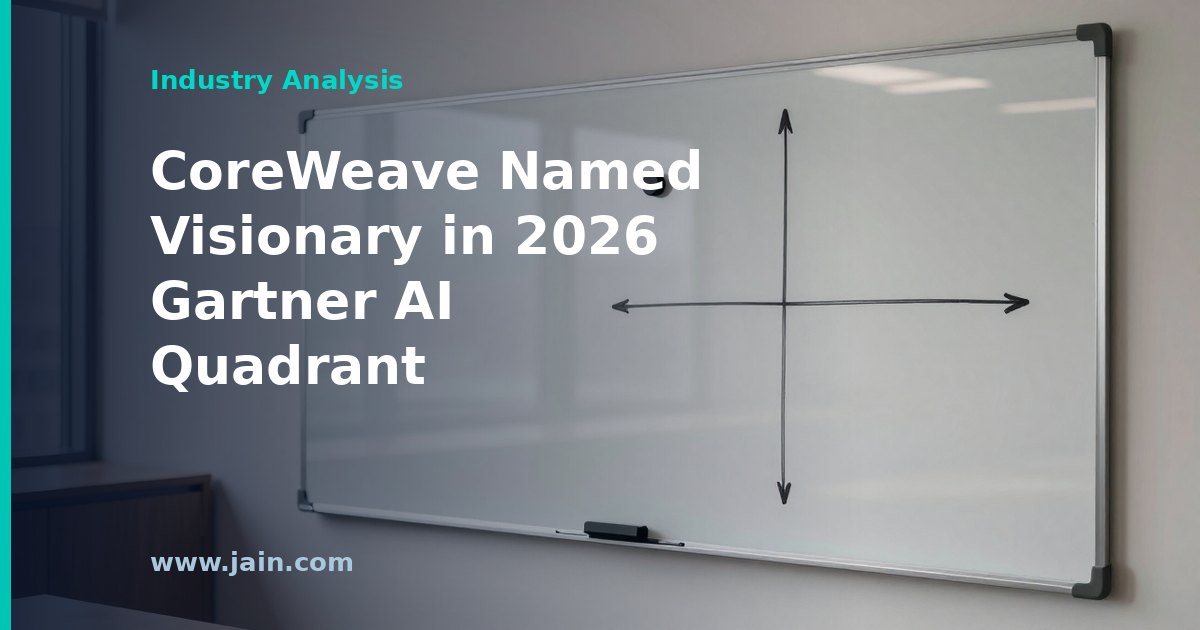
CoreWeave announced on July 6, 2026 that it has been named a Visionary in Gartner’s 2026 Magic Quadrant for Cloud AI Developer Services. The recognition places the GPU-focused cloud provider on one of the industry’s most closely watched analyst grids alongside larger hyperscalers.
Executive Summary
CoreWeave, best known for renting out large fleets of Nvidia GPUs to AI labs and enterprises, has picked up a Visionary designation in Gartner’s 2026 Magic Quadrant for Cloud AI Developer Services. Gartner’s Magic Quadrant is a widely referenced analyst report that plots vendors on two axes — completeness of vision and ability to execute — and Visionaries score high on vision but are typically still building out execution scale.
The placement matters because Cloud AI Developer Services is a category traditionally dominated by the three hyperscalers, whose managed AI platforms bundle models, training frameworks, and deployment tools. CoreWeave earning a named spot signals that its pitch — purpose-built GPU infrastructure with a developer-facing stack — is being taken seriously by procurement teams that historically default to AWS, Azure, or Google Cloud.
Why a Visionary Tag, Not a Leader Tag, Is the Story
Being named a Visionary is a genuine analyst endorsement, but the label carries a specific meaning. In Gartner’s framework, Visionaries understand where a market is heading and often shape it with differentiated technology, but they have not yet demonstrated the operational breadth of the Leaders quadrant. For a company like CoreWeave, that reading fits the public narrative: a GPU specialist that grew explosively during the generative AI wave, but whose managed developer services are newer than the hyperscalers’ decade-old platforms.
For buyers, the practical translation is that CoreWeave is worth a serious bake-off for AI workloads, particularly training and large-scale inference, without assuming it yet matches AWS or Azure on the breadth of adjacent services like identity, data warehousing, or global compliance tooling.
The Competitive Frame: Specialist Clouds Versus Hyperscalers
The Magic Quadrant category itself is worth unpacking. Cloud AI Developer Services covers the tools developers use to build, tune, and deploy AI applications — model APIs, training platforms, MLOps, and increasingly agent frameworks. The hyperscalers compete here with fully integrated stacks. Specialist clouds compete on price-performance for GPU-intensive workloads and, more recently, on time-to-capacity for scarce accelerators.
Getting graded in the same report as the hyperscalers is a validation of the specialist thesis: that a meaningful share of AI spend will flow to providers optimized specifically for the workload, rather than to general-purpose clouds that also happen to sell GPUs. Whether that share remains large as hyperscaler capacity catches up is the open strategic question.
What This Does — and Does Not — Prove
Analyst recognition is a procurement lubricant. Enterprise buyers frequently cite Magic Quadrant placement to justify shortlists, and inclusion can shorten sales cycles materially. In that narrow sense, the designation has real commercial value for CoreWeave beyond the marketing headline.
What it does not prove is durable margin, customer diversification, or that CoreWeave’s developer-services layer is at feature parity with incumbents. Gartner scores vision and execution against a defined market frame; it does not opine on unit economics, GPU supply contracts, or concentration risk with a small number of very large customers. Readers should treat the placement as one useful signal among several, not as a verdict on the business.
Background
CoreWeave began as a niche compute provider and repositioned during the generative AI boom into a specialist cloud focused on large-scale Nvidia GPU deployments, becoming a prominent supplier of training and inference capacity to AI labs and enterprises. It has since expanded into developer-facing services that sit above the raw infrastructure layer.
Gartner’s Magic Quadrant for Cloud AI Developer Services is one of the industry’s most cited analyst reports for AI platform procurement, historically dominated by the largest hyperscale cloud providers. Inclusion for a specialist cloud reflects the broader shift of AI workloads toward providers optimized specifically for accelerated computing.
New Jersey’s legislature has passed a bill establishing a data center tariff and sent it to the governor for signature, Utility Dive reported on July 2, 2026. The measure targets how the electricity costs of large data centers are recovered, with the aim of shielding other utility customers from grid expenses driven by data center growth.
Executive Summary
According to Utility Dive’s July 2, 2026 report, New Jersey lawmakers have approved legislation creating a tariff framework for data centers and forwarded it to the governor. A tariff, in utility parlance, is the regulator-approved schedule of rates and terms under which a customer class buys power — so a data center tariff bill is, at its core, a decision about who pays for the wires, substations, and generation capacity that very large computing facilities require.
The move matters well beyond New Jersey. Electricity demand from data centers — especially AI-oriented facilities — has become the dominant growth story on the U.S. grid, and the costs of serving that growth have increasingly landed in debates over household utility bills. If signed, New Jersey would join a growing list of states acting to assign those costs to the data centers themselves rather than spreading them across all ratepayers. Notably, New Jersey is doing it through legislation rather than leaving the question to case-by-case utility rate proceedings.
Why Data Center Power Costs Reached the Statehouse
New Jersey sits inside PJM, the regional transmission organization that operates the grid across 13 states and procures capacity — commitments from power plants to be available — on behalf of utilities. Capacity prices in PJM have risen sharply in recent auctions, driven in part by projected data center demand, and those costs flow through to retail electric bills. That chain from AI build-out to household bill is what has turned a technical rate-design question into a live political issue in Trenton and other state capitals.
Legislators stepping in is itself significant. Rate design is normally the province of utility regulators — in New Jersey, the Board of Public Utilities — moving deliberately through contested proceedings. A statute compresses that timeline and signals that lawmakers did not want to wait for the regulatory process to allocate these costs on its own.
What a Data Center Tariff Actually Does
The core principle behind large-load tariffs is cost causation: the customer whose demand triggers new infrastructure should bear its cost. Serving a single large data center campus can require new transmission lines, substations, and capacity procurement running into significant sums. Under conventional ratemaking, much of that spending enters the utility’s general rate base and is recovered from all customers. A dedicated data center rate class changes that default.
Tariffs of this kind elsewhere have typically included features such as minimum demand charges (paying for a high share of requested capacity whether or not it is used), long contract terms, collateral requirements, and exit fees — protections against a utility building for a load that never materializes. Whether New Jersey’s bill includes these specific mechanisms is not detailed in the source report, and the final terms will determine how burdensome or benign the framework proves in practice.
Winners, Losers, and the Competitive Map
Residential and small-business ratepayers are the intended beneficiaries: the bill’s premise is that they should stop subsidizing infrastructure built for hyperscale computing. Utilities gain clearer cost-recovery rules and stronger protection against stranded investment, though they lose some flexibility in courting large customers with favorable terms. For data center developers, the calculus is mixed — a transparent tariff provides pricing certainty that ad hoc negotiations do not, but it likely raises the all-in cost of a New Jersey megawatt.
The competitive question is whether developers simply build elsewhere. New Jersey offers real advantages — proximity to New York, dense fiber routes, and a deep enterprise customer base — but neighboring PJM states compete for the same projects. The counterpoint: states including Ohio and Georgia have already adopted large-load protections through their regulators, and development there has continued. Grid cost allocation is one input among many; power availability, land, latency, and tax treatment often weigh more heavily.
The Signal to the Industry
The larger story is a shift in the default social contract around data center growth. Through the first wave of the AI boom, states competed to attract data centers with incentives; the emerging second phase pairs that welcome with conditions, particularly on energy. For hyperscalers and colocation operators, the practical takeaway is that grid-cost responsibility is becoming a standard feature of U.S. market entry, not an outlier risk. That strengthens the case for strategies the industry is already pursuing: securing generation directly, co-locating with power sources, and engaging early with regulators rather than arriving with a load request after the fact.
Background
New Jersey occupies a distinctive position in the data center landscape: adjacent to New York City, laced with dense fiber routes, and home to a long-established financial-services and enterprise colocation market. Like the rest of the PJM region, it has felt the bill impacts of surging capacity prices as data center demand — increasingly driven by AI training and inference workloads — reshapes grid planning.
The question of who pays for that growth has moved rapidly up state agendas since 2024. Utility regulators in several states have approved special rate provisions for very large loads, and legislatures have begun taking up the issue directly. New Jersey’s bill, as reported by Utility Dive, places the state among the earlier movers to address data center cost allocation by statute rather than leaving it wholly to regulatory proceedings.
Chevron has struck a deal to supply electricity generated from natural gas to a Microsoft artificial-intelligence data center in West Texas, according to a Wall Street Journal report dated June 21, 2026. Deal terms — including capacity, pricing, and start date — were not disclosed in the source material available to us.
The agreement pairs one of America’s largest oil and gas producers with one of its largest data-center builders, and it lands in the Permian Basin region, where Chevron produces enormous volumes of natural gas close to where Microsoft needs power.
Executive Summary
The reported arrangement makes Chevron a power supplier — not just a fuel supplier — to a hyperscaler, the industry term for the handful of companies (Microsoft, Google, Amazon, Meta) that operate cloud computing at global scale. That distinction matters: selling gas molecules is Chevron’s traditional business, while selling electrons under long-term contract to a single anchor customer is a new one, and it captures more of the value chain.
For Microsoft, the deal addresses the single biggest constraint on AI expansion: getting large amounts of reliable power quickly. Utility interconnection queues — the waiting lists to plug big new loads or generators into the transmission grid — now stretch years in much of the country. Dedicated generation built by an energy company with its own fuel supply is one way to shortcut that wait.
Chevron had previously signaled this ambition: in early 2025 the company announced plans to develop gas-fired power plants co-located with data centers, in partnership with investment firm Engine No. 1 and turbine maker GE Vernova, with West Texas among the first targeted regions. The Microsoft deal, as reported, would be visible evidence that the strategy has landed a marquee customer.
Oil Majors Are Becoming Power Companies
For decades, the boundary was clean: oil and gas companies produced fuel, utilities and independent power producers turned it into electricity. AI is dissolving that boundary. Data-center operators need gigawatt-scale power on timelines utilities struggle to meet, and they are willing to sign long-dated contracts to get it. That contract structure — a creditworthy counterparty committing to buy power for many years — is exactly what makes a power plant financeable, and it is an asset profile oil majors understand from their LNG businesses.
Chevron’s advantage is vertical integration. In the Permian Basin, gas is so abundant relative to pipeline takeaway capacity that regional prices at the Waha hub have repeatedly traded near zero or even negative in recent years. Burning that gas on-site to serve a data center converts a stranded, low-value commodity into contracted electricity revenue. Few competitors can match that feedstock economics story.
Why Gas, and Why West Texas
Natural-gas turbines remain the fastest way to deliver large blocks of firm, around-the-clock power — the kind AI training clusters demand. Solar and wind are cheaper per unit of energy but intermittent; nuclear is firm but slow to build; batteries shift power in hours, not weeks. Texas adds a structural advantage: ERCOT, the state’s independent grid, has lighter interconnection processes than other U.S. regions, and state law accommodates large co-located or behind-the-meter loads — facilities that take power directly from a dedicated plant rather than through the public grid.
The tradeoff is emissions. Microsoft has a publicly stated goal of being carbon negative by 2030, and a new gas-fired power arrangement runs against that grain unless it is paired with carbon capture, offsets, or a credible transition plan. The source material does not say whether any such mitigation is part of this deal — a material omission, since how hyperscalers reconcile gas-fired AI power with climate commitments is one of the industry’s live controversies. The fair reading cuts both ways: gas power for data centers is neither the betrayal critics sometimes claim nor the bridge its promoters assert until the specifics — capture rates, contract duration, retirement plans — are on the table.
Winners, Losers, and the Competitive Map
If deals like this proliferate, the winners are gas producers with stranded Permian volumes, turbine manufacturers whose order books are already stretched to the end of the decade, and Texas jurisdictions collecting tax base. Traditional utilities lose a growth story if the largest new loads in a generation bypass them; conversely, they shed the risk of building for a demand boom that may not fully materialize.
The strategic question is whether hyperscaler-oil-major partnerships become a template. ExxonMobil has announced similar ambitions in gas-plus-carbon-capture power for data centers, and other producers are circling. If the model works, the AI buildout will have quietly created a new class of independent power producer — one with its own wells.
Background
Chevron is one of the world’s largest integrated energy companies and a top producer in the Permian Basin, the West Texas oil field whose wells also produce vast quantities of natural gas. Historically Chevron sold that gas into pipelines and export markets; in 2025 it announced a venture to build gas-fired power plants serving data centers directly, reserving turbine capacity with GE Vernova alongside investment firm Engine No. 1.
Microsoft, through its Azure cloud division and its partnership with OpenAI, has been spending tens of billions of dollars a year building AI data centers, and has pursued a wide portfolio of power deals — from renewables to the planned restart of a reactor at Three Mile Island — as electricity has replaced land and chips as the scarcest input in the AI buildout.
Market research firm Dell’Oro Group reported that worldwide data center capital expenditure moved higher in the first quarter of 2026, attributing the increase to two forces working in tandem: continued buildouts of AI infrastructure and inflation in memory costs. The finding, published June 10, 2026, comes from the firm’s ongoing tracking of data center IT and infrastructure spending.
The headline pairing matters. It signals that the capex surge is being driven not only by more servers, accelerators, and facilities being deployed, but also by each unit of that equipment costing more — a distinction with real consequences for how the numbers should be read.
Executive Summary
Dell’Oro Group’s first-quarter 2026 reading extends a multi-year run of elevated data center spending tied to artificial intelligence. Capex — capital expenditure, the money operators sink into servers, networking gear, storage, and the facilities that house them — climbed again in the quarter, with AI infrastructure named as the primary engine and memory cost inflation as a significant amplifier.
The memory angle is the notable wrinkle. High-bandwidth memory (HBM) and conventional DRAM are essential inputs to AI servers, and when their prices rise, total spending rises even if unit volumes were flat. Dell’Oro’s framing suggests both effects are in play: operators are buying more, and paying more per unit of what they buy.
For the infrastructure industry, the read-through is that the AI spend cycle is broadening rather than cresting. Spending strength that persists into 2026 — after two years in which skeptics repeatedly called a peak — keeps demand signals strong for chipmakers, memory suppliers, server OEMs, colocation providers, and the power and cooling ecosystem behind them.
Broadening, Not Peaking
Every quarter of continued capex growth is a data point against the “AI bubble about to deflate” thesis — and a data point that must itself be scrutinized. A first-quarter increase in 2026 means the hyperscalers and large AI builders entered the year still accelerating, not digesting. Historically, capex cycles in IT infrastructure end with a visible plateau in quarterly spending before the decline; Dell’Oro’s reading indicates that plateau has not yet arrived.
The word “broadening” is doing real work here. Early AI capex was concentrated in a handful of hyperscale cloud providers. As the cycle matures, spending typically spreads to second-tier cloud operators, GPU-cloud specialists, enterprises building private AI capacity, and sovereign or national AI initiatives. A quarter in which growth continues at scale is consistent with that widening base of buyers, though the release headline alone does not break out who spent what.
Memory Inflation: Growth With an Asterisk
The second driver Dell’Oro names — memory cost inflation — deserves careful reading. Memory (DRAM for general computing, and especially high-bandwidth memory stacked directly alongside AI accelerators) has been in tight supply as AI demand outstripped what the small number of memory manufacturers could produce. When memory prices rise, every AI server costs more, and aggregate capex inflates mechanically.
That means dollar-denominated capex growth overstates the growth in deployed computing capacity. An analyst comparing 1Q 2026 spending to a year earlier is partly measuring more infrastructure and partly measuring more expensive infrastructure. For memory suppliers this is a windfall; for buyers it is margin pressure; for anyone using capex as a proxy for AI capacity coming online, it is a reason to discount the headline number somewhat. Dell’Oro’s decision to name inflation explicitly as a driver is a useful piece of intellectual honesty in a market prone to reading every big number as pure demand.
Winners Along the Supply Chain
The beneficiaries of this spending pattern are ordered by scarcity. Memory manufacturers sit at the top: rising prices on constrained supply flow almost directly to their revenue. Accelerator vendors and the server OEMs that integrate them continue to ride volume growth. Behind the IT equipment, the physical layer — data center developers, colocation operators, power equipment makers, and cooling specialists — benefits from every incremental megawatt the AI buildout requires, and their revenue tends to lag IT capex, meaning a strong 1Q 2026 for equipment implies continued facility demand into 2027.
The squeezed parties are buyers without pricing power. Smaller cloud providers and enterprises paying inflated memory prices face a worse cost position than hyperscalers, who negotiate supply agreements at scale. If memory inflation persists, it acts as a regressive tax on the smaller end of the AI market — one more force concentrating AI capacity among the largest players.
The Risk Ledger
None of this eliminates cycle risk. Capex is a leading indicator of expected demand, not proven demand: the spending only pays off if AI services generate revenue commensurate with the infrastructure behind them. Input-cost inflation adds a second risk — cycles fed partly by price increases can unwind sharply when supply catches up and prices normalize, as memory markets have done repeatedly across their history. And the physical constraints on the buildout, chiefly electric power availability, remain unresolved in many markets.
The balanced read: 1Q 2026 confirms the AI infrastructure cycle remains in its expansion phase, while the memory-inflation component is a reminder to separate dollars spent from capacity gained before drawing conclusions about either demand or durability.
Background
Data center capex has been the defining economic story of the AI era. Since large language models triggered an infrastructure race in 2023, the biggest cloud and AI companies have committed historically unprecedented sums to accelerated computing — spending that flows through chipmakers and server vendors into land, buildings, power, and cooling. Independent trackers like Dell’Oro Group, which has analyzed telecom and data center equipment markets since 1995, provide the industry’s scorecard for whether that race is accelerating or cooling.
Memory has emerged as the cycle’s chokepoint. Production of high-bandwidth memory is concentrated among a handful of manufacturers, and AI demand has kept supply tight, pushing prices upward across memory categories. That inflation now shows up directly in aggregate capex figures — making 2026 the year analysts must ask not just how much the industry is spending, but how much of that spending buys new capacity versus simply covering higher input costs.
The Wall Street Journal reported on June 6, 2026 that Ireland — one of Europe’s most important data center hubs — is telling technology companies seeking new data center capacity that they should bring their own power generation rather than rely on the national grid. The report frames the stance as a response to years of mounting strain between the country’s booming digital infrastructure sector and an electricity system struggling to keep pace.
Executive Summary
According to the Journal’s reporting, Irish authorities are effectively shifting the burden of powering new data centers onto the companies that build them. Instead of queuing for grid connections that may not materialize for years, hyperscalers — the largest cloud and internet platforms, such as those operating massive server campuses — are being pointed toward on-site or self-procured generation as the price of admission.
Why it matters: Ireland has long punched far above its weight in European data center capacity, and its grid has been under visible stress as a result. If the sovereign host of one of the continent’s densest cloud clusters is now telling its largest customers to power themselves, that is a signal moment for every grid-constrained market — from Dublin to Northern Virginia to Singapore. The economics, siting logic, and competitive dynamics of data center development all change when the utility is no longer assumed to show up.
How Ireland Became the Test Case for Grid Saturation
Ireland’s predicament is not new — it is the culmination of a decade-long collision between two national success stories. Dublin became a preferred European landing zone for American cloud providers, drawn by tax policy, connectivity, a skilled workforce, and EU market access. But data centers are extraordinarily power-dense tenants: official Irish statistics have shown them consuming roughly a fifth of the country’s metered electricity in recent years, a share without parallel among developed economies. The grid operator, EirGrid, had already moved years earlier to restrict new data center connections in the Dublin region, citing capacity and system-stability concerns.
Seen against that backdrop, a “bring your own power” posture is less a sudden policy lurch than the logical end state of a queue that stopped moving. When a grid cannot absorb new large loads without threatening reliability for households and other industry, the choices narrow to three: build transmission and generation faster (slow and politically hard), ration connections (which Ireland has effectively done), or push the load to self-supply. Ireland now appears to be leaning into the third option.
The Economics of Powering Yourself
Self-generation transforms the data center cost model. A grid connection socializes enormous capital costs — power plants, transmission lines, system balancing — across all ratepayers. Bringing your own power means the developer finances generation capacity itself: on-site gas turbines or engines, batteries, contracted private-wire renewables, or some hybrid. That raises upfront capital expenditure substantially and adds fuel-supply, permitting, and emissions obligations that a simple utility contract never carried.
For hyperscalers, this is expensive but survivable — the largest cloud companies have the balance sheets, the energy-procurement teams, and increasingly the appetite to act as their own utilities, as the global wave of data-center-adjacent generation deals demonstrates. For smaller colocation operators and enterprises, the calculus is harsher: self-generation at scale requires expertise and capital that mid-tier players often lack. The likely effect is consolidation of new Irish capacity in the hands of the very largest operators, and a widening gap between markets where power is a utility service and markets where it is a competitive weapon.
Winners, Losers, and the Emissions Question
The clearest near-term beneficiaries are the suppliers of behind-the-meter power: gas turbine and reciprocating-engine manufacturers, battery storage integrators, and developers of private-wire renewable projects, all of which face a customer newly compelled to buy. Grid ratepayers arguably benefit too, since new digital load stops competing with homes and factories for constrained supply. The losers are developers whose Irish pipelines were premised on eventual grid connections, and potentially Ireland’s own climate accounting — if “your own power” means on-site fossil generation, national emissions targets absorb the impact even as grid stress eases.
That tension deserves scrutiny in both directions. Critics of data center growth will note that self-generation can amount to distributed gas plants by another name; industry advocates will counter that hyperscalers have been among the largest corporate buyers of renewable energy in Europe. Both claims can be true, and the honest answer depends on implementation details — fuel types, run hours, and whether storage and renewables are mandated alongside thermal capacity — that the reporting available at publication does not settle.
A Template Other Grids Are Watching
Ireland is not alone; it is simply early. Regulators and utilities in other saturated hubs — the Amsterdam region, Singapore, and parts of the United States where interconnection queues stretch years — have all experimented with pauses, caps, or conditions on data center growth. What makes the Irish stance notable is its directness: rather than saying “no,” it says “yes, if you power it yourself.” That formulation lets a small country keep courting digital investment without asking its citizens to underwrite the electricity. Expect other grid-constrained jurisdictions to study it closely, and expect site-selection teams to treat credible self-generation plans as a standard part of the pitch rather than an exotic fallback. In the AI era, the scarce input is no longer land or fiber — it is firm power, and whoever can bring their own will build first.
Background
Ireland became one of Europe’s foremost data center markets over the past two decades, with Dublin serving as a primary European hub for major American cloud and internet companies. That success came with an unusual burden: official Irish statistics have shown data centers consuming on the order of one-fifth of the country’s metered electricity — a share far higher than in most developed economies — prompting public debate over grid reliability, climate targets, and who should bear the cost of digital growth.
Grid operator EirGrid responded years before this report by constraining new data center connections in the Dublin region, and national policy has since wrestled with how to reconcile continued digital investment with electricity system limits. The reported ‘bring your own power’ stance represents the sharpest articulation yet of where that debate has landed.
Google has pledged $500 million toward local water projects, a commitment reported June 2, 2026 by E&E News (POLITICO) as the company continues an aggressive data center buildout. The pledge lands amid growing scrutiny of how much freshwater hyperscale computing facilities consume, particularly in water-stressed regions where new sites are planned.
Executive Summary
The announcement, as reported, ties a nine-figure dollar commitment to water infrastructure and stewardship in communities affected by Google’s data center push. Data centers use water primarily for evaporative cooling — a process that consumes water to reject the heat generated by servers — and the AI era has sharply increased both the number of facilities and the density of the computing inside them.
Why it matters: water has become the second front, after electricity, in the contest over where and how fast AI infrastructure gets built. Local opposition over water has delayed or reshaped projects in several U.S. markets, and hyperscalers have learned that a permit fight is more expensive than a partnership. A commitment of this size signals that community water benefits are moving from voluntary sustainability programs toward the cost of doing business for large-scale data center development — though the reported announcement leaves the mechanics of the spending largely undefined.
Water Is Now a Siting Currency
For most of the cloud era, electricity determined where data centers went. Water has now joined it. Evaporative cooling remains the most energy-efficient way to cool dense server halls, but it can draw millions of gallons per facility per year — a visible, local impact in a way that grid electrons are not. Communities from the American Southwest to the Pacific Northwest have pushed back on data center water use, and those disputes have made water access a genuine gating factor for new capacity.
Against that backdrop, a $500 million pledge functions as more than philanthropy: it is a de-risking tool. Funding aquifer recharge, leak repair, or watershed restoration in host communities builds the local goodwill and regulatory credibility that expedite the next permit. That does not make the money less real or less useful — it means the incentive structure has aligned so that community water investment and business strategy point the same direction.
From Pledges to Proof
Google has previously set a goal of replenishing more freshwater than it consumes across its operations — a “water positive” ambition targeting 120% replenishment by 2030. The challenge with replenishment accounting, as with carbon accounting before it, is locality: replenishing water in one basin does not help a community whose own aquifer supplies the cooling towers. The strongest version of this new commitment would direct money into the specific watersheds that host Google facilities, with independently verifiable volumes.
The reported announcement, based on the available source material, does not yet detail which projects, which basins, or over what period the $500 million will be deployed. That distinction — local, measured, and verified versus aggregate and self-reported — is exactly where community groups, utilities, and state regulators will focus. Hyperscalers that get ahead of it with transparent, basin-level disclosure will find siting easier; those that do not will keep meeting organized opposition.
What It Means for the Rest of the Industry
When the largest operators attach dollar figures to community water benefits, they reset expectations for everyone else. Colocation providers, GPU-cloud startups, and enterprise builders negotiating with the same counties will increasingly face water-benefit asks modeled on hyperscaler precedents. That favors operators with strong balance sheets and disadvantages smaller developers — a dynamic already visible in power procurement, where hyperscalers’ ability to fund grid upgrades and long-term energy contracts has become a competitive moat.
It also accelerates the engineering alternatives. Closed-loop liquid cooling, air-side economization, and treated wastewater (reclaimed water) supply all reduce potable water draw, each with cost and energy trade-offs. As community water commitments become priced into projects, designs that minimize freshwater consumption get relatively cheaper — a quiet but consequential shift in how the next generation of AI facilities will be engineered.
Background
Google operates one of the world’s largest data center fleets, and the generative-AI boom has pushed it — alongside Microsoft, Amazon, and Meta — into a historic expansion of computing capacity. Because many facilities rely on evaporative cooling, that growth has drawn increasing attention to freshwater consumption, especially in drought-prone regions of the U.S. where several communities have challenged or scrutinized data center water permits.
Google announced a company-wide water stewardship strategy in 2021, including the goal of replenishing 120% of the freshwater it consumes by 2030. The June 2026 pledge of $500 million for local water projects, reported by E&E News, extends that posture with a concrete dollar figure at a moment when water transparency has become a live permitting and political issue for the entire data center industry.
Amazon, Google, Meta and Microsoft — the four largest hyperscale cloud and platform operators — are jointly supporting an initiative aimed at advancing sustainable data center technology, according to a report published by trade outlet ESG Dive on May 28, 2026. The move brings direct competitors together on the environmental footprint of the AI-driven data center build-out.
Executive Summary
The four companies behind most of the world’s hyperscale data center capacity are aligning behind a shared effort to accelerate sustainable data center technology. Details in the initial report are limited, but the direction is clear: rather than each company pursuing greener infrastructure alone, the hyperscalers are pooling their influence — and, implicitly, their purchasing power — to pull cleaner technologies into the market faster.
Why it matters: these four companies are the dominant buyers of data center capacity, electricity, chips and cooling equipment worldwide. When they signal jointly that they want a class of technology to exist at scale, vendors, utilities and investors listen. A coordinated demand signal from Amazon, Google, Meta and Microsoft can do what no single procurement contract can — de-risk the early production runs of technologies such as low-carbon building materials, advanced cooling and cleaner backup power. The open question, which the initial reporting does not resolve, is how much money, binding commitment and measurable accountability sit behind the alliance.
Why Fierce Rivals Cooperate on Infrastructure
Amazon, Google, Meta and Microsoft compete intensely for cloud customers, AI workloads and advertising dollars, but they face an identical physical problem: the AI build-out requires enormous amounts of electricity, water, land, concrete, steel and cooling capacity, and public scrutiny of that footprint is rising. Sustainability technology is what economists call a pre-competitive domain — no hyperscaler wins market share because its concrete is lower-carbon, so there is little to lose and much to gain by developing the supply base together.
There is precedent for this pattern in the industry. Hyperscalers have previously collaborated through open hardware efforts and joint clean-energy procurement pledges, where aggregated demand from multiple large buyers gave manufacturers the confidence to invest in new production capacity. A sustainability-technology initiative follows the same logic: the hardest problem for emerging green technologies is rarely the science — it is finding a first buyer large enough to justify scaling up production. Four hyperscalers acting together are the largest first buyer imaginable in this market.
The AI Build-Out Makes This Urgent, Not Optional
The context for the alliance is the unprecedented wave of data center construction driven by AI training and inference — the computing processes behind models like chatbots and image generators, which consume far more power per rack than traditional workloads. All four companies have publicly held climate commitments, and all four have acknowledged in their own sustainability reporting that rapid data center expansion has made those goals harder to reach. Grid connection queues, community pushback on power and water use, and regulatory attention in the US and Europe have turned sustainability from a reporting exercise into a genuine constraint on growth.
Seen that way, this initiative is as much about securing the ability to keep building as it is about emissions. Data centers that use less water, draw less grid power per unit of computing, or can be permitted with lower-carbon materials are easier to site and faster to approve. Sustainable technology, in other words, is becoming a capacity-expansion strategy, not just an environmental one.
Winners, Losers and the Ripple Effects Down-Market
If the initiative translates into real procurement, the clearest winners are vendors of emerging sustainable infrastructure: low-carbon cement and steel producers, advanced cooling firms (including liquid cooling, which removes heat with fluid rather than air and can sharply cut energy use), clean backup-power providers, and grid-technology companies. Utilities and regional grid operators also benefit from any standardization the hyperscalers drive, since it makes large data center loads more predictable.
For the broader data center industry — colocation providers, regional operators and enterprise builders — the effects cut both ways. Technologies that hyperscaler demand pushes down the cost curve eventually become affordable for everyone, just as hyperscale-driven renewable power purchasing matured that market for smaller buyers. But in the near term, four dominant buyers coordinating around preferred technologies could concentrate supply, lengthen lead times, and effectively set de facto standards the rest of the market must follow without having had a seat at the table.
What Would Make This More Than a Press Release
The honest test of any joint sustainability initiative is whether it changes procurement. The initial report, as reflected in the available material, confirms the who and the intent but not the mechanics: no disclosed funding figure, no binding purchase commitments, no named technologies, timelines or measurement framework are visible in the source at hand. That does not make the effort hollow — early-stage coalitions often announce direction before detail — but it means the announcement should be read as a statement of intent whose substance is not yet substantiated.
History offers both encouraging and cautionary examples. Aggregated corporate buying genuinely transformed the renewable energy market over the past decade. Other multi-company pledges have faded once headlines passed. The indicators worth watching are concrete ones: signed offtake agreements (advance commitments to buy a technology’s output), dollar amounts, third-party verification of claimed impacts, and whether the group’s membership and criteria are opened to the wider industry.
Background
Amazon, Google, Meta and Microsoft collectively operate the largest fleet of data centers in the world, underpinning cloud services, social platforms and the current generation of AI systems. Each has spent years pursuing individual sustainability programs — renewable energy purchasing, efficiency engineering and public climate commitments — while the AI era has sharply increased their facilities’ demand for power, water and construction materials.
That tension has made the environmental footprint of data centers a mainstream policy and community issue in the US and Europe, with grid operators, regulators and local governments increasingly shaping where and how quickly new capacity can be built. Joint industry action on the technology supply chain, as reported here, is a logical next step from the collective clean-energy buying models the same companies helped pioneer over the past decade.